







Abstract

Dysmelias are a group a congenital limb defects characterized by the partial or complete absence of one or more limbs. In terminal transverse limb deficiency the distal limb segment is missing, whereas the proximal segment is preserved: the affected limb appears therefore to be amputated. 1 It represents the most frequent type of dysmelia, with a birth prevalence of approximately 2.5/10,000 births. 1
Although rare, congenital limb abnormalities have been observed since the antiquity, capturing the imagination of physicians and people, and could have served as a basis for the development of myths involving mythological creatures such as mermaids, sirens and harpies, or sciapodes and monopods. 2
Physical disabilities and deformities like dwarfism or hunched back deformity were often represented in ancient art, particularly of popular culture, probably reflecting the interest toward these unusual phenomena.2-5
A small pottery vase in Corinthian style from Sélinonte (Sicily) dating between 600 and 570 BC and currently preserved in the Musée d’art et d’histoire of Geneva, Switzerland depicts a bearded young male with severe limb deficiency (Figure 1).
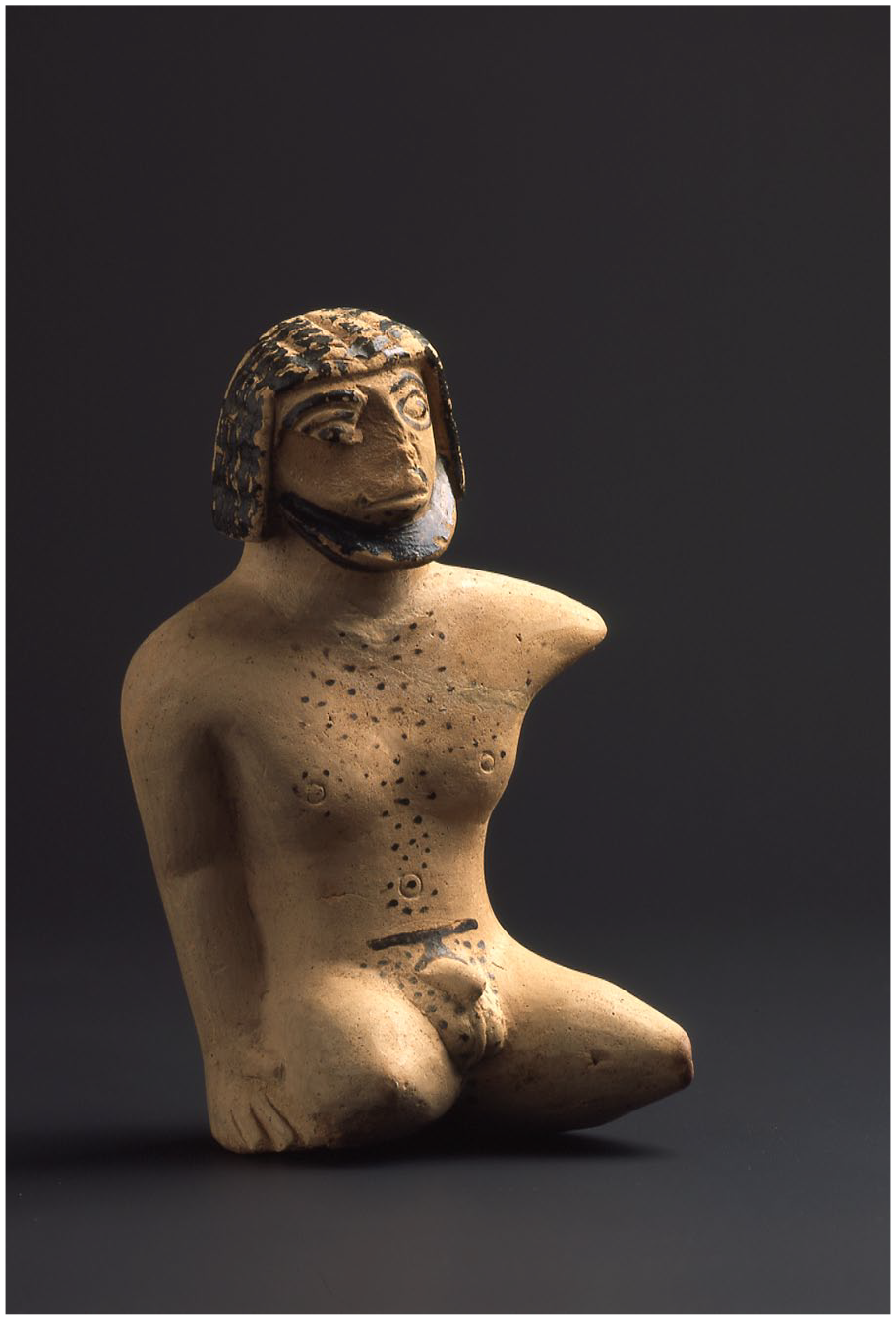
Pottery vase in Corinthian style from Sélinonte (Sicily) dating 600-570 BC. It depicts a man with severe terminal transverse limb deficiency affecting three limbs (height: 9.5 cm; width: 5.7 cm at the shoulders). © Musée d’art et d’histoire, Ville de Genève, Prêt de l’Association Hellas et Roma, photographe: Flora Bevilacqua.
The distal segments of left upper limb and both lower limbs are missing, and the man leans on his right hand, in a posture that further emphasizes his severe deformity. This pottery artifact belongs to the Corinthian style, characterized by the tendency to represent the forms naturalistically.
So far, it represents the earliest artistic depiction of limb deficiency (terminal transverse limb deficiency) in Western culture.
Although further details on its creation (including the artisan who made it and its client) are lacking, it is interesting to consider that the severe limb deficiency was considered worth being depicted in an artifact, reflecting the interest toward this physical abnormality by ancient people.
Footnotes
Acknowledgements
Funding sources: this research did not receive any specific grant from funding agencies in the public, commercial, or non-profit sectors
Authors’ Contributions
FB and MM conceived the study, drafted and revised the manuscript and performed a search of literature. Both critically revised the manuscript, have read and approved the latest version of the manuscript/letter to the editor.
Declaration of Conflicting Interests
The author(s) declared no potential conflicts of interest with respect to the research, authorship, and/or publication of this article.
Funding
The author(s) received no financial support for the research, authorship, and/or publication of this article.
