







Abstract
The current article explores walking ethnography as a mode of qualitative experimentation in organizational scholarship. Walking ethnographies allow researchers to experience the field in embodied ways that reflect the fluidity and unpredictability of contemporary organizational spaces. We identify and compare two ideal-typical approaches to open, ethnographic experimentation, involving a generative tension between determinacy and indeterminacy: pragmatist (inquiry-oriented) and phenocritical (drift-oriented) experimentation. These experimental forms replace the logic of confirmation of quantitative experimentation with a logic of consequences or critique. We examine how each mode of qualitative experimentation offers a unique relation to knowledge and experience. From our field work, relying on 30 discrete walking ethnographies of entrepreneurship and innovation spaces conducted between 2016 and 2020, we develop a taxonomy of eight modalities of inquiry-dérive encounters to better understand the experiential aspects appearing in moments of experimentation. By doing so, we show how qualitative research can rediscover the potentials of qualitative experimentation as a methodological impulse, particularly in the context of contemporary modes of organizing. We discuss methodological implications for the renewal of qualitative research on the basis of public experimentation and “radical openness” in research practices.
Keywords
Introduction
Qualitative and ethnographic methods in organizational research have taken an experimental turn (Calvey, 2021; Crewe, 2021; Slutskaya et al., 2018). From an earlier development in experimental ethnography (Marcus & Fischer, 1986; Massey, 2004), notions of reflexivity, corporeality, embodiment, and a problematization of knowledge as simply subjective or objective characterize the “experimental” moment in ethnography (cf., Calvey, 2021; Courpasson, 2020; Islam, 2015), and a broader interest in innovative qualitative research methods more generally (Langley et al., 2023; Lê & Schmid, 2022; Mees-Buss et al., 2022). While experimentation may be often associated with a positivist paradigm (e.g., Highhouse, 2009; Scandura & Williams, 2000), a less-recognized tradition of experimentation from non-positivist and qualitative methodological perspectives endures (Koro-Ljungberg & Knight, 2020). Not defined by adherence to the “gold standard” of randomized control, qualitative experimentation has been understood in terms of exploration and bricolage, collaboration and reflexivity around the roles of researcher and “native,” and an attitude of epistemic openness (Fayard, 2017; Gherardi, 2019). The current article seeks to clarify this terrain and make preliminary inroads into deepening understandings of qualitative, ethnographic experimentation as continuous ad hoc testing in context.
In terms of epistemology, while all empirical experimentation relies on building knowledge from experience, philosophies of experience have moved between more “closed” and “open” conceptions throughout the modern history of science (Jay, 2005). Whereas positivist notions of experimentation based on randomized control emphasize repetition and replication in a logic of closure (Bryman, 2003), experimentation in ethnography emphasizes openness to surprise and discovery, where the “data” provided are not definitive but indicative (Shotter, 2008). Ethnographers have called for experimentation in the sense of “playing” with styles of observation, field engagement and writing (e.g., Rabinow et al., 2008). To promote and maintain methodological openness, fieldworkers construct intentional experiential scenarios such as breaching experiments (Garfinkel, 1967; Rafalovich, 2006) or staged events or enactments (Denzin, 2018), spontaneously undergoing and recording experiences in ways that intentionally eschew direct control (Riddick, 2019). Such research practices are neither case studies nor classical ethnographies or autoethnographies, and take various forms, such as the development of collective walks and explorations of urban contexts (see Michels et al., 2020), art-based research experimentation (Grant & Wall, 2009), or educational experiments based on pragmatism (Moosmayer et al., 2019). These tend to focus on the sensory, aesthetic or embodied aspects of lived experience as a primary source of researcher discovery (e.g., Calvey, 2021; Pink, 2009).
Highlighting experiential practices that foster open relations of experimenting, knowing and living, we aim to broaden theorizing around experimentation to include qualitative and especially ethnographic conceptions. In line with recent calls to develop more creative and novel research methods, we ask: What role does experimentation play in different qualitative ethnographic methods/approaches? On this basis, how can we renew experimentation to enrich qualitative methods in organizational scholarship? By making underlying conceptions of experimentation explicit and examining how they implicate varying epistemological and methodological strategies, we contribute to a better understanding of qualitative research design and the philosophies of experience that underlie them.
To ground and theorize our approach to ethnographic experimentation, we focus on two ideal-typical logics within qualitative methods in general (Mir & Jain, 2017; Ciesielska & Jemielniak, 2018), and qualitative experiments in particular. We describe these as “dérive” (drifting) and “inquiry”, and their combination reflects an ongoing methodological tension between openness vs. closure, indeterminacy vs. determinacy (Dewey, 1938). Specifically, we draw on two thinkers who highlighted experimentation in knowledge production, in distinct ways but with key points of dialogue. Inquiry was developed by John Dewey, a founding figure in American pragmatism (Dewey, 1938), while dérive was theorized by Guy Debord, drawing on Marxism and phenomenology (Debord, 1958). These approaches, involving pragmatism and critical phenomenology (or “phenocritique”), are complementary yet distinct, and both center around a generative tension between determinacy and indeterminacy characterizing ethnographic experimentation. Considering these two together creates a conceptual grid to help map qualitative experimentation in terms of how it approaches determinacy and indeterminacy, a broad conception that theoretically informs research on qualitative experimentation more generally.
We develop and illustrate this novel approach, characterized by radical openness, with an empirical case involving a series of “walking ethnographies,” an ethnographic practice focusing on mobile and shifting relationships between the fieldworker, site and participants (cf., Beyes & Steyaert, 2021; Ingold & Vergunst, 2008). Walking ethnographies have garnered recent interest in organizational scholarship, particularly in studying urban environments, e.g., the making of urban incivilities or the public spacing of social movements (Kamsteeg et al., 2021; Lubit & Gidley, 2021; Raulet-Croset & Borzeix, 2014). They epitomize both processual (Langley & Tsoukas, 2016) and embodied qualitative research methods (Thanem & Knights, 2019). Walking ethnographies illustrate experimentation in qualitative research in ways that broadly inform organizational research methods, while providing an inspiring alternative to dominant qualitative approaches (Mees-Buss et al., 2022) and their increasing focus on “templates” or “roadmaps” (Langley & Abdallah, 2011) for qualitative procedural rigor.
Going beyond traditional standards in qualitative research, our experience of engaging in walking ethnographies (to understand local entrepreneurship and innovation) revealed aspects of both Deweyian inquiry and Debordian dérive, allowing us to compare and contrast these aspects of ethnographic experimentation in terms of how they approached knowledge acquisition and representation over time. We thus contribute to nascent treatments of walking ethnography as an organizational research method, while using walking ethnography to renew interest in innovative qualitative methods in general (see Langley et al., 2023; Lê & Schmid, 2022; Mees-Buss et al., 2022), and qualitative experiments in particular. Through this contribution, we address broader epistemological questions around experimental ethnography, which we discuss through an emergent theorization meant to be informative beyond the specific context of walking ethnographies.
To structure our presentation, we begin with an overview of qualitative experiments in organizational scholarship and focus on their theoretical and methodological stakes. On this basis, we present pragmatic (Dewey) and phenocritical (Debord) variations of experimentation, explaining their contrasts and why these contrasts matter. Then, we empirically illustrate our arguments by describing 30 discrete walking ethnographies of entrepreneurship and innovation spaces conducted between 2016 and 2020 by an open science network of organizational scholars. On this basis, we develop a taxonomy of eight modalities of experiential encounter, discussing how diverse experiential aspects appear in moments of experimentation and theorizing inquiry-dérive relationships in walking ethnography. Finally, we outline a research agenda for qualitative organizational methods, with guidelines and questions for future research. We invite organization scholars to draw implications from a posture of “radical openness” as we outline below.
Qualitative Experimentation in Organizational Scholarship: The Case of Walking Ethnography
Experimentation involves immersions into the world from which empirical knowledge is gathered. Researchers intervene directly with phenomena of interest, whether by carefully controlled intervention (involving closure) or through more spontaneous experience. The word “experiment” comes from the Latin experimentare meaning “experience” 1 (by contrast “éprouver” in French is linked to notions of test or proof) 2 . Experimentation involves deliberately provoking a phenomenon to explore how the consequences unfold. However, how and with what effects such provocations are structured leads to an array of conceptions of experimentation, from the dominant confirmatory one to more exploratory approaches.
Qualitative Experiments in Organizational Scholarship
In organizational research, experiments have been central to quantitative approaches associated with a positivist methodological paradigm (Highhouse, 2009; Scandura & Williams, 2000). Experimentation in such approaches involves establishing a controlled environment to test and confirm a specific set of relationships between variables (Ibid.). Experimentation in this conception relies on specific procedures (e.g., controlling contextual variables, a priori validation of measures, random selection strategies, and the like) to ensure clear, replicable causal inferences and falsifiable hypothesis testing. Such forms of experimentation and quasi-experimentation (Cook & Campbell, 1979; Grant & Wall, 2009) have been considered “invaluable resources for building, refining, accumulating, and applying knowledge about organizational life” (Grant & Wall, 2009, p. 653).
In contrast, qualitative experiments involve more “exploratory” forms of research design (see Table 1). Such approaches consider their objects of study as social constructs or processes of becoming (Langley & Tsoukas, 2016; Tsoukas & Chia, 2002). On this basis, experimentation involves an ongoing exchange between experience and theorization, emphasizing a spirit of open exploration and collaboration with diverse actors, objects and techniques. Such exchange is premised on an interactive and evolving research community that emerges through the inquiry process in a democratic spirit (Dewey, 1938). What will come to matter and how it is managed are made visible and sensible through the process of experimentation and cannot be established a priori. Such processes emphasize “learning by doing” or “actionable knowledge” as elaborated by Argyris and Schön (see Argyris & Schön, 1997; Schön, 1987).
Experimentation in Organizational Research.
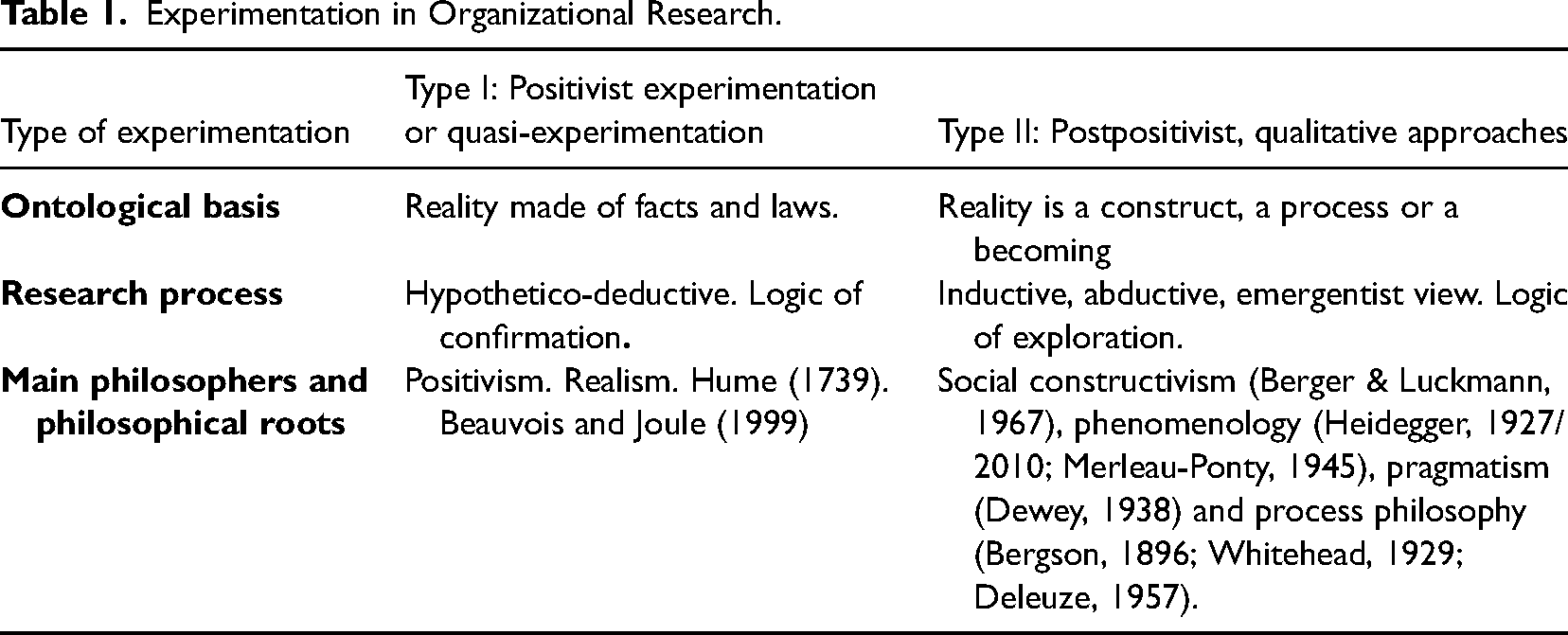
Notably, experimentation figures in several dominant approaches to qualitative research, although rarely as a leading principle and often without an elaboration of its process. For example, classical qualitative texts such as Yin (2015), while largely focusing on structuring and ordering qualitative research, note that methodological creativity and innovation are important “even if they ‘push’ the boundary between conventional and exotic” (p. 274). Gioia et al. (2013, p. 15) note of the widespread “Gioia method” that methodological rigor must be accompanied by the “creative, revelatory potential for generating new concepts and ideas”. Moreover, recent editorials have suggested a need for experimentation across methodologies, for instance, a recent call by editors of Academy of Management Journal for “openness to methodological variety and experimentation more generally” (Langley et al., 2023, p. 717). Such calls for alternative and creative ways of doing qualitative methods have been ever present, if somewhat parenthetical, in organizational methods scholarship.
However, explicitly experimental approaches to qualitative research are increasingly appearing (Bryman, 2003; Heath & Luff, 2018), particularly centering around ethnographic research (Calvey, 2021; Gerring & McDermott, 2007; Islam, 2015; Lloyd-Jones, 2003; Slutskaya et al., 2018). Ethnography can be applied in an experimental way (Marcus, 2014) while also involving specific techniques (e.g., visual techniques, Grimshaw & Ravetz, 2005, or sensory ethnography, Pink, 2009). Experimental collaborations are increasingly included in ethnographic protocols (Estalella & Criado, 2018; Ramirez & Islam, 2022). The experimental part of ethnography relies on improvisations that are part of the research process itself (Fayard, 2017), where, for instance, open collectivities of researchers 3 transform, make visible, and perform what gradually becomes scientific knowledge around problems revealed by inquiry itself.
An exemplary methodological development illustrating ethnographic experimentation is what has been termed “walking ethnography” (Ingold & Vergunst, 2008). The tradition of walking as an empirical method has multidisciplinary roots (see Raulet-Croset & Borzeix, 2014, for a summary) including phenomenological (Merleau-Ponty, 1945) and social scientific (Goffman, 1959) literatures. These practices often draw upon ethnomethodological traditions (Ryave & Schenkein, 1974), with a focus on walking as a way of understanding urban spaces in particular (de Certeau, 1980). Walking ethnography is a form of mobile observational practice where fieldworkers (often collectively) move across a landscape, in an exploratory way without pre-establishing what is to be observed or attended to (Ingold & Vergunst, 2008).
Recently making its way into qualitative organizational research methods, walking ethnography has been used to examine public and semi-public spaces and the origin of incivilities (Raulet-Croset & Borzeix, 2014), to track the temporariness of protests and social movements (Lubit & Gidley, 2021) and to explore multi-species relationships through collective walks in natural spaces (Kamsteeg et al., 2021). It has allowed organizational scholars to explore the “ebb and flow” of cityscapes (Aroles & Küpers, 2022, p. 3) while interrogating humans’ relation to nature and culture (Kamsteeg et al., 2021). While very new as a methodological approach in organizational scholarship, walking ethnography promises a novel and flexible form of qualitative experimentation well-suited to organizational contexts of movement and flow.
Walking ethnography illustrates what we consider an approach of radical openness. Not relating to a pre-defined organizational setting, a goal or set of problems, walking ethnographers cannot elaborate ex ante the where and when of their research. They can initiate, at any time, the analysis of emergent themes or interest in the exploration of public spaces. Although such movement does not imply that any activity constitutes research, it means that research (inquiry) can begin at any moment. A posture of radical openness raises numerous ethical issues (e.g., the possibility of blurring the boundaries between personal and research space, or the viability of prior ethical approval for every phase of inquiry). As with most innovative qualitative research methods, walking ethnography involves interweaving theory and method, empirical awareness and theoretical reflexivity.
The walking process engages public spaces with distinct concerns from traditional organizational settings (e.g., the closed company headquarters) and the company activities most common in organizational scholarship (Cnossen et al., 2021). Indeed, the very process of walking contributes to a treatment of space as public, constructing space as public for those involved. Walking is an open, potentially endless, fluid process that constitutes a primary mode of sensing and exploring the world (De Certeau, 1980). People understand the world by walking, spacing and moving across it (Courpasson, 2020). Walking openly organizes the world as much as it is organized by it and the collective process of walking in a shared place organizes the encounters, roles and rituals of social life (Yi’En, 2014). A purely immobile world does not require any organization, but a world in movement requires it continuously. Moving in the midst of other moving people allows the experience of this public world in the making.
Thus, methods such as walking ethnography, exemplary of the spirit of experimental qualitative approaches, operate on the principle of continuous reflexive exploration of lived experience and its consequences. In that sense, they have their place among processual qualitative methods (Langley & Tsoukas, 2016). The organized space is seen as provisional and ethnography itself as a practice in the making. Understanding such methods requires understanding the stakes of the exploratory process itself (Akyol & Garrison, 2013; Kenney & Kennedy, 2010), specifically, to what extent experimentation is goal-directed, chaotic, random, or playful. Despite the recent surge in experimental ethnographic methods (e.g., those based on the practice of walking), many of which focus on the changing organization of collective spaces 4 , the conceptual work around the nature of such experiences remains nascent. Specifically, how such methods alternate between goal-directed or teleological aspects and the more random, drift aspects and their coexistence is an open question.
Qualitative Experimentation as Inquiry and Dérive: Two Ethnographic Variations
To better conceptualize the design and practice of qualitative experimentation through experiences such as walking ethnography, we begin by identifying and comparting two approaches to open, qualitative, ethnographical experimentation: pragmatist (inquiry-oriented) and phenocritical (drift-oriented) experimentation (see Table 2). Both replace a logic of confirmation with a logic of consequences or critique, and both are likely to be co-present in the larger process of ethnographic inquiry (Kenney & Kennedy, 2010).
Two Ethnographic Variations of Qualitative Experimentation.
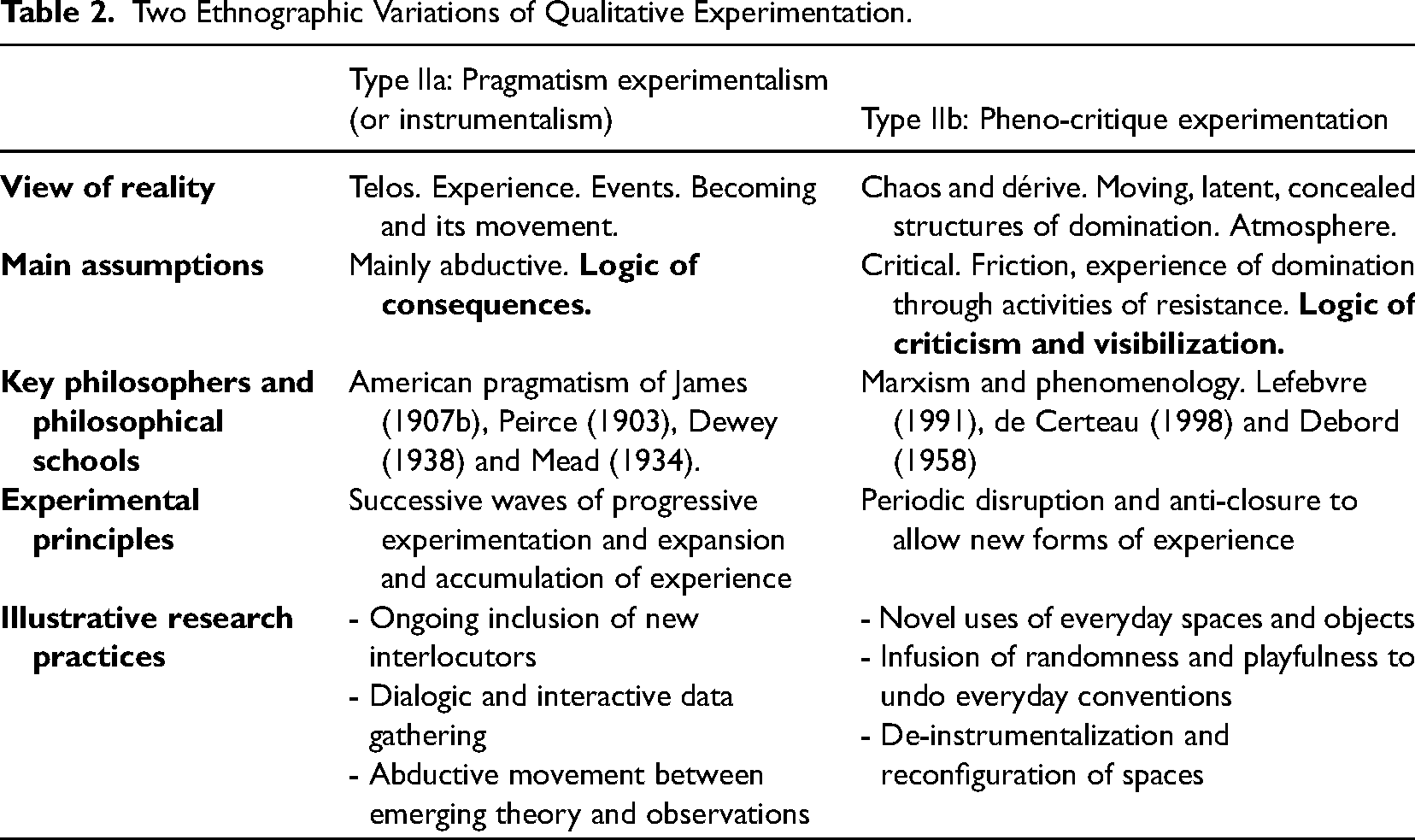
Pragmatist experimentalism relies on experience and a logic of consequences in an abductive approach inspired by American pragmatism (Lorino, 2018; Misak, 2016; Moore, 1966; Zask, 2015) (Table 2, Type IIa). The social world is considered as the consequence of human activities and not merely the background or cause of action. Actors continuously produce the world through their everyday activities, using signs and meanings to bring about states in the world and adjusting their behaviors to the consequences of their acts. Historically, Dewey (1938) is particularly well-known for his “instrumental” or “experimental” pragmatism (Zask, 2015) in which experimentation involves a move from indeterminacy to determinacy. Seeking determinacy involves ongoing temporary, transitional moves toward closure regarding research conclusions. In this approach, science is considered as “exploration-in-context.” Experimenting involves co-constituting solutions among participants and objects through a continuous process of inquiry. Linking the epistemology of experimentation with social integration (see also Mead, 1934), this process is also both a playful one, contributing to the emergence of the self, and a natural one, continuous with the already-existing processes of living.
In this pragmatist view, human activities involve continuous transactions with the world, constitutive of the persons, objects and agents that emerge from the process. This process of transaction is described as “social inquiry” (Dewey, 1938). Actors bump into situations that are problematic and indeterminate, and through experimentation, they gradually define the situation and its stakes, in a process that can involve speech but is often nondiscursive. The iterative process of testing and analyzing constitutes both problems and their solution(s). Through this process, actors move from indeterminacy (of what is at stake) to determinacy (identifying proper behaviors to tackle the initial problem). In so doing, for Dewey (1938), they also constitute a “community of inquiry” through their social-interactive processes of inquiry. This is possible because socially determined solutions and role identities evolve in parallel through this process, a combination of epistemic and social progress that links science with democratic organization. For instance, acknowledging shared problems, collecting experiences and perceptions across diverse actors, and collectively testing solutions combine epistemic, methodological, and social processes of inquiry. Theoretical and methodological dimensions are largely interwoven in pragmatism (e.g., Worren et al., 2002).
In contrast, phenocritical experimentation aims at revealing and resisting latent, concealed structures of domination in a logic of criticism inspired by Marxism and phenomenology (Debord, 1958; Lefebvre, 1991) (see Table 2, Type IIb). Rather than the ex-post control of inquiry, phenocritique aims at continuous problematizing, rather than pragmatic closure, of ongoing experience. Phenocritique 5 draws from phenomenological notions of experimentation (Murali, 2016), elaborated by Guy Debord (1958). Debord (1967) brought these views into a broad Marxist analysis of urban space and the “spectacle society,” a notion that has attracted periodic attention in organizational scholarship (Flyverbom & Reinecke, 2017; Islam et al., 2008; Shukaitis, 2014). From this perspective, contemporary capitalism places people in an abstract relationship with a world shot through with simulation and spectacle. Urban culture perpetuates spectacle while diminishing subjective awareness of the forces undergirding social life. Understanding requires modifying relationships with urban space to de-instrumentalize these relationships, which for Debord (1956) suggests a playful, experimental and chaotic way of moving in space. Walking spontaneously becomes an embodied mode of situating experience at a human scale and loosening the spatial ordering patterns that prevent critical understanding of one's surroundings.
Operationally, Debord (1956) invented a now-famous walking protocol that he called “dérive” (French for “drift”), an ephemeral process of understanding through drifting in the city and its public spaces and places 6 . Dérive consists, with a small group of two or three people (maximum ten, to avoid fragmentation), moving randomly about a city throughout a full day, from one atmosphere to another, and trying to dynamically map this process and the world it (re)constitutes (termed the “psycho-geography” of a city). The group of walkers moves together without a fixed destination to randomly encounter new places, people and atmospheres. The emphasis is on bumping into a non-habitual world and shaking conventional understandings through encounters and cross-conversations (which occur during and after the dérive, and involve discussing “what is behind” the encounters).
Dérive resembles similar concepts such as “flânerie” (discussed in Aroles & Küpers, 2022; Blair, 2019; Kociatkiewicz & Kostera, 2019; Nash, 2018). Indeed, “each one is demonstrated to be an errant body that utilizes movement through the city to actively resist and critique popular culture” (Blair, 2019, p. 27). The intent of dérive is that the city takes on an immersive quality, changing the horizon of experience, channeling mobility and directions, creating an aesthetic, and making visible a fully commodified world ready at hand. For Debord (1956), this immersive practice allowed a broader “psychogeographic” method of tracing affective areas in urban space. Walkers push in a direction, encountering resistance or feelings and responding to the changing surroundings, continuously calculating and re-estimating their relations to the environment.
As a reflection of social processes, while inquiry imagines an evolving democratic organization, phenocritique sees dérive as a critical process of problematizing and loosening structures of control. Drifting collectively in the space of the city, without specific concerns and following a group's mood and collective conversation, opens opportunities for critique, making visible and sensible the politics of the social world. By moving from one area to another, one atmosphere to another, walking is incomplete and indeterminate, continuously opened and reopened to surprises. Retrospectively, it can help describe the psychogeography of urban space (Murali, 2016), re-entering lived experience to dismantle domination and spectacle hidden within habituated experience. In contrast with inquiry-based pragmatist experimentation (Type IIa) (Dewey, 1938), phenocritique inspired by dérive (Type IIb) (Debord, 1956) relies on a move from determinacy to indeterminacy (and the maintenance thereof), such that experimenting with dérive in urban space is seen as cultivating indeterminacy. The idea is to make space lose its utility instead of increasing its power and utility.
Determinacy and Indeterminacy: Theorizing Qualitative Ethnographic Experimentation Through Inquiry and Dérive
Considering pragmatism and phenocritique in parallel allows us to compare their “logics of discovery,” i.e., how each approaches determinacy (i.e., finalized knowledge of the situation) and indeterminacy (the lack or refusal to assert finalized knowledge). While distinct in their considerations of experimentation, both approaches cultivate a sense of radical openness. They blur the boundary between theory and method (Lê & Schmid, 2022) and question the traditional time-space of qualitative research. Fieldwork is not expected to take place in a specific place, but happens or can happen anytime and anywhere. Pragmatist inquiry and phenomenological dérive continuously open the world.
Both approaches work around a tension between determinacy and indeterminacy. Their distinct ways of handling this tension, reflecting distinct epistemic approaches, result in different ways of conceptualizing and practicing experimentation. Specifically, they reflect differences in the direction and ordering of determinacy and indeterminacy, which lead to methodological variations that we subsequently elaborate upon.
Drawing on different epistemological traditions, historical periods and geographical contexts, inquiry-based pragmatism experimentalism (Dewey, 1936) and phenocritique experimentation (Debord, 1956) approach qualitative experimentation and qualitative methods in distinct yet complementary ways. Each contains a specific “logic of discovery,” in its move between indeterminacy and determinacy, although both present a radical departure from positivism. Determinacy involves a telos identified during the flow of the inquiry. Indeterminacy is closer to the derivation and drift of phenocritiques.
As a point of comparison, positivist epistemology is motivated by the desire to reduce indeterminacy as much as possible to diminish range of possible outcomes during the empirical phase. An initial state of indeterminacy “sharpens” into a determinate form as phenomena are defined and replicated, and consensus is built. The goal of science, in this conception, is to bring the field of knowledge into a focused and sustained state of epistemic determinacy encompassing a stable set of variables.
Pragmatist epistemology (Dewey, 1936) is more iterative and open, based on the ongoing inclusion and expansion of the field of inquiry. Inquiry, as in positivism, moves toward a state of determinacy but is periodically and regularly thwarted in its epistemic closure by the inclusion of actors, objects and perspectives in an ongoing process of epistemic expansion. This sense of expanded inquiry underlay Dewey's (1938) connection of scientific inquiry and democratic community. Nevertheless, determinacy remains an ultimate, if ultimately unreached, value that forms the epistemic horizon of inquiry.
In comparison, phenocritique qualitative experimentation draws upon a combination of Marxism and phenomenology 7 and moves inversely from determinacy to indeterminacy. Similar to pragmatism in its suspension of certainty in inquiry, phenocritique experimentation also values embodied activity and embracing novelty in experience. However, rather than positing an epistemic horizon of certainty, phenocritical experimentation emphasizes the fragility, ambiguity and freedom of experience, similar to that of a subject in an urban space. Through a process of reinstating indeterminacy, phenocritical experimentation attempts to make visible the structures of domination at stake in urban public spaces that reinforce an (ideological) sense of certainty. It questions the pre-emplaced selves and subjectivities incorporated in urban space.
The above description should make clear that both inquiry and dérive involve a spirit of openness; however, dérive emphasizes the critical spirit of resistance, with the consequence that closure is more directly problematized. Politically, dérive entails a shared drift that consciously appropriates and problematizes the field site. Furthermore, contrary to pragmatist experimentation, the dérive process does not seek to expand civic community but instead involves a sense of autonomous interdependence, copresence and epistemic camaraderie. Dérive does not imply consensus and convergence but allows bifurcation or indifference (“I just follow her or him”). The emphasis on very small groups also restricts the socialites at stake in the dérive process, contrary to the more institutionalized social process of inquiry.
In summary, pragmatist and phenocritique experimentation share the spirit of open exploration but approach exploration differently: while the former encourages participants to experiment, play, explore to understand, offering solutions through inquiry, the latter avoids instrumentality, emphasizing the sustained attention and critique that allows imagining new possibilities. The first view relies on a process of inquiry that constitutes community through progressive problematization and generation of patterns. In contrast, the second view relies on a chaotic process of drift in a specific space (a city and its various atmospheres), where successive encounters with, and passage through, atmospheres allow exploration of otherwise hidden social orders by breaking routine and displacing perspective.
To illustrate this difference empirically, we summarize a walking ethnography in which we aimed to understand the relationship and modes of copresence of teleological inquiry and dérive. In contrast to traditional experimental methods focused on ex ante control of the organizational setting of the research, we explore an ethnographic research process in which experimentation occurs jointly with (and not after) theorization and develops within a tension between inquiry and dérive. Our walking ethnography involved an embodied exploration and discovery of entrepreneurial and innovative processes of a local territory. ‘Walking with’ is gear toward the experience of a shared time-space within a decentered world. But in contrast to traditional ethnography, with specified field boundaries and researcher identities, walking ethnography involves fluidity of both (what we call here ‘radical openness’). This somewhat radical departure from traditional methods leverages the combination of inquiry and dérive co-produced by the group of walkers itself.
Experimenting Spatial Openness Through Walking Ethnography: From Inter-Case Analysis to Eight Modalities of Dérive-Inquiry
Given that ethnographic approaches are particularly well positioned to examine experimentation in public spaces (Low, 2010; Orrico, 2015) we examined the public spacing of entrepreneurial and innovative communities. The project involved walking ethnography to explore problems in communities and neighborhoods and allowed us to compare inquiry and dérive to explore their respective roles as approaches to experimentation. Our walking ethnography involved public and semipublic spaces (e.g., third places and collaborative spaces) explorations initiated namely by the first author 8 in 2016 as a collective experiment. Specifically, we were interested in how strangers could come to share common concerns grounded in spaces and places 9 . We thus aimed at “mobile encounters” (Yi’En, 2014) including some landmarks in our walk (Pierce & Lawhon, 2015).
Research Setting: 30 Walking Ethnographies
We relied on a set of 30 walking ethnographies conducted worldwide between 2016 and 2020, encompassing a total of approximately 35 days (Appendix Table 3). These walking ethnographies aimed to critically explore new places for innovation and entrepreneurship in the city in the context of the new world of work (Aroles et al., 2019) and to explore local problems encountered by workers and managers. Our initial idea was to initiate a group walk to explore and drift within cities, identifying and problematizing local concerns and formulating a collaborative report. To this end, we formed a group that “needs at some point to arrive somewhere physically and symbolically” 10 . No specific problems were thus identified ex ante, and a certain ambiguity was cultivated, e.g., by not delivering any precise program covering the expected duration of our walk.
List of the Walking Ethnographies Conducted Between 2016 and 2020.
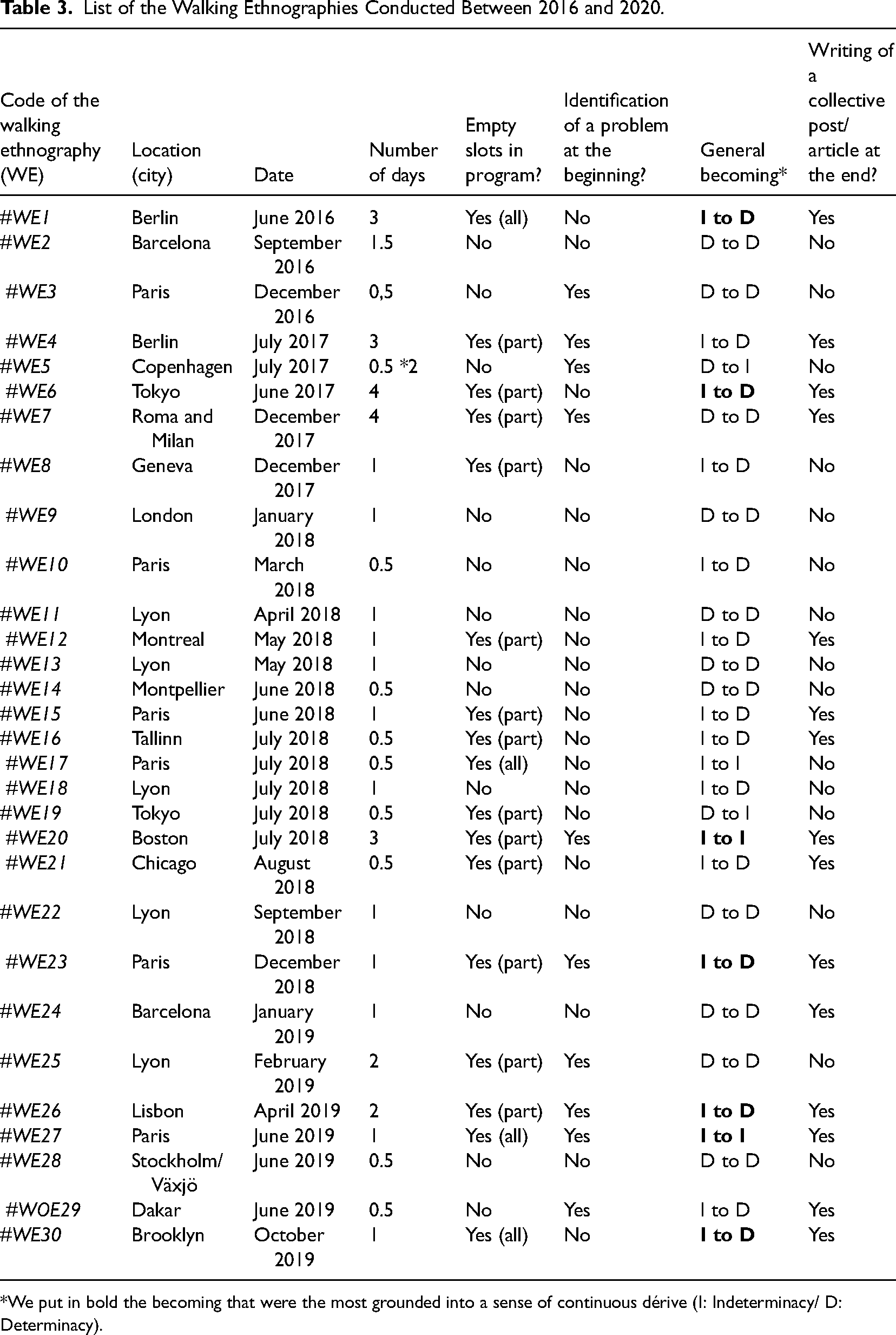
*We put in bold the becoming that were the most grounded into a sense of continuous dérive (I: Indeterminacy/ D: Determinacy).
Our walking ethnographies were ‘experimental’ from the beginning (see Part 1). They relied on the constitution of an activist researcher collective, Experiencia, 11 involving scholars (mainly in Europe) from the humanities and social sciences (management, organization studies, sociology, economics, anthropology), practitioners and activists. We began with the intuition that people's work and ways of living, their old and new modes of organizing, left subtle cues that could be gleaned from public spaces, which we hoped to access by walking and discussing together through a varied urban landscape. The ethnographic walks described below thus had both goal-directed and dérive (non-programmatic) elements. For instance, the program was often intentionally vague, with only general topics or none at all in a specific timeslot, and yet each event had a direction and some time constraints. The free and open registration process (via free Eventbrite link) reinforced this openness.
Preparation for each walking ethnography from our sample 12 (in particular those taking place abroad) was organized as follows. We first established contact with local people managing third places and collaborative spaces, and sought to compose a core group of researchers (1). We agreed on a very general topic for the walk (2). We activated a public Eventbrite link providing only rudimentary information (3). Information on the link and elsewhere were gradually updated (4). We contacted registered members and relied on them (in particular local people) to contribute to our overall plan, organizing meeting points the day before the event (5).
We were always surprised and excited to meet new people in places we had never visited before for experimentation purposes. The program, posted previously in vague detail, gave only the meeting coordinates. For instance, in the Lisbon event, we shared the text: “Following the X protocol, this event will be partly coproduced by participants. We will improvise and drift in Lisbon. Part of the program will be elaborated with your help in the flow of our walk. If you know local makers, entrepreneurs, activists, urbanists, geographers, historians, organizational scientists, economists likely to be interested in our collaborative learning expedition, do not hesitate to spread the word!”.
The organizing committee always had the same question in mind: will people ‘play the game’? A game with no explicit goal, somewhere between telos and chaos. We wanted to know if members would develop a mood, an atmosphere, in the simple pleasure of sharing a walk and meeting people on the way to nowhere. Would it be acceptable for the whole group to move with no precise direction or reason to move forward? Our experiment around the space of the city also involved a reflexive question of whether our collective process would result in determinacy regarding the local area and its problems or remain a sum of “flâneurs” or worse- a group of tourists. As registrations arrived, we invited participants to contribute to the experiment and this created proto-sequences in the program. The openness of the Eventbrite and the program were crucial features and allowed the walk to begin shortly after the stabilization of a partial program. The resulting event was not exclusively turned toward inquiry or dérive but allowed both logics to appear initially, welcoming ambiguity and hesitation.
As shown in the Appendix (Table 3), most of the walking ethnographies lasted between one and five days. Often, after early remote interactions with local people, broad problematizations started to emerge. While for some, this first experience resulted in collaborative reports or articles formalizing and pushing further the inquiry process, many others did not reach that point of closure and thus remained in some form of indeterminacy.
Research Process
Five features characterized this walking ethnography process and the experimental combination of telos and chaos: the gradual co-organization with participants; the coproduction of knowledge; openness in participation and the communicative process; improvisation as a guiding spirit promoted by the animators of the walk; and solidarity in the emerging community.
We relied on different qualitative digital techniques to describe the collective experience of walking, its collective and reflexive exploration, and, most of all, its collective narration (Cassell et al., 2020; Gabriel & Connell, 2010; Islam, 2015; Lassiter et al., 2005; Rappaport, 2008). We favored a continuous and collaborative process of cothinking, coproducing and cowriting, involving all participants in the experience and not relying on an “expert” logic. Beyond the first author elaborating his own logbook, the broader team of animators worked to involve all participants in the reflexive exploration and co-documentation. For instance, participants were invited to take and share pictures or videos on specific WhatsApp groups, post on social media using the hashtag of our event or use more open source technologies enabling co-documentation 13 . Such practices made it possible to trace the emergence of collaborative practices. These technologies were used to coordinate participants and manage the experiment, leaving over time a trace (or “digital archive,” Akemu & Abdelnour, 2020) that fed our collaborative ethnography. Ultimately, the main ‘treatment’ applied to our data was conversational. We continuously kept talking about the nascent narration and co-documentation of our event. We did our best to continuously stimulate open discussion, even beyond the perimeter of the walkers. Outsiders reacted on social media (and were incited to react). And beyond the time and space of the walk, we continuously re-initiated reflection during seminars, network meetings, or subsequent walks.
Problematization with Legs: Inquiring Through a Walking Ethnography
To illustrate our approach, we provide below an example of a walking ethnography in Berlin:
Berlin, July 2016 - The first walked event was organized in Berlin in July 2016, to make sense of hacking movements by exploring a series of collaborative spaces (e.g., hackerspaces, makerspaces and fablabs). The initial idea was to record what is usually not observed or noticed in hackerspaces’ practices - gestures, informal exchanges, and body movements, through pictures, drawings and sketches. We aimed to communicate on this first event during the first Experiencia symposium in Paris the following December, which dealt with work transformations, including walks and an exhibition organized at Paris city hall.
This first walk in Berlin involved five academics (one local and four non-locals), was the first Experiencia event and the first opportunity to experiment with our Twitter account. We were impressed by how walking in and between these spaces resonated with the concept of “dérive” (Debord, 1958; Michels et al., 2020). Spending time in these spaces, we talked to a great variety of new workers (coworkers and makers) while simply walking around. The experience was enjoyable and reflexive, contrasting with our everyday academic lives of intense temporal pressure and concentration with little time for play, surprises and unexpected encounters. For the first time, the idea of developing a “walking ethnography protocol” emerged, fed by the spirit and principles of open science.
Berlin, March 2017 - This first experiment was followed by a second event (a learning expedition over three days) in March 2017. This time, we voluntarily left the program more open, with one full day empty. In doing this, we intended to codesign the event “on the go,” relying on collective dynamics along the way to point our direction. Thirty-seven individuals took part. We began with an opening seminar including academic presentations on the new world of work, followed by a panel with a coworking space co-founder, a fablab project manager, a worklab project manager, an academic economic geographer and an urban and regional development consultant, and a set of visits and walks. After visiting a coworking space, some participants explored an urban gardening space nearby, while others visited different coworking spaces in the city, interspersed with informal conversations and encounters over meals. At this point, improvisations were still rare, although participants enjoyed meeting others and discovering new spaces.
The second day began with a visit to an iconic makerspace further away. Many people arrived late, and two unregistered newcomers joined us; having “heard” about the event, they appeared distant and lost when asked what they had come for. One group member guessed that one of them, a woman, was a refugee and had spent the night on the street. Welcoming them to the group, the coworking space community manager then organized a tour. At some point, we heard jazz music on the upper floor. We went up and discovered a group of jazz musicians who were there to film a video clip and invited us to their concert in the evening.
The program was voluntarily open for subsequent days, with the third day beginning over lunch nearby, and contacting another place suggested by the newcomers. We visited a fablab with the help of its community manager, followed by a workshop on practitioner-academic collaboration, and impromptu visits of coworking spaces and walks. During this time we discussed ways of informing management education in new ways through experimentation. An evening discussion at a coworking space café included the refugee crisis and ideas for how makers and hackers could help. One participant knew the owner of the space and asked him to organize a visit. He improvised an inspiring talk about the history of the coworking concept and coworking places in Germany. We ended the day much later than expected, and extended our walks into the next day.
To summarize, inquiry was the heart of the first two days of this experimentation, with a strong sense of focus and time (organized in a heavy program). The end of the second day saw dérive emerge (“what's next? There is almost nothing in the program…”, said a participant). The third day was full of dérive and improvisations in Berlin. Then, the following days were focused on discussing, analyzing what happened, and what was going on in the area. We thus moved again to a very reflexive inquiry. We also realized that many people were following us virtually through various online platforms, and we reflected on making our walking expeditions more accessible and open online.
After another expedition (in Tokyo in June 2017, related to the hacking movement), a formalization of our learning expedition practice was suggested and discussed on various online outlets (LinkedIn Pulse, business and social sciences blogs), helping us specify the nature of our collaborative expeditions as a “#commons” method for academics and entrepreneurs.
Ultimately, our Berlin experiment was an important phase in constructing our walking ethnography practice, and the kind of inquiry or drift it rendered visible. Elaborating its underlying protocol led us to the intuition that inquiry and dérive were co-present aspects and each took prominence at given moments. In Berlin, we also experimented with the idea of logging our experiences in a blog managed by Experiencia community managers; such ideas emerged out of a process that nobody controlled, but that instilled both telos and chaos as an ongoing modus operandi.
Some months later, during an experiment in Tokyo, this blog was implemented to follow codesigned processes and practices. We documented our walking ethnography practices systematically through a dedicated project developed in January 2018 with eighteen coordinators. This resulted in the production of several collective articles and conference papers, six research seminars, books and book chapters, and a white paper related to our walking ethnography, to which 24 coordinators and participants contributed. The numerous bricolages and improvisations (as part of our dérive) did not diminish the academic productivity but rather opened new sources of generativity that could not have been seen in advance.
Our experimentation was both chaotic and teleological, motivated by drift but also a necessity to rationalize, ex post, the events we had experienced. The network of experimental events was continuously evolving and taking experimental forms, without a priori control. Each accumulated walk, and the subsequent discussions, digital traces and collaborations, created continuity through space and time. By the end of 2018, we had consolidated the idea of connecting these events and retweeting past and future events during learning expeditions, more systematically organizing these across social media channels (with pictures, videos, texts, comments on social media, e.g., Twitter and Facebook's account of the network and WhatsApp, or more open source technologies).
Theorizing Inquiry-Dérive Relationships in Walking Ethnography: Eight Modalities
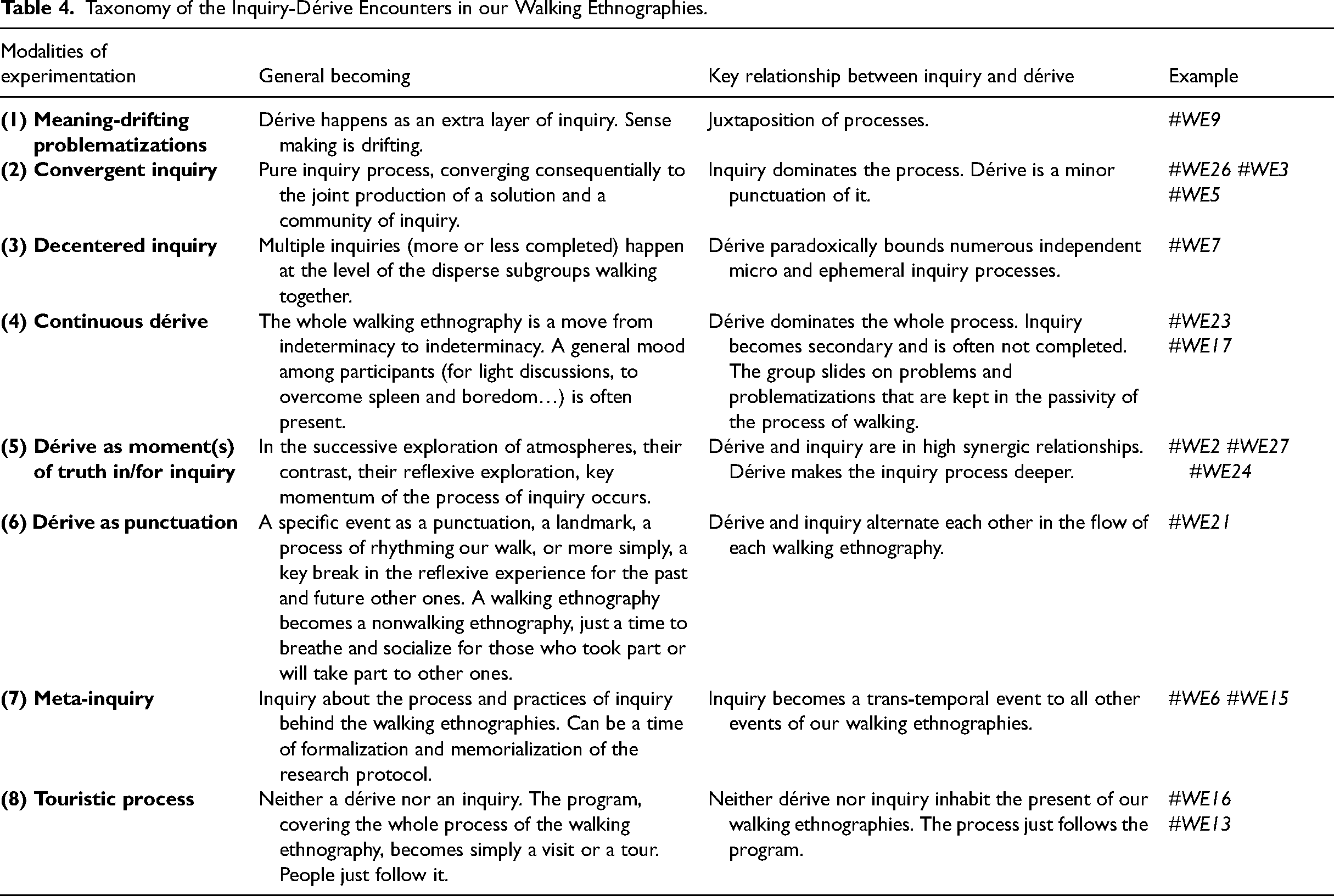
An inter-case analysis across our 30 walking ethnography experiments led us to theorize inquiry-dérive encounters across a range of possible expressions (see Table 3). We summarize our findings across 8 modalities, reflecting diverse dérive-inquiry relationships in our process of walking ethnography.
Modality 1: Meaning-drifting problematizations - First, even for all participants who were oriented by a search for determinacy, the sense of drift and playfulness was present. Walking in the public space of cities fostered unexpected events, opportunities to get lost, and long conversations with diverse participants, including local actors, through drift. These moments were the epitome of ethnographic practice: An ongoing, conversational, fluid exercise. Embodiment was key, with participants physically immersed in the walk, likely to lead it at some point, involved in a collective movement of arriving somewhere eventually. As part of public space, walking produced interaction that was collectively visible. Walk formed the center of a public spacing practice, a moment of truth of the rules of the game in the public spaces both produced and encountered through the walk.
Local people played an important role in this first kind of process. Their place-based knowledge created numerous bifurcations for nonlocal walkers, allowing us to progress in space and time. Sense-making drifted while mobility and directions, pushing programmatically, problematized the territory we explored.
Modality 2: Convergent inquiry - Some of our walking ethnographies clearly moved from indeterminacy to determinacy. Such cases were marked by a reflexive problematization, with the group constituting itself as a community of inquiry. Nonlocal walkers shared their practices (e.g., in managing events, configuring space, forming community, and the like) as the walk progressed. In this context, coproducing a collaborative report or article at the end of the experiment allowed us to concretize the process of inquiry.
Modality 3: Decentered inquiry - In contrast, other walking ethnographies kept reopening questions, despite attempts at focus. Heterogeneous lines of inquiry were encountered online and offline during the walk, in what we termed a “decentralized process of inquiry”. This decentralization developed as new people continuously joined the group (e.g., the partner of a registrant, people encountered in a third place, customers of an entrepreneur met randomly, curious neighbors overhearing our conversation and following, and the like). Decentered inquiry produced diverse atmospheres during moments of drifting and a sense of playfulness. Again, these (not necessarily friendly or positive) encounters introduced numerous new narratives and bifurcations into the process of the walk.
Modality 4: Continuous dérive – In some cases, ethnography became a continuous dérive. The joy and playfulness of the walk became the primary concern. This often happened when members mostly already knew each other and/or had strong common interests (e.g., third-places, social entrepreneurship, makers’ culture, and the like). The surrounding space served as a pretext for the conversation, although rarely was any conclusion reached or comprehensively analyzed. In such moments, a sense of context was dominant, including the architectures, matters, textures, surfaces, public facilities we encountered. However, these contexts grounded very general conversations about our lives, our professional practices, or debates about wider topics. In such situations, drifting did not enable a common construction or consensus, but in deeply experienced moments (e.g., positive memories for those close to us in the process of walking) without durable community building processes or traces.
Modality 5: Dérive as moment of truth in/for inquiry - Other walking ethnographies alternated moments of drift and inquiry. This could be seen in the shift from the predefined to the undefined part of the program, and the consequences of this shift for the group. One consequence was in allowing initiatives to be let loose, giving voice to accumulated but contained desires that were expressed in the moment of dérive. Local participants who were silent suddenly contributed by showing “their place,” “their true concerns,” or and “their real daily life.” Critical discussions ensued around these experiences and concerns. In contrast, other walking ethnographies exhibited a lack of focus as people began wondering what they were doing there.
Modality 6: Dérive as punctuation - Some walking ethnographies were felt by participants as a “punctuation”, in contrast to an intensity of rhythm. These moments involved dérive as a way to avoid external pressure, as the organizers and participants could relax and speak comfortably about past and future events. Immediate context was important but functioned aesthetically as background. In such situations, all the sites we crossed, the places we visited, and the people we encountered remained cloaked in mystery. Such events served to slow the rhythm of the other ethnographies.
Modality 7: Meta-inquiry (i.e., inquiry about the modalities of inquiry) – Rather than a move from indeterminacy to determinacy for a local object of analysis, some walks involved moving from indeterminacy to determinacy around the ethnography itself. In such cases, a kind of collaborative ethnography was devoted to documenting and analyzing the research process across events. These movements created an undertone of dérive, even when it was built into the program. The walking ethnography in Tokyo, for example, or a long walk in Paris observing Street Art, served to formalize a broader research protocol and to clarify the process of inquiry itself.
Modality 8: Touristic process – Finally, some of our walking ethnographies were simply failures in the sense that the program, which was (or became) obviously too detailed and programmatic, structured the walking ethnography in too strict of a manner. Openness did not characterize such moments, which felt “touristic”, i.e., a set of visits of predetermined iconic places. Few or no local people appeared. More simply, a pedagogic motivation, the dominating presence of students or short period (a half-day) made strict organization necessary and a “didactic” mindset sought to produce quickly a sense that something useful was happening.
Each type of experiment, its relationship with inquiry and dérive, and illustrative examples are detailed in Table 4 below.
Taxonomy of the Inquiry-Dérive Encounters in our Walking Ethnographies.
Discussion: Walking Ethnography in Qualitative Research – Experimentation Between Inquiry and Dérive
In the context of qualitative research methods in general, and qualitative experimentation in particular, our work identifies walking ethnography as an experimental form, analyzing its joint creation of knowledge about organizing processes (of the group, its roles and its logics of action) and the co-production of public space and publicity. Our research question asked how notions of experimentation characterized ethnographic work, and through our exploration of walking ethnography, we examined the relations between inquiry and dérive, and their complex relations throughout the walking ethnography process.
Methodological Contributions
Understanding and experimenting with qualitative methods in public is increasingly pressing in a world where the temporalities and spatialities of work and managerial activities interpenetrate and pervade public space (Cnossen et al., 2021). In such a world, intimacy is projected into public space (Bauman, 1999), and managerial activities and public spaces are co-constituted. Management is less grounded and more in movement, while forming a major visible component of lived realities.
Qualitative research must find ways of exploring such hybrids of public space and management in states of instability. Some qualitative techniques assume a grounding and fixity of researchers (e.g., with semi-structured interviews, observation guidelines or case studies, which are often emplaced and stable research practices); in contrast, walking organizational ethnography epitomizes the spirit of processual methods (Langley & Tsoukas, 2017) and embodied approaches (Thanem & Knights, 2019). It follows movement itself in a spirit of “radical openness” and a mixture of telos and chaos. It invites researchers to jump from one situation to another fluidly, both in their conversations and bodily movements. The very process of the walking ethnography, as an open, shared, opportunistic, discussed, collectively enriched practice in the making, crystallizes the friction between management and publicity at stake in our contemporary world. It adheres to “radical openness” in the crafting of qualitative research.
To be sure, such an approach raises important ethical issues. Even if we affirm that research is not supposed to take place continuously but instead to begin at a given moment, this still means that personal and intimate realms are likely to be blurred. Research becomes more intimate and ongoing than discrete and bounded (with a clear beginning and end). It means that researchers may need to bound the process individually and collectively to protect themselves and their participants from an all-encompassing research immersion in radical openness. This problem is common to any engaged or activist research, but it is even stronger here (as it is not grounded in a specific set of values or normative projects paving the way for the research).
While walking in public spaces, telos and chaos, inquiry and dérive are necessary components of the process. At the outset of collaboration, we have argued in this paper that numerous organizing possibilities exist, combining or polarizing telos and chaos in the settling of a fragile, ephemeral collective organization of the walk itself, putting drift and inquiry into conversation and generative tensions.
As stressed by Dewey (1938), common concerns can dominate the research process, leading to a natural inquiry and the emergence of a community of inquiry. By contrast, a sense of dérive and playful exploration, disconnected from concerns around problem solving, may be prevalent. Both can coexist sequentially or simultaneously during a walking ethnography. In all our cases, people continued to experiment, producing bricolages and improvisation of diverse kinds. Innovative qualitative organizational research in open, public, fluid contexts should be able to drift or actively contribute to the ongoing, decentered inquiry as part of a collective exploration. Our experience described here is thus very close to examples given by Lê and Schmid (2022, p. 316) of “harnessing the ‘mundane’ through a global, team-based ethnography” and “harnessing collaborative inquiry through action research”.
To achieve such a contribution, method itself should be in movement, decentered, open to encounters, part of a pragmatic publicity. Likewise, such moments can stimulate the generation of emergent propositions, problems or even moods. These numerous micro experiments can reveal new epistemic and practical openings in the flow of their own inquiry, discovering these in public spaces and their modes of organization. In short, our work insists on the potential “methodological opportunism” (see Girin, 1989) for qualitative researchers of contemporary management; an immediate, impulsive opportunism grounded in the collaborative atmosphere of a walk needing to arrive somewhere unspecified. Organizational ethnographers are continuously and actively part of the story as they themselves drift and/or inquire about the phenomena they explore.
Addressing calls to develop methodological experimentation (Langley et al., 2023) and to go beyond institutionalized templates or roadmaps (Langley & Abdallah, 2011; Mees-Buss et al., 2022) that limit methodological pluralism, this article generates a novel exploration of experimentation in qualitative research. In particular, the current study has examined how qualitative research can rediscover the potentials of qualitative experimentation as a methodological principle. We do this by comparing two different ethnographic logics embodied in the concepts of inquiry and dérive. Illustrating these logics concretely in our fieldwork, we compare and contrast them to formulate a more general conception of qualitative, non-confirmatory experimentation in which they form two methodological ideal types.
From this broader conception, we hope to support innovative qualitative research in general, by encouraging organizational scholars to leverage dérive more intentionally in their research beyond the mere investigation of organizational phenomena starting from pre-existing constructs. We also hope to support qualitative “experimentalists” in particular, in crafting new research agendas that align with contemporary modes of organizing, which are increasingly fragmented, fluid, decentered, open, producers of their own public spaces, temporalities and publicity.
Qualitative research in organizations has had a long but largely implicit chorus of support for methodological experimentation and creativity, which is becoming increasingly explicit (Langley et al., 2023). The current article resonates with a growing desire to see experimentation in qualitative research, while making explicit the diverse ways in which it can be imagined between a process of progressive knowledge building and one of constant problematization. For instance, inquiry and dérive resonate with a growing desire in processual methods (Langley & Tsoukas, 2016) to examine specific sets of practices that simultaneously co-produce and trace organizing processes. These ideal-typical concepts inform extant treatments of qualitative experimentation in organizational research (Fayard, 2017; Van Maanen, 2011), while resonating with social inquiry as it is conceived in pragmatist research (Farjoun et al., 2015; Lorino, 2018).
We highlight the issue of nonpositivist experimentation as inherent to the ethnographic method (in particular embodied ethnography, cf., Thanem and Knight, [2009]) and contribute to literature on the role of experimentation in coproducing embodied knowledge (Jarzabkowski et al., 2010; Reed et al., 2020). The cross-reference of pragmatism and phenocritique, here contained in the concepts of inquiry and dérive, produce a theoretical complementarity with which to refine experimental methods such as walking ethnography. Our theorization and case show the interweaving of inquiry and dérive in the organizing process of the walking group. Our inter-case analysis shows the diversity of possible combinations in eight modalities of inquiry-dérive encounters. By illustrating this cross-fertilization of inquiry and dérive, we go beyond pragmatic inquiry and pheno-Marxist ethnography to examine their interface, thus supporting a critical, phenomenological approach turned toward co-creation of knowledge communities.
Moreover, in the vein of the development of “collaborative ethnography” (Lassiter, 2005), we respond to calls for ethnography involving collaboration with a large network of participants and blurring distinctions between academics and practitioners (cf., Brannick & Coghlan, 2007). In such views, participants are seen as producers of analysis and knowledge, rather than mere sources of raw data (Islam, 2015). In sharp contrast with positivist experimental methods, the qualitative experimentation developed here recognizes the concern with researcher community construction as part of the scientific method itself. For example, we emphasize the importance of jointly pushing inquiry and dérive processes in experimentation to coproduce embodied knowledge (Jarzabkowski et al., 2010; Reed et al., 2020). This approach appears to be very important in, through, and for the emergence of the knowledge commons process.
By emphasizing this collaborative aspect through interlinked, multiple and ongoing ethnographic projects, our work contributes to the nascent literature about “open science” in practice (Plesner & Husted, 2019; Przemysław, 2021; Leone et al., 2021). At the scale of a large research network involving a high diversity of stakeholders and interests, the copresence of inquiry and dérive is simply unavoidable. We thus draw on walking ethnography to pave the way to a more open approach to social science.
Limitations of Our Research
Despite the above points, some conceptual and empirical limitations remain. Conceptually, the alternative approach to experimentation developed here relies on Dewey (1938) and Debord (1956), thinkers separated in time and space, whose concepts tend to be complex and difficult to operationalize and articulate. Whether dérive and inquiry can be combined in a single research process is not truly debated by these scholars (to our knowledge). We do not attempt to synthesize them but to counterpose their approaches to understand experimental possibilities in qualitative organizational research. As such, our fieldwork opens new perspectives on the relation between the two approaches, each of which provides a distinct epistemic standpoint to experimentation.
Empirically, our walking ethnographies focused on urban contexts, in particular large cities; indeed, the concept of dérive was closely associated with the urban environment. How this would apply to other spatial and geographical settings, such as small cities or rural areas (more and more at stake in new ways of working, see e.g., Bürgin et al., 2021), remains to be seen. Specifically, how inquiry – with its progressive move toward order – and dérive – with its ongoing generation of indeterminacy – would relate in different sociospatial settings requires conceptualization beyond our current scope.
Moreover, our data, consisting of logbooks, collaborative reports, posts and tweets on social media, pictures and videos done by walkers, ex post collaborative articles and our own experience as coordinators, could be complemented by the digital layer that is increasingly ubiquitous in urban navigation. The wider issue posed by contingencies such as geography and technology is how such contingencies shape the relation between inquiry and dérive and what epistemic consequences.
Avenues for Future Research: Open Science as a Research Practice Combining Inquiry and Dérive
The openness of research processes is a topic of increasing confusion and complexity in the social sciences (Mirowski, 2018). Openness is for sure a prevalent leitmotiv in organizational scholarship (see Splitter et al., 2023). However, while it is often investigated theoretically or institutionally, as a general organizing principle, it is far less examined from an empirical and methodological perspective. Thus, if knowledge access and knowledge cross-validation have been at the heart of numerous open experiments (Morey et al., 2017), the coproduction of knowledge in the context of social studies and the construction process of a research community have been less explored (Islam, 2015), particularly coproduction by means of qualitative methods such as collaborative ethnography (Lassiter, 2005). Far from it, some scholars are even skeptical about this ambition, particularly when it is grounded in the ambition of replication and the reuse of qualitative data (Pratt et al., 2019).
Walking ethnography is very new to organizational scholarship (Beyes & Steyaert, 2021; Lubit & Gidley, 2020), and theorizations of walking have been rare (Fabbri et al., 2016). This may be because of the misguided idea that public space, and the public at large, are outside the scope of organizational research and the phenomenon of organizationality (Cnossen et al., 2020). However, in a world of work and management that is becoming increasingly remote, mobile, nomadic, platform-based and conducted through ubiquitous technologies, such a lack of attention to the practice of walking may neglect the key processes at the heart of contemporary management and organizing (Ibid). We thus invite qualitative scholars to think about their methods differently and actively embrace qualitative experimentation, with walking ethnography as an important part of the methodological toolbox.
For instance, the principles of openness in walking ethnography could pave the way, more broadly, to a more open approach to social science - in a world where work and management pervade public spaces openly (Cnossen et al., 2020). In a context where our technical objects and knowledge systems are increasingly invited to “open” themselves (Simondon, 1958), open science requires all its users (in the broadest sense) to be openly coproductive of its contents, its directions and even its instruments. Collaborative walking ethnography, as an embodied experience of drift and conversations around the local concerns of our time, can be a distinctive and valuable way to move forward. Rural contexts could be more systematically explored and walked in future research. Likewise, larger dérive (e.g., that of digital nomads - see Nash et al., 2021), from one country to another, and in the context of larger time spans than those explored here, could be fruitful avenues. Gender issues may also come into play, as “the street” may be experienced in very gendered way, and some have suggested that walking, “negotiating” and thinking in the urban space remain subversive acts for women (Elkin, 2017). Further examining the specific subject positions from which participants traverse space and experience their surroundings would add an important layer to the current study.
In conclusion, we propose that qualitative experimentation (in its distinct meaning) is alive and well in qualitative research and is ideal for examining the complexities of organizing in collective and public spaces. Walking ethnography, however, is unlikely to be satisfying for researchers whose primary goal is epistemic closure, certainty or replicability. Our qualitative approach of experimentation indeed stands in contrast to classical approaches to controlled experiments. Thus, unlike experimental methods in the positivist tradition, we cannot offer specific procedures to produce desired knowledge estimates, such as controlling contextual variables, a priori validation of measures, or random selection strategies. In lieu of these strategies, we illustrate how research findings—always partial and situated, yet generative of knowledge nonetheless—can emerge from different practical procedures that structure the knowledge gathering process in unique ways.
Despite this pervasive openness, we show that qualitative experiments such as walking ethnographies do offer some version of the goals epistemic closure, certainty or replicability in it its inquiry form, although patience and collaboration become central to this slow process. For Dewey (1938), it was precisely this aspect that made inquiry a democratic value. For dérive, however, certainty is elusive and, indeed, avoided; however, the generativity of experience emanating from that process offers an alternative epistemic value that should not be forgotten. In increasing the possibilities for different forms of experimentation available for the researcher's toolbox, we conclude in the pragmatic spirit that would value both the critical and constructive moments of social scientific inquiry.
Footnotes
Declaration of Conflicting Interests
The authors declared no potential conflicts of interest with respect to the research, authorship, and/or publication of this article.
Funding
The authors received no financial support for the research, authorship, and/or publication of this article.
