







Abstract
Rhythms form an essential part of organizational life, involving embodied patterns of repetition and difference that structure work processes, against the ongoing background of wider organizational and environmental rhythms. Organizational literature increasingly recognizes the importance of rhythms; yet little methodological work exists, either at the level of theorization or practical guidance. The current study draws on Lefebvre's foundational work on rhythmanalysis to elaborate an organizational methodology for studying rhythms. We argue that rhythmanalysis provides a critically oriented approach to understanding social dynamics and advances theorizing about organizational environments by overcoming the dichotomy between entities and processes, stability and change. In this article, we propose methodological guidelines for developing the field of rhythmanalysis in organizational settings by illustrating how it can be conducted through the reanalysis of ethnographic material. We discuss the methodological contributions of rhythmanalysis for a critical exploration of organizational dynamics.
Keywords
Introduction
Organizations are permeated with rhythms (Katila et al., 2020; Klarner & Raisch, 2013; Stephenson et al., 2024), defined as “repetitive temporal patterns that define the order and tempo of practice” (Katila et al., 2020, p. 4). This definition highlights the dynamic aspect of rhythms, including both rhythm's temporality and activity-orientation, and its relation to repetition and ordering. In doing so, it places rhythms in-between the solidity of structures and the fluidity of processes (Lefebvre, 2004). Emerging literature recognizes this rhythmic nature of organization (Nadegger & Wegerer, 2026; Reinecke & Lawrence, 2023); from the daily rhythms of the workday, to organizational processes of emergence and transformation, to macro-level economic cycles and institutional processes. Neither purely fluid nor static, such processes are marked by repetitions and differences that make them both stable over time and sources of potential change (Islam, 2015). Studies of organizational rhythms have examined organizational dynamics of startup accelerators (Katila et al., 2020), urban organization (Nash, 2020), and migrant labor (Agar & Manolchev, 2020), among other settings. They have examined difference and repetition in organizational members’ spatio-temporal experiences, for example in the case of affective work (Katila et al., 2020) or flexible work (Rouse et al., 2021), in which distinct spatio-temporalities are combined. In short, studying organizational rhythms can support new ways of seeing and understanding social relations and develop theory around organizational environments on a continuum between entities and processes, stability and change. As we describe below, they can also provide a way of diagnosing social domination and formulating organizational critique, with a normative lens.
Nevertheless, organizational scholarship that recognizes rhythms as relevant often does not emphasize the analytical or methodological aspect of rhythmanalysis (e.g., Holt & Johnson, 2019; Reinecke & Lawrence, 2023). Little dialogue exists around the methodological challenges of studying rhythms, and how such methods can enrich understandings of the dynamic aspects of organizational life. Thus, scholarship remains theoretically and methodologically dispersed even as interest increases in organizational rhythms. Given rhythm's potential to contribute to organizational scholarship, and the emerging nature of organizational studies on rhythm (e.g., Agar & Manolchev, 2020; Katila et al., 2020; Nash, 2020; Vesala, 2024), the scarcity of methodological discussions seems surprising. At the same time, examining rhythms methodologically poses practical and onto-epistemological challenges. Specifically, the processual nature of rhythms, involving both material and temporal dimensions, their embodied, experiential aspect, and their existence at multiple levels from micro- to macro- rhythms, makes rhythmanalysis a complex project. Researchers wishing to investigate rhythms confront difficulties grasping and analyzing what rhythms are, how they emerge and how they are maintained. The cross-disciplinary field of rhythm studies (Alhadeff-Jones, 2016; Chen, 2016; Lefebvre, 2004; Walker, 2021), positioned at the intersection between philosophy and management, holds potential insights for organizational researchers interested in rhythm-related phenomena.
The present article draws on and elaborates concepts from rhythmanalysis to propose methodological guidance for organizational scholars. Specifically, we build on insights from the field of rhythm studies to organizational contexts and empirically illustrate a methodology for rhythmanalysis. In doing so, we seek to contribute to methodological understandings of rhythm, asking the question: what are the methodological possibilities for organizational scholars to study rhythm, and what empirical and analytical tools can they bring to bear to better understand organizational processes? To address this question, we draw upon Lefebvre's (2004) rhythmanalysis, a nascent approach, proposed shortly before Lefebvre's death, that has remained a promising yet underdeveloped method to study social rhythms. Primarily known for his work on space (Lefebvre, 1991), Lefebvre extended his theorizing into a spatio-temporal conceptualization of rhythms, first in collaboration with Catherine Régulier (1985), and later in his final work, published posthumously (Lefebvre, 1992), and translated into English over a decade later (Lefebvre, 2004). Conceptualized as a “new science,” the project of rhythmanalysis was left partially completed, with many of its components reintegrated into other theoretical perspectives such as urbanism and geography (Lefebvre & Régulier, 1985). The goal of rhythmanalysis is to understand the diverse rhythms that permeate and constitute actors’ daily lives and link these to the embodied experiences of everyday rhythms.
Specifically, we identify a link with processual approaches in their focus on temporality and embodied activities, as a key point of contact with rhythmanalysis. Emergent literature on rhythms touches on aspects of rhythmic processes found across organizational scholarship. Rhythms are found in everyday activities (Bennett, 2015), rituals (Endrissat & Islam, 2022), and practices (Katila et al., 2020), for instance. Rhythms are often linked to process studies (Gherardi et al., 2019), temporality (Reinecke & Lawrence, 2023), and embodiment (Vesala, 2024). Following Lefebvre (2004), through an analysis of different rhythms, rhythmanalysis provides a critically oriented and normatively grounded approach that allows scholars to understand organizational dysfunctions in new ways. We argue, moreover, that focusing on rhythms uncovers hitherto unacknowledged points of contact between the temporal and embodied aspects of processes and their ordering effects in organizations, enhancing the critical possibilities of process perspectives.
Our argument unfolds as follows. First, we argue that rhythms are an important, underexplored component of organizational life, present in but underdeveloped within extant literature. Next, we summarize Lefebvre's approach, elaborating on its potential by examining the conceptual issues resulting from cyclical and linear aspects of rhythms, as well as the question of alignment (eurhythmia), conflict (arrhythmia), and plurality (polyrhythmia) among rhythms. Based on this framework, we provide methodological guidelines for advancing the field of rhythmanalysis in organizational settings. We illustrate these guidelines through a reanalysis of an ethnographic study on the spatial and temporal practices of train station service workers. Finally, we develop rhythmanalysis’ contributions to organizational research methods, highlighting its critical potential, and outline a future research agenda for understanding organizational rhythms.
Rhythms and Organizational Scholarship
Organizational literature has acknowledged the pervasiveness of rhythms within and across organizations (Ancona & Chong, 1992; Katila et al., 2020; Nash, 2020; Reinecke & Lawrence, 2023; Rouse et al., 2021), but has said little about the onto-epistemological nature of rhythms or the methodological challenges of studying rhythms, which are complex by nature. Rhythms are repeated and collective activities that structure daily life, as experienced materially and sensorially through bodies (e.g., Nash, 2020). Courpasson (2017, p. 848) describes organizational life as composed of breaks such as “cigarette breaks, lunch breaks, morning and evening greeting rituals” (Courpasson, 2017, p. 848), while Rouse et al. (2021, p. 713) examine how “business or working hours and school or nursery schedules” constitute rhythms. Rhythms are processual in that they involve unfolding over time (Klarner & Raisch, 2013); however, they also involve inertia and resistance to temporal flow (Agar & Manolchev, 2020). Moreover, their relation to embodiment (i.e., rhythms are felt and experienced) place them at a distinct analytical level to many process studies. Focusing on rhythms involves an onto-epistemology that moves away from considering organization in terms of identities and their boundaries, but rather systems of repetition and differences, expressed in the lived experience and practices of actors. We examine the concept of rhythms through Lefebvre's work, before examining its application in organizational research.
Lefebvre's Approach to Rhythmanalysis
Rhythmanalysis begins from the onto-epistemological position that social life is composed of multiple overlapping rhythms, rather than static entities. In this sense, rhythmanalysis resembles process-based ontologies (e.g., Langley et al., 2013), although Lefebvre does not use this language. Rhythms are considered as phenomena happening in reality, but describe the unfolding of reality itself, involving an entanglement of space, time and energy (Lefebvre, 2004). In opposing an entity-view, Lefebvre resists the essentialization of society and aligns himself with a processual, practice-based view of society. Focused on practice, rhythms are seen as socially and historically produced, and thus are actor-dependent. Rhythms are seen as “movements, forces, expenditures of energy that recur with variable regularity in time and space” (Blue, 2019, p. 937). This variable regularity and repetition lend an entity-like appearance to social phenomena, although difference and change are always present in the unfolding of rhythms. That is, although processual, rhythms involve repetition and are therefore stable, even as repetition introduces a permanent difference across each iteration. Rhythms are born, develop, change, and exist in relation to other rhythms with which they may harmonize, oppose or coexist.
Lefebvre theorizes a dialectical tension within rhythms, involving repetitions but with differences over time. The repetitiveness of everyday rhythms also contains the “exceptional,” which he understands as a break in monotonic dimension of a rhythm: “The repetitive monotony of the everyday, rhythmed by the (mediatized) media need not bring about the forgetting of the exceptional” 1 (p.50). Drawing on this conception, Lefebvre critiques the rhythm of capital, which he characterizes as production and destruction processes that homogenize social life into the form of commodities. Rhythmanalysis thus serves a critical and political project, revealing the destruction of plurality in the embodied, sensitive experience of rhythms: “Capital replaced these alternatives with the conflicting dualities of production and destruction, with increasing priority for the destructive capacity (…)” (p.55). This critical aspect of rhythmanalysis emphasizes that rhythms do not always harmonize, but can clash or cancel each other, and that this cancelation can cause harmful effects on social life.
Importantly, rhythms work through embodied experience and it is through the body that the analysis of rhythms is possible. It is our own bodies that enable us to grasp and experience the diversity of rhythms, and it is through this same sensitive experience that a “fragment of the revolutionary transformation of this world and this society in decline” (p. 26) is possible. For Lefebvre, embodied experience takes on a double role in analysis, both methodological and critical-normative. Methodological, in the sense that rhythms provide new ways of seeing and understanding social relations, and critical-normative, in that they provide a way of diagnosing social domination as the overwhelming of life rhythms by rhythms of capital.
Lefebvre develops rhythmanalysis from a theoretical and abstract perspective; however, he did not develop the methodological applications of this approach before his death. Nevertheless, this diversity of rhythms in the embodied experience is of particular interest in that it can contribute methodological insights to literature about the ways in which organizational processes are approached in organizational scholarship (e.g., Bailey & Madden, 2017; Bansal, 2022; Reinecke & Lawrence, 2023).
The Uses of Rhythmanalysis in Organization Studies
Rhythmanalysis has appeared sporadically in organizational scholarship, often as a background frame for empirical studies, although theoretical or methodological elaborations of rhythmanalysis remain to be elaborated. Early works mentioning rhythms (e.g., Huy & Mintzberg, 2003) do not explicitly mention rhythmanalysis by Lefebvre, and this carries through to more recent work (Klarner & Raisch, 2013; Reinecke & Lawrence, 2023; Stephenson et al., 2024). These studies are juxtaposed with more explicit uses of rhythmanalysis, in a way that requires some clarification.
To elaborate, a small number of scholars have noted the value of Lefebvre and rhythmanalysis specifically, as a way of understanding embodied experiences of time and space in and around organizations. Studies drawing on rhythmanalysis tend to focus predominantly on embodied and sensory experience. For example, Nash (2020) uses rhythmanalysis as an embodied perspective to show the emergence and use of organizational places in the City of London. Building on her embodied experiences of walking in the City, Nash develops a “rhythmanalysis map” that refers to specific rhythms of different places and the emotions she experiences. These rhythms are grounded in a self-evocative mode of writing. Similarly focused on emergent spaces of actions, Rouse et al. (2021, p. 709) draw on the notion of “space-time-energy rhythms” to analyze mutual adjustment in workplaces. They specify rhythmanalysis as a conceptual tool to analyze workplace maternity management processes. In the context of maternity, rhythms are used to describe how interviewees experience the processes of pregnancy, maternity leave, and return to work: they are understood as analytical constructs rather than directly observable empirical data. Interestingly, rhythmanalysis is used by Borch and colleagues to explore relationships between micro-level bodily rhythms of traders and macro-level market rhythms (Borch et al., 2015). Although Borch et al., (2015) do not outline their specific analytical steps in implementing rhythmanalysis, their application of this approach to the body-market interface suggests its usefulness as a research method.
In these studies that mobilize rhythmanalysis, rhythms include both temporality, where repetitions and differences unfold and develop over time, and embodiment, where this unfolding is expressed through lived experiences. Katila et al. (2020) underscore how embodiment is central to engaging with the critical potential of rhythmanalysis. Organizations control workers rhythmically by establishing an “upbeat” affective tone in employee experience and promoting a fast-paced organizational order where temporality is regulated through “inter-corporeality.” Similarly, Agar and Manolchev's (2020) study examines how the macro-temporality of agricultural work involves speeding up and slowing down rhythms in migrant workers’ bodies. Both studies reveal forms of domination through the imposition of rhythms to critique workplace exploitation, thereby demonstrating the potential of rhythmanalysis as a critical analytical tool, precisely by engaging different levels and their interrelations, which we detail in the following subsection.
Rhythms as Organizational Dynamics: Temporal and Embodied Processes
A large body of literature invokes concepts of rhythm without referring explicitly to Lefebvre or rhythmanalysis, positioning rhythms as empirical objects or analytical inspiration rather than as analytical frameworks. Recognizing rhythmanalysis as an empirical method provides distinctive value by rendering rhythms analytically operational and by foregrounding their critical potential. Moreover, relying on rhythmanalysis can help explain how rhythms occur at different levels of organizational life, and how these can come into conflict.
Organizational literature identifies rhythms at micro, organizational, and macro levels of analysis. For instance, at the level of team interaction, rhythms mark the entrainment of work processes and interpersonal behaviors (Reinecke & Lawrence, 2023), where members adjust to each other's temporal flow to coordinate activities. At the level of organizations and institutions, rhythms describe how organizational members cope with new work rhythms in effectuating strategic change (Stephenson et al., 2024) and to the evolution of institutional processes from nascent to more stable institutions (Reinecke & Lawrence, 2023). Rhythms have been used to describe organization-level phenomena such as mergers and acquisitions, where the differing rhythms of constituent organizations or branches require degrees of autonomy or alignment (Shi & Prescott, 2012). Finally, at the macro-level, ecological or geopolitical rhythms shape how organizations transition to meet changing background conditions, including those of resource availability or ecological transitions (Nadegger & Wegerer, 2026). Across these levels, the changing rhythms of individual, group, organizational, and ecological processes result in a potential cacophony of interfering influences that can conflict. Rhythms unfold in the interstices between micro, organizational, and macro levels; their analysis holds particular promise for rethinking these dynamics from a renewed perspective.
Because rhythms occur at the interfaces of embodied experience and social processes, scholars often bring in rhythms to understand the dynamics of these interfaces, particularly in terms of mutual adjustment at work (e.g., Rouse et al. 2021; Vesala, 2024). For instance, Stephenson et al. (2024) examine how forms of rhythms and rhythmic attunement shape how actors engage in strategic change at the organizational level, a “bottom-up” direction of influence. By contrast, Katila et al. (2020) use rhythmanalysis to examine how employees are enrolled within an “affecto-rhythmic order” that emphasizes upbeat, fast-paced sales and business practices, trained through embodied repetition and normative pressures to establish competence. This understanding of rhythms as control takes a “top-down” character, although both studies acknowledge the interactive and relational influences of rhythms across bodies and social forces. The idea of rhythms thus renders fluid the distinction between “top” and “bottom” and deepens the more static notion of “levels of analysis” with a more interactive conception by which different rhythms can be entrained within one another. Such entrainment helps to explain how “macro” phenomena at the global level can resonate in local actors’ embodied experiences.
In such examples, static views of individual and organizational levels would obscure the rhythmic dynamics that connect these levels. By contrast, process perspectives acknowledge temporality, while tending to focus on change over time (Langley et al., 2013), rather than the maintenance of dominant structures through imposed rhythm. The very focus on change may draw attention away from the repetitive and regulated ordering of rhythms. With this in mind, the lack of methodological attention to rhythms may result from the bifurcation of methods between entity and processual views (e.g., Schoeneborn et al., 2016). A focus on stasis or change, respectively, renders it difficult to examine continuity within change and vice-versa. The lack of appropriate methodological approaches suggests that while few have contested the importance of rhythms in organizational life, the need remains to examine rhythms more fully. Rhythmanalysis (Lefebvre, 2004) thus fills an important methodological gap distinct from that addressed by both entity and processual approaches.
Elements of Rhythmanalysis for Organizational Research Methods
To begin such an elaboration and grounding, we propose a methodological framework for analyzing rhythms based on Lefebvre's rhythmanalysis. We draw on two fundamental distinctions from his work: type of rhythm (i.e., cyclical and linear) and forms of rhythmic relations (i.e., arrhythmia, eurhythmia, and polyrhythmia), as shown in Figure 1. We focus on these two conceptual distinctions because the first is linked to the possibility of rhythmic novelty and the second, to the co-existence of rhythms or lack thereof; taken together, these two distinctions allow us to explain the critical-normative potential of the rhythmanalysis for analyzing forms of domination in organizations, the possibility of rhythmic novelty, and the potential clash between rhythms.
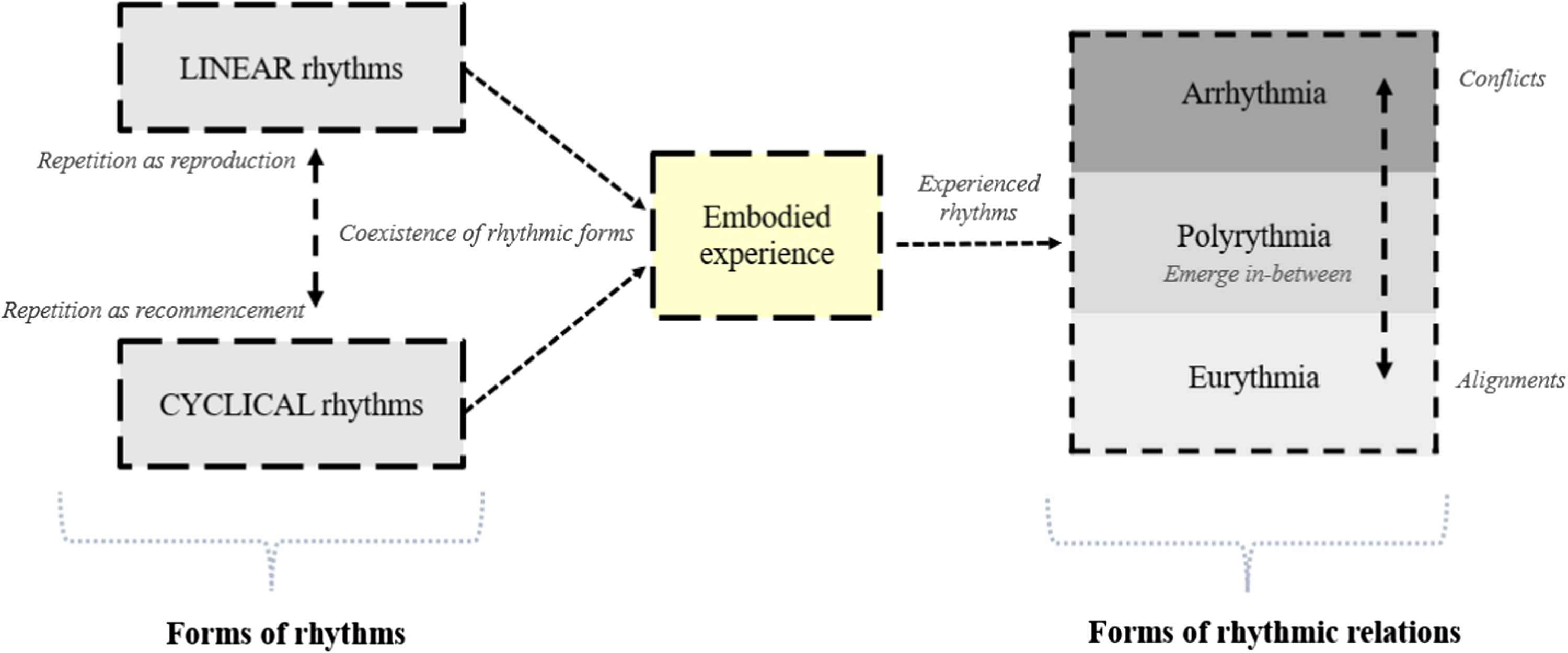
Forms of rhythms and rhythmic relations.
Rhythms as Forms of Repetition and Difference: Cyclical and Linear Rhythms
Rhythms inherently entail repetition, and according to Lefebvre, are characterized as “movements and differences of repetition” (2004, p. 100). Lefebvre analytically distinguishes two primary forms of rhythm—cyclical and linear—based on their relation to repetition and difference. Cyclical rhythms involve repetition with a distinct difference, described as a “recommencement” (2004, p. 100) as named in Figure 1, exemplified by phenomena like the cosmic rhythm of day and night or seasonal changes. In contrast, linear rhythms entail repetition in a manner that reproduces the same phenomenon identically as specified in Figure 1, such as the rhythmic patterns found in mechanical or controlled activities like work gestures, metronomic beats, or the striking of a hammer (Lefebvre, 2004). The distinction between cyclical and linear rhythms is not inherently tied to objects or situations but to subjective experience of them. As Lefebvre notes, “repetition is tiring, exhausting and tedious, while the return of a cycle has the appearance of an event and an advent. Its beginning, which after all is only a recommencement, always has the freshness of a discovery and an invention” (2004, p. 73).
As noted above, the distinction between linear and cyclic rhythms inheres in the relative roles of repetition and difference within the rhythmic structure, where linear rhythms tend toward “mechanical” repetition (Lefebvre, 2004 p. 90). By contrast, cyclic rhythms involve the appearance of newness or creativity within a mechanical repetition. Importantly, Lefebvre (2004) notes that while analytically distinct, cyclicality and linearity are always embedded in practice and defined in “dialectical” opposition to each other. Accordingly, we visualize this relationship in Figure 1 with a horizontal arrow linking cyclical and linear rhythms. This means that the sense of newness produced by difference in cyclical rhythms is perceived in contrast to the mechanical repetition of the linear, where the latter is always repetition against the possibility of a new event occurring, thus “oppose[s] that which becomes” (p. 90). Yet, Lefebvre (2004) argues rhythms can be more or less mechanical, tedious, or repetitive, and can thus be characterized as more or less linear or cyclic. In short, linearity and cyclicality together compose the alternation of repetition and difference that constitutes rhythms.
Forms of Rhythmic Relations: Arrhythmia; Eurhythmia, Polyrhythmia
Building on the distinction between cyclicality and linearity, Lefebvre argues that “the relationship between the cyclical and the linear (…) is not simple: there is a contradictory unity between them” (2004, p. 116), thereby highlighting relations of “alliance” or relations of “force” between rhythms. The body itself comprises an interaction between cyclical rhythms (e.g., biological rhythms) and linear rhythms (e.g., institutional rhythms that regulate members): “It is in this body that we have located the paradigm of rhythmological study” (2004, p. 93), which allows Lefebvre to distinguish three forms of rhythmic relations. The centrality of embodied experience is thus visualized at the center of Figure 1, as comprising the coexistence of cyclical and linear rhythms and shaping how rhythms take form as situationally specific relations. First, arrhythmia tends toward the cancelation of one rhythm by another, where a rhythm “breaks apart” (p.28) because of its interruption or domination by another rhythm. By contrast, eurhythmia involves the organic synchronization of rhythms within a body (whether biological or social), observable in normalized everyday life. Finally, polyrhythmia involves the composition of different rhythms that remain separate but not antagonistic, the multiplicity and ongoing persistence of parallel rhythms.
In the context of embodied relations, a rhythmic perspective highlights diverse and sometimes contradictory rhythms in the same spatiotemporal experience; these can be eurhythmic, arrhythmic or polyrhythmic. This is why relational forms can be porous and vary from conflict to alignment. The three forms of relations between cyclical and linear rhythms depend on the extent to which they harmonize or coexist, versus entering into an antagonistic relation. Figure 1 offers an illustrated synthesis of these concepts, and their relations derived from Lefebvre's theoretical framework. The linear and cyclical forms of rhythm are interrelated across a spectrum of tensions and alignments, reflecting the centrality of the body that Lefebvre describes.
Polyrhythms as a Critical Examination of Organizational Dynamics
We can understand these three relations between rhythms as potentially disturbances that, for Lefebvre, produce contradictory or even pathological effects. Lefebvre observes a dynamic relation between cyclic and linear rhythms in working life, where linear rhythms, dictated by the structured measurement of work time (e.g., recurring tasks and mealtimes), coexist with cyclic rhythms, such as the day-night cycle that underpins career development. This interplay gives rise to a “bitter and obscure struggle over time and the use of time” (2004, p. 114), where cyclical rhythms are understood to be progressive and creative, while linear rhythms are often perceived as “monotonic, tiresome, or even intolerable” (2004, p. 116). Consequently, this distinction enables a critical examination of social rhythms, carrying normative implications: linear rhythms impose a sense of regularity, for instance, through the quantification of time (as exemplified by the presence of clocks), while cyclical rhythms allow variation and development through the insertion of difference into repetition.
Lefebvre thus suggests a critical-normative value to these concepts, where arrhythmia is considered a “pathology” (p. 27) related to domination of one rhythm over the others, and eurhythmia is considered the “normal” state of sustainable life of a body. Moreover, eurhythmia is considered consistent with polyrhythms, in that a normal body is polyrhythmic in a way that does not lead to breakdown and domination of one rhythm over the others. The result of such domination, notably, is the mechanization of the body and the erasure of differences that arise in the normal state of plurality of rhythms. According to Lefebvre, capitalist rhythms are arrhythmic, i.e., as “parasitizing” daily work lives, expressed in the machine-like commodification of bodily gestures in this mode of production, rather than the versatile embodiment of craft or creative work.
We can interpret this distinction as the presentation of two extreme forms of rhythmic relations: first, arrhythmia as the discordance between two rhythms and second, eurhythmia as the alliance of two rhythms, with polyrhythms is their co-existence. As we elaborate in our empirical example below, this continuum view of rhythmic relations emerged from our attempt to empirically analyze different rhythms in our ethnographic work. In this conception, domination of one rhythm over others reduces difference across rhythms, augmenting mechanistic action and reducing novelty, and thus by definition, promoting linearity over cyclicality. As linearity reaches its limit, bodies cannot maintain their living state of balancing repetition and novelty, and become tediously entrained into “the time of a clock or a metronome” (p. 78). In this way, arrhythmia, eurhythmia and polyrhythmia serve as processual indicators of an underlying cyclicality and linearity, while also providing normative indicators of the extent to which a “living” system can avoid reduction to a mechanical process.
Guidelines for Rhythmanalysis Across the Research Process
Based on our analysis of Lefebvre, we begin by formulating broad guidelines and heuristics for a kind of “translation” of rhythmanalysis in organizational studies. Lefebvre introduced rhythmanalysis as a philosophical and predominantly abstract framework; our aim is to make its core propositions analytically and empirically operational. Given the ample breadth of Lefebvre's work, our goal is not to fix a single “correct” procedure or template (cf., Köhler et al., 2022), but to facilitate researchers seeking clarity in operationalizing rhythmanalysis on possible considerations of relevance. In the following paragraphs, we outline our methodological framework for a rhythmanalysis inspired by Lefebvre, including an articulation of the researchers’ onto-epistemological assumptions, site scope and selection, the researcher's role in the field, the nature and collection of empirical material, and the analytical strategies. Although Lefebvre did not explicitly develop these methodological stages, our propositions are derived from and grounded in his theoretical premises. These considerations are then illustrated in the following section in an empirical example in which we “retheorise” (Köhler et al., 2025) our material through the lens of rhythmanalysis. We synthesize the main points in Table 1 below. While abstract, they provide the first attempt to codify specific rhythmanalytic steps, albeit heuristically. Below, we apply these steps specifically to an empirical case using our own ethnographic data, for further illustration, outlining our main empirical and analytical steps in interpreting rhythms within an ethnographic context.
Summary Guidelines for Rhythmanalysis Across the Research Process.
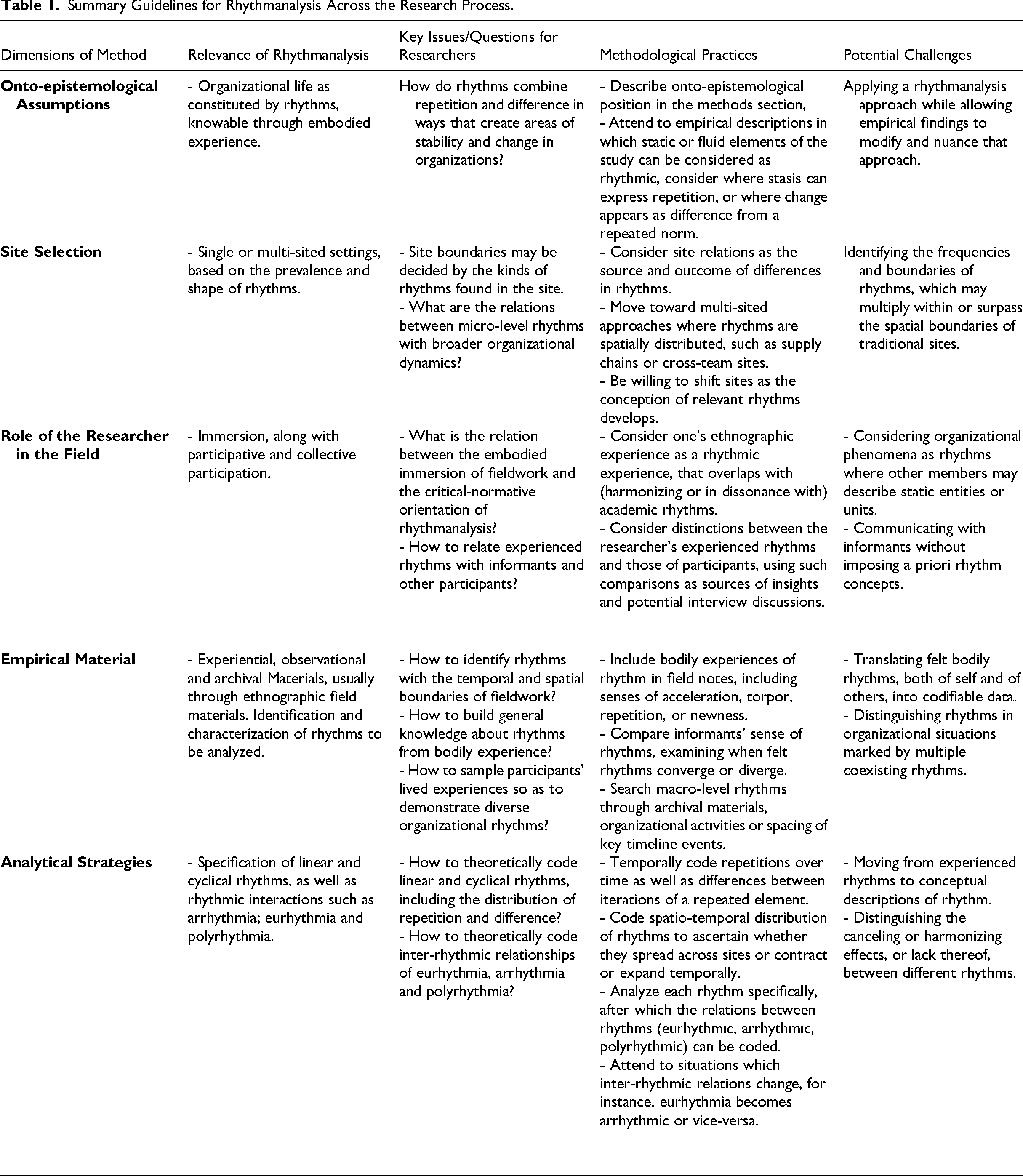
Onto-Epistemological Assumptions. Given the onto-epistemological assumptions underlying rhythmanalysis, as specified in Table 1, namely, an ontology of space-time entanglement processually unfolding through activity, together with an epistemology of embodied, situated knowing, researchers should be explicit about the role of their embodied experience in the research process. For instance, Nash (2020) emphasizes the subjective experience of the body as foundational for knowledge in her rhythmanalysis of the city of London, while Katila et al. (2020, p. 8) describe embodied experience as analogous to a “metronome” that can register rhythms at multiple levels. These authors note the parallels between onto-epistemological stances in rhythmanalysis and those of practice, socio-material and process approaches; namely, a non-positivist approach that emphasizes ongoing activity and the unfolding of subjective and material elements that are felt through lived experience. Yet, Katila et al. emphasize that the focus on the rhythmic and repetitive element and interlocking rhythms across levels gives rhythmanalysis a distinct flavor. Given these overlaps, as well as the novelty and breadth of the approach, future research should describe the specifics of their onto-epistemological position in the methods section and emphasize which forms of relational alliances or conflicts are relevant to their research question.
Site Selection and Scope. Given that Lefebvre and Régulier developed a dedicated essay on the rhythmanalysis of Mediterranean cities (Lefebvre & Régulier, 1985), it is unsurprising that organizational scholars have focused on related space-oriented sites, such as streets (Kingma et al., 2018 ; Cnossen et al., 2021) and cities (Vandeventer et al., 2024). However, rhythmanalysis may encompass a broader range of organizational processes characterized by repetition (e.g., organizational change, work patterns, team dynamics) at macro and micro levels. In such situations, site selection and scope can be justified by the kinds of rhythms under interest, e.g., work rhythms, business cycles, project cycles, among others. Considering these as defining site parameters suggests that multi-sited approaches (Marcus, 1995) may be particularly useful, as rhythms move across specific geographical boundaries. Production rhythms moving across global value chains could be one example; work rhythms across distributed teams could be another. In such situations, site parameters should be argued as part of the methodological design (see Table 1), based on a theoretical expectation of the kinds of rhythms of interest, including multi-sited approaches where rhythms are spatially distributed.
Role of researcher in the field. As noted above, rhythmanalysis scholars are cognizant of the central role of the body as an instrument of research (Katila et al., 2020; Nash, 2020). However, as previously discussed, Lefebvre's rhythmanalytical project is underpinned by a critical-normative orientation grounded in a critique of the mechanistic linearity of rhythms under capitalism and oriented towards the celebration of difference within repetition. Researcher positionality regarding this orientation is thus an issue of fine balancing between the ethnographic immersion of fieldwork and its orientation to everyday experience, on the one hand, and the critical possibilities of unveiling the domination of imposed rhythms, on the other. The latter may imply taking a variety of positions to establish critical distance, or using a variety of observational, interview, textual, and artefactual data to uncover faultlines or discern different positions, as specified in Table 1. It could also involve comparing one's experienced rhythms as a partial outsider (entrained to the rhythms of academia and the research process) with those of one's participants, and using potential dissonances as sources of insight or theorization.
Empirical Material. The type of empirical material collected is crucial to a rhythmanalytic approach, in order to capture the different forms of repetition in daily activities—specifically, cyclical and linear rhythms, and their eurhythmic, arrhythmic, and polyrhythmic relations. This raises challenges of how to identify specific rhythms at different levels within the temporal and spatial confines of a study (as noted in the site selection discussion). To empirically translate Lefebvre's theoretical proposition, grounded in the embodied experience of rhythms, the empirical material should be drawn from bodily experiences of rhythms and affective and sensorial processes, including senses of acceleration, fatigue, repetition, or novelty. Moreover, comparisons across informant descriptions of rhythms, and between fieldworker and informants, can reveal points at which rhythms converge or diverge, and allow such points to be related to structural roles or power positions, for example. Such material could be given greater sensitivity through tools such as mode-enhanced transcription (Li, 2024) that registers participants’ non-verbal expressions, gestures, and movements. Moreover, larger scale rhythms such as project—or business—cycles could be inferred through archival materials, organizational activities, or the spacing of key events in organizational histories.
Analytical Strategies. In terms of analysis of empirical materials, we would stress approaches that move beyond mere categorization using thematic coding to emphasize processual, embodied, and affective knowledge (Gherardi, 2019; Langley et al., 2013). Our methodological ambition is to bring rigor to the interpretation of rhythms by drawing on Lefebvre's distinction between forms of rhythms and relations between them. Such an analytic strategy would involve several components as depicted in Table 1: first, a temporal interpretation of repetitions over time and differences between iterations of a repeated rhythm. It would also involve analyzing the spatio-temporal scope of the rhythm, to determine its scale, whether it extends across sites and over time. These specific rhythmic elements could then be used to interpret the consonances and dissonances between different organizational rhythms, to determine forms of rhythmic relations. Because rhythmanalysis involves an interpretation of empirically experienced phenomena, the researchers’ interpretation plays a central role in identifying forms of repetition—whether cyclical or linear—as well as in understanding the relations between rhythms and their critical implications. The need for interpretation highlights the challenge of rhythmanalysis to conventional notions of “data” as given, emphasizing the interpenetration of theory and empirics.
How to Conduct a Rhythmanalysis: A Methodological Illustration
To begin exploring how rhythmanalysis can be applied within organizations, we engaged in a reanalysis of ethnographic material examined through a rhythmanalytic lens. Our empirical case involves a 2-year ethnographic study of railway station sales employees (observations, interviews and autoethnographic material), which we then interpreted in terms of organizational rhythms.
A Reanalysis from a Rhythmanalytical Perspective
To illustrate how to conduct a rhythmanalysis and to describe the stages of data collection and analysis, we draw on a prior ethnographic field study conducted by the first author, which we consider well suitable for rhythmanalysis. In developing this approach, we were inspired by “reanalysis” in the sense of Köhler et al. (2025), i.e., re-examining the original data from an empirical study with the goal of reinterpreting previous conclusions. In this section, we illustrate the methodological steps outlined above and detail how we re-examine these data through a rhythmanalytical lens.
Onto-Epistemological Stance: Analyzing Rhythmic Relations. Our reanalysis aligns with the theoretical aim of our original study, which had adopted an embodied, phenomenological approach drawing on Merleau-Ponty (2012). As researchers, we sought to access knowledge of work activities through embodied experience in the field, following a phenomenological onto-epistemological positioning. In our initial onto-epistemological stance, we therefore paid close attention to what is made visible and invisible, continuous and discontinuous, by these embodied practices of service workers. This approach is consistent with Lefebvre's view that the body is the site where “rhythms cross and mix, intersect and are connected to space” (Lefebvre, 2004, p. 236), thereby ensuring coherence in our onto-epistemological assumptions between our initial study and the reanalysis we propose here. It also aligns with organizational scholarship that emphasize the body and activity, where rhythms are understood through a phenomenological lens that integrates the body into the world (Vesala, 2024).
Empirical Site Selection and Scope: Rhythms of Service Work. Following Köhler et al.'s (2025) approach, we first consider the choice of our illustrative case. In our initial research, we focused on the case of a major train station in France, employing numerous service workers selling goods and services (e.g., a train ticket or a special service for business travelers in a dedicated lounge) and providing specific information to passengers. These workers were dispersed across different areas of the station—such as the ticket office and the platforms—that we now reanalyze as spaces and activities marked by distinct organizational rhythms. This case is relevant to rhythmanalysis’ relation to social situations in which rhythms reinforce, juxtapose, or cancel each other (Nash & Lyon, 2023). Depending on the specific area (such as inside the ticket office or outside) and the type of interaction with clients (whether face-to-face or via a digital tool), the information may align or diverge, leading to potential rhythmic clashes. Through this reanalysis, we identified the often-conflicting rhythms of service workers’ activities, enabling a critical interpretation of the rhythmic conflicts observed in the field.
Role of Researcher in the Field: An Embodied Experience of Rhythms. In our initial fieldwork, the first author engaged in participant observation as a sales employee for eight consecutive weeks, a time that allowed for experiencing the rhythms of employees’ practices. During this extended period of observation, the researcher was introduced to the routines of the service workers’ practices, learning their professional gestures and adopting their uniforms. The ethnographic immersion proved especially relevant for reanalyzing this experience through rhythmanalysis. Indeed, this immersion made it possible to achieve an embodied, in-depth, and nuanced experience of rhythms that would not have been accessible through external observation or interviews only. The fieldworker experienced the rhythms from a position of both insider (i.e., being a sales employee) and outsider (i.e., observing the employees’ work), inspired by Nash's (2020) claim that “we cannot experience rhythms unless it is through our body, and we cannot analyze our experience unless we observe; we need to be therefore both inside and outside, participant and observer” (Nash, 2020, p. 12). The researcher's reflexivity during data collection was informed by these shifts between insider/outsider positions, which paved the way for a critique of dominant rhythms in relation to others.
Empirical Material. In our initial research, the empirical material was collected through the embodied experience of the fieldworker, by focusing on repetitive gestures and movements within service workers’ practices, both those enacted by the fieldworker and those observed directly. These embodied practices were documented through observational notes from the first author's 2 months spent in one major train station in France (69 pages of logbook notes), illustrative photographs (404 photographs of the places, artifacts and employee practices), and internal presentation materials provided by the railway company. To contextualize our observational data and participation in these everyday micro-practices, the fieldworker conducted additional interviews (55 qualitative interviews) with middle managers, those responsible for developing the jobs of commercial employees, providers of other station services, and some of the architects and designers of station service areas. In our reanalysis, we paid close attention to the typical gestures prescribed by the organization as “professional gestures” to be learned and replicated, interpreting as linear rhythms. Equally, we noted unexpected gestures and movements—those reflecting the workers’ adaptability and improvisation in response to disruptions in rail traffic or challenging customer interactions, interpreting as cyclical rhythms. The data were closely focused on work activities, proved particularly well suited to our reanalysis and shed new light on the ethnography by foregrounding the rhythmic conflicts in service workers’ micro-activities.
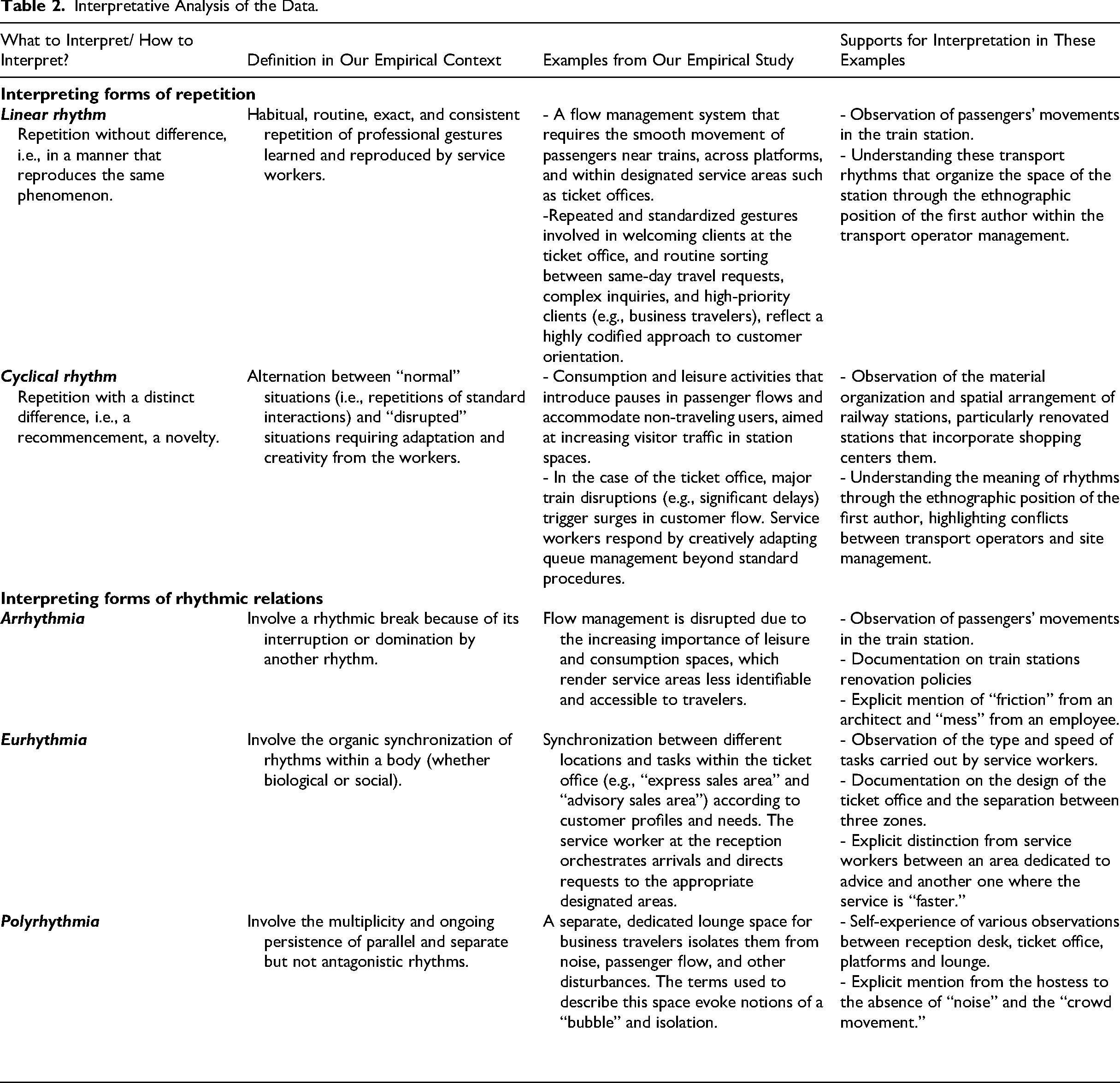
Analytical Strategy: Identifying Rhythms. We draw on the ethnographic work conducted by the first author, which was then reanalyzed together with the second author with the specific purpose of interpreting the material from the perspective of rhythmanalysis. The interpretive processes involved a shared discussion where the second author contributed to elaborating interpretive categories for identifying rhythms in this empirical material and offered reflexive insights based on their different standpoints regarding the field (see Case et al., 2024, for reflexivity in collective analysis). We applied a Lefebvrian interpretive scheme to the material, through an iterative process of collective concept development (see Locke et al., 2022). Specifically, we sought to identify patterns of repetition within the activities of service workers. We examined linear rhythms as habitual, routine, exact, and consistent repetitions of professional gestures learned and reproduced by service workers. In contrast, we analyzed cyclical rhythms as the alternation between “normal” situations (i.e., repetitions of standard interactions between service workers and customers in ticket offices, platforms, or lounges) and “disrupted” situations requiring adaptation and creativity from the workers (i.e., disruptions related to rail traffic or unusual customer interactions). The author team discussed experiences in terms of the tensions felt as clashes or synergies of tempo, how these were experienced in the field, and how participants’ verbatim reflected tendencies to acceleration or slowing, linking these to demands made by managers, customers, or worker's own personal demands and bodily rhythms. We summarize these interpretative keys in Table 2, providing various examples to interpret the forms of rhythms and the forms of rhythmic relations.
Interpretative Analysis of the Data.
Interpreting Rhythms in Service Work: Empirical Insights
Below, we present several illustrative examples to demonstrate how our empirical data enabled us to analyze the three forms of rhythmic relations from Lefebvre's theoretical typology: arrhythmia (the cancelation of one rhythm by another); eurhythmia (the harmonization of one rhythm with another); and polyrhythmia (the coexistence of several rhythms that may or may not be in conflict). For each illustration below, we explain how we analyzed the empirical material and how this reanalysis generated new interpretations. Moreover, we elaborate on these aspects in Table 1 and provide methodological guidance for each step of the analysis which we summarize in Table 2. This involved first examining the identifiable forms of rhythm present in the observed situations (i.e., cyclical or linear rhythms, as outlined on the first page of Table 2), followed by the modes of rhythmic relation (outlined on the second page of Table 2). For brevity, we provide a single example for arrhythmia, eurhythmia and polyrhythmia, with details about our interpretations from the ethnographic material.
Illustrating Arrhythmia: When the Rhythm of Consumption Erases the Rhythm of Transport
The following example illustrates an arrhythmia between the macro-rhythms of consumption and transport within a railway station. We identified these competing rhythms through the experience of being in the station, moving through the spatial architecture and communicative environment of the station (with its signals, messaging systems and flows of publics), and through descriptions of service workers and their management around the work process in those spaces. This led us to identify, on the one hand, a rhythm of transport that involved the rapid movement of publics across hallways and transport points, a service environment geared to quick turnover in ticket offices and platforms, providing information in truncated and abstract ways that we interpret as linear rhythms (see Table 2). On the other hand, we identified a rhythm of consumption, interpreted as encouraging individuals to leisurely wander and stroll through shops, regard advertisements, and spend time seated in consumption areas with affectively and sensorily rich stimuli, that we interpret as cyclical rhythms (see Table 2). These two rhythms embodied distinct and competing spatial organizational rhythms within the station: a consumer-centric rhythm, seeking to offset the costs of station renovation through the creation of retail spaces and reducing associated expenses for transport operators, and a transport-oriented rhythm focused on optimizing passenger flow and ensuring efficient service delivery by commercial staff.
Abstracting from these experiential moments to the macro-organizational context, we noted that large railway stations, particularly those in major urban centers, had undergone significant renovation policies in the previous decade. In these stations, a shift was observed from the rhythm of transport to the rhythm of consumption in specific areas, notably the halls between platforms and the station forecourt. This transformation was evident in the renaming of these areas; once historically referred to as “lounges for lost footsteps” (salle des pas perdus), they were repurposed as shopping centers, where foot traffic was carefully measured and managed to generate retail sales. According to insights gathered from an interview with an architect, these shopping areas were often overly spacious, hindering the optimization of flow management within the stations: ‘In my opinion, there is too much retail space (…). In other words, at some point we won't be able to manage traffic flows forever with so much space devoted to retail. Because, once again, retail creates … potential frictions between flows (…). These frictions have to last… for a certain period of time, and not too long’ (interview with a station architect). ‘It's not that it's hard to see the staff, it's just that it's a real mess. So if you're in Hall 1, I'm not even sure if someone on the other side of the hall can see you. Because the station is a mess. And they're going to put shops in there, so we'll be even less visible. Apart from walking around with a pennant on your head.. !’ (interview with a station employee).
In this example, our interpretation of arrhythmia is situated in relation to the micro-registers of experienced rhythms of acceleration/deceleration, the discursive and material indications of “frictions” between the rhythms, and a contextualization against the more long-term history and trajectory of the station's development and strategic plan.
An Illustration of Eurhythmia: When Different Service Orientations Reinforce Each Other
Our second example illustrates a situation in which rhythms reinforced each other, involving two distinct but complementary rhythms we identified within ticket offices where sales employees sold transport goods and services. We identified the ticket office rhythms by the type and speed of tasks carried out across several locations in the ticket office, which were also physically distinguished so as to enable a differentiation of tasks across these locations. Within the ticket office spaces, each employee or group of employees had tasks that complemented each other, even though they had very different rhythms in their work practices. Specifically, the design of these ticket offices distinguished three zones: a “reception zone” for customers entering the area; an “express sales” area (i.e., dedicated for purchases on the day of departure by customers identified by management as having priority, such as business travelers); and an “advisory sales” area (i.e., for purchases at a later date, the purchase of a loyalty card, and the like). These three zones were marked by very different experiences of task routines, ranging from an accelerated pace in the “reception zone,” to accommodate as many incoming customers as possible, to the slowest pace in the “advisory sales zone,” where the objective was a personalized dialogue with the customer. The first author observed recurring disruptions that interfered with standard procedures for customer reception and orientation. At the ticket office, such disruptions—like significant delays—trigger an unusual influx of customers. In response, agents show creativity by setting up queue management systems, even if this contradicts managerial directives aimed at preserving an open and fluid space. We interpreted these service workers’ activities as an alignment between linear rhythms—such as the scripted gesture of sorting customers at the entrance of the ticket office—and cyclical rhythms—such as workers’ adjustments in response to unexpected customer flows.
Spatially and materially, the three zones were evidently designed for different work process flows, reflected in the choice of furniture and layout between these three zones: for example, the “express zone” contained a small desk and a seat with a high stool where the employee and customers could stand, encouraging short interactions. In the “advisory sales” area, the furniture encouraged employees and customers to take their time: each employee had a large individual desk and the customers enjoyed comfortable seating, with employees and customers well isolated from the rest of the sales area, which was often noisy. The time, the nature of the inquiry and the dialogue between employee and customer were therefore distinct. The following interview extract with a staff member illustrates this difference in rhythm between the “express sales” area and the “advice” area (referred to here as “area B”): ‘It's true that when you're sitting in front of someone, you can explain all your needs, you're not stressed and rushed by someone who's queuing with you and then says “I've been waiting 10 min” and you hear the whining because it's too long and he's telling his life story. So if you're a customer, you listen to them and try to find a solution together. Personally, I think this area B is very well designed’ (interview with a sales employee).
At the intersection of the three areas, the key role of the “sales area reception” was played by one or a group of employees whose job was to welcome a customer and “dispatch” incoming customers to the various areas of the ticket office. The complementary nature of the two areas, “advisory sales’’ and “express sales,” was thus orchestrated by an employee or group of employees. We interpreted this orchestration as a “switching” role between the two rhythmic practices. For example, in the following interview extract, the employee explains how welcoming customers in the sales area rendered it possible to identify professional customers (referred to as “Pros”) so that they could benefit from an “express” sale, i.e., a quicker sale:
So the Pros, at the base of the base, are even faster, which seems logical to me because we mark ‘Pro Express’, which means what it means. If the Pro has to wait longer, that's not logical, is it? So having a queue manager already makes it easier to target the Pros, so they don't have to go into a general queue manager where they have to wait ¼ of an hour when they have a train in 5 min, do we agree?
An Illustration of Polyrhythmia: Different Rhythms Coexisting in the Same Space-time. As a third example, different rhythms can coexist in the same space-time, without exhibiting either complementarity or conflict. We interpreted our empirical material as involving polyrhythms when we identified multiple rhythms but without either a clashing or interfering dynamic, on the one hand, or a mediating or complementary dynamic, on the other. These were cases in which rhythms were isolated, but where this isolation did not seem to offer a “function” or solution to any specific problem (e.g., as in the sales area example above).
Of the variety of rhythms we identified at the station, several involved situations where employees were isolated from each other, and distinct polyrhythms were allowed to proliferate across these isolated spaces in the same station. Employees working in the frequent business travelers’ lounge were completely cut off from the rest of the station, including the hall, platforms, and the ticket office. The isolation in this space was both physical and sensory, both physically separated from the platforms and shopping areas and quiet and peaceful despite its location in a busy station with thousands of travelers. During the first author's observation days in the station, she alternated between observing the reception desk, the ticket office, platforms, and this kind of lounge and experienced this great difference of rhythm. She interviewed the hostess of the frequent business traveler lounge, whose front door overlooked the quays. She described the isolation at the “end of the platform” and the lack of “crowd movement,” which made it feel like a “bubble.” ‘I mean a bubble, like a bubble, that's it. A somewhat special corner in the station, it's true that it's like no other, we don't have the noise of the station, since we're quite out of the way, it was also done on purpose to put us at the end of the tracks. And we don't have the crowd movement, we have less noise, we're really like a bubble’ (interview with a receptionist).
Overall, our rhythmanalytic reanalysis enabled us to foreground rhythmic conflicts at a micro level, whereas our previous theoretical framework, based on a phenomenological approach, focused primarily on embodied experience and the continuity between human things—interactions, service agents, users—and non-human ones, such as digital artifacts and the design of the ticket office, traveler lounge, tracks, and platforms. The way these conflicts manifest through terminology, bodily positioning, and spatial design reveals the methodological and critical potential of rhythmanalysis. From the above illustrations, we showcased cases from our empirical material to give a concrete sense of how rhythmanalysis can be applied in organizational analysis. Below, we discuss the implications of this approach and propose a future research agenda on rhythmanalysis in and around organizations.
Discussion
We propose a methodological contribution to organizational scholarship through an elaboration of rhythmanalysis. Because this method is based on a social-theoretic approach that itself is novel in the field, we may label it as a theoretical-methodological contribution, with principles and guidelines for methodological practice. Indeed, Lefebvre's (2004) approach does not clearly distinguish between a substantive social theory and its proposed method of study, and the two are intertwined within his work. Doing justice to this theory-method entwinement, we consider rhythmanalysis as an empirical approach that has both theoretical and methodological implications.
Methodological Contributions for Rhythmanalysis in Organizational Scholarship
Our study's primary contribution is to establish a basis for using rhythmanalysis as a methodology in organizational scholarship. After outlining the concepts behind rhythmanalysis, we illustrated our methodological approach by examining data from an ethnographic study with a rhythmanalytic lens, providing guidelines for methodological application. We bring these conceptual and operational tools to studying rhythmanalysis in organizational dynamics. This contribution dialogues with organizational literature such as process studies, which considers organizations as ongoing flows of activities and materials over time (Langley et al., 2013). Varying between “static” and “process” ontologies, the latter of which focus on ongoing processes of becoming (Reinecke & Lawrence, 2023), emerging scholarship examines the temporal work through which organization emerges (e.g., Bansal et al., 2022; Kaplan & Orlikowski, 2013). The rhythmic aspect of such emergence complements and extends such literature, by thinking time together with space and material aspects of organizing (cf., Schatzki, 2020).
Where rhythm has appeared in this research (cf., Stephenson et al., 2020), it often focuses on activities’ speed and frequency in relation to organizational outcomes such as change (e.g., Klarner & Raisch, 2013). Processes are usually described as forward-moving, even if concepts of repetition and cycle are sometimes mentioned (e.g., Howard-Grenville et al., 2013). Even in cases drawing on Lefebvre (e.g., Verduyn, 2015), the specifically methodological aspects are usually not emphasized. Thus, process perspectives have had an ongoing flirtation with rhythm and a peripheral awareness of rhythmanalysis, but here we consolidate, deepen, and elaborate on the implications of this approach.
Rhythmanalysis provides a methodological tool to examine stability and change in organizational practices and structures. No tool is perfect, and the limitations of rhythmanalysis require further exploration. For instance, the difficulty of directly observing rhythms is a challenge, and it may be that observations may lead to a focus on repetitions rather than disruptions, which would emphasize the linear aspect of rhythms 2 . Moreover, rhythmanalysis should be elaborated and developed so as to capture both stability and change. As organizations undergo alternating periods of acceleration and deceleration through various rhythms in the intensity and frequency of activities (Huy & Mintzberg, 2003), change and stability operate dialectically through rhythmic variations (Klarner & Raisch, 2013). Adopting a rhythmic perspective allows understanding organizational stasis without ontologizing it as “structure,” and fluidity without assuming speed. Finally, rhythmanalysis provides a way to link embodiment with broader organizational processes, through a method based on “embodied and embedded experience” (Agar & Manolchev, 2020, p. 252). Rouse et al.'s (2021) study of maternity rhythms makes it clear how the body establishes rhythms that can potentially clash with rhythms of work or economy, leading to a multi-level approach that links bodily experiences with organizational and social processes. The current paper provides a method for critically analyzing such dynamics across multiple rhythms.
Rhythmanalysis and the Critical-Normative Potential of Arrhythmia, Eurhythmia and Polyrhythmia
Our treatment of rhythmanalysis highlights a critical and normative potential in the concepts of arrhythmia, eurhythmia, and polyrhythmia that is suggested in Lefebvre's original work, but remains underdeveloped. Rhythms can clash, and in their clashing can disrupt, amplify or cancel each other out, which Lefebvre describes as potentially “pathological” effects (2004, p. 20), specifically in relation to the rhythm of capitalist production as a “parasite” on the rhythm of creative work (p. 53). Taken as a normative approach, each rhythm is expressed according to a pattern that can be respected or interrupted in its interactions with other rhythms. Multi-rhythmic systems can give rise to arrhythmia, with destructive consequences. Arrhythmia can be also generative of new imaginaries, particularly in times of crisis such as those characterizing the Anthropocene. In a recent piece of research, Nadegger and Wegerer (2026) compellingly examine forms of eurhythmic harmony and arrhythmic disturbance in the context of the alpine winter tourism industry, highlighting the potential of arrhythmia to transform business-as-usual. The current study provides a methodological support for this kind of critical rhythmanalysis of organizations.
By contrast, rhythms can reinforce and harmonize each other (eurhythmia), or coexist in pluralities that are not mutually disruptive (polyrhythmia). While Lefebvre (2004) does not go so far as to distinguish between “emancipatory” and “oppressive” rhythms, the critical-normative potential of these rhythmic concepts can easily be developed from this core idea. To illustrate, Bailey and Madden (2017) argue that temporal dynamics can generate a sense of being “stuck in the moment” (p. 11), characterized by the perception of work as meaningless, repetitive, and lacking autonomy. Using a rhythmanalytic approach, this could be conceptualized as the dominance of a linear rhythm, perceived as oppressive. On the contrary, in her study of esthetic and emotional coordination among choral musicians, Stephens (2021) shows how artistic performance involves an adaptation and collective learning process in order to harmonize, which is useful for understanding “coordinating as a more dynamic, continuously fluctuating process” (p. 28). According to a rhythmanalytic reading framework, rhythms here would be seen as cyclical, with a form of relation that is perceived as emancipatory.
Complementing perspectives about the ongoing tensions within, for instance, institutional processes (Reinecke & Lawrence, 2023) or organizational communication (Smith, 2022), notions of rhythmic combination allow a more dynamic and normatively rich conception of tensions in practice. This is because, differently than institutional logics for example, rhythms are not stable social structures but dynamic and normatively charged action impulses. Thus, their consonance or dissonance is not simply a matter of logical consistency, but of lived conflict. The tensions that emerge from these conflicts in rhythmic relations provide a basis for a critique of organizational dynamics through the lens of rhythm. This phenomenon is exemplified by Ehrnström-Fuentes (2016), in which social imaginaries of a local community clashed with those of an extractive industry. The lens of rhythmanalysis could allow further insights into this process by examining the possibilities of rhythmic compromise between the different stakeholders, and the extent to which local rhythms are subordinated to a linear rhythm of production, or whether a polyrhythmic order can be established between the different actors. Understanding the alignment, misalignment, or diversity of rhythms therefore provides a new way of understanding organizational tensions while conferring a critical-normative potential to such understanding.
Conclusion and Future Research Agenda on Organizational Rhythms
From the above contributions, we can conceptualize a future research agenda using rhythms to study organizational processes, a methodological advance that creates the possibility for theoretical developments. Elements of such a research agenda could involve the processual nature of rhythms, the normative and critical possibilities of rhythmanalysis, and the relation between rhythms at multiple scales.
First, the study of rhythmanalysis can dialogue well with process perspectives and provide a novel perspective on temporality and embodiment. Recent work has emphasized the periodicity and variable temporalities of organizing (e.g., Reinecke & Lawrence, 2023; Sadeghi et al., 2025), mentioning rhythm as an important aspect of temporality but not centering it in the analysis. A similar point can be said of embodiment literature, where bodies are acknowledged as rhythmic, but only recently have begun to be studied as such (e.g., Katila et al., 2020). Future research might, for instance, examine the temporal, embodied processes of rhythmic organizing in teams over time, including hybrid and virtual teams, where multiple rhythms may need coordination over time at a distance. Such processes, at team, organizational and institutional levels, involve processes of rhythmic entrainment (Reinecke & Lawrence, 2023) that require empirical and theoretical development.
Second, rhythms can provide a normative and critical possibility for studying conflict and organizational politics. Future research can examine, for example, how struggles over legitimacy or interests may be expressed through conflicting rhythms, for instance how long- versus short-term investment cycles may express different actors’ interests and conceptions of an organization. Struggles over sustainability transitions have a similar struggle over rhythms of change, for instance, the pace of divestment of fossil fuels and the overlapping rhythms of environmental versus social aspects of sustainability. Arrhythmic outcomes could occur when, for example, a rapid energy transition threatens certain job sectors and retraining or other capacity-building efforts are not implemented to realign these rhythms. On the other hand, a eurhythmic transition would involve aligning social, economic and environmental rhythms to reduce the cancelation of one rhythm by another. Future research can thus examine potential conflicts as movements between harmonization and arrhythmia, for example, or examine the conditions under which polyrhythms can be sustained without mutual cancelation.
Elaborating on this critical potential and the possibility of mutual non-cancelation is our conception of polyrhythms, which contained a tension requiring further attention. On the one hand, we defined polyrhythms as coexisting rhythms, that neither harmonize (eurythmia) nor destabilize (arrhythmia) each other. In the example we gave, this co-existence was rendered possible by the spatial distancing of the rhythmic activities, which simplified the question of how they could be maintained in parallel. Brought together, however, can polyrhythms maintain a stable co-existence, or must they move eventually into a situation of eurhythmia or arrhythmia, both of which would eventually erase this plurality? The idea that polyrhythms can only exist where rhythms are separated has critical consequences because it obscures a dialectic or interactive idea of rhythmic mixture, constructive tension, or progression. A critical approach to rhythms would benefit from theorizing how multiple rhythms can be pulled between situations of sameness and difference, which adds a potential for struggle, seeing their relations as a site of fluctuation and thus potential contestation. While developing this point is beyond our current scope, we welcome research that examines the relation between polyrhythms as we describe them in our illustrations (rhythms in parallel) and a more entangled view of polyrhythms, in the sense of a rhythmic “ensemble” or “encounter.” Considering polyrhythms in this way opens up an avenue for future research to examine the overlaps among eurhythmia, arrhythmia, and polyrhythmia, and to conceptualize them as a continuum rather than as distinct forms of rhythmic relation. From this perspective, rhythmic relations are ongoing and fluctuating rather than fixed. Arrhythmia, eurhythmia, and polyrhythmia can thus be understood as dynamically intertwined: neither so incompatible that one necessarily effaces the others nor in complete harmony, but as constituting a polyrhythmic ensemble that persists through the ongoing differences among its component rhythms.
Finally, relating to the multi-level aspect of rhythms, because rhythms can be combined both horizontally and at multiple scales, they provide an analytical tool to explore micro-macro relationships. For example, work-life relationships may be understood as an imbrication of personal and bodily rhythms with those of the office, which are then imbricated in broader organizational, sectoral, and economic rhythms. Seeing this multi-level ensemble as rhythms adds a dynamic element to the classical “multi-level” paradigm. In this view, each “level” is no longer seen simply as a distinct source of variance, but as an internally changing, processual object that is semi-autonomous yet coordinated to rhythms at different scales. Multi-level embedding is thus comparable to the way the musical score of a single instrument is embedded within the ongoing flow of a coordinated orchestra (or improvisational ensemble, or cacophonic jumble, as the case may be). Future research can thus examine how multi-level ensembles both are composed by and regulate their constitutive scores, both by external signals that regulate flows and by internal adaptation and adjustment processes.
Given the breadth and potential of the rhythmanalysis project, the above lines are initial ideas in what we hope will develop into a wide-ranging organization-theoretic approach. Materializing such an approach requires both a reconsideration of many of the objects we study as rhythmic, but also methodological tools and illustrations to guide researchers as to how to build rhythmanalytic projects. The goal of this paper has been to give an idea of the former while creating a basis for the latter, providing methodological examples and guidance to stimulate the growth of rhythmanalytic perspectives in organizational scholarship.
Footnotes

Funding
The authors received no financial support for the research, authorship, and/or publication of this article.
Declaration of Conflicting Interests
The authors declared no potential conflicts of interest with respect to the research, authorship, and/or publication of this article.
Notes
Author Biographies
Albane Grandazzi has been an Assistant Professor of Management at GEM Alpine Business School since 2020. Her research examines spatial, temporal, and embodied practices in organizations, with a particular focus on how these practices shape and reconfigure organizational strategies and members’ lived experiences of work. Her work has been published in journals such as the Journal of Business Ethics and Work, Employment and Society.
Gazi Islam is Professor of People, Organizations and Society at Grenoble Ecole de Management, and member of the research laboratory IREGE (Research Institute for Management and Economics) at the University of Savoie Mont-Blanc. He is co-Editor-in-Chief of Journal of Business Ethics. His research interests revolve around business ethics and the contemporary meanings of work, including the relations between identity, power and the production of group and organizational cultures.