







Abstract
Firms increasingly equip field service workers with virtual team technology that enables them to deliver services more efficiently and take part in new service development. However, the “out-of-office” nature of field service tasks limits the possibilities for supervision, so virtual team outcomes are hard to control. To predict virtual team service performance, this study delineates the notion of team efficacy in the context of virtual service teams. The authors assess virtual team members' perceptions of virtual team efficacy and its perceived antecedents and consequences. The authors find that perceived virtual team efficacy explains service performance better than previously established, generalized confidence beliefs. Specifically, data collected from 192 field service employees in 28 virtual teams reveal that perceived virtual team efficacy provides a strong predictor of in-role service performance and extra-role innovative service performance. Factors external to the organization (i.e., competitors' use and customer appreciation of virtual team technology) drive perceived virtual team efficacy, whereas internal factors (i.e., supervisor and peer encouragement of virtual team technology) are less effective. Therefore, managers must keep up-to-date with competitive developments and openly discuss insights with the team. Positive customer feedback should also be distributed to team members when employee contributions to new service development are envisioned.
Introduction
Organizations increasingly use virtual teams of field service employees to improve their service delivery performance. For example, Agfa Graphics introduced virtual global service teams as a means to deliver cost-effective global support (Questra 2008), and Intermec, an international manufacturer of information and data capture systems, uses virtual teams to increase its customer service productivity (Microsoft 2008). The emergence of virtual team technology, ranging from voice-over-Internet protocol conference calls to shared file servers to decision-supportive groupware to video conferencing, has made such teams the rule rather than the exception. Their popularity also stems from their benefits; they offer reduced travel costs, improved synergies because the most suitable employees undertake the job regardless of their geographical location, and more diverse perspectives for solving customer problems. The use of virtual technologies also enables the firm to bundle insights, spur creativity, and push service employees to go beyond regular service tasks and suggest innovative service solutions to their customers (Challagalla, Venkatesh, and Kohli 2009; Chen, Tsou, and Huang 2009).
Yet the lack of physical interaction, absent face-to-face synergies, low outcome reliability, and reduced managerial monitoring and intervention possibilities make the outcomes of virtual teams harder to control than those of traditional teams (Cascio 2000). In a study of 54 effective virtual teams, Malhotra and Majchrzak (2004) find that creating shared understanding among team members about goals, objectives, requirements, and responsibilities can improve output quality. This notion is consistent with recent theorizing about offline team performance, which identifies shared confidence beliefs about a team’s ability to work successfully (i.e., team efficacy) as a main driver of performance. No literature reveals how these shared confidence beliefs can be established in virtual teams though. Virtual team members tend to report less confidence in their ability to work together in a virtual environment (Fuller, Hardin, and Davison 2007), yet we still do not know how the added complexity in virtual service delivery affects the positive influence of team efficacy on work outcomes in a virtual team setting. Therefore, we propose a model that examines virtual team members' perceptions of virtual team efficacy and its perceived antecedents and consequences. We offer three substantive contributions.
First, we delineate the concept of perceived virtual team efficacy, which reflects the collective confidence beliefs of a team of employees who work in geographically dispersed locations. Several studies have investigated the role of team efficacy in non-virtual production teams (Gully et al. 2002; Lee, Tinsley, and Bobko 2002) and service teams (De Jong, De Ruyter, and Wetzels 2006); we expand this analysis to consider how employees in geographically dispersed groups—who must coordinate their actions through technology with few social and interactional cues—can develop shared perceptions of team efficacy. We thus position the team efficacy construct relative to the more general collective concept of group potency and show that perceived virtual team efficacy improves predictions of service performance in virtual teams.
Second, prior literature has studied the effect of team efficacy on group-level outcomes extensively (Cohen and Bailey 1997). For field service employees of virtual teams though, the emphasis usually is on individual performance, because the individual employees leave the office, take up stations at the customer location, work on a one-to-one basis with a customer, and make decisions relatively autonomously. Effective team collaboration and information exchanges with colleagues through advanced communication technologies, such as discussion forums and shared document repositories, may help solve this puzzle in more complex situations (Sergeant and Frenkel 2000). In addition, confident workers can share their experiences in a virtual environment, such that the technology helps keep team members updated about the latest service solution news and trends in the market and thus enables them to recommend service innovations to their customers. We know little about how such collective confidence beliefs facilitate individual work in virtual team environments though. Therefore, we examine the impact of perceived virtual team efficacy on two key performance criteria: (a) in-role service performance is the extent to which a field service employee reports to adhere to the behaviors prescribed by firm guidelines, such as solving customer problems within a standardized time period and (b) extra-role innovative service performance is the extent to which a field service employee reports to undertake additional efforts to cross-sell other services, move the customer into an updated service contract, or suggest the newest innovations. These tasks can be conducted in addition to solving the customer problem. Perceived virtual team efficacy drives both performance metrics, especially compared with more generalized beliefs about group potency.
Third, previous research has offered little guidance about the impact of different types of determinants of efficacy in virtual service teams. In offline settings, scholars have examined the impact of variables internal to the organization, such as organizational support and team design (De Jong, De Ruyter, and Wetzels 2005). Yet virtual team members are often out of the office, and complex products may require collaboration with customers and sometimes even competitors, so the beliefs of virtual team members may be more sensitive to factors that originate outside to the organization and the team, such as customer attitudes and competitor practices. We therefore specify both external (i.e., competitors' use and customer appreciation of virtual team technology) and internal (i.e., virtual team technology encouragement by peers and supervisors) variables as antecedents of perceived virtual team efficacy. We explore whether external variables are more or less important drivers of perceived virtual team efficacy than internal variables; we also investigate whether their role is more pronounced in teams in which members depend more on one another to conduct their tasks effectively. Furthermore, we study whether task process interdependence alters the impact of perceived virtual team efficacy on the performance outcomes in our conceptual framework.
Theoretical Background and Hypotheses
Perceived Virtual Team Efficacy
The construct of efficacy derives from social cognitive theory, whose central element is self-efficacy, that is, “people’s judgments of their capabilities to organize and execute courses of action required to attain designated types of performances” (Bandura 1986, p. 391). The level of efficacy determines how much effort a person will invest in attaining a preset goal, as well as how determined he or she feels when the going gets tough. At the group level, efficacy entails employees' collective or group-based beliefs that a team can perform a specific task or course of action (Bandura 1997). Collective efficacy therefore can be meaningfully distinguished from self-efficacy: An employee who effectively carries out a specific task may belong to an unsuccessful team, which would give that person a high sense of self-efficacy but low beliefs about collective efficacy (Lindsley, Brass, and Thomas 1995). Team efficacy is also distinct from group potency, which refers to generalized confidence beliefs that a team will succeed, regardless of the task, so the conceptual distinction refers to the task specificity (Gully et al. 2002).
In the case of virtual service teams, task-specific team efficacy may be more relevant than generalized group potency. Compared with face-to-face teams, virtual teams rely considerably more on electronic means of communication and are characterized by different configurational spirals, in the sense that the selection and realization of useful contributions, and thus the emergence of shared knowledge and confidence, is complicated by the reduced amount of social interaction (Kozlowski and Klein 2000; Lindsley, Brass, and Thomas 1995). Virtual team members often “screen out” social information, interpersonal exchanges, and emotional content from group interactions, to ensure the efficient use of virtual team technology. Beliefs about core tasks thus may involve greater team awareness and salience and be better predictors than generalized beliefs (Gibson and Earley 2007). Focusing on salient, domain-specific efficacy beliefs is thus more helpful for understanding the factors that lead to specific outcomes.
Fuller, Hardin, and Davison (2007, p. 215) accordingly define the concept of perceived virtual team efficacy as a team’s “belief in its ability to work together successfully in a noncollocated, technology-mediated environment.” That is, perceived virtual team efficacy reflects the confidence beliefs of employees, who are geographically dispersed, about their ability to cooperate using communication technology. It differs substantively from the efficacy of collocated teams, because it emphasizes the role of virtual team technology. However, it remains largely unknown how companies can develop perceived virtual team efficacy and whether it affects team members' work results. To address this gap, we develop hypotheses regarding the antecedents and consequences of perceived virtual team efficacy and summarize the framework in Figure 1 .
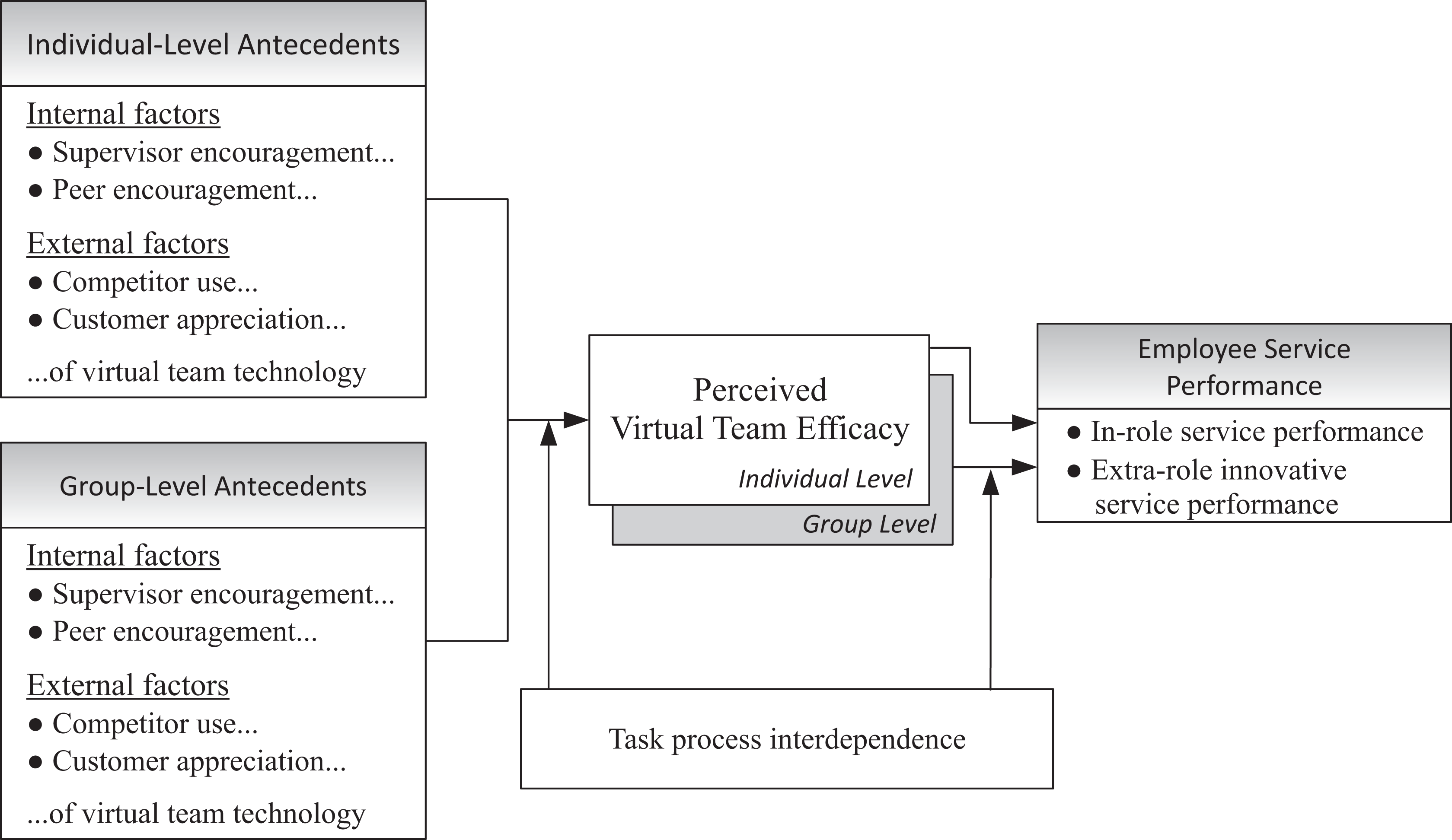
Conceptual model.
Internal Antecedents of Perceived Virtual Team Efficacy
Although collocated teams can, and often do, thrive without hands-on leadership, virtual teams generally can produce results only with the right level of support. In recent decades, organizational support has emerged as a key determinant of successful technology implementation (Igbaria and Iivari 1995; Sykes, Venkatesh, and Gosain 2009). Employees likely can deal effectively with technology if they receive the necessary support from their organization. In contrast, a lack of organizational support reduces users' motivation to use technology appropriately (Armstrong and Sambamurthy 1999; Boynton, Zmud, and Jacobs 1994).
Such assistance is especially important in teams of employees that span the firm-customer boundary, because those teams already experience high stress levels (Sergeant and Frenkel 2000). In such settings, a manager’s attitude toward virtual team technology can critically determine employees' beliefs about their ability to work together using technology. In a virtual context, managers also have less capacity to control and motivate group members, so they often shift their strategic focus to things they can control, such as adding technology to a work group (Giambatista and Bhappu 2010). In this scenario, a supervisor may take the role of technology champion and enthusiastically promote virtual team technology to deliver better customer solutions; this positioning likely enhances team members' collective confidence in their service delivery abilities (Howell and Shea 2006). In addition, if a supervisor strongly encourages the use of virtual team technology, subordinates may feel they have better access to organizational technology-related resources. A supportive supervisor can facilitate access to specialized personnel to address technology-related questions, troubleshoot emergent problems, and provide hands-on support (Bhattacherjee and Hikmet 2008). These forms of support reassure team members that technical assistance is readily available whenever they need it, which increases their confidence in the virtual work structure. Therefore, we hypothesize:
Hypothesis 1: Supervisor encouragement of virtual team technology positively influences perceived virtual team efficacy.
Hypothesis 2: Peer encouragement of virtual team technology positively influences perceived virtual team efficacy.
Previous studies also highlight the role of peer support in confidence perceptions. Maurer and Tarulli (1996) find that social support by coworkers positively affects beliefs about working with a new technology in the workplace. Especially among customer contact employees, Sergeant and Frenkel (2000) find that support from coworkers is essential for enhancing employee motivation. Peers can encourage technology usage within an organization and thereby increase perceived virtual team efficacy. A colleague who has experienced user-related technology problems in the past may be an ideal person to provide assistance to colleagues facing similar issues (Trauth and Cole 1992). By sharing his or her expertise, this user gains informal status and influence within the team. Persuasive communication from such influential individuals then increases confidence beliefs (Howell and Shea 2006). In addition, first-line technology support often comes from colleagues (Cole 1984; Sykes, Venkatesh, and Gosain 2009). Even if adequate formal support exists, employees tend to rely on informal assistance from a technology champion, who verbally persuades colleagues to think positively about the technology (Bandura 1997; Howell and Shea 2006). The more employees in a team accept the benefits of the virtual team technology, the more likely they are to convince others about the team’s capabilities to work with that technology. We hypothesize:
External Antecedents of Perceived Virtual Team Efficacy
Virtual teams blur the boundary between people internal to an organization and those previously considered external. Field service employees thus interact more with customers than with colleagues in their own firm, and customers increasingly cocreate complex products with them. In many service organizations, frontline employees also provide competitive intelligence, because a wealth of information becomes available during customer visits. In the hospitality business, for example, Vértice Hotels and DeVere Hotels equip their frontline employees with software that monitors the prices charged by competitors in real time, which supports their onsite decisions about rates and discounts. Bell Canada uses a simulation game to train employees to monitor competitors' activities and adjust their business practices to increase the firm’s competitiveness. Meehan and Baschera (2002, p. 37) also describe how Hilti has launched a so-called competitor radar, aimed at “gleaning from sales representatives any specific moves by competitors that are outside Hilti’s understanding of their strategy.”
In business-to-business (B2B) settings especially, salespeople from competing firms often approach a firm’s customers, who then likely share the competitive value propositions with field service employees, as a logical consequence of their strongly rooted relationships based on frequent visits and “speaking the same language.” Many companies allow field operatives to participate in trade shows and conventions and play active roles in tech-support forums. Thus, insights about both successes and failures by competitors should disseminate quickly and encourage interorganizational imitation. That is, one or more organizations' use of a practice increases the likelihood of that practice being used by other organizations, whether due to legitimization effects or an unconscious social influence that endows a practice with a taken-for-granted status (Haunschild and Miner 1997).
At the employee level, we predict a similar social influence process. When field service workers notice a proliferation of virtual team technologies on the market, they gain confidence in the positive replications of the routines and designs used by apparently successful competitors. This information provides an update on the technology’s technical efficiency or returns (Frohlich and Westbrook 2002). Doubts about the usefulness or applicability of virtual teams declines with greater evidence of competitors using similar technologies. Thus, employees' recognition of the use of virtual team technology by competitors reduces the amount of incomplete information they have about virtual teamwork structures (Abrahamson and Rosenkopf 1993). As Bandura (1997) notes, reduced information incompleteness through vicarious learning from competitors helps employees generate expectations that they can improve their own performance. We posit:
Hypothesis 3: Competitors' use of virtual team technology positively influences perceived virtual team efficacy.
In contrast, customer influence can be either positive or negative. A customer may appreciate that a field service employee uses virtual team technology, because it provides “always-on service,” and hope that the field service employee thinks about improving business processes. This customer should value the power of a shared knowledge base that includes process solutions used by other clients. But another customer may not care about virtual team technology or its application; it just wants the service as contracted.
De Jong, De Ruyter, and Wetzels (2006) further show that customer perceptions of delivered quality relate to employee beliefs about team competence. Receiving appreciation from customers signals that current practices are effective, which can spark confidence perceptions. In addition, virtual team technology allows field service employees to impress customers by solving complex problems onsite, using the shared knowledge base, and then presenting hot-off-the-press solutions. Customers should be “wowed” and express appreciation; a frontline employee then would gain confidence about the merits of the virtual team as a whole. We hypothesize:
Hypothesis 4: Customer appreciation of virtual team technology positively influences perceived virtual team efficacy.
Outcomes of Perceived Virtual Team Efficacy
Although scholars relate collective confidence perceptions to team outcomes, such as profitability (Gully et al. 2002), the effect of team efficacy on individual performance is uncertain. When field service employees work on a one-to-one basis with a customer though, it is imperative for managers to control individual outcomes. Preliminary evidence indicates that individual performance can be managed more effectively through controls over collective perceptions, rather than by optimizing individual-level beliefs (Jex and Gudanowski 1992; Zellars et al. 2001). We build on these findings to relate perceived virtual team efficacy to the individual performance outcomes of field service employees.
We contrast two service behaviors, based on the well-established distinction of in-role and extra-role performance by service employees (Bettencourt and Brown 1997). First, in-role service performance measures whether frontline employees report to meet the standards prescribed in organizational documents, such as job descriptions and performance evaluations. These standards may include “hard” prescriptions, such as solving customer problems within a specific time period, and “soft” prescriptions, such as treating customers in a friendly way. Second, extra-role innovative service performance reflects whether field service employees report to go beyond formal job requirements by trying to sell (new) service solutions to existing customers. A customer problem may be solved by a standard service response, but it also might push an employee to explore the potential of new service solutions and business opportunities. This search requires probing whether a customer is interested in solutions that might extend the existing service contract. The service employee thus performs elements of a sales role.
If individual field service engineers strongly believe that their colleagues share information effectively through virtual team technologies, they are likely to be better informed about the latest changes in their formal performance requirements, job responsibilities, or customer requirements. In turn, they should invest more cognitive energy into adhering to guidelines. Efficacy beliefs typically are accompanied by increased effort (Gully et al. 2002), such that field service employees likely will pay more attention to performing their role-prescribed tasks.
Because they work at the customer location, field service employees establish long-term bonds with their clients. Their long-term dedication to one specific customer should grant the service employee greater credibility if he or she recommends upgrades. In this way, employees can safeguard business over time by selling new, and improving existing, products and services. Collective confidence perceptions also might push field service employees to explore new procedures and practices and get clients more involved in new products or services (Howell and Shea 2006). With such joint confidence, team members should believe that their efforts to promote innovation will not be regarded as discrepant from existing service guidelines. If a frontline employee fails to achieve the desired result, collective confidence perceptions means the failure will not be held against him or her (Edmondson 1999). Finally, efficacy perceptions breed mutual trust and encourage shared insights and innovative solutions, so employees can experiment with sales behavior that extends beyond their formal role requirements. In summary,
Hypothesis 5: Perceived virtual team efficacy positively influences in-role service performance.
Hypothesis 6: Perceived virtual team efficacy positively influences extra-role innovative service performance.
Group-Level Effects
Employee beliefs about virtual team efficacy represent individual properties that reflect each person’s unique perception of his or her team’s collective competency. In addition, each team likely develops a unique set of shared perceptions about factors that influence efficacy cognitions, such that between-group differences emerge (Bliese 2000). Team members then may converge if the variance in their perceptions is relatively low (Mathieu et al. 2000). Even if field service employees work autonomously at the boundaries of the organization, they integrate their opinions when they digitally communicate, provide and receive feedback, and work on documents in the digital repository. Team members also assess whether the internal and external factors they experience converge into an internally consistent pattern. We thus can distinguish individual- versus group-level predictors of perceived virtual team efficacy. Shared group-level predictors significantly influence team confidence beliefs, beyond the individual-level antecedents (De Jong, De Ruyter, and Wetzels 2005).
On the outcome side, perceived virtual team efficacy is more than the sum of the efficacy beliefs of the individual team members (Bandura 1997). As field service employees work to coordinate their actions, they experience an influence of coworkers' attitudes. Individual confidence in the team gets reinforced if all peers think alike. The relationship between team efficacy and performance also is stronger at the team level (Gully et al. 2002); we thus apply these insights to our conceptual model and posit that shared perceptions explain a significant amount of additional variance in the dependent variables, beyond the individual-level effects. We hypothesize:
Hypothesis 7: Group-level perceptions of (a) supervisor encouragement, (b) peer encouragement, (c) competitors' use, and (d) customer appreciation of virtual team technology have a positive effect on employee beliefs about virtual team efficacy that accounts for significant additional variance beyond the individual-level effect.
Hypothesis 8: Group-level perceptions of virtual team efficacy have a positive effect on employee’s (a) in-role service performance and (b) extra-role innovative service performance that accounts for additional variance beyond the individual-level effect.
Moderating Effect of Task Process Interdependence
Recent studies suggest that the impact of these synergetic group-level processes is contingent on the degree of task process interdependence among team members (Gibson and Earley 2007; Gully et al. 2002; Katz-Navon and Erez 2005). Task process interdependence refers to the level of interaction and cooperation required to perform a task effectively (Gibson and Earley 2007). When interdependence is low, individual members can contribute to team or organizational goals without much interaction with others. In contrast, members must cooperate to perform the team tasks when interdependence is high. Especially in teams that depend on technology for their collaboration, interdependence is a key variable that determines the formation and effectiveness of shared cognitions (Baba et al. 2004). In teams of field service employees, members usually are autonomous and can solve customer problems individually. However, if they must attain more complex customer solutions, input from other team members can be salient. The incremental impact of shared perceptions, over and above individual perceptions, therefore likely depends on the degree of task process interdependence among employees within the team.
If task process interdependence is low, the members experience environmental stimuli in relative isolation, and we expect cognitive divergence (Katz-Navon and Erez 2005). In contrast, when virtual team members cooperate closely to perform, shared group-level cognitions should affect the team’s outcomes more powerfully (Gully et al. 2002). Therefore, with increasing interdependence, the incremental impact of shared group-level perceptions becomes more substantial than that of individual perceptions (Lindsley, Brass, and Thomas 1995). We expect teams with higher task process interdependence to have a tighter social fit that strengthens the impacts of the group-level antecedents on perceived virtual team efficacy, as well as the impacts of group-level perceived virtual team efficacy on its outcomes, and thus hypothesize:
Hypothesis 9: Compared with the individual-level effect, the incremental effect of group-level perceptions of (a) supervisor encouragement, (b) peer encouragement, (c) competitors' use, and (d) customer appreciation of virtual team technology on employee beliefs about virtual team efficacy is greater when task process interdependence is higher.
Hypothesis 10: Compared with the individual level effect, the incremental effect of group-level perceptions of virtual team efficacy on employees' (a) in-role service performance and (b) extra-role innovative service performance is greater when task process interdependence is higher.
Methodology and Study Design
Research Setting
We selected an international, high-tech company as our empirical setting to test our conceptual model. The firm offers innovative print and document management products and services for professional environments, operates in 80 countries, and employs 24,000 people. Its markets face rapid commoditization of products, which creates significant pressure on the company to shift from selling disposable products to offering a range of innovative services that will help customers improve their business. To address this development, the company employs virtual field service teams, whose members offer onsite service, including repair of installed products and proactive identification of latent customer service demands. Team members mostly work out of the office, performing tasks for (and together with) clients. Employees share their field experiences (e.g., error codes, user complaints and demands, innovative ideas/solutions) through knowledge repositories and discussion forums, where fellow members also provide feedback, opinions, and solutions. The virtual technology thus enables an employee to make more informed decisions and reduces the risk that a field service employee lacks skills to diagnose and solve a customer problem. The virtual technology platform also features news about the latest R&D developments, which triggers field service employees to offer clients the latest innovations.
In addition, visits by field service employees might be initiated by one of two incidents: (a) a customer contacts the company’s call center to report an error or problem or (b) the installed product issues a remote service call itself. In-role service performance usually includes repair of the broken product, according to the standards prescribed in job descriptions and performance evaluations, such as the maximum time allowed to fix a problem and the greeting to the customer. If the field service employee performs extra-role innovative service, he or she might offer the customer the option of repairing a problem in a traditional way (e.g., installing a spare part) or implementing a new technical component that will both fix the problem and provide the customer with new and extended functionalities. If the new component is not included in the customer’s service contract, the service employee can engage in cross-selling activities.
Each team services companies in a specific geographical area; a customer company thus receives visits only from field service employees who represent a single team. In addition, only one employee at a time visits a company to repair broken products. If the employee cannot ensure that the product functions properly, he or she schedules a second service call, which may feature a different service employee from the same team. However, team members never meet up at the customer location.
Sample Characteristics
For the study, we handed out 327 questionnaires to field service employees; we received a total of 192 completed questionnaires, for a response rate of 58.7%. Of these 192 respondents, 49 were between 21 and 30 years old, 58 were between 31 and 40 years, 54 were 41 to 50 years, and 31 were older than 50 years of age. Furthermore, 49 respondents had been working with the company for less than 4 years, 47 had 5–12 years of tenure, and 96 had been working there for more than 12 years. The 192 respondents represented 28 teams. For each of these teams, more than 70% of team members responded, which supports the use of data at the team level.
Measurement
We operationalize all the latent constructs with multi-item scales, on which participants indicated their disagreement with a set of statements using a 7-point Likert-type scale ranging from strongly disagree (1) to strongly agree (7). To reduce common method bias, we ensured psychological and methodological separations of the measurements in the survey instrument and pretested the survey to avoid unfamiliar or complex terminology. In addition, we tried to reduce social desirability bias by ensuring confidentiality in response handling. The measures of virtual team members' perceptions of supervisor encouragement, peer encouragement, competitors' use, and customer appreciation of virtual team technology all used 3 items each. The item wordings are based on the operationalization suggested by Schillewaert et al. (2005), adapted to the study context. The measure of perceived virtual team efficacy was based on the 4-item scale provided by Fuller, Hardin, and Davison (2007). Jung and Sosik (2003) suggest this individual-level measurement is a more accurate measure of collective efficacy compared with group discussions, because perceptions of vocal group members do not dominate the evaluation. The measures of in-role and extra-role innovative service performance relied on scales by Bettencourt and Brown (1997). We assessed task process interdependence with 4 items adapted from Kiggundu (1983). The exact item wordings appear in Table 1 .
Item Wordings, With Reliability and Validity Information
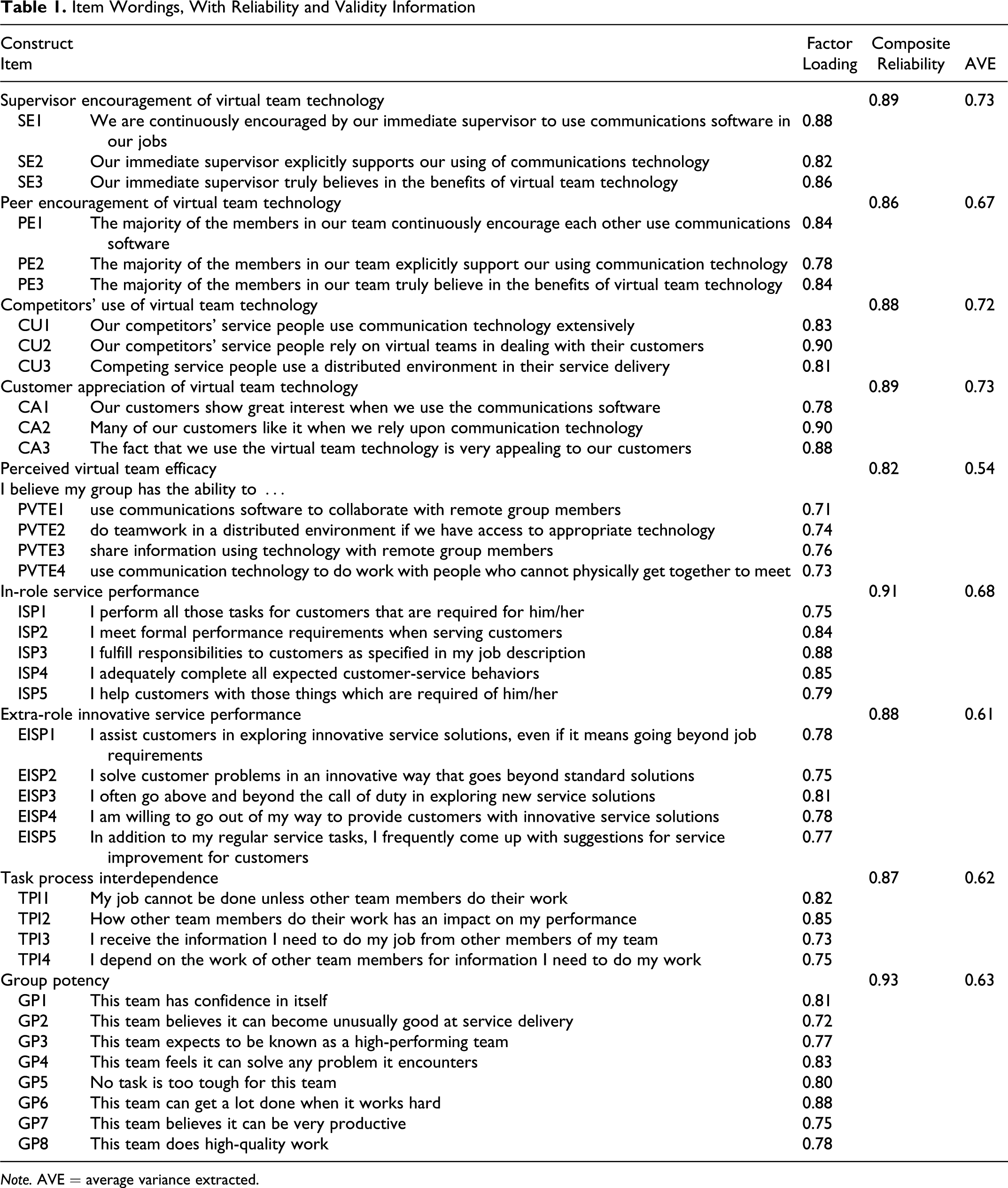
Note. AVE = average variance extracted.
We also assessed self-efficacy, role ambiguity, and role conflict as control variables. Self-efficacy accounted for the possibility that confident persons would be more optimistic about their overall working environment, including their virtual team. In addition, confidence in one’s own ability may influence performance (Gully et al. 2002). The frontline environment typically is characterized by role conflict and role ambiguity, and these factors may also affect collective confidence beliefs (Crosno et al. 2009; Zellars et al. 2001). To assess self-efficacy, we used 4 items from Jex and Bliese (1999). Role ambiguity and role conflict also included 4 items each, based on scales developed by Rizzo, House, and Lirtzman (1970). All three constructs were included in the confirmatory factor analysis (CFA) and displayed satisfactory psychometric properties. Finally, we asked respondents to report their true team size. We included this variable and its square to acknowledge that confidence beliefs may not increase infinitely with team size.
Data Analysis and Results
Validity and Reliability
To verify the validity and reliability of the measures, we estimated a measurement model at the individual level. For the CFA factor loadings, we used the robust maximum likelihood estimator in AMOS 7.0 and attained satisfactory global fit measures: χ2(764) = 1289.3, confirmatory fit index (CFI) = .93, Tucker–Lewis index (TLI) = .92, root mean squared error of approximation (RMSEA) = .06, and square root mean residual (SRMR) = .06. All items loaded significantly on the hypothesized latent variables, and the composite reliability values were all greater than the commonly suggested threshold of .70 (Nunnally 1978). To check for discriminant validity, we applied Fornell and Larcker’s (1981) procedure; all latent constructs passed the test, and the biggest correlation occurred between perceived virtual team efficacy and in-role service performance (.61).
We also tested for possible common method variance (CMV) effects using Lindell and Whitney’s (2001) approach. They posited that the smallest correlation of a theoretically unrelated variable with manifest variables would be a sensible alternative for CMV. If we were to treat the summed scales as observed variables (cf. Bagozzi and Heatherton 1994), for all bivariate correlations, the effect of the smallest correlation must be partialled out to remove the CMV effect. We used organizational commitment as our unrelated variable, because it displayed the smallest correlation with task process interdependence (.05). After correcting the correlations, we concluded that for all significant positive effects, the bivariate correlation coefficients remained statistically significant at p < .05. Only supervisor encouragement correlated significantly with perceived virtual team efficacy at p < .10. In addition, we controlled for the effects of an unmeasured latent methods factor through adding such a factor to the CFA (cf. Podsakoff et al. 2003). As this procedure requires the methods factor to be uncorrelated to all other latent constructs in the measurement model, these correlations were set to 0. The model fit of this CFA is χ2(777) = 1276.6. Compared to our original CFA, χ2(764) = 1289.3, this results in a nonsignificant change in model fit: Δχ2(13) = 12.7. In addition, all factor loadings to the latent variables were still significant. We therefore conclude that common method bias, if any, did not affect our results.
Multilevel Analysis
To capture shared beliefs in virtual teams, we aggregated the individual team member perceptions to a team level (Mathieu et al. 2000). The higher-level constructs are composites of the individual-level measures, but these aggregate-level constructs are conceptually distinct from their individual-level counterparts, in that they represent psychosocial aspects that cannot be captured by individual constructs. To attain the higher-level constructs, we applied the direct consensus model procedure (Bliese 2000), which requires intrateam consensus to be high enough to aggregate; if individual scores vary too widely within the team, it indicates a lack of shared beliefs, and aggregation is not allowed.
We distinguished between individual scores and the aggregated group mean for all four antecedents, perceived virtual team efficacy, and task process interdependence. Two statistics can empirically justify data aggregation to higher levels, the r wg(j) statistic and the intraclass correlation (ICC) coefficient. With regard to the r wg(j), which indicates the homogeneity of individual ratings within teams, we found the lowest median value of .88 for supervisor encouragement of virtual team technology; thus, all variables showed high levels of within-group agreement (James, Demaree, and Wolf 1993). In contrast, the ICC coefficient takes both within- and between-group variances into account. In this study, ICC values corrected for measurement error were all significant at p < .05. An accurate measure requires taking group size into account and thus applying the ICC(2) statistic. All ICC(2) values were at least .50 (from .51 to .64), which indicated reliable group means and supported the derivation of aggregate-level relationships (Bliese 2000).
Multilevel Analysis Results
To test our hypotheses, we applied multilevel regression analysis using MLwiN 2.14 software. Our conceptual framework includes hierarchical levels, because employees are nested in teams. Conventional statistical techniques (e.g., ordinary regression analysis) ignore this hierarchy and thus may lead to biased results. In contrast, the hierarchical linear analysis ensures (a) the effects within a particular hierarchical level and between hierarchical levels are estimated simultaneously; (b) the statistical dependence among members of the same unit is taken into account; and (c) a distinction is made between sampling error that is due to variation between versus within units (Bryk and Raudenbush 1992; Hofmann 1997). To estimate the model parameters, we used the restricted iterative least squares (RIGLS) estimation method, instead of iterative generalized least squares, because RIGLS produces less biased estimates when there are relatively few level-two units (i.e., when N < 30).
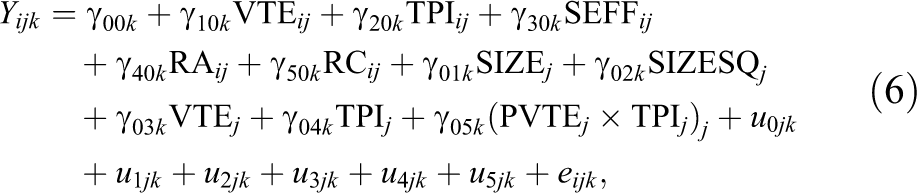
To begin, we tested the antecedents of perceived virtual team efficacy with a two-level regression model. We first included the control variables and antecedents at the individual level (Model A1), then specified the antecedents at the group level (Model A2) to test Hypothesis 7. This approach is consistent with the multilevel convention that the individual-level coefficient should act as a control for its group-level counterpart (Bryk and Raudenbush 1992; Hofmann 1997). If the group-level coefficient of an antecedent is significant, over and above its individual-level counterpart, it explains incremental, unique variance in perceived virtual team efficacy that cannot be captured by individual-level phenomena. Finally, Model A3 adds the interaction effects of task process interdependence. Our model specification is reflected in the following formulas: Individual-level model: Group-level model: Full two-level model:
where i denotes individuals; j indicates groups; PVTE
ij
= the perceived virtual team efficacy of employee i in team j; SE = supervisor encouragement of virtual team technology, PE = peer encouragement of virtual team technology, CU = competitors' use of virtual team technology, CA = customer appreciation of virtual team technology, SEFF = self-efficacy, RC = role conflict, RA = role ambiguity, SIZE = team size, SIZESQ = team size squared, and TPI = task process interdependence.


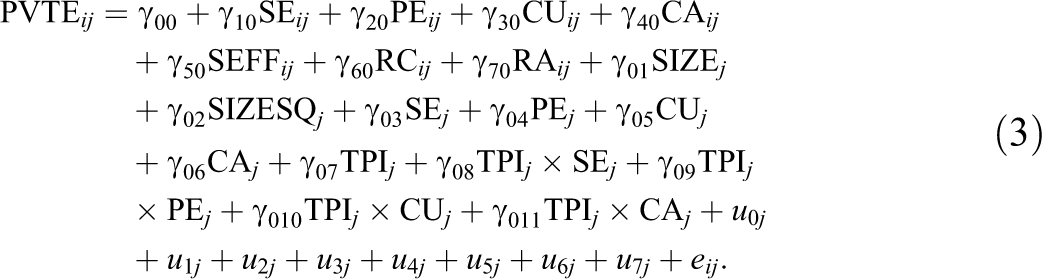
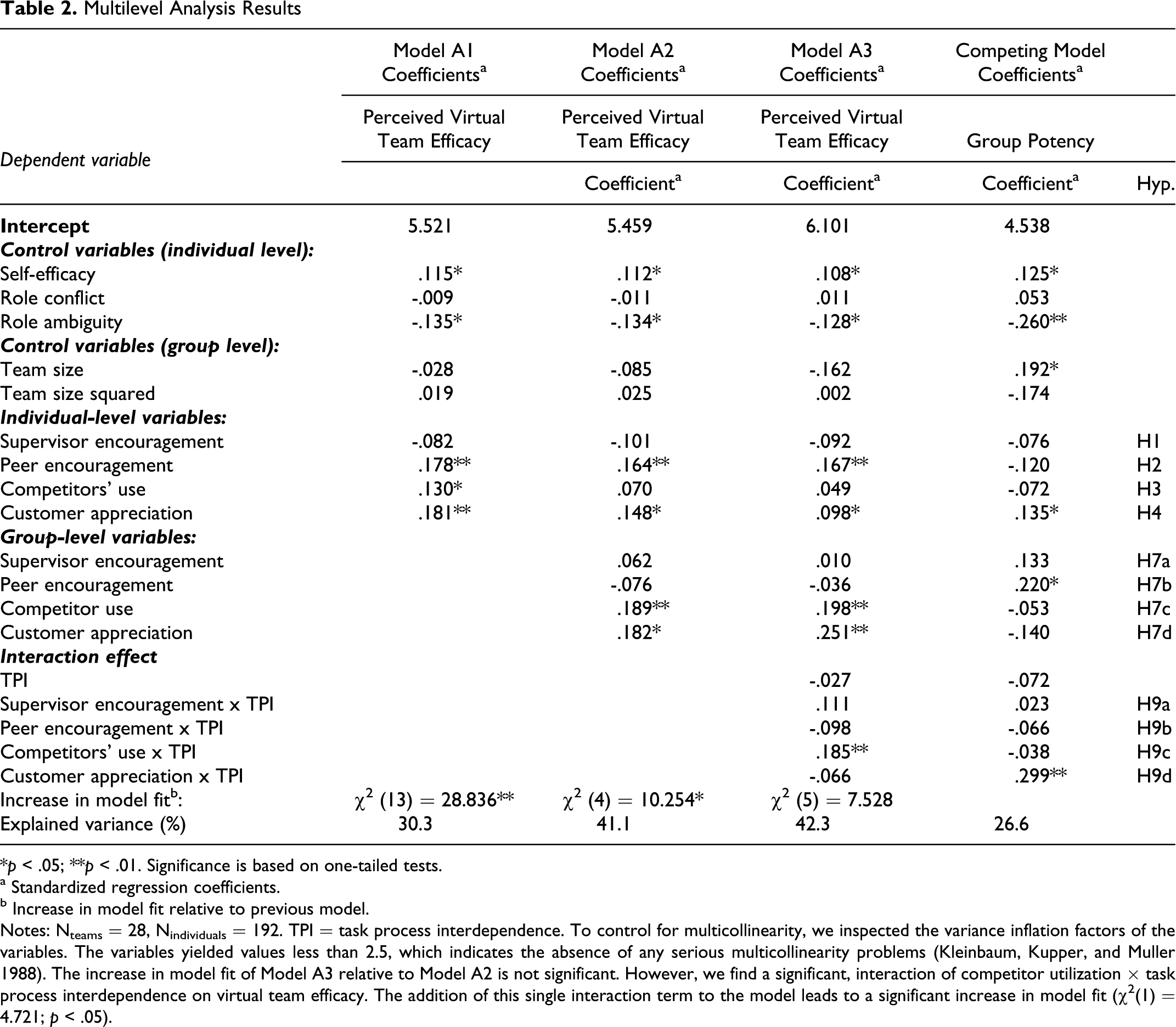
The individual-level error term eij is normally distributed with a mean of 0 and variance σ2. The random effects uqj (q = 1, 2, 3, 4, 5, 6, 7) follow a multivariate normal distribution over teams, with an expected value of 0 and var(uqj ) = τ qq . In addition, uqj indicates group j’s unique deviation from the overall effect on the intercept β0j , even while accounting for the group-level predictor variables. The coefficients β0j , …, β7j are specified as random components that may vary across groups. We present the findings of this multilevel analysis in Table 2 .
Multilevel Analysis Results
*p < .05
**p < .01. Significance is based on one-tailed tests.
a Standardized regression coefficients.
b Increase in model fit relative to previous model.
Notes: Nteams = 28, Nindividuals = 192. TPI = task process interdependence. To control for multicollinearity, we inspected the variance inflation factors of the variables. The variables yielded values less than 2.5, which indicates the absence of any serious multicollinearity problems (Kleinbaum, Kupper, and Muller 1988). The increase in model fit of Model A3 relative to Model A2 is not significant. However, we find a significant, interaction of competitor utilization × task process interdependence on virtual team efficacy. The addition of this single interaction term to the model leads to a significant increase in model fit (χ2(1) = 4.721; p < .05).
Model A2 reveals a higher R 2 than Model A1, which implies that the addition of the group-level antecedents significantly increases the proportion of variance in perceived virtual team efficacy we can explain. Model A3, the full model, explains the most variance. We therefore use this model to test our hypotheses. Individual perceptions of supervisor encouragement of virtual team technology do not relate significantly to perceived virtual team efficacy (β = −.092, n.s.), which means we must reject Hypothesis 1. In contrast, peer encouragement of virtual team technology has a significant and positive impact on perceived virtual team efficacy at the individual level (β = .167, p < .01), in support of Hypothesis 2. However, we cannot offer support for Hypothesis 3, because no significant effect emerges for employee perceptions of competitors' use of virtual team technology (β = .049, n.s.). Customer appreciation of virtual team technology has a positive individual-level effect on perceived virtual team efficacy (β = .098, p < .05), in support of Hypothesis 4. At the group level, we find no significant effects of internal variables and thus cannot confirm Hypothesis 7a (β = .010, n.s.) or 7b (β = −.036, n.s.). In contrast, the external variables indicate group-level synergetic effects on perceived virtual team efficacy, in support of both Hypothesis 7c (β = .198, p < .01) and d (β = .251, p < .01). Finally, we find a positive interaction effect of the group-level competitors' use of virtual team technology variable and interdependence on perceived virtual team efficacy (β = .185, p < .01), which supports Hypothesis 9c, though Hypothesis 9a, b, and d are not supported by our data.
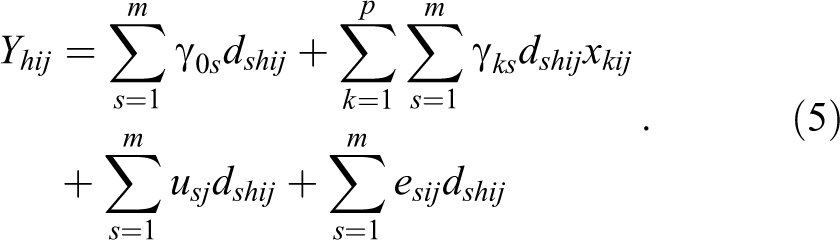
To test the effects of perceived virtual team efficacy on field service employee performance (Hypotheses 5, 6, 8, and 10), we used a multivariate regression analysis, formulated as a three-level hierarchical linear model. Level 1 refers to the dependent variables indexed by k = 1, …, m (i.e., in-role service performance, extra-role innovative service performance); Level 2 reflects the individual employees i = 1, …, nj
; and Level 3 involves the teams j = 1, …, N. Each assessment of a given outcome variable on a certain team therefore can be indicated by a specific line in the data matrix that contains i, j, k, Yij
, x
1ij
, and all other predictors. To formulate the multivariate regression model as a hierarchical linear model, we used the dummy variables d
1 to dm
to indicate the dependent variables, as expressed by the following equation:
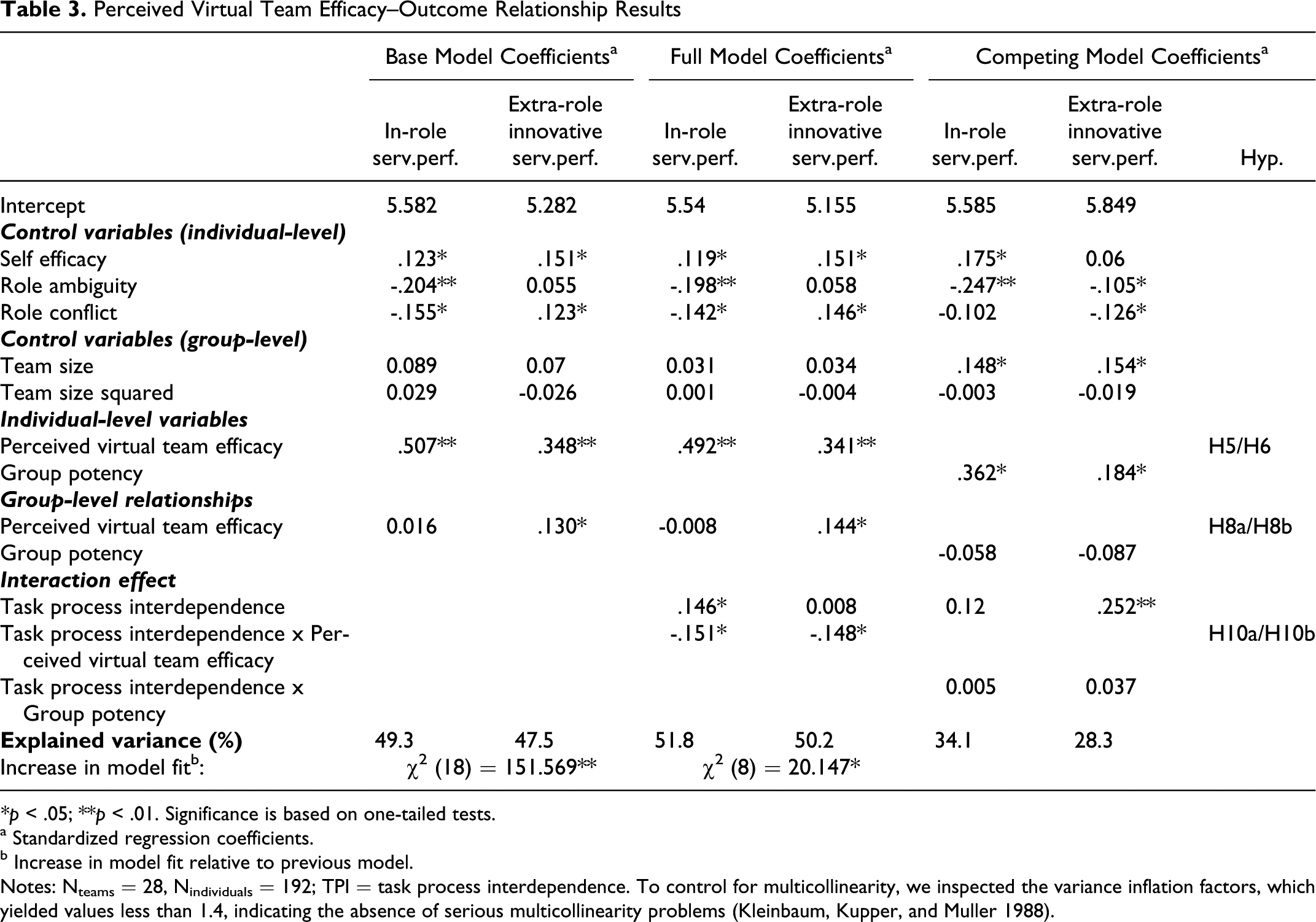
Perceived Virtual Team Efficacy–Outcome Relationship Results
*p < .05
**p < .01. Significance is based on one-tailed tests.
a Standardized regression coefficients.
b Increase in model fit relative to previous model.
Notes: Nteams = 28, Nindividuals = 192; TPI = task process interdependence. To control for multicollinearity, we inspected the variance inflation factors, which yielded values less than 1.4, indicating the absence of serious multicollinearity problems (Kleinbaum, Kupper, and Muller 1988).
We find significant, positive effects of perceived virtual team efficacy on employees' in-role (β = .492, p < .01) and extra-role innovative (β = .341, p < .01) service performance at the individual level, in support of Hypotheses 5 and 6. At the group level, perceived virtual team efficacy has no additional influence on in-role service performance (β = −.008, n.s.), and we must reject Hypothesis 8a. In contrast, group-level perceived virtual team efficacy significantly affects extra-role innovative service performance (β = .144, p < .05), in support of Hypothesis 8b. Contrary to our expectations, we find significant negative interaction effects of task process interdependence and group-level perceived virtual team efficacy on in-role service performance (β = −.151, p < .05) and extra-role innovative service performance (β = −.148, p < .05). With increasing interdependence, the positive impact of perceived virtual team efficacy on service performance weakens. These results contrast with our predictions in Hypothesis 10a and b, which therefore cannot be supported.
Finally, with respect to the controls, we find a significant individual-level effect of task process interdependence on in-role service performance. In addition, role ambiguity and role conflict exhibit significant negative effects that indicate perceived virtual team efficacy has robust influences, even after we account for role stress factors.
Mediator Analysis
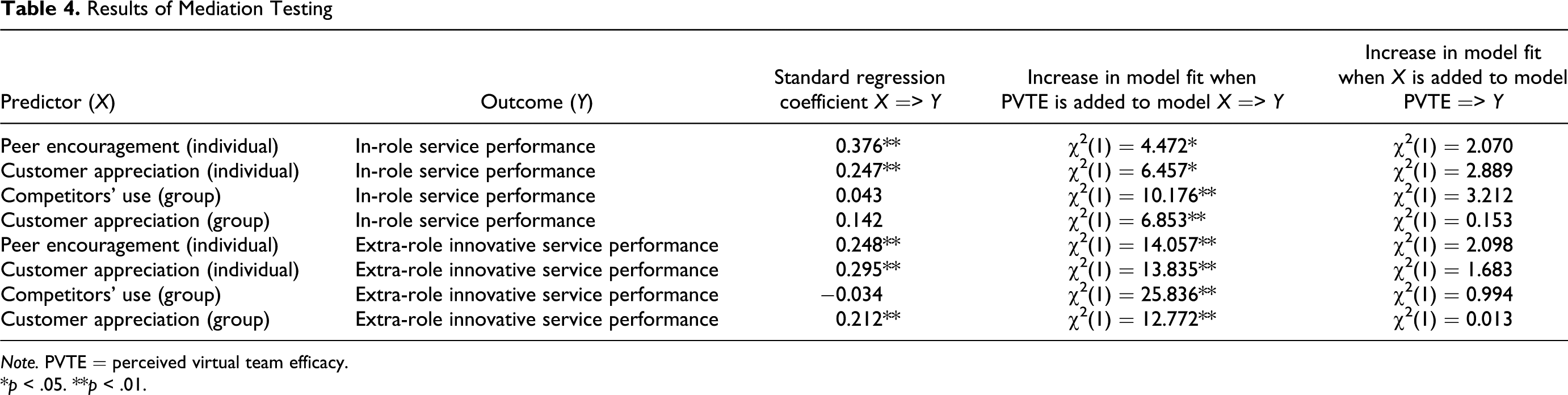
Our conceptual model also features the mediating role of perceived virtual team efficacy. We follow Homburg, Wieseke and Bornemann (2009), who suggest that full mediation exists if (a) there is a significant increase in model fit when the mediator gets added to a predictor-outcome model and (b) there is no such increase when the predictors enter the mediator-outcome model. In the results in Table 4 , we consider only significant predictor variables from Model A3. In all models that directly relate the predictor to the outcome, we find significant increases in model fit when we add perceived virtual team efficacy as a predictor. We also find no significant effect of adding a single predictor to a model when perceived virtual team efficacy serves as a predictor of field service employee behavior. As an additional test, we applied the procedure outlined by Zhao, Lynch, and Chen (2010), which is based on bootstrap confidence intervals for indirect effects. Applying this procedure on individual-level-only mediation relationships, we found that none of the resulting confidence intervals contained 0. Therefore, perceived virtual team efficacy fully mediates the four defined predictors and the two outcomes.
Results of Mediation Testing
Note. PVTE = perceived virtual team efficacy.
*p < .05.
**p < .01.
Post Hoc Analyses
We have argued for the importance of perceived virtual team efficacy as a concept distinct from more general operationalizations, but others might question this view. Some scholars argue that generalized confidence beliefs, rather than domain-specific constructs, explain work outcomes. For example, Guzzo et al. (1993) propose the concept of group potency, or the collective belief within a group that it can be effective, which reciprocally and longitudinally relates to team effectiveness (Pearce, Gallagher, and Ensley 2002). Substantive evidence also indicates that undifferentiated, context-free measures of employee confidence have less predictive value than domain-specific measures (Chen et al. 2002; Gibson, Randel, and Earley 2000). A domain-specific approach, using more proximal measures to capture the task-specific performance context, therefore might be more effective (Gibson and Earley 2007). This controversy raises a question: Is it really more relevant to study perceived virtual team efficacy than a more general construct, such as group potency?
We reanalyze our conceptual model with group potency as our focal construct, which we had measured concurrently in the survey instrument. We assessed group potency with 8 items suggested by Guzzo et al. (1993), which we reported in Table 1. Replacing our perceived virtual team efficacy construct with group potency yielded an acceptable fit in the CFA: χ2(934) = 1577.6, CFI = .92, TLI = .91, RMSEA = .06, and SRMR = .06. The standardized loadings were all greater than .7, and the r wg(j) (.92) and ICC (.17/.67) statistics offered support for the aggregation of group potency to the group level. The findings from the multilevel regression analysis—as displayed in the “competing model” column in Tables 2 and 3—revealed that customer appreciation had a significant positive effect on group potency on the individual level (β = .135, p < .05), whereas peer encouragement of virtual team technology displayed a positive group-level effect (β = .220, p < .05). No other antecedents related significantly to group potency. In addition, we found a significant positive interaction effect of task process interdependence with customer appreciation (β = .299, p < .01). In total, the antecedents explain 26.6% of the variance in group potency, significantly less than the 42.3% we found for perceived virtual team efficacy. Thus, the two concepts are clearly distinct in their antecedents, and what “works” for perceived virtual team efficacy seems less effective as a means to boost group potency.
We next analyzed the effects of group potency on our dependent variables. Group potency still had an individual-level effect on in-role service performance (β = .362, p < .01) but no group-level effect. Furthermore, group potency indicated only a weak effect on extra-role innovative service performance at the individual level (β = .184, p < .05) and no significant group-level effect. We therefore conclude that, at least in our sample, group potency explains substantially less unique variance in the individual service behavior of virtual team members than does perceived virtual team efficacy. This finding also is reflected in the R 2 values that do not exceed .35 when group potency is the focal construct (.341 for in-role, .283 for extra-role innovative service performance), whereas they were greater than .50 for perceived virtual team efficacy. Consistent with recent insights (Fuller, Hardin, and Davison 2007; Gibson and Earley 2007), we thus conclude that context-free measures of efficacy have weaker predictive value than their context-specific alternatives, which justifies the consideration of perceived virtual team efficacy as a focal construct.
Conclusion
Discussion and Theoretical Implications
Our study represents a first attempt to delineate the notion of team efficacy in the context of virtual service teams. Developing a further understanding of perceived virtual team efficacy is important to both academic researchers and service management practitioners, because it reveals an important element associated with predicting virtual service team performance. We have identified two context-relevant performance criteria, in-role service performance and extra-role innovative performance, and tested the predictive impact of perceived virtual team efficacy on them. We also contribute to extant literature by examining perceived virtual team efficacy within a comprehensive research framework that contains unique predictors and thus providing valuable insights into how perceived virtual team efficacy is shaped across individual and team levels of analysis. Finally, we compare the role of perceived virtual team efficacy with that of group potency and conclude that our domain-specific efficacy measure is more effective for explaining service performance in virtual teams than its more generalized alternative.
Perceived virtual team efficacy as a predictor of service performance
With regard to our focal construct, the findings generally confirm an assertion central to social cognition theory: Domain-specific confidence beliefs exert a strong impact on performance (Bandura 1997; Gibson and Earley 2007). We also demonstrate that relative to the more general construct of group potency, perceived virtual team efficacy provides a stronger predictor of service performance. The robust predictive ability of perceived virtual team efficacy on performance receives corroboration from our mediation analyses. However, our main contribution stems from our effort to elucidate the specifics of the relationship between confidence beliefs and performance. In addition to individual virtual team efficacy perceptions, our results reveal a positive group-level effect on extra-role innovative performance and thus extend extant research on new service development, according to which shared cognitive structures can help overcome uncertainties in functional coordination and consensus achievement (Atuahene-Gima 1996; Froehle et al. 2000; Lievens and Moenaert 2000).
We encountered no group-level effect on in-role service performance. Task process interdependence, contrary to our theory-based prediction, also weakens the effects of group-level perceived virtual team efficacy on both performance outcomes. The explanation may relate to the specific characteristics of virtual service teams, in which well-trained service engineers simply solve customer problem onsite. In teams with low perceived interdependence, information and on-the-job learning are likely to be viewed more as individual assets and tickets to career advancement, which would attenuate the impact of shared confidence beliefs.
The effects of encouragement
In addition to establishing its relevance and performance impact, we develop an intricate insight into the unique drivers of perceived virtual team efficacy in a comprehensive theoretical framework of predictor-criterion relationships across several levels of analysis (and in relation to the parallel construct of group potency). Our findings form a first and important step in understanding how perceived virtual team efficacy develops across geographically dispersed service teams. At the individual level, service firms can control perceptions of virtual team efficacy, if they stimulate peer championing of virtual team technology. A service employee who receives positive feedback from team members will develop more confidence in the abilities of the team, though group-level peer encouragement appears not to affect employee perceptions of virtual team efficacy. Apparently, an employee’s belief in the virtual team’s ability to communicate using technology derives from individual experiences and dyadic exchanges, rather than shared experiences. We posit that in a virtual service context, individual team employees likely have frequent and intense contact with other team members on a one-to-one basis, as is often caused by bandwidth restrictions. Plenary team exchanges also occur less frequently, in that they are more difficult to organize. In addition, the lack of an effect of supervisor encouragement on efficacy perceptions suggests that supervisory influences are too distal to contribute significantly to confidence beliefs, perhaps because field service employees operate relatively autonomously, often work out of office, and create value through their close cooperation with the customer. This setting not only complicates managerial interventions but also makes these workers susceptible to the influence of factors outside their organization (Singh 1998).
The importance of external antecedents
Susceptibility to onsite client needs and demands often conflicts with the interests of the service organization. Previous research has shown that factors external to the team may cause virtual collaborations to fail, as a result of these conflicting signals from various actors (Duarte and Snyder 2001; Hinds and Mortensen 2005; Kankanhalli, Tan, and Wei 2006). Our findings substantiate the prediction that external (customer attitudes and competitors' use of virtual team technology) rather than internal (supervisor and peer encouragement) factors shape virtual team efficacy perceptions, particularly at the team level. When customers express their appreciation for service provided by members of a virtual team, it boosts team members' confidence. This finding extends previous reports that team cognitions drive customer attitudes (e.g., Mathieu, Gilson, and Ruddy 2006), as well as adds new insights to the field, in that we investigate the relationship between customer appreciation and perceived virtual team efficacy with an outside-in approach. Our findings underscore observations by De Jong, De Ruyter, and Wetzels (2006) that customer attitudes (about service quality) influence employee confidence. The individual- and group-level effects indicate that the shared feeling that both customers and coworkers appreciate virtual service delivery enhances perceived virtual team efficacy.
At the group level, competitors' use of virtual team technology determines perceived virtual team efficacy, yet at the individual level, the effect is not significant. This finding seems to confirm the assertion that individual employees rarely take a strategic perspective (Ancona and Caldwell 1992), whereas in collective settings, such as meetings and training sessions, teams stop and think more about competitive realities (Peyrot et al. 2002). Individual employees may not have the ability to picture competitive situations, but a joint understanding of competitors prompts a greater sense of virtual team efficacy. In addition, this effect strengthens with higher task process interdependence, such that employees are more likely to share insights on competitors' experiences when their shared responsibilities increase. In summary, the significant group-level effects underscore the relevant observation that because field service employees perform their tasks in close proximity to their customers and competitors, their perceptions of external salient sources are more critical to the development of perceived virtual team efficacy than are the attitudes and actions of their own managers or colleagues.
Managerial Implications
Our findings in turn yield some key insights for business practice. By managing virtual team efficacy beliefs within a virtual team, managers can improve in-role service performance and extra-role innovative service performance. The sales element subsumed in the latter is clearly distinct from key account management and has the potential to be more effective. Customer relationships with service employees typically focus on customer satisfaction, rather than a sales orientation, which supports greater customer openness to future service commitments. In addition, a service employee enters a client’s organization from the bottom up and may be able to better identify and target influential decision makers within the client organization and thus secure successful future sales (Üstüner and Godes 2006).
Because extra-role innovative service performance depends on shared perceptions of efficacy, managers should work to stimulate synergy among team members in their vision of virtual team efficacy, such as by optimizing technology support resources. Managers can do a better job getting team members to encourage each other about technology issues, rather than advocating virtual teams themselves. Creating team confidence synergies is especially important for virtual teams characterized by low-task process interdependence. Offline team-based activities, such as role playing, might stimulate shared perceptions of virtual team efficacy by establishing a “we are in it together” attitude.
Our findings reveal though that the most important drivers of perceived virtual team efficacy are external to the organization and therefore difficult to control. Because service employees are close to customers and gain knowledgeable about competitors, perceptions of these environmental factors represent their everyday work environment and have great impacts on efficacy perceptions. Yet experiences must be shared to catalyze perceived virtual team efficacy. To speed up the convergence of team members' opinions, managers might install special market intelligence agents who are assigned to distribute knowledge about the competitor to team members who are less naturally sensitive to developments in their external environment. Finally, teams that attempt to solve complex customer problems need more input from team members to find efficient solutions than teams whose members handle relatively simple tasks. Greater information exchange in the former allows members to translate competitors' use of virtual team technology into confidence perceptions. Resources designed to ensure that members are aware of market developments therefore should be aimed specifically at teams in which members perform their tasks relatively autonomously.
Limitations and Further Research Directions
We note several limitations to this study. First, our sample consists of cross-sectional data. Previous research has noted that shared perceptions of efficacy can develop over time and should be studied from a longitudinal perspective (De Jong, De Ruyter, and Wetzels 2006). Studying the concept of perceived virtual team efficacy and its antecedents over time remains a challenge.
Second, our outcome measures assess service behavior over multiple service visits and are perceptual in nature. Additional research might identify service- or visit-specific characteristics that influence performance or employ objective performance criteria, such as share of customer, response time, and sales productivity. Third, the outcome measures tap individual-level performance. Studies might relate perceived virtual team efficacy to previously established group-level performance measures, such as decision speed and quality, process improvement, or customer satisfaction (Hertel, Geister, and Konradt 2005).
Yet our study substantiates many of the hypothesized consequences of perceived virtual team efficacy relative to its antecedents. Research opportunities therefore lie in the further exploration of perceived virtual team efficacy drivers, which can add insight for management. Finally, this study highlights the relevance of analyzing synergetic effects at the team level, whereas further research could extend the analysis to the business-unit level by taking into account variability between teams that operate within the same business unit, as opposed to between-team variability across business units. Teams that are part of the same business unit likely share more task-related information and therefore express more similar perceptions than teams that represent different business units. Therefore, the impact of synergetic processes on team effectiveness appears to depend on the broader organizational system in which teams operate, which highlights the need to perform cross-unit organizational research.
Conclusion
This study empirically substantiates the importance of team efficacy in the context of virtual service teams. When service workers work on out-of-office tasks and their communication is virtual, the supervisory possibilities are limited. Existing studies provide a few insights into the drivers of service performance in these increasingly common situations; we find that perceived virtual team efficacy is a particularly powerful driver. We also add to the foundations of social cognitive theory by showing that in-role and extra-role innovative service performance can be explained better by domain-specific perceived virtual team efficacy than by the generalized notion of group potency. By including innovative performance, we acknowledge that service workers are increasingly valuable innovation resources for sales and new service development (Challagalla, Venkatesh, and Kohli 2009; Chen, Tsou, and Huang 2009; Üstüner and Godes 2006). Finally, we examine perceived virtual team efficacy using a comprehensive research framework of unique predictors and thus provide valuable insights into how virtual team efficacy is shaped across individual and team levels of analysis.
Footnotes
The author(s) declared no potential conflicts of interest with respect to the research, authorship, and/or publication of this article.
The author(s) received no financial support for the research, authorship, and/or publication of this article.