







Abstract
Despite a long history of independent sales and service functions within organizations, customers are pressuring organizations to rethink their sales and service operations. Specifically, customers expect organizations to offer a “single face” of the firm rather than being forced to interact with multiple agents across both sales and service throughout their relationships. As firms attempt to meet these customer demands, they have countless options to integrate sales and service operations, but little is known about which strategies are most effective. This article attempts to shed new light into the challenges and potential benefits of sales-service integration, in an effort to spur research in this area and better inform this managerial challenge. Specifically, we formalize the concept of the sales-service interface, discuss how it relates to sales-service ambidexterity, and identify several opportunities for future research. Given the complexity of the sales-service interface, we contend that future researchers must view these issues through a multilevel lens and, as a result, we focus on identifying opportunities ideally suited for testing in a multilevel environment. The goal of this article is to provide a platform for researchers to tackle this challenging problem and generate new insights into how best to meet customer’s evolving demands.
Traditionally, practitioners and researchers have framed the functions/disciplines of sales and service as belonging to discrete categories. The implicit assumption underlying this framing is that the skills required for sales and service are so distinct that expertise is better developed and exploited within functional silos. Despite structural constraints on the organization side, customers have increasingly pushed for integration of sales and service, seeking a “single face” rather than dealing with multiple salespeople and service personnel (e.g., Ingram, LaForge, and Leigh 2002). As a result, frontline employees often play an ambidextrous role, engaging in both sales and service activities regardless of formal title or position.
Given this emerging pattern of engagement, academic researchers have launched research investigations from both a sales and service perspective. Service researchers have begun to examine service personnel who perform sales activities (e.g., Gwinner et al. 2005; Jasmand, Blazevic, and de Ruyter 2012), while sales researchers have begun to examine service performance within the salesforce (e.g., Ahearne, Jelinek, and Jones 2007). These initial forays have typically focused on how employees in one silo (i.e., sales or service) execute extracategory behaviors but have not systematically or formally articulated a sales-service integration or explored the complexities of the integration of sales and service within a single face.
In an effort to provide a foundation for research at the intersection of these areas, we formalize the concept of sales-service interface. Consistent with research on the sales-marketing interface (Rouziès et al. 2005), we define sales-service interface as the level of integration between the sales and service function. The stronger the interface, the more seamless communication and understanding of other business processes, strategies, and goals. Sales-service interface reflects the extent that the activities of these functional units are consistent, congruent, and coordinated. Using sales-service integration as a platform, we integrate perspectives across sales and service, highlight core issues, develop an overarching conceptual framework, and provide research priorities, structuring the article in the following way.
First, we present the need for formalization of sales and service integration building from research on the sales-marketing interface (e.g., Guenzi and Trolio 2006), and sales, marketing, and research and development (R&D) interface functions. We first introduce perspectives at both the macro- (i.e., organizational) and microlevels (individual). We adopt a capabilities perspective where the sales-service interface is reflective of a dynamic capability. At the microlevel, ambidexterity is discussed as a micro-foundational capability that resides within employees, accounting for systematic variation in performance.
Second, we discuss the role of employee ambidexterity underlining this dynamic capability and the multilevel nature of the sales-service interface. Organizations are influenced by their environment and their performance in unpredictable environments subject to their dynamic capabilities. Because the interface operates at the organizational level, it can directly influence the behaviors and perceptions of employees working at this interface. We acknowledge that employees work within the sales-service interface and accordingly this multilevel frame underlies the future research agenda we develop. Third, we develop a research agenda and present a series of research priorities, which are structured around the following topic areas: (1) antecedents to the sales-service interface, (2) outcomes of the sales-service interface, (3) when/how the sales-service interface leads to ambidextrous behavior, (4) the antecedents to ambidexterity, and (5) the outcomes of ambidexterity.
Evolving Business Landscape and the Need for a Sales-Service Interface
In their seminal work, Lawrence and Lorsch (1967) examined differentiation and integration in organizations. Differentiation refers to the separation of organizations into subsystems (e.g., sales, production), where each develops attributes in relation to the external environment. Integration refers to unity of effort among subsystems. Lawrence and Lorsch (1967) found that the most competitive organizations were good at both differentiation (skill-based focus) and integration (conjoint efforts). The need for functional integration has steadily increased. In their efforts to decrease response time and increase competitive advantages, firms have adopted flattened structures using horizontal approaches in communication and coordination that typically depend on cross-functional integration (Rouziès et al. 2005). Successful implementation of firm strategy also requires firms to leverage their structure and the skills and capabilities housed within each function (Varadarajan 1999)—here, between marketing and other functions because interfunctional coordination underlies market orientation (Guenzi and Troilo 2006).
Research has traditionally focused on the interface of marketing with sales, R&D, and manufacturing (e.g., Day 1994; Dewsnap and Jobber 2000; Guenzi and Troilo 2006; Gupta, Raj, and Wilemon 1986; Gupta and Wilemon 1988; Rouziès et al. 2005). We draw from foundational research on the marketing-sales interface (Dewsnap and Jobber 2000). While the focus of research at the marketing-sales interface tends to be on interrelations between marketing activities (i.e., advertising) and the customer-facing activities of the sales force, the focus of the sales-service interface is on two functional groups operating in direct customer-facing functions where the performance of one function directly affects the other. This functional interdependence may underlie the view that sales and service activities are complimentary and mutually reinforcing (Yu, Patterson, and de Ruyter 2013). Despite strong logic for a sales-service interface, connecting these two functional groups introduces unique challenges. Specifically, sales and service are the only two functional roles regularly executed in the presence of customers. Thus, integration is by necessity explicitly frontline and real time, creating additional levels of complexity. Ultimately, the frontline nature of the integration introduces more acute challenges.
These challenges become evident in reviewing the extensive research on frontline employees that over the last 35 years has tended to focus exclusively on sales or service in isolation. Early research tended to address frontline issues in isolation. Service researchers focused on building service employees’ customer orientation (Brown et al. 2002; Hartline, Maxham, and McKee 2000), employees’ role in enhancing customer experiences (Brady, Voorhees, and Brusco 2012; Maxham and Netemeyer 2003), service employees’ role in developing the service brand (Sirianni, Brown, and Mandel 2013), and employees’ role in the service recovery process (Smith, Bolton, and Wagner 1999). Sales researchers focused almost exclusively on selling behaviors (Dubinsky 1981; Franke and Park 2006), selling effectiveness (Ahearne, Jelinek, and Jones 2007), salesperson motivation (Hughes and Ahearne 2010), key account management (Richards and Jones 2009), sales management/leadership practices (Oliver and Anderson 1994), and sales performance drivers (Verbeke, Dietz, and Verwaal 2011).
Building on this rich history, Di Mascio (2010) recognized the need for sales-service integration, arguing that frontline personnel maintain unique perspectives and tend to subscribe to one of the following schemas: “(1) the act of giving customers what they ask for, efficiently and courteously; (2) a means to accomplishing immediate objectives, such as sales quotas; or (3) the formation of mutually beneficial relationships with customers through problem solving” (p. 63). There is also growing recognition that sales channels and customer service functions operate as two key functions driving firms’ value creation activities (Cespedes 1995). Mathieu (2001a, 2001b) classified services as either supporting suppliers’ product (SSP) and/or supporting clients’ actions in relation to suppliers’ product (SSC). Traditionally, firms divided sales and service functions which were primarily SSP oriented. The rise of marketing of services (primarily SSC), with associated delivery immediacy in a number of service areas (Zeithaml et al. 2014), led to two shifts.
First, with the growth of SSC firms increasingly relied on salespeople to become more involved in selling services and recognized that product salespeople were less effective in selling services. Second, in response to the rise in service offerings, frontline employees who provided services also developed relationships with customers. For example, in the 1980s, retailers recognized that service professionals could be trained to sell and improve sales skills (Evans and Grant 1992). As salespeople started selling more services, they also became more involved in the fulfillment function. Thus, sales-service integration gradually became more common for firms selling SSCs.
These shifts emerged in conjunction with fundamental shifts in sales portfolios, as firms increasingly require sales professionals to shift away from a traditional product-centric focus toward an integrative emphasis on bundled combinations of products and services, and in some cases, services alone (Zeithaml et al. 2014). Moreover, service employees are regularly tasked with selling (Jasmand, Blazevic, and de Ruyter 2012). These changes have catalyzed recognition of the need for research focused on deepened understanding of the complex interrelationships between sales and service and focus on issues broadly relevant to frontline employees.
Benefits of the Sales-Service Interface
The sales-service interface facilitates pursuit of both sales and service goals (e.g., revenue generation and customer satisfaction), and these activities increasingly complement one another (Yu, Patterson, and De Ruyter 2013). Coordination between sales and service, which necessitates higher levels of interdependence (Dewsnap and Jobber 2000), can enhance interfunctional efficiency and balance (Sarkees, Hulland, and Prescott 2010). This integration can also increase process efficiencies, performance improvements, and market orientation effectiveness (Rouziès et al. 2005). Building on the sales and marketing integration work of Rouziès and colleagues (2005), we use a Venn diagram (Figure 1) to illustrate these interrelationships. The right side of the figure depicts activities primarily undertaken in sales but which are influenced by the service function. The left side depicts activities primarily undertaken in services, influenced by the sales function. Activities in the middle require interfunctional coordination and collaboration.
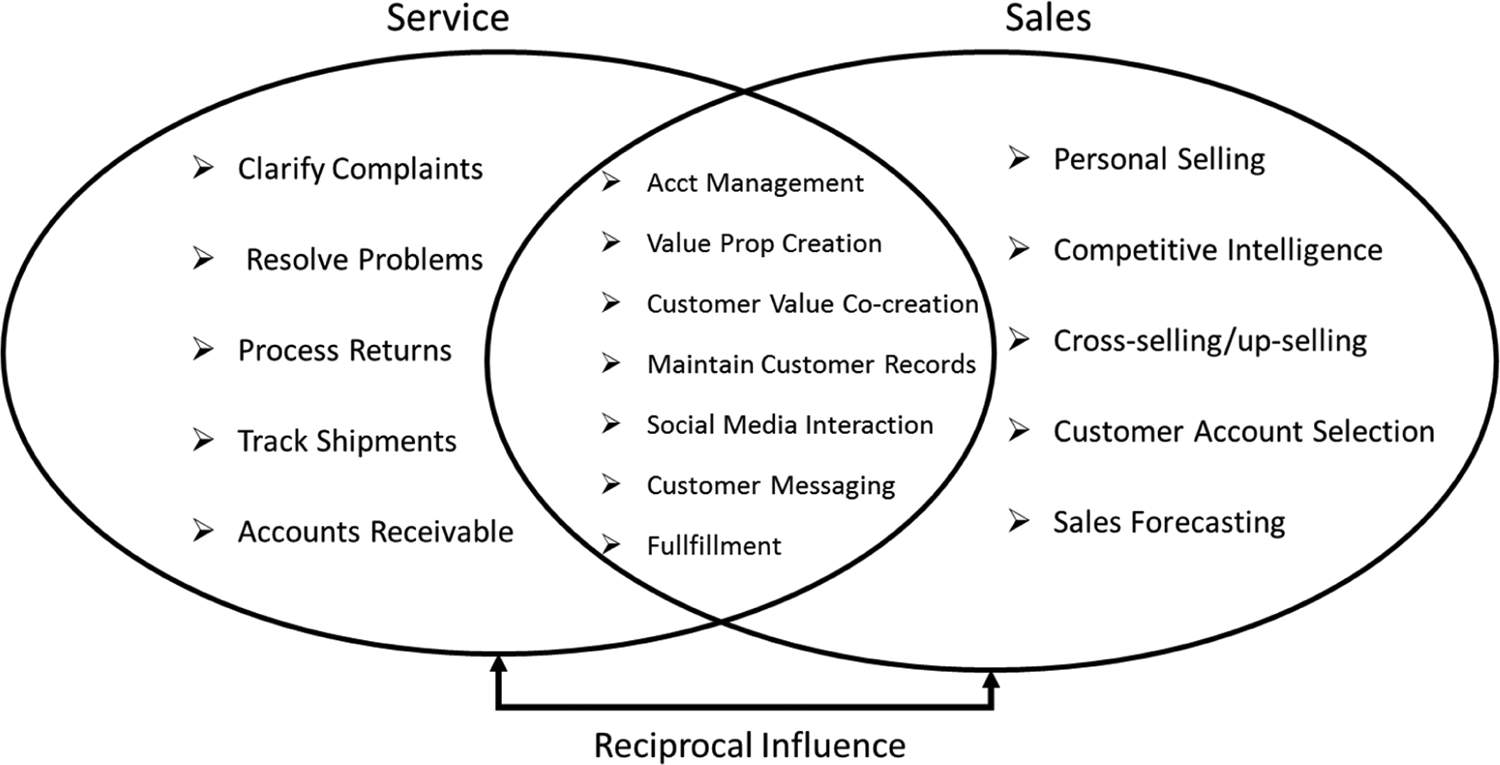
Sales-service interface diagram.
There are natural opportunities for integrated sales and service to provide customers a better total experience although their integration is rarely routine. Firms report inconsistent returns and lower-than-expected revenues (Jasmand, Blazevic, and de Ruyter 2012). Among the challenges related to generating sales-service ambidexterity at the individual level is the creation of an organizational context facilitating role integration. Often, “…firms struggle to create conditions that are conducive to a successful alignment between customer service and sales” (Jasmand, Blazevic, and de Ruyter 2012, p. 20).
The Tie That Binds: Capabilities Perspective
In an effort to increase the probability that frontline employees integrate sales and service activities or have the necessary skills to work across traditional role boundaries, firms have made structural investments to integrate these functions. At the organizational level, coordination at the sales-service interface creates opportunities for organizational adaptability, information sharing, and responsiveness to market demands. The sales-service interface represents a dynamic capability and the “capacity of an organization to purposefully create, extend, and modify its resource base” (Helfat et al. 2007, p. 121). When organizations can leverage resources to generate competitive advantages in task performance (e.g., meeting the demands of customers, creating a better customer experience, enhancing customer satisfaction, etc.), this dynamic capability allows firms to capitalize on superior operations for revenue generation (Helfat and Winter 2011). This dynamic capability manifests when functions operate with mutual understanding, teamwork, involvement, and a shared vision (Dewsnap and Jobber 2000). An integrated sales-service capability enables firms to align sales- and service-related strategic foci and firms’ ability to pursue dual and conflicting goals (Gibson and Birkinshaw 2004).
A key to understanding organization-level capabilities are individual-level constructs, as the goals associated with sales and service often are seen as complementary at the organizational level (Yu, Patterson, and de Ruyter 2013) but elicit individual-level conflicts (Lawrence and Lorsch 1967). In light of these cross-level dynamics, it is essential to examine relationships between individual-level capabilities, collective and organization-level capabilities, and firm-level outcomes associated with these relationships—particularly as they relate to competitive advantage for organizations in dynamic environments. This collective understanding facilitates insight into the microfoundations of dynamic capabilities (Eisenhardt, Furr, and Bingham 2010; Teece 2007), which stress the dependence of dynamic capabilities on the individual’s capabilities and capacities (Teece 2007).
In light of inherent reciprocal influences of contextual factors on individuals and individual capabilities on organizational dynamic capabilities, these levels cannot be considered in isolation. For this reason, we present a framework highlighting the strengths and challenges associated with sales-service ambidexterity nested within the sales-service interface. The alignment (misalignment) between organizational-level interactions and individual-level ambidexterity underlies key issues identified in sales-service research (e.g., Jasmand, Blazevic, and de Ruyter 2012; Yu, Patterson, and De Ruyter 2013). This nested view offers insight into the implications of the interaction of firm-level processes and competing individual-level role demands.
An overview of the strengths and weaknesses related to sales-service interface and individual-level ambidexterity is presented in the 2 × 2 matrix depicted in Figure 2. The two cells with aligned dimensions (high sales-service interface, high ambidexterity; low sales-service interface, low ambidexterity) may be designed to fit the environment. High sales-service interface, high ambidexterity may be the ideal structure for firms with long-term customer relationships and a relatively continuous stream of sales/orders. Low sales-service interface, low ambidexterity may be appropriate for onetime sales with little possibility of future sales/orders (e.g., tunnel boring machines for a single-time project). The two cells that are misaligned (high sales-service interface, low ambidexterity; low sales-service interface, high ambidexterity) create issues with either implementation or role conflict.
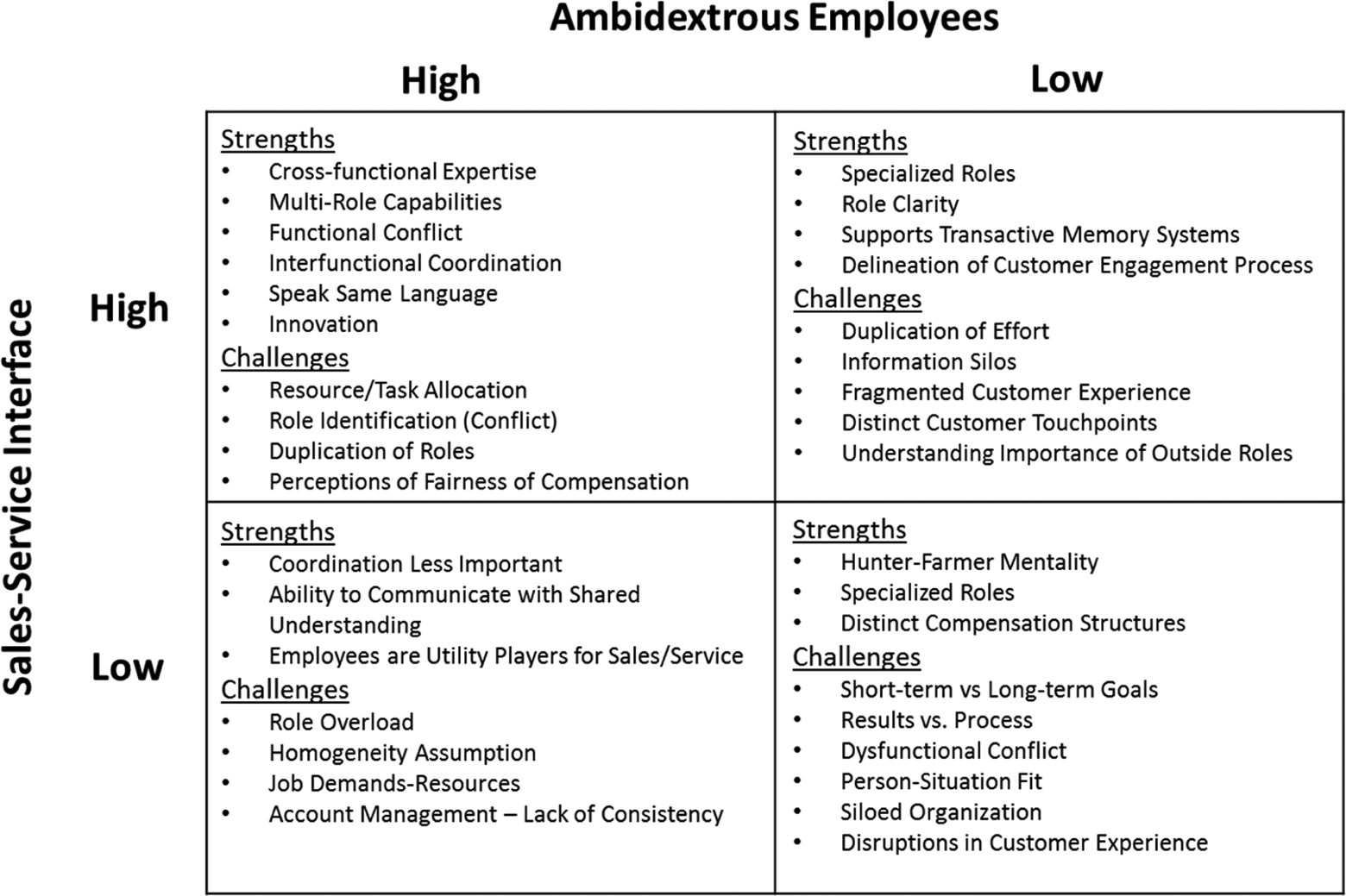
A 2 × 2 matrix of the sales-service interface and employee ambidexterity.
Future research would benefit from a deeper investigation of these inherently present relationships. An examination of employee composition (high vs. low ambidexterity) within an organization and the alignment/misalignment of employees to the sales-service interface would greatly advance research in this area. Understanding of these strengths and challenges would benefit both researchers and practitioners operating in dynamic environments.
The Inherent Multilevel Nature of a Sales-Service Interface
The complexity of studying the sales-service interface across the spectrum of integration depicted in Figure 2 implies that traditional, unitary-level approaches are simply unlikely to effectively capture the dynamics present in coordination efforts, which implies the need for a multilevel perspective to tackle challenges at the sales-service interface. “The multilevel paradigm refers to a way of thinking: considering management phenomena in context and looking for driving variables not only from the focal unit of analysis but also from levels above and below” (Mathieu and Chen 2010, p. 632). In this research, our multidisciplinary approach reflects the explicit realization that the behaviors of most frontline employees are directly (and indirectly) subject to the influence of micro- (customer), meso- (employee/manager/team), and macrolevel (firm/industry) factors. In light of this foundational recognition, we embrace both a cross-level perspective to propose research questions deepening and refining understanding of the amalgamated role played by firm-, employee-, and customer-level drivers of frontline employees’ behaviors/performance.
Multilevel approaches are of particular relevance to research within contexts informed by multiple levels of operations (e.g., organizations), in which participants (e.g., employees, teams, and managers) are nested. Multilevel, or meso, research can capture “…much of the nested complexity of real organizational life….” (Klein and Kozlowski 2000, p. 211). Central to the multilevel frame is the assumption that organizational entities reside and should be studied within their nested context (Hitt et al. 2007) as most organizational management problems encompass multilevel phenomena (Hitt et al. 2007).
The multilevel focus is also essential in light of the impact of behaviors across levels of social organization (Hitt et al. 2007), requiring focused consideration of the context in which critical behaviors emerge. The capacity to address many levels of theory, measurement, and analysis for a holistic understanding of critical organizational relationships (Klein and Kozlowski 2000) enables multilevel research to provide deeper understanding of—and capacity to address—contemporary issues. It is not surprising that researchers have increasingly adopted multilevel research models (e.g., Ahearne et al. 2010; Martin and Hill 2015; Schmitz, Lee, and Lilien 2014; Yu, Patterson, and de Ruyter 2013). It is critical this approach be adopted here, as it is essential to “understand the whole and keep an eye on the parts” (Kozlowski and Klein 2000, p. 53).
Conceptual Framework/Research Priorities
Given the importance of the sales-service interface and ambidexterity, the balance of this article is devoted to discussion of potential antecedents and outcomes. We first provide a conceptual framework for our discussion based on sales-service research discussed above (Figure 3). Recognizing the core role of cross-level relationships, we propose that organizations, managers, teams, individuals, and customers are representative of the various levels ripe for investigation and which might potentially affect employee-level ambidexterity and the sales-service interface. Key points of focus we identify from their relevance in strategic marketing include technology, structure, and strategic orientation. While these are broad antecedents, it is important to emphasize that the specific nature of their impact on ambidexterity may not be invariant. For example, the strategic concept of market orientation may demonstrate a different relationship with the sales-service interface as compared to an entrepreneurial orientation. In turn, these constructs would ultimately influence various outcomes across different dimensions (e.g., psychosocial, behavioral, relational, and performance), and these relationships are affected by transactive memory systems (TMSs). Finally, we present TMSs as an important boundary condition in many of our relationships because of the critical role played by communication between sales and service employees across boundaries and the importance of leveraging previously siloed knowledge and information. Below we discuss five research areas, and for consistency and clarity, each section that follows first offers a short research review, the multilevel features, and/or potential boundary conditions that should be considered and questions for future research (Table 1 briefly highlights these core research questions).
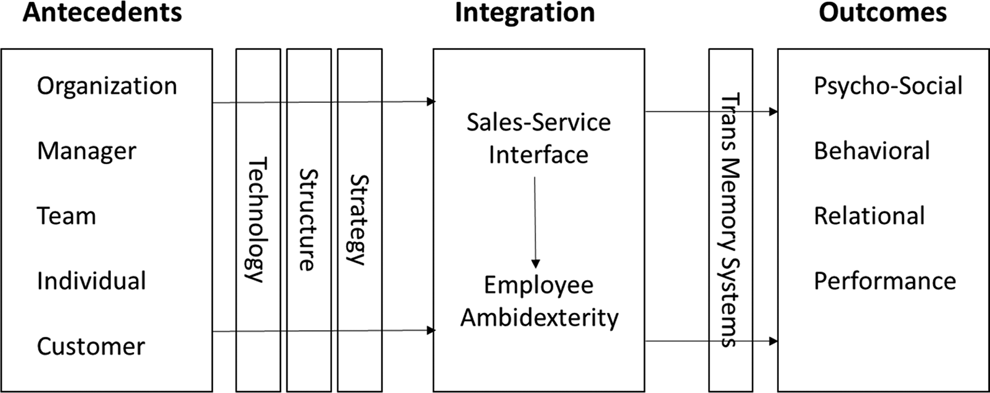
The conceptual framework.
Summary of Important Issues Worthy of Future Research.
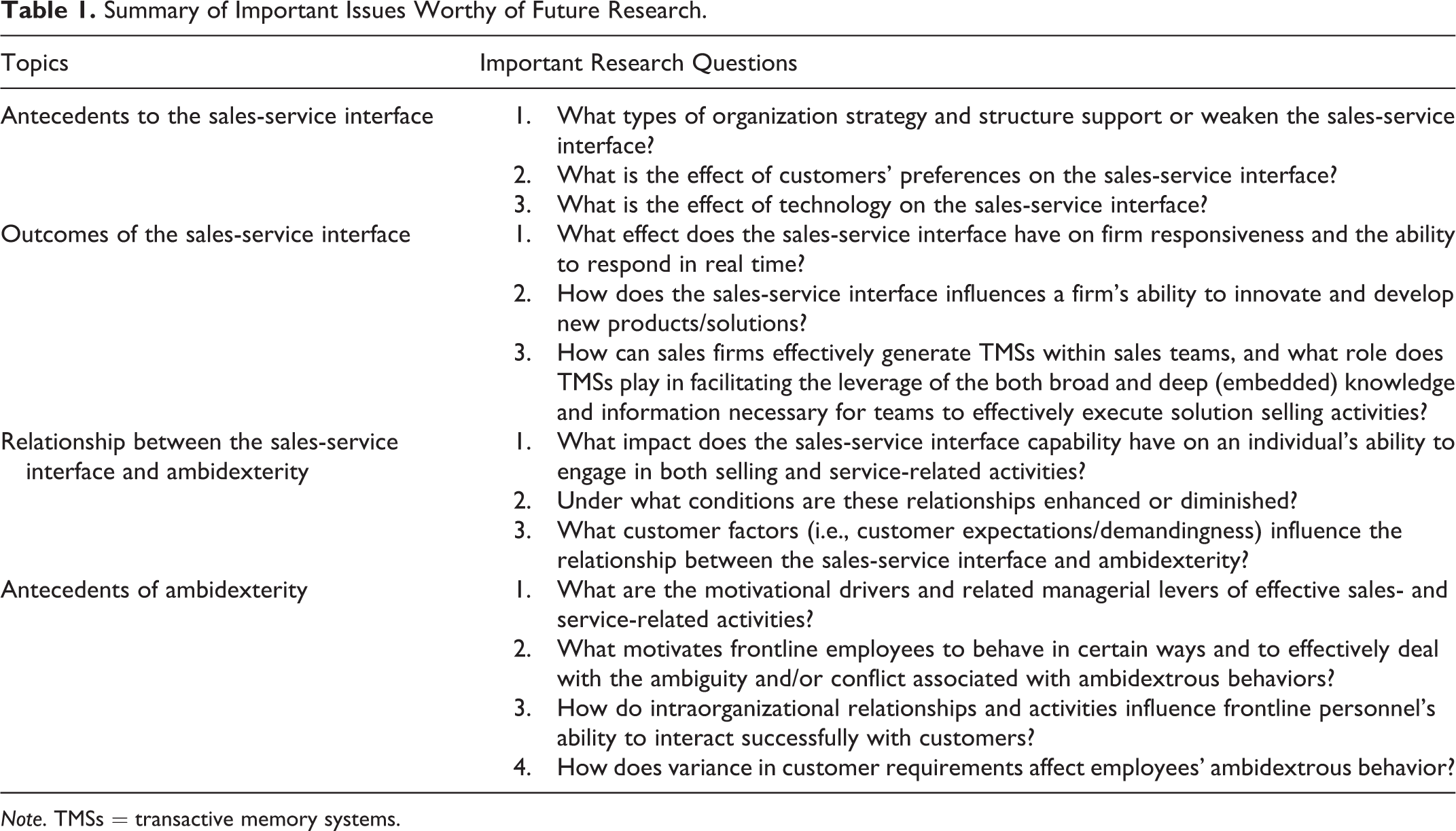
Note. TMSs = transactive memory systems.
Antecedents to Sales-Service Interface
There are two approaches to examining the antecedents of the sales-service interface—the organizational and the customer perspective. Above we discuss research on differentiation and integration in organizations. There is emergent consensus that firms’ assets need to be combined to provide value to customers (Teece 2007). However, the role of organization design is critical. In the context of ambidexterity, Jansen et al. (2009) argued that differentiation must be combined with senior team awards, senior team social integration, cross-functional interfaces, and connectedness in order to achieve effectiveness. Issues associated with integration typically emerge at the individual level where employees operate in different domains (March 1991) and may be more comfortable or effective in one.
However, integration is not easy. First, as with the growth of SSC firms’ needs changed as salespeople became more involved in selling services and firms found that product salespeople were less effective in selling services. As Ulaga and Reinartz (2011, p. 13) noted, “The distinction resonates well with anecdotal evidence in the business press that describes ‘hunters’ (product salespeople) versus ‘farmers’ (service salespeople).” Second, in response to new service offerings, frontline employees providing service increasingly developed relationships with customers. As such, most firms and specifically industrial firms needed to train frontline employees to sell (Ulaga and Reinartz 2011).
A number of customer-driven imperatives underlie the integration of the sales-service function. First, based on the demand for more tailored products and services, more business-to-business supplier organizations began to organize their business around customers rather than product lines (Sheth and Sharma 2008). Selling organizations started organizing around common customer needs (also known as verticals such as financial services, oil, and natural gas) or organizational size (key accounts, large, medium, and small customers). Customers also started demanding a single face of the firm (e.g., Ingram, LaForge, and Leigh 2002) rather than multiple salespeople and multiple service personnel interactions. This led to a Pareto increase in sales-service integration. Sheth and Sharma (2008) offer the example of the consultant model where the lead partner is in charge of sales, fulfillment, and customer profitability. This model, adopted by most consulting firms, has the lead partner marshaling resources to match customer needs and retain responsibility for sales, profitability, and customer satisfaction. The research question is whether this pattern is also relevant for other industries.
Multilevel Nature—Boundary Conditions
Issues at the sales-service interface are similar to those relating to ambidexterity, where firms have to execute complementary but seemingly contradictory functions. The sales-service interface can take place at the structural and/or at the individual level. As Raisch and Birkinshaw (2009) pointed out, tensions of joining two different sets of skills are resolved at the next level. At the structural level, different departments may be combined, teams can be created with employees from different departments or single departments may have separate groups executing different tasks. At the individual level, some employees can engage in both sales and service tasks effectively, but this may be less common. Managing potential contradictions (short term vs. long term) and filling multiple roles may be difficult for employees. It is important to note (Figure 3) that organization-level attributes such as technology, structure, and strategy can be both antecedents as outlined above and potential boundary conditions strengthening or weakening primary relationships.
Research Questions
In addition to these broader antecedents, several specific questions warrant examination. What types of organization strategy and structure support or weaken the sales-service interface? This question has been addressed in the service (e.g., Gebauer et al. 2010) and sales areas (e.g., Leigh and Marshall 2001) but not on their interface. A traditional focus on product/service likely leads to weak sales-service interface because the structure, processes, and outcomes (e.g., product-level profit and loss) are products/service rather than customer focused. When the strategy/structure focus is on customers, and customer outcomes are the focus of measures, the sales-service interface is enhanced. We need better understanding of factors driving success at this interface. What is the effect of customers’ preferences on the sales-service interface? This area also has received research attention in sales (Sheth and Sharma 2008) and key account management (Richards and Jones 2009). Service climate research (e.g., Bowen and Schneider 2014; Dietz, Pugh, and Wiley 2004) also addresses these issues from the service perspective. The interface, however, has not received research attention. What is the effect of technology on the sales-service interface? Research has focused on the effect of technology on service (e.g., Antioco et al., 2008) and sales (e.g., Hunter and Perreault 2007) but not on the sales-service interface. Technology such as databases and analytics potentially allow the sales-service interface to be virtual rather than an integration of departments/functions.
Outcomes of a Sales-Service Interface
As noted above, a great deal of focus has been on understanding processes and outcomes at the intersection of sales with a number of broader organization functions including marketing (Dewsnap and Jobber 2000; Guenzi and Trolio 2006; Rouziès et al., 2005), R&D, and manufacturing (e.g., Gupta, Raj, and Wilemon 1986; Gupta and Wilemon 1988). Despite recognition of critical points of intersection with sales in research focused on relationships, service behavior (Ahearne, Jelinek, and Jones 2007), and performance goals, perhaps as a consequence of engrained cultural momentum (Jasmand, Blazevic, and de Ruyter 2012) and despite mutual cross-domain reinforcement (Yu, Patterson, and de Ruyter 2013), little if any research to date has focused on consequences or outcomes of the integration of sales and service. Integration of these historically distinct customer-facing areas has a range of implications (Day 1994; Rouziès et al. 2005).
Although generations of practitioners and scholars alike have implicitly and explicitly advocated an increasingly outdated siloization of these domains, the functional membrane separating sales and service has become progressively porous (Hartline and Ferrell 1996; Singh 1998, 2000). Despite hazardous segregation, what insight has emerged suggests that an ambidextrous sales-service dynamic capability (Eisenhardt and Martin 2000; Teece, Pisano, and Shuen 1997) positions firms to maximize the productivity of customer relationships (Jasmand, Blazevic, and de Ruyter 2012) and enhance financial outcomes (Rapp et al. 2006). An ambidextrous dynamic capability enables firms to effectively build, integrate, and reconfigure organizational resources and competencies critical to firm performance in today’s hyperdynamic markets (Adner and Helfat 2003). This capability is also likely to have unintended consequences as well (Ostrom et al. 2010), as inherent resource constraints can limit effective simultaneous exploitation along potentially discrete performance vectors (DeCarlo and Lam 2016; Hunter and Perreault 2007; Schmidt and Dolis 2009; Yu, Patterson, and de Ruyter 2013). We recognize that an ambidextrous sales-service dynamic capability has the potential to generate both positive and negative consequences (Figure 3).
Perhaps the most potent consequence of this dynamic capability is the behavioral capacity to respond to customers in real time, which is becoming a de facto requirement for market-oriented firms (Jaworski and Kohli 1993) contending against not only their competitors but increasingly stringent service responsiveness standards (Daugherty, Sabath, and Rogers 1992). As sales and service functions become more effectively integrated, this enhances the potential to meet and to exceed customers’ expectations over shorter and shorter periods of time. Extrapolated outward, this responsiveness also then broadly has the effect of changing baseline industry-level responsiveness expectations. The ultimate limit of these expectations is unknown. This capability also—quasi definitionally—effectively removes cross-functional information silos (Duncan and Moriarty 1998) facilitating real-time cross-functional communication and firms’ ability to respond nimbly and adapt to market shifts. At a broader level, integrated sales-service functionality can also accelerate firms’ innovation and new product development (Atuahene-Gima 2005).
An extension of this integrated capability is enhanced coordination within a more broadly defined sales-service group (Ross Wooldridge and Minsky 2002) that is likely to lead to more creative problem-solving across all levels within organizations (Auh and Menguc 2005). Ultimately, when sales and service systematically operate in conjunction, this is likely to lead to better customer experiences (Verhoef et al. 2009) and associated relational outcomes.
At the same time, this integration is also likely to lead to the emergence of multiple versus singular touch points (Hogan, Almquist, and Glynn 2005) and to an evolving and expanded range of—in some cases functionally overlapping—demands on both sales and service to connect with customers in new ways that coincide with the integration of their previously discrete responsibilities. This expanded—and expanding—set of expectations carries with it the potential psychosocial outcome of role overload (Singh 1998) or feelings of stress and exhaustion, as the boundaries between the sales and service roles become blurred. The blurring of these increasingly outmoded functional boundaries also implies a series of systematic shifts in performance expectations, as new roles become more complex (Johnson, Anderson, and Fornell 1995).
As performance and role expectations change as a consequence of this integration, this shift is also likely to require a fundamental shift in firms’ focus on and attention to employee training (Chonko, Tanner, and Weeks 1993; Erffmeyer, Russ, and Hair 1991). Conventional preintegration training approaches will most certainly fail to account for the heightened levels of complexity and cross-boundary activity required to support firms’ sales-service dynamic capability. Effective integration of sales and service will depend on establishment of an entirely new set of knowledge, skills, abilities, and other characteristics (KSAOs) to navigate the complexity of the functional and boundary spanning roles implied by this integrative sales-service approach (Ployhart, Van Iddekinge, and MacKenzie 2011). The individual-level competencies necessary to navigate in this context will demand firms adopt both a more sophisticated approach in the recruitment of employees with a broader range of knowledge, skills, and abilities as well as new training approaches to support this broadened role.
The organizational costs in terms of both finances and other resources associated with the design, development, and implementation of an entirely new training paradigm that supports this dynamic capability are also unlikely to be trivial (Laird, Holton, and Naquin 2003). This complexity also extends to approaches for employee performance management (Otley 1999). As employees’ roles expand in firms with this dynamic capability, to account for integration of sales and service goals, managing employees’ expectations and maintaining their motivation will require increasingly sophisticated performance management tools.
Multilevel Nature—Boundary Conditions
In light of the heightened emphasis on the effective, systematic integration of both broad and deep knowledge and information from the full roster of members of sales and service teams, it is critical that firms implement a knowledge storage and exchange vehicle that allows team members unfettered access. Without a team-level system in place that facilitates access to knowledge/information of other members—in real time—the sales-service dynamic capability is unlikely to reach its full potential. TMSs may be a mesolevel vehicle firms can leverage to effectively navigate in this new world. A substantial academic literature has developed around the concept of TMSs, which is a collective system for encoding, storing, and retrieving information (Lewis and Herndon 2011). TMS helps teams—a mesolevel factor—efficiently allocate information and responsibilities across team members and functions as a “directory” that members leverage to locate and retrieve knowledge and technical information from domain experts. Within TMS, an implicit division of cognitive labor can develop over time, as members come to assume functional responsibility for learning, remembering, and communicating knowledge and information from different domains to the members of their teams.
It is essential to understand how TMS operates within an integrated sales-service context. TMS is typified by three primary characteristics. The first is differentiated expertise, which reflects the degree that members have specialized knowledge of distinct, complimentary aspects of team tasks (Lewis 2003). For supplier firms to effectively leverage TMS as a driver of effective the sales-service interface, it is critical to understand the ways in which knowledge/information is subdivided across sales team members and what organizational processes contribute to this pattern of distribution. The second characteristic is mutual reliance on member experts for domain-specific knowledge. For supplier firms to effectively leverage TMS, it is important to create a culture of collaboration that provides team members with the confidence to rely on one another. The third characteristic is the extent that differentiated expertise can be coordinated to achieve team goals (Lewis 2003). In cross-functional integrated sales-service teams operating a TMS information search is more efficient, critical information is less likely to be ignored or forgotten, and the volume of knowledge available to the team as a whole is higher, increasing team performance (e.g., Lewis and Herndon 2011). Moving forward, effective coordination of sales-service team members’ differentiated knowledge/information may become a focal responsibility of sales-service managers tasked with guiding/leading supplier firms’ integrated efforts.
Research Questions
In light of the increased capacity emergent as a consequence of an integrated sales-service dynamic capability, it is critical to explore cross-level factors associated with this integration. What are the factors likely to impact firms’ capacity to effectively integrate current employee management systems with those necessary to leverage this capability? Related to the question of vestigial technology and procedural infrastructure is what profile of KSAOs, at the sales-force level, are likely to be necessary to position firms to maintain an effective interface of these two areas? As an additional macrolevel consideration, it is critical to recognize that this kind of paradigm shift does not emerge in a vacuum but is fully embedded in a functioning ecosystem. As a consequence, it is critical to understand that firm-level cultural processes are likely to play a role in the effective development of a sales-service interface?
When/How Sales-Service Interface Leads to Ambidexterity
As noted above, frontline employees face increasingly complex roles, where sales and service functions can be at odds. Effective interfunctional coordination focused on coordinating tasks and aligning goals across disparate functions provides an important mechanism to deal with these complexities. Research has established that sales-service interface capability can lead to firm performance benefits. It nurtures teamwork and a shared vision across organizational functions, enabling firms to align sales and service strategies (Gibson and Birkinshaw 2004). Interfunctional collaboration, in general, enables departments to share resources and work conjunctively toward a common vision (Shrage 1990). This integration depends on open lines of communication, trust, and mutual understanding. Ultimately, the sales-service interface enables units to “converse, learn and work across the silos that have characterized organizational structures” (Liedtka 1996, p. 25).
Effect of Sales-Service Interface on Ambidexterity
A sales-service interface capability in many respects represents the culture of the organization, and more specifically the value placed on collaboration. Research on interfunctional collaboration suggests that differences in backgrounds often form a barrier to effective interfunctional integration (Griffin and Hauler 1996). On the other hand, organizations that demonstrate integration across functions, or an effective cross-functional interface competency, are typically characterized by sufficient knowledge within the organization of the other function, as well as cross-functional training. To the extent that sales-service capability depicts these characteristics, there is an important link between this capability and frontline employee ambidexterity.
Building on value congruence research (e.g., Meglino, Ravlin, and Adkins 1989; O’Reilly, Chatman, and Caldwell, 1991) and ambidexterity (e.g., Birkinshaw and Gibson 2004; O’Reilly and Tushman 2008), we propose that organizational-level competency in the sales-service interface lends itself to enhancing individual-level frontline ambidexterity. Sales-service capability aligns the work values of sales and service personnel. Increased congruence results in greater overlap in cognitive processing, clearer roles, and less friction (Fisher and Gitelson 1983). It also reduces perceptions of in-group/out-group distinctions occurring across functions (Dewsnap and Jobber 2000).
Research investigating individual-level ambidexterity among managers provides some evidence that ambidexterity may emerge from formal structural and coordination mechanisms (Mom, van den Bosch, and Volberda 2009). Ambidextrous individuals can pursue a range of different tasks and goals (Tushman and O’Reilly 1996), balancing conflicts from cross-functional collaboration (Floyd and Lane 2000). Cross-functional interfaces can also positively impact individuals’ ambidexterity, offering opportunities to exchange knowledge and the capacity to balance various types of work (Mom et al. 2009). Cross-functional interfaces enable managers to be ambidextrous. We argue sales-service integration also provides frontline employees the opportunity to demonstrate ambidexterity.
Multilevel Nature—Boundary Conditions
Given the potential benefits of a sales-service capability for employee ambidexterity, it is important to consider how this process emerges and under what conditions sales-service interface leads to ambidexterity? From the motivation–opportunity–availability (MOA) framework, a competency in the sales-service interface is a valuable resource that, if leveraged properly, can enhance important organizational outcomes. However, investigation of employee motivation and behavior does not occur in a social vacuum (Homburg, Klarmann, and Schmitt 2010). Research exploring factors related to how the organization, the environment, the unit, and the customer influence employees’ ambidexterity is necessary. The MOA framework provides a useful approach to identifying conditions for realizing the benefits of ambidexterity.
We argue that sales-service interface at the organizational level creates the opportunity for frontline employees to develop and demonstrate ambidexterity—a key individual-level ability. Importantly, factors such as market turbulence, competitive intensity, customer demands, and reward structures potentially drive the ambidexterity motivation. These motivational factors potentially attenuate/accentuate the effect of the sales-service interface on ambidexterity. It will be important for future research to address these interactions, particularly from a multilevel perspective.
Research Questions
While research has established that coordination between sales and service can lead to enhanced performance and market orientation (Rouziès et al. 2005), it is essential to further unbundle this relationship. We offer that frontline employee ambidexterity operates as a potential mediating mechanism that must be understood before the benefits of functional integration can be realized. Thus, we focus on two critical research gaps. What impact does the sales-service interface capability have on individuals’ ability to engage in both selling and service-related activities? Assuming a link between the interface capability at the organization level and ambidexterity at the individual level, what conditions enhance/attenuate this relationship? What customer factors (i.e., customer expectations/demandingness) influence the relationship between the sales-service interface and ambidexterity?
Antecedents to Ambidexterity
Despite the importance of individual ambidexterity to the effective functioning of the sales-service interface, little research has explicitly examined antecedents to sales-service ambidexterity in frontline employees. Generally, we know that individual performance with respect to any organizational objective is a function of both motivation and capabilities, subject to contextual factors (e.g., Brown et al. 2002; Hughes and Ahearne 2010; Zoltners, Sinha, and Lorimer 2012). In this case of ambidexterity, frontline employees must be motivated to fulfill both sales and service responsibilities and have the capability to do so.
In examining the motivation of sales and service personnel, researchers have considered both individual and managerial influences. Specific to sales-service ambidexterity, Jasmand, Blazevic, and de Ruyter (2012) showed that a customer service representative’s locomotion orientation, that is, her or his desire to be proactive in making things happen and engage in disparate tasks, is positively associated with ambidextrous behavior and that this is amplified when representatives also have a strong tendency toward self-evaluation. Yu, Patterson, and de Ruyter (2013) demonstrated that transformational leadership, empowerment, and team support positively impact sales-service ambidexterity among bank branch customer service personnel. Similarly, Evans, Arnold, and Grant (1999) showed that autonomy, task variety, and feedback increased cross-selling activity in personnel responsible for both customer service and sales. While this evidence is useful, the limited work in this area suggests fertile ground for additional inquiry.
Notwithstanding the paucity of research specific to sales-service ambidexterity, there is ample research that independently examines individual and managerial influences on selling and service behaviors as a starting point from which to investigate other ambidexterity antecedents. For example, it is widely accepted that managerial direction in the form of control systems and incentives, as well as various leadership styles and actions, can motivate salespeople to engage in desirable sales-oriented behaviors (e.g., Ingram, LaForge, and Schwepker 2007; Miao and Evans 2013; Zoltners, Sinha, and Lorimer 2012). There is also abundant research on the effect of organizational culture and climate on customer contact personnel service-oriented behaviors (e.g., Dietz, Pugh, and Wiley 2004; Liao and Chuang 2004; Salanova, Agut, and María Peiró 2005; Susskind, Michele Kacmar, and Borchgrevink 2003). Similarly, salesperson perceptions of other types of organizational climate may also drive sales-oriented behaviors (e.g., Schrock et al. 2014).
In addition, researchers have identified a large number of individual characteristics and dispositions with potential to affect sales or service-oriented behaviors and outcomes. For example, Ulaga and Loveland (2014) identified 13 individual difference variables key to transitioning from a goods-centric to a service-centric sales approach. Similarly, constructs such as customer orientation (Brown et al. 2002), trait competitiveness (Schrock et al. 2014), empathy (Pilling and Eroglu 1994), emotional intelligence (Rojell, Pettijohn, and Stephen Parker 2006), adaptability (Predmore and Bonnice 1994), optimism (Dixon and Schertzer 2005), agreeableness (Liao and Chuang 2004), conscientiousness (Barrick, Mount, and Strauss 1993), coachability (Shannahan, Shannahan, and Bush 2013), and personal initiative (Rank et al. 2007) all have potential performance implications in this context.
Along this same line, researchers have identified numerous individual capabilities from adaptive selling (Hughes, Le Bon, and Rapp 2013) to technology usage (Ahearne, Jelinek, and Jones 2007; Trainor 2012) to political and interpersonal skills (Bolander et al. 2015) with potential to facilitate achievement of sales objectives, while researchers in the service domain have identified multiple competencies core to customer service outcomes such as customer satisfaction (e.g., Liao and Chuang 2004). Moreover, Attia, Honeycutt, and Leach (2005) showed how firm interventions such as training can facilitate critical, frontline skills. Relatedly, self-efficacy is a driver of both effort and performance (Fu et al. 2010), underscoring the importance of perceived competence in customer-facing personnel. Although not yet explicated, there quite likely are particular traits, states, and capabilities conducive to the simultaneous successful provision of both sales and service, that is, ambidexterity.
Multilevel Nature—Boundary Conditions
Sales/service personnel motivation is inherently a multilevel process that ultimately benefits from a multilevel approach. The focus is on units of analysis composed of employee–customer and employee–manager/organization dyads. The likelihood of emergent cross-level moderating influences on both employee and customer attitudes and behavior is strong, and model underspecification is a likely consequence when multilevel framing is absent. Moreover, there are undoubtedly related tensions within and across organizational levels that contribute complexity to the full delineation of relationships core to these customer interfaces. For instance, frontline employees’ motivation to act ambidextrously, their ability to develop related skills, and their attempts to forge relationships and marshal resources within and across organizational disciplines is likely impacted not only by managers’ orientation and behavior but also by team dynamics (i.e., TMSs) and by more macrolevel factors including organizational culture, climate, social/behavior/performance norms, and other interventions. One example of this potential relationship is how TMS can facilitate knowledge transfer across sales and service team members to enable them to provide information more efficiently and effectively. This is best accomplished via a multilevel conceptual and analytical framework.
Research Questions
The above points to critical gaps inhibiting current understanding of ambidexterity antecedents while also suggesting areas of opportunity for more directed investigation of this important topic. For instance, what are the motivational drivers and related managerial levers for effective frontline behaviors? Operating on the boundary connecting company and customer, organizations’ boundary spanning employees often enjoy relative autonomy with regard to how they organize and manage their day-to-day responsibilities. In addition, they continually face situations requiring not only proactive communication with customers but immediate responses to customer issues and concerns. In a very real sense, frontline personnel are decision makers (Fu et al. 2010) positioned to increase/decrease customer satisfaction and sales performance.
As we have postulated, the blurring of roles between sales and service personnel leads to a number of challenges that have macro, meso, and individual-level implications. Critical among these is recognition that organizations depend on frontline personnel to behave in certain (perhaps new) ways and that this requires a corresponding positive intent, that is, a decision, on the part of the actor. Therefore, it is critical that researchers dive more deeply into what motivates frontline employees to behave in certain ways and to effectively deal with the ambiguity and/or conflict potentially accompanying the requirement to meet firm and customer objectives in terms of sales targets and customer service. The underlying motivations of sales, service, or hybrid personnel are likely to be quite different, particularly in consideration of intrinsic and extrinsic satisfiers. Numerous motivational theories potentially serve as a framework to shed light on these dynamics, with multiple conceptual and substantive contingencies worthy of examination.
A related question demanding more research is how intraorganizational relationships and activities influence frontline personnel’s ability to interact successfully with customers and how such relationships can be created and facilitated. In the face of heightened competition and dramatically increased information available to buyers, the role of frontline personnel has shifted from value communicators/value deliverers to value creators. This in turn requires frontline personnel to improve their ability to leverage relationships both within and across their own organization to enhance their stature as value-added consultants. Indeed, salespeople’s intraorganizational effectiveness, in particular, their ability to build and leverage social networks, can significantly impact sales performance (Bolander et al. 2015). There are important intrafirm resources frontline personnel can leverage against customer problems and opportunities. Access to such resources, however, requires that personnel foster relationships to successfully navigate what often can be large and complex organizational bureaucracies. More research is needed to understand how such internal relationships are built and nurtured and also how they influence external relationships with customers.
In summary, the following research questions are in need of investigation. What are the motivational drivers and related managerial levers of effective frontline behaviors? What motivates frontline employees to behave in certain ways and to effectively deal with the ambiguity and/or conflict potentially accompanying the requirement to meet both firm and customer objectives in terms of hitting sales targets and delivering desired levels of service? How do intraorganizational relationships and activities influence frontline personnel’s ability to interact successfully with customers and how can these relationships be created and facilitated? How does variance in customer requirements affect employees’ ambidextrous behavior?
Outcomes of Ambidexterity
The evolving business landscape now evidences increased competitive pressures and intensified customer expectations to unprecedented levels. Because having both an aptitude for selling (Rapp et al. 2006) and providing high levels of service quality (Bowen and Schneider 2014) can lead to revenue generation which provides a competitive advantage, many frontline employees are expected to do both at a high level. Thus, managers increasingly depend on service-sales ambidexterity to provide extraordinary levels of service and sales (Evans, Arnold, and Grant 1999; Jasmand, Blazevic, and de Ruyter 2012).
As evidence suggests that ambidexterity is tied to positive outcomes such as exemplary service and the ability to cross-sell/up-sell (Jasmand, Blazevic, and de Ruyter 2012), which ultimately leads to financial gain (Rapp et al. 2006), we argue that this approach can instigate conflicting or competing employee demands. When employees are required to engage in multiple activities with the same resources (Ostrom et al. 2015), inherent trade-offs emerge between resources dedicated to one set of behaviors versus another. While some employees may have the capability to cultivate customer relationships and increase sales dollars (DeCarlo and Lam 2016; Hunter and Perreault 2007; Yu, Patterson, and de Ruyter 2013), others may not. Thus, there may be an unexplored dark side to ambidexterity. It is quite possible that frontline employees become “…stretched thin by an increasing number of responsibilities competing for their time and attention….” (Schmidt and Dolis 2009, p. 678).
Multilevel Nature—Boundary Conditions
While the above sheds light on the potential dark-side consequences of ambidexterity, there are also inherent challenges due to the long-term versus short-term nature of service versus sales. Junni and colleagues (2013) reported that in a meta-analysis across firm-level ambidexterity, there was no significant relationship with performance. This suggests that future research should focus on a wider range of outcomes and boundary conditions, particularly inherent multilevel influences. We propose that adequate resources at the individual, unit, and organizational levels influence the extent employees effectively respond to the demands of dual sales-service roles. Taking a multilevel perspective, where organizational-level and leader-level factors and their influence on individual-level outcomes are considered, is essential. Likewise, cross-level characteristics of leaders (e.g., empowerment, support, empathy) and organization characteristics (e.g., support, formal structure, customer relationship management programs, rewards, etc.) can also serve as critical resources impacting these relationships.
Research Questions
We are interested in potential negative outcomes of requiring frontline employees to attempt to engage in ambidextrous activities (Stokes et al. 2015). Also, of concern, are both (a) are there boundary conditions—such as level of training or experience that can enhance or detract from ambidexterity and (b) is there an optimal level of ambidexterity—optimal time dedicated to activity sets or abilities apparent across selling and service activities. Before examining these questions in greater detail, we address potential theoretical lenses and general assumptions grounding these questions.
The notion of ambidexterity takes into consideration general assumptions that may not always be present. First, an assumption of homogeneity has emerged, where all ambidextrous employees are assumed to have the same abilities to manage the dual requirements. We offer that this is unlikely. Second, these dual requirements place a heavier load on available resources for both employees and firms. Both firms and individuals are constrained by external and internal resources (i.e., time; Sabnis et al. 2013) and cannot increase resource levels based on the need to both sell and service. Third, sales and service activities emerge across a wide range of circumstances, and divergent routines and activities don’t necessarily offer a foundation for the development of functional synergies. While some points of synergy may exist, there are likely a wide range of activities that are not complementary. Task-switching and dual-goal theories (Schmidt and Dolis 2009) offer that changing tasks or goals may lead to lower levels of performance. Fundamental to both perspectives is the understanding that efficiencies are lost (Jasmand, Blazevic, and de Ruyter 2012) and resource allocation optimization is difficult to achieve when moving between separate tasks. Finally, activities may become self-perpetuating (Gupta, Smith, and Shalley 2006). Self-perpetuating behaviors (Deci and Ryan 2000) offer that if success is achieved on a task (e.g., sales or service), individuals will continue to exert effort on successful tasks while ignoring other tasks.
Although these represent some potentially applicable theoretical perspectives, other potential fruitful avenues for research will leverage the job demands-resources model (Bakker and Demerouti 2007), conservation of resources theory (Hobfoll 2001), and person-situation fit (O’Reilly, Chatman, and Caldwell 1991). Ultimately, the capacity of employees to function ambidextrously depends on two general factors: (1) whether they perceive dual sales and service roles as a stressor, and (2) if so, the kinds and amounts of resources that are available to meet the added demands incurred by the stressor—in this case, the dual-role demands of sales and service. To a great extent, the above account for the unique balance of supportive resources and fit versus imposed demands. For example, employees’ individual “resource stock” (e.g., identification with the organization, customer orientation, adaptive selling, etc.) can buffer against added pressures to both sell and provide service that can increase stress/decrease performance.
Concluding Thoughts—What’s Next
Here, we highlight questions at the sales and service interface across multiple levels by examining extant research and providing directions for future research. The sales and service function are increasingly being integrated, but this integration has received limited research attention. To provide a conceptual roadmap to facilitate deeper examination in future research, we focus on three areas that have become relevant. The first is the sales-service interface, which is critical in intrafunctional areas of research. The second area is ambidexterity, where we focus on the overlap of sales and service roles by individuals. To integrate these concepts, we ground our discussions in the evolving business landscape and address the inherent multilevel aspects of the relationships.
We seek to highlight the importance of deepened understanding of the integration of the sales and service function by examining extant sales strategies and demonstrating a movement toward salespeople as providers of more service to customers and the service function morphing into a heavier focus on the sales role. Building on growing evidence from the literature, we provide a conceptual model to help frame research interactions from the firm level, leadership, organization and team interaction, and team and individual effectiveness. We offer several broad areas for future research focused on the antecedents and outcomes in this space and help facilitate the development of multiplex conceptual models. We also provide guidance in the form of research questions derived from these broad research areas. We hope this effort will help excite continuing interest and provide the conceptual impetus for future research in this space.
Footnotes
Declaration of Conflicting Interests
The author(s) declared no potential conflicts of interest with respect to the research, authorship, and/or publication of this article.
Funding
The author(s) received no financial support for the research, authorship, and/or publication of this article.