






Abstract
To investigate how socially assistive robots shape caring practices and support well-being in dementia care settings, this study focuses on agencement—emergent configurations of humans, nonhuman actors, and discourses. Using practice-based action research, the authors introduced the companion robot Hiro in two Italian nursing homes over an 8-month period, involving 22 cognitively impaired residents, followed by a 1-year follow-up. Drawing on qualitative data from observations, interviews, and field notes, the study advances three key contributions, formalized through five propositions. First, caring constitutes a sociomaterial practice, emerging through relational, embodied engagements in which care recipients actively participate in shaping the care. Second, the operationalization of agencement in human–robot dynamics shows how Hiro mobilizes sensory experiences (touch, sound, and movement) to generate relational entanglements that transform caregiving roles and flows of affect. Third, a proposed framework of affect-based well-being, articulated across three interrelated sensory dimensions—psychological (sensory intimacy), physical (sensory responsiveness), and social (sensory bonding)—extends existing service research by capturing embodied, situated, and relational dimensions of well-being. For managers, the findings provide actionable insights for using companion robots to enhance care practices by supporting affect-based well-being, reinforcing relational ties, and enabling personalized, dignified sensory experiences in resource-constrained settings.

Care is a fundamental human need, linked to survival, development, and well-being. As an interdisciplinary research topic, it also has been investigated extensively and defined variously in medicine (e.g., health), psychology (mental well-being), and philosophy (ethics, compassion) domains. In service research, care instead tends to be framed according to a relational, human-centered approach designed to enhance consumers’ service experiences, satisfaction, and loyalty (Huang and Rust 2023; Kipnis et al. 2022). A related perspective also highlights its value co-creation role, due to its ability to address psychological needs, beyond transactional services (Danaher et al. 2024). Yet gaps in service research continue to hinder such an approach to care, particularly in relation to opportunities created by emerging technologies; we propose those gaps might be overcome by conceptual shifts.
First, extant literature often conflates care with healthcare, overlooking the experiential and relational aspects that inherently shape how care gets delivered and perceived (Berry, Yadav, and Hole 2024). A dominant task-based perspective, focused on discrete actions rather than interaction quality, neglects a user-centered experience that prioritizes feeling cared for—through empathy and attentiveness—to define care (Kipnis et al. 2022). Therefore, we propose a practice-based approach and conceptualize caring as a sociomaterial practice, enacted through interactions among professionals, tools, technologies, and discourse (DeFalco 2020; Gherardi and Rodeschini 2016). In so doing, we can address rising issues and concerns related to how technology (e.g., robotic solutions) can and should mediate care provision (Mele and Russo Spena 2025).
Second, service research describes the introductions of interactive, socially assistive robots in labor-intensive environments, where they perform routine tasks, alleviate caregiver workloads, and provide personalized support, especially for elderly consumers or people with cognitive impairments (Sumioka et al. 2021; Yamato et al. 2023). However, such adoptions face resistance in these highly affective spaces (Kipnis et al. 2022), largely due to fears that robots might replace human caregivers, dehumanize care, or violate the dignity of patients. Yet evidence also demonstrates how effectively companion robots—such as those resembling baby mammals—can help engage and animate dementia care recipients (Ge and Schleimer 2023; Paterson 2023). Across various studies that attempt to predict such uses and adoption, we note a general tendency to frame humans and robots as separate agents or else as an agent and a passive resource to be used (Xiao and Kumar 2021). This view obscures the relational and dynamic nature of their interactions. Therefore, in an effort to acknowledge and integrate the practices of all actors in hybrid care environments, we adopt the concept of agencement (Deleuze and Guattari 1987), which refers to entanglements of human and nonhuman elements, in mutually influential relationships, creating a co-dependent dynamic. Building on the idea that agency occurs in intra-action within structures, agencement emphasizes becoming-with; human actors, technologies, and environments are not separate but instead co-constitute one another through interactions. With this view, we also extend a “practice turn” in service research (Russo Spena, Mele, and Nuutinen 2017; Skålén 2024), which reconceptualizes services as interconnected practices enacted by diverse actors within ecosystems to co-create value (Mele and Russo Spena 2025).
Third, to understand the well-being effects of social robots, extant service research tends to apply a hedonic or utilitarian lens (Huang and Rust 2023; Wirtz et al. 2018), particularly when studying their companionship value for vulnerable populations (Čaić, Odekerken-Schröder, and Mahr 2018). However, Bagozzi, Mahesh, and Nyer (1999) argue for deeper explorations of feeling processes focused on affect, beyond subjective assessments of well-being based on immediate emotional states. In practice theory, affect encompasses bodily sensations, moods, and unconscious forces that shape human interactions; it operates pre-cognitively and guides engagement with the world. Using an affect-oriented lens in accordance with this theoretical perspective (Gherardi and Rodeschini 2016), we seek to investigate the dynamics of caring practices involving companion robots and people with cognitive impairments.
In our efforts to address these gaps, by expanding a practice-based approach to service research (Mele and Russo Spena 2025; Skålén 2024), we assert that care constitutes a sociomaterial practice, manifested in a reciprocal process in which users (i.e., residents of care facilities) are both recipients and agents of care. We test this notion with an action research design, in which we introduced the “baby” robot Hiro into two nursing homes. This social robot reconfigures extant care dynamics by prompting sensory experiences—touch, sound, and movement—that then foster agencement among care recipients, caregivers, and the robot. Caring emerges as a co-constituted process of being-with, shaped by relational entanglements; the interconnected system mobilizes affect to enhance well-being. In turn, we use our practice-based approach to answer two pressing research questions: How do human–robot dynamics emerge in caring practices? How do these dynamics influence the well-being of care recipients?
Our primary contribution results from theorizing about affect-based well-being. This novel concept encapsulates flows of affect within agencement in robotcare practices. We further articulate this construct through a broad range of sensory experiences that we can structure around three dimensions: sensory intimacy (psychological), sensory responsiveness (physical), and sensory bonding (social). We formalize the contributions in five propositions.
Conceptual Background
After detailing key contributions of prior service research to our investigation, as well as some gaps in this field, we take an interdisciplinary perspective to ground our proposal that practice theory can inform both care provision and service research, particularly as it relates to the role of companion robots. The analysis centers around three key conceptual insights that emerge from existing scholarship: caring as a sociomaterial practice, the notion of agencement in robot-mediated care, and the entanglement of affect and technology (Table 1).
Key Conceptual Insights.

Care in Service Research: From Clinical Tasks to Sociomaterial Practices
Service literature often conflates care with healthcare, framing it primarily through medical and task-based interventions. However, emerging interdisciplinary research highlights the need to distinguish care as a broader, relational, and context-dependent phenomenon (Gherardi and Rodeschini 2016; Miele and Gherardi 2025). In this section, we explore two interrelated perspectives: The first clarifies conceptual boundaries between caregiving and healthcare in service research, and the second advances a practice-based approach that illuminates the sociomaterial dimensions of care.
Healthcare and Care in Service Research
Ongoing discussions in service research related to healthcare customers and related value co-creation processes (Danaher et al. 2024) aim to address questions about how to enhance patient engagement, redesign healthcare practices for greater collaboration, and develop supportive policies. Although a prominent stream of service literature often merges the notion of care provision with that of healthcare services (Berry, Yadav, and Hole 2024), clarifying the distinctions between the two is essential. Healthcare pertains specifically to medical interventions and clinical settings (Danaher et al. 2024); care encompasses broader activities, including empathetic and social support (Guillemot et al. 2022; Kipnis et al. 2022). The provision of assistance improves the quality of life of people who require help, whether due to age, disability, or vulnerability (Verleye and Holvoet 2024), by supporting tasks linked to hygiene, feeding, and mobility (Rosenbaum, Seger-Guttmann, and Giraldo 2017).
At the same time, defining care only according to tasks risks reducing it to a checklist of actions—what is done, rather than how it is done. Providers might see acts of care as “duties,” but patients place more value on the way those tasks are performed. Having one’s face washed gently instead of roughly conveys care and shapes consumers’ sense of being cared for (Kipnis et al. 2022). Such considerations are especially relevant for understanding the unique circumstances of consumers who experience vulnerabilities that influence their service experiences (Kabadayi et al. 2020). In turn, we propose that moving beyond a task-based view and embracing a stronger focus on practice theory and caring practices (Verleye and Holvoet 2024) can better define service provision that contributes to well-being beyond medical interventions (Skålén 2024).
Sociomaterial Caring Practices
Practice theory offers a conceptual bridge between individual agency and social structures, in that it positions practices as fundamental units of social life (Bourdieu 1977). Practice scholars investigate how practices are organized, maintained, and transformed, with particular attention to their interrelations and dynamics (Russo Spena, Mele, and Nuutinen 2017). In turn, practices constitute collective accomplishments, for which actors share understandings and engage in coordinated activities (Spaargaren, Weenink, and Lamers 2016). Practices are also deeply embedded in specific contexts and shaped by a constellation of social, cultural, material, and temporal conditions (Braidotti 2013). Illustrative insights in turn conceptualize care as a set of interconnected practices (Boykin 2001; Mol, Moser, and Pols 2010), framed not as series of discrete tasks but rather as a relational and situated process through which actors manage vulnerabilities while fostering resilience and capabilities (DeFalco 2020). This process demands the mobilization of knowledge, collaboration, tools, technologies, and discursive practices (Gherardi and Rodeschini 2016), which comprise three interdependent elements: materials (including objects and technologies), competencies (skills and knowledge), and meanings (symbolic significance) (Barad 2003; Orlikowski 2007). In turn, growing research emphasizes the role of materiality and illustrates how objects, technologies, and spaces become co-constituted through processes of agencement (Gherardi 2016).
Having introduced this practice-based perspective, we also specify two ways in which it diverges from a task-oriented perspective. First, it emphasizes the process inherent to lived experiences and real-time caregiver–recipient interactions, as when a caregiver adjusts the amount of pressure applied while washing a care recipient’s face (Twigg 2000). Therefore, care results not solely from task outcomes (clean face) but also from the experience it fosters. The “how” matters as much as the “what” because care is the ongoing activity of caring, not a static object or trait (Gherardi and Rodeschini 2016). This shift, from noun to verb, underscores the focus on processes over outcomes. Thoughtful caregiving preserves dignity and identity, which is vital for people experiencing vulnerability (Cruise and Lashewicz 2022); it also imposes substantial cognitive, physical, and resource demands (Rodriquez 2011). Second, a practice perspective treats materials as integral rather than incidental, in line with a sociomaterial view (Gherardi 2016; Orlikowski 2007). Especially as smart technologies and robots become embedded in care, this insight is increasingly important (Mele and Russo Spena 2025).
Reframing Human–Robot Entanglements
Service research that addresses how social robots shape service experiences has specified the robots’ roles, users’ perceptions, and their interactional dynamics. Such approaches often rely on linear agency models, such that they separate humans from machines. Care contexts instead might require a shift toward more relational, practice-based perspectives that recognize the entangled, co-constitutive nature of human–robot dynamics. In the following sections, we trace this evolution by reviewing dominant frames applied thus far to understand social robots in service, then proposing agencement as a theoretical perspective on robotcare, as a relational achievement of co-becoming.
Social Robots and Human Dynamics
Service research that explores service providers’ adoption and management of robotic technology to enhance their service quality and customer satisfaction has identified some key considerations for understanding human–robot dynamics (Huang and Rust 2023), such as social cues, language comprehension, and nonverbal communication (van Doorn et al. 2017). It also cites the importance of trust, perceived usefulness, and ease of use for determining users’ acceptance of (Shanks et al. 2024) and engagement (Azer and Alexander 2024) with robots. Related research outlines pertinent roles for robots, as providers, facilitators, or companions, depending on their designed levels of autonomy and intelligence (Wirtz et al. 2018). Some studies predict that robots eventually will replace human actors (Xiao and Kumar 2021); others emphasize the promise of human–robot collaborations (Shanks et al. 2024), especially for social robots that engage with humans in socially meaningful ways (Azer and Alexander 2024; Čaić, Odekerken-Schröder, and Mahr 2018) and effectively enhance their interactions (Odekerken-Schröder et al. 2020). Yet such role-based framings risk reducing human–robot dynamics to simplified agency models, rather than acknowledging the emergent nature of these relations in practice. In care contexts especially, rigid categorizations seem less helpful than exploring the outcomes that may arise from human–robot agencement in robotcare.
Robotcare and Agencement
Sociology studies define care robots as those “designed and/or used for care” (DeFalco 2020, p. 32), which can encompass a wide range of services, from physical assistance to complex forms of support. Furthermore, robotcare spans broad social and cultural contexts, and it could have diverse, negative, or positive impacts on caregivers and recipients. From an ethical standpoint, concerns about the use of robots for care provision appear particularly acute in relation to care recipients with cognitive impairments; robotic caregivers arguably could undermine human dignity, especially when users are at risk of being infantilized (Sætra 2020) or deceived (Sharkey 2014). A person with dementia might engage with a robotic animal and come to perceive it as a living being, which raises ethical issues related to deception. Another argument raises the concern that the use of companion robots could displace meaningful human relationships or jeopardize users’ safety (Sætra 2020). In contrast, other scholars propose that robotcare can support and enhance users’ dignity by expanding their capabilities and fostering autonomy (Parviainen and Pirhonen 2017; Sharkey 2014). In this view, even deception can be ethically defensible if it contributes to emotional well-being and social connectedness (DeFalco and Dolezal 2023; Khaksar et al. 2016).
Notably, such ethical debates often depict robots as autonomous entities, even though they lack agency, decision-making, or moral responsibility (Parviainen and Pirhonen 2017). Rather than applying models of conventional interactions, we therefore propose an alternative perspective, rooted in a practice approach, that emphasizes human–robot entanglement (Mele and Russo Spena 2025) and predicts that caregiving outcomes emerge through co-shaped dynamics, rather than the actions of the robots alone. In line with practice-based studies that adopt a relational onto-epistemology, in which human and nonhuman entities are co-constitutive and continuously reshape one another in dynamic interdependence, we embrace the idea of intra-action (Barad 2003). In this view, agency only emerges through relations (Gherardi 2016). The French term agencement (Deleuze and Guattari 1987) captures such mutual co-constitution (Barad 2014). Rather than treating individual actors, technologies, and environments as separate, agencement emphasizes processes of becoming-with (Gherardi, 2016). Applied in service (Mele and Russo Spena 2025) and business (Ramaswamy and Ozcan 2018) research, agencement describes humans’, technologies’, and contexts’ value co-creation. We believe it also offers a valuable framework for understanding how care recipients engage with companion robots.
Companion Robots and the Affective Foundations of Well-Being
Even as companion robots increasingly function to promote social connection and enhance well-being in real-world settings, research efforts still reflect limited conceptualizations of affective experience and relational engagement. To characterize this research gap, we first examine notions of companionship and intimacy in human–robot encounters, and then introduce affect as an embodied, relational force that can shape care.
Companion Robots and Well-Being
Robots interact with humans by leveraging their cognitive, analytical, and social capabilities (Huang and Rust 2023; Wirtz et al. 2018). When used to establish companionship and intimacy, robots can facilitate social engagement, alleviate loneliness, and enhance people’s quality of life (Khaksar et al. 2016; Odekerken-Schröder et al. 2020). For the purposes of this study, we define companionship as “the combination of attachment, commitment, and intimacy” (Lee et al. 2017, p. 924) between parties, whereas intimacy refers to openness to sharing thoughts and feelings. In human–robot interactions, intimacy is co-constructed. Technological mimicry induces feelings, even if artificial or inauthentic, that foster attachment (Belk 2022). Such intimacy requires verbal (speech, personalized responses) and nonverbal (gestures, facial expressions) signals, which then determine the robot’s social presence and perceived connections (Chiang and Chou 2023).
Despite such possibilities, integrating robotic technologies into caregiving settings faces various challenges, including financial limitations, ethical tensions, institutional resistance, and concerns about diminished human interaction (Wirtz et al. 2018). As robots become more advanced though, they increasingly provoke nuanced emotional responses—such as joy, affection, and surprise—shaped by users’ behavior and the cultural context in which they are embedded (Filieri et al. 2022). Service scholars acknowledge these affective dimensions; they also consistently emphasize the irreplaceability of human touch. Robots’ inability to experience or convey genuine empathy limits their capacity to deliver the relational depth that caregiving seemingly demands and that may be essential for enhancing well-being (Kipnis et al. 2022).
Compounding this limitation, service research tends to conceptualize well-being according to utilitarian or hedonic frameworks, privileging subjective measures like satisfaction or happiness. Such models often overlook the affective, embodied, and relational qualities that characterize caregiving interactions (Čaić, Odekerken-Schröder, and Mahr 2018; Mele et al. 2022). Although some recent studies have begun to recognize the importance of intimacy and emotional closeness in improving well-being (Odekerken-Schröder et al. 2020), a more integrative approach remains lacking. This tension is especially salient in dementia care, where tactile interactions with robots can elicit strong affective responses. Embodied experiences may be central to well-being, yet they remain largely unexplored. The absence of research on how affect shapes outcomes in robotic care represents a significant omission, given that sensory states are fundamental to how recipients experience care.
Affect and Well-Being
Service research often uses emotion and affect interchangeably or inconsistently (Bagozzi, Mahesh, and Nyer 1999). For the purposes of this study, we focus explicitly on affect, which extends beyond emotions and can be conceived of “as an umbrella for a set of more specific mental processes, including emotions, moods, and (possibly) attitudes. Thus, affect might be considered a general category . . . [of] feeling processes rather than a particular psychological process” (Bagozzi, Mahesh, and Nyer 1999, p. 184). That is, affect is a dynamic process, not a fixed attribute, encompassing broad physical states (e.g., arousal, pleasure, and displeasure), and it is always directed toward something (Reckwitz 2012). It relates to bodily sensations and their influence on actions, interactions, and interpretations. These responses are both personal and collective, shaped by the materiality of the social context and expressed through shifting engagement with the surroundings (Gregg and Seigworth 2010).
The concept of affective technotouch in turn refers to how robots communicate or elicit feelings, which then shape experiences of care, vulnerability, and attachment, particularly when they enable tactile engagement (DeFalco and Dolezal 2023; Paterson 2023). Designed to stimulate embodied affect, robotcare allows users to both engage in touch and be touched, evoking multiple sensory and affective reactions (DeFalco 2020). For example, the pet robot Paro mimics real animal behaviors and can foster affectionate bonds, because users perceive a nurturing relationship with the robot (Ge and Schleimer 2023). This connection promotes belonging, comfort, and social attachment (DeFalco and Dolezal 2023; Paterson 2023). Considering the lack of research into the role of companion robots for the care of people with cognitive impairments, we seek to examine the implications of affect for well-being in care settings. By integrating an affect-oriented lens with practice theory, we conceive of a new way to examine the interplay of companion robots and patients with cognitive impairments during caring practices.
Methodology
Approach: Action Research
Various studies of companion robots focus on robopets and gather quantitative evidence; we include other robot types and seek deeper, qualitative insights into the affect–well-being relationship, in an attempt to capture nuances that quantitative methods may miss. In detail, we deploy action research to examine human–robot dynamics in caring practices, such that we attempt to facilitate both action and reflection among the studied organizations (Perry and Gummesson 2004). Researchers’ roles in action research include observing phenomena, identifying challenges, and developing interventions (Reason and Bradbury 2008). The goal is to bridge knowledge and practice, by fostering co-creation with practitioners (Bradbury and Divecha 2020). Action research is particularly valuable for capturing the sociomaterial dynamics of collective interactions (Mele et al. 2022). For the current application of action research, the research group, comprised of four scholars (researchers), two psychologists, two nursing home managers, and 16 caregivers (together, informants), engaged in iterative processes of planning, action, and learning (Reason and Bradbury 2008). We introduced the companion robot Hiro in real-world dementia care settings. Designed with a minimal, abstract form to resemble a genderless human baby (online Table A1), Hiro is well-suited for care involving older people experiencing cognitive decline and social difficulties.
To analyze interactions between Hiro and human patients, and thereby understand the impacts on well-being, we employed a temporal bracket strategy (Langley 1999), applied over 8 months, and then conducted a 1-year follow-up investigation. In detail, we first observed caring practices without Hiro. Then, while introducing Hiro in four weekly sessions (lasting 20–120 minutes), we documented care recipients’ and caregivers’ embodied reactions. Next, we assessed the agencement by which care recipients, Hiro, and caregivers affected and were affected during these robotcare practices. Finally, we compared affect-based well-being outcomes, measured before and after the research undertaking.
Research Context
This study was conducted in two Italian nursing homes for elderly patients, each with a specialized dementia unit. The sites were selected for strategic reasons beyond geographical proximity. Both homes were active collaborators in a government-funded project on aging, providing an ideal setting for exploring robotic applications in an innovative environment. Italy's rapidly aging population, low technological literacy levels among elderly residents, strong cultural preferences for family-based caregiving, and cultural resistance to technology as a replacement for human interaction combine to create significant care system challenges. Thus, it represents a crucial context for studying the potential of robotcare. By 2050, 35.9% of the population will be older than 65 years of age, and many of them will experience cognitive declines (www.age.it). Because our site selection reflected relevance, rather than convenience, criteria, we anticipated unbiased data collection, suggesting the validity and generalizability of these data.
Care Recipients: Selection Criteria
Preliminary interviews were conducted with nursing home managers, caregivers, and psychologists to determine suitable care recipients. The inclusion and exclusion criteria are detailed in online Table A2 in the Web Appendix. The researchers, assisted by two psychologists, reviewed medical records, and conducted interviews and tests (Weiner et al. 2000) to assess potential participants’ vulnerability (e.g., diseases, sensory deficits) and eligibility.
Before the introduction of Hiro, we observed no significant differences between the two selected homes in terms of care recipient types, care delivery, settings, or the care recipients’ independence or social connectivity. Therefore, these factors are unlikely to influence the study outcomes. All eligible participants’ families were fully informed; those who agreed signed consent forms for us to collect and process data and audio–visual material. Families could withdraw consent at any time, but none did. Initially, we selected 28 care recipients (15 from Nursing Home 1, 13 from Nursing Home 2), each of whom underwent at least three test rounds. Anyone who refused to participate in three consecutive rounds was excluded. In total, 6 people were removed (3 due to deteriorated health), leaving 22 participants. In the web appendix, we offer details about the data in online Table A3, the psychological tests administered in online Table A4, and the participants in online Table A5.
Data Collection
We introduced eight identical Hiro robots to the two nursing homes. The data collection spanned three phases: April to July 2022 in Nursing Home 1, January to April 2023 in Nursing Home 2, and a 2024 follow-up (after Hiro’s full integration into daily routines) at Nursing Home 2. With this extended timeframe, we can identify subtle issues. Furthermore, our long-term, on-site presence helped foster trust between the researchers and informants.
Studying vulnerability experiences is invariably challenging, though it might be achieved through observations and interviews (Leino et al. 2021), in line with the idea that more accurate affect and well-being assessments can be attained through outward observation rather than self-reports. The researchers collected multiple data sources, including handwritten notes, videos, pictures, and assessment forms, to ensure data triangulation and saturation. In detail, our observations focused on Hiro’s actual service provision to care recipients and their verbal and nonverbal reactions, including facial expressions (Reason and Bradbury 2008). We also gathered responses from caregivers and documented our conversations with care recipients. After each session, we carefully transcribed our handwritten field notes. Furthermore, we conducted in-depth, face-to-face, and online interviews with caregivers, in each home, who had at least 12 months of experience. These 60 interviews, lasting 32 to 60 minutes, provided insights into key issues. With audio–visual data, such as pictures, video field notes, and assessment forms, we added depth to our own observations (Reason and Bradbury 2008). In particular, the caregivers completed daily forms that detailed care recipients’ actions before, during, and after their engagement with Hiro; we obtained approximately 500 such data sheets. Two psychologists also assessed the care recipients' affective states, before and after their engagement with Hiro, using the I-PANAS-SF (Watson, Clark, and Tellegen 1988). Among the 22 participants, living in two nursing homes, we achieved theoretical saturation, such that no new themes emerged. Finally, in the follow-up phase, we aimed to confirm our initial findings and the stability of the core dynamics, as well as strengthen the reliability of our derived framework of affect-based well-being across timeframes and varying real-world conditions.
Data Analysis
As implied by the previous description, we adopted abductive reasoning for this study, in an iterative process in which we moved constantly between data and theory (Sætre and Van de Ven 2021). This approach is essential in action research, to capture the emergent and relational nature of the focal concepts—in this case, robotcare. With a participatory approach, we sought ongoing validation and pursued clear practical applicability for our findings in real caregiving settings. Thus, the coding process followed a structured, iterative approach. The researchers conducted independent, preliminary coding to identify key patterns, and then, we refined these initial interpretations during consensus meetings, which helps ensure analytical rigor and consistency (Gioia, Corley, and Hamilton 2013). For greater reliability, we also leveraged the triangulation provided by our multiple data sources (Reason and Bradbury 2008).
Next, with a systematic analysis in NVivo, we worked to organize, refine, and categorize the coded data, in support of a more structured framework of core themes. Such software-assisted analyses help ensure that the findings are empirically grounded and traceable. Specifically, we considered a three-level coding scheme (Figure 1). The first level captured care recipients’ observed actions and reactions to Hiro. The second identified broader affective activities and states within the robotcare process. Finally, the third level aggregated affect-based well-being categories (psychological, physical, and social) on the basis of our theoretical insights. Due to the complex, relational nature of human–robot interactions, we needed an extended observation period to understand how care recipients, caregivers, and Hiro co-adapted over time. Accordingly, our longitudinal approach captures initial adaptation and resistance, as well as the emergence and stabilization of new care practices. In this way, we can confirm that observed changes were sustained and repeatable, not just short-term effects. During three validation sessions with caregivers and psychologists, we also confirmed that our interpretations aligned with their lived experiences (Bradbury and Divecha 2020). This combination of diverse data sources, abductive reasoning, and rigorous coding helps provide a solid foundation for deriving theoretical and practical contributions.
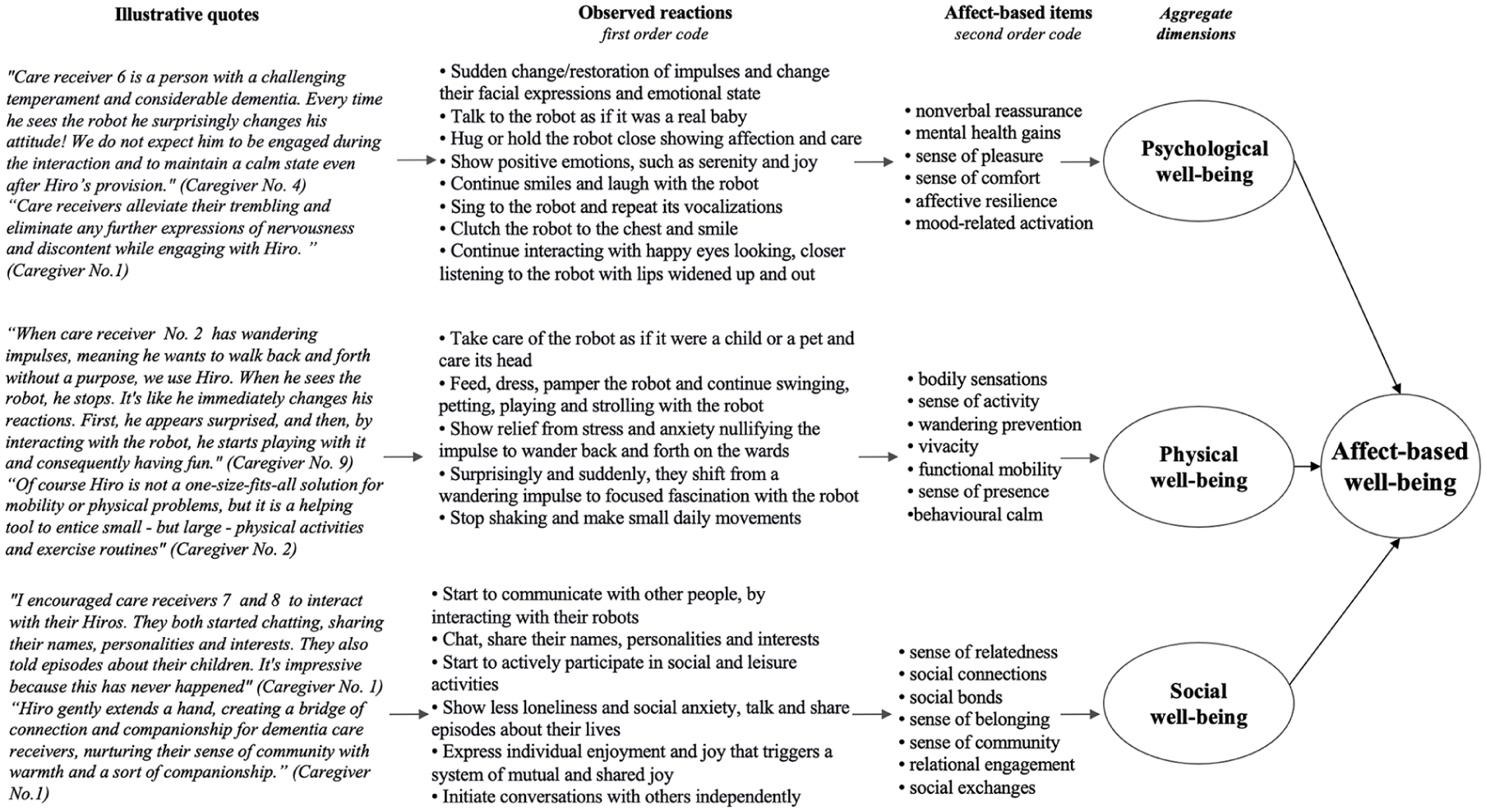
Data structure and illustrative quotes.
Framework of Affect-Based Well-Being
In conceiving of care as a sociomaterial practice, we leverage key conceptual insights linked to agencement and affect, both to present and to discuss our results. To derive an affect-based framework of well-being, we explore how integrating Hiro reshaped caring practices in nursing homes and thus yield a first proposition related to the transformative role of agencement in robotcare. Next, we examine the emergence of well-being, as based on the affect flows within agencement. We categorize well-being into three affect-based dimensions, which we discuss in detail: psychological, physical, and social. Thus, we derive three propositions pertaining to the subcomponents of affect-based well-being. Finally, we discuss the dynamic interplay among these dimensions, which yields a holistic understanding of affect-based well-being in caring practices, summarized in a fifth proposition.
Figure 2 illustrates the proposed framework. In line with our propositions, agencement sits at the core, and affective rings ripple out from it. The middle ring comprises the main agentic actions that manifest as care recipients’ affect, during, but also after, their intra-action with Hiro. The bodily actions and socially embedded intra-actions are observed while in process, so we refer to them using “-ing” verbs (e.g., “singing to Hiro”; “interacting with caregivers”). These elements graphically reflect the second-order coding from Figure 1. They lead to the three dimensions of affect-based well-being in the outer ring, which match our aggregate coding dimensions.
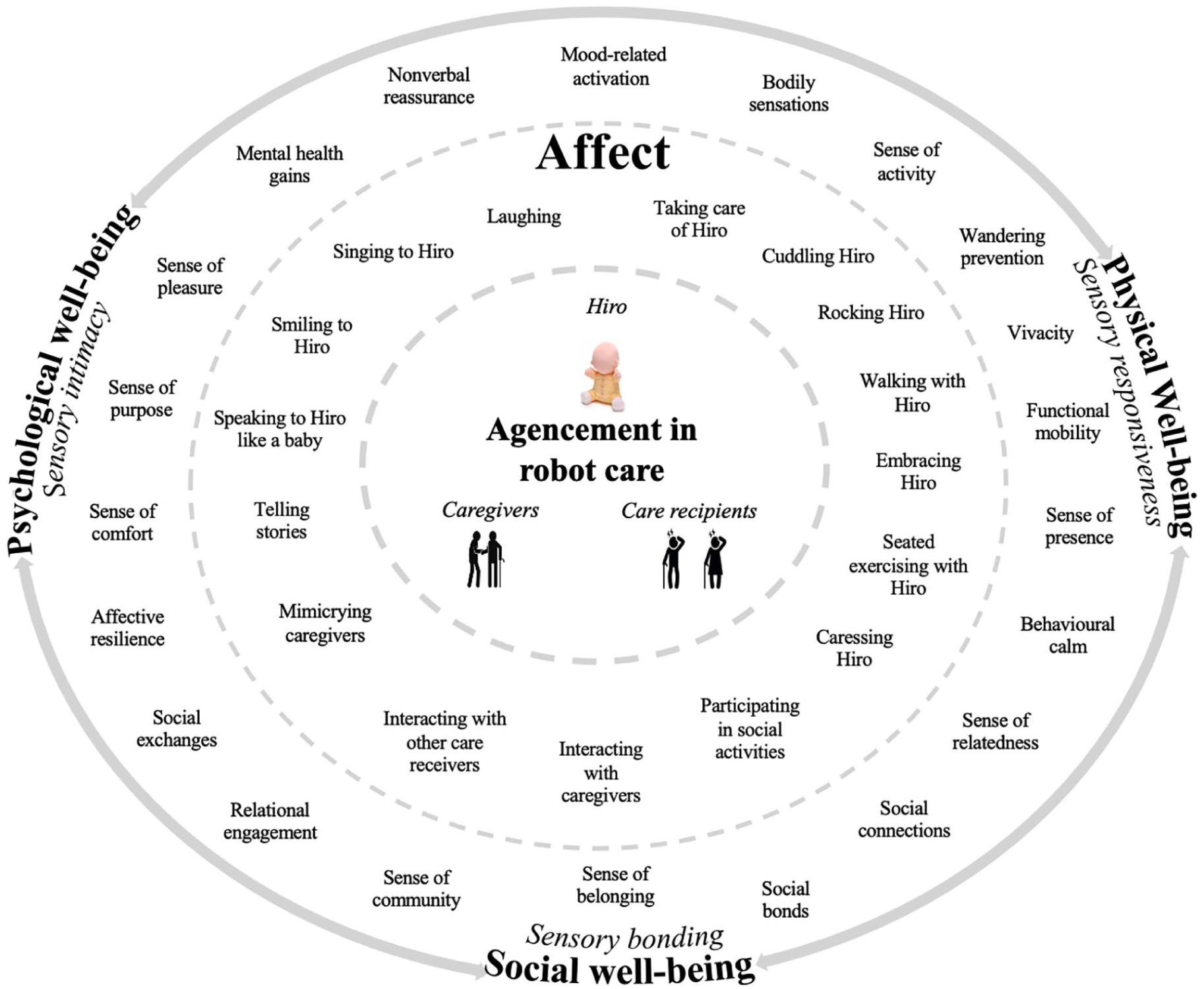
Affect-based well-being framework.
Agencement in Robotcare with Hiro
In the pre-experimental observations, we noted that care focused on routine tasks, with limited opportunities for affective engagement, due to the demands of managing care recipients' basic needs and behavioral symptoms. Hiro’s introduction reshaped these dynamics, fostering deeper connections between caregivers and care recipients, along with new, relationship-centered practices.
Caring Practices before Hiro's Introduction
In both nursing homes, caring practices adhered to structured routines, and caregivers dedicated significant effort to essential tasks such as monitoring hygiene, sleep patterns, and physical activity. Such tasks, combined with the need to manage behavioral symptoms (e.g., agitation, depression, and sense of isolation) among the residents, placed considerable strain on caregiving staff, who underscored the importance of effective communication and empathetic listening to forge sensory connections and trust with the residents. Yet their day-to-day duties, required to address immediate needs and manage episodes of agitation and nervousness, made meaningful relations hard to achieve. Both homes were committed to the principles of recipient-centered care, including facilitating leisure activities, but such principles demand substantial time and effort: In our daily routines, we prioritize ensuring that residents remain calm, and their basic needs are met, including nourishment and cleanliness. Unfortunately, the additional workload, particularly given the residents' conditions, limits our capacity to engage in extended, enjoyable conversations or to entertain residents to the extent we desire. Despite these challenges, we make it a point to find opportunities for relation, such as brief chats while distributing snacks or during walks. (Caregiver No. 3)
Care scenarios also tend to be characterized by monotony while also requiring concerted efforts to mitigate residents’ agitation, depression, and isolation. The cumulative effect of routine care obligations and the struggle to alleviate related symptoms often meant that care recipients did not receive direct, engaging interventions from caregivers and instead spent long periods inactive—sitting quietly, exhibiting desolation, sadness, or nervousness (Online Figure A1), expressions that mirrored their unmet psychological needs and highlighted the imperative for more dynamic engagement strategies. Therapeutic interventions, such as doll or music therapy, had attained varying success, largely dependent on individual residents’ abilities and condition. Yet the passivity of these interventions diminished their appeal, with little impact on participants' sense of engagement or belonging to a community: To keep the residents entertained, we initially utilized dolls; however, the contacts were short-lived, resulting in boredom. Additionally, the residents found the dolls cumbersome and unappealing due to their inert nature. (Nursing Home Manager No. 1)
To address these challenges, some proposed solutions experimented with an integrated approach, involving multidisciplinary teams such as entertainers and volunteers to create personalized care plans. However, recreational activities often followed a weekly schedule, leading to a repetitive and monotonous routine for both residents and caregivers: Unfortunately, we can only offer recreational activities to residents a few times a week due to time and budget constraints. Our music therapy sessions happen just once a week, which isn't enough. (Psychologist No. 1).
Considering the pressing need for enhanced engagement, both nursing homes decided to introduce a companion robot into their care contexts.
New (Caring) Practices with Hiro
The Hiro sessions were the only practice in the care regime of each nursing home that changed as part of the action research. Caregivers experienced their own dynamics with Hiro, but for the purposes of this research, we focus on the human–robot relationship with care recipients. In both homes, caregivers presented Hiro to care recipients with empathetic, peer-like invitations that requested a role-reversal dynamic, such that usual recipients of care would give it. Caregivers introduced Hiro with phrases such as, “This is Hiro, would you help by looking after him?” or “I don’t have enough time to comfort my little one. Could you show some affection to Hiro?” Such invitations sparked a sense of purpose among residents, as evidenced by one’s immediate eagerness: “May I embrace the child?. . . His name is the same as my son's, Robi!” The resulting agencement among Hiro, care recipients, and caregivers unfolded according to the situated actions and touches and stimulated by Hiro’s richly modulated ability to vocalize. Its vocalizations depend on how it is managed by each resident, who can touch, hear, see, cuddle, speak to, carry, walk with, name, and dress Hiro.
The care recipients’ sensory engagement with Hiro (e.g., gentle caress vs. firm embrace) promoted a soothing, affirming embodied connection, in line with the robot’s intended design. That is, Hiro represents a shortening of Haptic Interface Robot, where haptic refers to a sense of touch. The touch-mediated intra-actions it supports are not unidirectional: The resident touches Hiro, and Hiro responds to such touch, such as by laughing. Auditory components complement these tactile elements. The sound of Hiro's movements, responses, and ambient noises became familiar over time, contributing to a soundscape that care recipients associated with companionship and attention. Cuddling and speaking with Hiro brought out their nurturing behaviors. In performing these situated actions, care recipients started to personalize Hiro with names and activities, like dressing it or drawing on its face, such that the humans and technology co-created each other in their entanglements. As one caregiver explained: We avoid suggesting ideas about the robot identity to the residents, leaving them free to imagine and construct the identity they wish to assign to the robot, a doll, a child. In the same way, we help the residents to personalize the robot. We also allow them to continue relating with the robot, monitoring its movements, even when they stand up to rock it. We avoid taking the robot away without a reason. Often, we tell them: “thank you for taking care of it,” “now I'll take it to rest,” or “I'll leave you to have lunch, I'll take care of it, thank you for helping me.” (Caregiver No.2)
Each of these actions reflects a unique form of connection between care recipients and the robot, with caregivers, and with one another, which transformed caring practice regimes in both homes. The caregivers reported finding themselves at the center of a reinvigorated care context, with roles expanded beyond routine tasks, such that they introduced Hiro to care recipients and also engaged with them differently. Hiro's integration into daily activities allowed caregivers more time for deeper engagement and meaningful conversations: The robot has facilitated relations between us and the residents. Our rapport has significantly flourished. By assuming the responsibility of caring for Hiro, care recipients remain more active and attentive, making it simpler for us to attend to and engage with them. (Caregiver No. 2)
The caregivers, care recipients, Hiro, and forms of talking and sensing together gave rise to a complex agencement in which all parties come into being through their relations and mutual influence. This agencement reveals a nuanced choreography of care, in which human actions and sensory experiences intertwine with robotic responses. The entanglement extends beyond functional connections; it invokes a more resonant connection. Caregivers facilitate the encounter in which Hiro and the care recipients discover modalities for relating and communicating through touch, hearing, and sight. Meanwhile, they gain opportunities to establish deeper affective relations with care recipients, through Hiro. Sensory engagements—touching, hearing, cuddling, and speaking—serve as conduits for affect, engendering a caring practice that supports task execution while also creating an affective, shared experience of becoming-with for care recipients and caregivers in a caring atmosphere. Formally, we propose:
Dimensions of Affect-Based Well-Being in Robotcare
Our conceptualization of agencement in robotcare frames caring as a matter of affect. Regardless of their cognitive capabilities, many care recipients’ bodies were central to how they perceived and engaged with their environment. This insight highlights the importance of material–discursive linkages, where affect connotes bodily sensations and discourses, which flow within the relational space connecting human and robot. We conceptualize affect-based well-being as multifaceted and deeply rooted in the embodied experiences of humans and robots. Such well-being transcends mere cognitive evaluations and encompasses precognitive, bodily-felt sensations. The bodily capacity to experience affect is fundamental to how care recipients engage with their context, and it fosters well-being through three dimensions: psychological, physical, and social.
Psychological Dimension
The way care recipients, caregivers, Hiro, and their verbal and nonverbal communication connect within the agencement implies a psychological dimension of affect-based well-being. It fosters sensory intimacy by creating relational dynamics, together with a sense of pleasure and comfort, even when traditional cognitive functions and verbal communication are impaired. Hiro directly influences how care recipients experience and express their affective states and relational presence, underscoring its transformative potential. By engaging with Hiro, care recipients rediscover a range of beneficial embodied sensations, from the simple joy of touch to more complex feelings of intimacy. Take Antoinette’s story: Antoinette has always been a very active woman. She managed a pizzeria with her husband, worked in a senior living facility, and once retired, she took care of her grandchildren. Due to dementia, she is introverted and shy, but her speech is communicative despite her simple and brief sentences. Her procedural memory in her daily life practices is decent; often, just showing her the correct gestures is enough to replicate them correctly. However, she displays significant busyness: she rhythmically repeats certain gestures, such as rubbing her hands and movements that resemble “cleaning” surfaces. Antoinette begins using her gestures to care for Hiro. She caresses it and speaks to it like a baby. Her previously mentioned busyness becomes purposeful and aimed at caring actions towards Hiro. Her facial expressions become more expressive, with smiles emerging more frequently. (Researcher’s diary comments)
Antoinette’s changed gestures suggest a sense of pleasure and comfort from embodied engagement with Hiro, illustrating how sensory experience can enhance mood and happiness. Two other stories reveal how agencement fostered behaviors and thought patterns conducive to psychological well-being, including diminished apathy and enhanced mental health:
(1) Lino was a bricklayer and tiler passionate about dancing in his previous life. In his current context, he interacts with limited words, sometimes only affirmations or negations. He rarely expresses feelings through facial expressions. He does not always willingly accept physical contact and often has a vacant stare with an apathetic expression. In his engagement with the robot, Lino starts relating with it by hugging it and holding it tight. The attachment behavior shown has helped him reduce anxiety and loneliness, improving his mood. Facial expressions and the emergence of smiles have increased in frequency. Hiro has provided beneficial support during difficult times and demonstrates an improvement in Lino's affective balance. (Researcher’s diary comments).
(2) Hiro's ability to mimic laughter and produce amusing sounds at opportune moments represents a significant advancement in therapeutic strategies for individuals like Caterina. She is a care recipient who has always dedicated her life to work, her family, and her commitment to the parish. Due to her severe cognitive impairments, she has an anxious-depressive syndrome, and her speech appears completely unstructured, with constant vocalizing. Through Hiro, she introduces moments of levity into her daily routine, reducing her vocalization. Hiro makes Caterina laugh and enhances her overall mood balance. In addition, her positive connection with Hiro makes her feel more positive about her overall care context (Caregiver No. 4)
In addition, Hiro’s numerous and appropriate, responsive vocalizations richly mimic a baby. Those sounds tap into care recipients’ profound human experiences of caretaking and parenthood. Many treat the robot as if it were a real baby. For people with dementia, it represents a powerful bridge to their past, revitalizing memories and feelings that affirm their identity and enrich their present life. Participating in care for Hiro somewhat restores the care recipients’ social roles as (grand)parents, such that Hiro gives them a sense of purpose that combats feelings of apathy and boosts affective resilience. In this sense, the robot represents a source of comfort and security, reminiscent of the bond between a relative and a child: The positive impact on Antoinette's self-esteem, stemming from her engagement with Hiro, contributes to self-acceptance. By valuing her contributions and reconnecting with a cherished aspect of her identity, Antoinette likely experiences an enhanced sense of self-worth and acceptance. This acceptance is a foundational element of psychological well-being, as it entails recognizing and appreciating oneself, including one's strengths and limitations. Such engagement is crucial for individuals, especially in care settings, as it fosters a sense of identity and belonging. (Psychologist No. 2)
Caring implies identity as a value, suggesting the importance of these observations about Antoinette and identity in general. In dynamic agencement processes, Antoinette reconnects “with a cherished aspect of her identity,” and the inferred improvements in her self-worth and acceptance would foster identity further, while the inferred gains in self-esteem and self-acceptance would promote the value of dignity, which care also aspires to achieve.
In summary, Hiro’s capacity to evoke intimacy and affect reduces distress, provides nonverbal reassurance, and contributes to the psychological well-being of care recipients (Online Figure A2a). For people with dementia, psychological well-being is not merely the absence of mental illness but a more complex and dynamic state of positive embodied engagement and sensory experience. Accordingly, we propose:
Physical Dimension
Regarding the physical dimension of affect-based well-being, agencement in robotcare contributes to improved physical outcomes by activating sensory responsiveness. Hiro provides stimulation and improves care recipients’ daily routines, which are crucial to facilitating embodied actions and reactions. Through bodily engagement and auditory feedback, Hiro enables them to activate various, often dormant senses. Such sensory responsiveness also contributes to care recipients’ affective contentment and cognitive alertness and prevents some physical decline associated with inactivity, as demonstrated in the case of Mario's participation: Mario's apathy and cognitive decline are evident in his significant struggles with personal hygiene tasks. Additionally, when Mario becomes agitated, his impulses become uncontrollable, with gestures that hurt him. Through sessions with Hiro, Mario has shown remarkable moments of clarity and focus. This enhances collaboration in hygiene and motor exercises, previously met with greater resistance. For example, Mario was observed gently guiding Hiro through a series of motions (washing one's face and clapping hands) and mimicrying caregivers. This activity captivated his attention towards finalizing the task and elicited a more collaborative response. (Researcher’s diary)
Engagement directly contributes to care recipients’ sense of presence and vivacity, reinforcing their connection to their bodies and the context around them. Their bodies constitute vital communication channels and connections to the world, so physical activities remain critical for sensory experiencing, in which sense: Generally, Hiro encourages small yet significant daily movements among all care receivers. For instance, several individuals find motivation to stand up and engage in ambulatory activities, such as walking around while singing lullabies to Hiro, treating it with the same care and affection one would show to a real infant. Those who use wheelchairs also participate by gently rocking Hiro, simulating the soothing motion one might use with a child. This engagement offers them a chance to engage in body movements. (Caregiver No. 3)
Caring for Hiro facilitated physical exercise by activating small, daily gestures and by channeling physical movement toward controlled activities. By focusing their energy and attention on caregiving, they engaged in more purposeful and controlled movements, like rocking or cuddling. The relationship enriched the residents’ bodily activity range and reduced the risks associated with behaviors such as wandering and falling: Aimless wandering is a typical behavior among Alzheimer's residents, significantly increasing the risk of falling. The introduction of Hiro has marked a positive change in minimizing the risk of falls. By focusing their movements on Hiro, residents find a more meaningful outlet for their impulses, showcasing Hiro's effectiveness in enhancing safety and providing therapeutic engagement (Caregiver No. 5)
By stimulating physical movement, facilitating sensory experiences, and encouraging purposeful connection, Hiro helped enhance care recipients’ physical well-being. The positive changes observed in their mobility and engagement in physical tasks reflect the significant impacts of such integrated physical experiences. For care recipients with dementia, physical well-being is a multifaceted state that transcends mere physical fitness or the absence of disease, to include bodily activity (Online Figure A2b). We propose:
Social Dimension
Agencement in robotcare enables the social dimension of well-being, particularly for people with dementia, and enhances their ability to connect and engage within social networks. Even acknowledging the challenges posed by dementia (e.g., impaired speech and cognitive clarity), adding Hiro into care settings facilitated positive relational engagement through social connections and a heightened sense of community. Care recipients experienced a sense of bonding and active participation in their social contexts; in particular, noticeable improvements in care recipients’ moods promoted social exchanges: Franco has always been a sociable person. His sociability has gradually diminished due to disorganized speech and cognitive decline. Within the department, his actions are sometimes misunderstood by other residents, and he too does not always correctly interpret the attitudes of others, tending to respond in an occasionally aggressive manner. We have included Franco in the Hiro project to try to promote better sociability and relationships with the rest of the group. When Franco feels happier and more content, he is more likely to engage in social activities, communicate effectively, and build stronger relationships with those around him. These improved relations contribute to a reinforcing cycle, where enhanced socialization leads to better moods, which in turn promote further social engagement. (Researchers’ diary)
Hiro actively engages care recipients in a unique dialogue that often serves as a catalyst for broader attachments. It is not uncommon to observe a resident seeking out the companionship of other care recipients, in spontaneous forms of relational engagement that encourage a shared social space for laughter and contacts. The robot nurtured a sense of relatedness among project participants, when then also emerged through nonverbal engagements. The affective resonance promoted through Hiro’s intervention strengthened relational bonds among residents: Pierina entered the nursing home last January due to moderate cognitive impairment and depressive syndrome. She has a daughter who currently assists her from home and previously worked as a shopkeeper. She possesses a peaceful soul and, to an outside observer, appears vulnerable and defenceless, almost as if she were frightened by her surroundings and intimidated by the people around her. She appears shy and very attentive to personal care. From the first administrations of Hiro, Pierina showed a surprisingly positive reaction, appearing playful, amused, and at times even moved. The presence of Hiro, whom the care recipients named “Dani” (like her daughter) encouraged her to interact with the staff and even to play with other residents: on more than one occasion, Pierina and Annamaria were effectively playmates; the two elderly women shared some sessions and played together using two Hiro robots. Hiro stands as a social orchestrator, creating a context where socialization is not just encouraged but starts to naturally flourish. (Psychologist No. 1)
Due to its regular presence in the care context, the robot also offered a unique form of continuity for care recipients, that is, a steady reference point around which their daily activities can revolve. Human therapists may change, but Hiro remained a sort of anchor during daily routines, contributing to building a more trusting and comforting relationship between care recipients and caregivers: Rosa entered Nursing Home 1 in August 2016 due to mild cognitive impairment. Formerly a seamstress and a mother of three, she exudes a sweet and caring demeanour, being sociable, calm, and kind-hearted, though occasionally intimidated by more aggressive care receivers. Whenever Rosa interacts with Hiro, she actively seeks out contact with the caregivers, eager to share anecdotes about her children, reminisce about past experiences, and even provide updates on their current lives. This desire for connection and storytelling, shared with both caregivers—whom she knows or has just met - and fellow care receivers, becomes a repetitive action that proves challenging for dementia residents to establish. For instance, Rosa's relations with caregivers often include repeated mentions of her fond memories, such as her trips to the beach at Bathhouse 33 during her youth. Her enthusiasm for these recollections not only sparks conversations but also fosters social connections among those present. (Researchers’ diary)
Thus, agencement in robotcare opens alternative avenues for social well-being. Care recipients engage in a form of socialization that does not rely solely on verbal communication but that instead features sensory bonding, which is equally powerful for maintaining a sense of relatedness and belonging (Online Figure A2c). Accordingly, we propose:
Dynamic Interplay of Affect-Based Well-Being Dimensions
The three dimensions of well-being do not stand alone but influence one another throughout the new caring practices. They also can create a virtuous cycle, manifest as a positive (self-reinforcing, not self-dampening) feedback loop of improvements. Agencement in robotcare serves as a catalyst.
Specifically, engagement with Hiro through tactile connections or guided activities stimulates sensory intimacy that bolsters a sense of pleasure and comfort (psychological well-being). The resulting affective regulation and cognitive stimulation also encourage care recipients’ sensory responsiveness, reducing their inactivity (physical well-being). Such sensory engagements alleviate feelings of depression and diminish residents' aggressive behaviors, underscoring a mind–body link, or symbiosis between psychological and physical dimensions. The sense of belonging fostered by Hiro also enhances sensory bonding and the social well-being of care recipients. We refer to social bonds as part of the social dimension in Proposition 4, but Antoinette’s psychologist also mentioned the relationship with her sense of identity, an aspect we might associate with the psychological dimension. Considering that care recipients with improved affective states appear more likely to participate in social activities and communicate more effectively, we note symbiosis between psychological and social dimensions, in a reciprocal relationship that showcases a clear pattern: Enhanced social connections and a reinforced sense of belonging contribute to psychological health, creating a virtuous cycle of well-being improvements. This virtuous cycle is further fuelled by the symbiotic relationship of the social and physical dimensions of well-being. Enhanced mobility achieved through Hiro enables residents to participate more actively in social relations and community activities, such as group exercises or chatting with other residents, especially in ways that reflect their experiences of (grand)parenthood. The stronger social bonds created among participants motivate them to increase their activity levels, highlighting the importance of the physical state for maintaining and enhancing social connections.
With Hiro, care receivers have undergone a profound change in their affective and psychological state, leading them to have a more serene attitude and decreased levels of agitation. This calmness fosters a favourable atmosphere, creating social relationships among us. As a result, the overall health status of the care receivers is improved and, for example, they accept physical activity with more ease and less drama. (Caregiver No. 10)
We use this dynamic interplay among psychological, physical, and social dimensions to conceptualize both the whole and the parts and thus to conceive of well-being as a holistic concept that cannot be simply or reductively compartmentalized but that does include discernible, workable parts. Each dimension influences and is influenced by the others. In our study, affect acts within an agencement to foster this interplay through intimacy, responsiveness, and bonding (as depicted in Online Figure A2a–2c). Formally, we propose:
That is, affect-based well-being, emerging within and expanding through agencement in robotcare, constitutes a dynamic cycle in which sensory experiences (sensory intimacy, sensory responsiveness, and sensory bonding) enhance psychological comfort, which stimulates physical activity. Increased mobility fosters social participation, and stronger social bonds reinforce affective balance, creating a self-sustaining loop of well-being improvements. This agencement rekindles identity, enhances self-worth, and promotes dignity, illustrating the transformative potential of embodied interactions in dementia care.
Theoretical Contributions
This study contributes to service literature pertaining to companion robots’ implementation in practice and their impacts on actors’ well-being (Čaić, Odekerken-Schröder, and Mahr 2018; Kipnis et al. 2022; Odekerken-Schröder et al. 2020) by laying foundations for new, interdisciplinary discourses, forged from practice-based theory. We outline some valuable insights and reflections across three key areas: care provision, human–robot dynamics, and well-being.
Caring Practices
We (re)conceptualize care as a sociomaterial practice that unfolds as a reciprocal process, in which residents are not only recipients but also agents of care. The social robot Hiro reconfigures care dynamics by evoking sensory experiences—touch, sound, and movement—that foster agencement among care recipients, caregivers, and the robot. Caring thus emerges through the entangled interplay of human actors, nonhuman entities, and discourses (Gherardi and Rodeschini 2016), enabling it to address the necessities of life while integrating relational, affective, and embodied dimensions of sensory experience. This configuration nurtures the flow of affect and redefines caring as a co-constituted practice.
Emerging research into caring for people who experience vulnerability has called for efforts to widen the traditional focus on customer care (Huang and Rust 2023). Advancing prior work (Kipnis et al. 2022; Verleye and Holvoet 2024), we argue for the recognition of caring practices as an essential research domain, alongside but separate from healthcare practices (Danaher et al. 2024).
With the aid of insights from sociology, we define caring practices to denote the broad range of actions and processes involved in providing sensory experiences to people. An emphasis on relationship-based, person-centered, processual activities prioritizes the affective aspects of care and captures overlooked, lived experiences. Caring practices often are embedded in contexts that are designed primarily to provide comfort and well-being. If we connect this notion of caring as a practice with Skålén’s (2024) argument that services are practices, we further contend that service research must acknowledge the deeply relational and processual nature of care and attend to how actions, discourses, resources, and interactions fundamentally shape service experiences (Mele and Russo Spena 2025). In addition, we assert that integrating materiality is vital, particularly as smart technologies such as companion robots extend the provision and experience of care—a layer of the contemporary service landscape that service research mostly ignores.
Agencement in Robotcare
By applying the concept of agencement to explore robotcare, we address the first part of our research question: How do human–robot dynamics emerge in caring practices? As we show, relations among caregivers, care recipients, and robots can best be understood through an agencement lens (Gherardi 2016), because they acquire agency in intra-actions. This theoretical contribution enriches discussions that focus on robots as either separate agents or passive resources (van Doorn et al. 2017; Xiao and Kumar 2021). Our findings reveal material and embodied aspects of care, particularly in the form of sensory engagement (touch and hearing). We propose that agencement in robotcare shapes caring into a shared, affective practice (Proposition 1), and this dynamic even transforms the care recipient, animating a cognitively weakened patient who may have lost much of their adult identity into an active caregiver. Reciprocally, the care recipient “animates”—in the sense of “personifies”—the robot, treating it as a needy infant. This reversed caregiving role creates new forms of agency and relationality. In turn, we frame robotcare as a multifaceted sociological phenomenon (Odekerken-Schröder et al. 2020) that entails more than just integrating robotic technologies into caregiving roles. It necessitates a critical re-examination of how technologies influence human relationships, societal norms, and the dignity, identity, and autonomy of caregivers and care recipients. By situating robotcare within broader social frameworks, our research offers new perspectives on how care can be conceptualized and enacted in technologically mediated settings.
Furthermore, this study advances existing service literature on both caregiving and human–robot relations (Čaić, Odekerken-Schröder, and Mahr 2018; Kipnis et al. 2022) by detailing the precise ways that companion robots performs in care practices. Agencement in robotcare refers to the emergent, dynamic co-constitution of human and robotic entities, in which both continuously shape and are shaped by their entanglement, becoming-with each other in the creation of new forms of care.
Affect-Based Well-Being
Finally, we propose an expanded conceptualization of well-being that encompasses a broad range of affective and sensory experiences, which are both embodied and socially embedded. We introduce the concept of affect-based well-being (Table 2), composed of three interrelated psychological, physical, and social dimensions, and thereby emphasize the importance of sensory intimacy (pleasure and comfort), sensory responsiveness (presence and activity), and sensory bonding (belonging and social bonds). This framework also addresses the second part of our research question: How do human–robot dynamics in caring practices influence the well-being of care recipients? We argue that well-being is enacted and sustained through caring practices, where affect, flowing through and rippling out from agencement in robotcare, has a central role. We regard affect as foundational to human experience and essential for comprehensive care, particularly in contexts involving companion robots. Such an affect-based lens both widens the field of view and establishes more granular depictions of human and robot dynamics, thereby capturing diverse impacts on care recipients’ well-being. Our framework represents a more holistic, context-sensitive approach to understanding well-being in robotcare.
Glossary of Affect-Based Well-Being Terms.

Our theoretical contributions are articulated in four propositions (P2–P5). Rather than limiting well-being to subjective states or cognitive evaluations of life satisfaction, our framework also accounts for embodied and social dimensions (Anderson and Ostrom 2015; Kabadayi et al. 2020). We phrase the propositions purposefully to portray embodiment in such terms, including “sensory intimacy” for the psychological dimension in P2, “sensory responsiveness” for the physical dimension in P3, and “sensory bonding” for the social dimension in P4. Affect allows for the sensory back-and-forth that we observed in practice with Hiro. Sociology literature has indicated the general power of technotouch (DeFalco and Dolezal 2023); we introduce this notion to service research to foster debate.
In our study context, we find that psychological well-being can be enhanced by restoring care recipients' self-esteem and confidence, as attained when the companion robot helps them feel safe and supported. Physical well-being emerges through bodily engagement with Hiro that stimulates their activity, allowing care recipients to experience a sense of vivacity. Social well-being involves the cultivation of social bonds and a sense of belonging, through engagement with caregivers and Hiro. Agencement facilitates active social involvement. This result adds to and extends the few studies on the role of robots in mitigating consumers' social isolation or loneliness (Odekerken-Schröder et al. 2020).
Ultimately, affect-based well-being (P5) emerges from the dynamic interplay created by interconnected psychological, physical, and social dimensions. Each dimension reinforces the others, contributing to a more cohesive and integrated model of well-being in caring practices. This multidimensional approach provides valuable insights into how companion robots can holistically address complex human needs. It advances both theoretical and practical discussions on well-being in service research. Rather than dehumanizing people who experience vulnerability, robotcare promises to deepen the human experiences of a growing cohort of older consumers.
Practical and Policy Implications
The findings of this action research offer important, immediate implications for hybrid caregiving, especially in nursing homes, which apply to practitioners, developers of companion robots, and policymakers. Their relevance is underscored by the success of our real-world trials of Hiro, which informed the framework that we propose for understanding its mechanisms and impacts on human well-being. In particular, we show that integrating companion robots represents an innovative means to enhance affective connections between caregivers and care recipients, especially those with cognitive impairments. Beyond simple functionality, we illustrate how affect flows dynamically within agencement and thus the crucial role of robots for enhancing well-being.
If nursing or care homes incorporate robots into daily routines, they can create a more comprehensive caregiving environment, in which affective care and relational care complement physical care. The introduction of robots during activities that encourage social engagement allows caregivers to interact better with residents. For example, robots may facilitate sensory shared experiences. In one-on-one sessions with residents, the robots can evoke affective engagement by sparking conversations or providing calming sounds and movements—personalized forms of care that caregivers know is needed but lack time to provide. Furthermore, integrating robots into care plans to offer affective support can allow caregivers to attend to physical tasks. In addition, robots could be used to organize group activities, such as storytelling sessions or games, that bring residents together, promote social bonds, and strengthen their sense of belonging.
To achieve these benefits, nursing home staff need to receive training on how to integrate robots into caring practices most effectively. Nursing home managers also should establish a collaborative, caregiving environment of sociomaterial practices, which can help reduce caregiver burnout and allocate scarce human resources. Because the economic impact of robotcare requires an appropriate balance of the high initial costs with long-term efficiency, managers also should undertake financial feasibility assessments, to account for maintenance, training, and adoption barriers and to identify potential solutions, such as public funding, subsidies, or shared-use models.
For tech developers, our findings highlight the need to design robots capable of deep sensory engagement, not just task-based functionalities. To enable touch, auditory engagement, and affective support, they should include tactile sensors, speech recognition features, and affective expressions, which can improve robots’ capacity to foster sensory connections. User testing can refine such capabilities and ensure that robots can sense and respond to changes in mood, which further personalizes the care experience. Similarly, developers should explore the possibilities of long-term affective bonding, such that robots might evolve with care recipients over time, using affective computing technologies to recognize and respond to cues for tailored and sustained support.
For policymakers, this research suggests solutions to resource crises in long-term elderly care but also raises some ethical and regulatory considerations. Policies should be in place to ensure that robots support rather than replace human caregivers, emphasizing their use as complementary resources to enhance psychological, physical, and social well-being. Perhaps policymakers could promote hybrid care models that safeguard jobs while maximizing affective benefits. Ethical guidelines also must guarantee standards of safety, privacy, and dignity. Government funding and subsidies could be designed to support the judicious adoption of robotcare by establishing certification processes for companion robots that include criteria linked to affect-based well-being, whose multidimensional indicators we elaborate herein. Finally, national training programs should upskill caregivers, enabling them to integrate robots into their practices expressly to foster holistic well-being.
Limitations and Further Research
Several limitations of this study suggest avenues for research on agencement in robotcare and affect-based well-being. Our findings might not generalize beyond the nursing homes in Italy that we analyzed, though we predict that these insights are relevant for care provision in countries facing similar challenges, such as aging populations with low technological familiarity. Yet diverse participant groups and contexts could shape agencement and well-being differently. For example, which contextual and organizational factors enable or constrain agencement in robotcare? Do the cultural perceptions of caregivers or care recipients influence affect-based well-being? Do different vulnerabilities shape human–robot dynamics in care settings? Similarly, establishing the empirical validity of our framework would require cross-cultural comparisons, to determine if and how sociocultural attitudes affect human–robot interactions and whether various robot designs exert different effects on well-being. Controlled experiments also might contrast robot-assisted with traditional care, to clarify long-term integration challenges and test the applicability of our framework across contexts. We anticipate that different cultural norms and values might shape users’ acceptance of and resistance to robotcare; socioeconomic factors also likely determine their access to and perceptions of robotic caregivers.
We encourage research that specifies the depth of agencement and affect-based well-being that can be achieved by different companion robots. For example, generative-AI-equipped robots that personalize engagement on the basis of users’ immediate feedback might offer additional, varied benefits across the social, physical, and psychological dimensions of care. The robot’s physical form (e.g., humanoid, animal-like, abstract) also likely influences its ability to meet users’ embodiment needs. Comparative studies could identify the attributes and interaction styles that best support well-being and thereby specify which companion robot designs are most effective for specific care tasks. A related question pertains to how functionality and form align with different groups' affective needs.
Further research might benefit from engaging with literature pertaining to the psychosocial effects of robots in healthcare and empathy in human–robot interactions. We foreground the affective and relational dimensions of caring as a sociomaterial practice; further inquiry could strengthen this theoretical grounding by drawing on studies of how robots influence users’ emotional states, social engagement, or perceptions of being cared for. Considerations of empathy also might clarify how different forms of robot expressiveness shape affective bonds and support psychological well-being. For example, how might perceived empathy in robotic systems influence affective bonds in caregiving relationships? The psychosocial outcomes also might vary across populations and care settings.
All these inquiries also imply ethical and social considerations, such as the potential for dependency, privacy concerns, and diminished human contact. Any use of robots must prioritize dignity and respect. Further studies could explore best practices for blending robotic and traditional care to enhance rather than replace human interaction; define ways to integrate robots into care protocols without disrupting existing practices; determine how caregivers' experiences and concerns shape robot implementation; or develop effective training and support systems to equip caregivers to work with robotic technologies.
Finally, the long-term effects of human–robot agencement on affect-based well-being require further study. A multiphase, longitudinal approach, incorporating repeated observations, interviews, and behavioral tracking, would provide deeper insights into sustained engagement patterns. A mixed-methods framework combining ethnographic insights with standardized well-being measures also could offer a more comprehensive evaluation. Our study captures a temporally limited snapshot, so we call for additional research into the long-term effects of continuous engagement with companion robots on elderly consumers’ physical health, cognitive functioning, and social lives. More broadly, we need studies to determine the effects of a growing reliance on robots for affective support on well-being. New ethical frameworks likely are needed to mitigate potential dependencies and related risks.
Supplemental Material
sj-docx-1-jsr-10.1177_10946705251372448 – Supplemental material for Affect-Based Well-Being in Caring Practices with Companion Robots
Supplemental material, sj-docx-1-jsr-10.1177_10946705251372448 for Affect-Based Well-Being in Caring Practices with Companion Robots by Cristina Mele, Tiziana Russo-Spena, Irene Di Bernardo and Silvia Gherardi in Journal of Service Research
Supplemental Material
sj-docx-2-jsr-10.1177_10946705251372448 – Supplemental material for Affect-Based Well-Being in Caring Practices with Companion Robots
Supplemental material, sj-docx-2-jsr-10.1177_10946705251372448 for Affect-Based Well-Being in Caring Practices with Companion Robots by Cristina Mele, Tiziana Russo-Spena, Irene Di Bernardo and Silvia Gherardi in Journal of Service Research
Footnotes
Declaration of Conflicting Interests
The authors declared no potential conflicts of interest with respect to the research, authorship, and/or publication of this article.
Funding
The authors received no financial support for the research, authorship, and/or publication of this article.
Supplemental Material
Supplemental material for this article is available online.
Author Biographies
 ). Her research interests include practice-based studies, post-qualitative methodologies in organization studies, feminist new materialism, and critical posthumanism.
References
Supplementary Material
Please find the following supplemental material available below.
For Open Access articles published under a Creative Commons License, all supplemental material carries the same license as the article it is associated with.
For non-Open Access articles published, all supplemental material carries a non-exclusive license, and permission requests for re-use of supplemental material or any part of supplemental material shall be sent directly to the copyright owner as specified in the copyright notice associated with the article.
