






Abstract
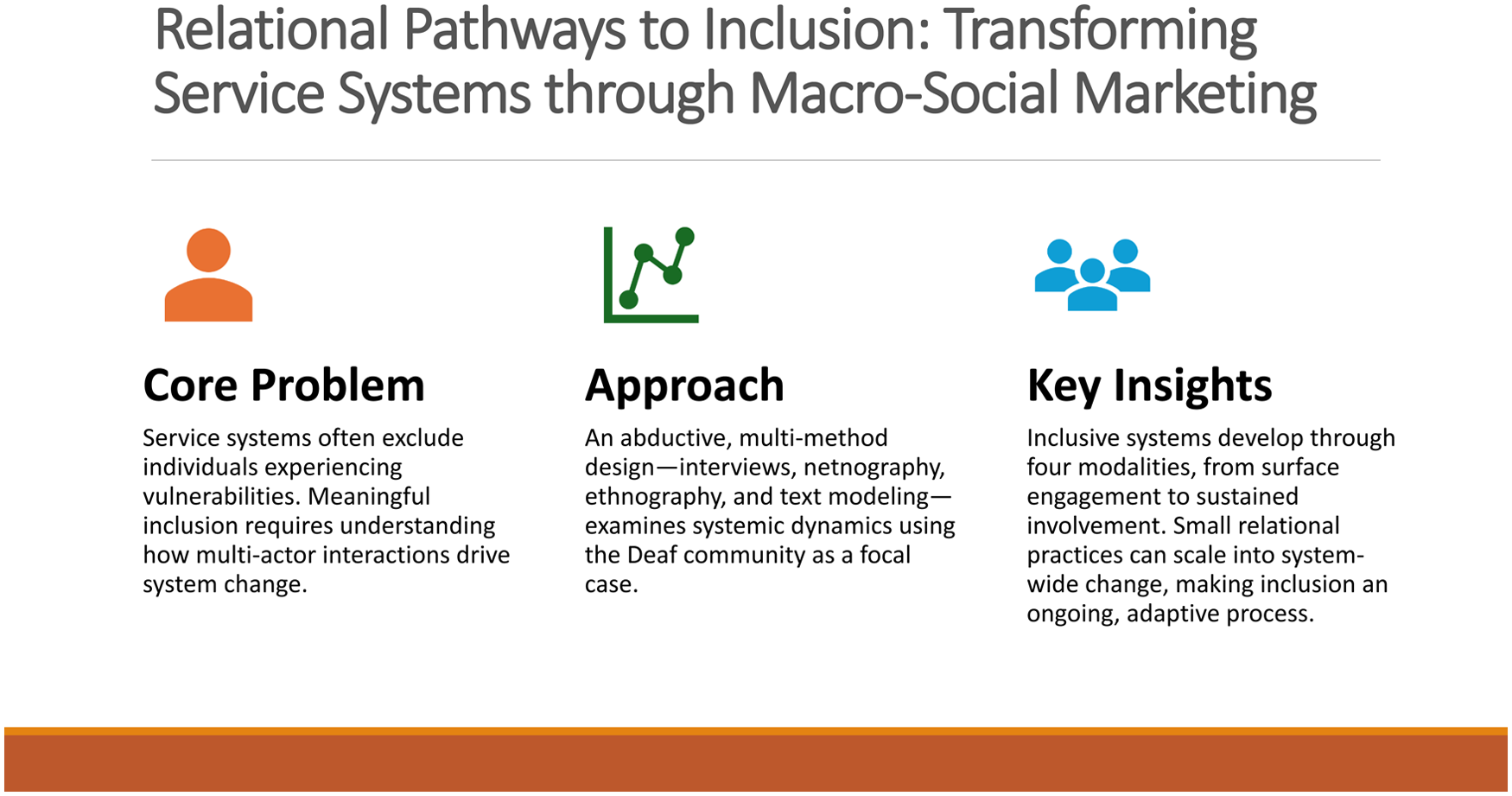
Systemic exclusion remains a significant barrier for individuals experiencing vulnerabilities, limiting their participation in service systems—configurations of interdependent actors, institutions, and infrastructures that shape service environments. This study examines how inclusive service systems evolve through dynamic, multi-actor engagement by integrating systems thinking, transformative service research, and macro-social marketing. Using an abductive, multi-method design, we focus on the Deaf community in Indonesia as a salient case and combine interviews with Deaf and hearing individuals, netnographic analysis of Deaf-oriented online content, rapid ethnographies at community events, and computational topic modeling of user-generated discourse. The analysis uncovers four evolving modalities of system transformation—Surface-Level Engagement, In-Depth Exploration, Co-Creative Participation, and Sustained Involvement—which trace how micro-level relational practices and communicative adjustments accumulate into meso- and macro-level shifts in structures and norms. We conceptualize inclusion as an emergent, iterative process rather than a stable end-state and propose a scalable framework to diagnose and facilitate inclusive transformation in complex service environments. The study advances theoretical perspectives on inclusive service systems and macro-social marketing and offers actionable guidance for designing and governing service systems that give marginalized groups an active role in shaping services.
Keywords
Introduction
The service landscape can be conceptualized as a system—a structured set of interdependent components or subsystems that continuously interact (Henkens et al. 2023; Polonsky et al. 2024; Koskela-Huotari et al. 2024). These subsystems include individuals, institutions, and infrastructures that are mutually reliant (Kelleher et al. 2020). A supplier depends on interactions with buyers; service providers coordinate with customers and other providers; and both individuals experiencing vulnerabilities—those marginalized due to socioeconomic, physical, or cultural disadvantages—and widely represented individuals—those whose needs, preferences, and voices are institutionally prioritized—coexist within the same service system (Finsterwalder et al. 2020; Fisk et al. 2018; Leino, Davey, and Johns 2023). Despite asymmetries in power and agency (Mustak and Plé 2020), no actor operates in isolation. Each participant is embedded within, and contributes to, the dynamics of the overarching system (Breidbach, Antons, Salge 2016).
This study adopts a systems 1 thinking perspective (Jackson 2009, 2016, 2019), which refers to a paradigmatic approach that views entities not in isolation, but in relation to the broader system of which they are a part (see for instance Tax, McCutcheon, and Wilkinson 2013). Systems thinking emphasizes interconnectivity and the emergent behavior of complex networks. Building on this foundation, we adopt the concept of service systems (Chandler and Lusch 2015), defined as configurations of interrelated actors and processes that co-create and exchange value. Within these systems, service interactions are central to shaping outcomes (Pavia and Mason 2012).
Although the broader literature increasingly engages with the concept of service ecosystems, which describe open, adaptive, and emergent configurations governed by evolving institutional arrangements (for instance Chandler et al. 2019; Field et al. 2021; Vargo, Akaka, and Vaughan 2017; Vink et al. 2021), we adopt the service systems lens to foreground the structural, designed, and governable nature of inclusion (Supplemental Appendix 1). In doing so, we emphasize intentionality in system configuration—recognizing that inclusive outcomes often require deliberate institutional design and coordinated actor engagement, rather than emergent evolution alone (Beudaert, Mason, and Nau et al. 2024).
Crucially, service systems, particularly when viewed through the lens of vulnerability, are not neutral structures (Fisk et al. 2018); they can serve either as mechanisms for inclusion—the intentional process of recognizing, empowering, and enabling the full participation of individuals experiencing vulnerabilities—or, conversely, as sites of exclusion, where systemic arrangements, often unintentionally, marginalize and disadvantage less represented groups (Supplemental Appendix 2). This highlights the need for a critical examination of service systems through an inclusive and equity-focused lens.
The systems approach in service research, particularly in addressing the needs of groups experiencing vulnerabilities, represents a promising yet underexplored area that requires further investigation. Existing studies have provided valuable perspectives on dynamic value formation within service ecosystems and the complexities of marketization in human services (Echeverri 2021; Randle and Zainuddin 2020), enriching our understanding of specific service contexts (Adkins and Jae 2010; Machin et al. 2019). Furthermore, the importance of inclusive service systems for refugees has been emphasized, indicating a growing recognition of the need to develop more holistic frameworks to support inclusion toward consumer experiencing vulnerabilities (Finsterwalder et al. 2020). Building on this work, our study advances the conversation by uncovering paradoxical dynamics—such as how symbolic recognition can entrench exclusion or how institutionalization remains fragile and adaptive—that challenge assumptions of linear progression toward inclusivity. In doing so, we extend service system scholarship by showing that inclusion is not a stable outcome but an iterative recalibration of interdependencies across micro, meso, and macro levels.
Given that service systems are constituted through interdependent actors and interactions that collectively shape the distribution of value and access, they inevitably reflect the structural conditions in which they operate. As such, these systems can either reproduce existing inequities or serve as platforms for systemic transformation. Therefore, aligned with the principles of transformative service research (TSR) (Anderson and Ostrom 2015; Anderson et al. 2013; Blocker, Davis, and Anderson et al. 2022), we advocate for the intentional design and governance of inclusive service systems—those explicitly structured to promote meaningful participation, recognition, and responsiveness to the lived experiences of individuals experiencing vulnerabilities, wherein inclusion is not treated as an incidental outcome but is institutionalized through coordinated mechanisms of practice (Fisk et al. 2018). By emphasizing communicative and relational dynamics, our study extends TSR beyond resource-based perspectives, showing that well-being is not only a matter of access but of how service interactions themselves are configured to enable or constrain equity.
To further conceptualize how such systemic change can be mobilized, we integrate macro-social marketing (MSM) as a complementary theoretical lens (Layton 2007, 2019; Layton and Grossbart 2006). MSM involves the strategic application of marketing thought and practice to address complex social challenges through multi-level, cross-sectoral interventions (Flaherty et al. 2020). It extends beyond individual-level persuasion to engage with collective behaviors and institutional arrangements to reconfigure social systems in ways that enhance social cohesion (Shaw, Harris, and Ali 2024). Our study extends this tradition by showing how micro-level relational practices—such as everyday communicative adjustments—scale into systemic transformation when reinforced through institutional design. Combined with systems thinking, MSM thus offers a framework for not only diagnosing systemic barriers to inclusion but also designing adaptive interventions that respond to emergent exclusions over time (Kennedy 2019). Based on these conceptual foundations, we pose the following research question: How do individuals experiencing vulnerabilities engage with widely represented individuals to overcome systemic barriers to inclusion?
Hence, this study adds to the service literature by integrating systems thinking with TSR and MSM to examine and address the persistent systemic challenges encountered by individuals experiencing vulnerabilities within service systems. To achieve this objective, we adopted an abductive research approach (Timmermans and Tavory 2012; Vila-Henninger et al. 2024), facilitating iterative engagement between empirical insights and theoretical development. Using a multi-method case study design (Yin 2018), empirical observations were drawn from four data sources, encompassing both individuals experiencing vulnerabilities—with a focus on engagement within the Deaf community as a salient case—and widely represented individuals who have participated in service interactions involving members of the Deaf community.
Theoretical Background
This section establishes systems thinking as a foundational lens, integrating insights from TSR and MSM to position inclusion as both an ethical commitment and a systemic objective, culminating in a model of service systems transformation that unfolds through four evolving modalities to enhance equity and adaptability, particularly for individuals experiencing vulnerabilities in their interactions with widely represented individuals (Supplemental Appendix 3).
Systems Thinking and Inclusive Service Systems
Systems thinking is a paradigmatic approach that views phenomena not as isolated entities but as interconnected elements within a larger whole (Jackson 2009, 2016, 2019; Kim and Senge 1994). It emphasizes the dynamic relationships, feedback loops, and emergent behaviors that arise from the interactions between system components (Fowler 2003). Rather than focusing on linear cause–effect patterns, systems thinking seeks to understand how structures and interdependencies shape systemic outcomes over time (Maani and Maharaj 2004). It offers a holistic lens through which complexity, adaptation, and co-evolution can be interpreted (Grewatsch, Kennedy, and Bansal 2023). Although systems thinking itself constitutes a broad and diverse body of literature (for instance Jackson 2009; Mingers and White 2010), encompassing multiple philosophical traditions such as cybernetics, complexity theory, and general systems theory, engaging with its full ontological and epistemological debates lies beyond the scope of this study.
Systems and Subsystems
Building on the systems thinking perspective, systems can be understood as a structured set of interconnected elements—actors, resources, processes, and institutions—that collectively produce outcomes greater than the sum of their parts (Johnson 2008). Subsystems refer to smaller, semi-autonomous units within the broader system, each of which maintains distinct functions yet remains interdependent with other subsystems (Wallis and Valentinov 2017). In service contexts, systems are composed of networks of actors or subsystems who engage in service interactions, co-create value, and co-shape institutional conditions (for instance, Barile et al. 2016).
Within this study’s focus, two critical subsystems are identified: individuals experiencing vulnerabilities and widely represented individuals. These groups, while operating within the same overarching service landscape, experience and contribute to the system in distinct yet interconnected ways (Finsterwalder and Kuppelwieser 2020). The systemic configuration and the quality of interrelations between these subsystems are crucial in determining whether service environments promote inclusion or perpetuate exclusion.
TSR and Systems Thinking
TSR complements systems thinking by providing a normative orientation to the design and evaluation of service systems, with a central emphasis on enhancing individual and collective well-being (Anderson and Ostrom 2015; Anderson et al. 2013; Blocker, Davis, and Anderson 2022). While systems thinking offers an analytical lens to examine the interdependencies, feedback mechanisms, and adaptive capacities within service configurations, TSR foregrounds the moral and humanistic imperative to design services that not only function efficiently but also foster equity, dignity, and empowerment (Boenigk et al. 2021b; Rosenbaum 2015a, 2015b). By integrating TSR, this study views service systems not merely as technical or institutional arrangements, but as platforms for human transformation, where systemic inclusion is pursued as both a social and ethical objective. Thus, the convergence of TSR and systems thinking allows for a more purposeful inquiry into how service systems can be reconfigured to enable meaningful participation, reduce structural disparities, and catalyze positive change across social strata (Polonsky et al. 2024; Rahman, Finsterwalder, and Kuppelwieser 2024).
Inclusive Service Systems
We extend the systems thinking foundation by adopting the notion of inclusive service systems. An inclusive service system extends the systems perspective by emphasizing the design, governance, and operation of service environments that actively recognize, accommodate, and empower the diverse needs and capacities of all participants, particularly those who have historically been marginalized (Fisk et al. 2018). Inclusive service systems are not merely open to participation but are intentionally structured to dismantle systemic barriers and create conditions where individuals experiencing vulnerabilities and widely represented individuals can engage equitably (Alkire et al. 2022).
Such systems require a shift from reactive, ad hoc adjustments to proactive institutional arrangements that embed inclusion as a normative and operational principle (Reynoso et al. 2015). By acknowledging and addressing the interdependencies between different subsystems, inclusive service systems seek to foster environments where diverse actors can meaningfully contribute to and benefit from service interactions (Gong et al. 2022).
Individuals Experiencing Vulnerabilities
Building on the foundational definitions of service systems, we now turn to a brief discussion of what is meant by individuals experiencing vulnerabilities as one subsystem. This study adopts the term “individuals experiencing vulnerabilities” to emphasize that vulnerability arises from dynamic and contextual conditions rather than being an intrinsic or static characteristic (Baker, Stephens, and Hill 2002; Russell-Bennett, Bedggood, and Raciti 2024). In adopting this terminology, we depart from deficit-based labels such as “vulnerable customers,” which risk perpetuating stigmatization and diminishing recognition of individual capabilities (Baker, Gentry, Rittenburg 2005). 2 Grounded in a strengths-based approach (Raciti, Russell-Bennett, Letheren 2022), this perspective highlights the structural and situational forces that engender exclusion, while simultaneously affirming the agency, resilience, and potential of those affected.
In this study, we acknowledge that individuals experiencing vulnerabilities encompass a wide range of groups, including those experiencing socioeconomic disadvantage, cultural marginalization, and diverse physical or cognitive conditions (see Hill and Sharma 2020). While recognizing the breadth and heterogeneity of these classifications, we specifically focus on individuals with physical vulnerabilities. Within this domain, our attention centers on the Deaf 3 community, whose experiences offer a particularly salient case for examining exclusion within service systems (see, for instance, Abney et al. 2017). This focus 4 is guided by the sustained engagement of the author(s) with Deaf communities and the rich experiential insights developed over time, allowing for a more nuanced, contextually grounded, and relational understanding of their lived experiences.
While the primary focus of this study is on individuals experiencing vulnerabilities, we also consider the role of widely represented individuals. Although this may initially seem tangential to the discussion of vulnerabilities, it aligns with our systems thinking perspective (Jackson 2009, 2016, 2019), which emphasizes the interdependence of subsystems within the overall service systems. Individuals experiencing vulnerabilities do not exist in isolation; rather, they are embedded within societal structures where interactions with widely represented individuals are inevitable and influential (Anderson et al. 2016; El Jurdi, Baktir, and Price 2025).
Viewing both groups as distinct yet interrelated subsystems (Supplemental Appendix 4) underscores the necessity of examining not only the experiences of marginalized individuals but also the perceptions, actions, and responsibilities of those who are more widely represented (Abney et al. 2017). From a systems perspective, fostering inclusive service systems requires an understanding of how these subsystems interact, influence one another, and collectively shape conditions of inclusion (Parkinson et al. 2017). Therefore, this study incorporates the perspectives of both individuals experiencing vulnerabilities and widely represented individuals, reflecting the systemic interrelations that must be navigated to advance meaningful service inclusion.
Macro-Social Marketing, Systems Thinking, and Inclusive Service Systems
Moving from service systems, we employ MSM as a framework for transforming structural and institutional conditions (Adkins and Jae 2010; Kennedy and Parsons 2012). MSM emerges from the convergence of macromarketing, which examines the societal impacts of marketing systems (Layton 2007, 2019; Layton and Grossbart 2006), and social marketing (Flaherty et al. 2020; Kemper and Ballantine 2020; Kennedy and Santos 2019; Kennedy and Smith 2022), which seeks to influence individual behaviors for collective benefit. Rather than focusing solely on changing individual behaviors, MSM addresses how systemic structures, institutional norms, and collective practices produce and sustain exclusionary outcomes (Domegan et al. 2020; Kennedy 2016). It frames marketing as a strategic tool for achieving holistic, system-level transformation. Recent studies (for instance, Jagadale and Kemper 2022; Shaw, Harris, and Ali 2024) highlight how MSM facilitates system-wide change by fostering strategic partnerships and reshaping institutional structures, reinforcing its role in advancing social well-being through durable, system-level transformations. We build on this foundation by highlighting how everyday communicative and relational practices at the micro and meso levels contribute to these broader transformations, showing that systemic change unfolds not only through institutional design but also through the accumulation of situated interactions.
Systems thinking provides a complementary perspective by making explicit the interconnections between micro- and macro-level dynamics. While MSM emphasizes the institutional and collective arrangements that foster inclusion, systems thinking highlights how exclusion emerges from interdependent subsystems and feedback loops (Machin et al. 2019). Bringing these perspectives together makes it possible to analyze how performative actions—subjective, voluntary behaviors such as advocacy, resistance, or inclusive practices—interact with institutional actions, involving codified rules, policies, and governance structures that formalize systemic change (Kennedy 2016). These dual mechanisms influence cultural-moral norms (shared values, beliefs, and ethical expectations) and economic-task norms (practices related to resource allocation, efficiency, and operational roles), both of which shape how service systems include or exclude different actors.
In line with prior TSR, which has emphasized access, well-being outcomes, and institutional arrangements for marginalized groups such as refugees or those in human services (Finsterwalder et al. 2020; Randle and Zainuddin 2020), this study adds an additional layer by focusing on the communicative and relational dynamics that operate within and across subsystems. By doing so, it complements existing work and underscores that pathways to inclusion involve not only structural resources but also the quality of interactional practices that shape everyday service engagement.
Individuals experiencing vulnerabilities and widely represented individuals are seen as interacting subsystems whose engagements co-create systemic conditions of inclusion or exclusion. Flaherty et al. (2020) systematically map how systems thinking and MSM complement one another by addressing multi-level complexity and non-linear causality in social change processes. Additionally, Wymer (2021) highlights the importance of building stakeholder coalitions across levels, reinforcing the view that systemic transformation requires coordinated actions among interdependent actors within service systems.
Building from the convergence of MSM and systems thinking, inclusive service systems can be defined as service environments intentionally structured to dismantle systemic barriers and promote equitable participation for both individuals experiencing vulnerabilities and widely represented individuals (Fisk et al. 2018). In this way, the study extends TSR by deepening attention to communicative mechanisms of well-being and complements MSM by showing how institutional and policy interventions are reinforced through micro- and meso-level adjustments over time. These systems deploy performative and institutional mechanisms to shift social norms, operational practices, and governance structures, embedding inclusion as a core design principle rather than a secondary consideration. Huff and Barnhart (2022) emphasize that addressing complex problems in service systems requires recognizing the entanglement of market, social, and institutional dynamics—an insight critical to building genuinely inclusive systems. By engaging both subjective experiences and objective systemic structures, inclusive service systems create conditions where diversity, empowerment, and collaboration are foundational to service interactions.
Toward Inclusive Service Systems Transformation
With the theoretical foundations established, we now conceptualize the process through which service systems progressively adapt toward greater inclusivity (Supplemental Appendix 5). Building inclusive service systems for individuals experiencing vulnerabilities requires more than isolated intervention points; it demands a fundamental systemic reorientation of values, practices, and institutional structures. Rather than treating inclusivity as an additive layer, this approach embeds fairness, equity, and accessibility as foundational properties of the service systems (Alkire et al. 2022). These systems must not only accommodate diversity but actively evolve through continuous recalibration to address emerging and often unforeseen forms of exclusion (Fehrer, Kemper, and Baker 2024).
Here, we build on existing TSR scholarship that has highlighted the importance of access and well-being outcomes for marginalized groups (Finsterwalder et al. 2020; Randle and Zainuddin 2020) by drawing attention to the communicative and relational dimensions through which these outcomes are enacted. Complementing this, MSM emphasizes structural and institutional interventions (Shaw, Harris, and Ali 2024), and systems thinking allows us to view these processes as interconnected and adaptive, emphasizing feedback loops and emergent change (Jackson 2009; Maani and Maharaj 2004). Together, these perspectives underline that inclusivity is not a static state but a process of iterative recalibration within complex systems.
Shaw, Harris, and Ali (2024) and Flaherty et al. (2020) emphasize that system-level change is not linear but adaptive, with inclusive service systems developing through feedback loops, incremental shifts, and iterative stakeholder re-engagements. Integrating systems thinking into this framing reinforces the view that exclusion emerges from interdependencies rather than isolated barriers, and that transformation requires continuous monitoring of feedback and dynamic coordination among actors. Accordingly, fostering inclusivity demands sustained, reflexive processes that build upon both performative and institutional actions over time, rather than relying on discrete, one-time interventions (Wymer 2021).
Hence, we conceptualize this progress through four interrelated modalities, representing dynamic zones of transformation within service systems. The term modality is used to emphasize that the processes of transformation within service systems are not fixed, linear, or sequential. Instead, modalities capture dynamic, overlapping, and recurrent patterns of systemic change, allowing for multiple points of entry, feedback, and reconfiguration rather than prescribing a rigid developmental pathway. These modalities do not follow a fixed or sequential pathway; rather, they emerge and recur in iterative cycles, deepening systemic engagement with inclusivity through continuous recalibration (Sönnichsen et al. 2024). By grounding these modalities in systems thinking, we highlight how adaptive, recursive feedback cycles drive change; by aligning them with TSR, we stress that such change is oriented toward well-being and equity; and by linking to MSM, we illustrate how cross-sectoral and institutional interventions can amplify localized practices into durable transformation. Each modality spans one or more levels of the service system—micro (individual), meso (organizational/community), and macro (institutional/policy)—and together, they delineate how systems adapt and evolve. Together, they delineate how service systems progressively move from surface-level awareness of exclusion toward the institutionalization of inclusive norms, with each cycle enhancing resilience against new exclusionary structures.
The first modality, Awareness of Exclusion, marks the emergence of initial recognition of systemic inequities. At the micro level, actors begin identifying marginalized experiences and questioning entrenched assumptions, often through symbolic or performative actions that initiate ethical shifts (Boenigk et al. 2021a). Although early-stage responses may lack deep structural impact, they are vital for opening discursive spaces and mobilizing broader system sensitivity to exclusionary dynamics (Sönnichsen et al. 2024).
Interrogation of Norms introduces more critical and reflective engagement. Actors turn their attention to the underlying institutional routines, cultural logics, and systemic structures that normalize exclusion. This occurs predominantly at the meso level, where organizational practices and community norms come under scrutiny. Critical interrogation of these norms enhances the system’s capacity to detect and challenge institutionalized barriers, particularly those that disadvantage individuals experiencing vulnerabilities (Dean and Indrianti 2020; Tanouri, Kennedy, Veer 2022). This modality is crucial for shifting from superficial recognition to deeper systemic awareness.
Participatory Realignment represents a pivotal shift from analysis to redesign. It involves collaborative reconfiguration efforts, where those historically excluded—especially individuals experiencing vulnerabilities—actively co-create inclusive structures, practices, and governance mechanisms. Drawing on the transformative ethos of MSM and participatory approaches (Rahman, Finsterwalder, and Kuppelwieser 2024), this modality sees performative and institutional actions converge, creating durable systemic shifts through stakeholder collaboration across diverse sectors (Boenigk et al. 2021a). This modality operates across meso and macro levels, engaging organizations, public institutions, and multi-actor coalitions in the structural co-design of inclusive service delivery.
Finally, Institutionalization of Inclusivity signals the embedding of inclusive values into formalized policies, operational routines, and collective service norms. Inclusivity becomes codified and reinforced through systemic feedback mechanisms that maintain alignment across cultural, organizational, and governance domains (Fehrer, Kemper, and Baker 2024; Russell-Bennett, et al. 2024). At the macro level, this institutionalization shapes policy frameworks and standard-setting mechanisms. However, this institutionalization is not a static endpoint; as demonstrated by Sönnichsen et al. (2024) and Huff and Barnhart (2022), it is inherently adaptive, requiring the system to remain alert to emergent exclusions and adapt accordingly.
Methodology
Research Approach
This study adopts an abductive approach (Timmermans and Tavory 2012; Vila-Henninger et al. 2024) to investigate the research questions, commencing with a preliminary conceptual model—outlined in the Theoretical Background—centered on four modalities of inclusive service systems transformation (Supplemental Appendix 6). This initial model operates as a heuristic guide, refined iteratively through sustained engagement with empirical data sourced from individuals experiencing vulnerabilities. To achieve this, we implement a multi-method case study design (Yin 2018) that synthesizes multiple empirical layers to inform theory development (Jaakkola 2020; Ulaga et al. 2021).
The Deaf community is adopted as a salient case to illustrate systemic dynamics of inclusion and exclusion, offering a compelling lens into how individuals experiencing vulnerabilities engage with service systems. By multi-method, we refer to the integration of diverse data collection and analysis techniques conducted within a unified epistemological and methodological orientation: a qualitative, constructivist, and exploratory paradigm. Rather than seeking to confirm pre-specified hypotheses, the objective is to construct a contextually grounded conceptual framework, emergent from the interpretive synthesis of lived experiences, digital discourse, and situated practices.
Anchored in this approach, our empirical strategy draws upon four key sources: (1) interviews with members of the Deaf community; (2) netnographic analysis of Deaf-oriented practices and discourses in digital environments; (3) interviews with widely represented (hearing) individuals who have engaged with Deaf individuals; and (4) rapid ethnography conducted across four events that featured interactions between Deaf and hearing individuals 5 (Supplemental Appendix 7). This ensemble of data sources affords both breadth of perspective and depth of experience—two complementary dimensions critical to capturing the complexity of inclusive service phenomena (Supplemental Appendix 8). Breadth is attained through interviews with a range of actors and the expansive coverage enabled by netnographic inquiry, which encompasses digital narratives from diverse contributors within the online Deaf community. Depth, in contrast, is generated through immersive rapid ethnographic engagement and in-depth interviewing, both of which uncover nuanced, situated experiences that are not always accessible via mediated discourse.
Research Context
The study is situated in Indonesia, where the Deaf community—estimated at approximately two million individuals (Kementerian Pendidikan Dasar dan Menengah 2023)—faces exclusion not because of deafness itself but due to societal and institutional structures that insufficiently recognize their linguistic and cultural identity. Despite this sizable demographic, public awareness of Deaf culture remains limited, illustrated by incidents such as officials proposing whistles as communication aids (Christine and Kristian 2021), reflecting persistent deficit-based misconceptions that overlook the community’s cultural and linguistic richness.
Within this context, Bahasa Isyarat Indonesia (BISINDO) functions as the community’s preferred sign language, grounded in lived experience (Palfreyman 2020), whereas institutional promotion of SIBI (Sistem Isyarat Bahasa Indonesia), a constructed system, often feels misaligned with Deaf communicative norms (Wirajuda 2022). Such institutional preferences, combined with impairment-focused views, reinforce communication barriers and contribute to ongoing stigma, demonstrating how formal structures can exacerbate exclusion even when framed as supportive.
At the same time, the Deaf community in Indonesia has built strong grassroots movements through advocacy, social media engagement, and Deaf-centered digital content, alongside emerging technological initiatives that support visual communication. These developments highlight the community’s resilience and signal growing momentum toward more inclusive service systems—ones that address structural inequities while affirming Deaf linguistic and cultural identity as foundational to equitable service design.
Data Source 1: Engagement with Deaf Individuals
The author(s) engaged directly with the Deaf community in Indonesia, grounding their interaction in both linguistic preparation and cultural sensitivity. Drawing on functional fluency in Bahasa Indonesia and foundational exposure to BISINDO, they undertook a certified 10-week BISINDO training program in 2024 led by a Deaf instructor. This experience not only provided essential signing skills but also fostered a deeper appreciation for the communicative norms, cultural practices, and lived experiences of the Deaf community. Through this deliberate preparation, the author(s) sought to build respect and understanding—positioning themselves to collaborate with, rather than merely study, the community.
Following the completion of formal BISINDO training, the author(s) conducted in-depth interviews directly with 12 Deaf individuals in Indonesia (Supplemental Appendix 9), without relying on a sign language interpreter. This direct engagement enabled the collection of firsthand insights into how Deaf participants navigate familiar service environments, particularly in relation to the study’s conceptual model of inclusive systems transformation. By conducting the interviews in BISINDO—the participants’ preferred mode of communication—the author(s) ensured dialogic authenticity and mutual intelligibility, even as minor asymmetries in fluency occasionally emerged.
Participants were initially recruited through informal interactions at a local coffee shop where Deaf baristas work, providing a comfortable and accessible environment for initiating conversations. After obtaining consent to participate, the author(s) employed a snowball sampling technique to reach other potential participants. This engagement process occurred over approximately 10 months spanning from August 2024 to May 2025, spanning five informal meetings, allowing for the gradual and respectful building of trust within the Deaf community.
Each interview was guided by a semi-structured protocol (see Supplemental Appendix 10), lasting 20 to 30 minutes to balance conversational flexibility with thematic focus. These interactions revealed nuanced, context-rich accounts of participants’ service experiences, highlighting both systemic constraints and their own adaptive responses. Complemented by field notes capturing contextual observations and researcher reflections, this bottom-up approach centers lived realities and communicative agency over prescriptive, top-down service design solutions.
Although the absence of a professional sign language interpreter represents a methodological limitation, the author(s) deliberately chose this path to preserve direct engagement and cultivate trust. Informants demonstrated flexibility in communication, navigating the conversations through a combination of visual and verbal cues. Their willingness and ability to adapt not only sustained the flow of dialogue but also reinforced the importance of recognizing communicative diversity as a strength rather than a deficit (AccessForce 2023).
The analytical process began with descriptive coding to surface salient features within the interview data (see Supplemental Appendix 11). This initial phase employed a set of predefined categories—such as “social media awareness,” “public event,” and “community event”—that were conceptually aligned with the study’s preliminary framework. Subsequently, thematic analysis (Braun and Clarke 2012) was applied to synthesize these descriptive codes into broader, interpretive themes including “initial awareness,” “institutional initiative,” and “community movement.” In conducting the coding process, we adopted a multi-step approach that integrated both theory-driven and data-driven strategies.
Descriptive coding was initially guided by our conceptual framework, with codes derived from predefined constructs related to service accessibility, public perception, and institutional response (Saldaña 2021). In parallel, in vivo coding was employed to capture participants’ own language and expressions, preserving the emic meanings embedded in their accounts. This dual approach enabled the identification of both anticipated and emergent dimensions of meaning. The coded data were then thematically organized through a process of iterative refinement and constant comparison, allowing for the generation of higher-order themes that reflected patterns across the interviews and aligned with broader socio-institutional dynamics.
Data Source 2: Netnographic Method
This study employed a netnographic approach (Kozinets, Dolbec, and Earley 2024) using YouTube to capture self-authored narratives of Deaf individuals, enabling analysis of naturally occurring discourse while maintaining analytical distance and transparency in interpreting socially situated experiences. The sampling process employed a purposive strategy, guided by three inclusion parameters: (1) the content must foreground personal or communal experiences of Deaf individuals; (2) the format must reflect conversational genres such as interviews, talk shows, or news reports; and (3) the language of delivery was limited to English or Bahasa Indonesia, regardless of the availability of closed captions, due to the author(s)’ linguistic competencies and the practical constraints of accurately interpreting content beyond these two languages.
A total of 44 videos published between 2013 and 2024 were selected using specific keywords 6 representing diverse national contexts including Indonesia, the United States, the United Kingdom, Austria, Australia, Russia, the Netherlands, and Japan (Supplemental Appendix 12). These selections captured a heterogeneous spectrum of themes ranging from sign language advocacy and educational barriers to familial dynamics and Deaf entrepreneurship. Of the 39 captioned videos included in the netnographic analysis, additional non-captioned materials were excluded from formal coding but used contextually to enrich interpretation without compromising rigor.
Data were acquired using Python scripts in Jupyter Notebooks, with the YouTube Data API retrieving structured metadata and comment threads and the Transcript API providing closed-caption transcripts in English or, when unavailable, Bahasa Indonesia (Supplemental Appendix 13). All transcripts were stored as text files, organized into a unified DataFrame with language metadata, and supplemented with documented fallback procedures to ensure transparency. The dataset comprised 10,218 comments from 8,902 users (9,979 unique entries, totaling over 1 million characters; Supplemental Appendix 14), with videos lacking comments retained for analysis through their metadata and transcripts. This process yielded two complementary corpora—audience discourse and speaker-authored captions—subsequently preprocessed to ensure textual consistency, analytical tractability, and alignment for qualitative and computational analysis.
The comment dataset was extracted via the YouTube Data API, yielding 10,218 comments from 8,902 users (9,979 unique entries; 1,047,570 characters). Closed-caption transcripts were retrieved using the YouTube Transcript API, organized into a DataFrame by video ID and language, and cleaned through a custom function that removed timestamps and formatting artifacts. Non-English transcripts were translated into English using a Google Translate API pipeline with preprocessing and a throttled retry mechanism. This multistage process—de-duplication, cleaning, annotation, and translation—produced a harmonized dataset suitable for thematic extraction, linguistic modeling, and cross-cultural interpretation. For transcripts, we analyzed a pre-processed corpus of 39 translated videos, normalized the text, and vectorized it into a 5,000-term document-term matrix before applying a semi-supervised CorEx model guided by four anchors (“awareness,” “engagement,” “collaboration,” “institutionalization”).
For comments, 10,218 entries (including four previously excluded videos) were cleaned, language-detected, and stemmed, yielding 1,867 English comments aligned with the same anchors. These were analyzed using a semi-supervised CorEx model with CountVectorizer (bigrams; 5,000-term cap), where some stemmed anchors (e.g., “exposur,” “institute”) triggered sparsity warnings. Applying a 0.05 relevance threshold retained 752 comments (40.3%) and excluded 1,115 as diffuse. Retained comments averaged 369 characters (median 264; range 2,360), with a right-skewed distribution—25% below 160 characters and the upper quartile above 469—and higher-liked entries (mean 11.67; max 713) tended to contain richer reflections on awareness, critique, and gratitude.
Principal component analysis (PCA) was applied to a document-term matrix of 1,000 high-frequency lexical features after stopword removal and zero-variance filtering, with 241 components explaining 90% of variance and 352 retained to preserve finer lexical structure. MANOVA tested topic separability using these 352 components as dependent variables and semi-supervised topic labels as the independent factor, while PERMANOVA—using Euclidean distance matrices derived from term-frequency vectors—relaxed parametric assumptions and ensured robustness for sparse, high-dimensional text. To assess semantic distinctiveness, Jensen-Shannon Divergence (JSD) was computed between normalized topic-level word distributions, with significance evaluated through 1,000-label permutation tests and Benjamini–Hochberg corrections, confirming statistical separability and coherence across topics. Temporal analyses standardized timestamps into year–month bins, constructed time-indexed contingency tables, and applied chi-squared tests before modeling topic series through ARIMA, with stationarity verified using the Augmented Dickey–Fuller test and parameters optimized via stepwise AIC, enabling 12-month forecasts that illuminate retrospective and projected patterns in discursive.
Data Source 3: Engagement with Widely Represented Individuals
We focused on widely represented individuals who had direct engagement with Deaf individuals—recruited through snowball sampling—to capture how their perceptions, misunderstandings, and systemic responses illuminate subsystem dynamics and inform the design of more inclusive service systems. A total of 28 informants participated between August 2024 and May 2025, comprising eight customers, eight business owners, seven industry professionals, and five government officials (Supplemental Appendix 9). Data collection involved semi-structured interviews of 20–30 minutes, supported by field notes, with informed consent obtained from all participants. Following the same approach as Data Source 1, descriptive coding and thematic analysis were conducted, integrating predefined framework categories with emergent in vivo codes to generate higher-order themes (Healy and Perry 2000; Miles, Huberman, and Saldaña 2020).
Data Source 4: Rapid Ethnography with Deaf and Hearing Individuals
We incorporated rapid ethnography to complement interviews and digital analysis, grounding the study in real-time, situated practices. Rapid ethnography condenses ethnographic immersion while retaining its interpretive depth (Handwerker 2001; Millen 2000). Researchers in other marginalized contexts have used it to surface hidden dynamics (e.g., Galea et al. 2020; Janda, Shainesh, and Hillebrand 2021; Vo 2020), and we applied it here to examine systemic exclusion and resilience within Deaf–hearing interactions. Rather than replacing other methods, we used rapid ethnography to extend them, generating experiential insights into how Deaf and hearing individuals negotiate inclusion in everyday settings. While interviews and online discourse revealed retrospective accounts, our fieldwork captured embodied and co-present interactions, giving us a closer view of relational, communicative, and spatial dynamics in practice.
We carried out fieldwork across four sites between May 2024 and May 2025: (1) a weekly Jakarta community event over 4 weeks, where we observed facilitated cross-modal participation; (2) an international sign language celebration, where hearing and Deaf participants demonstrated linguistic inclusivity in advocacy and celebratory spaces; (3) an inclusive performing arts workshop, where Deaf and hearing audiences redefined the boundaries of sound-based art; and (4) six visits to a Deaf-staffed café, where we engaged in informal dialogue with baristas and observed how visual communication, assistive tools, and customer familiarity shaped service encounters. These engagements provided grassroots insights into barriers, adaptive strategies, and resilience (Supplemental Appendix 16).
We analyzed fieldnotes with a systems orientation, focusing on relational dynamics and interdependencies. We constructed causal loop diagrams (CLDs) from observations of communicative patterns, interaction flows, and environmental enablers, iterating sketches to capture emergent system behaviors (Supplemental Appendix 17). By applying CLDs, we visualized nonlinear feedback and systemic change, aligning with earlier ethnographic applications in health and social research (Burrell et al. 2021; Carr et al. 2022). In doing so, we reinforced the methodological and theoretical contribution of ethnographic insights to our multi-method design.
Validity, Reliability, and Data Saturation
We ensured validity and reliability following Healy and Perry’s (2000) criteria, with thematic convergence across interviews, netnography, and ethnography providing consistency and contextual depth (Miles, Huberman, and Saldaña 2020) and reinforcing the credibility of the findings (Supplemental Appendix 11). Data saturation was evaluated across all sources rather than relying solely on Deaf interviews, and ethical integrity was maintained through informed consent, institutional approval, and adherence to established guidelines to ensure confidentiality, respect, and non-maleficence (Dodds et al. 2023).
Findings
The Four Modalities of Inclusive Service Systems Transformation
Drawing from the empirical findings, we refined the conceptual modalities initially proposed into four empirically grounded modalities that more accurately reflect the relational, communicative, and adaptive processes observed in situated practice. These refined modalities are: Surface-Level Engagement, In-Depth Exploration, Co-Creative Participation, and Sustained Involvement (Supplemental Appendix 18). While the original conceptual terms captured the progression toward system-level transformation in abstract terms, the revised modalities offer a more practice-oriented vocabulary (Supplemental Appendix 19). The rearticulation allows us to better illustrate not only the structural dimensions of inclusion but also its ongoing negotiation in everyday service encounters.
Surface Level Engagement
Surface-Level Engagement refers to the initial recognition of exclusionary dynamics, where both individuals and institutions begin to acknowledge the presence of marginalized groups—but without yet engaging in substantive behavioral or structural change. We adopt this revised term instead of Awareness of Exclusion to emphasize that mere awareness, in practice, often remains shallow, unaccompanied by meaningful shifts in norms, capabilities, or service interactions. The term “surface-level” foregrounds the performative and symbolic nature of these early-stage engagements. This phase is marked by limited communicative adaptation in public and social spaces. V5 highlighted this issue by noting, “When I talk about sign language, I hear the same phrase a lot of time. Hey, sign language is not universal? Why not?” This statement reveals a prevalent misconception where the acknowledgment of sign language as a communication tool remains superficial, without an understanding of its diversity or cultural context. V8 also emphasized the gap between recognition and practical engagement, stating, “My world is completely silent. And I'd like to invite all of you here today to come into my world so I can share a few Deaf issues with you.” This invitation underscores the disconnect between awareness of Deafness and actual efforts to bridge communicative barriers.
Similarly, V6 shared a personal anecdote that encapsulates the symbolic nature of surface-level engagement: “I was at the platform waiting for a train with my dad. . . It said this was an assistance card for a person with a handicap. I said, ‘Dad, you bought the wrong ticket.’ And he said, ‘No, this is how society views you.’” This illustrates a broader paradox of surface-level engagement: while recognition signals progress, it can simultaneously reinforce exclusion by framing disabilities through deficit-oriented institutional categories. In addition, V9 expressed frustration with persistent stereotypes: “A lot of people out in the world think about Deaf people as being very different than you are. . . Can you speak? Can you read?” Such questions, while often well-meaning, reveal an underlying ignorance masked as curiosity, perpetuating exclusion despite the intention to acknowledge Deaf individuals.
Surface-Level Engagement is not limited to public or interpersonal spaces but also manifests within organizational contexts. A1 reflected, “When people know I’m Deaf. . . they don’t really understand how to communicate with me.” This sentiment reflects the broader issue where acknowledgment of Deaf identity does not translate into practical changes in communication practices. Similarly, A3 described feeling marginalized, stating, “I’m usually left out. . . because they don’t think to include me in conversations.” These narratives point to a form of passive recognition in which Deaf individuals are acknowledged in a literal sense, yet not included in ways that alter the communicative norms of interaction.
Surface-Level Engagement is often accompanied by organizational or institutional hesitance. D1, reflecting on inclusive hiring, shared, “It was eye-opening. . . but you could still sense some hesitation from colleagues about hiring employees [with disabilities ].” This statement highlights how early-stage inclusion remains confined to symbolic gestures, such as discussing inclusivity without enacting structural changes. From a professional perspective, V7 critiqued the persistent gap in employment practices: “We still call Deaf, deafened, down. We still deny their right to get a good education and a good job.” At the meso level, such hesitance reflects how institutions may adopt inclusive language or symbols without substantively changing communicative or structural practices.
The narratives collectively reveal that Surface-Level Engagement often consists of performative gestures—such as superficial interest in sign language or basic accessibility measures—that remain unstable, risk regression, and may become tokenistic without further relational or structural commitment. Moving beyond this phase requires active investment in everyday communicative practices that prioritize Deaf experiences, positioning Surface-Level Engagement as a starting point rather than an endpoint on the pathway toward deeper exploration and co-creative participation.
In-Depth Exploration
In-Depth Exploration reflects a developmental shift from passive acknowledgment toward active efforts to understand and adapt to the lived realities of marginalized individuals. We depart from the conceptual term Interrogation of Norms to emphasize that, in practice, this phase is less about explicit critique and more about experiential learning and relational adjustments. The term "exploration" better captures the evolving, often informal, and trial-based nature of these engagements—where individuals and organizations start uncovering the concrete barriers that hinder inclusion and begin developing practical strategies to address them.
This exploration is most evident in interpersonal micro-adjustments. A2 shared, “When I explained to my neighbors how to better communicate with me—like using gestures or writing things down—they started making an effort to learn. Now they wave or make sure to face me when talking.” This example highlights the gradual shift from passive acknowledgment to active engagement, where hearing individuals begin to adapt their communication practices. This relational adjustment fosters a more inclusive environment, demonstrating how even small changes can significantly improve interaction quality.
Similarly, A5 described how a friend’s willingness to learn basic sign language made a profound difference: “One of my friends started learning BISINDO so we could communicate better. . . Even though not fluent, just knowing she’s trying makes a big difference.” This instance underscores how the effort to learn and incorporate new communicative strategies symbolizes a deeper commitment to inclusion beyond mere recognition. The focus on practical adaptation marks a clear departure from the superficial engagement seen in earlier phases.
In some cases, the shift toward In-Depth Exploration is facilitated by structured learning environments. V8 shared how their parents attended BSL classes to improve communication: “My parents decided to go to BSL classes at that point. Unfortunately, at that time, and still now, parents go on courses, but they're not subsidized.” This commitment, despite financial challenges, reflects an emerging awareness that inclusion requires more than just acknowledging Deafness; it requires investing in skills and knowledge that support meaningful interaction.
In professional contexts, In-Depth Exploration often takes the form of organized initiatives that prompt critical reflection and proactive change. D25 described the transformative potential of workshops where employees with disabilities shared personal experiences: “We held several workshops where employees [with disabilities ]shared their experiences. It was the first time many of us realized how outdated some of our policies were.” Such settings enable institutions to move beyond compliance and start questioning ingrained practices that perpetuate exclusion. D10 also highlighted the significance of skill development rather than mere empathy: “It’s not just about empathy, but about practical skills that benefit everyone.”
These cases underscore a shift from performative acknowledgment toward relational and skill-based adaptation, where the emphasis is on changing communicative practices rather than symbolic gestures. A central shift in this modality is the move from unilateral to bilateral engagement, as hearing individuals begin sharing the communicative burden and fostering the relational adjustments that distinguish in-depth practices from surface-level gestures. Although often uneven and fragile, this practical, mutual learning lays the groundwork for structural and cultural change and prepares the conditions for more collaborative redesign in subsequent phases.
Co-Creative Participation
Co-Creative Participation represents a transformative modality in which individuals experiencing vulnerabilities and widely represented actors work collaboratively to design, implement, and govern inclusive practices. We adopt this term in place of Participatory Realignment to highlight the generative nature of co-creation—emphasizing not only structural reconfiguration but also shared authorship and mutual agency in shaping service systems. This modality is not merely about inclusion in existing systems but about reshaping the very logic of those systems through joint contribution.
Co-creative participation is evident in contexts where inclusivity is not just accommodated but actively integrated into creative and cultural processes. A5 shared a vivid example from the arts sector: “When we started rehearsing for the play, I worked closely with the director and the other actors to integrate sign language into the choreography. . . we made sure that the signs became part of the story’s expression.” Similarly, A7 emphasized the collaborative ethos of such projects: “We created a space where I didn’t feel like I had to adapt alone—everyone adapted.” This statement underscores the collective responsibility inherent in co-creative participation, where the onus of inclusion does not rest solely on marginalized individuals but is a shared commitment. The integration of sign language into performance was not just a means of inclusion but a creative enhancement that enriched the artistic output.
In educational contexts, V1 highlighted a similar shift toward co-creation: “We set up workshops where Deaf and hearing students worked together to develop a bilingual curriculum. It wasn’t just about teaching sign language, but about designing the whole learning process to include both perspectives.” This approach contrasts starkly with surface-level efforts where sign language is merely offered as an elective. Instead, the process of co-design ensures that both Deaf and hearing voices shape the educational environment.
The cultural sector has also seen significant transformations through co-creative participation. V8 shared an instance where a cultural exhibition was co-designed by Deaf artists and curators: “We didn’t just translate the captions into sign language; we reimagined the entire layout to be more visually engaging and accessible.” This approach demonstrates how co-creative practices challenge the traditional hierarchy of design, emphasizing collaborative authorship that respects Deaf cultural expression. In the realm of advocacy, V9 recounted the success of a community project where both Deaf and hearing activists jointly organized a public event: “It wasn’t just about raising awareness; it was about creating a space where both communities could actively participate and share their experiences.” However, even within co-creative participation, subtle asymmetries may persist, as individuals experiencing vulnerabilities are often expected to carry a greater share of adaptation. This tension highlights that genuine co-creation requires not only shared authorship but also balanced responsibility among subsystems.
What distinguishes this modality is not just structural adaptation but shared ownership over system transformation. Through co-creative participation in meso level, inclusion becomes a collaborative practice, embedded in ongoing relationships rather than procedural mandates. By moving beyond accommodation and integrating diverse voices from the outset, co-creative participation ensures that inclusion is not merely reactive but generative, fostering environments where diversity is an inherent and celebrated aspect of everyday practice.
Sustained Involvement
Sustained Involvement refers to the long-term integration of inclusive principles into institutional, cultural, and governance frameworks. We revise the conceptual label Institutionalization of Inclusivity to better capture the active, ongoing nature of this modality. “Sustained” implies that inclusion is not a one-time accomplishment but a recurring and reflexive commitment—one that is maintained, adapted, and reinforced over time through both formal structures and social norms. This modality embodies a shift from short-term initiatives to enduring practices that persist through organizational evolution and societal change.
Sustained involvement often materializes through participation in community institutions that serve as hubs for learning, advocacy, and cultural continuity. A3 emphasized the transformative potential of such spaces: “The center is not just a place to learn sign language—it’s a community. . . It helps break down the barriers in society by teaching sign language to everyone, not just the deaf.” These centers act as relational infrastructures, where learning and social interaction are intertwined, fostering a more inclusive culture that extends beyond isolated educational efforts. A6 illustrated the significance of policy-oriented advocacy within sustained involvement: “Our foundation is focused on making sure the deaf community has a voice in important decisions.” This statement highlights how long-term advocacy fosters systemic change by embedding inclusivity within policy frameworks. Rather than being reactive, this approach is proactive, anticipating the evolving needs of the Deaf community and continuously adapting institutional practices.
Sustained involvement also manifests through community-driven projects that maintain momentum over time. V8 described how an inclusive cultural initiative continued to grow: “The museum project started small, but over the years, it became a network of 16 associated museums, all committed to having tours in sign language. It wasn't just a one-time effort—it kept expanding as more institutions recognized the value.” This ongoing growth exemplifies how sustained efforts not only institutionalize inclusion but also inspire broader participation.
In cultural and creative sectors, V7 recounted how a long-running collaboration between Deaf and hearing artists not only produced impactful performances but also established lasting networks: “We didn’t just create one inclusive show; we built a platform where Deaf and hearing artists regularly co-create. It became a space where both communities could continuously learn from each other.” This consistent engagement builds resilience against regressions into symbolic or superficial inclusion. One prominent theme within sustained involvement is the ongoing commitment to feedback and adaptation. V9 emphasized the importance of maintaining dialogic practices within community projects: “We don’t just set up a program and leave it—we keep asking for feedback from Deaf participants to see what needs improvement. It’s never just ‘done’—it’s always evolving.” This approach ensures that inclusion remains responsive to the lived experiences of marginalized individuals.
In governance contexts, sustained involvement requires persistent advocacy to ensure that inclusive policies are not only enacted but also maintained. V10 pointed out the challenges of keeping inclusion on the policy agenda: “We got the law passed, but maintaining its implementation is another struggle. It’s not enough to get the policy in place—we have to keep pushing to ensure it’s upheld.” This reveals an unexpected dynamic: the very processes that codify inclusion through policy and organizational practice also expose its fragility, as inclusive norms require constant defense and renewal against shifting institutional priorities.
Sustained Involvement ensures that inclusivity is continually practiced and adapted in meso and macro level. It requires mechanisms for feedback, policy reinforcement, and cultural renewal to ensure that service systems remain responsive to both persistent and emergent forms of exclusion. As such, it is the most resilient—but also the most demanding—modality within the system transformation process. Taken together, the four modalities illustrate that inclusion is not a linear achievement but a negotiated process marked by paradoxes of visibility, responsibility, and stability, reinforcing our conceptualization of inclusive service systems as adaptive and communicative configurations.
Conversational Dynamics: Netnographic Support of the Four Modalities
The MANOVA results suggest that the four modalities 7 —Surface-Level Engagement, In-Depth Exploration, Co-Creative Participation, and Sustained Involvement—are statistically distinct in their linguistic composition. MANOVA on 352 PCA components revealed a significant topic effect (Wilks’ Lambda = .093, F = 1.355, p < .001), supported by Pillai’s trace, Hotelling–Lawley, and Roy’s root (Supplemental Appendix 20). Topic 1 contained general interaction terms such as “understand” and “hear,” whereas Topic 4 used system-level language such as “institutionalization” and “embedded,” confirming that each modality forms a coherent semantic cluster aligned with differing levels of system engagement. PERMANOVA further confirmed discursive separability across all pairwise comparisons (p = .001), with the strongest contrasts between Topic 1 and Topic 2 (pseudo-F = 7.60) and between Topic 1 and Topic 3 (pseudo-F = 5.87), and the closest overlap between Topics 4 and 3 (pseudo-F = 1.54), reflecting shared structural emphases (Supplemental Appendix 21).
JSD results reinforced these findings, showing high divergence (JSD > 0.57) and significant differences (FDR-adjusted p < .05) for five topic pairs—including (4,3), (2,4), and (2,3)—with the greatest contrast between Topic 4 (Sustained Involvement) and Topic 3 (Co-Creative Participation) (Supplemental Appendix 22). Topic visualizations, including bar charts of the top 20 terms (Supplemental Appendix 23) and proportion plots (Supplemental Appendix 24), highlight clear thematic structures and reveal the dominance of certain modalities within the broader discourse.
Temporal analyses indicate that Surface-Level Engagement (Topic 1) consistently dominates over time (Supplemental Appendix 25), while Topics 3 and 4 remain marginal. A chi-square test (χ2 = 379.899, p = .884) shows no significant temporal shift; regressions reveal slight, non-significant increases for Topics 2 and 3 and near-zero change for Topic 4 (Supplemental Appendices 26–27). ARIMA modeling (Supplemental Appendix 28) shows Topic 1 exhibits strong temporal dependence (ARIMA(1,0,1), AR = –0.861, p < .001; intercept = 0.984, p < .001), Topic 2 follows an ARIMA(2,0,0) pattern (intercept = 0.313, p < .001), and Topics 3 and 4 fit intercept-only models (Topic 3 = 0.108; Topic 4 = 0.058; both p < .001). Collectively, these results confirm that the modalities are semantically and temporally distinct, with Surface-Level Engagement persistently dominating public discourse and more advanced modalities appearing only sporadically.
Discussion
Theoretical Implications
This study extends systems thinking, TSR, and MSM by conceptualizing inclusion as an iterative, adaptive process rather than a linear trajectory. TSR positions service systems as platforms for well-being (Anderson et al. 2013; Anderson and Ostrom 2015; Blocker, Davis, and Anderson 2022), while MSM emphasizes systemic and institutional interventions (Flaherty et al. 2020; Layton 2019). Our four modalities show how service systems move between symbolic gestures, relational adjustments, collaborative redesign, and adaptive institutionalization across micro, meso, and macro levels, advancing systems thinking in service research by foregrounding feedback loops and interdependencies (Chandler and Lusch 2015; Jackson 2009).
A first key contribution concerns the paradox of symbolic recognition. Awareness campaigns and accessibility symbols can entrench exclusion when they remain at Surface-Level Engagement and are not supported by deeper communicative and relational change, thereby reproducing inequities under an “inclusive” veneer (Fisk et al. 2018; Russell-Bennett, Bedggood, and Raciti 2024). Likewise, Sustained Involvement reveals that institutionalization is fragile: inclusive policies and structures require continuous monitoring and recalibration to remain responsive to emergent exclusions, aligning with systems thinking’s emphasis on non-linearity and adaptation (Domegan et al. 2020; Kennedy 2016; Maani and Maharaj 2004; Shaw, Harris, and Ali 2024).
A second contribution refines the understanding of co-creation in TSR. While co-creation is often treated as inherently empowering (Polonsky et al. 2024; Rahman, Finsterwalder, and Kuppelwieser 2024), our findings show that marginalized actors may still bear disproportionate communicative and emotional burdens, even in ostensibly collaborative arrangements, complementing work that focuses on resource access for communities experiencing vulnerabilities (Finsterwalder et al. 2020; Randle and Zainuddin 2020). By integrating MSM and systems thinking, we further extend MSM beyond macro-level campaigns to show how micro-level relational practices—such as everyday sign language use and communicative adjustments—accumulate into system-level transformation (Flaherty et al. 2020; Kennedy and Parsons 2012; Wymer 2021). The four modalities thus offer a practice-oriented vocabulary that links TSR’s well-being focus, MSM’s institutional strategies, and systems thinking’s adaptive insights into a unified account of inclusive service systems transformation.
Managerial Implications
Managers can advance inclusion by shifting from symbolic gestures toward practices that mirror the relational and adaptive dynamics identified in the findings and theoretical implications. This requires embedding communicative adaptation—such as basic sign language skills, visual interaction techniques, and structured training on Deaf communication norms—into everyday operations rather than treating them as one-off initiatives. Co-design mechanisms, including advisory groups or participatory workshops with Deaf stakeholders, help redistribute the burden of adaptation and reflect the collaborative ethos central to Co-Creative Participation. These structures convert micro-level relational adjustments into meso-level organizational routines, ensuring that inclusion is practiced rather than merely declared.
To maintain alignment with Sustained Involvement, managers should institutionalize inclusion through reflexive systems that support continuous recalibration. Integrating inclusion metrics into organizational evaluation, establishing ongoing feedback loops with marginalized stakeholders, and partnering with community organizations reinforce adaptive governance and guard against regression into surface-level efforts. Such mechanisms reflect the non-linear, iterative nature of system transformation emphasized in the theoretical framing and ensure that inclusive practices remain resilient as service environments evolve.
Limitations and Future Research
This study’s focus on the Deaf community within predominantly a single national context offers depth but limits the transferability of findings to other groups and settings, while the reliance on English and Bahasa Indonesia YouTube content narrows linguistic diversity. The rapid ethnographic design provided situated insights but constrained prolonged immersion, and the semi-supervised modeling captured discursive patterns without accounting for multimodal communication central to Deaf experiences. Future research should therefore examine how the four modalities manifest across different forms of vulnerability, employ multilingual and cross-context digital ethnographies, and adopt longitudinal or multi-site ethnographic designs to trace how inclusion evolves, stabilizes, or regresses over time.
Supplemental Material
sj-docx-1-jsr-10.1177_10946705251412880 – Supplemental material for Relational Pathways to Inclusion: Transforming Service Systems Through Macro-Social Marketing
Supplemental material, sj-docx-1-jsr-10.1177_10946705251412880 for Relational Pathways to Inclusion: Transforming Service Systems Through Macro-Social Marketing by Harriman Samuel Saragih in Journal of Service Research
Footnotes
Acknowledgements
The author extend their heartfelt thanks to the Special Issue Editors—Dr. Ron Hill, Dr. Linda L. Price, and Dr. Sterling Bone—the Associate Editor of the Journal of Service Research, and the anonymous reviewers for their thoughtful guidance and constructive feedback throughout the review process. Their insights have greatly contributed to shaping this work. This study acknowledges that the study is done with and not on individuals experiencing vulnerabilities. Without their support and willingness to participate, this study will not be possible to conduct. While the author has taken every care to ensure the manuscript’s accuracy and rigor, all remaining errors are solely the responsibility of the author.
Declaration of Conflicting Interests
The author declared no potential conflicts of interest with respect to the research, authorship, and/or publication of this article.
Funding
The author received no external financial support for the research, authorship, and/or publication of this article: but gratefully acknowledge support from an internal research grant provided by Monash University Indonesia.
Ethical Considerations
This study was conducted in accordance with the ethical standards set by the author relevant institutional review board. The research involved no physical or psychological harm to participants.
Consent to Participate
All participants provided verbally informed consent prior to participation.
Consent for Publication
No personal data or identifying details were used in this research. All data remain confidential and anonymized.

Supplemental Material
Supplemental material for this article is available online.