







Abstract
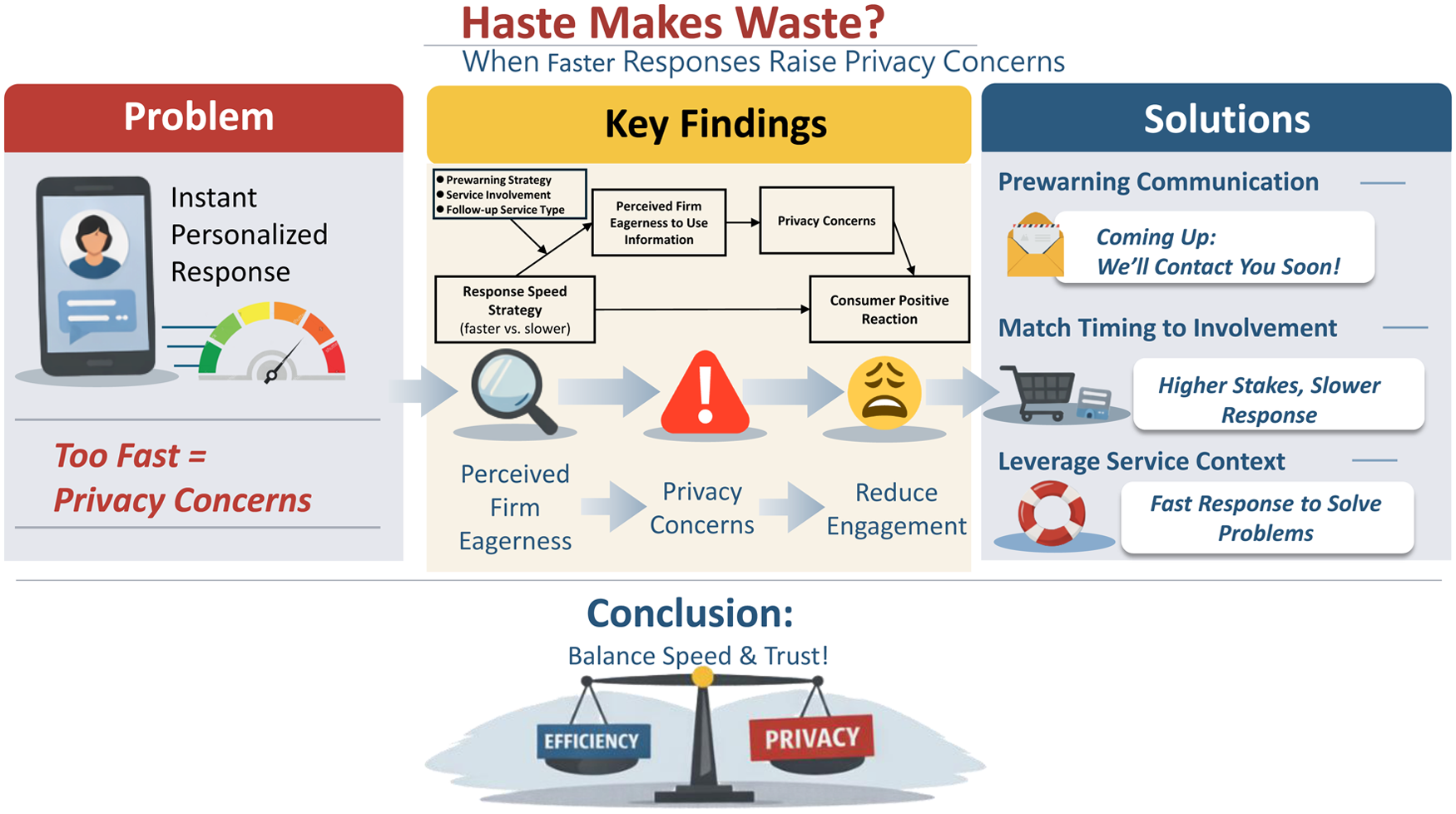
Empowered by advances in artificial intelligence (AI) and data technologies, service personnel can deliver highly personalized communication using automatically acquired consumer data. However, as firms increasingly rely on such data to enhance service efficiency, consumers’ privacy concerns have become more salient. Drawing on the persuasion knowledge model, this research integrates field data with four controlled experiments to examine how response speed following data acquisition influences consumer reactions. We find that faster (vs. slower) responses, defined as those delivered moderately earlier (vs. later) than consumers’ normative expectations in comparable service contexts, attenuate consumers’ positive reactions to marketing communications. This effect is driven by a serial mediation involving perceived firm eagerness to use information and privacy concerns, highlighting privacy concerns as one of the key psychological mechanisms shaping consumer reactions. Importantly, this negative effect is attenuated when firms provide prewarning messages about upcoming data-based communication, when service involvement is low, or in service recovery contexts. These findings suggest that response speed should be managed strategically. While overly fast responses may backfire in high-involvement or routine services, combining fast responses with prewarning strategies can help firms balance efficiency and privacy perceptions in digital service environments.
Keywords
Introduction
Recent advances in AI and data technologies have enabled firms to integrate consumers’ personal data into targeted service marketing strategies (Cui et al. 2021), with algorithms identifying consumer needs and service personnel delivering personalized, rapid communication (Luo et al. 2021). However, as the scope of personal data utilization continues to expand, consumers’ concerns about privacy breaches and potential data misuse have intensified (Cui et al. 2021; Goldfarb and Tucker 2012; Steinhoff and Martin 2023), with these concerns emerging as one of the important determinants of consumers’ subsequent responses (Quach et al. 2022). Consequently, a critical question arises: after acquiring consumers’ personal data, how can firms and their service representatives provide efficient and personalized responses without exacerbating privacy concerns or undermining consumers’ positive engagement, thus addressing the paradox between response efficiency and consumer privacy?
To address privacy concerns, prior research has proposed a variety of mitigation strategies. From the consumer perspective, enhancing individuals’ perceived control over personal information (Morimoto 2021), privacy self-efficacy (Schade et al. 2018), and trust in firms (Bleier and Eisenbeiss 2015) has been shown to reduce privacy-related anxiety. From the content perspective, emphasizing transparency or highlighting the benefits of personalization can similarly alleviate consumers’ discomfort (Ham 2017; Kim et al. 2019). Moreover, subtle language strategies in personalized advertising, including the use of hedge words, can attenuate consumers’ perceptions of privacy invasion (Lv et al. 2025). However, existing research has primarily focused on consumers’ subjective perceptions and message-level interventions, with limited attention to how service personnel’s behavioral cues influence consumers’ inferences and reactions regarding data usage after firms have already obtained personal data.
Notably, when firms use AI to automatically access consumers’ personal data, response speed itself can become a salient psychological cue (Dai and Zhang 2019; Förster et al. 2003). Although faster responses often improve customers’ positive reactions (Istanbulluoglu 2017; Mattila and Mount 2003), excessively fast replies may also trigger negative inferences, including perceptions of haste, overzealousness, or insincerity (Efendić et al. 2020; Iveson et al. 2023). Thus, in digital service contexts, response speed not only signals efficiency but also conveys social and motivational intentions that may heighten consumers’ vigilance about how their data are used. Yet, systematic empirical evidence on how response speed shapes privacy concerns and downstream consumer reactions remains limited.
To address these gaps, this research draws on the persuasion knowledge model (Friestad and Wright 1994) and, using field data and four controlled experiments, shows that faster responses decrease consumers’ positive reactions to marketing communications through a serial process whereby heightened perceived firm eagerness to use information increases privacy concerns, which in turn diminish consumers’ positive reactions. This effect weakens in low-involvement service contexts and service recovery scenarios, and is substantially mitigated when firms provide prewarning messages disclosing upcoming data-based communication. By identifying response speed as a dynamic marketing cue with both efficiency and privacy implications, this research advances understanding of privacy concerns, digital service communication, and response-speed management, while offering actionable guidance for balancing technological agility and consumer privacy in digital service marketing.
Literature Review
Privacy Tension in Digital Service Marketing
Advances in AI and data analytics enable firms to seamlessly collect, integrate, and apply consumer data, improving targeting precision and boosting service efficiency (Cui et al. 2021). Yet, as digital tracking becomes more pervasive, consumers experience heightened privacy tension because they value personalization while simultaneously fearing excessive data extraction and misuse (Okazaki et al. 2020; Quach et al. 2022). This tension undermines trust, weakens relationship quality, and constrains the benefits of digital marketing (Quach et al. 2022).
Prior research has proposed several strategies to alleviate privacy concerns, primarily from the consumer perspective (Schade et al. 2018) and the advertising-content perspective (Kim et al. 2019). From the consumer perspective, perceived control is central: greater perceived control reduces privacy concerns and avoidance of marketing messages (Morimoto 2021). Enhancing consumers’ privacy-management self-efficacy similarly lowers privacy-related anxiety (Schade et al. 2018). Individuals with stronger persuasion knowledge also exhibit higher self-efficacy and respond more rationally to perceived persuasive threats (Ham 2017). Trust in firms or platforms further diminishes privacy concerns (Bleier and Eisenbeiss 2015).
From the content perspective, privacy concerns decrease when consumers perceive meaningful benefits from data-based personalization (Ham 2017). Increasing message transparency enhances perceived advertising effectiveness while reducing anxiety about data use (Kim et al. 2019). More recent work shows that subtle linguistic cues, including hedge words, can soften perceived intrusiveness and mitigate privacy concerns (Lv et al. 2025).
Despite these advances, most research focuses on static message-level interventions, overlooking consumers’ dynamic reactions when their data are automatically utilized. In digital service contexts, fast responses following data access may act as a psychological cue (Dai and Zhang 2019; Förster et al. 2003), prompting inferences that firms are overly eager to exploit personal information, thereby elevating privacy concerns and triggering defensive responses. Few studies have systematically examined this mechanism. Furthermore, managing this privacy tension is increasingly recognized as a critical pillar of corporate digital responsibility (Lobschat et al. 2021; Kunz and Wirtz 2024), particularly in relation to proactive data stewardship (Moffett et al. 2025). To address these gaps, the present research investigates how response latency in digital communication shapes privacy perceptions and subsequent consumer outcomes.
The Consequence of Marketing Response Speed
In the era of digital transformation and AI marketing, firms operate in increasingly dynamic environments, and within these environments, marketing agility, defined as firms’ ability to rapidly reconfigure resources in response to evolving consumer needs, has become a key source of competitive advantage (Kalaignanam et al. 2021). Agile marketing emphasizes real-time responsiveness and aims to minimize the time between data acquisition and strategic action, enabling near-instant operations that enhance efficiency and relevance (Rydén and EI Sawy 2019). Accordingly, faster response speed is widely regarded as a driver of superior customer experiences and firm performance.
A large body of research documents the benefits of fast responses. Faster delivery boosts online sales (Fisher et al. 2019), quicker handling of complaints improves satisfaction and loyalty (Clark et al. 1992; Istanbulluoglu 2017), and timely replies signal care, attentiveness, and accountability (Cambra-Fierro et al. 2015; Istanbulluoglu 2017). Overall, responsive interactions consistently elevate customer satisfaction and repurchase intentions (Mattila and Mount 2003). However, emerging evidence shows that faster responses can also elicit unintended negative reactions. In some circumstances, overly fast responses may appear hasty, unreflective, or insincere (Iveson et al. 2023). In algorithmic or automated contexts, slower responses can sometimes be interpreted as more thoughtful or quality-assured (Efendić et al. 2020). Moderate delays paired with empathetic communication may even enhance perceived authenticity and trust (Kim et al. 2026). These findings suggest that response speed functions not only as an efficiency cue but also as a motivational signal that shapes consumers’ inferences about firms’ intentions and data practices.
While prior studies highlight both benefits and risks of fast responses, limited research examines their consequences in digital service contexts. In digital service marketing environments, service personnel often contact consumers immediately after accessing their personal data, making response speed a salient cue regarding how eagerly the firm uses such information. Faster responses may thus heighten privacy concerns and trigger defensive reactions. The present research explores the psychological mechanisms and boundary conditions underlying this efficiency–privacy paradox.
Hypothesis Development
The Impact of Response-Speed Strategies
According to the persuasion knowledge model, consumers develop knowledge about marketers’ strategies and motives through repeated interactions, enabling them to infer potentially self-serving or manipulative intent and respond defensively when such motives are suspected (Campbell and Kirmani 2000; Eisend and Tarrahi 2022; Friestad and Wright 1994). In our context, response speed following the use of personal data is an inherently interpersonal and communicative cue, which invites motive inference rather than neutral causal attribution. As such, unusually fast responses can activate persuasion knowledge, heighten skepticism, and trigger defensive reactions, making the persuasion knowledge model particularly well suited for explaining consumers’ psychological responses in data-driven service interactions (Kirmani and Zhu 2007; Morales 2005).
Because personal data are highly privacy-sensitive, marketing actions based on such data may be perceived as boundary intrusions (Wang et al. 2026). Faster responses refer to responses delivered moderately earlier than consumers’ typical expectations in comparable service contexts, whereas slower responses refer to those delivered moderately later than these normative expectations. Faster responses informed by personal data can signal excessive attentiveness or eagerness, prompting consumers to infer ulterior motives (Li and Sung 2021; Lv et al. 2022) and thereby reducing satisfaction (Li et al. 2024; Liu et al. 2019). Prior work shows that overenthusiastic or unsolicited assistance can overwhelm customers, eliciting negative emotions and resistance (Ku et al. 2013; Liu et al. 2019). This tension is amplified in digital service environments, where proactive AI-based data collection may violate social boundaries and undermine trust (Wang et al. 2026).
Building on this logic, faster responses following the use of personal data serve as a salient cue that activates persuasion knowledge. When consumers infer that marketers are leveraging their data to influence decisions, they become suspicious and vigilant (Eisend and Tarrahi 2022; Kirmani and Zhu 2007). Thus, response speed communicates not only efficiency but also motivational intent. In data-based interactions, faster responses are more likely to be interpreted as strategic manipulation or firm self-interest, thereby diminishing trust and positive affect (Li et al. 2024; Zhou et al. 2014).
Therefore, we propose the following hypothesis:
The Serial Mediating Role of Perceived Firm Eagerness to Use Information and Privacy Concerns
The persuasion knowledge model posits that consumers develop knowledge to infer marketers’ motives and adjust their responses (Campbell and Kirmani 2000; Friestad and Wright 1994). In digital service interactions, faster (vs. slower) responses after personal information collection may signal that the firm is highly motivated to use such data, which aligns with what prior research describes as consumers’ perceptions of the firm’s eagerness to use their personal information (Aiello et al. 2020; Wang et al. 2021). Fast responses can be interpreted as hasty or overly attentive behavior, heightening discomfort and triggering privacy-related concerns (Iveson et al. 2023; Zhou et al. 2014).
Psychological research consistently links speed with motivational intensity: strong desires prompt individuals to act more quickly (Dai and Zhang 2019; Förster et al. 2003), and higher motivation produces faster behavioral responses (Bijleveld et al. 2010). Accordingly, consumers may interpret fast responses as evidence of hidden firm motives. This inference aligns with persuasion knowledge processes in which consumers attribute such actions to strategic manipulation (Campbell and Kirmani 2000; Li and Sung 2021; Lv et al. 2022). For example, repeated data requests framed as “personalization” can be perceived as autonomy invasion, intensifying suspicion of firm motives (Wang et al. 2026).
As persuasion, knowledge, and motive inference co-activate, consumers become increasingly attuned to the firm’s eagerness to use their personal information, which then amplifies privacy concerns (Morimoto 2021). Elevated privacy concerns subsequently reduce favorable attitudes and behavioral intentions, increasing resistance to persuasion (Morimoto 2021; Wang et al. 2026). We distinguish between perceived firm eagerness to use information and privacy concerns by highlighting their different roles within the persuasion knowledge process. Perceived eagerness reflects a motive attribution, referring to a cognitive inference regarding the firm’s strategic intensity and “data greed” (Aiello et al. 2020). In contrast, privacy concerns are a psychological state reflecting the consumer’s perceived vulnerability and apprehension regarding their data (Morimoto 2021). This cognitive shift toward perceived eagerness subsequently amplifies privacy concerns, as consumers perceive that their personal information is being eagerly exploited by the firm. Ultimately, these heightened concerns activate defensive mechanisms, resulting in less favorable consumer reactions. Thus, faster responses heighten perceived firm eagerness to use information, which in turn increases privacy concerns and ultimately undermines consumers’ positive reactions.
The Moderating Role of Prewarning Strategy
According to the persuasion knowledge model, once consumers detect persuasive intent, they activate persuasion knowledge and adopt defensive reactions to protect autonomy and personal interests (Friestad and Wright 1994). When firms respond “too proactively” or “too rapidly,” consumers may infer an eagerness to exploit personal data, raising privacy concerns and reducing positive evaluations.
A prewarning strategy offers a mechanism to reduce such resistance by disclosing relevant information before persuasion occurs. Prewarning enhances perceived transparency, reduces perceived manipulative intent, and promotes psychological safety (Boerman et al. 2014; Campbell et al. 2013). In digital service contexts, prewarning signals that although firms hold personal information, they are not rushing to act on it. Because fast responses typically convey urgency or goal-driven intensity (Seibt and Förster 2004), a prewarning strategy makes firms appear more deliberate and restrained. This reduces perceived eagerness to use personal data, lowers privacy concerns, and improves consumer reactions. Thus, a prewarning strategy should decrease the negative effect of faster responses.
The Moderating Role of Service Involvement
The persuasion knowledge model holds that detecting persuasive intent requires cognitive resources: consumers first form initial impressions (characterization) and then adjust them by inferring underlying motives (correction) (Campbell and Kirmani 2000; Friestad and Wright 1994). Thus, persuasion knowledge activation is cognitively effortful.
With high service involvement, consumers process information more deeply, attend closely to diagnostic cues, and engage in extensive evaluation (Amarasinghe et al. 2022; Gu et al. 2012; Nayeem and Casidy 2013). Under these conditions, faster responses based on personal data are more likely to be interpreted as strategic, which heightens perceived firm eagerness to use information and, in turn, increases privacy concerns.
Conversely, in low-involvement services, consumers rely on heuristics and routine processing, devote fewer cognitive resources, and pay less attention to subtle cues (Gu et al. 2012; Pansari and Kumar 2017). They are thus less likely to engage in motive attribution or activate persuasion knowledge. Accordingly, the negative effect of response speed should weaken under low involvement.
The Moderating Role of Follow-Up Service Type
The activation of persuasion knowledge depends on how consumers interpret the interaction context (Campbell and Kirmani 2000; Friestad and Wright 1994). When an interaction is perceived as persuasive, consumers infer motives and adopt defensive cognition. However, when interpreted as service recovery, consumers shift attention from persuasive intent to fairness evaluation (Bhandari et al. 2007), suppressing persuasion knowledge activation.
In service recovery, consumers focus on justice, emotional responsiveness, and relational norms (Bhandari et al. 2007; DeWitz et al. 2008). They evaluate cues such as response speed and apologies as signals of procedural and interactional fairness (del Río-Lanza et al. 2009). Under this framing, faster responses signal responsibility and care rather than strategic manipulation (Bhandari et al. 2007). Thus, faster responses are less likely to trigger persuasion knowledge or privacy concerns in recovery contexts.
Our research framework is illustrated in Figure 1.
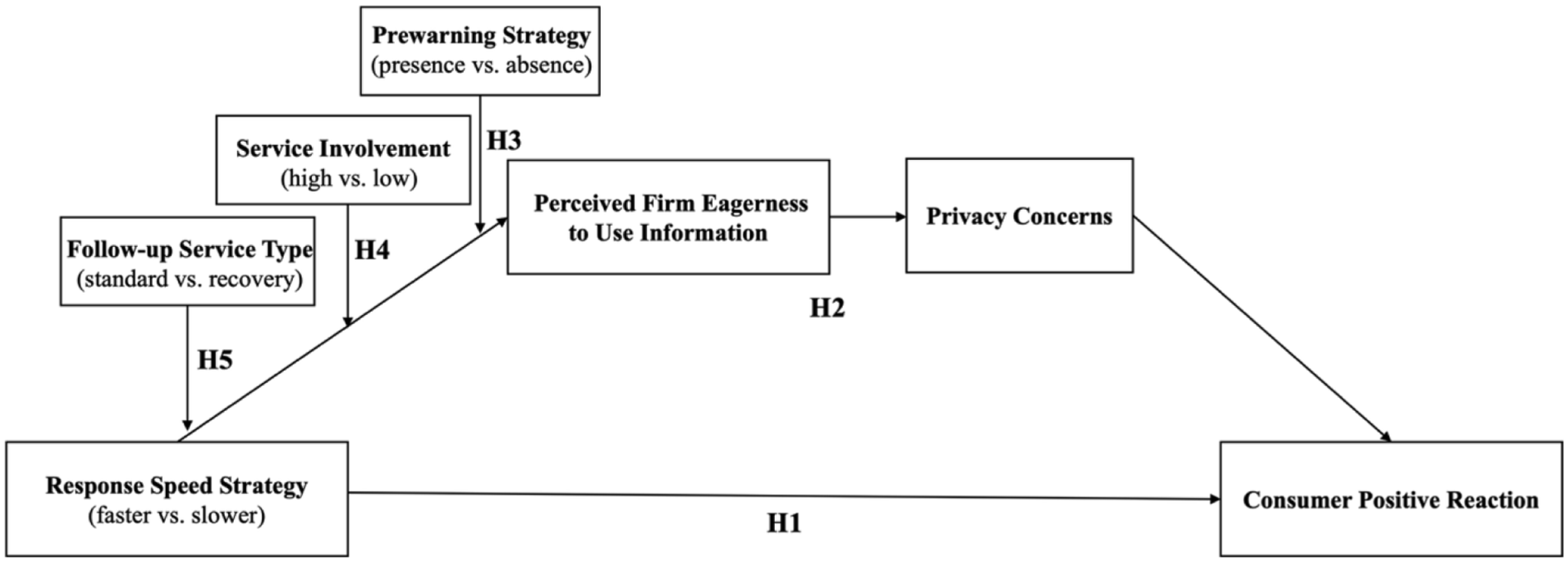
Research framework.
Study 1
Purpose
The primary objective of Study 1 is to establish the external validity of our central hypothesis by examining field data from a real-world, high-involvement service context. By analyzing actual marketing interactions, we test whether response speed (faster vs. slower) after the firm acquires consumers’ contact information affects consumers’ positive reactions.
Field Setting and Data Collection
The data for this study were obtained through collaboration with one of the largest automotive data analytics firms in China, which provides marketing services to prominent automotive brands such as Toyota, Honda, and Volkswagen. The automotive industry provides a strong field context for this research because vehicle purchases are highly involved, making consumers particularly sensitive to how firms use their personal information. The service interaction follows a structured Online-to-Offline conversion journey. It begins when consumers browse online platforms (e.g., car.com) and voluntarily submit their contact information to request dealership services (Camplone et al. 2013). These digital leads are then assigned to local dealerships, where salespeople make follow-up calls to address inquiries and invite customers to in-store consultations or test drives.
By capturing the granular timestamps for both the initial information submission and the subsequent follow-ups, this dataset enables precise measurement of response speed. The outcome variable, representing consumers’ decision to accept or decline the follow-up service invitation, serves as a direct behavioral proxy for their positive reactions to the firm’s marketing outreach. This unique field setting thus enables a robust analysis of how response speed affects consumers’ reactions in a real-world context.
Model and Measurement
Dependent Variable
In this study, the dependent variable is willingness, which captures customers’ willingness to accept follow-up service invitations and is measured as a binary indicator that equals 1 if the customer indicates they are willing to be contacted for follow-up services, and 0 otherwise.
Independent Variable
The independent variable, response speed, is operationalized as a binary measure. Based on the pretest results indicating that a 12-hour interval serves as a critical psychological threshold for same-day service expectations (see Supplemental Web Appendix B), responses occurring within 12 hours of receiving the customer’s contact information are categorized as faster responses, while those exceeding 12 hours are considered slower responses.
Regression Model
The analysis employs a Logit regression model, with the following specification:

where Willingnessi represents whether the customer i is willing to be contacted for follow-up services, which serves as a proxy for consumers’ positive reactions, β captures the effect of response speed on consumers’ positive reactions, Controli includes a set of control variables, and εi is the error term. The control variables in the model account for factors such as customer demographics, geographic proximity between the customer and the dealership, the price of the vehicle of interest (log-transformed), the source platform from which the customer information was obtained, and the car brand. Please see Supplemental Web Appendix C for details about the variable measurement.
Results
Main Analysis
The analysis reveals that faster responses significantly reduce the likelihood of consumers’ positive reactions. As shown in the Logit regression results, customers contacted within 12 hours of submitting their information exhibited a lower likelihood of being willing to accept follow-up services (β = −.09, p = .02). This finding provides initial empirical support for H1, suggesting that faster responses in a high-involvement field setting can heighten privacy concerns and diminish consumers’ willingness to accept follow-up services. To ensure the robustness of our findings and address potential model misspecification, we estimated the effect of response speed using multiple functional forms. While the Logit model is our primary specification, we also employed the Linear Probability Model for direct coefficient interpretability and the Probit model to test sensitivity to distributional assumptions. The pattern across all three models is consistent (β LPM = −.04, p < .001; β probit = −.06, p = .003). The details are reported in Supplemental Web Appendix C.
Propensity Score Matching
A critical concern in archival field data analyses is sample selection bias, as firms may naturally prioritize high-potential leads, thereby creating systematic differences between faster and slower response groups. To address this endogeneity concern, we conducted Propensity Score Matching to improve comparability between response groups.
Specifically, we estimated each customer’s propensity to receive a faster response based on observable characteristics, including demographics, vehicle price, source platform, and other variables listed as control variables (see Supplemental Web Appendix C). In the matched sample, where these confounding factors were balanced, faster responses continued to have a negative effect on consumers’ positive reactions (β = −.22, p < .001). This substantial increase in the magnitude of the coefficient after matching suggests that the negative impact of haste is even more pronounced when controlling for observable characteristics. Collectively, these results provide robust preliminary evidence for H1, which we further examine through controlled experimentation in Study 2.
Study 2
Purpose
Study 2 had three main objectives. First, this study aimed to provide causal evidence for the proposed effect of response speed (faster vs. slower) on consumers’ positive reactions, thereby testing H1. Second, we included a control condition to examine whether the observed effects were driven primarily by the faster or the slower response condition, thereby clarifying the direction of the main effect. Finally, we tested the proposed serial mediation mechanism via perceived firm eagerness to use information among consumers and their resulting privacy concerns. This study was preregistered at AsPredicted (https://aspredicted.org/35pc-pfz6.pdf).
Procedure and Measures
A total of 300 U.S. participants were recruited via Prolific and randomly assigned to one of three experimental conditions (response-speed strategy: faster vs. control vs. slower) (46.3% male, 53.0% female, 0.3% nonbinary, 0.3% preferred not to say; Mage = 45 years).
The study context involved health insurance services. Based on the pretest (see Supplemental Web Appendix B), participants estimated the average response time for health insurance services to be approximately 11.53 hours. Accordingly, the response time was set to 12 hours for the control condition, 8 hours for the faster condition, and 16 hours for the slower condition.
Participants were first presented with the following scenario: Recently, you have been considering purchasing private health insurance for yourself. To explore your options, you searched online and reviewed information from several insurance providers. As part of this process, you also logged into the official app of a national insurance brand with both online and physical branches and browsed several of its products. Afterward, you temporarily closed the app.
Participants were randomly assigned to one of three response-speed conditions: a faster response (contact after approximately 8 hours), a slower response (contact after approximately 16 hours), or a control condition reflecting the industry-normative response time (contact after approximately 12 hours).
All participants were then presented with the following message: The staff member first checked whether it is a convenient time to talk and asked about your needs and any questions you may have regarding health insurance. To help you better understand the insurance terms and select a suitable plan, the staff member invited you to attend a complimentary in-store consultation at the nearby branch. During the consultation, a professional advisor would explain coverage, waiting periods, claims procedures, the pricing structure, and how the plan will integrate with your existing insurance.
Detailed descriptions of the stimuli are provided in Supplemental Web Appendix E.
Subsequently, participants evaluated their willingness to accept the in-store consultation, privacy concerns, perceived firm eagerness to use information, and perceived response speed in the following order. Willingness to accept the in-store service invitation was measured with three items (α = .98; adapted from Lu et al. 2019; Yuan et al. 2022), for example, “I am willing to accept the in-store service invitation from the insurance firm’s staff” (1 = strongly disagree, 7 = strongly agree). Privacy concerns were measured with five items (α = .97; adapted from Mousavi et al. 2020), for example, “I am concerned that this firm is collecting too much information from me.” Perceived firm eagerness to use information was measured with three items (α = .93; adapted from Hwang et al. 2021), for example, “This firm is eager to use my personal information.” Perceived response speed was assessed with a single item (adapted from Ziano and Wang 2021): “How do you feel about the firm’s marketing communication response speed?” (1 = very slow, 7 = very fast) (see Supplemental Web Appendix A for the detailed scales information).
To control for potential additional confounds, participants also rated perceived product quality and the perceived sales performance of the product using 7-point Likert-type scales (1 = strongly disagree, 7 = strongly agree). Finally, demographic information (age and gender) was collected.
Results
Manipulation Check
An ANOVA on perceived response speed revealed a significant main effect of response speed strategy (F (2, 297) = 12.22, p < .001,
Main Effect
An ANOVA on willingness to accept the in-store service invitation showed a significant effect of response speed strategy (F (2, 297) = 5.37, p = .005,
Participants reported lower willingness in the faster condition (Mfaster = 3.86, SD = 1.89) than in the control condition (Mcontrol = 4.60, SD = 1.50; p = .003, d = −.43) and the slower condition (Mslower = 4.52, SD = 1.85; p = .008, d = −.35). No difference emerged between the control and slower conditions (p = .74). The effect remained significant after controlling for perceived product quality, perceived sales performance, age, and gender (F (2, 293) = 3.97, p = .02,
Privacy Concerns
An ANOVA on privacy concerns revealed a significant main effect, F (2, 297) = 7.75, p = .001, = .05. Participants reported higher privacy concerns in the faster condition (Mfaster = 4.91, SD = 1.67) than in the control (Mcontrol = 4.07, SD = 1.59; p < .001, d = .52) and slower (Mslower = 4.13, SD = 1.74; p = .001, d = .46) conditions.
Perceived Firm Eagerness to Use Information
An ANOVA on perceived firm eagerness to use information also revealed a significant main effect (F (2, 297) = 5.20, p = .006,
Serial Mediation
PROCESS Model 6 (Hayes 2017) was employed to examine the proposed serial mediation via perceived firm eagerness to use information and privacy concerns. The results indicated that the indirect effect of faster (vs. control) response on willingness to engage in further communication via perceived firm eagerness to use information and privacy concerns was significant (indirect effect = 0.13, 95% confidence interval [CI] [0.03, 0.26]). Similarly, the serial mediation for faster (vs. slower) response was significant (indirect effect = 0.16, 95% CI [0.05, 0.31]).
Discussion
The findings of Study 2 provide causal evidence for the proposed effect of response-speed strategies on consumers’ positive reactions (H1). Specifically, compared with the slower and control response conditions, faster responses reduced consumers’ willingness to accept in-store service invitations. Furthermore, the results further supported that the main effect was serially mediated by perceived firm eagerness to use information and privacy concerns. In the next study, we examine the moderating role of service involvement.
Study 3
Purpose
The purpose of Study 3 was to examine the moderating role of prewarning in the relationship between response-speed strategies and consumers’ positive reactions. Specifically, we tested whether the negative effect of faster (vs. slower) response speed on consumers’ reactions would be attenuated or become nonsignificant in the presence of a prewarning message (H3).
In addition, we aimed to test the robustness of our findings in an online educational training service context, using a single communication channel. This study was preregistered at AsPredicted (https://aspredicted.org/bv3p-fspj.pdf).
Procedure and Measures
A 2 (response speed: faster vs. slower) × 2 (prewarning: presence vs. absence) between-subjects design was employed. We recruited 400 Chinese participants via credamo (36.8% male, 62.8% female, 0.5% third gender; Mage = 31 years). Participants were randomly assigned to one of the four experimental conditions.
Participants first read a scenario describing their interest in enrolling in an online English course from Xintong Education. They were told that they had registered on the company’s official website using their phone number, browsed several English courses, and then closed the webpage. In the prewarning present condition, about 1 hour before the company called, participants read that they had received the following message: “Hello! This is Xintong Education. Thank you for browsing our courses on our official website. Our customer service representative would contact you soon to address your inquiries and introduce our latest promotional offers.” In the prewarning absent condition, participants did not receive any such message.
Based on the pretest (see Supplemental Web Appendix B), the average perceived response time for educational training services was 11.67 hours. Accordingly, participants were told that the company had contacted them either 9 hours (faster response) or 15 hours (slower response) after they had left the website. The customer service manager first checked whether it was a convenient time to talk, introduced a promotional offer (“You can take a one-on-one English trial lesson for only 50 RMB”), and asked if the participant was interested in enrolling in the trial class. Detailed descriptions of the stimuli are provided in Supplemental Web Appendix F.
After reading the scenario, participants sequentially reported their enrollment decision (Yes/No), privacy concerns (α = .73), perceived firm eagerness to use information (α = .94), perceived prewarning strategy, and perceived response speed. Privacy concerns, perceived firm eagerness to use information, and perceived response speed were measured using similar items to those used in Study 2.
To confirm the manipulation, participants were asked whether they were aware that the company would contact them before receiving the call (“Before receiving the call, I already knew the company would contact me for further marketing communication”) (Boerman et al. 2014; Campbell et al. 2013; Leon et al. 2003).
To rule out alternative explanations, we measured the following: scenario realism, using the item “Overall, how realistic do you think this marketing communication scenario was?” (1 = not realistic at all; 7 = very realistic); and brand familiarity, using the item “In your daily life, how familiar are you with Xintong Education?” (1 = not familiar at all; 7 = very familiar). Finally, participants provided demographic information.
Results
Manipulation Checks
A 2 (response speed: faster vs. slower) × 2 (prewarning strategy: presence vs. absence) ANOVA on perceived response speed revealed a significant main effect of response speed (Mfaster = 5.38, SD = 0.97; Mslower = 3.30, SD = 1.09; F(1, 396) = 402.34, p < .001,
A 2 (response speed: faster vs. slower) × 2 (prewarning strategy: presence vs. absence) ANOVA on perceived prewarning strategy revealed a significant main effect of prewarning strategy (Mpresence = 5.67, SD = 1.34; Mabsence = 4.38, SD = 1.62; F (1, 396) = 74.34, p < .001,
Enrollment Choice
A logistic regression with response speed, prewarning, and their interaction as predictors revealed a significant main effect of response speed (B = −0.94, Standard error [SE] = 0.31, Wald = 9.41, p = .002, Exp(B) = .391), no significant main effect of prewarning (p = .50), and a significant interaction (B = 1.27, SE = 0.48, Wald = 7.08, p = .01, Exp(B) = 3.57).
In the absence of the prewarning strategy, fewer participants enrolled under the faster-response condition (54.0%) than under the slower-response condition (75.0%; B = −0.94, Wald = 9.41, p = .002, Exp(B) = .39). In the presence of the prewarning strategy, the difference between faster (84.0%) and slower (79.0%, p = .36) response conditions disappeared (see Supplemental Web Appendix D-Figure W1).
Privacy Concerns
A 2 × 2 ANOVA revealed main effects of response speed (F (1, 396) = 11.68, p = .001,
In the absence of a prewarning strategy, faster responses (vs. slower responses) elicited greater privacy concerns (Mfaster = 5.50, SD = .86; Mslower = 4.83, SD = 1.03; F (1, 396) = 22.29, p < .001,
Perceived Firm Eagerness to Use Information
A 2 × 2 ANOVA revealed a significant main effect of prewarning (F (1, 396) = 12.92, p\< .001,
Moderated-Mediation Effect
A moderated-mediation analysis (Model 83; Hayes 2017) was conducted, in which response speed as the independent variable, enrollment choice as the dependent variable, perceived firm eagerness to use information and privacy concerns as sequential mediators, and prewarning as the moderator, moderating the path from response speed to perceived firm eagerness to use information.
Results revealed a significant moderated-mediation effect (index = 0.40, 95% CI [0.09, 0.95]). Without prewarning, there was a significant indirect effect through perceived firm eagerness to use information and privacy concerns (indirect effect = −0.30, 95% CI [−0.70, −0.07]), whereas with prewarning, the indirect effect was nonsignificant (indirect effect = 0.11, 95% CI [−0.08, 0.36]). When including brand familiarity and scenario realism as covariates, the moderated mediation remained significant (index = 0.48, 95% CI [0.13, 1.09]), indicating a consistent pattern.
Discussion
The results of Study 3 provide robust evidence for the moderating role of prewarning (H3). Specifically, when consumers were forewarned that the company would initiate marketing contact, the negative effect of faster (vs. slower) responses speed on positive reactions disappeared. These findings suggest that prewarning effectively reduces consumers’ perceived firm eagerness to use information and their resulting privacy concerns. However, this interaction effect may be influenced by perceived service professionalism; therefore, we rule it out in the subsequent study. In the next study, we further explore another boundary condition, namely, the moderating effect of service involvement.
Study 4
Purpose
The purpose of Study 4 was to examine the moderating effect of service involvement. Specifically, we aimed to test whether the proposed effect of response-speed strategy (slower vs. faster) on consumers’ positive reactions would diminish for low-involvement services (H4). In addition, we sought to verify whether the observed effect held across different service contexts (i.e., financial consulting) and among Chinese participants, to further test the robustness of our findings. This study was pre-registered at AsPredicted (https://aspredicted.org/spbw-rdv2.pdf).
Procedure and Measures
Study 4 employed a 2 (response-speed strategies: faster vs. slower) × 2 (service involvement: high vs. low) between-subjects design. A total of 400 Chinese participants were recruited from Credamo and randomly assigned to one of the four conditions (38.0% male, 61.8% female, 0.3% preferred not to say; Mage= 32 years).
In the low service involvement (vs. high involvement) condition, participants first read the following scenario: You are currently considering investing in a small, short-term financial product. This decision involves a modest amount of money and has little impact on your future financial security or lifestyle (vs. a large long-term financial product involving a substantial amount of money that could significantly affect your financial security and lifestyle).
Participants were then presented with the following scenario: “To explore potential investment options, you visited the official website of an online financial consulting company, registered an account, and browsed several of its investment and wealth management products. Afterward, you exited the website.”
Based on the pretest (see Supplemental Web Appendix B), the average perceived response time for financial consulting services was 10.63 hours. Accordingly, in the faster response condition, participants were told that 7 hours after they had left the website, a service staff member had called them, whereas in the slower response condition, the call occurred 14 hours after they had left the website. In both conditions, participants were told that the service representative recommended a financial product tailored to their browsing history and registration data, emphasized that it was a personalized offer, and invited them to consider purchasing it. Detailed descriptions of the stimuli are provided in Supplemental Web Appendix G.
Subsequently, participants sequentially reported their purchase choice, privacy concerns, perceived firm eagerness to use information, perceived service involvement, and perception of response speed.
Purchase choice was measured with a binary item: “Would you purchase this product?” (Yes/No). Privacy concerns (α= .97), perceived firm eagerness to use information (α= .84), and perceived response speed were measured using the same scales as in Study 2. Perceived service involvement was measured with three items: “I will plan this investment decision very carefully,” “This investment decision is extremely important to me,” and “I am highly interested in this investment decision” (1= strongly disagree, 7= strongly agree) (α= .84; adapted from Mittal 1995; Zaichkowsky 1985). To control for potential confounds, participants also rated the following items on 7-point Likert scales (1= strongly disagree, 7= strongly agree): perceived commission reliance, using the item “I think the company’s staff rely too heavily on high commissions”; perceived service professionalism, using the item “I think the company’s service is very professional”; and perceived service efficiency, using the item “I think the company’s service is very efficient.” Finally, participants reported their demographic information (age and gender).
Results
Manipulation Checks
A 2 (response speed strategy: faster vs. slower) × 2 (service involvement: high vs. low) ANOVA on perceived response speed revealed a significant main effect of response speed (Mfaster= 5.69, SD= 1.04; Mslower= 3.59, SD = 1.46; F (1, 396) = 237.86, p < .001,
A separate ANOVA on perceived service involvement revealed a significant main effect of service involvement (Mhigh = 5.87, SD = 0.95; Mlow = 4.88, SD = 1.31; F (1, 396) = 74.58, p < .001,
Purchase Choice
A logistic regression with response speed (faster vs. slower), service involvement (high vs. low), and their interaction predicting purchase choice revealed a significant interaction effect (B = −0.93, SE = 0.42, Wald = 4.95, p = .03, Exp(B) = .39). In the high-involvement condition, fewer participants chose to purchase under the faster response (38.0%) than under the slower response condition (62.0%; B = −0.98, p = .001, Exp(B) = .38). In the low-involvement condition, purchase rates did not differ between faster (67.0%) and slower (68.0%) response conditions (p = .88) (see Supplemental Web Appendix D-Figure W3).
Privacy Concerns
A 2 × 2 ANOVA on privacy concerns revealed significant main effects of response speed (F (1, 396) = 7.52, p = .006,
Perceived firm eagerness to use information
A 2 × 2 ANOVA revealed significant main effects of response speed (F (1, 396) = 5.42, p = .02,
Moderated-Mediation Effect
A moderated-mediation analysis (PROCESS Model 83; Hayes 2017) was conducted, in which response speed was treated as the independent variable, purchase choice as the dependent variable, perceived firm eagerness to use information and privacy concerns as mediators, and service involvement as a moderator on the a-path between response speed and perceived firm eagerness to use information. Results revealed a significant moderated mediation (index = −0.52, 95% CI = [−0.94, −0.13]). In the high-involvement condition, the indirect effect of response speed on purchase choice through perceived firm eagerness to use information and privacy concerns was significant (indirect effect = −0.49, 95% CI [−0.78, −0.25]). In contrast, this indirect effect was nonsignificant in the low-involvement condition (indirect effect = 0.03, 95% CI [−0.29, 0.34]). When including perceived commission reliance, perceived service professionalism, and perceived service efficiency as covariates, the moderated mediation remained significant (index = −0.12, 95% CI [−0.27, −0.01]), indicating a consistent pattern.
Discussion
The results of Study 4 provided robust evidence for the moderating role of service involvement (H4). Specifically, for low-involvement services, the negative effect of the faster response speed strategy on consumers’ positive responses (i.e., purchase choice) disappeared. These findings provide additional support for the boundary condition of the proposed effect. In the next study, we examine another moderator, namely, follow-up service type.
Study 5
Purpose
The purpose of Study 5 was to examine the moderating effect of follow-up service type. Specifically, we aimed to test whether, in the case of service recovery follow-ups, the effect of response speed strategy (slower vs. faster) on consumers’ positive reactions would be attenuated or become nonsignificant (H5).
Additionally, this study sought to test the robustness of our findings in the automobile purchase consultation context. This study was pre-registered at AsPredicted (https://aspredicted.org/yzwq-ywmm.pdf).
Procedure and Measures
Study 5 adopted a 2 (response speed: faster vs. slower) × 2 (follow-up service type: standard service follow-up vs. service recovery follow-up) between-subjects design. A total of 400 UK participants were recruited via Prolific and randomly assigned to one of four conditions (50.0% male, 49.5% female, .3% third gender, .3% preferred not to say; Mage = 46 years).
Participants first read the following scenario: “Recently, you have been considering purchasing a car through an online car dealership platform.” Based on the pretest (see Supplemental Web Appendix B), the average perceived response time for car consultation services was 12.26 hours.
In the service recovery follow-up–faster response condition, participants were presented with the following scenario: You registered on the platform with your phone number and browsed several car models via its official app. During this process, you encountered repeated app crashes and instability issues that disrupted your browsing experience. Afterward, you temporarily exited the app. Approximately 9 hours later, the platform’s customer service manager had called you. She first apologized for the inconvenience you had experienced and confirmed whether it was a good time to talk. Then, she asked if you needed help with submitting information or learning more about the models and expressed a willingness to continue the conversation.
In the service recovery follow-up–slower response condition, the only difference was again the time interval (15 hours). Detailed descriptions of the stimuli are provided in Supplemental Web Appendix H.
Subsequently, participants sequentially evaluated their willingness to engage in further communication, privacy concerns, perceived firm eagerness to use information, perceived response speed, and perceived follow-up service type.
Willingness to engage in further communication was measured with a three-item scale (α = .98): “I am willing to engage in further communication with the firm’s customer service staff”; “I want to have further communication with the firm’s customer service staff”; “I am likely to engage in further communication with the firm’s customer service staff” (adapted from Lu et al. 2019; Yuan et al. 2022).
Privacy concerns (α = .96), perceived firm eagerness to use information (α = .88), and perceived response speed was assessed with similar scales used in Study 2. To verify whether participants perceived the manipulation of follow-up service type, they responded to the following item: “To what extent do you feel the customer service contact was motivated by the following? (1= standard service follow-up; 7= service recovery follow-up).”
Finally, participants provided demographic information (age and gender) at the end of the survey.
Results
Manipulation Checks
A 2 × 2 ANOVA on perceived response speed revealed a main effect of response speed (Mfaster = 4.70, SD = 1.50; Mslower = 4.25, SD = 1.34; F (1, 396) = 9.80, p = .002,
Another ANOVA on perceived follow-up service type revealed a main effect of follow-up service type (Mstandard = 3.76, SD = 1.77; Mrecovery = 4.95, SD = 1.47; F (1, 396) = 53.35, p<.001,
Willingness to Engage in Further Communication
A 2 × 2 ANOVA on willingness to engage in further communication revealed a significant main effect of follow-up service type (F (1, 396) = 9.05, p = .003,
Privacy Concerns
The ANOVA revealed significant main effects of both response speed (F (1, 396) = 5.43, p = .02,
Perceived Firm Eagerness to Use Information
A similar pattern emerged for perceived firm eagerness to use information: the main effect of response speed was marginally significant (F (1, 396) = 2.87, p = .09,
Moderated-Mediation Effect
To further test the proposed mechanism, a moderated-mediation analysis (Model 83; Hayes 2017) was conducted, with response speed as the independent variable, willingness to engage in further communication as the dependent variable, perceived firm eagerness to use information and privacy concerns as mediators, and follow-up service type as the moderator (on the path from response speed to perceived firm eagerness to use information). The results revealed a significant moderated mediation effect (index = −0.18, 95% CI [−0.37, −0.01]). For standard service follow-ups, there was a significant indirect effect of response speed on willingness through perceived firm eagerness to use information and privacy concerns (indirect effect = −0.17, 95% CI [−0.31, −0.04]). For service recovery follow-ups, this indirect effect was nonsignificant (indirect effect = 0.02, 95% CI [−0.11, 0.14]).
Discussion
The results of Study 5 provide empirical evidence supporting the moderating role of follow-up service type (H5). Specifically, in the case of service recovery follow-ups, faster (vs. slower) marketing communication did not diminish consumers’ positive reactions to the firm’s outreach. This finding identifies an important boundary condition under which the negative impact of rapid marketing communication may not occur.
General Discussion
Key Findings
Advances in AI and data technologies enable firms to integrate consumer information across touchpoints, generate deeper insights, and enhance user experience (Okazaki et al. 2020; Quach et al. 2022). Consequently, firms adopt faster response strategies to achieve marketing agility and sustain competitive advantage (Kalaignanam et al. 2021). Yet, while digital agility improves operational efficiency, it can heighten privacy concerns, limiting the benefits of technology-enabled marketing (Aiello et al. 2020).
Focusing on digital service marketing, we examine how firms’ response speed after automatically acquiring consumer data shapes perceived data use and subsequent reactions. Using field data and controlled experiments, we find that faster (vs. slower) responses increase consumers’ perceptions that the firm is eager to use their personal information. This perception elevates privacy concerns, which in turn reduce favorable reactions to marketing communication; that is, the effect of response speed on positive reactions is serially mediated by perceived firm eagerness to use information and privacy concerns.
This main effect is moderated by three boundary conditions. First, prewarning messages informing consumers of forthcoming personalized communication reduce perceived firm eagerness to use information and privacy concerns, mitigating the negative impact of fast response. Second, in low-involvement contexts where consumers rely on heuristics and exert limited cognitive effort (Gu et al. 2012; Pansari and Kumar 2017), the effect disappears. Finally, in service recovery scenarios, fast responses signal responsibility and empathy rather than excessive data use (Bhandari et al. 2007), attenuating the main effect observed in standard interactions.
Theoretical Contributions
First, our findings advance the literature on reducing consumers’ privacy concerns. Prior studies have focused mainly on individual-level determinants—such as perceived control (Morimoto 2021), self-efficacy (Schade et al. 2018), and trust (Bleier and Eisenbeiss 2015)—or content-based strategies, including transparency cues, personalization benefits (Ham 2017; Kim et al. 2019), and linguistic framing (Lv et al. 2025). In contrast, this research highlights firms’ behavioral cues after data acquisition, identifying response speed as a critical signal that shapes privacy perceptions. Specifically, faster responses increase perceived firm eagerness to use information, thereby amplifying privacy concerns. By moving beyond perceptual and content-based mechanisms, this study extends privacy research to interactional behavioral cues in digital service contexts.
Second, this research enriches the digital service marketing literature by elucidating how firms should communicate after automatically obtaining consumer data. While advances in AI and big data have enhanced firms’ ability to integrate consumer information across touchpoints (Cui et al. 2021; Okazaki et al. 2020; Quach et al. 2022), they have also intensified privacy challenges (Steinhoff and Martin 2023). Addressing this gap, our findings show that response speed functions as a salient psychological trigger that shapes consumer reactions through perceived firm eagerness and privacy concerns. This work thus offers a novel framework for understanding the efficiency–privacy trade-off, emphasizing that the tempo of firm behavior, not only data practices, is a key source of perceived privacy risk.
Third, our research extends the literature on service response speed by integrating insights from the persuasion knowledge model (Friestad and Wright 1994). Whereas prior research has primarily emphasized the benefits of fast responses (Dai and Zhang 2019; Mattila and Mount 2003; Förster et al. 2003), our findings reveal an important downside in data-driven service interactions. When consumers are aware that firms possess their personal data, excessively fast responses can activate persuasion knowledge, prompting inferences of excessive eagerness and strategic intent, which in turn heighten privacy concerns and trigger defensive reactions. Importantly, we show that this effect can be mitigated through prewarning communication and is attenuated in low-involvement or recovery service contexts. By conceptualizing response speed as a communication cue that activates persuasion knowledge, this research extends the persuasion knowledge model in digital service marketing contexts and advances understanding of when and why fast responses may backfire.
Practical Implications
First, firms engaged in digital communication should recognize the inherent paradox between service efficiency and consumer privacy. Faster responses can backfire if perceived as intrusive, especially after the firm has collected personal data. Our findings demonstrate that excessively fast responses heighten perceived firm eagerness to use information among consumers, which subsequently amplifies privacy concerns and undermines receptivity to marketing communications. From a managerial perspective, this implies that speed should not be viewed as an unconditional virtue. In data-driven service encounters, carefully balancing efficiency with respect for psychological boundaries is critical. Firms that reflexively optimize for speed risk activating persuasion knowledge and privacy-related skepticism, thereby eroding the very effectiveness that rapid responses are intended to achieve.
Second, the efficiency–privacy paradox is context-dependent. Not all service situations require equal attention to this trade-off. Firms should calibrate response speed based on service involvement and service type. We find that the negative effects of fast responses are attenuated for low-involvement services and service recovery contexts, where consumers prioritize convenience and problem resolution over privacy vigilance. Accordingly, marketers can strategically modulate response speed by slowing down in high-involvement or privacy-sensitive contexts to signal caution, while maintaining agility in low-involvement or post-failure interactions to enhance satisfaction. This context-contingent approach enables firms to optimize both operational efficiency and psychological safety in digital environments.
Third, when faster responses are desirable in standard service or high-involvement contexts, firms can implement “privacy pre-warning” strategies to build a trust buffer before rapid interactions occur. By transparently notifying consumers in advance that personalized, data-driven communication will follow, firms can create a psychological buffer that reduces perceived firm eagerness to use information and dampens privacy concerns, even when responses are rapid. Practically, this suggests that brief prewarning messages delivered via SMS, app notifications, or email can meaningfully reframe subsequent fast responses as signals of preparedness and attentiveness rather than intrusion. More broadly, this approach underscores the value of preemptive transparency as a low-cost, scalable tool for reconciling speed with trust in digital service environments.
Limitations and Future Research Directions
Although our findings are robust across multiple methods and data sources, several limitations point to promising directions for future research and situate the present work within a broader research agenda.
First, the present research abstracts away from competitive dynamics that are pervasive in real-world service environments. Consumers often interact with multiple firms simultaneously, and response speed may be evaluated relative to competitors rather than in isolation. Future research could incorporate competitive response timing to examine how relative speed influences consumer choice, motive inference, and privacy-related concerns.
Second, while response speed was operationalized using standardized time intervals to ensure internal validity, temporal norms such as time of day, same-day versus next-day contact, and communication channel were not explicitly modeled. Future research could examine how response timing relative to consumers’ initial contact and situational expectations shapes perceptions of responsiveness, appropriateness, and intrusiveness.
Third, future research should move beyond linear effects to explore the potential inverted U-shaped relationship between response speed and consumer responses. Whereas slow responses may signal neglect or inefficiency, overly fast responses may elicit suspicion or privacy concerns. Identifying the optimal response timing and how it varies across decision stages and information complexity represents an important extension of the current findings.
Fourth, although this research highlights privacy concerns as an important psychological mechanism, faster responses may also trigger broader motive-based inferences, such as perceptions of aggressive selling, profit-seeking, or low deal quality. Future research could disentangle privacy-related concerns from other inferred motives and examine their relative influence across service contexts.
Fifth, our findings demonstrate that prewarning communication can mitigate the negative effects of faster responses, yet we operationalized prewarning in a specific and standardized manner. Future research could systematically vary the timing, format, or granularity of prewarning messages to examine how different implementations shape persuasion, knowledge activation, and consumer responses. In addition, future studies could further validate the proposed underlying process by directly measuring persuasion knowledge activation or experimentally manipulating consumers’ awareness of firms’ persuasive intent, thereby providing a more comprehensive account of the mechanisms through which response speed shapes consumer reactions.
Supplemental Material
sj-docx-1-jsr-10.1177_10946705261447627 – Supplemental material for Haste Makes Waste: How Faster Responses after Data Collection Trigger Consumer Privacy Concerns and Reduce Positive Reactions
Supplemental material, sj-docx-1-jsr-10.1177_10946705261447627 for Haste Makes Waste: How Faster Responses after Data Collection Trigger Consumer Privacy Concerns and Reduce Positive Reactions by Linxiang Lv, Tao He, He Wang and Lingpiao Wang in Journal of Service Research
Footnotes

Author Contributions
The first author and the second author contributed equally to this work.
Funding
The authors disclosed receipt of the following financial support for the research, authorship, and/or publication of this article: This research was supported by the National Natural Science Foundation of China (72502039), the Natural Science Foundation of Liaoning Province (2025-BS-0109), the Fundamental Research Funds for Central Universities (N25XQD037), the China Postdoctoral Science Foundation (2024M760373), and the Postdoctoral Fellowship Program of CPSF under Grant Number GZB20250179.
Declaration of Conflicting Interests
The authors declared no potential conflicts of interest with respect to the research, authorship, and/or publication of this article.
Supplemental Material
Supplemental material for this article is available online.
Author Biographies
References
Supplementary Material
Please find the following supplemental material available below.
For Open Access articles published under a Creative Commons License, all supplemental material carries the same license as the article it is associated with.
For non-Open Access articles published, all supplemental material carries a non-exclusive license, and permission requests for re-use of supplemental material or any part of supplemental material shall be sent directly to the copyright owner as specified in the copyright notice associated with the article.
