







Abstract
This article presents the 2026 Service Research Priorities (SRPs), developed via a hybrid AI–human agenda-setting approach. We construct large-scale concept networks from more than 10,500 service-related articles in core service journals and Financial Times (FT) 50 outlets, and apply machine-learning link prediction to identify high-probability, but underexplored, concept pairs. Fifteen forward-looking themes emerge that fall into four topical clusters: (a) Human–AI Agency, Interactions, and Service Reconfiguration; (b) AI-Enabled Omnichannel Engagement and Ecosystem Orchestration; (c) Responsible, Inclusive, and Resilient AI Service Systems; and (d) Psychological Dynamics of Service Experiences. Comparing the themes’ relevance in the service outlets vis-à-vis the FT50 journals helps identify where service research currently leads, where it imports from adjacent disciplines, and where cross-fertilization is most promising. Furthermore, we reflect our themes against the 2021 SRPs, distinguishing “emerging,” “evolved,” and “continuing” priorities. Importantly, we also survey the Journal of Service Research leadership to further calibrate and enrich the AI-derived SRPs. Next, we introduce a new descriptive statistic, the “Interdisciplinary Influence Index,” to map which disciplines “drive” a particular service theme within the literature broadly defined. Finally, we provide the “Interactive Service Scholarship Incubator” app that enables scholars to explore the underlying concept network, predicted links, and themes, in light of their own interests and skill sets. Together, these SRPs offer a scalable roadmap for high-impact future service scholarship and practice.
This is a visual representation of the abstract.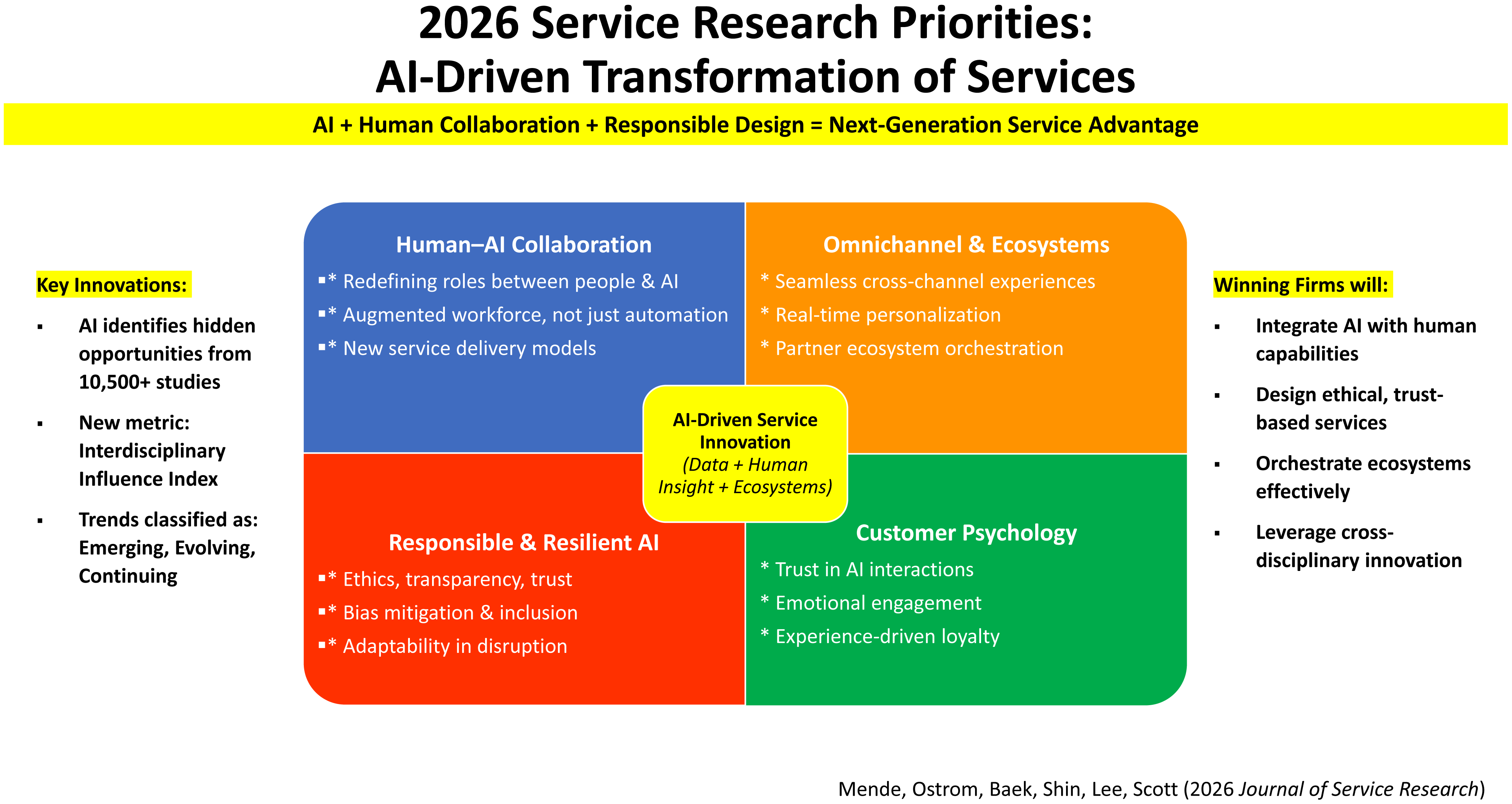
Keywords
Introduction
Agenda-setting scholarship has played a pivotal role in shaping the trajectory of service research and beyond, offering shared frameworks that align academic inquiry with evolving managerial, consumer, and societal needs (MacInnis et al. 2020; Marketing Science Institute 2024; Moorman et al. 2019; Ostrom et al. 2010, 2015, 2021). Through systematic synthesis of expert insight, research-priority agendas help scholars diagnose research opportunities, anticipate emerging issues, and design rigorous, impactful programs of inquiry; for journals, funding agencies, and researchers alike, such frameworks function as strategic tools that guide topic selection, foster theory advancement, and inspire interdisciplinary collaboration (Aksoy et al. 2019; Bolton et al. 2018; Keating et al. 2018).
Within service research, few agenda-setting efforts have been as influential as the Service Research Priorities (SRPs) by Ostrom et al. (2010, 2015, 2021; Field et al. 2021). Across three iterations, the SRPs provided consensus-based, forward-looking guidance that helped unify a diverse community, expanded the conceptual boundaries of the field, and articulated how service systems create value for firms, customers, and society at large (Anderson et al. 2013). Although the SRPs offered increasingly systemic and purpose-driven perspectives, the pace and magnitude of disruption since 2021 indicate the need for an updated perspective. Profound technological change—particularly the evolution of artificial intelligence (AI)—is transforming service and marketing, redefining value co-creation, and raising far-reaching ethical and experiential questions (Belanche et al. 2024; Davenport and Mittal 2023; Huang and Rust 2018, 2021a, 2021b; Keating et al. 2018; Kunz et al. 2019; Wirtz et al. 2018). Simultaneously, climate pressures, geopolitical instability, demographic transitions, and new forms of labor continue to reshape service landscapes (Field et al. 2021; Ostrom et al. 2021).
These developments demand an AI-embracing research agenda equipped to address interconnected challenges spanning environmental sustainability, digital governance, social equity, and institutional resilience. Moreover, the methodological foundations of (service and marketing) scholarship are themselves being reshaped (Arora et al. 2025; Berger et al. 2025; Blanchard et al. 2025; Blythe et al. 2025; De Freitas et al. 2025; Krenn et al. 2020, 2022). The exponential growth of scientific output—and the rising complexity of service systems—has intensified the need for new tools to detect research opportunities and synthesize literature at scale (Agarwal et al. 2024; Delgado-Chaves et al. 2025). AI, particularly large language models (LLMs) and machine-learning techniques, enable large-scale text synthesis, semantic mapping, dynamic topic modeling, and link prediction (Behrouzi et al. 2020; Chaoguang et al. 2025; Frohnert et al. 2025; Grootendorst 2022; Krenn et al. 2023; Wang et al. 2022; Wu et al. 2025; Xiong et al. 2025; Zhang et al. 2025). Such AI systems can surface co-evolving themes, identify underexplored research areas, and augment expert-driven agenda-setting. While these tools do not replace interpretive human expertise, they enrich the analytical capacity for developing robust, forward-looking research priorities.
Against this backdrop of accelerated technological, societal, and methodological change, the 2026 SRPs are conceived as a timely renewal of the field’s research agenda. Our work makes multiple contributions to service research. First, we introduce an AI-assisted agenda-setting approach that uses link prediction on large-scale concept networks to identify novel research opportunities. Rather than relying solely on human expert judgment, we leverage LLMs to extract the existing knowledge structure from the literature, then apply machine learning to identify concept pairs that this structure suggests should be connected but are not yet fully developed. This provides a scalable, replicable way to detect nascent research spaces and complements traditional approaches via human expertise (e.g., Delphi-style or survey-based priority setting). 1
Second, through this methodological approach, we identify fifteen research themes and quantify how they are differentially rooted in the service literature as well as in Financial Times 50 (FT50) outlets. By distinguishing themes driven primarily by endogenous service scholarship from those imported from adjacent fields, and by identifying “linkage themes” that are prominent in both corpora, we offer a nuanced map of where service research currently leads, where it lags, and where cross-fertilization with marketing, operations, and management is promising.
Third, by systematically comparing our themes with the 2021 SRPs (Field et al., 2021; Ostrom et al. 2021), we recast the evolution of the field in terms of “emerging,” “evolved,” and “continuing” priorities. This lens shows how earlier SRPs have differentiated into more specific directions (e.g., from technology replacement to human–AI collaboration), which topics remain stable, and which new priorities (e.g., temporal service dynamics, privacy–personalization ethics) have arisen in response to generative AI and regulation.
Fourth, our analyses provide the first holistic, multi-disciplinary picture of the service literature by introducing what we term the “Interdisciplinary Influence Index.” This novel descriptive statistic indicates which disciplines primarily “drive” the discourse around a given theme within the broader service research landscape. This approach allows us to identify domains where service research is an intellectual net “exporter” of concepts (service-dominated communities), domains where it is largely an intellectual “importer” (communities led by operations, marketing, strategy), and hybrid zones of effective cross-fertilization. Moreover, in contrast to traditional counts of publications or citations, our Interdisciplinary Influence Index is grounded in the structure of the concept network; as such, it reveals which disciplines are central to the conceptual anatomy of each research area, not merely where papers are published. In this regard, it is notable that, aggregating across all conceptual communities, the service discipline has the largest average share (≈0.18), followed by operations (≈0.14), marketing, management, and information systems. This indicates that service research is not confined to a niche; rather, it is interwoven across the broader knowledge structure of business research.
Fifth, we provide the “Interactive Service Scholarship Incubator” (ISSI), which is an interactive web application built on the full literature corpus and link predictions used in our analyses: https://interactive-service-scholarship-incubator.vercel.app/. That is, rather than “freezing” our agenda into a static list of priorities, the ISSI allows scholars to dynamically explore the underlying concept network, inspect predicted links, and navigate themes according to their own interests, domains, and methodological preferences. In doing so, we personalize and democratize access to the AI-supported discovery process: researchers can interrogate the evidence behind our themes, identify additional opportunities beyond those we highlight, and leverage the tool for their own research programs. This interactive resource exemplifies how agenda setting can evolve in the age of AI-supported science—from one-off priority lists toward living, transparent, and collectively explorable knowledge maps.
Together, these contributions position our work as a methodological template for AI-enabled agenda setting and a substantive roadmap for future service research.
SRPs: Overview, Context, and Background
Previous SRPs: The Contributions of Ostrom and Colleagues
Understanding how service systems create and sustain value for customers, firms, and society has long been a defining question for service research. Among the most influential efforts to articulate a shared agenda are the SRPs by Ostrom et al. (2010, 2015, 2021; Field et al. 2021; see Supplemental Web Appendix A). In these papers, the authors synthesized extensive input from academics and practitioners worldwide to establish a comprehensive, dynamic agenda for service research.
The 2010 Agenda: Foundations for the Science of Service
The foundational paper (Ostrom et al. 2010) sought to unify a relatively fragmented domain by articulating ten broad priorities. Developed through a large-scale, multi-stakeholder process led by the Center for Services Leadership at Arizona State University, these SRPs emphasized the relevance of service innovation, design, technology, networks, and measurement. Importantly, they also introduced transformative service research—the study of how services enhance individual and collective well-being (Anderson et al. 2013)—as a key concern. Collectively, the 2010 SRPs indicated a shift from firm-centric conceptions of service to a broader, systemic perspective emphasizing co-creation with customers and societal outcomes. This marked an important evolution: service research would no longer be confined to customer satisfaction or operational efficiency but, in addition, explore how service systems contribute to human, social, and societal flourishing.
The 2015 Update: Service Research in a Rapidly Changing Context
Five years later, Ostrom et al. (2015) revisited the agenda in light of technological and societal disruptions. The 2015 iteration identified twelve priorities, reflecting developments such as digital transformation, globalization, and data analytics. While themes such as service innovation, design, and value creation remained central, new emphases emerged around big data, employee engagement, servitization (i.e., the shift from products to service-based value propositions), and the global context of service. As such, the 2015 SRPs framed services as interconnected socio-technical systems, highlighting the need for multi-level analysis that links individual, organizational, and ecosystem perspectives. In terms of methods, Ostrom et al. (2015) called for greater interdisciplinarity and methodological pluralism, arguing that the complex nature of service requires integration across marketing, operations, information systems, and social sciences. Conceptually, the agenda drew on service-dominant logic, systems theory, and network perspectives to understand how value is co-created in dynamic, data-rich environments.
Evolving Themes in 2021: Service Research in Turbulent Times
The most recent set of SRPs (Field et al. 2021; Ostrom et al. 2021) recognizes a turbulent context for service research: a period characterized by uncertainty, crises, and transformation. Building on the earlier versions, the 2021 SRPs emphasize resilience, inclusivity, sustainability, and digital transformation. That is, the focus was not only on identifying what topics to study but also on articulating why service research matters for society at large. This view further bolstered the notion that service systems are not only economic engines but also critical infrastructures for human well-being, public health, and environmental stewardship. Critically, the 2021 agenda also highlighted how service research can contribute to addressing global challenges such as climate change, inequality, and digital ethics, issues that extend well beyond traditional firm-centric service contexts.
Significance and Enduring Influence
The three preceding SRPs remain central for several reasons: they provide a shared vocabulary that unites diverse subfields and disciplines within our research community (cohesion); they incorporate societal and technological shifts to help ensure that academic research remains aligned with pressing real-world issues (relevance); the periodic updates indicate an adaptive framework for service research that evolves alongside its context (dynamics); and they function as diagnostic tools for identifying research opportunities, framing proposals, and positioning contributions within the broader literature (guidance). These valuable aspects notwithstanding, we recognize some limitations. The SRPs are typically intentionally broad and sometimes lack operational specificity, which can make empirical translation challenging. Moreover, rapidly evolving issues (e.g., AI, sustainability) require continued refinement of the agenda.
Considerations Inspiring the 2026 SRPs
The pace and magnitude of technological advancements and societal disruption since 2021 inspired the 2026 iteration of SRPs, as we briefly highlight below.
Accelerating Technological Transformation
AI and automation are evolving from emerging tools into pervasive infrastructures transforming the design, delivery, and experience of service (Huang and Rust 2018, 2021b). Since 2021, the proliferation of AI, autonomous systems, and algorithmic decision-making has reshaped service encounters and the nature of value co-creation and human labor. Prior SRPs recognize “technology” and “digital transformation” as broad themes but lack detailed conceptualization of AI’s social, ethical, and experiential implications. Our SRPs offer a variety of research themes for a better understanding of AI and algorithmic service design, data governance, and trust in digital ecosystems.
Service–Society Nexus and Shifts in Global Systems
The 2021 SRPs introduced “resilience” and “inclusivity” as guiding principles, but the need for responsible and resilient service systems has only intensified since then. The post-pandemic period has witnessed ongoing geopolitical and economic instability, demographic transitions, and evolving labor models. Hybrid work, platform labor, and geopolitical value-chain disruptions continue to reshape employment and service systems. Moreover, complex issues such as social justice, accessibility, and diversity challenge business models and service operations. Because services are macro-, meso-, and micro-level mechanisms that are directly linked to achieving sustainable societal well-being, our SRPs include various facets of service ecosystems governance as well as transformative service research related to vulnerable populations, human (customer/employee) well-being, and crisis-resilient service systems.
Methodological Innovation and Open Science
Prior SRPs emphasized methodological pluralism but predated the surge of AI-driven analysis, computational modeling, and open-science practices. Future research will rely increasingly on hybrid methodologies, for example, by combining qualitative depth, digital ethnography, machine learning, and experimental design. Our SRPs deliberately leverage methodological innovation by combining AI analysis with input from human experts, thereby practicing the digital transformation we seek to study.
Collective Evolution and Stimulation
Finally, the Ostrom et al. series has always been as much a community-building exercise as a research roadmap. Revisiting the SRPs in 2026 helps renew the collective dialogue among academics and practitioners at a time when the topics and boundaries of service research are evolving rapidly in a world-on-edge. A new iteration thus not only captures emerging themes but also reaffirms the discipline’s societal relevance, ensuring that service research continues to make a difference in an increasingly complex world.
The Increasing Role of AI in Identifying Research Opportunities
The exponential growth of scientific output has made it increasingly difficult for scholars and editors to keep pace with emerging ideas and underexplored questions. Traditionally, research agendas have been determined through human-centered methods (e.g., expert consensus, literature reviews). While these approaches ensure interpretive richness, they are constrained by human cognitive and temporal limits. In the past three years, AI—particularly LLMs and machine-learning (ML) tools—has transformed this process. By automating literature synthesis, detecting latent patterns, and even generating hypotheses, AI offers new ways to identify research opportunities and emerging fields (Behrouzi et al. 2020; Chaoguang et al. 2025; Frohnert et al. 2025; Grootendorst 2022; Wang et al. 2022; Wu et al. 2025; Xiong et al. 2025; Zhang et al. 2025). One early demonstration of AI’s potential for identifying research opportunities comes from physics, where Krenn and colleagues developed AI systems capable of autonomous scientific discovery. Their models found new relationships and theoretical configurations in quantum optics (Gu and Krenn 2024, 2025; Krenn et al. 2023). Krenn’s work showed that AI can act as a co-discoverer, exploring theoretical landscapes that exceed human intuition. This insight has profound implications for fields such as service and marketing, where complex socio-technical systems defy linear theorization. Against this background, we now describe our methodological approach to the 2026 SRPs.
Methodological Overview of This Iteration of SRPs: Theme-Focused Analysis
We employ a link prediction framework based on an evolving knowledge network (Krenn et al. 2023; Mende et al. 2025; for further details, see Supplemental Web Appendix B and C). In this framework, a research opportunity is conceptualized as a novel linkage between two existing concepts. For example, connecting the concepts of “chatbot services” and “information search” generates research questions concerning how chatbot services influence consumers’ information search processes. Our methodological framework integrates bibliometric network analysis, ML-based link prediction, and LLM-assisted theme identification to systematically derive emerging SRPs. The approach consists of four interconnected stages (see also Supplemental Web Appendix B): (a) concept extraction, (b) network construction, (c) link prediction, and (d) theme identification, which we further explain below, after explaining our data sources.
Data Sources
We analyze two complementary datasets to capture both cross-disciplinary and service-focused perspectives on emerging research priorities. Our data was collected from OpenAlex, an open-source database of scholarly papers (Priem et al. 2022). Both datasets span 2000 to 2025. For papers with missing abstract information, we supplemented the data through web crawling from journal websites to ensure complete coverage. The first dataset comprises papers from five leading service journals: Journal of Service Research (811 papers), Journal of Services Marketing (1,720), Journal of Service Management (1,074), Journal of Retailing (1,034), and Service Science (337), totaling 4,976 papers. The second dataset takes a broader cross-disciplinary view, drawing from the FT 50 journals, which are the most influential business publications globally. We identified service-related papers containing the word “service” in either the title or abstract and supplemented these with papers from JSR, yielding a total of 6,536 papers. This dual-dataset approach enables us to compare SRPs emerging within the dedicated service discipline as well as those surfacing across the broader body of business scholarship.
Step 1: Concept Extraction
To identify key concepts from paper titles and abstracts, we employ a LLM-based hierarchical concept extraction method (Mende et al. 2025). This multi-stage approach leverages LLMs to capture both the breadth and depth of the underlying concept network, making it particularly well-suited to service research, where topics typically exhibit multiple levels of abstraction and are often grounded in broader contextual frameworks. First, each article abstract is reformatted into a standardized structure that highlights core elements such as research objectives, methods, and key findings, while removing non-essential content to ensure consistent and concise input for the subsequent analysis. Based on these structured abstracts, a hierarchical concept extraction procedure is applied to identify concepts at multiple levels of abstraction, ranging from broad thematic areas to more specific research ideas (to avoid source-based bias, journal identifiers are excluded from the input during this stage). Then, the extracted concepts are transformed into vector representations using a transformer model trained on academic text, and semantically similar concepts are consolidated through agglomerative clustering based on cosine similarity, thereby reducing redundancy and merging synonymous or closely related terms. Finally, the resulting clusters are reviewed by a language model to assess semantic coherence and assign concise, descriptive labels; when heterogeneous concepts are grouped together, the model further refines the structure by splitting them into smaller, conceptually coherent clusters. The resulting concepts serve as nodes in the subsequent network analysis, representing the core vocabulary of service research.
Step 2: Network Construction
We establish links between concept nodes based on their co-occurrence within the same papers. Link strength incorporates both the frequency of co-occurrence (number of papers in which concepts appear together) and the scholarly impact of those papers (citation counts). By constructing networks for each year, we create a temporal sequence that captures how conceptual relationships evolve, emerging, strengthening, or weakening over the twenty-five-year period.
Step 3: Link Prediction
Building on the historical evolution of concept networks, we apply ML to predict which concept pairs, currently unconnected in the network, are likely to be studied together within the next five years. Specifically, using data up to 2025, our model predicts concept pairs that will emerge by 2030. We compared two approaches: (a) traditional ML with 141-dimensional hand-crafted node/pair-level features extracted from the network, and (b) graph neural network (GNN) methods that learn representations directly from network structure. The feature-based ML approach outperformed the GNN methods in our context and was therefore adopted for the final analysis. From each dataset, we extracted the top 1,000 predicted concept pairs based on link formation probability.
Step 4: Theme Identification
To translate predicted concept pairs into coherent SRPs, we implement the following process. First, we apply a filtering step to ensure relevance to service research. Since FT50 journals span diverse business disciplines, many concept pairs may involve non-service concepts that are not meaningful for SRPs. To address this, we calculate a “field ratio” for each concept based on the journal field distribution of papers containing that concept, and retain only pairs where at least one concept is service-dominant. Next, from the filtered results, we extract the top 1,000 predicted concept pairs based on link formation probability from each dataset, yielding 2,000 pairs in total.
Second, we employ an LLM to generate potential research questions for each concept pair, transforming abstract concept combinations into concrete, investigable inquiries aligned with the format of prior SRPs (Ostrom et al. 2010, 2015, 2021). Third, we encode these research questions into vector representations using the all-MiniLM-L6-v2 sentence transformer and apply K-means clustering to group semantically similar questions. The optimal number of clusters was determined by maximizing the silhouette score, yielding fifteen distinct themes. Finally, we employ an LLM to assign descriptive labels to each theme and select representative research questions, which are then further refined by human experts, that exemplify core tensions and research directions within each emerging priority.
Results and Findings from the Theme-Focused Analysis
To structure the discussion of our results, we proceed in several steps. We first introduce the 15 AI-derived themes and organize them into four topical clusters, providing an orienting map of these emerging directions. Next, we position the themes within the business literature by comparing their predicted prominence in service journals versus FT50 outlets, interpreting both their percentage origins and rank. Then, we reflect the 2026 themes against the 2021 SRPs, classifying them as “emerging,” “evolved,” or “continuing” priorities to highlight continuity and change in the field’s agenda. Next, we integrate human expertise via evaluations from the JSR leadership. Subsequently, we zoom out to adopt a multi-disciplinary perspective using our new Interdisciplinary Influence Index. Finally, we introduce the ISSI as an interactive tool that allows scholars to explore our knowledge network.
Emerging Themes in Service Research
This section presents the fifteen themes emerging from the analyses. Each theme reflects a cluster of ideas, constructs, and relationships our models identified. Together, these themes offer an initial platform for a forward-looking agenda that helps guide scholars toward questions that are visible in the literature’s topology, but not yet fully articulated in scholarly discourse.
Emerging Themes in Leading Service Journals
We organize the fifteen themes from our AI-assisted analysis into four higher-order topical clusters that reflect their semantic proximity and shared underlying questions (these clusters are not prioritized). This structure is intended to provide readers with an orienting “map” before we delve into the themes in detail (see Table 1).
Fifteen Overarching Emerging Themes, Organized in Four Topical Clusters.
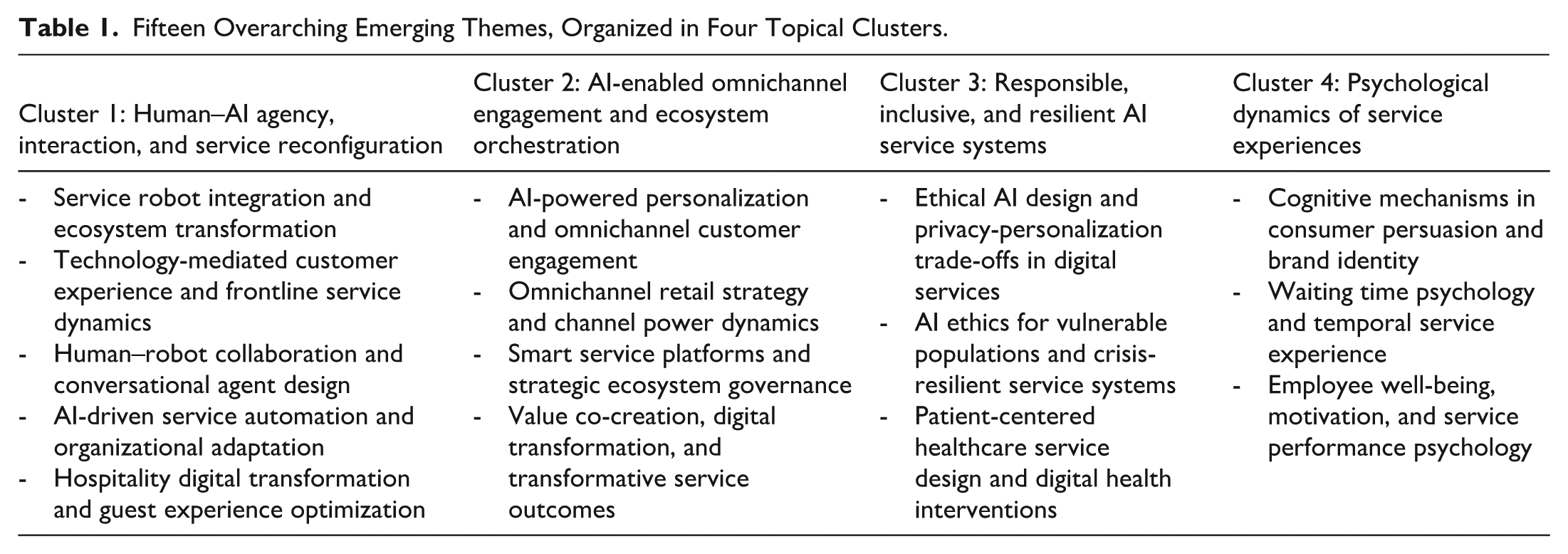
Cluster 1, “Human–AI Agency, Interactions, and Service Reconfiguration,” centers on the redesign of service encounters through advanced technologies. These themes highlight how robots, agents, and AI-based automation reconfigure roles, workflows, and touchpoints. Together, they raise questions about hybrid service models, employee–technology configurations, and the redefinition of frontline work and experience. Cluster 2, “AI-Enabled Omnichannel Engagement and Ecosystem Orchestration,” shifts the focus to strategic and ecosystem-level transformations. These themes underscore how firms orchestrate interactions across channels, platforms, and partners. They point to emerging tensions around data-driven personalization, power asymmetries in ecosystems, and the conditions under which digital transformation leads to genuinely trajectory-shaping (vs. merely incremental) service outcomes. Cluster 3, “Responsible, Inclusive, and Resilient AI Service Systems,” emphasizes ethics, vulnerability, and societal impact, thereby suggesting research on governance mechanisms, stakeholder safeguards, and design principles that ensure AI-enabled services do not exacerbate inequality or risk. Finally, Cluster 4, “Psychological Dynamics of Service Experiences,” includes individual-level mechanisms that shape service experiences, persuasion, and performance. These themes emphasize how cognitive, affective, and motivational processes influence service experiences. Together, they call for finer-grained theorizing of how new technologies and organizational practices interact with human psychology in service.
Although we present these themes in distinct clusters, we note that their boundaries are porous. For example, psychological mechanisms underpin technology-mediated encounters; ethical concerns permeate platform strategies; and sector-specific contexts (e.g., healthcare and hospitality) cut across multiple themes. The goal of this structure is therefore not to impose rigid silos, but to help scholars navigate an arena of complex opportunities and identify synergies across levels of analysis, technologies, and societal outcomes.
Emerging Themes in Service Literature vis-à-vis the FT 50
To understand how our AI-derived themes are positioned within broader business research, we conducted a comparative theme analysis across a variety of leading journals. Specifically, we combined the top 1,000 concept pairs predicted using the papers in the five service journals with the top 1,000 concept pairs predicted using the papers in FT50 + JSR. 2 This approach produced two parallel corpora of AI-predicted concept relationships: one rooted in the service literature and one embedded in the wider, FT50-dominated management and marketing literature (see Table 2).
Emerging Themes in Service Literature vis-à-vis FT 50 Journals.
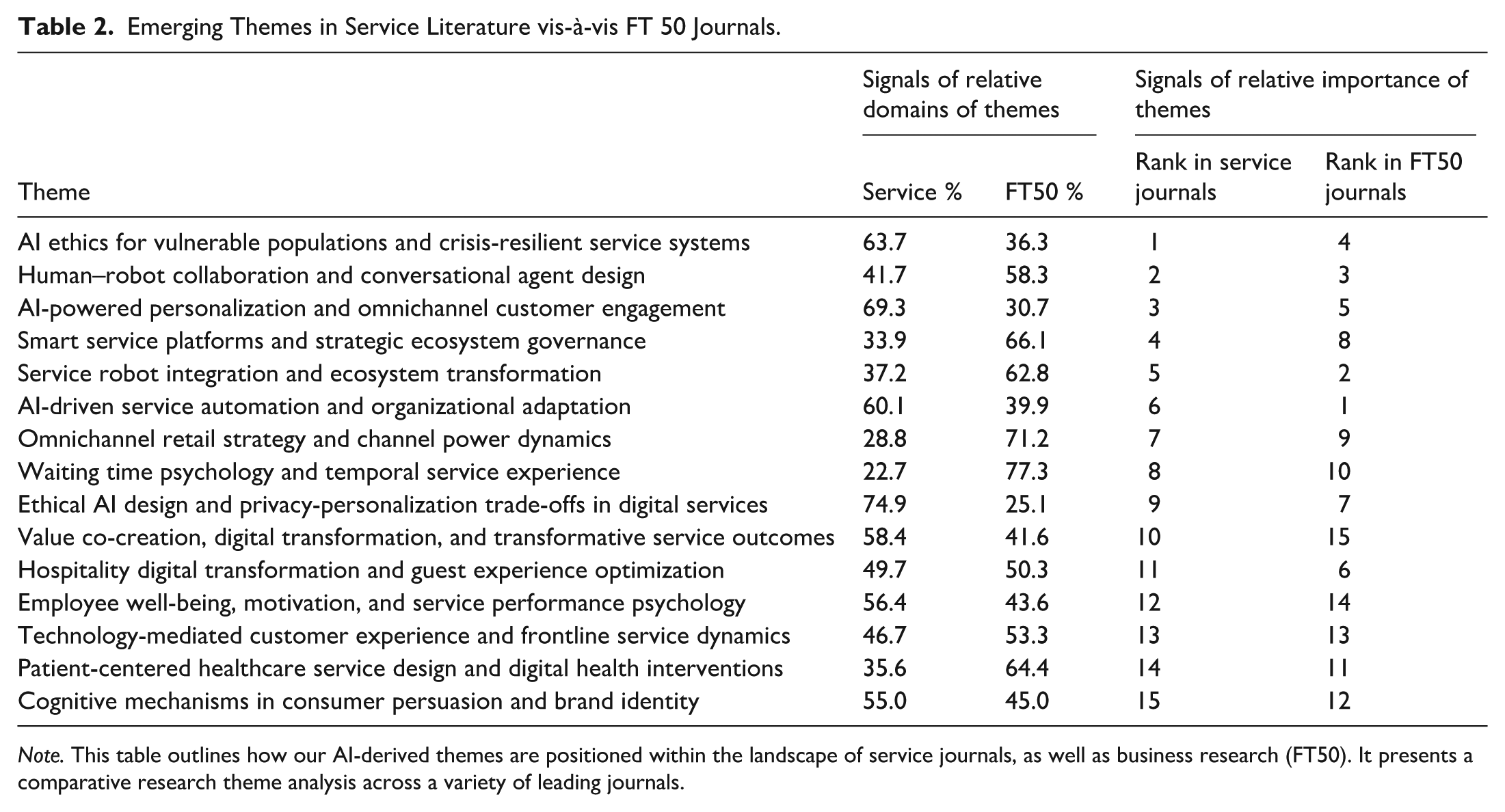
Note. This table outlines how our AI-derived themes are positioned within the landscape of service journals, as well as business research (FT50). It presents a comparative research theme analysis across a variety of leading journals.
Next, we mapped these predicted concept pairs onto our fifteen research themes and calculated theme-level scores separately for the service-journal corpus and the FT50 corpus. Comparing these scores allowed us to assess whether each theme is predicted to appear more strongly in service journals or FT50, effectively positioning themes along a continuum from “service-centric” to “mainstream business.” At the same time, the scores provided a ranking of themes in terms of their predicted prominence. This step enabled us to highlight where service research is already leading, and to identify themes that are underrepresented in either domain, thus, representing high-potential opportunities for cross-fertilization and future agenda setting.
The Intellectual Domains of Themes (Interpreting the “Percentage”)
We begin with interpreting the two percent columns in Table 2: for each theme, we first grouped together all predicted concept pairs that belonged to that theme. Each concept pair has an origin; that is, it was predicted either from the service-journal corpus or from the FT50 corpus. 3 Deliberately, the two percentages for a given theme sum to 100%. Consequently, they should be read as a signal of a theme’s primary origin and domain in the existing literature topology. Accordingly, a high “Service_%” indicates that a theme is driven mainly by connections within the service literature. As such, it reflects endogenous research trajectories: questions and constructs that have grown out of the service field’s own conversations. Such themes often embody the field’s distinctive concerns and theoretical traditions (e.g., customer experience, transformative service, frontline work). 4 Analogously, a high “FT50_%” indicates a theme is fueled mainly by connections in the broader business literature; it signals cross-disciplinary influence flowing into service research: ideas that originate elsewhere but have clear relevance for services. 5 These themes represent imported insights that service scholars can adapt, extend, or challenge. Finally, balanced percentages (~50/50) indicate themes that are supported by both corpora. These likely function as a meaningful linkage, where service and FT50 literatures are already intertwined and where integrative work may be especially impactful. Taken together, Table 2 allows researchers to see not only which themes are most prominent, but also where they are rooted and housed intellectually—within service research, in adjacent FT50 fields, or their intersection.
The Relative Relevance of Themes (Interpreting the “Rank”)
Alongside the percentages, Table 2 reports two rank measures (Rank in Service/Rank in FT50) for each theme. For every corpus, the link prediction model produces a long list of concept pairs ordered by their predicted connection probability: pairs at the top are those the model predicts to be most likely to become connected in future research. Next, we map these pairs to themes and compute the average prediction score across all concept pairs within each theme. Themes are then ranked by this average score. “Rank in Service” then represents a theme’s position when all themes are sorted by how strongly their constituent pairs are predicted in the service journals (and “Rank in FT50” represents the analogous position based on the FT50 corpus). Because a lower number means a higher position (1 = highest-ranked theme in that corpus), top ranks suggest a theme that is built from concept pairs that appear near the top of the link prediction results; this signals a research area that is “ripe for emergence,” because the underlying knowledge graph already positions these concepts very close to one another, even if the literature has not yet fully connected them. These themes can be read as high-priority opportunities, where relatively small conceptual or empirical steps could yield influential contributions. 6 Vice versa, lower ranks (e.g., 10–15) suggest themes that still are predicted to matter, but the constituent pairs lie further down the ranked list. This implies longer-term or more speculative opportunities: the concepts are less tightly clustered in the existing literature, and linking them may require more theoretical innovation or boundary-spanning work. Because ranks are calculated separately for each corpus, a theme can be highly ranked in one corpus but not in the other, highlighting where opportunities are currently more visible to service scholars versus the FT50 community.
Synthesis
Considering Table 2 holistically, readers can see not only where each theme is rooted (service vs. FT50) but also how imminent its emergence appears in each corpus. Multiple insights emerge: first, there is a core set of AI-related themes that are central in both scholarly domains. Themes such as AI Ethics for Vulnerable Populations and Crisis-Resilient Service Systems (service rank 1; FT50 rank 4), Human–Robot Collaboration and Conversational Agent Design (2; 3), AI-Powered Personalization and Omnichannel Customer Engagement (3; 5), Service Robot Integration and Ecosystem Transformation (5; 2), or AI-Driven Service Automation and Organizational Adaptation (6; 1) sit near the top of both rankings. These topics form a shared agenda: they are predicted to be highly salient regardless of outlet; thus, they represent natural linkages around which service and mainstream business scholars are likely to converge.
Second, service journals are predicted to lead on human-centric, ethical, and transformative themes. Several themes show markedly higher service percentages: Ethical AI Design and Privacy–Personalization Trade-offs in Digital Services (74.9% service vs. 25.1% FT50), AI-Powered Personalization and Omnichannel Customer Engagement (69.3% vs. 30.7), AI Ethics for Vulnerable Populations and Crisis-Resilient Service Systems (63.7% vs. 36.3), AI-Driven Service Automation and Organizational Adaptation (60.1% vs. 39.9), Value Co-creation, Digital Transformation, and Transformative Service Outcomes (58.4% vs. 41.6), and Employee Well-being, Motivation and Service Performance Psychology (56.4% vs. 43.6). Together, these patterns suggest that the service literature is especially poised to shape conversations about ethical AI, privacy and vulnerability, customer engagement, employee welfare, and transformative service. In short, these are topics where service research may already be, or could become, agenda-setting for the broader field.
Third, FT50 journals place relatively more emphasis on structural, strategic, and context-specific issues. Themes with substantially higher FT50 percentages include Waiting Time Psychology and Temporal Service Experience (22.7% service vs. 77.3% FT50), Omnichannel Retail Strategy and Channel Power Dynamics (28.8% vs. 71.2), Smart Service Platforms and Strategic Ecosystem Governance (33.9% vs. 66.1), Patient-Centered Healthcare Service Design and Digital Health Interventions (35.6% vs. 64.4), Service Robot Integration and Ecosystem Transformation (37.2% vs. 62.8), and Human–Robot Collaboration and Conversational Agent Design (41.7% vs. 58.3). These themes lean toward issues of platform and ecosystem governance, channel power, robotics at scale, temporal operations, and healthcare more broadly—areas where mainstream outlets may currently host more of the conversation, and which therefore might represent promising “import” opportunities for service scholars.
Finally, a small group of themes is predicted to be more evenly distributed across the two portfolios. Hospitality Digital Transformation and Guest Experience Optimization (roughly 50/50), Technology-Mediated Customer Experience and Frontline Service Dynamics (46.7% vs. 53.3), and Cognitive Mechanisms in Consumer Persuasion and Brand Identity (55.0% vs. 45.0) appear relatively balanced. These topics are boundary-spanning spaces: neither service- nor FT50-dominated, they invite cross-fertilization of methods and theories from both communities.
Overall, Table 2 reveals a mutually reinforcing but asymmetric landscape: service journals are predicted to be especially influential on ethical, human, and transformative dimensions of AI and service, while FT50 outlets more strongly emphasize structural and strategic aspects such as platforms, omnichannel power, and robotics at scale. Themes that score highly in both sets of outlets—particularly around AI, automation, and robotics—signal where cross-disciplinary discourse is most likely to accelerate the future trajectory of service research.
Reflections vis-à-vis 2021 SRPs
Next, we situated our AI-derived themes relative to the prior SRPs (Field et al. 2021; Ostrom et al. 2021), which were developed through extensive expert consultation and community input, providing a scholar-driven view of where the field should be heading. In contrast, we use AI-fueled link prediction to infer where the existing knowledge structure suggests new connections are likely to emerge. By juxtaposing these two perspectives, we explore areas of strong convergence—where our themes reinforce Field et al.’s/Ostrom et al.’s (2021) priorities—as well as spaces of divergence, where our analysis points to emerging issues that extend or reconfigure prior priorities (Table 3). This comparison positions our results not as a replacement for, but as a data-driven complement to, the previous SRPs.
Themes Relative to Previous Journal of Service Research’s Research Priorities (Field et al. 2021; Ostrom et al. 2021).
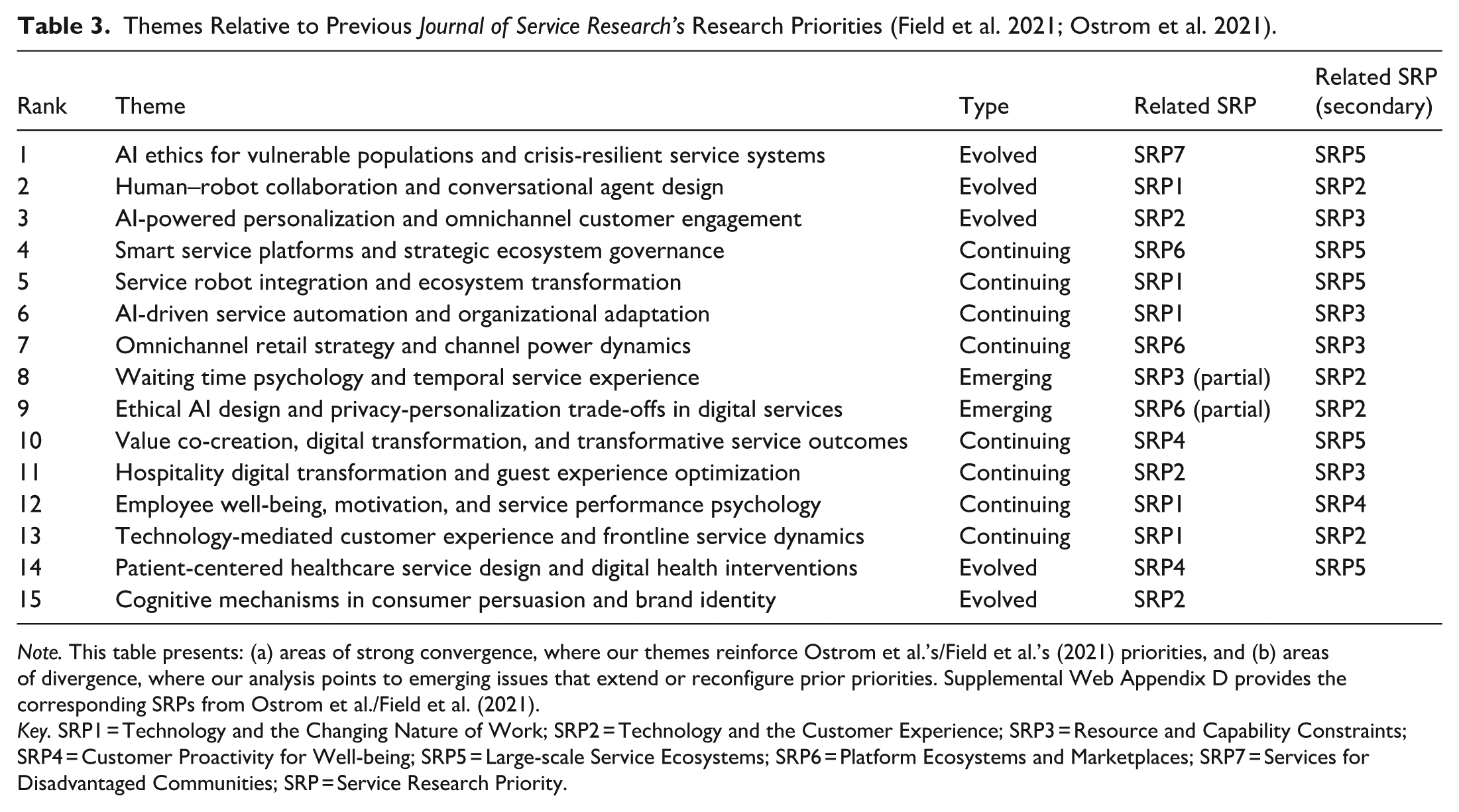
Note. This table presents: (a) areas of strong convergence, where our themes reinforce Ostrom et al.’s/Field et al.’s (2021) priorities, and (b) areas of divergence, where our analysis points to emerging issues that extend or reconfigure prior priorities. Supplemental Web Appendix D provides the corresponding SRPs from Ostrom et al./Field et al. (2021).
Key. SRP1 = Technology and the Changing Nature of Work; SRP2 = Technology and the Customer Experience; SRP3 = Resource and Capability Constraints; SRP4 = Customer Proactivity for Well-being; SRP5 = Large-scale Service Ecosystems; SRP6 = Platform Ecosystems and Marketplaces; SRP7 = Services for Disadvantaged Communities; SRP = Service Research Priority.
Building on this comparison, we classify our themes into emerging, evolved, and continuing priorities. Emerging themes (two themes; ranks 8 and 9) represent new spaces that were not explicitly articulated as independent topics in prior SRPs (Field et al. 2021; Ostrom et al. 2021). Here, Waiting Time Psychology and Temporal Service Experience and Ethical AI Design and Privacy–Personalization Trade-offs in Digital Services surface as distinct streams. Both reflect the growing salience of temporal dynamics and ethical service in an era of AI-enabled instant services, evolving regulatory frameworks (e.g., the EU AI Act), and the rapid proliferation of generative AI since 2021. These themes capture genuinely new agenda items for service scholars. Evolved themes (five themes; ranks 1, 2, 3, 14, 15) can be traced back to broader 2021 SRPs (Field et al. 2021; Ostrom et al. 2021) but have since differentiated into more specific directions; the corresponding shifts are notable: a focus on “technology replacing frontline employees” (Ostrom et al. 2021) has morphed into human–AI collaboration; relatively more generic well-being has evolved into domain-specific concerns (e.g., AI ethics for vulnerable populations, AI interventions in healthcare); and broad “customer experience” priorities now sharpen around cognitive and psychological micro-foundations. The fact that the top three ranked themes all fall in this category suggests that the field is not simply adding new topics, but actively refining and re-specifying existing theoretical domains. Finally, continuing themes (eight themes; ranks 4, 5, 6, 7, 10, 11, 12, 13) maintain their original SRP framings while deepening the focus within established areas. These themes are concentrated in the mid-to-lower portion of the ranking, indicating relatively lower (but still meaningful) predicted priority; they center on issues such as platform governance, ecosystem dynamics, omnichannel integration, and employee well-being. In combination, these three categories (emerging, evolved, continuing) show how the broader service research agenda is characterized by continuity and evolution: some priorities persist, others evolve, and a smaller set of themes emerges in response to technological, regulatory, and societal shifts.
Integrating Human Expertise
While our models provide a powerful AI-driven map of latent connections in the literature, they are limited in judging which opportunities are most important. To reintroduce such a normative layer (Ostrom et al. 2021), we included expert judgment through a survey of the Journal of Service Research’s Editors, Advisory Board, and Associate Editors (Gu and Krenn 2024). 7 Our survey asked these scholars to evaluate the 15 AI-derived themes in terms of their (a) importance for future service research and (b) novelty. We also asked the experts to identify which of the fifteen themes would be in their “Top 3” priorities. Finally, we invited them to comment on missing angles or mis-specified emphases. This approach allowed us to retain the AI-generated structure of themes and predicted links, while opening space for human experts to interpret, endorse, challenge, and reweight the model’s suggestions.
In total, we invited sixty-four experts, and twenty-three completed the survey. Consistent with the diversity of the JSR community, responses came from Australia, Canada, Finland, Germany, Italy, the Netherlands, Sweden, Switzerland, the UK, and the USA. The respondents read some background on our analysis and the randomized list of the fifteen themes. Next, for each theme, they indicated their agreement with two statements: “This is an important future research direction” and “This theme is relatively novel” (1 = strongly disagree, 7 = strongly agree), see Table 4.
Expert Judgment of the Service Research Community Through a Survey of the Journal of Service Research’s Editors, Advisory Board, and Associate Editors.
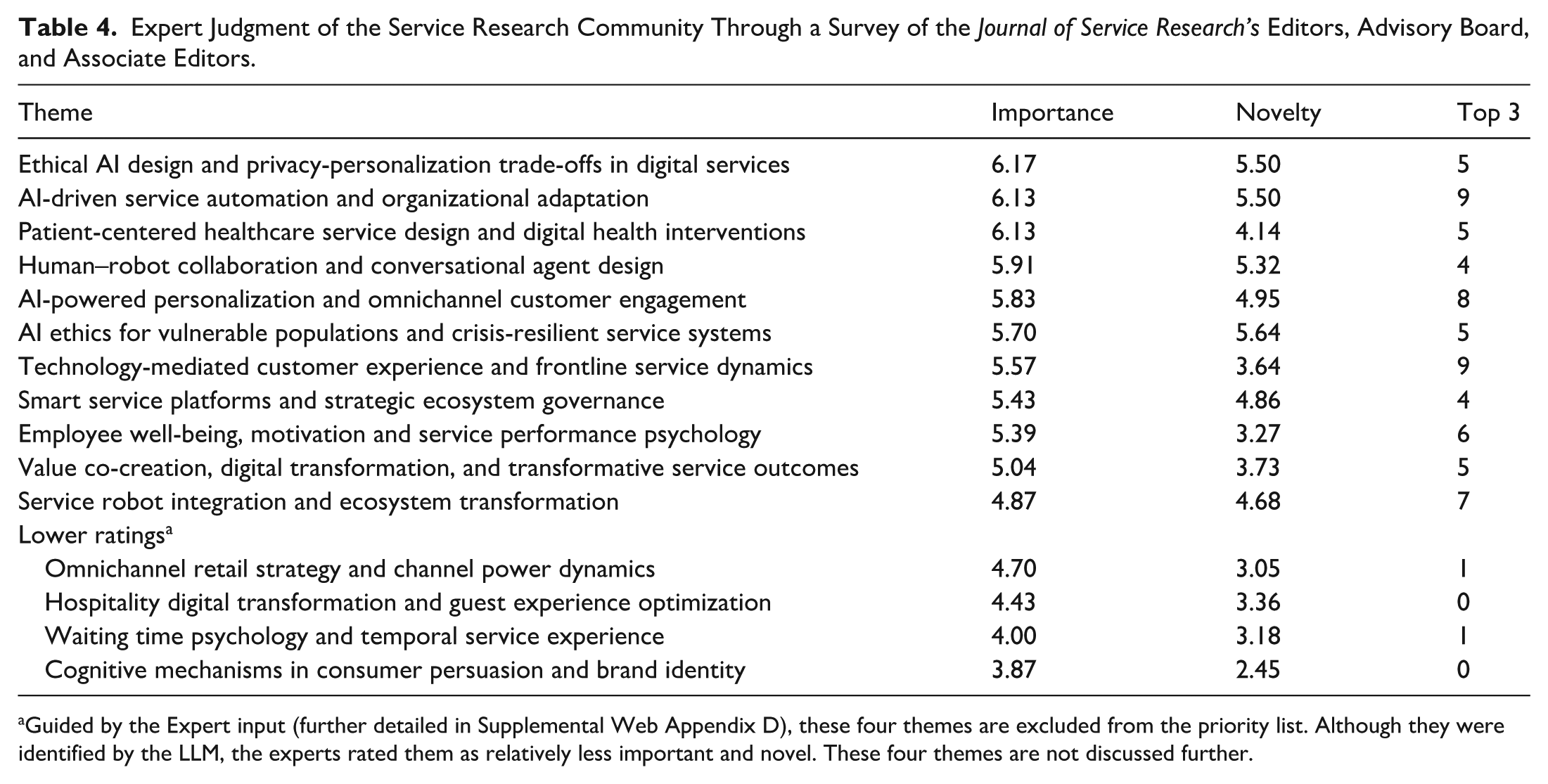
Guided by the Expert input (further detailed in Supplemental Web Appendix D), these four themes are excluded from the priority list. Although they were identified by the LLM, the experts rated them as relatively less important and novel. These four themes are not discussed further.
Table 4 reveals a clear clustering of “high importance and high novelty” around AI-centered themes, suggesting that AI has become a structural driver of service scholarship. The highest-ranked theme, “Ethical AI Design and Privacy–Personalization Trade-offs in Digital Services” (Importance = 6.17; Novelty = 5.50), indicates that the frontier of the field lies not merely in technological advancement, but in governance, transparency, and responsible system design. Closely following are “AI-Driven Service Automation and Organizational Adaptation” and “Human–Robot Collaboration and Conversational Agent Design,” both of which combine strong importance with substantial novelty. Together, these responses point to a shift from studying technology at the service encounter-level toward examining AI as an embedded, system-level force reshaping organizational structures and service architectures.
Notably, “AI Ethics for Vulnerable Populations and Crisis-Resilient Service Systems” shows the highest novelty score (M = 5.64), signaling untapped conceptual space at the intersection of AI, inclusion, and resilience. This notion bolsters the expansion of service research beyond efficiency and personalization toward broader societal and transformative concerns. Thus, AI is emerging not only as a performance-enhancing tool but as a domain requiring normative evaluation and institutional redesign.
Healthcare-related issues (“Patient-Centered Healthcare Service Design and Digital Health Interventions”) rank high in importance but comparatively lower in novelty, suggesting strategic relevance but conceptual maturity. Similarly, “AI-Powered Personalization and Omnichannel Customer Engagement” demonstrates continued centrality but appears to be moving into a consolidation phase. Mid-tier themes addressing ecosystem governance and service robot integration further indicate that platform and ecosystem perspectives remain important, though less radically emergent. In contrast, more traditional domains (waiting time psychology, persuasion mechanisms, and omnichannel retail strategy) display comparatively lower novelty and limited top-tier presence. While foundational to the discipline, these areas appear conceptually stabilized relative to AI-driven system transformation.
The “Top 3” column in Table 4 provides an additional lens on the thematic portfolio by capturing the frequency with which each theme appears among the three highest-ranked priorities. Two themes stand out with the highest Top 3 counts (9 each): “AI-Driven Service Automation and Organizational Adaptation” and “Technology-Mediated Customer Experience and Frontline Service Dynamics.” Their repeated prominence suggests that digital transformation is unfolding simultaneously at the organizational and frontline levels. While automation reflects systemic restructuring and high novelty, the continued prioritization of technology-mediated customer experience indicates that encounter-level dynamics remain central to the field’s evolution. “AI-Powered Personalization and Omnichannel Customer Engagement” also ranks highly (8), underscoring the sustained strategic relevance of personalization and channel integration. Although less novel than AI ethics, its consistent selection signals consolidation around personalization as a core pillar of digital service strategy. Themes such as “Employee Well-being, Motivation, and Service Performance Psychology” and “Service Robot Integration and Ecosystem Transformation” further highlight the intertwined roles of workforce adaptation and ecosystem change. In contrast, more traditional domains (i.e., hospitality digital transformation, waiting time psychology, and consumer persuasion) receive few or no Top 3 selections.
Overall, the evaluation of themes signals a broader reorientation of service scholarship. Earlier emphases on encounter optimization and customer experience management are giving way to concerns about AI-enabled service systems, organizational adaptation, and ethical governance. The convergence of technological innovation, institutional redesign, and societal responsibility defines the emerging frontier of the field.
Finally, we considered the open-ended comments from the human experts. These responses largely affirmed the proposed priorities but highlighted several areas for refinement. Specifically, four interrelated themes emerged: the need for integrative AI frameworks, stronger societal grounding, renewed human-centered emphasis, and attention to advanced AI forms and governance risks (see Supplemental Web Appendix D for more detail). That is, the experts supported the AI-centered agenda but called for deeper integration, stronger societal framing, human-centered safeguards, and methodological reflexivity in advancing the 2026 research priorities.
The First Interdisciplinary Influence Index of Service Research
Our analyses provide the first holistic interdisciplinary picture of the service literature by introducing the “Interdisciplinary Influence Index,” which shows how strongly each discipline contributes to the underlying knowledge base of a focal conceptual realm. While prior reviews typically focus on a single journal set or discipline, we examine how different academic fields collectively generate and structure the portfolio of service knowledge. To do so, we construct a large concept network from both service journals and service-related papers in FT50 outlets (i.e., papers containing “service” in the title or abstract) and identify concept communities (i.e., clusters of closely connected concepts that form the backbone of focal research areas, such as AI ethics, omnichannel strategy, service robotics). This sampling strategy allows us to examine how different disciplines engage with service-related concepts across the broader business literature. For each community, we then compute the Interdisciplinary Influence Index, which captures the relative contribution of different disciplines (e.g., service, marketing, operations, information systems) to that community. Because the number of service-related papers varies substantially across fields in our dataset, we normalize the raw concept counts (by dividing by the total number of papers in each field). The resulting ratio can be interpreted as the propensity of service-related papers within a given field to engage with concepts from a focal community, enabling fair comparison across fields of different sizes. Conceptually, the Interdisciplinary Influence Index indicates who primarily “drives” the scholarly discourse around a given concept cluster within the service research landscape. To illustrate, a community with a high service share is one in which service journals dominate the discussion; vice versa, a community dominated by other fields indicates that key ideas are being shaped primarily outside the core service literature; and more balanced ratios reveal genuinely interdisciplinary spaces where multiple fields contribute in roughly equal measure.
This approach yields the first multi-layered view of influence and dependence; specifically, we can identify domains where service research is an intellectual net “exporter” of concepts (service-dominated communities), domains where it is largely an intellectual “importer” (communities led by operations, marketing, strategy), and hybrid zones of cross-fertilization. In contrast to traditional counts of publications or citations, the Interdisciplinary Influence Index is grounded in the structure of the concept network; as such, it reveals which disciplines are central to the conceptual anatomy of each research area, not merely where papers are published.
Table 5 reports the Interdisciplinary Influence Index for twenty-two focal concept communities. Each row sums to one (with small rounding error), so the entries can be read as shares of conceptual influence rather than counts of articles. Multiple communities are service-anchored because service research provides the largest share of concepts for Marketing and Retail Management (0.48), Service Science and Research (0.45), Consumer Behavior and Decision Making (0.44), Customer Relationship and Experience (0.43), Psychology and Behavioral Science (0.27), Technology Adoption and Diffusion (0.27), Service Systems and Platform Design (0.30), and Social Sciences and Research Methods (0.16). These domains correspond closely to the field’s historical strengths, such as customer behavior, experience management, service systems, and methods tightly tied to service. They represent areas where service journals and scholars effectively “lead the conversation” and act as net exporters of ideas to other disciplines.
Interdisciplinary Influence Index for twenty-two Focal Concept Communities.
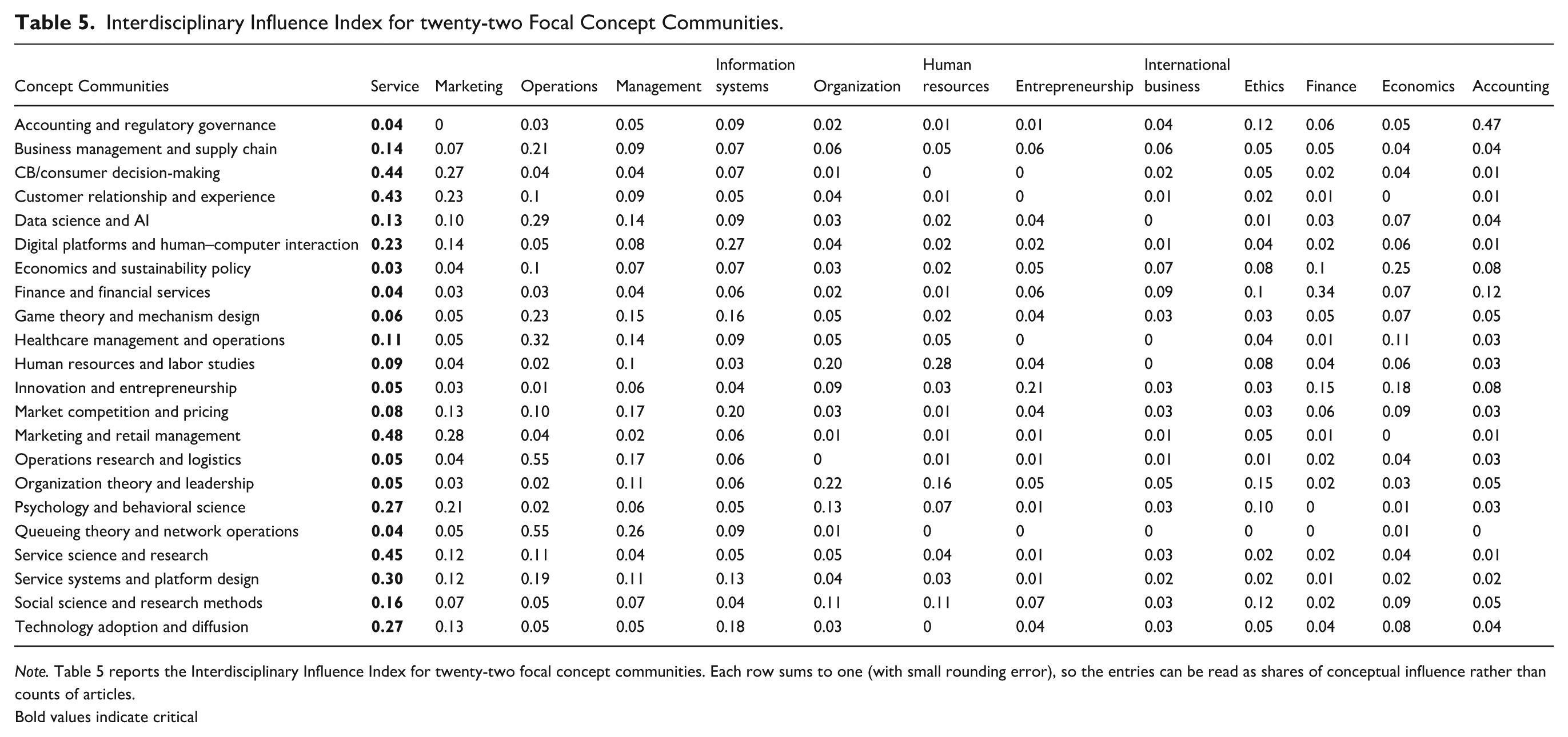
Note. Table 5 reports the Interdisciplinary Influence Index for twenty-two focal concept communities. Each row sums to one (with small rounding error), so the entries can be read as shares of conceptual influence rather than counts of articles.
Bold values indicate critical
In contrast, a second group of communities is dominated by operations and related fields, revealing where the backbone of service knowledge is shaped outside the core service literature. Operations Research and Logistics (0.55), Queueing Theory and Network Operations (0.55), Healthcare Management and Operations (0.32), Game Theory and Mechanism Design (0.23), and Business Management and Supply Chain (0.21) all show operations as the leading contributor, with service playing a more modest role (0.04–0.14). Data Science and Artificial Intelligence also leans toward operations (0.29) and management/IS, with service contributing 0.13. These patterns suggest that many of the analytical, optimization, and infrastructure aspects of service systems are being developed primarily in operations research and management science, offering fertile ground for deeper engagement by service scholars.
A third set of communities is led by policy, finance, and accounting, with service in a supporting role. Accounting and Regulatory Governance is heavily shaped by accounting (0.47), with notable contributions from ethics (0.12) and information systems (0.09), while service accounts for only 0.04. Finance and Financial Services is dominated by finance (0.34), with ethics (0.10) and international business (0.09) somewhat prominent. Economics and Sustainability Policy shows economics as the anchor (0.25), with important roles for finance (0.10) and operations (0.10). These communities underscore that many regulatory, financial, and macro-level issues (that are highly consequential for services) are conceptually grounded outside the service field, again highlighting additional opportunities for service-specific theorizing.
At the same time, a number of communities appear genuinely multi-disciplinary, with no single discipline contributing more than 0.30. Examples include Digital Platforms and Human–Computer Interaction (service 0.23, IS 0.27, marketing 0.14), Market Competition and Pricing (IS 0.20, marketing 0.13, management 0.17, service 0.08), Innovation and Entrepreneurship (entrepreneurship 0.21, finance 0.15, economics 0.18, service 0.05), Organizational Theory and Leadership (organization 0.22, HR 0.16, management 0.11, service 0.05), and Human Resources and Labor Studies (HR 0.28, organization 0.20, management 0.10, service 0.09). In these areas, service research is one important voice among several others, suggesting that progress is already being driven by cross-disciplinary dialogue rather than by a single field.
Notably, aggregating across all communities, service has the largest average share (≈0.18), followed by operations (≈0.14), marketing, management, and information systems. This confirms that service research is not confined to a narrow niche; rather, it is interwoven across the broader knowledge structure while still depending heavily on adjacent disciplines for operations, analytics, regulation, and economic perspectives.
In sum, the Interdisciplinary Influence Index offers a novel metric and acts as a strategic tool for guiding more multi-disciplinary service scholarship in the age of AI-supported science.
The ISSI
Beyond offering SRPs, we created a resource that empowers scholars to personalize their engagement with future research directions. This ISSI is a web-based dashboard designed to help researchers navigate the evolving landscape of service scholarship, discover unexpected connections across research streams, and identify promising opportunities aligned with their expertise and interests. The ISSI dashboard is publicly available at https://interactive-service-scholarship-incubator.vercel.app/.
ISSI Dashboard Overview
The ISSI integrates our link prediction results with interactive visualization tools and is organized into three main components: (a) a ranked list of top predicted concept pairs, (b) a concept community network visualization, and (c) a community pair ranking panel. 8
Navigating Service Research at Multiple Levels with ISSI
One key challenge in identifying SRPs is balancing breadth with depth. Overly broad themes may lack actionable specificity, while highly specific topics may miss important interdisciplinary connections. ISSI addresses this tension by enabling exploration at three complementary levels of analysis: the community level, concept pair level, and child concept level. At the community level, scholars can examine how major thematic areas are predicted to evolve and intersect. The network visualization (Figure 1) reveals which themes are gaining prominence and how linkages among themes are taking shape (e.g., the strong predicted connections from “Data Science and Artificial Intelligence” to multiple service-related communities show the field’s expanding role in driving work on technological transformations).
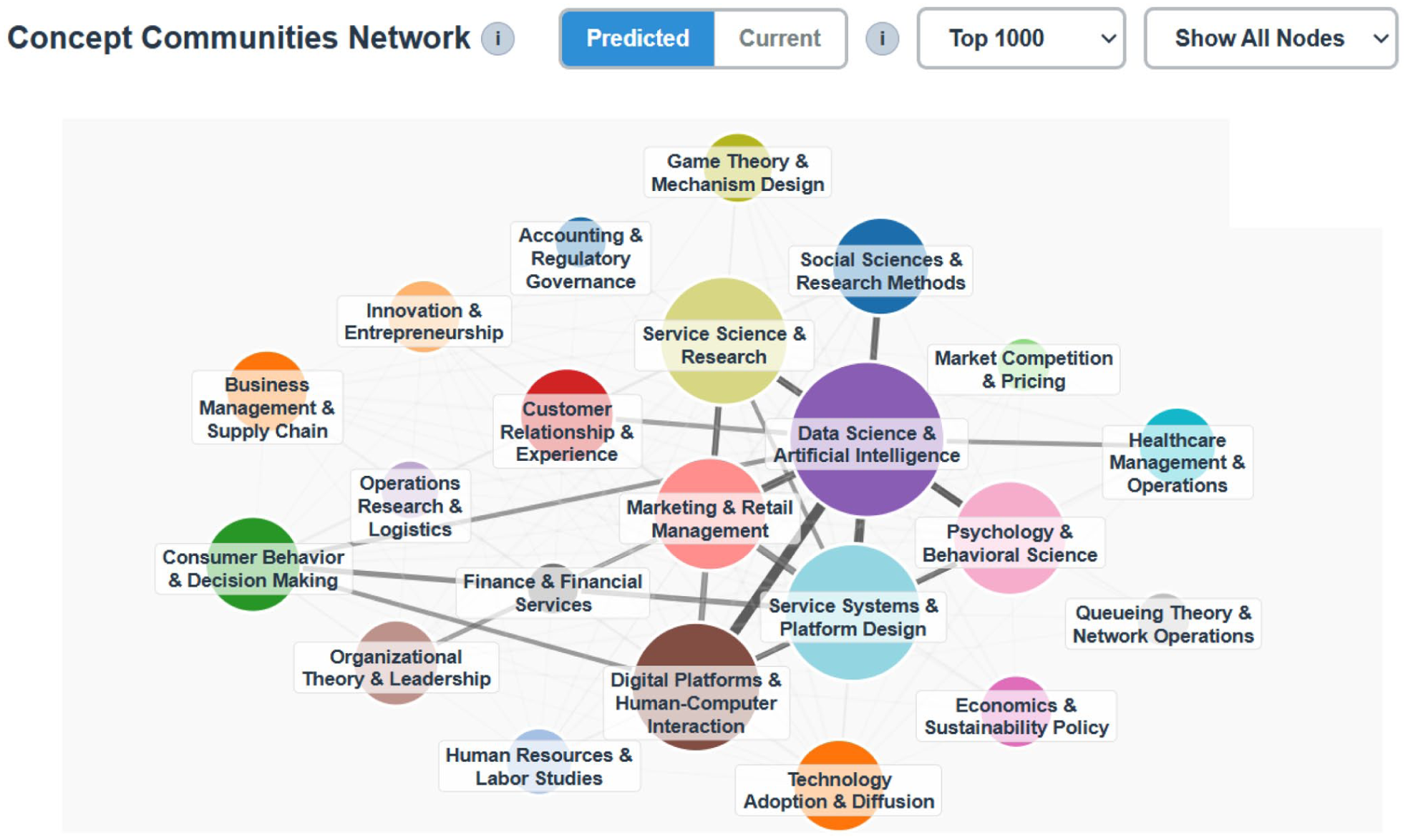
Service research network visualization.
At the concept pair level, researchers can drill down into specific predicted connections between concepts that have not yet been studied together. Each prediction represents a potential research opportunity where two established concepts may yield novel insights when examined jointly. At the child concept level, scholars can explore the granular sub-concepts nested within broader terms, transforming abstract thematic connections into concrete questions. This hierarchical structure bridges the gap between high-level trends and actionable research designs.
Matrix Analysis: Identifying Research Trajectories
Not all emerging connections carry the same strategic implications. ISSI’s matrix analysis feature helps scholars distinguish between different types of opportunities by classifying community pairs based on their historical and predicted connection patterns. The matrix analysis feature classifies community pairs into four categories based on predicted versus current connection strength using a median split:
- Accelerating (high predicted, low current) connections represent perhaps the most compelling opportunities for scholars seeking to position themselves at emerging frontiers. These are areas where our model predicts significant growth despite limited historical attention, suggesting untapped potential that early movers.
- Consolidating (high predicted, high current) connections indicate core areas where the field is deepening its engagement. These represent opportunities to contribute to established conversations with strong ongoing momentum.
- Stabilizing (low predicted, high current) connections signal mature research streams where foundational questions have been addressed, potentially requiring fresh theoretical perspectives or methodological innovations to reinvigorate inquiry.
- Exploring (low predicted, low current) connections highlight white spaces in the literature where novel inter-disciplinary work might open new research streams.
Illustrative ISSI Workflow: From Theme to Research Idea
To illustrate how ISSI can guide discovery, consider a researcher exploring where AI is creating new opportunities. Beginning at the community level, they observe that “Data Science and Artificial Intelligence” occupies a central position in the predicted network with strong connections to multiple communities, confirming AI’s growing importance across service research domains. The corresponding matrix analysis (Figure 2) reveals a particularly intriguing finding: the connection between “Data Science and Artificial Intelligence” and “Healthcare Management and Operations” ranks at the top of the accelerating quadrant. This suggests that, while AI applications in healthcare have received relatively limited attention in the service literature to date, our model predicts this intersection will become increasingly prominent. For service researchers, this signals an emerging frontier where foundational contributions are possible.
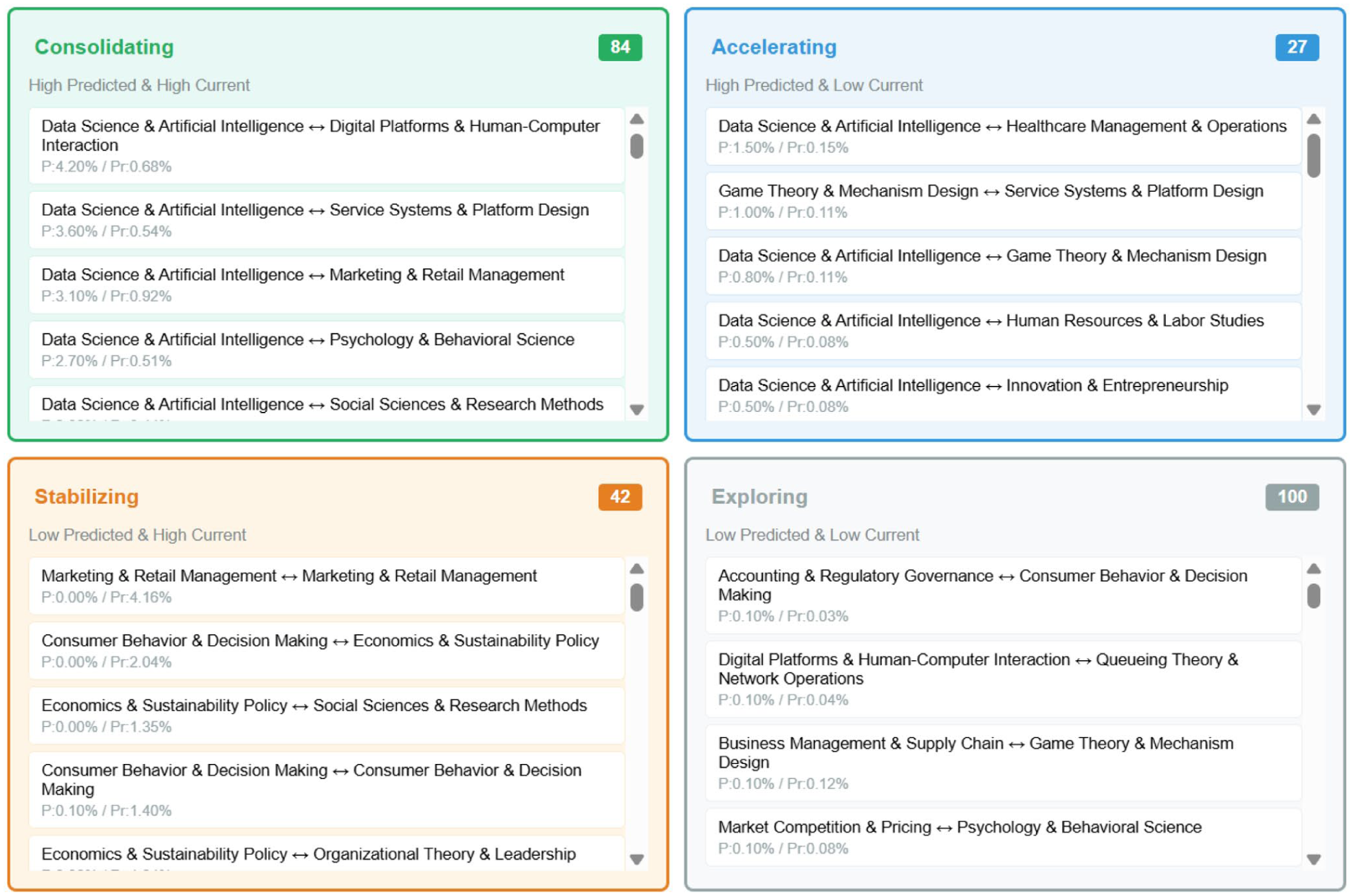
Matrix analysis as part of the ISSI workflow from theme to research idea.
Drilling down to the concept pair level, the scholar finds specific predicted connections such as “artificial intelligence and applications ↔ patient experience research and management” and “artificial intelligence and applications ↔ value co-creation in healthcare services.” These pairings suggest that the service field’s distinctive focus on customer experience and value co-creation may offer unique theoretical lenses for studying AI in healthcare, differentiating service research contributions from those in health informatics or computer science.
At the finest level of granularity, expanding the child concepts level reveals specific research directions. The intersection of AI-related child concepts (e.g., “explainable AI,” “voice assistants and conversational agents,” “human–AI interaction and collaboration”) with child concepts in healthcare experience (e.g., “patient satisfaction and experience,” “patient participation in healthcare,” “patient choice and autonomy”) suggests rich research questions grounded in service theory, including questions such as: How does AI explainability influence patient trust and service quality? How will voice-based AI agents reshape co-creation of healthcare? How can AI tools enhance rather than diminish patient agency in service encounters?
This workflow demonstrates how the ISSI helps transform relatively abstract predictions into theoretically grounded, actionable research agendas.
General Discussion
The 2026 SRPs build on a rich tradition of agenda-setting work in service (Ostrom et al. 2010, 2015, 2021) while responding to its evolving technological and societal environment. Our goal was not simply to update a list of topics, but to rethink how priorities are generated in an age where AI, data abundance, and multi-disciplinary collaboration reshape both service systems and scholarly practice. We leverage AI-assisted link prediction to unearth emergent thematic structures within service research. The findings depict structural transformation in the field. Rather than incremental topic variation, we observe a reconfiguration of service scholarship around four interconnected clusters: (1) Human–AI agency, interactions, and service reconfiguration; (2) AI-enabled omnichannel engagement and ecosystem orchestration; (3) responsible, inclusive, and resilient AI service systems; and (4) psychological dynamics of service experiences. These clusters suggest that the future of service research will be shaped by the interplay of technology, governance, human agency, and societal impact.
Cluster 1 (Human–AI Agency, Interactions, and Service Reconfiguration) highlights how AI, robotics, and automation are reshaping frontline roles, workflows, and hybrid service models. Notably, the highest-ranked themes across both service and FT50 corpora concentrate in this space, signaling a shared cross-disciplinary agenda. The shift from “technology replacing employees” to human–AI collaboration marks a conceptual maturation of the field. Rather than framing AI as substitutional, emerging research emphasizes configurational questions: how human and technological agents co-produce value, how responsibilities are redistributed, and how service failures and accountability are managed in hybrid systems. This cluster reflects a movement from encounter-level optimization toward system-level redesign. It also signals that service research is well positioned to lead theorizing on hybrid agency, given its historical strengths in frontline work, customer experience, and relational value creation.
Cluster 2 (AI-Enabled Omnichannel Engagement and Ecosystem Orchestration) shifts attention to strategic and ecosystem-level transformation; its themes highlight structural tensions in increasingly data-driven service ecosystems. The FT50 corpus shows relatively stronger emphasis on these structural and strategic dimensions, suggesting that service scholars may benefit from deeper engagement with adjacent literatures in strategy, information systems, and operations. At the same time, service research contributes distinctive insights into value co-creation and transformative outcomes. The balanced distribution of several themes across both corpora indicates fertile ground for integrative work. Future work will likely depend on bridging micro-level service insights with macro-level ecosystem governance and power asymmetries.
Cluster 3 (Responsible, Inclusive, and Resilient AI Service Systems) underscores ethics, vulnerability, and societal impact. Themes such as ethical AI design and crisis-resilient service systems rank highly within the service literature, suggesting that service journals are particularly poised to shape discourse on responsible AI. Compared to FT50 outlets, service research seems more strongly oriented toward human-centric and Transformative Service Research (Anderson et al. 2013). Future service research not only studies how AI improves efficiency or engagement but also how governance mechanisms, safeguards, and design principles prevent harm and mitigate inequality. Thus, service research may serve as an agenda-setter in articulating responsible digital transformation, especially as regulatory and societal scrutiny intensifies.
Cluster 4 (Psychological Dynamics of Service Experiences) revisits individual-level mechanisms that shape service experiences, persuasion, and performance. While some of these themes rank lower in importance, they seem foundational. Notably, evolved themes show how broader concepts (e.g., “customer experience”) have sharpened into more fine-grained cognitive and affective processes. The linkage between clusters is particularly evident here: psychological mechanisms underpin AI-mediated interactions, platform engagement, and ethical responses. Rather than representing a retreat to traditional micro-foundations, this cluster signals the need for integration. As service systems become technologically complex, understanding human cognition, motivation, and well-being becomes more—not less—critical.
Research Implications Within and Across Clusters
Our findings help generate forward-looking research implications—both within individual clusters and at their intersections:
From Hybrid Agency to Governed Autonomy
Within Cluster 1, research should move beyond documenting human–AI interaction toward theorizing governed autonomy to explain when, how, and under what safeguards agency can be delegated to AI. Future work can examine boundary conditions of control relinquishment, accountability structures in multi-agent systems, and the design of recovery mechanisms in hybrid service failures. Linking Cluster 1 and Cluster 3, scholars might investigate how ethical design principles can be operationalized in frontline AI systems, embedding fairness, transparency, and resilience directly into interaction architectures.
Micro–Macro Integration in Platformed Service Systems
Cluster 2 highlights the strategic orchestration of platforms and ecosystems, while Cluster 4 emphasizes psychological mechanisms. A promising cross-cluster agenda lies in integrating these levels of analysis. For example, how do ecosystem power asymmetries shape customer cognition, trust, and perceived autonomy? How do algorithmic personalization strategies alter value co-creation processes at both the individual and network levels? Addressing these questions requires bridging Service Dominant Logic (SDL) with platform governance and behavioral theory, producing more unified accounts of AI ecosystems.
Responsible AI as a Design Science for Services
Cluster 3 invites research that moves from abstract ethical principles to design science approaches for responsible service systems. Scholars can develop testable governance frameworks, stakeholder safeguard models, and measurable indicators of resilience and inclusion. Cross-cluster integration suggests examining how responsible AI practices influence employee well-being (Cluster 4) and organizational adaptation (Cluster 1). Rather than treating ethics as an external constraint, future research can conceptualize it as a generative capability that shapes innovation trajectories.
Re-Skilling, Human Capital, and Service Capability Evolution
Across Clusters 1 and 4, a critical aspect is human capital. As automation and AI expand, service research must investigate re-skilling, deskilling risks, and new capability configurations. How do hybrid service systems reshape employee identity, motivation, and professional growth? What organizational designs foster human–AI-complementarity rather than substitution? Integrating these insights with an ecosystem lens (Cluster 2) may reveal how labor markets and service platforms co-evolve.
Temporal and Resilience Dynamics in Service Systems
Themes around temporal experience and crisis resilience suggest a dynamic, longitudinal agenda. Scholars can explore how service systems adapt over time under technological acceleration and regulatory change. Cross-cluster research might examine how psychological responses to automation (Cluster 4) interact with ecosystem governance (Cluster 2) during periods of disruption. This temporal lens helps service research study volatility, uncertainty, and systemic risk more explicitly.
Methodological Innovation and AI-Augmented Research
Our AI-assisted approach emphasizes the need for methodological innovation across all clusters. Future research can leverage synthetic data, digital twins, and simulation-based modeling to study complex service ecosystems. Integrating computational methods with qualitative and experimental designs helps scholars test multi-level theories spanning individuals, organizations, and platforms.
Toward an Integrative Service Research Agenda
Taken together, these implications point toward a more integrative and boundary-spanning future for service scholarship. Innovative contributions are likely to emerge not from isolated themes but from research that connects hybrid agency, platform governance, ethical design, and psychological mechanisms within coherent theoretical frameworks. By advancing cross-cluster inquiry, service research can shape how AI-enabled service systems are configured, governed, and aligned with societal well-being.
Theme-Based Tensions and Research Directions
In a related step, with the goal of making our abstract themes more tangible, we used an LLM to translate the highest-ranked concept pairs within each of the fifteen themes into 10 illustrative research questions; then, we prompted ChaptGPT 5.2 to use these 150 questions to derive two core tensions and one trajectory-shaping research direction per theme (see Table 6; note: Table 6 only includes the eleven themes that the human JSR experts in our survey rated highest).
Core Tensions and Trajectory-Shaping Research Directions by Themes.
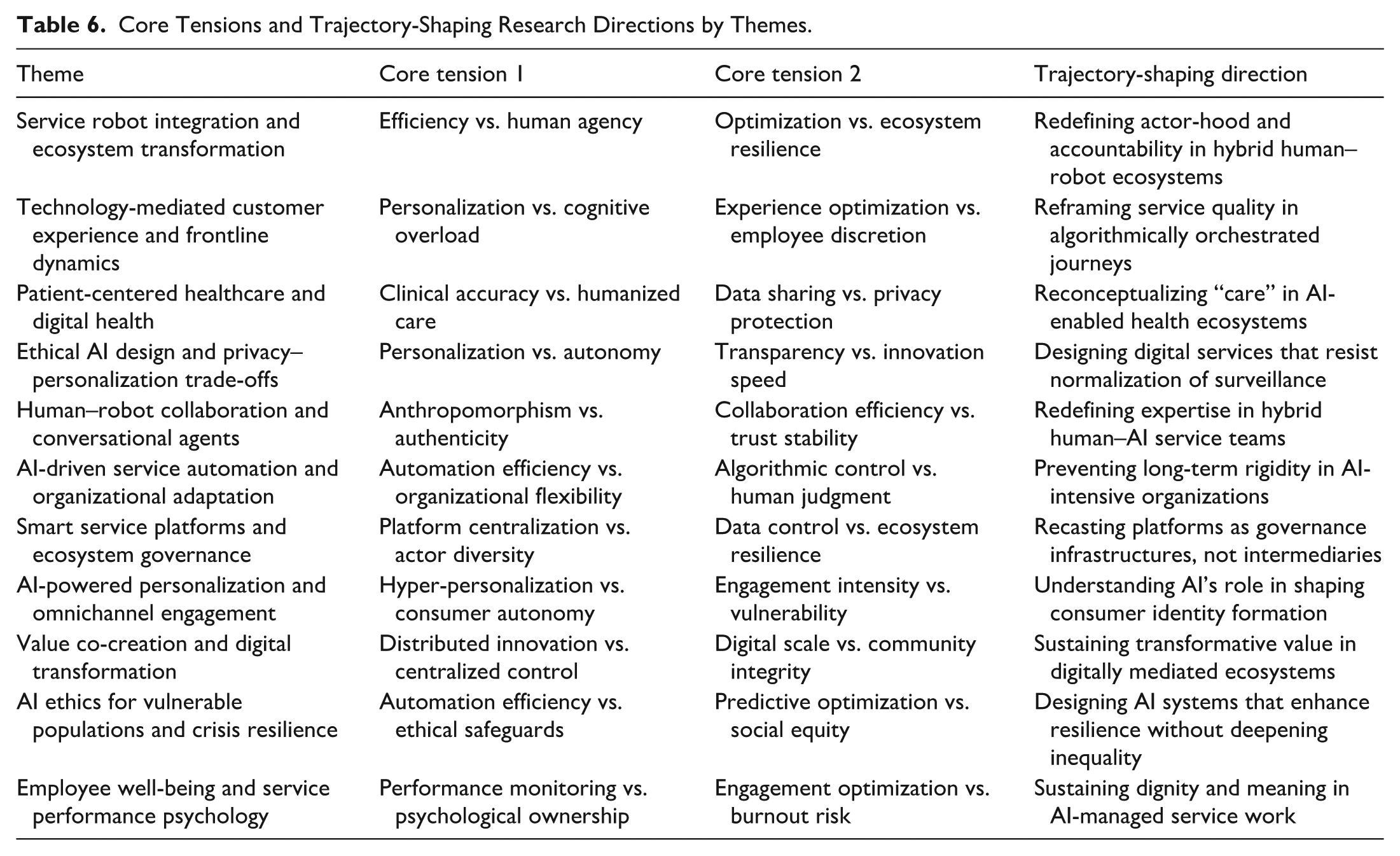
Our focus on core tensions highlights the structural trade-offs that increasingly define contemporary service systems. Moreover, such tensions are not isolated within focal domains; rather, they interact across technological, organizational, psychological, and ecosystem levels. A first key pattern concerns efficiency versus human agency. Robotics, AI-driven automation, and personalization technologies promise optimization and scalability, yet may simultaneously constrain discretion, psychological ownership, and professional identity. Across themes, the issue is not simply whether efficiency improves performance, but how it reshapes agency and meaning within service ecosystems. A second cross-cutting tension involves optimization versus resilience. Standardization and centralization—often enabled by platforms, analytics, and automation—can increase short-term reliability but may reduce diversity, redundancy, and adaptive capacity. This suggests a need to move beyond static performance metrics and examine long-term ecosystem robustness and fragility. A third tension centers on personalization versus vulnerability. Data-driven customization enhances relevance and engagement, but that may intensify surveillance, information asymmetries, or inequality—particularly for vulnerable populations. Here, micro-level psychological dynamics intersect with macro-level governance and ethical considerations. Importantly, these tensions are interdependent. Efficiency-driven automation affects employee well-being, which shapes customer experience and co-creation. Personalization relies on centralized data control, influencing platform governance and ecosystem resilience. Thus, technological, organizational, and psychological trade-offs cascade across system levels. Finally, the trajectory-shaping research directions in Table 6 signal where incremental extension may be insufficient. Redefining actor-hood in hybrid ecosystems, reconceptualizing care in AI-enabled healthcare, or sustaining dignity in algorithmically managed workplaces point toward potential revision of foundational constructs in service.
Further Implications for Scholars, Editors, and Educators
Our clusters, themes, and the accompanying ISSI provide an additional scaffold for designing research programs that are both forward-looking and grounded. The combination of cluster-level themes, concept-pair predictions, and child concepts enables scholars to move from high-level agendas to specific, testable questions. The matrix analysis further distinguishes between accelerating, consolidating, stabilizing, and exploring community pairs, helping scholars position their work—whether they seek to be early movers at emerging frontiers or to deepen understanding in core streams. For journal editors, the themes and our Interdisciplinary Influence Index offer a lens for evaluating submissions and shaping special issues. Recognizing which domains are service-dominated versus operations- or economics-dominated can inform editorial decisions about which cross-disciplinary bridges to encourage. Our findings also suggest that studies that integrate ethical, human-centric, and transformative perspectives with rigorous analysis of AI-enabled systems are likely to be particularly impactful. Finally, educators can draw on the themes to update curricula in service marketing, operations, and management. Courses (e.g., doctoral seminars) might be structured around technology-mediated interfaces, platforms and ecosystems, responsible service systems, and psychological foundations, with specific modules on topics such as service robotics, AI-driven personalization, or crisis-resilient services. Incorporating exercises that use the ISSI can help graduate students experience how AI tools can guide literature review and idea generation.
Managerial and Policy Implications
Although our focus is academic, the themes have implications for managers and policymakers. The prominence of AI ethics, vulnerable populations, privacy–personalization trade-offs, and crisis resilience underscores that service can no longer be evaluated solely via efficiency or effectiveness. Organizations must design AI-enabled services that are transparent, fair, and inclusive; they must invest in employee well-being as well as human–AI collaboration, and build robustness against shocks ranging from natural disasters to cyberattacks. Moreover, structural themes around smart platforms, ecosystem governance, and omnichannel power dynamics call for consideration of data access, algorithmic control, and value distribution among actors. Policymakers concerned with consumer protection and sustainability may find our Interdisciplinary Influence Index helpful in identifying where regulatory debates are currently shaped (e.g., in operations, economics, or accounting) and where service perspectives on experience, well-being, and vulnerability could add important nuance.
Limitations and Avenues for Future Research
Our approach has limitations. First, while we draw on a broad corpus of service-related papers from core service journals and FT50, our dataset is constrained by indexing choices (e.g., using “service” in title/abstract to select FT50 articles) and, to some degree, by the coverage of OpenAlex. Some emerging domains (e.g., in computer science, public administration, health policy) may be underrepresented. Future work could extend the corpus to additional disciplinary databases and non-English sources.
Second, link prediction relies on the historical structure of the knowledge network. As a result, it may be conservative with respect to truly radical or paradigm-shifting ideas that lack strong antecedents in the literature. While our emerging themes capture some novel directions, we caution against treating the ranked list as exhaustive. Human creativity, societal shocks, and technological breakthroughs will continue to generate “black swan” topics that no model can foresee. Third, our concept extraction and clustering procedures, while carefully designed and validated, depend on LLM performance and parameter choices (e.g., clustering thresholds). Different design decisions may yield slightly different theme sets. We view our fifteen themes as a robust but not unique representation of the opportunity landscape. Further exploration with alternative models and concept taxonomies would be valuable.
Finally, our expert survey focused on the JSR leadership. While this group is highly knowledgeable, it does not capture the full diversity of perspectives across regions, career stages, or practitioner communities. Future agenda-setting efforts could incorporate broader stakeholder input, including the global community of service scholars and doctoral students, as well as industry partners and policymakers.
Supplemental Material
sj-pdf-1-jsr-10.1177_10946705261447646 – Supplemental material for The 2026 Service Research Priorities: AI-Driven Discovery, Interdisciplinary Influence Dynamics, and the “Interactive Service Scholarship Incubator” for Personalized Priorities
Supplemental material, sj-pdf-1-jsr-10.1177_10946705261447646 for The 2026 Service Research Priorities: AI-Driven Discovery, Interdisciplinary Influence Dynamics, and the “Interactive Service Scholarship Incubator” for Personalized Priorities by Martin Mende, Amy Ostrom, Juneha Baek, Donghyuk Shin, Sanghak Lee and Maura L. Scott in Journal of Service Research
Footnotes
Author Note
The authors thank the Editor, Dr. Ming-Hui Huang, for her support and expert guidance throughout the development of this article.

Funding
The authors received no financial support for the research, authorship, and/or publication of this article.
Declaration of Conflicting Interests
The authors declared no potential conflicts of interest with respect to the research, authorship, and/or publication of this article.
Supplemental Material
Supplemental material for this article is available online.
Notes
Author Biographies
References
Supplementary Material
Please find the following supplemental material available below.
For Open Access articles published under a Creative Commons License, all supplemental material carries the same license as the article it is associated with.
For non-Open Access articles published, all supplemental material carries a non-exclusive license, and permission requests for re-use of supplemental material or any part of supplemental material shall be sent directly to the copyright owner as specified in the copyright notice associated with the article.
