







Abstract
Service research has typically treated technology as a tool directed by human actors to influence service systems; however, the rapid rise of generative artificial intelligence (GenAI) challenges this assumption and our understanding of service system transformations. Drawing on information systems (IS) research, we examine how GenAI’s unique capabilities influence service system transformation mechanisms—particularly emergence and phase transitions—yielding three contributions to service research. First, we theorize how human–GenAI hybrids give rise to hybrid intelligence and influence transformation through unplanned, stabilized, and intelligent forms of delegation in service exchange, and through GenAI-enabled capacities of autoreflexivity and autoreformation. Second, we refine the understanding of service system transformation mechanisms by showing how the compound effects of first-order and fourth-order emergence explain the frequency of phase transitions, while heightened reflexivity and reformation influence their speed. Third, we extend service system design research by demonstrating how GenAI can enhance human reflexivity and reformation, challenging human-centric assumptions by positioning human–GenAI hybrids as contributors to service system design. We discuss how managers can strategically mobilize GenAI to influence markets and institutional arrangements. We conclude with future research directions addressing empirical, ethical, and design-oriented questions related to human–GenAI hybrids in service system transformation.
Keywords
Introduction
Generative artificial intelligence (GenAI) is being viewed as a transformative technology, quickly gaining widespread usage across different domains and predicted to greatly impact service firms’ business models, employee roles, customer interactions, and the broader socio-institutional contexts they are embedded in (Dwivedi et al. 2023). While all AI-driven output can technically be described as generative, GenAI can be defined in its ability to generate novel, human-like synthetic content in various forms, and in support of diverse tasks (Feuerriegel et al. 2024). As such, traditional notions of human–technology interaction are challenged, leading to novel forms of output, shifting from a technology-as-a-tool perspective to a mutual-learning partnership that triggers unanticipated changes to service systems as they unfold (Le et al. 2025; Lim et al. 2023; Sturm et al. 2021). Given developments toward “human-like machines” (Schuetz and Venkatesh 2020), understanding how GenAI influences service systems is a pressing concern for both scholars and practitioners.
Despite pioneering studies on the design of technology-enabled services (Tuunanen et al. 2024) and digital services (Tuunanen et al. 2023), as well as calls to examine how technology mediates or drives systemic change (As’ad et al. 2024; Fehrer et al. 2024), technology is still often treated as a passive resource rather than as a shaping force in the service system transformation literature. By service system transformation, we refer to the reconfiguring of actors, resources, and institutional arrangements within or across service systems (Koskela-Huotari et al. 2021; Skålén et al. 2015). These transformations occur through underlying mechanisms (Machamer et al. 2000)—most notably emergence and phase transitions (Polese et al. 2021; Vargo et al. 2023)—which explain how service systems both evolve incrementally and undergo more radical shifts. While technology is acknowledged as having a growing role in service systems (Breidbach et al. 2013; Lim and Maglio 2019), existing research often takes a generic view of technology (e.g., Patrício et al. 2020) or a narrow focus on specific applications, such as chatbots, and their impacts on customers or employees (e.g., Blaurock et al. 2025; Le et al. 2025). The application of GenAI presents a timely opportunity to explore how unintended systemic shifts and deliberate interventions might be realized (Koskela-Huotari et al. 2021; Patrício et al. 2011; Polonsky et al. 2026; Skålén et al. 2015; Vink and Koskela-Huotari 2022; Vink et al. 2021).
To explore this new technological frontier within the service system transformation context, we can draw on work emerging in the information systems (IS) field, particularly the agentic IS and human–computer interaction perspectives. GenAI has recently been flagged as a disruptive technology which necessitates reconsideration of long-established assumptions relating to human–technology interactions, specifically its capacity for ongoing learning, bidirectional, relationships and environmental awareness (Chen et al. 2024; Schuetz and Venkatesh 2020; Sturm et al. 2021). This adds momentum to shifts in the IS literature in recognizing technology’s evolving agency in organizational and societal contexts (Baird and Maruping 2021; Feuerriegel et al. 2024) and specifically acknowledging hybrid intelligence—the evolving intelligence co-created through continuous human–GenAI interaction and mutual adaptation—as a critical area of inquiry (Dellermann et al. 2019; Engelbart 1962; Gnewuch et al. 2024; Krinkin and Shichkina 2023). This perspective, therefore, offers a novel lens to challenge assumptions within service research.
Much of the current discourse in service research frames technology as a tool or a substitute for human labor, extending a historical focus on automation that first targeted routine, physical tasks and now increasingly impacts cognitive functions (Huang and Rust 2018). Yet, recent developments suggest a different reality: Rather than simply replacing humans or being used by humans, GenAI is increasingly intertwined with them, distributing tasks, decisions, and creative processes across human and machine actors in what is often termed “augmented intelligence,” “human-AI collaboration,” or “hybrid intelligence,” where artificial intelligence (AI) can act as an assistant, coach, or even a co-creator, providing intelligent responses, suggestions, and learning alongside humans to enhance overall performance (Banh and Strobel 2023; Brynjolfsson, Li, and Raymond 2025; Dellermann et al. 2019; Dwivedi et al. 2023; Ebel et al. 2021; Jain et al. 2021; Muller et al. 2020). This shift raises urgent questions for service research. Within just a few years, GenAI has moved from experimental pilots to institutionalized processes embedded in education, healthcare, and professional services (Dwivedi et al. 2023; Lim et al. 2023; Sundberg and Holmström 2024), rapidly transforming how value is created through new modes of customer interaction and innovation (Banh and Strobel 2023; Larivière et al. 2025; Reinhard et al. 2026; Tuunanen et al. 2023; Wirtz et al. 2023). If service research continues to conceptualize technology merely as a passive resource or a substitute for human actors, it risks overlooking the profound systemic changes introduced by human–GenAI entanglements, particularly as GenAI reshapes value co-creation practices and institutional arrangements within service ecosystems (Baird and Maruping 2021; Böhmann et al. 2018; Murray et al. 2021). We address this tension by theorizing how GenAI reshapes the mechanisms of service system transformation through its entanglement with human actors, building on foundational work in service system transformation (Skålén et al. 2015; Koskela-Huotari et al. 2016, 2021; Polonsky et al. 2026).
The purpose of this study is to develop a conceptual understanding of how human–GenAI hybrids influence service system transformation mechanisms. By mechanisms, we refer to the underlying entities and activities (Machamer et al. 2000) through which service systems change and stabilize; specifically, the orders of emergence and phase transitions (Polese et al. 2021; Vargo et al. 2023). We examine how human–GenAI hybrids—process-relational entities in which humans and GenAI systems interact and mutually adapt—contribute to service system transformation through their interactions and evolving hybrid intelligence. To achieve this, we adopt a theory adaptation approach (MacInnis 2011; Jaakkola 2020), which involves revising existing theoretical perspectives by introducing alternative frames of reference. Our domain theory is service system transformation (e.g., Skålén et al. 2015; Koskela-Huotari et al. 2021), which we extend by integrating insights from IS research as our method theory. Specifically, we draw on IS research examining GenAI as an agentic actor and its interactions with human actors recognized as Human-Computer Interaction (e.g., Baird and Maruping 2021; Dellermann et al. 2019; Feuerriegel et al. 2024).
We make three key contributions to service research. First, we conceptualize how human–GenAI hybrids influence service system transformation mechanisms, focusing on the four orders of emergence and phase transitions (Polese et al. 2021; Vargo et al. 2023). We suggest that GenAI enables to identify patterns in existing institutional arrangements and explore alternative configurations (autoreflexivity) and to generate and adapt human-like content that supports the intentional shaping of institutional arrangements (autoreformation). We introduce delegation in service exchange—unplanned, stabilized, and intelligent—as an intervention point that introduces novelty and reinforces inertia in service systems. Second, we propose that the frequency of phase transitions can be partly explained by the compound effect of first-order and fourth-order emergence and that the speed of phase transitions is influenced by heightened reflexivity and reformation. Third, we extend service system design research by showing how GenAI augments human designers’ capacities. Further, we propose managerial implications and future research directions exploring GenAI’s influence on service system transformation mechanisms, human–GenAI hybrids, service research implications, and responsible design. Table 1 includes a glossary of key terms used.
Glossary of Terms.
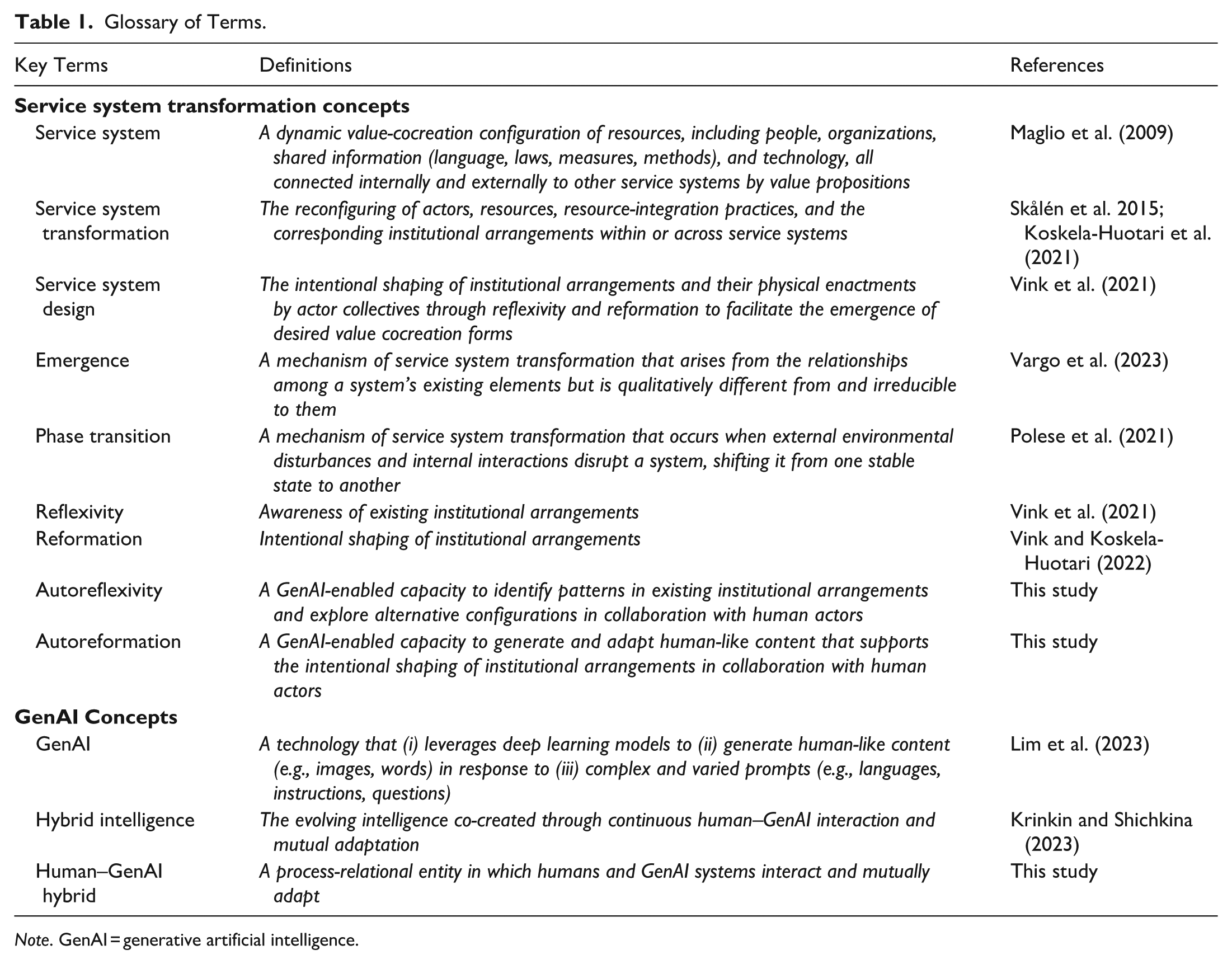
Note. GenAI = generative artificial intelligence.
Service System Transformation
Service systems are dynamic, evolving networks of interconnected actors that emerge through ongoing resource integration and service exchange (Vargo et al. 2023). Maglio et al. (2009) describe them as dynamic configurations of resources that are being reshaped through interactions. These interactions are guided by institutional arrangements—shared norms, rules, and beliefs—which both shape and evolve with actor behavior (Edvardsson et al. 2012). Thus, service systems are inherently adaptive, continually redefined by the actors within them.
The dynamics of service systems can be understood as an ongoing interplay between self-adjustment and transformation (Vargo et al. 2023). First, service systems are self-adjusting: Service systems are able to regulate and reproduce themselves by arranging and rearranging their elements without an overall external governance mechanism (Lusch and Vargo 2018; Vargo and Akaka 2012). Second, service systems undergo transformations, which can be recognized as observable changes within individual service systems and across multiple systems (Koskela-Huotari et al. 2016, 2021; Skålén et al. 2015). In this paper, we focus on service system transformation and thus discuss self-adjustment only when it is necessary to understand transformation.
Past research has examined service system transformation through three aspects: qualitative attributes, ideal types, and underlying mechanisms. Koskela-Huotari et al. (2021) address the first, proposing that transformations vary in scope, endurance, and paradigmatic radicalness. As'ad et al. (2024) address the second, identifying three ideal types—reproduction, where behavioral patterns and institutional arrangements remain stable; reconfiguration, where behavioral patterns and some institutional elements undergo change; and transition, where behavioral patterns are disrupted, and the service system is perceived as qualitatively new—of which reconfiguration and transition constitute service system transformation in our terms.
While both perspectives illuminate transformation outcomes, our focus is the third: the mechanisms (Machamer et al. 2000) underlying these processes, specifically emergence and phase transitions (Fehrer et al. 2024; Polese et al. 2021; Vargo et al. 2023). Alongside these mechanisms, we foreground their outcomes and intervention points, enabling us to trace how micro-level human–GenAI interactions accumulate into system-level outcomes and feed back to enable or constrain subsequent interactions. Figure 1 represents these five mechanisms visually.
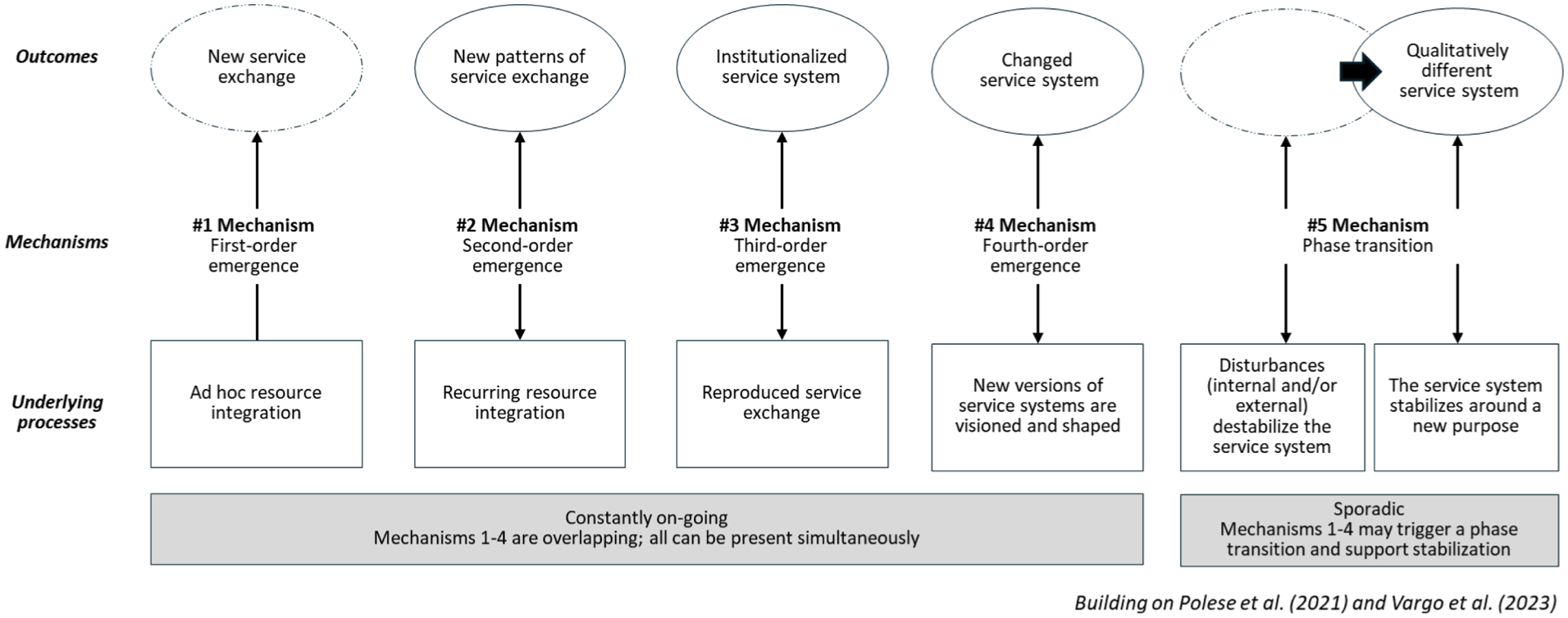
Mechanisms of service system transformation.
Orders of Emergence
Vargo et al. (2023) divide emergence into four analytically distinct, but interlinked orders of emergence within service ecosystems. To clarify, these orders form an additive typology in which multiple orders may—and oftentimes do—coexist. In this way, basic interactional processes persist even as they become entangled with higher-order arrangements. Together, the four orders of emergence capture how service systems operate through multiple, coexisting layers of novelty, stabilization, institutionalization, and deliberate reconfiguration. Rather than representing sequential stages, these orders remain simultaneously operative and mutually reinforcing, even if illustrative examples are narrated in temporal form for clarity. To make this additive logic explicit, we use social robots in hospitality as a running example.
The first-order emergence occurs when novel service exchanges emerge from ad-hoc resource integration taking place within the service system (McLaughlin 2008; Vargo et al. 2023). These resulting novel service exchanges may be transient, and thus they may vanish unless they are made more enduring by the second-order emergence (Sawyer 2005). For example, in service systems experimenting with frontline social robots, first-order emergence occurs through ad hoc trials in service encounters. Employees may temporarily test a robot for greeting customers or providing additional information to them. These improvised human–robot interactions generate novel outcomes for customers and employees alike.
Second-order emergence builds on the first-order emergence, transforming novel service exchanges into new, relatively stable patterns of service exchange (Vargo et al. 2023). It relies on feedback loops: As the new service exchange is reinforced, it becomes habitual through repetition (Martin and Sunley 2012). In service systems that incorporate frontline social robots, second-order emergence becomes visible when initially improvised human–robot interactions stabilize into recurring practices. For instance, robots may become routinely assigned to specific service tasks (e.g., check-in support or information provision), and employees and customers come to expect social robots in these instances.
Third-order emergence occurs when actions are guided by and reproduce taken-for-granted institutional arrangements (Vargo et al. 2023). The third-order emergence requires memory capability that enables pattern recognition, which in turn reproduces institutionalized service systems, including system structure and actors' behaviors (Martin and Sunley 2012; Vargo and Lusch 2016). Institutionalized service systems foster goal-directed behavior, but this behavior is reactive, constrained by the service system elements and configuration (Ellis 2006; Vargo et al. 2023). In service systems incorporating frontline social robots, stabilized interaction patterns become embedded within broader institutional arrangements, such as organizational policies, role definitions, training standards, liability frameworks, and professional norms. These arrangements define legitimate forms of robot-supported service delivery and provide institutional scaffolding through which routinized practices are reproduced—and deviant behaviors are noticed and corrected.
The fourth-order emergence relies on reflexive actors, who can envision alternative versions of the service system and proactively shape them toward these future visions (Vargo et al. 2023), suggesting that service system transformation can be, to a certain degree, designed. This is discussed in the contemporary service system design research as “the intentional shaping of institutional arrangements and their physical enactments by actor collectives through reflexivity and reformation to facilitate the emergence of desired value cocreation forms” (Vink et al. 2021, p. 169). Reflexivity enables actors to criticize their social context and recognize its mutability (Voronov and Yorks 2015). Reformation, on the other hand, involves not only changing institutional arrangements intentionally but also preserving them to ensure that the service system transformation is sustainable over the long term (Koskela-Huotari et al. 2016). In service systems incorporating frontline social robots, fourth-order emergence becomes visible when actors reflexively engage with and deliberately reconfigure institutionalized arrangements surrounding robot-supported service delivery. This may involve collectively redesigning governance structures, physical places, evaluation criteria, or service concepts to support alternative forms of human–robot collaboration.
Importantly, these orders do not replace one another. Ad hoc experimentation, stabilized interaction patterns, institutionalized arrangements, and reflexive redesign remain simultaneously operative and nested within one another. For example, in a service setting deploying frontline social robots, improvised robot-assisted encounters, routinized task allocations, formalized policies and role definitions, and coordinated redesign initiatives may coexist. Each order presupposes and incorporates the dynamics of the others, jointly shaping the ongoing transformation of the service system.
Phase Transitions
In addition to emergence, which continuously occurs in all service systems (Vargo et al. 2023), another change mechanism manifests more sporadically: phase transitions. These transitions occur when service systems shift from one state (or phase) to another that is qualitatively different from the initial state (Polese et al. 2021). Generally, phase transitions unfold in three stages: First, an initial stable state; followed by a period of de-institutionalization, where existing structures begin to break down; and finally, a phase of re-institutionalization, leading to a new stable state. This new state differs qualitatively from the initial one, as it is shaped not only by new institutional arrangements but also by a new dominant value that guides actors' behaviors and decisions.
Phase transitions and emergence are inherently interlinked: Emergence can trigger a phase transition, and emergence is always present when new service systems are re-institutionalized (Polese et al. 2021). These five service system transformation mechanisms can also be understood as aligning with the intervention points of service systems, triggering changes in system behavior. As per As’ad et al. (2024), there are three levels of leverage for intervention points in a service system, ranging from shallow (e.g., minimal changes to existing components) to deep (e.g., shifts in the system's purpose or worldview). First, adaptations in resources and service exchange are considered to result in shallow changes, leading to the reproduction of service systems with no institutional changes. Thus, the first three orders of emergence can be considered as mechanisms for shallow change.
Second, developing and altering the institutional arrangements that guide resource integration has the capacity to produce changes in the service system structure. Therefore, this medium-leverage intervention point corresponds with the fourth-order emergence.
Third, the deep-leverage intervention point requires changing the purpose(s) and worldview(s) shared by the actors in a particular service system. This is aligned with phase transitions (Polese et al. 2021), which require the presence of both materially different institutional arrangements and a new dominant value or purpose.
A phase transition in hospitality incorporating frontline social robots may occur when robot-mediated interaction becomes the default, dramatically lowering the costs of luxury service elements such as concierge, personal butler, and personal chef—delivering them more consistently and immediately than human staff. This, in turn, eliminates the differences between low-cost and high-end service providers as well as elevating instant, perfect personalization as the dominant customer expectation. In this scenario, hospitality is no longer organized around human host–guest relationships but around human–robot interaction systems that prioritize algorithmic consistency, traceability, and scalable personalization. Thus, accreditation bodies might evaluate hotels based on the sophistication and transparency of their robotic service infrastructures rather than staff training programs, and liability regimes could assign primary accountability to platform operators instead of individual employees. Earlier human-centered arrangements are not completely eliminated, but they persist only as niche or artisanal alternatives outside a fundamentally altered service system.
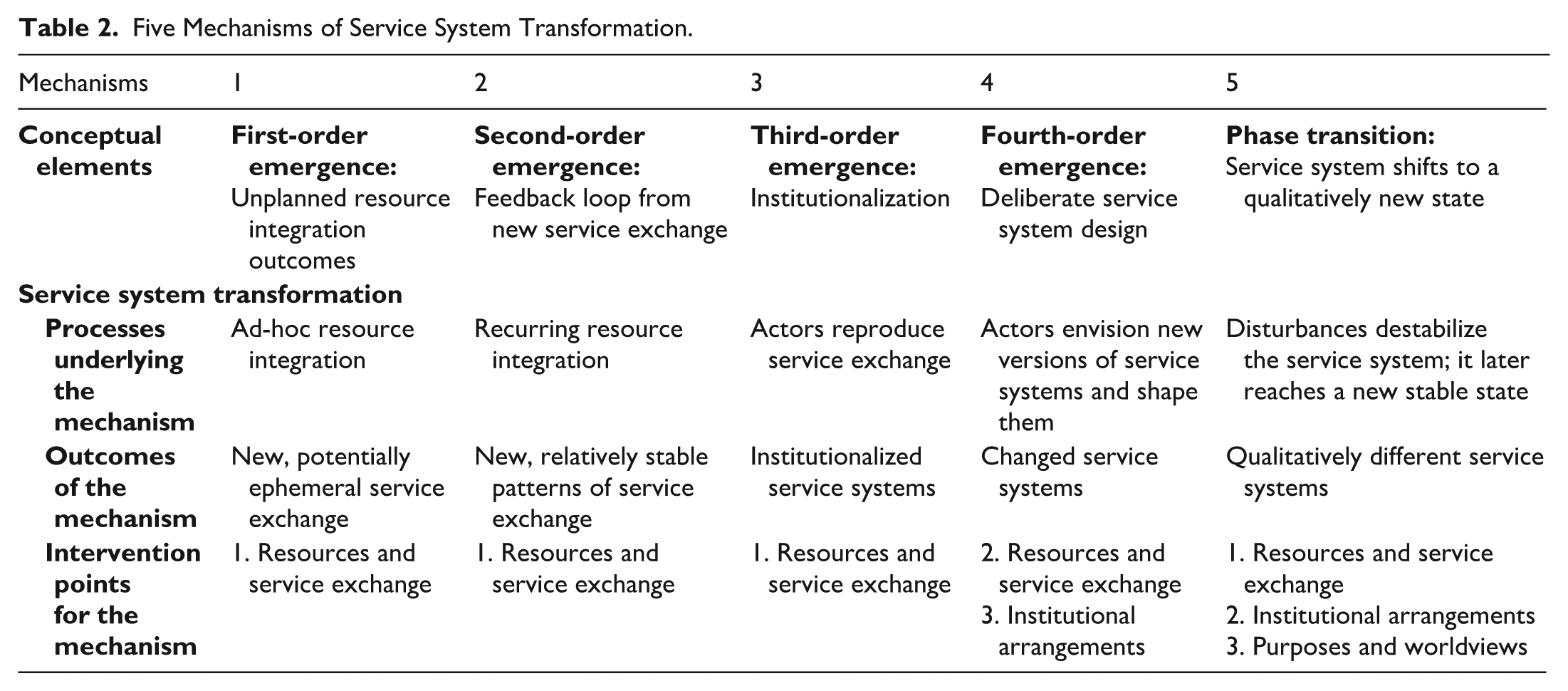
Table 2 summarizes the above discussion related to the five mechanisms underlying service system transformation and their intervention points. For clarity, we have divided each mechanism into three components: processes underlying the mechanism (e.g., ad-hoc resource integration for first-order emergence), the outcome of this process (e.g., new, potentially ephemeral service exchange for first-order emergence), and the underlying intervention points (e.g., resources and service exchange for first-order emergence).
Five Mechanisms of Service System Transformation.
To deepen our understanding of how GenAI might play a role in service system transformation, we next examine the unique capabilities of GenAI and specifically—human–GenAI interaction, which challenges traditional thinking in the research domain.
Generative AI
GenAI Capabilities
Each technology is made of multiple components and features that create technological systems (Arthur 2010). In use, these lead to certain functionalities and can also be translated into capabilities. Compared to other forms of AI, which require explicit instructions to perform tasks, GenAI can utilize the tacit knowledge available in its training combined with ongoing retrieval of up-to-date data to produce contextually appropriate output closer to human responses (Brynjolfsson et al. 2025). This means, GenAI is much more situated and aware of contextual specificities, can flexibly apply computational processes to diverse tasks, and can interact in a social, human-like way (Baird and Maruping 2021; Le et al. 2025). Consequently, applied GenAI capabilities can vary from reactive perceiving or analyzing to proactive planning and decision-making (e.g., Baird and Maruping 2021).
Many established IS assumptions of how humans use technology have been challenged by GenAI’s unique characteristics, namely—the relationship is now bilateral, meaning machines can communicate and influence human users; machines can draw on unspecified information to become environmentally aware; functionality will change over time through learning, thus reducing consistency; functionality is less transparent, giving humans less clarity on how output was generated; and given its human-like capabilities, users may even be unaware of GenAI’s presence (Schuetz and Venkatesh 2020). As most previous studies assume technologies are human-controlled tools, the greater autonomy and functionality of GenAI necessitate reconsideration of the role of technology in organizations (Sturm et al. 2021). We argue that this contrast in technological capabilities—moving away from the analytic capabilities of AI toward the cognitive capabilities of GenAI (Banh and Strobel 2023)—represents a fundamental difference to consider GenAI as agentic, autonomous actor (Feuerriegel et al. 2024). This requires deeper examination of how interaction with humans may unfold.
Human–GenAI Interaction
The IS literature examines GenAI’s influence through human–technology interaction (Baird and Maruping 2021) or human–AI collaboration (Dellermann et al. 2021) situated within the Human–Computer Interaction domain (Gnewuch et al. 2024; Gupta et al. 2022). Scholarly discourse has long foregrounded technology as a tool for human purposes and the primacy of human agency (Burton-Jones et al. 2020; Orlikowski and Iacono 2001; Vial 2019); however, technological agency is increasingly acknowledged, labelled as “agentic IS artifacts” (Baird and Maruping 2021) or “machine intelligence” (Dellermann et al. 2019). GenAI’s unique capabilities have moved the IS literature toward reconsidering this primacy in favor of hybrid agency—or hybrid intelligence—co-created through continuous human–GenAI interaction and mutual adaptation (Engelbart 1962; Krinkin and Shichkina 2023). Accordingly, we focus on GenAI’s effective capabilities in interaction with human actors rather than its inherent capability potential alone (Hemmer et al. 2025).
To acknowledge human–GenAI interaction, we must shift our perspective to account for both actors in this hybrid. Towards this end, Baird and Maruping (2021) propose a theoretical framework of delegation as the “[transfer] of rights and responsibilities for task execution and outcomes to another” (p. 317). Originating from team leadership contexts, delegation is considered a process requiring continuous adaptation and alignment between the interacting actors (Klein et al. 2006). Specifically, the human–technology interaction is asymmetric in its initiation, requiring ongoing adaptation of delegated tasks until an accepted delegation set-up stabilizes (Baird and Maruping 2021; Ebel et al. 2021). Given the broad-ranging, unspecific tasks that GenAI can be applied for, delegation can initially look markedly different and not necessarily complementary or productive in various human–GenAI hybrids (Fügener et al. 2022; Vaccaro et al. 2024). For service research, Huang and Rust (2018) conceptualize AI in terms of task-level job replacement, which our paper reconceptualizes as delegation in service exchange. Through interaction, the tasks and roles related to delegation evolve and stabilize over time. Human–GenAI hybrids become increasingly complementary and autonomous, evolving into integrated units (Rai et al. 2019; Reinhard et al. 2026).
Through continuous interactions in human–GenAI hybrids, deeper learning emerges, distinguishing human–GenAI interaction from other human–technology hybrids. The combination of human intelligence—characterized by biologically given intuition, empathy, and the ability to apply “common sense” to interpret data in highly specific and contextual situations—with AI, which provides analytic speed, efficiency, and consistency, drives outcomes that were previously impractical due to cognitive and computational constraints (Ebel et al. 2021; Dellermann et al. 2019). Specifically, human–GenAI interaction leads to hybrid intelligence as feedback loops enable learning in “both as a whole and each single component” (Dellermann et al. 2019, p. 640). In fact, human intelligence is enhanced through human adaptive learning, as actors continuously adapt and learn from GenAI-generated content. Similarly, following training through reinforcement learning from human feedback, GenAI can be refined further through enterprise data and user prompting (Banh and Strobel 2023). Accordingly, this reflects GenAI adaptive learning. Beyond the individual learning of both, the continuous human–GenAI interaction enables higher-level learning in their joint hybrid sphere (Li et al. 2024). This form of ongoing real-time feedback between human actors' prompts and GenAI’s varied outputs leads to continuous refinement based on preferred patterns (Figure 2), giving rise to hybrid intelligence.
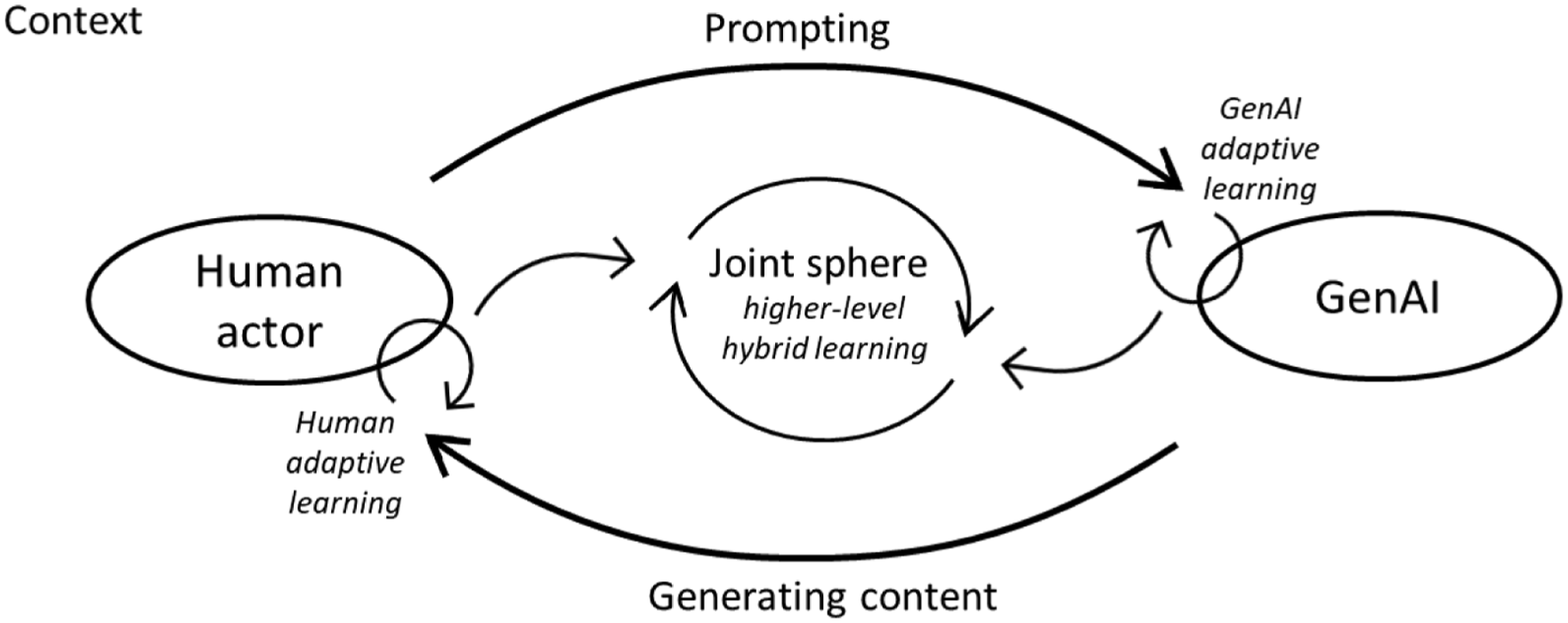
Simplified human–GenAI interaction and learning.
Autoreflexivity
Building on our discussion of hybrid intelligence, we introduce autoreflexivity as a GenAI-enabled capacity to identify patterns in existing institutional arrangements and explore alternative configurations in collaboration with human actors, grounded in GenAI's capabilities for recursive pattern recognition and generative modeling (Banh and Strobel 2023; Feuerriegel et al. 2024). Unlike conventional AI systems—typically narrow, well-defined, and reliant on structured data—GenAI develops this capacity through a dual process: training on vast and diverse datasets enables detection of complex linguistic, social, and behavioral patterns (Brewer et al. 2024; Dwivedi et al. 2023), while human interaction via prompts and contextual inputs creates real-time feedback loops that refine outputs and generate alternative framings that extend human reflexive engagement (Brewer et al. 2024; Muller et al. 2020; Sundberg and Holmström 2024). Through these bidirectional relationships and adaptive learning, GenAI can develop environmental awareness (Chen et al. 2024; Schuetz and Venkatesh 2020; Sturm et al. 2021).
Autoreflexivity becomes consequential under conditions of institutionalized stability characteristic of fourth-order emergence, where stabilized arrangements provide the object of deliberate redesign. The prefix “auto,” derived from the Greek for “self,” does not denote autonomous agency or system-level self-consciousness. Rather, it refers to GenAI’s capacity for self-referential and recursive processing within delegated analytical and generative tasks. Reflexive processes may thus be initiated within model-driven generative cycles and subsequently interpreted and enacted within human–GenAI collaboration (Bartelheimer et al. 2025). In this sense, the “self” designates recursive model operations rather than independent reflexive awareness located in the service system. Whereas reflexivity refers to human actors’ awareness of institutionalized arrangements and their effects (Vink et al. 2021), autoreflexivity highlights how GenAI-enabled pattern recognition and generative exploration can extend and intensify this reflexive engagement within institutionalized service systems.
Service system design research highlights that institutional arrangements are made tangible through their enactment in symbols, artifacts, activities, and interactions (Vargo and Lusch 2016), making their identification and analysis central to intentional transformation (Vink et al. 2021). Autoreflexivity enhances this process in two ways. First, GenAI processes diverse, unstructured data sources to surface the structures and dynamics of institutional arrangements, leveraging complementary human insight and GenAI data processing capabilities. Second, where human-centered design methods rely on perspective shifts to uncover contradictions (Vink and Koskela-Huotari 2022), GenAI surfaces overlapping and contradictory institutional logics, presenting insights through summaries, role-plays, or scenario simulations that make conflicts tangible (Banh and Strobel 2023; Feuerriegel et al. 2024; Sundberg and Holmström 2024), enabling organizations to probe intervention points and envision how systemic transformations might unfold (Vink and Koskela-Huotari 2022).
Autoreformation
Autoreformation refers to a GenAI-enabled capacity to generate and adapt human-like content that supports the intentional shaping of institutional arrangements in collaboration with human actors. This capacity is grounded in GenAI's generative and adaptive capabilities through which outputs are iteratively produced and refined in response to prior interactions and contextual inputs (Banh and Strobel 2023; Feuerriegel et al. 2024). Whereas autoreflexivity concerns recognition and exploration of alternative institutional configurations, autoreformation—consequential under conditions of fourth-order emergence—emphasizes strategic mobilization of generative outputs to reshape the physical enactments of institutional arrangements over time, extending and accelerating the reformative efforts that service design attributes to human actors alone (Vink et al. 2021).
GenAI is unique in its capacity to support reformation of service systems through its generative capabilities. Unlike prior digital technologies that primarily distributed or recombined human-created content, GenAI can produce new and diverse content using probabilistic rather than deterministic approaches (Riemer and Peter 2024). This ability allows amplifying reformation processes as human–GenAI hybrids can accelerate experimentation, scale alternative enactments, and adapt content based on feedback. As a result, human–GenAI hybrids can generate material that challenges established norms in markets or simulate alternative compliance documents that prefigure regulatory innovation. In both cases, human actors remain essential for directing goals, validating outputs, and institutionalizing selected changes, but the speed and scale of iteration fundamentally differ from previous technologies.
To illustrate autoreformation, consider hospitality organizations that delegate generation of service scripts, training materials, promotional content, and industry guidelines to GenAI in order to frame robots as legitimate frontline actors. As this content circulates across digital channels, repeated exposure can normalize robot-mediated service encounters, leading customers and managers to perceive robotic frontline actors as an expected component of hospitality service, making GenAI-generated content a resource through which human–GenAI hybrids deliberately reshape the institutional arrangements structuring such service systems.
Human–GenAI Hybrid as a Collective, Embedded Construct
We conceptualize human–GenAI hybrids as process-relational entities (Kleinaltenkamp et al. 2025)—constituted through ongoing interaction and mutual adaptation rather than existing as fixed configurations. As such, they are not limited to one-to-one interactions. Human–GenAI hybrids may involve collectives on either or both sides: for example, GenAI can be utilized in organizational project groups, or organizations can develop specialized models fine-tuned on proprietary datasets that collectively embody institutionalized knowledge. Moreover, GenAI can consist of a constellation of models, ranging from general-purpose LLMs to multi-modal generative systems for images, video, and audio, which may work together to generate, validate, or adapt outputs (Bandi et al. 2023). For a human user, it may not be clear whether they are interacting with a single model or a multi-modal system; likewise, for GenAI, it is not evident whether it is prompted by an individual or a collective. At a higher level of abstraction, we treat all such constellations as human–GenAI hybrids. In this sense, hybrid intelligence, as well as capacities for autoreflexivity and autoreformation, emerge from many-to-many interactions, where learning, delegation, and stabilization are distributed across human actors, GenAI technologies, and data resources within service systems. This positions data not merely as input, but as a liquefied resource—information decoupled from its physical form and therefore more easily shared, recombined, and mobilized across contexts (Lusch and Nambisan 2015)—that underpins hybrids’ role in influencing service system transformation across multiple levels through distinct transformation mechanisms.
Institutional arrangements profoundly condition how GenAI is deployed and how its outputs are interpreted and stabilized in practice. This conditioning is particularly dynamic given GenAI’s rapid emergence into a regulatory environment lacking established templates and ethical guidelines, prompting stakeholders to actively shape new norms for its responsible deployment (Banh and Strobel 2023; Dwivedi et al. 2023), reconfiguring expertise, coordination, and control (Raisch and Krakowski 2021). Accordingly, hybrid intelligence, autoreflexivity, and autoreformation emerge not only through human–GenAI hybrid interactions but within broader service systems where institutional arrangements simultaneously constrain and enable learning and capacity development. As human–GenAI hybrids adapt and generate novel practices, they can create, disrupt, and stabilize institutional arrangements (Koskela-Huotari et al. 2016), generating feedback loops through which new solutions emerge via de- and re-institutionalization (Fehrer et al. 2024; Polonsky et al. 2026; Vink et al. 2021).
Human-GenAI Hybrids and Service System Transformation
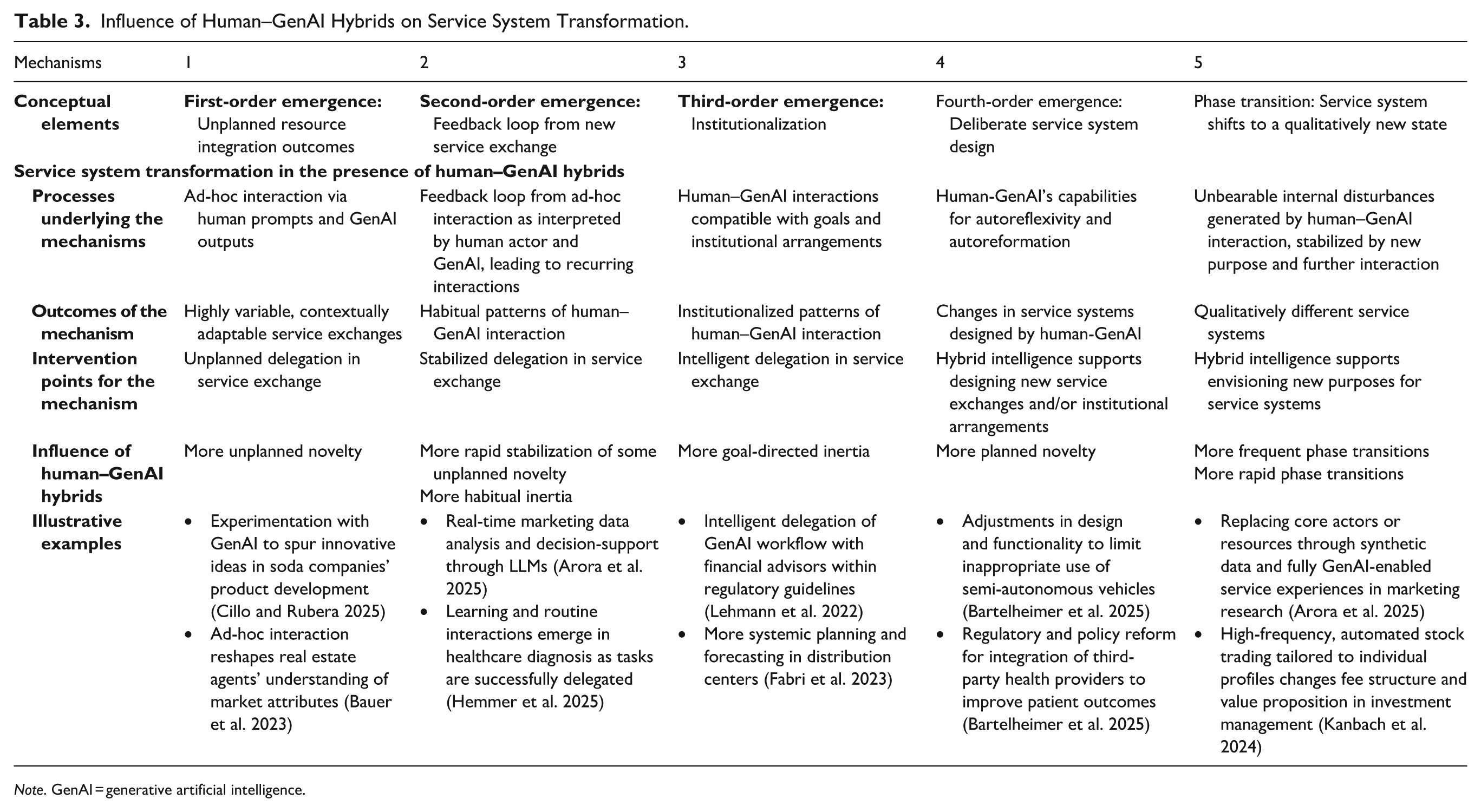
Building on the capabilities of GenAI and the dynamic nature of human–GenAI interactions, we examine their influence on service system transformation. Specifically, we outline how human–GenAI interaction processes unfold across different intervention points—ranging from shallow to deep leverage level—driving transformation in service systems through distinct mechanisms of change. In doing so, we emphasize hybrid intelligence as a catalyst for transformation, culminating in the conceptual framework depicted in Table 3.
Influence of Human–GenAI Hybrids on Service System Transformation.
Note. GenAI = generative artificial intelligence.
Our framework deliberately connects micro-level human–GenAI interactions with macro-level service system transformation. At the micro level, hybrid intelligence emerges through situated interactions in which humans and GenAI co-create outputs. As these interactions accumulate, they form patterns across orders of emergence—first unplanned novelties, then stabilized routines, and eventually intentionally reconfigured practices. Over time, these emergent patterns interact with institutional arrangements (e.g., norms, rules, infrastructures), which are both constrained by and reshaped by those patterns, ultimately leading to transformations at the macro level of service systems feeding back to the human–GenAI hybrids. In this way, ongoing emergence and institutional embedding link the microdynamics of human–GenAI hybrids to macro-level changes in service systems.
First-Order Emergence: More Unplanned Novelty from Ad-hoc Human–GenAI Interactions
GenAI is able to blend into multiple systems and solve unspecified tasks (Feuerriegel et al. 2024), also referred to as generativity. Through its broad-ranging cognitive capabilities, GenAI can support diverse human–GenAI interactions in diverse situations going beyond the possibilities of prior technologies. In fact, GenAI’s outputs are inherently non-replicable (Weisz et al. 2023) and can vary even with similar inputs. This can cause a higher information asymmetry in the initial delegation of tasks and responsibilities (Baird and Maruping 2021; Hemmer et al. 2025), which involves an assessment of the delegation opportunities with regard to the other actor (Fadel and Brown 2010). As a result, GenAI and its ad-hoc output creation appear unexplainable, marking a loss of control and transparency in the human experience and decision-making (Jovanović and Campbell 2022). This has been associated with unresolved challenges such as bias, hallucinations, and toxicity in GenAI responses (Brewer et al. 2024).
Given GenAI’s high generativity and variance in outputs, human–GenAI interaction may appear as rather random, ad-hoc, trial-and-error experiments rather than deliberate, goal-oriented use. We refer to this as unplanned delegation in service exchange, describing how unexpected shifts in responsibilities for task execution and outcomes in human–GenAI hybrids trigger changes in the service system. As a result, a lack of identified goals for GenAI and unspecified (or uneducated) human prompting amplify unplanned novelty in service systems, as outputs remain novel and heterogeneous. Furthermore, GenAI’s contextual adaptability enables its use across diverse domains, driving transformations in multiple service systems. For instance, a professor trialing GenAI for the first time to quickly develop lecture slides, may find the output presented in an unexpected way. Because the system’s reasoning is not transparent, she discards inconsistent or inaccurate content but sees value in the unique way the topics are categorized and presented. This leads the professor to revise her prompting approach to improve alignment with her context, while also incorporating the novel ideas into her teaching plan for the upcoming lecture.
Second-Order Emergence: More Rapid Stabilization and Habitual Inertia from Feedback
Beyond ad-hoc use, humans may develop habitual interaction patterns with GenAI (Riemer and Peter 2024). As human–GenAI interactions are recurring, feedback loops from previous, more ad-hoc prompts and outputs inform reasoning in the delegation process (Baird and Maruping 2021) and help actors align their strengths and roles (Muller et al. 2020; Vaccaro, Almaatouq, and Malone 2024). The continued interaction describes a negotiation leading to the alignment of rights and responsibilities (Eisenhardt 1989). We refer to this as stabilized delegation in service exchange, where unplanned shifts in task responsibilities stabilize through adaptive feedback loops and user experiences. As the feedback loops are interpreted both by human actors and GenAI, this stabilization may occur faster than in other contexts. This process results in routinization of human–GenAI delegation patterns, often emerging from unconscious habits rather than intentional design. As a result, human–GenAI interaction reinforces habitual inertia in service systems, as human–GenAI hybrids establish durable patterns of resource integration and service exchange.
Following our previous example, while keeping on experimenting with GenAI, the professor develops a habit of using GenAI to create lecture slides after recognizing its efficiency and output quality. What begins as a one-off trial evolves into a routine, with the professor reusing and refining past prompts. However, as GenAI interprets her feedback—such as repeated modifications to structure, emphasis, and phrasing—it gradually refines its outputs to better align with her pedagogical style. Through adaptive learning, GenAI not only streamlines content generation but also stabilizes its responses, producing more consistent materials that increasingly match the professor’s expectations, though potentially at the expense of creative variation. This process may also be influenced by other users utilizing the same programs in parallel for similar purposes, thereby contributing to the further fine-tuning of underlying models.
Third-Order Emergence: More Goal-Directed Inertia from Stabilizing Hybrid Intelligence
As the human actor and GenAI learn from past interactions, learning mechanisms feed the specification of prompts and the evaluation of generated content leading to more targeted results (Patil et al. 2023). This co-evolutionary process leads to the emergence of hybrid intelligence (Engelbart 1962; Krinkin and Shichkina 2023). Meanwhile, research on GenAI has also captured the need for human actors to develop capabilities for applying GenAI (Feuerriegel et al. 2024). As biases, hallucination, and unethical use cases are recognized, these are met by development and launch of GenAI control mechanisms (Jovanović and Campbell 2022) providing a framework to monitor and update human–GenAI interaction.
The continuous process of learning determines how the use of GenAI is perceived as acceptable. Thus, hybrid intelligence starts building up as human–GenAI interaction appears more and more calibrated over time, with decision-making becoming more consistent between users, reducing the degree of diversity in organizational routines (Bauer et al. 2023). As institutional arrangements emerge to govern and stabilize human–GenAI interactions, they shape the boundaries of hybrid intelligence, influencing both its scope and novelty. These institutional arrangements can vary from enabling the permeation of GenAI into frontline service routines (Reinhard et al. 2026), to broader, context-specific regulations shaping entire systems such as industries (Smits and Borghuis 2022). Positive experiences not only reinforce past behavior but also drive the deliberate creation of supporting structures for stabilization. We refer to this intelligent delegation in service exchange as goal-directed reconfiguration of task responsibilities within human–GenAI hybrids, producing institutionalized patterns of interaction in the service system. Thus, on service system level, we expect to see more goal-directed inertia as human–GenAI hybrids—and humans and GenAI separately—adjust their interactions so that they remain compatible with the prevailing goals and institutions.
For illustration, now a familiar user of GenAI for teaching preparation, our professor may begin sharing her experiences with colleagues and offer guidance. As more actors join, best practices for preparing lectures with GenAI may emerge. Universities might license custom GenAI technologies that draw on institution‑specific materials and usage patterns to better refine content to user needs; provide training to all teachers on how to use GenAI more effectively and within policy boundaries (e.g., prompting with personal data and copyrighted material); and establish intelligent delegation of GenAI workflow to reduce the burden of laborious tasks on employees. At this level, it is likely that multiple GenAI technologies may be in use, leading to more multi-directional interactions between different platforms and users, potentially in less deliberate or transparent way than other technologies.
Fourth-Order Emergence: More Planned Novelty from Autoreflexivity and Autoreformation
A human–GenAI hybrid may, over time, enhance its contextual capabilities and become “naturalized” to its organizational environment, contributing to the implementation of new practices (Sundberg and Holmström 2024). Consistent with the additive nature of the orders of emergence, such naturalization reflects the stabilization of recurring interaction patterns characteristic of third-order emergence, while other dynamics remain operative. It is only under these conditions of relative stability that autoreflexivity and autoreformation can meaningfully emerge, as sustained patterns of delegation, learning, and institutionalized interaction provide the interpretive and organizational resources required for systematic reflection and deliberate reconfiguration. In this fourth order of emergence, autoreflexivity enables human–GenAI hybrids to iteratively refine outputs through structured learning processes, guided and calibrated through ongoing interaction. As a result, evolving contextual capabilities facilitate the envisioning and simulation of alternative service system futures (Abdel-Karim et al. 2023), translating institutional insights into actionable interventions.
Autoreformation extends this capability in service system design by enabling GenAI to actively influence institutional arrangements within service systems. Central to this process is GenAI’s ability to generate human-like content—such as persuasive narratives, strategic recommendations, and contextualized arguments—that align with prevailing discourses and stakeholder concerns identified through autoreflexivity. By producing compelling arguments, contextualizing change within familiar paradigms, and strategically adapting to institutional logics, GenAI functions as a catalyst for reconfiguring institutional structures. As a result, autoreflexivity and autoreformation enhance planned novelty in service systems, enabling human–GenAI hybrids to explore and experiment with various alternative arrangements. To clarify, autoreflexivity and autoreformation are not analytically meaningful across all orders of emergence but are specifically associated with fourth-order emergence, as they presuppose stabilized institutional arrangements that can be reflexively engaged and deliberately reshaped. To continue with our illustration, the professor seeks to customize teaching at scale using GenAI to develop personalized learning materials but finds that current rules make personalization nearly impossible. GenAI helps her identify institutionalized limitations—such as strict data privacy and rigid academic policies—and envision alternative institutional arrangements that enable flexible data use while addressing ethical concerns (an example of autoreflexivity). To implement these changes, GenAI generates human-like content—including draft policies, consent forms, and stakeholder communications—designed to influence behavior and foster institutional change (an example of autoreformation). Equipped with these materials, the professor-GenAI engages decision-makers to update data governance policies, enabling more personalized student learning.
Phase Transitions: More Frequent and Rapid Phase Transitions from Hybrid Intelligence-Driven Reforms and Stabilization
Service systems undergo phase transitions when the internal and/or external disturbances affecting the system become unbearable and dislodge the service system from its current, dynamically stable state (Polese et al. 2021). Our discussion related to first- and fourth-order emergence suggests that human–GenAI hybrids increase the likelihood of internal disturbances. First, there is more unplanned novelty emerging from the ad-hoc interactions of human prompts and GenAI outputs (first-order emergence). Second, the hybrid intelligence of human–GenAI hybrids, together with GenAI’s autoreflexive and autoreformative capabilities, contributes to more frequent and more efficient re-designs of service systems (fourth-order emergence). The simultaneous rise in the frequency of both unplanned and planned novelty is likely to heighten internal disturbances within service systems, making phase transitions more frequent.
Beyond unbearable disturbances that unsettle service systems, phase transitions also require an additional key component: The service systems need to find a new stable state, guided by new institutions and dominant values that guide actors’ behaviors and decisions (Polese et al. 2021). Hybrid intelligence, coupled with autoreflexivity and autoreformation, plays a crucial role in envisioning and enacting new overarching purposes and worldviews needed to stabilize the service system. Thus, service systems influenced by human–GenAI hybrids are likely to experience more rapid phase transitions, as the new overarching purposes and worldviews are no longer results of organic trial-and-error processes but outcomes of deliberate design through heightened reflexivity and reformation.
For instance, if customized learning programs are found beneficial, students may utilize GenAI to design alternative service systems that support their learning, fundamentally differing from traditional higher education structures by emphasizing decentralization and learner-driven pathways. In illustrating multiplicity of relationships, student–GenAI interactions may, for instance, lead to leveraging personal data in a way that is not possible for university professors due to regulation and other institutional restrictions. This student–GenAI interaction fosters hybrid intelligence, enabling continuous refinement of study paths and shifting responsibility for learning materials from professors to students—a fundamental transition from faculty-led to student–GenAI education. This shift introduces a new dominant logic in higher education: The belief that direct student–GenAI collaboration offers an effective pathway to personalized learning. The resulting phase transition leads to an enduring transformation of the service system, reshaping assessment methods, credit structures, and funding models. Underpinning this change is a reorientation toward learner autonomy, data ownership, and adaptive education—values that fundamentally and irreversibly reshape the purposes and worldviews guiding higher education service systems.
Discussion
Theoretical Contributions
Our research makes three contributions to service research. First, we develop a conceptual understanding of how human–GenAI hybrids influence service system transformation. Second, we use this understanding to broaden the conceptualization of service system transformation mechanisms. Third, we contribute to service system design research by showing how GenAI augments human designers' capacities, thereby broadening who can act as a service system designer.
1. The influence of human–GenAI hybrids on service system transformation mechanisms. In addressing the research gap relating to the role of technology in (smart) service system transformation (Lim and Maglio 2019; Skålén et al. 2015), we offer a conceptualization of how human–GenAI hybrids influence service system transformation mechanisms. Specifically, we highlight how human–GenAI hybrids influence the emergence (Vargo et al. 2023) and the phase transitions of service systems (Polese et al. 2021). Thus, we address calls in service research (As’ad et al. 2024; Böhmann et al. 2018; Fehrer et al. 2024) to examine how digital technologies introduce different dynamics to service systems.
Compared to Skålén et al. (2015), who examined digital technologies broadly, we focus specifically on GenAI and its distinct role in service system transformation. Whereas Skålén et al. (2015) conceptualized digital technology as both a resource integrator and a resource that actors integrate, GenAI’s generative capabilities and human-like content production necessitate a more nuanced understanding of its capabilities and human–GenAI interaction. Rather than treating GenAI as a passive technological tool, our study emphasizes the hybrid intelligence that emerges from human–GenAI interaction, adaptive learning, and their conjoined higher-level learning. By examining how human–GenAI hybrids co-create hybrid intelligence, we highlight their relational and dynamic nature, demonstrating how they uniquely drive transformation processes within service systems. We further recognize that the learning dynamics underpinning hybrid intelligence unfold within institutional arrangements that both constrain and are reshaped by human–GenAI hybrids, embedding hybrid intelligence in broader service system contexts.
Previous AI-in-service frameworks, such as Huang and Rust (2018), conceptualize AI capabilities as progressing from mechanical to analytical to intuitive, with firms deciding whether tasks should be accomplished by humans or by machines. This framing emphasizes substitution. By contrast, we conceptualize GenAI as hybridizing: GenAI’s capabilities manifest in conjunction with humans, reshaping how tasks are delegated and how hybrid intelligence emerges. Unlike traditional technologies, GenAI actively participates in meaning-making, shaping service systems in ways that extend beyond passive resource provision. This distinction raises critical questions regarding whether GenAI primarily acts as an integrator of resources, is integrated by human actors, or operates in both capacities depending on the context. Building on this perspective, Lim and Maglio (2019) introduced context awareness to describe how digital technologies generate information enabling users to manage and enhance interactions with people and objects. While their perspective emphasizes how technology supports decision-making, GenAI extends this role through its generative and pattern-recognition capabilities. In human–GenAI interaction, these capabilities enable what we conceptualize as autoreflexivity and autoreformation—GenAI-enabled capacities through which patterns in institutional arrangements are identified, alternative configurations are explored, and human-like content is generated to support the redesign of service systems.
Human–GenAI hybrids influence service system transformation through various intervention points, one of which is the delegation in service exchange—referring to how task responsibilities are distributed between humans and GenAI as their interaction evolves. Building on the concept of delegation from IS research (Baird and Maruping 2021), we extend its application to service research by linking three distinct forms of delegation to the orders of emergence as intervention points. As human–GenAI hybrids learn and develop hybrid intelligence through continuous feedback and adaptation, delegation patterns emerge, illustrating how human–GenAI hybrids introduce both change and inertia in service system transformation: Unplanned delegation sparks shifts in service systems, stabilized delegation embeds new routines and habitual practices, and intelligent delegation enables deliberate reconfiguration of tasks. By framing delegation in this way, we not only contribute to service research by clarifying how delegation functions as a mechanism of systemic transformation but also provide a nuanced understanding of how hybrid intelligence drives transformation mechanisms across the first three orders of emergence (Vargo et al. 2023).
Our framework links micro-level human–GenAI interactions to macro-level service system transformation through a nested structure of emergence. As these interactions are embedded within institutional structures, hybrid intelligence drives transformation at the service system level. GenAI’s unique attributes—generative capacity, autoreflexivity, and autoreformation—warrant deeper investigation across multiple service research streams, including transformative service research (Polonsky et al. 2026), AI in service (Huang and Rust 2018), service robots (Choi et al. 2021; Larivière et al. 2025), and digital responsibility in service systems (Wirtz et al. 2023). Potential future foci include the influence of specific GenAI features (e.g., data sources and real-time feedback loops), mechanisms for effective human–GenAI interaction (e.g., infrastructure integration), and ethical considerations (e.g., data privacy and biases).
2. Broadened conceptualization of service system transformation mechanisms. Past research has explored three aspects of service system transformation: (1) qualitative attributes, (2) ideal types, and (3) the underlying mechanisms. We contribute to the third by synthesizing prior works that propose emergence and phase transitions as key mechanisms (Polese et al. 2021; Fehrer et al. 2024; Vargo et al. 2023). Polese et al. (2021) established that emergence can trigger a phase transition and persists through stabilization. Building on this, we introduce two novel insights into service system transformation.
First, the frequency of phase transitions can be partly explained by the compound effect of first-order and fourth-order emergence. Specifically, when a high volume of novel, unplanned outcomes from ad-hoc resource integration (first-order emergence) eventually intersects with deliberate attempts to design and reform service systems (fourth-order emergence), the internal tensions within the system can intensify. As these changes accumulate, they can create disturbances that exceed the system’s capacity to absorb them, increasing the likelihood of a phase transition. This insight underscores how unanticipated novelty and intentional design efforts jointly influence systemic (in)stability.
Second, we argue that the speed of phase transitions is influenced by heightened reflexivity and reformation (fourth-order emergence). More reflexive and deliberate design interventions enable service systems to process disturbances more effectively, reorient toward new purposes, and stabilize into a new equilibrium more rapidly. In other words, while frequent unplanned changes can destabilize a service system, thoughtful and adaptive design efforts can accelerate the system’s journey toward a new stable state. Together, these insights contribute to a more broadened understanding of service system transformation, highlighting how the interplay between emergent dynamics and deliberate design shapes both the frequency and velocity of systemic shifts.
We also contribute to the nascent conversation about the differences between changing existing service systems and creating new ones. As’ad et al. (2024, p. 170) differentiate between service system reconfiguration and transition, where the latter leads to “the service ecosystem to be intersubjectively perceived as a qualitatively new.” Our conceptualization of service system transformation mechanisms substantiates this view: Fourth-order emergence leads to reconfigured service systems whereas phase transitions generate qualitatively different service systems. Reflexivity and reformation (Koskela-Huotari et al. 2021; Vink et al. 2021) play a role in both fourth-order emergence and phase transitions, but the intervention points differ: Changing purposes and worldviews is likely to trigger a phase transition (As’ad et al. 2024).
3. Service system design by non-human actors. We contribute to the growing research on service system design (Anzivino et al. 2024; Polonsky et al. 2026; Vink and Koskela-Huotari 2022; Vink et al. 2021) in two ways. First, we outline the ways in which GenAI can augment the capacities of human service system designers. This occurs through two main mechanisms: GenAI (1) increasing the reflexivity of humans, and (2) supporting humans’ reformation efforts throughout the change process. GenAI can augment all three core processes that aid in building reflexivity in humans: Revealing hidden structures, noticing structural conflict, and recognizing structural malleability (Vink and Koskela-Huotari 2022). In terms of GenAI’s ability to support humans’ reformation efforts throughout the process of changing the service system, we answer the call by Vink et al. (2021) to explain how long-term change emerges from service system design. In particular, we suggest that autoreformation is important in supporting human actors’ reformation efforts, ensuring that the change process does not lose momentum, deviate from the desired vision, and/or fail to incorporate new insights.
Second, we challenge conventional, implicit assumptions about who or what can act as a service system designer by showing how human–GenAI hybrids shape service systems. Traditionally, service system design has followed the principles of design thinking (Elsbach and Stigliani 2018), which are fundamentally human-centric—both in positioning humans as designers and in prioritizing outcomes that are beneficial for humans. However, hybrid intelligence introduces new dynamics that extend beyond purely human-driven design efforts, acknowledging that while human actors remain central to the design process, human–GenAI interaction expands how alternative service systems are envisioned and transformed.
Managerial Implications
Our findings suggest that managers should move beyond viewing GenAI as a stand-alone tool and instead consistently embed human–GenAI hybrids into service and service design processes. This involves developing tailored infrastructures, such as internal platforms that integrate customer feedback, regulatory documents, and operational data, that support continuous experimentation and learning, enabling autoreflexivity and autoreformation to become embedded in everyday organizational practices. Human actors retain responsibility for validating outputs and stabilizing selected changes, allowing relatively small teams to coordinate complex service systems and scale redesign across organizational boundaries.
The diffusion of human–GenAI hybrids across service systems is likely to increase both the volume and speed of transformations. Thus, managers must prepare for more frequent and rapid phase transitions that reshape markets and service ecosystems. Organizations that actively mobilize hybrid capabilities may generate more unplanned novelty, stabilize innovations more rapidly, and deliberately reconfigure established practices. At the same time, even passive organizations will be affected as competitors, partners, and regulators mobilize autoreformation to shape standards, narratives, and coordination mechanisms.
Organizations face a choice between primarily using human–GenAI hybrids for monitoring and adaptation or mobilizing them to actively influence institutional change. In the first case, managers can rely on autoreflexivity to track emerging discourses, regulatory shifts, and stakeholder expectations and adjust service systems accordingly. In the second, they can use autoreformation to generate and disseminate alternative framings and practices, positioning their organizations as proactive contributors to evolving service systems.
At the same time, managers must remain attentive to the risks of excessive delegation. While human–GenAI hybrids can amplify reflexive and reformative capacities, effective transformation depends on sustained human judgment regarding goals, interpretation, and accountability. As generative capabilities become embedded in development infrastructures, such as automated model design platforms that iteratively generate governance templates, autoreformation can scale rapidly across organizational and market contexts. Without careful oversight, such embedded reformative dynamics may codify biases, destabilize accountability structures, or institutionalize unintended arrangements. Successful use of GenAI in service system transformation therefore requires combining scalable hybrid infrastructures with sustained human governance.
Limitations and Future Research
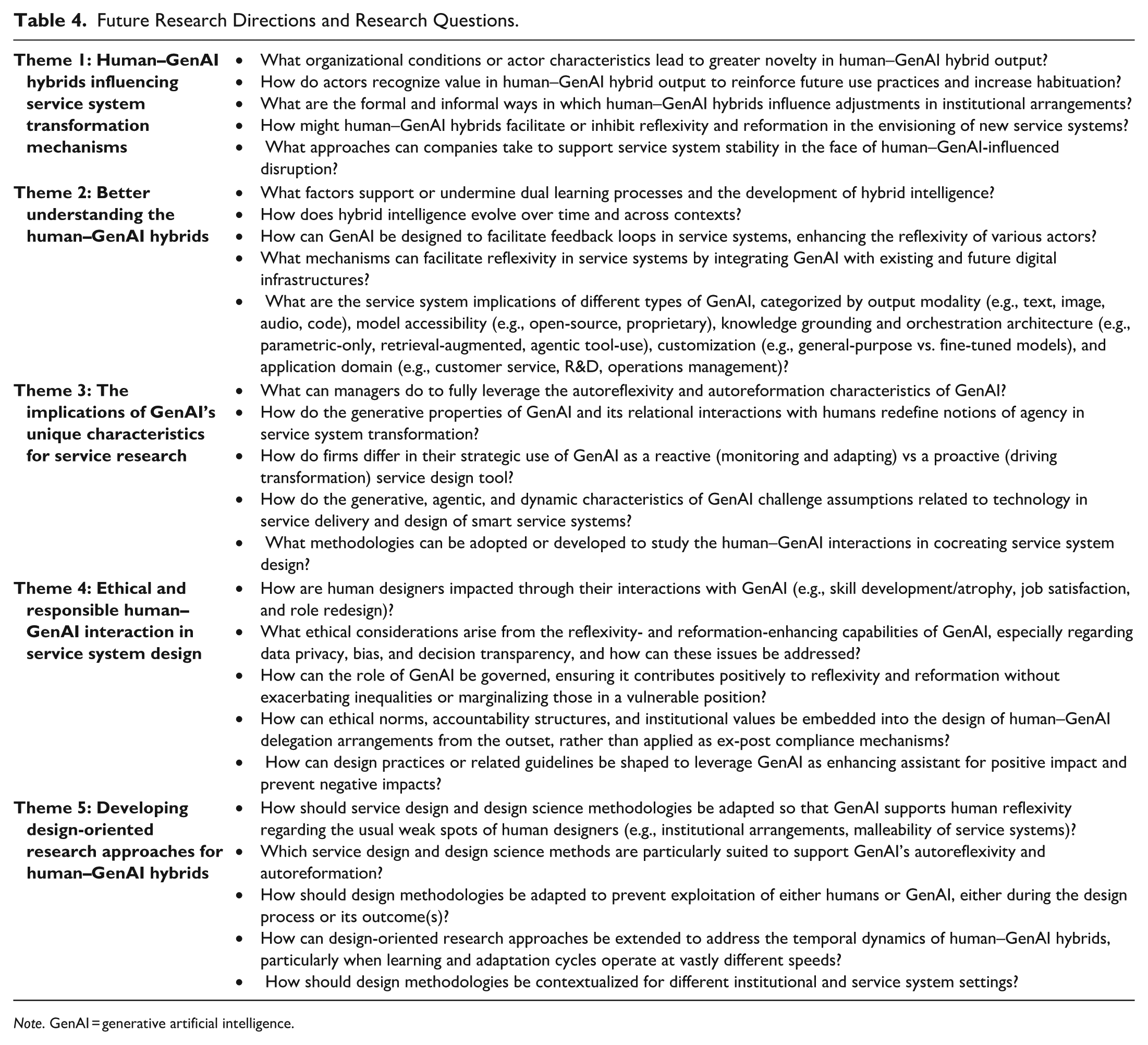
This study develops a conceptual understanding of human–GenAI hybrids in service system transformation but has several limitations which should be addressed through future research outlined in Table 4. First, empirical research is needed to validate the assumption of unfolding human–GenAI hybrid intelligence through case studies, experiments, or longitudinal observations. Research Theme 1 proposes questions for empirical investigation of service system transformation mechanisms in practice, to explore the ways in which human–GenAI hybrids trigger emergence across different levels and contexts.
Future Research Directions and Research Questions.
Note. GenAI = generative artificial intelligence.
Second, while we do not consider contextual differences, industry-, organization-, and user-specific constraints may shape GenAI-driven reflexivity and reformation, requiring a contingency framework for differences in implementation. Research Theme 2 encourages examination into the complexities of human–GenAI interactions and hybrid intelligence.
Third, we present a static view of autoreflexivity and autoreformation, and do not expand on differences between use-cases or technological specifics. Investigating these nuances is valuable for understanding GenAI’s future role in service transformation, therefore Research Theme 3 builds on the unique characteristics of GenAI to reconsider the role of technology in service system research.
Fourth, while we assume that human–GenAI hybrids co-evolve to create value, alternative forces, such as autonomous AI decision-making, control-driven AI use, or even abandonment, may lead to value co-destruction. This highlights the importance of embedding ethical norms, human values, and accountability structures directly into service system design rather than treating them as ex-post compliance requirements. Accordingly, Research Theme 4 calls for research examining the ethical and societal implications of GenAI in service system design and how such risks can be mitigated.
Finally, human–GenAI hybrids pose new challenges for design-oriented research and offer a unique opportunity to synthesize the design-oriented research from service research (Shostack 1982; Vink et al. 2021) and IS research (Li et al. 2024; Peffers et al. 2007), which only recently have started to cross-pollinate (e.g., Blaurock et al. 2025; Tuunanen et al. 2024, 2023). Research Theme 5 encourages to integrate the more formalized, process-based, and rigorous methodologies from IS research with the contextually-rich, institutionally-grounded approaches of service research to create comprehensive methodologies for service system design for human–GenAI hybrids.
Footnotes
Acknowledgements
We acknowledge the use of GenAI (OpenAI’s ChatGPT, Anthropic’s Claude, Google’s NotebookLM, and Microsoft Copilot) in ideating examples, suggesting headings, and polishing language.

Funding
The authors disclosed receipt of the following financial support for the research, authorship, and/or publication of this article: We gratefully acknowledge the financial support received from the Strategic Research Council (SRC) within the Research Council of Finland grant for TRANSFORM-AI (#372923).
Declaration of Conflicting Interests
The authors declared no potential conflicts of interest with respect to the research, authorship, and/or publication of this article.