






Abstract
Customer experience management (CXM) is a strategic priority for service firms, yet its conceptualization and implementation in business-to-business (B2B) markets remain underdeveloped. Existing research offers limited insight into the nature of customer experience (CX) as a managerial objective and into competitive CXM strategies. This study addresses these gaps by examining the nature of B2B firms’ target experiences (TXs), defined as the set of customer reactions a firm intentionally seeks to evoke, and how TXs inform CXM strategy. Using an abductive approach, we conducted a qualitative field study of forty-one B2B service providers practicing CXM with strategic intent. Our findings reveal two TX approaches: general TX, emphasizing reactions’ valence (e.g., positive, improved), and specific TX, describing qualitatively distinct reactions (e.g., effortless, caring, inspiring). The findings show how the nature of TXs shapes the execution of CXM, shared CX culture, and CX-based competitive positioning. We further identify two competitive CXM strategies—responsive and proactive—and articulate their conditions and implications. This study advances service research by clarifying CX as a managerial objective, explicating TX’s role within CXM, and introducing a framework for TX-informed CXM strategies. For B2B service firms, the study offers actionable insights to advance differentiation through CX.
This is a visual representation of the abstract.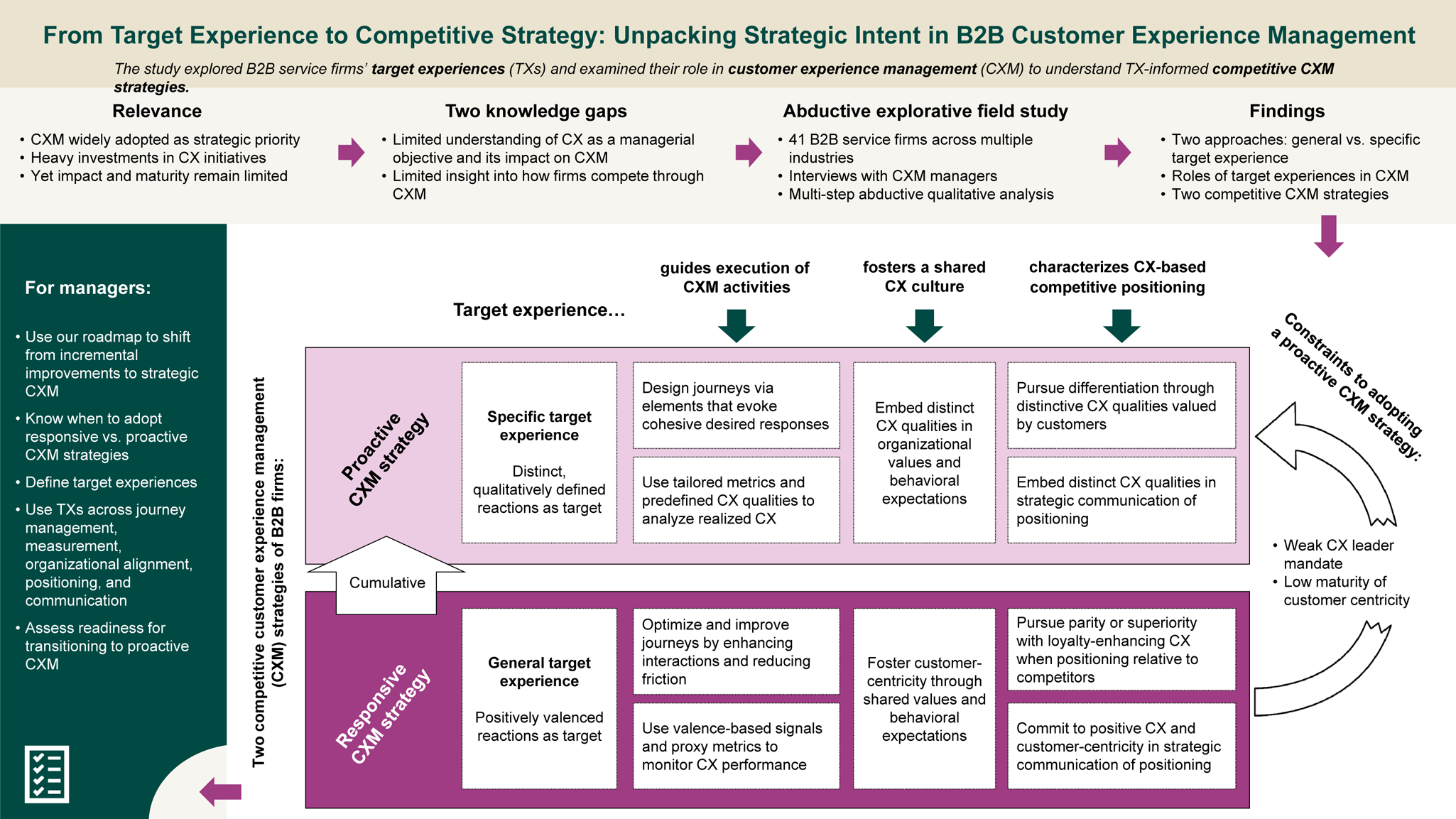
Keywords
Introduction
Customer experience management (CXM) has emerged as a fundamental basis for contemporary service design and management (Gahler et al. 2023), and, therefore, a key strategic priority for service research and practice (Ostrom et al. 2021). Service firms across industries are reorganizing processes, investing in new technology, and appointing dedicated managers to improve the customer experience (CX), aiming to boost customer loyalty and achieve sustainable competitive advantage (Gennis 2019; Schmidt et al. 2024). While CX-based strategies were first adopted by companies developing experiential consumer services, CXM has also become an important strategic approach for increasingly servitized industrial markets (Ulaga 2018). For example, Caterpillar, a leading provider of construction and mining solutions, aims to deliver “the Cat Customer Experience” by offering personalized support, reliability, and innovative solutions. 1 In turn, General Electric aims for “customer experience excellence,” in which low net promoter scores (NPS) or negative comments are systematically used as opportunities to improve the way customers are served. 2 A 2020 survey of business-to-business (B2B) firms in North America and Europe reveals that CX had already gained significant traction, with over 50% reporting its integration into their strategies (Doheny 2020). Given the pace of digital transformation and rising customer expectations, CXM adoption in B2B firms has likely accelerated.
However, CXM has yet to mature, both as a managerial practice and as an academic concept. Managerial reports claim that firms often gain unsatisfactory returns on their CXM investments, as many CXM initiatives fail to differentiate, remain incremental rather than strategic, and lack a clear purpose (Dasteel 2022; Smith 2021; Thompson 2018). The challenge is particularly evident in B2B firms, where CX index ratings are reported to lag significantly behind those of retail customers (Gounaris and Almoraish 2024). Still, there is reason for optimism: Forrester predicts that CX differentiation will be easier than ever for firms willing to invest, as many competitors stagnate due to reliance on short-term solutions and operational concerns (McAllister et al. 2024). We highlight two major shortcomings in existing knowledge that, if addressed, can support a better strategic-level understanding of CXM and help service firms compete using CX.
First, the current research lacks insights into the nature of CX as a managerial objective. Many studies observe that the very meaning of “good CX” remains fragmented among researchers and practitioners alike, ranging from high NPS and service quality scores to the consideration of multidimensional customer responses (Becker and Jaakkola 2020; De Keyser et al. 2020; Imhof and Klaus 2020; McKinsey 2022). As De Keyser and Van Vaerenbergh (2024, p. 147) note, “executives often express a desire to enhance CX, yet seldom specify the precise experience they aim to provide.” Determining a firm’s vision for what distinguishes its CX from competitors should be a cornerstone of successful CXM (Bleier et al. 2019; Williams et al. 2021), yet existing research tends to treat all CX the same, paying little attention to its intended qualities and whether and how those affect firms’ CXM efforts (cf. Becker and Jaakkola 2020). Most studies that mention such target experiences (TXs) do so in passing and limit their focus to a single empirical business-to-consumer (B2C) context (Ponsignon 2023) or to a particular aspect of CXM, that is, journey design (Siebert et al. 2020). This narrow focus has hindered the understanding of B2B firms’ CXM objectives and the development of effective CXM approaches.
Second, the existing research offers scant insight into competitive CXM strategies (Wirtz et al. 2025). Although research shows that high-performing companies view CXM as their strategic “guiding light” (Wetzels et al. 2023), much of the current research focuses on understanding isolated CXM components; for instance, the techniques of gaining customer insight or capabilities to design smooth journeys (Homburg and Tischer 2023; McColl-Kennedy et al. 2019), rather than alternative overarching CXM strategies. Even seminal research conceptualizing CXM as a strategic approach overlooks the potential diversity of CXM objectives and offers little insight into how firms compete through CXM (Homburg et al. 2017). Although scholars have called for research on how CX aligns with a firm’s strategy (Keiningham et al. 2020) and have recognized CXM as a source of superior competitive advantage in B2B markets (Ulaga 2018; Witell et al. 2020), empirical research on competitive B2B CXM strategies is virtually nonexistent.
Against this backdrop, the purpose of this study is to explore B2B service firms’ target experiences (TXs) and examine their role in CXM to understand TX-informed competitive CXM strategies. In this study, TX denotes the set of reactions that a firm intentionally seeks to evoke in its customers. To address this purpose, we conduct a qualitative field study of 41 B2B service providers practicing CXM with strategic intent, using an abductive approach (Van Maanen et al. 2007). In line with abductive logic, empirical insights iteratively interact with the existing CXM literature and are interpreted through Mintzberg’s (1987a) perspectives on strategy.
This study makes three important contributions to service and marketing literature on CXM. First, it offers the first examination of firms’ target experiences, distinguishing between two key TX approaches: the valence-focused general TX (e.g., positive and improved), and the qualitatively descriptive specific TX (e.g., effortless, caring, and inspiring). This advances understanding of CX as a managerial objective and helps explain and resolve conceptual ambiguity about its meaning. Second, this study offers novel and rich insights into the roles that TXs play in CXM: TXs not only inform operational decisions but also shape how firms foster a shared CX culture and position themselves relative to their competitors, thus having a dual identity both as guiding ideas for operational service improvement and as expressions of the firm’s broader strategic intent. Third, this study advances understanding of how B2B service firms compete through CXM. We identify two distinct competitive CXM strategies: responsive and proactive. Through a responsive strategy, firms can foster customer-centricity, while a proactive strategy enables them to use CXM for differentiation. We introduce a framework for TX-informed CXM strategies, articulated through empirically grounded premises. This framework moves beyond fragmented or overly general views of CXM by offering a foundation for theorizing its strategic variation and supporting future research on competitive CXM strategies.
Conceptual Background
Customer Experience and Its Management in B2B Markets
Academic research defines customer experience (CX) as “customers’ nondeliberate spontaneous responses and reactions to offering-related stimuli along the customer journey” (Becker and Jaakkola 2020, p. 638). CX is inherently subjective and personal to the individual (Lemke et al. 2011), and rather than being merely an evaluation of a service, it is grounded in a customer’s everyday life. State-of-the-art research characterizes CX based on its attributes, such as multidimensionality, ordinariness, level of involvement, time flow, and valence (see De Keyser et al. 2020; Gahler et al. 2023). These properties make the concept of CX uniquely qualitative, rich in content and meaning, but also challenging to understand, measure, and use in practice.
While CX occurs naturally and continuously, it becomes a strategic concern when firms deliberately seek to shape it. This is the focus of CXM, a holistic, firm-wide approach that integrates cultural, strategic, and capability-related aspects (Homburg et al. 2017). CXM seeks to influence how customers perceive and respond to their interactions with the firm, which unfold across various touchpoints—defined as any moment where a customer connects with the firm or its associated service partners (De Keyser et al. 2020). We adopt the recent definition of B2B CXM as “the process of designing, analyzing, and orchestrating customer journeys, including their associated cues and touchpoints, to foster experiences that support the achievement of customer goals at both individual and collective levels over time” (Wirtz et al. 2025, p. 3).
Research on CXM in business markets remains scarce, with only a few studies offering initial conceptual grounding (Table 1). Early empirical research into B2B CXM suggests that B2B customer journey management is a key capability to achieve superior customer value and loyalty (Homburg and Tischer 2023), and CX orientation is a crucial cultural aspect of CXM, driving experience-based learning and institutionalizing this learning across the organization (Arkadan et al. 2024). Conceptual B2B CXM studies further describe the complex, evolving nature of B2B CX. They highlight the need for a thorough understanding of both individual and collective actors involved in the purchase and use of offerings (Wirtz et al. 2025; Witell et al. 2020), particularly as these interactions increasingly take place in digital environments (Bolton et al. 2018; Holmlund et al. 2020). These studies also note that B2B customer journeys are embedded in business relationships. They typically occur within contractual settings, may be multiple and simultaneous for a single customer, and often unfold over extended periods (Purmonen et al. 2023; Wirtz et al. 2025; Witell et al. 2020). This complexity shapes how CX is managed in B2B, requiring firms to navigate long-term, multi-touchpoint relationships with individual and collective actors.
Key Customer Experience Management Studies in a B2B Setting.
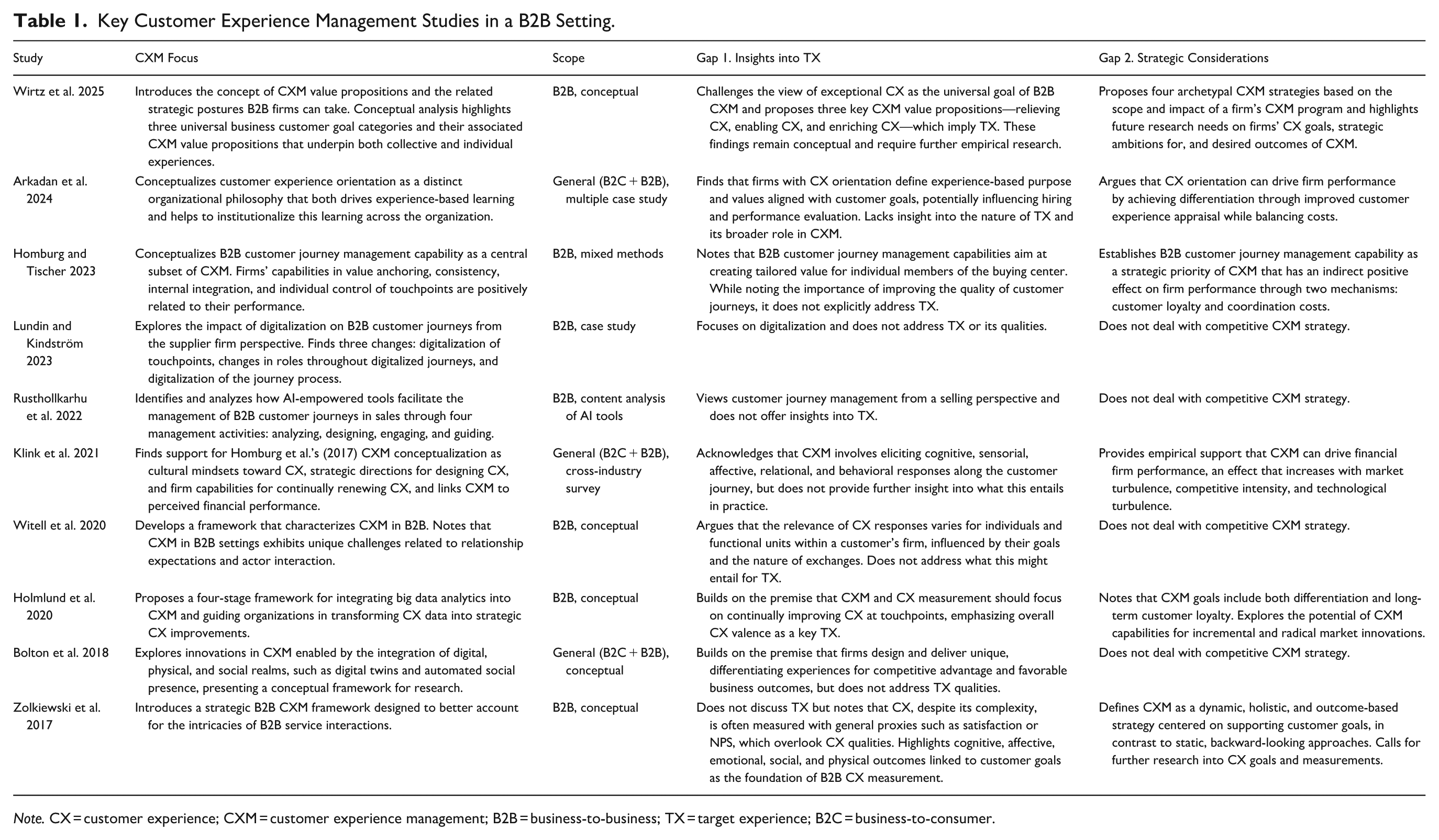
Note. CX = customer experience; CXM = customer experience management; B2B = business-to-business; TX = target experience; B2C = business-to-consumer.
While extant research has laid the conceptual foundation for understanding B2B CXM, two substantial knowledge gaps remain. First, insights into target experiences (TXs) in B2B CXM remain scarce (see Table 1, Gap 1). A notable exception is the study by Arkadan et al. (2024) that highlights the importance of the “extent to which organization members are guided by a purpose and values that encapsulate customers’ experience goals” (p. 1,565). However, the study does not elaborate on the nature of these customer-defined experience goals or their broader influence on CXM. Other B2B studies have addressed the concept of TX only implicitly, and their perspectives remain notably divided. Some imply that improving the quality or valence of CX is the core focus of CXM (Holmlund et al. 2020; Homburg and Tischer 2023). Others suggest a more qualitative approach to CX as a managerial objective, highlighting its multidimensional nature (Klink et al. 2021; Witell et al. 2020; Zolkiewski et al. 2017) and the value creation associated with achieving customer journey goals (Wirtz et al. 2025). However, no empirical knowledge exists about different approaches to TXs or how they work within B2B CXM.
Second, B2B CXM research lacks deeper insights into how CXM is leveraged as a competitive strategy, which we provisionally define as the way a firm chooses to compete through CXM (see Table 1, Gap 2). In particular, there is limited understanding of how different CXM approaches contribute to a firm’s value proposition and market leadership (cf. Treacy and Wiersema 1993). Some studies suggest that the competitive goals of CXM may vary (Wirtz et al. 2025), but no empirical studies exist in this area. Existing CXM literature occasionally references strategic intent aimed at customer loyalty and retention (Holmlund et al. 2020; Homburg et al. 2017; Homburg and Tischer 2023), while others highlight CXM’s potential as a differentiation and growth strategy (Arkadan et al. 2024; Zolkiewski et al. 2017). However, empirical evidence remains scarce. In sum, more research is needed to examine potential differences in CXM strategies and better understand how firms compete through CXM initiatives.
Target Experience: A Missing Piece of the Puzzle
To confirm what is known about target experience, we review broader CXM literature (Supplemental Web Appendix A). Through this process, we define target experience (TX) as the set of reactions that a firm intentionally seeks to evoke in its customers. This definition reflects our synthesis of existing explicit definitions and implicit mentions of TX as an intended, yet-to-be-realized form of CX that firms aim to shape through their CXM efforts.
The review reveals that empirical studies acknowledging TXs predominantly focus on B2C contexts. Most address TXs implicitly or in passing, whereas only a handful explicitly consider TX. Some implicit mentions hint that TXs may help shape and communicate strategic intent, for example, by articulating value propositions in experiential services to drive firm performance (Kwortnik and Thompson 2009; Hung et al. 2023). The few empirical studies that explicitly examine TX tend to focus on its operational role, often adopting narrow, context-specific perspectives (Youssofi et al. 2024). For example, Siebert et al. (2020) and Ponsignon (2023) highlight that firms can design the customer journey to intentionally evoke more unpredictable or hedonic experiences. In turn, von Richthofen and von Wangenheim (2021) indicate that TX steers how service platform leaders manage their external service partners.
The studies in our review offer only scattered insights into the roles TX may play. They typically focus on predefined CX types or characteristics within specific empirical contexts and restrict their analyses to selected aspects of CXM, most often in single‑firm settings. Since CXM always involves a deliberate aim, a limited understanding of the nature of TX and its role in shaping CXM in strategically meaningful ways makes it difficult to develop effective frameworks for competitive CXM strategies.
A Strategic Lens on the Roles of Target Experience in CXM
To move beyond fragmented, predominantly operational views of what TX can do, we need to approach CXM more strategically. We employ a structured analytical lens informed by Mintzberg’s (1987a) classic work, which articulates a multifaceted meaning of strategy as both planned and evolving, and internally and externally focused. According to Mintzberg (1987a), a strategy can be viewed as (a) a consciously concocted plan or an emergent pattern of behavior, (b) a shared perspective existing as an abstraction in the minds of interested parties, and (c) the position of an organization in relation to its environment.
The first view of strategy is about what an organization does—an intentional plan meant to set a direction for a firm’s efforts, or an emergent, consistent pattern in a realized stream of action (Mintzberg 1978, 1987b). Indeed, existing research indicates that while in some firms CXM is driven by explicit directions, in others it is based on continuous adaptations (Homburg et al. 2017). In line with this duality, we expect that TX may both reflect predefined strategic intent and also emerge and establish itself through ongoing CXM activities, understood here as the concrete actions within “the process of designing, analyzing, and orchestrating customer journeys” (Wirtz et al. 2025, p. 3). To understand the strategic role of TX, we analyze how it guides such actions.
Strategy can also be viewed as a shared perspective that gives meaning to people working within an organization, uniting them by a collective idea (Mintzberg 1987a, 1987b). Existing research connects CXM with a cultural change toward customer centricity (Shah et al. 2006) and suggests that organizational members can be guided by CX-based values (Arkadan et al. 2024). To understand the strategic role of TX in providing shared meaning, we analyze how it guides CX-related culture and behavior in an organization.
The final viewpoint on strategy frames it as a position, focusing on the means by which an organization locates itself within its competitive environment (Mintzberg 1987a) and establishes differentiation relative to others (Mintzberg 1987b). CXM literature indicates that firms can differentiate through CX by designing experience cues that are difficult for competitors to replicate (Berry et al. 2006; Bolton et al. 2018), or through CX-based value propositions (Wirtz et al. 2025) that refer to the clusters of functional and emotional values that comprise a brand promise for the buyer (Ballantyne and Aitken 2007). However, empirical research on CX-based differentiation is limited, and its link to firm positioning remains unexplored. Therefore, we analyze the potential role that TX has in positioning a firm in the market.
Our analytical lens assumes that TX is embedded in strategic CXM action. This perspective allows us to understand competitive CXM strategy as a combination of two interrelated components: TX, which refers to what the firm aims to evoke in customers, and CXM, which encompasses what the firm does to achieve that aim across the three proposed facets of strategy. In this way, the competitive CXM strategy describes how a provider firm aims to get the competitive advantage it desires. Hence, we can organize the observed roles of TX across broader operational, cultural, and market-facing facets of competitive CXM strategy. Each analytical facet highlights a different aspect of this complex concept.
Method
Research Design: An Abductive Explorative Field Study
We take an abductive research approach that is well-suited to qualitative research aimed at developing theories that are both novel and practically relevant (Van Maanen et al. 2007). Abduction allows for the restructuring of initial frameworks through a nonlinear creative process of systematic combining that involves going back and forth between theory, data, and analysis, to confront theory with the empirical world (Dubois and Gadde 2002). To access the empirical world and generate a comprehensive, comparative, and narrative dataset suitable for theorizing, we conducted an explorative cross-sectional field study, analyzing a large number of diverse firms (Lillis and Mundy 2005).
Purposive Sampling Criteria and Process
We used purposive sampling to access information-rich instances of the phenomenon (Patton 1990). First, we sampled a cross-section of B2B service firms to adequately represent CXM in B2B markets beyond a single industry (cf. Homburg et al. 2017). Second, we focused on firms in which CXM existed as a distinct function. As a proxy for this, we used the presence of a manager whose primary role was to oversee and develop CXM. Third, informants were selected for their involvement in high-level decision-making processes to examine the strategic nature of CXM. While the firm is the unit of analysis, we focused on one key informant per firm, as CX managers are uniquely positioned to observe the phenomenon of interest (Gioia et al. 2013).
The search for informants was conducted primarily on the professional social networking site LinkedIn, supplemented by a snowballing technique as the study progressed. Data collection continued until sufficient depth of information was achieved, and no new initial insights emerged in the confirmatory interview round (O’Reilly and Parker 2013).
Our sample consists of 41 firms varying in size and service sectors: manufacturing firms that provide services from delivery and installation to business solutions, infrastructure services, wholesale, financial and insurance services, human resource and workforce services, operational software services, and project-based information technology services (Table 2, Supplemental Web Appendix E). All selected firms identified improving CX as their strategic priority, with their CXM practices spanning one to five years. The sample includes firms from Northern Europe, with no substantial differences in findings across national contexts, allowing for comparisons between the sampled firms.
Sample Characteristics (n = 41) and Interview Duration.
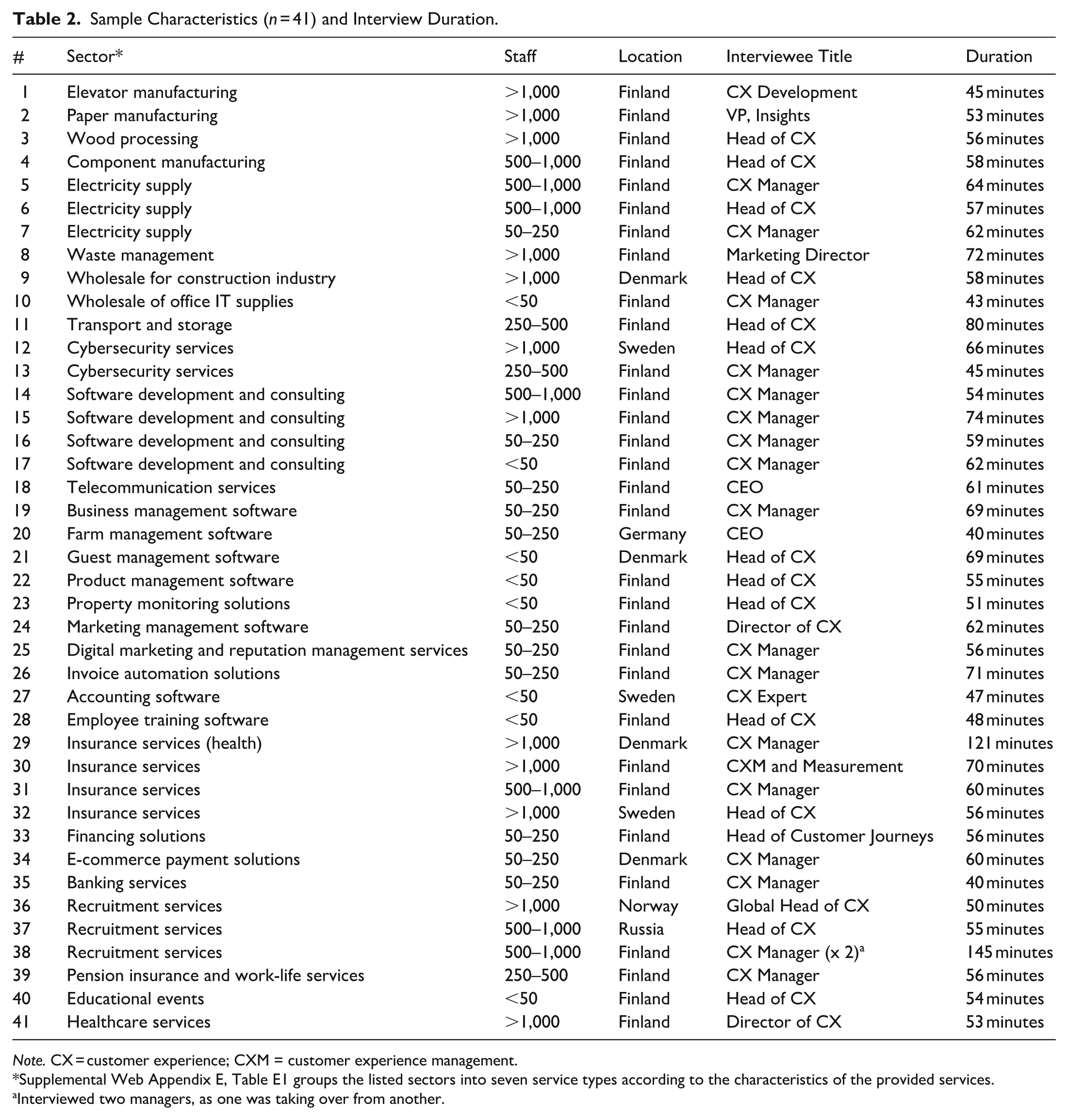
Note. CX = customer experience; CXM = customer experience management.
Supplemental Web Appendix E, Table E1 groups the listed sectors into seven service types according to the characteristics of the provided services.
Interviewed two managers, as one was taking over from another.
Data Collection Through In-Depth Interviews
This study employed semi-structured in-depth interviews with executive CX managers, who, depending on the stage of their projects, could present both retrospective and real-time accounts, as well as future visions, of their CXM initiatives. The study also produced supplementary data, such as multimedia and textual materials from firms’ websites, public strategy content, and internal workshop visuals (see Supplemental Web Appendix B). This material supported the primary data collection strategy and enabled triangulation by confirming interpretations through converging lines of evidence (Jonsen and Jehn 2009).
The principal researcher conducted the interviews with managers in three rounds between August 2018 and May 2021. Each interview lasted approximately 1 hour, yielding rich, firm-specific data on CXM. Our literature review informed the main themes of the interviews: (a) the role of CX in the company and its business context, (b) the company’s strategic goals connected to CXM, probing for TXs, (c) how firms conduct CXM, and (d) organizational requirements for CXM. The interviewees were given a significant voice in shaping the conversation (Gioia et al. 2013). All interviews were recorded and transcribed, forming a dataset of 44 hours (268,000 words).
Data Analysis and Assessment of the Study’s Trustworthiness
We adopted established approaches for data-driven qualitative analysis, incorporating techniques such as open, focused, and axial coding, as well as memo writing (Gioia et al. 2013; Saldaña 2021). Additionally, we applied general recommendations for interpreting qualitative data, including categorizing and connecting strategies (Maxwell and Miller 2008). The analysis was performed simultaneously with data collection, yet emerging findings were consistently verified across the entire dataset. The analysis also involved abductive matching with an evolving theoretical understanding (Dubois and Gadde 2002). The analysis concluded when additional comparisons across the full dataset failed to yield new insights, that is, when the theoretical saturation point was reached (Corbin and Strauss 1990).
Our analysis proceeded in three stages. First, we identified the nature of firms’ TXs and their roles in CXM, using Mintzberg’s (1987a) perspectives on strategy as an analytical lens (Figure 1). Second, we examined patterns across cases to identify distinct competitive CXM strategies by analyzing qualitative differences in how these roles were enacted (Figure 2). Third, we explored the constraints that shape these strategies and firms’ ability to transition between them.
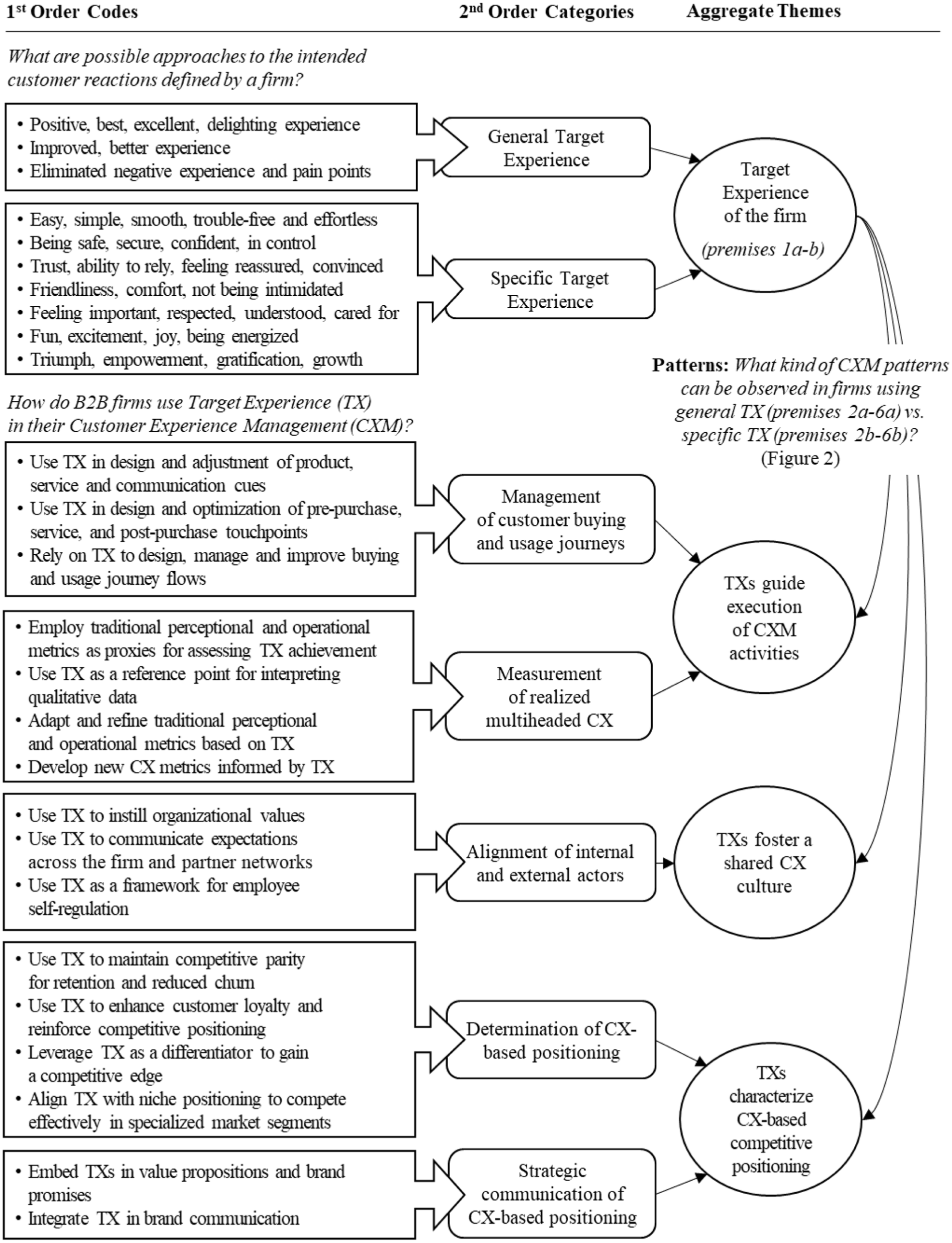
Data structure of emergent themes.
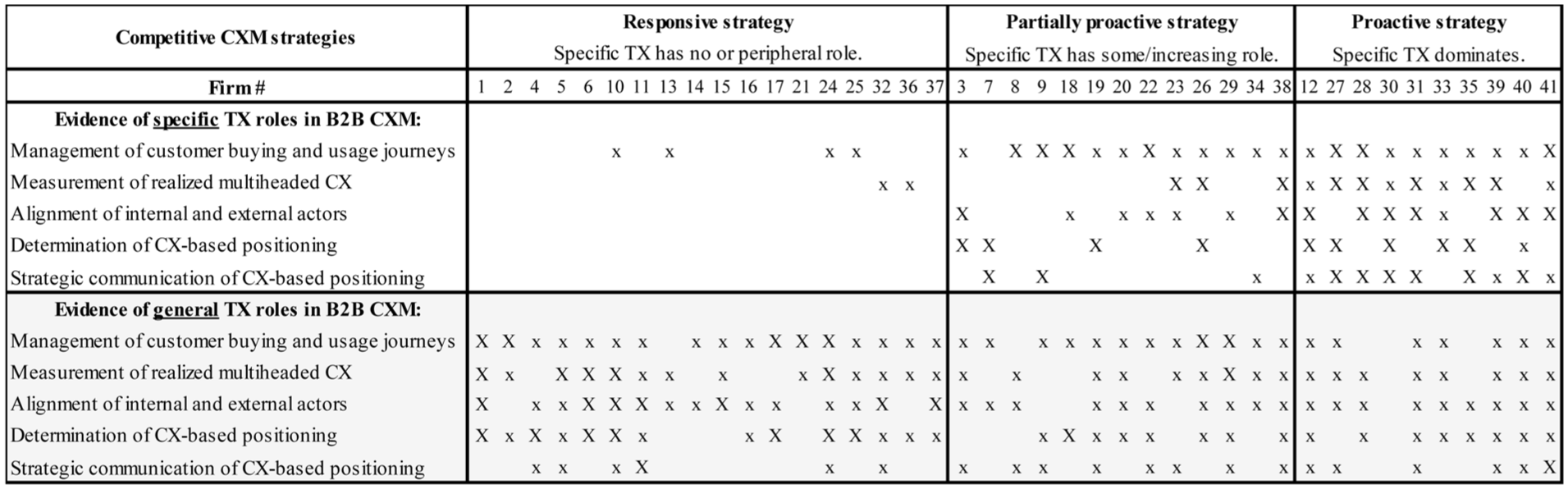
Data patterns across firms revealing competitive customer experience management (CXM) strategies.
In the first stage, after clarifying the research problem through exploratory open coding on the initial batch of interviews, we coded for (a) the reactions that a firm intentionally seeks to evoke in its customers and (b) how B2B firms use them in their CXM. Investigating the latter question required the use of connecting strategies (Maxwell and Miller 2008). It started with a TX articulated in each case, aiming to understand what it involves and how it relates to a firm’s CXM. Initially, 1st-order codes were derived from in vivo expressions in participants’ language. As the analysis progressed, these codes evolved into more interpretive concepts reflecting our developing understanding. To illustrate, the in vivo description “TXs of different buying center members considered in sales material” stabilized under a more interpretive 1st-order code, “Use TX in design and optimization of pre-purchase, service, and post-purchase touchpoints,” with sales material being a touchpoint at a pre-purchase stage of the journey. In an abductive fashion, prior literature and constant memo writing aided in the interpretation of codes, which were refined and validated through team discussion, consistent with interpretive approaches (Saldaña 2021).
Continuing the coding stage, we examined commonalities and differences in informants’ accounts across 1st-order codes (Gioia et al. 2013) and developed 2nd-order categories. We grouped TX-related codes into two distinct approaches (general and specific) and organized the emerging roles of TX across the CXM aspects mentioned by informants. These aspects ranged from measurement and journey management to less-studied areas of CXM, such as strategic communication and organizational alignment. As 2nd-order categories represent the most analytically sensitive level, we conducted a post hoc intercoder reliability check to validate them and reduce confirmation bias. We selected 10 % of the data with the highest category coverage, provided a codebook to an independent coder, and followed the guidelines of O’Connor and Joffe (2020). Agreement was calculated with statistical software (SPSS) using Cohen’s kappa, as in similar studies (Siebold et al. 2023). In two cases of weaker agreement indicated by low Cohen’s kappa (.400 and .500), we merged overlapping categories into a single new one. After merging, the intercoder reliability averaged κ = .816 (p < .001), ranging from κ = .719 to .952 (p < .001) for the data units coded (N = 134), indicating substantial agreement (McHugh 2012).
We then aggregated second-order categories into overarching conceptual themes. While a firm’s TX was a direct aggregation, addressing its use across different aspects of CXM required additional conceptual support. These categories were grouped according to the different perspectives on strategy (Mintzberg 1987a), thereby providing criteria for assessing the extent to which the emerging themes constitute a strategy. The resulting aggregate themes were further refined to characterize the distinct, embedded ways in which TXs work within organizations: guiding the execution of CXM activities, fostering a shared CX culture, and characterizing CX-based positioning. Although these coding steps are reported in a linear hierarchical sequence, the process was iterative; defining aggregate themes also helped refine second-order categories and 1st-order codes, ensuring a stronger foundation. This approach enabled a structured, consistent analysis of TX’s roles in CXM and revealed distinct facets of emerging competitive CXM strategies. Figure 1 shows the final data structure.
In the second stage, we examined CXM patterns across firms employing general versus specific TX (see Figure 1, “Patterns” arrows linking the aggregate themes). We approached this analysis in two ways. First, we assessed the roles that each TX approach played in CXM of the studied firms (see Figure 2 for evidence of Patterns). This analysis helped us distinguish between two competitive CXM strategies: a responsive strategy, associated with the dominant use of general TX, and a proactive strategy, aligned with the use of specific TX. We also identified a transitional subtype of the proactive strategy, characterized by the presence of only a few specific TX roles, which we label the partially proactive strategy. Second, we explored qualitative differences in how the roles that the two distinct TX approaches played were enacted in practice. These distinctions are reported in detail in the findings section. While the patterns illustrated in Figure 2 reflect the presence or absence of the coded roles across firms, the qualitative analysis enabled us to interpret these configurations as distinct and coherent competitive CXM strategies.
In the third stage, we also explored constraints that might limit firms’ ability to transition from one strategy to another. Unlike previous hierarchical coding steps, this analysis systematically examined managers’ accounts of CXM challenges through memo writing, revealing two constraints as particularly relevant. Supplemental Web Appendix C provides three exemplary analytical case summaries that illustrate how identified configurations of responsive, partially proactive, and proactive strategies manifest within individual firms. These summaries, derived from memos and within-case analyses, also show how the identified constraints shape firms’ strategic approaches.
To ensure that our empirical insights hold across the sample characteristics, we mapped key findings onto service type and firm size (see Supplemental Web Appendix E). This analysis confirms that the general and specific approaches to TX, TX’s roles in CXM, and the two competitive CXM strategies are generalizable to diverse B2B service firms. The overall evaluation of the credibility, transferability, dependability, and confirmability of this study was conducted according to Lincoln and Guba’s (1985) criteria for assessing exploratory research and is available in Supplemental Web Appendix D.
Findings
We report the findings in three parts (Figure 3), articulating the key results as sets of premises that are generalized theoretical statements defining the core elements of the studied phenomenon (Ulaga et al. 2021). First, we outline two main approaches to target experience (TX) in B2B firms: general and specific TX (premises 1a/1b). Second, we examine the roles of TXs and show how CXM efforts differ depending on whether firms adopt a general or specific TX approach (premises 2a/2b to 6a/6b). Third, based on CXM patterns across firms employing general versus specific TX, we identify two competitive CXM strategies: responsive and proactive. We explain how these strategies relate to one another and identify constraints that limit firms’ ability to shift from a responsive to a proactive approach (premises 7–8). Supplemental Web Appendix C provides additional quotes that support each finding.
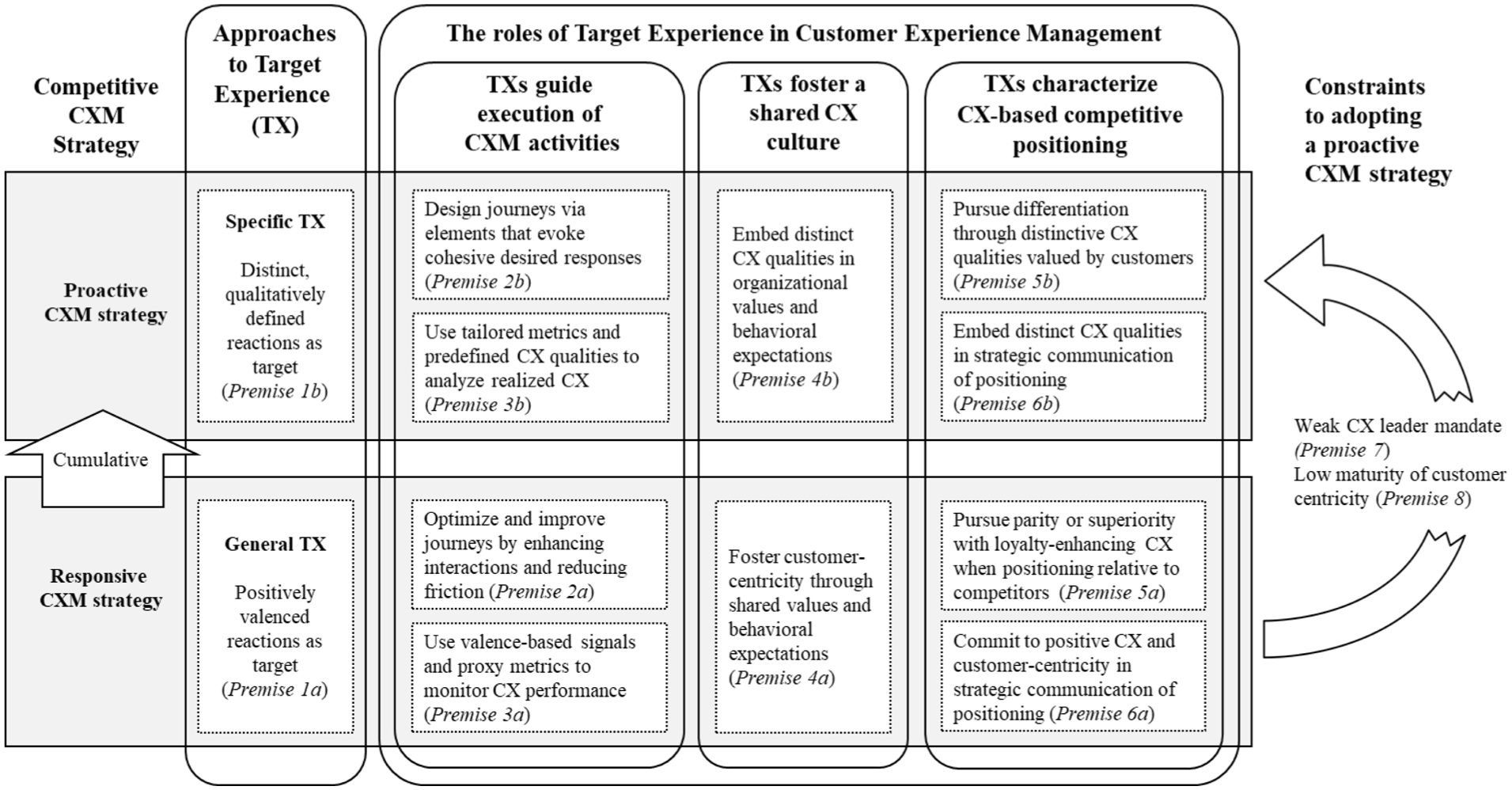
A framework for target experience-informed competitive customer experience management (CXM) strategies.
Approaches to Target Experience in B2B Service Firms
In B2B service contexts, defining target experience is rarely straightforward. Unlike in B2C settings, where the customer is typically a single decision-maker or user, B2B firms must often consider multiple stakeholders—each with distinct roles, expectations, and touchpoints. Our analysis revealed that firms vary in whose experience they prioritize when defining their target experiences (TXs), understood here as the sets of reactions that a firm intentionally seeks to evoke in its customers. Roughly one-third of the firms in our sample focused on either the buying center (e.g., procurement teams) or the usage center (e.g., organizational end users). The remaining two-thirds took a combined approach, considering multiple stakeholder groups. Industry differences were also evident: manufacturing, infrastructure, wholesale, and project-based IT services tended to emphasize buying-center experiences due to the importance of pre-purchase and repurchase interactions. In contrast, software and financial services more often prioritize usage center experiences, reflecting the influence of digitalization and the prevalence of app-based service delivery. Still, the combined approach was common across firms of all service types and sizes (see Supplemental Web Appendix E, Table E3). Within this context, our analysis identified two distinct approaches to TX that underpin how firms manage and strategize around customer experience: general TX and specific TX (see Figure 3, Approaches to TX).
General Target Experience
The first approach, general TX, represents the baseline approach for virtually all firms engaged in CXM. This view focuses on the valence of CX: managers consistently reported that their firms’ CXM efforts aim to deliver great experiences, improve current ones, or eliminate negative ones. However, firms using only general TXs did not articulate content-specific attributes of experience or define desired customer reactions beyond their general positivity, as illustrated in the following quotations:
We want to deliver an excellent, really good customer experience. (#25)
As long as the person you identify for your product is happy and has a really good experience using that service, you are quite successful [in CXM]. (#21)
[The goal is] to improve both customers’ and users’ performance and experience [. . .] how it could be better. (#4)
Condensing firms’ accounts of valence as the core managerially relevant attribute of CX, we derive the following (Figure 3):
Specific Target Experience
The second approach, specific TX, was evident in two-thirds of the firms in our sample. In addition to aiming for positive CX, these firms went further by articulating the specific reactions they wanted their customers to have. Specific TXs were descriptive and rich in content, representing a synthesis of desired responses and reactions of varying complexity, often capturing multiple experiential dimensions, thus aligning well with the conceptualization of CX in academic literature.
Across the dataset, firms described specific TX using terms such as ease and effortlessness, security and confidence, trust and reassurance, feeling valued and supported, comfort and approachability, joy and excitement, and empowerment and growth. Firms considered these experiences valuable to their B2B customers because they addressed both practical needs and emotional expectations of individuals and groups. These specific TXs were expressed both informally, as simple descriptions of desired customer states, and more formally, through icons, abbreviations, or slogans:
Now we are talking about the “smooth energizing experience” principle. (#40)
Easy to order, easy to use the services, but also easy to manage [their waste disposal needs] . . . who would not want ease in their own work? (#8)
[We aim] that the client has felt valued and cared for and relieved (#31)
Across the dataset, we see that firms leveraging specific TX emphasize the qualitative attributes of CX as managerially relevant and desirable end result of their activities. This interpretation is supported by firms that have embedded specific TXs into the core of their service offerings. In sum, we delineate (Figure 3):
We find that certain TX qualities are more prevalent in specific industries (see Supplemental Web Appendix E, Table E3). For instance, security and safety were commonly mentioned by financial, infrastructure, and workforce services. Firms focused on the buying center emphasized trust, care, and reliability—hallmarks of good customer service and strong business relationships—while those targeting the usage center emphasized fun and excitement, particularly in gamified software or events. However, these findings are not prescriptive; firms across sectors may adopt any TX qualities that align with their brand and customer needs.
The Roles of Target Experience in CXM
While defining TX clarifies what firms aim to evoke in customers, examining how TX is used in practice reveals deeper strategic patterns. Our analysis shows that TX is not merely a stated goal; it plays three main roles within organizations (see Figure 3, TX roles in CXM). First, TXs guide the execution of CXM activities, specifically, the management of customer buying and usage journeys and the measurement of realized, multiheaded CX. Second, TXs foster a shared CX culture by aligning internal and external actors. Third, firms use TX to characterize their CX-based competitive positioning, which involves determining their position internally and communicating it externally.
In the following sections, we explain the three identified TX roles in CXM in detail and theorize through five pairs of premises that capture variations in CXM patterns across firms using general versus specific TXs (see Figure 2), showing how these roles differ depending on the TX approach.
Target Experiences Guide the Execution of CXM Activities
The interviews revealed that TXs play a central role in shaping the execution of CXM activities: managing customer buying and usage journeys and measuring realized CX.
Our data showed that TXs guide how firms manage customer buying and usage journeys in relation to the design and optimization of experiential cues, touchpoint properties, and customer journey flows. The managers described how their firms used TX in the design and adjustment of various product, service, and communication cues. When firms relied on general TXs, they tended to focus either on cues that created a broadly pleasant or enjoyable experience—such as good coffee in offices (firm #17)—or on reactive adjustments to improve touchpoint quality. This reactive approach was especially characteristic of general TX. For example, service personnel were encouraged to be responsive and prevent negative experiences from escalating:
If there’s somebody who’s not happy with something, we want to address that really quickly. We try to identify if something seems like it’s going the wrong direction, we identify it early, and address it. (#21, General TX expressed)
Specific TXs, in turn, provided concrete guidance for innovating cue design—such as adjusting vocabulary based on a customer representative’s expertise to help them feel at ease or using joyful colors to shape the emotional tone of interactions:
Accounting is the most boring thing you can do. If you can find something within this that brings you joy or a smile—that is fundamentally important . . . We want our customers not to be intimidated. We work with nice, cozy, happy colors and try to have the little things, details that . . . make the customer feel a sliver of joy. (#27, Specific TX expressed)
Furthermore, firms used TX in the design and optimization of pre-purchase, service, and post-purchase touchpoints, often leveraging digital technologies to enhance interactions. Financial, software, wholesale, and delivery services, in particular, drew heavily on B2C service models. Firms using general TX focused on optimizing existing processes, such as automating service interactions and improving logistical efficiency:
We have developed robotics to automate the front end of the customer service journey. When we get a case from a customer, it can identify directly from the text whether it is a request, an incident, what products it relates to, what teams it may belong to, and it can put the ticket in the right queue already to go through it without the need to do anything manually by any human. (#26, General TX expressed)
In contrast, firms leveraging specific TX emphasized more transformative touchpoint innovation for shaping the customer’s experience at key touchpoints, ensuring that interactions facilitated the experiential response intended by the brand:
We’re more of a tool, and we need to be an efficient tool to work with. We need to be very convenient . . . A good example where this brand promise comes into play—a lot of businesses, especially B2C businesses, are doing these abandoned baskets [prevention]. Instead of having a very commercial perspective, we’ve tried to say how this could be a service. We focused on saying: ‘You put this into the basket while there was a promotion. That promotion ends in two days’. Or if we can see that the stock level is going down, then we wanna say to some of our good [important] customers that if you want this, you should definitely get it now. (#9, Specific TX expressed)
Finally, firms rely on TX to design, manage, and improve buying and usage journey flows by aligning existing touchpoints, eliminating underperforming touchpoints, or identifying the need for new touchpoints, such as onboarding or user education. For firms using general TX, the emphasis was on improving the overall journey flow by identifying and resolving customer pain points. Firms use customer feedback and analytics to reduce friction, ensuring a consistently positive experience throughout the buying and usage processes:
We can measure at each point in the customer journey whether it’s a positive, negative, or neutral [experience]; then, what we can do based on customer feedback over time is to tweak and improve it. So, if we’re doing that, we’re providing a great customer experience, which is constantly evolving and improving . . . How can we streamline it, how can we improve it, how can we cut things out potentially? (#29, General TX expressed)
In contrast, firms leveraging specific TX commit to a more in-depth design of customer journeys to enhance consistency and cohesion across touchpoints. Rather than just streamlining processes, they ensured that each interaction evoked the intended emotions and perceptions, such as “personal and exciting experience”:
All the touchpoints where the client or the prospect is dealing with us—be they websites or newsletters or implementation training or salespeople or something else—each of these points is examined through certain criteria that they then follow the same trajectory to reinforce that [personal and exciting] emotional experience of the company as a whole. . . Now that the different touchpoints are synced and we say the same things everywhere, we can bring our point of view and realize this [chosen specific TX of] personal and exciting experience. (#28, Specific TX expressed)
Roughly two-thirds of the firms in our sample used specific TX to manage customer journeys (Figure 2), making this the most common TX role identified in our data. Based on the empirical patterns found across cases, we theorize (Figure 3):
We also found that TX guides the measurement of realized CX, serving as a yardstick for analyzing it. Firms consider feedback from buyers, software users, and service beneficiaries, and the overall CX is measured either by focusing on key decision-makers’ impressions or by aggregating multiple individual responses. Our findings show that the degree of refinement and customization of CX metrics varies according to the nature of TX: typically, firms using general TXs employed traditional perceptional and operational metrics such as Customer Satisfaction or NPS as proxies for overall CX and used sentiment analysis, categorizing qualitative feedback as positive, negative, or neutral. This makes sense in light of firms’ aim to track the valence of CX over time, identifying trends, fluctuations, and pain points where CX falls short of expectations:
We have goals for NPS; our support service always sends inquiries [to customers] after resolving support requests. We have certain goals about . . . how many commendable answers there are. Those are the things that we pay attention to. [We look] at trends like whether general satisfaction is declining or rising. (#10, General TX expressed)
In contrast, firms using specific TXs emphasized a more detailed CX assessment, looking for specific desired emotions, thoughts, and perceptions. They used specific TXs as a reference point to interpret qualitative data from sources such as social media, feedback, surveys, interviews, and sales conversations. Additionally, while some developed new custom CX metrics informed by their TX frameworks, others adapted and refined traditional metrics to align with their TX focus:
We promise to be present in the customer’s life . . . the sense of trust and the fact that the client feels valued and appreciated and cared for and relieved . . . Our customer satisfaction surveys [that are given after touchpoints] measure NPS [and] CES [Customer Effort Score]. . . We [also] ask, “What is the main feeling that comes to mind about that encounter?” and provide ready-made options for those feelings, which are linked to the brand—the kind of emotional experience the brand wants to achieve. (#31, Specific TX expressed)
Only half of the firms that used a specific TX to manage customer journeys integrated it into their measurement (Figure 2). This suggests that firms more readily focus on designing for specific TX but do not always extend this approach to assessing realized experiences, often being content with the valence-based approach or finding specific reactions more challenging to measure. Based on our empirical analysis across cases, we delineate the following premises (Figure 3):
Target Experiences Foster a Shared CX Culture
Next, our data analysis shows that TX fosters a shared CX culture, defined here as an aligned understanding of CX meanings, values, and expectations across internal and external actors. We find that TX serves as an orienting framework that shapes organizational values, communicates expectations to different units within the provider firm and across external service partners, and guides employee self-regulation.
We found that, as part of their CXM efforts, firms seek to instill CX-related organizational values among employees. TXs influence this process in distinct ways. General TX shape values more implicitly, reinforcing a broad customer-centric ethos focused on attentiveness and continuous improvement:
What do we manage [in CXM]? We manage the attitude of our colleagues, this environment of constant improvement in the company. We try to nurture this attitude that we have to be attentive to the client . . . I saw the change in their [employees’] attitude. I saw how they think differently, and I saw how they actually sincerely tried to do things better. . . These people are 100 percent dedicated to the goal of making customers happy and working on continuous improvements. (#37, General TX expressed)
In contrast, specific TXs translate into more explicit value frameworks, often articulated through visual tools or keywords, that shape how employees interpret and reflect on desired customer experiences:
Before, we had reliability as a main value, but now we have friendliness and flexibility alongside it. And they appeared incredibly naturally. Both customers and staff began to see that these seem to be things that are already appreciated, and we are already partly acting according to them . . . In a way, words create the world we live in. When you act and talk according to these values, it slowly takes hold. (#41, Specific TX expressed)
TX is also used to communicate expectations across the firm and partner networks, helping to break down silos and foster an environment conducive to delivering the desired CX (“last year I was breaking some silos,” #19; “we put the responsibility for customer service on everyone,” #18). Since multiple units and service partners often contribute to a single customer journey, CX managers emphasized the need to coordinate work around customer processes. For B2B firms with a less central role in the value chain, alignment with service partners was seen as even more critical than journey management. Without frequent direct customer contact, these firms relied on TX as a shared framework to support CX across the service ecosystem. General TXs supported such an alignment through ongoing communication of the shared commitment to improving customer journeys:
The main idea is to have a continuous dialogue with the partner, to strive to always improve the customer journey. And that is because we want to keep the partner engaged. (#32, General TX expressed)
In contrast, specific TXs provided a unifying reference point that standardizes expectations across departments and partners around a more specific experience idea:
[Our TX] guides us well. The same smooth energizing experience is what our IT department should do, our sales should do, our communication [unit] should do. (#40, Specific TX expressed)
The two aforementioned codes relate to how executives organize CXM activities. However, we further found how TX becomes embedded in employee practice. Employees use TX as a framework for self-regulation; that is, they interpret TX to guide their own decisions and behaviors in customer interactions. This self-regulation occurs both through informal reflection, which allows flexibility in interpretation, and through more formal behavioral reinforcement mechanisms, such as key performance indicators (KPIs), coaching, and feedback systems. The KPIs and systems, typically based on various CX metrics, are used by firms to evaluate employee performance and guide recognition and rewards. Notably, our data did not indicate any punitive use. General TXs serve as broad motivational anchors, reinforcing behaviors that have historically improved CX. They exist as general ideas of positive experiences being a desired outcome of action:
We have measurable KPI for customer experience that I can distribute throughout the organization, which also makes it easier to set targets and goals around it, and that way it [CX] becomes everyone’s business. It’s getting people engaged and working more with themselves and realizing things from the data and from the feedback. [General TX: make people happy to do business with us] (#11, General TX expressed)
Specific TXs, on the other hand, provide more concrete experiential principles that employees can act upon and be evaluated against. These TXs encourage the achievement of defined customer reactions, while still allowing flexibility in how they are applied:
A good example of a good understanding of the customer experience in this company is that we also understand that we can’t have a thick manual on how to do things, but we have a strong, empowering approach towards it. [Our employees] have a few basic principles [smooth, energizing], but how they do it varies a lot. (#40, Specific TX expressed)
Specific TXs shaped the shared CX culture in over one-third of the firms (Figure 2). However, about half of these firms either reported difficulties or lacked a sufficiently formalized version of their TX, suggesting that the intended role of the specific TX was only partially realized. Based on our cross-case analysis, we delineate (Figure 3):
Target Experiences Characterize CX-Based Competitive Positioning
The third strategic role of TX concerns CX-based positioning, referring to how firms use CXM to distinguish themselves from competition. We found that TXs characterize how firms define their positioning internally against competition and communicate it externally.
First, our data showed that firms actively use TX in determining their CX-based positioning, including maintaining competitive parity, supporting a leading position, pursuing differentiation, or establishing a niche. General TXs were used in strategic work to articulate a point of parity among firms aiming at customer retention:
The holistic experience is what counts. . . . And it tells you how competitive the industry is, that if [customers] are not happy with us, then there’s a competitor suddenly dropping an offer and trying to get customers for themselves. (#10, General TX expressed)
In some cases, general TXs were framed as a commitment to delivering “the best CX in the industry,” positioning CXM as a lever for building loyalty and reducing churn, supporting the leading position alongside other competitive factors:
We’ve made customer experience one of the most important OKRs [Objectives and key results], and the strategic objectives are to continuously aim for a very high customer satisfaction, so over 70 net promoter score, which we as a company aim for, and then the lowest possible customer churn. (#24, General TX expressed)
In contrast, specific TXs were leveraged in strategic work as a means of differentiation, enabling firms to position themselves with unique experiences that align with their core strengths and are particularly valuable to customers. This was especially evident in financial services, where products are commoditized, and experience becomes the primary basis for competition (“competing on CX is important because we are a commodity” #33). Other firms, like this wood processing company, also leveraged CX-based differentiation:
[We focus on] making it easier because it’s quite a complex space in which we operate . . . we see that as a differentiator between our competitors and us. . . We discuss a lot about the experiences that we want [to create] and what kind of positioning [we aim for] as a whole. (#3, Specific TX expressed)
Some firms used specific TXs to establish a niche, differentiating themselves within a narrower segment and attracting customers by emphasizing a distinct experiential approach:
There are a lot of companies that do accounting software, obviously. But yes, I do believe that we approach it in a unique way. Just by the removal of all the things that are obviously accounting from the user, as much as possible. (#27, Specific TX expressed)
Slightly over half of the firms that defined a specific TX were ready to base their positioning on it; the remainder let general TX play this role instead (Figure 2). Based on our findings across firms, we formulate the following premises (Figure 3):
Second, our data showed that firms use TX in the strategic communication of their positioning, articulating their positioning as providers of either positive or unique customer experiences by embedding their TXs in value propositions and integrating them into their communication. General TXs allowed only general value propositions that signal a firm’s deep understanding of and commitment to customers and their experience as a priority:
At the strategic level, we have expressed it very clearly that we compete in terms of staff and customer experience. We want to be the most well-liked company in the industry. . . Customer experience is important to us, and it is both our internal and external message. (#41, General TX expressed)
[We have] set those values and communicated them . . . “make people happy to do business with us.” (#11, General TX expressed)
In contrast, a recognizable, specific TX was central to shaping a more distinctive positioning. Firms embedded it in their value propositions, brand promises, and communication, making specific TX almost inseparable from the brand:
It’s a distinctive, personalized [experience], the kind that leaves a strong emotional connection . . . we understand that customer experience has such a huge impact on how people see [#40] as a brand that they seem to merge together. (#40, Specific TX expressed)
In our new brand, we promise to be present in the customer’s life in a way that the customer can boldly live their own life and shape their life into something unique. [#31] is “a partner that allows you to live a bold, unique life.” (#31, Specific TX expressed)
Among firms where a specific TX played a key role in positioning, three-quarters communicated it to customers in some form, while a quarter kept it only as an internal strategic focus (Figure 2). Based on our findings across firms, we develop the following premises about strategic communication of firm positioning (Figure 3):
Two Competitive CXM Strategies
By analyzing the observed patterns in the two key TX approaches and their respective roles in CXM across firms (premises 1a–6a and 1b–6b), we identified two overarching competitive CXM strategies: responsive and proactive. These labels resonate with the proactivity literature in organizational behavior, where proactive strategy is characterized as a future-oriented, change-driving approach in which firms take the initiative to create opportunities, whereas responsive strategy refers to reacting to realized events or customer feedback (Brege and Kindström 2020). A competitive CXM strategy emerges as a multifaceted concept that encompasses TX-aligned execution of CXM activities, CX culture shared across internal and external actors, and CX-based competitive positioning (see Figure 3). Next, we summarize the responsive and proactive strategies and report constraints in adopting a proactive strategy identified in additional data analysis.
Competitive CXM Strategies: Responsive and Proactive
As Figure 2 shows, the responsive strategy has been the most widely adopted approach in our sample, with nearly half of the firms relying solely on it and others using it as a baseline. This competitive CXM strategy aligns with general TX (Premise 1a) and is enacted through: optimizing and improving customer journeys (Premise 2a); monitoring CX performance using valence-based signals and proxy metrics (Premise 3a); fostering customer-centricity through shared values and behavioral expectations (Premise 4a); positioning relative to competitors by pursuing parity or superiority in CX (Premise 5a); and expressing positioning through value propositions signaling customer-centricity (Premise 6a).
Accordingly, we define that a responsive CXM strategy involves creating and maintaining positive customer experiences by reacting to observed performance signals and continuously improving existing customer journeys while aligning CX culture and competitive positioning with customer-centricity. A responsive strategy could thus increase customer loyalty and reduce churn, reflecting core service management principles aimed at maintaining quality and meeting customer expectations.
The proactive strategy represents a more selective approach to CXM, adopted by a quarter of firms in our sample (Figure 2). This competitive CXM strategy aligns with specific TX (Premise 1b) and is enacted through: designing customer journeys to ensure cohesive CX qualities (Premise 2b); analyzing realized CX using tailored metrics and predefined CX qualities (Premise 3b); embedding distinct CX qualities in organizational values and behavioral expectations (Premise 4b); positioning relative to competitors by pursuing differentiation through distinctive CX qualities (Premise 5b); and expressing positioning by embedding these qualities in strategic communication (Premise 6b).
Accordingly, we define that a proactive CXM strategy involves creating distinctive customer experiences through a forward-looking approach that designs customer journeys, builds CX culture, and focuses competitive positioning around a set of predefined experience qualities valued by customers. A proactive strategy could thus support differentiation and firm growth through service innovation, reflecting service management’s focus on creating distinctive and valuable experiences.
Our analysis of patterns across firms indicates that responsive and proactive strategies are not mutually exclusive but co-exist in a cumulative manner, with proactive strategies building on a well-developed responsive foundation (see Figure 2). The data further suggest that firms can transition from responsive to proactive CXM over time. Approximately one-third of the firms exhibited partially proactive strategies, combining general TX with emerging specific TX applied at the operative level without integrating it into strategic positioning or broader competitive CXM strategy facets. For example, firms such as #20 or #22 had defined specific experiences they wanted to create and used them to guide service interactions and employee behavior, yet continued to manage the business around maintaining a consistently positive overall experience and reinforcing a customer-centric brand. This indicates that the specific TX had not yet been elevated to drive positioning or broader competitive strategy. The existence of this transitional subtype, together with the observation that all firms begin from a baseline of managing overall experience quality, indicates that a responsive foundation is a prerequisite for developing a proactive approach.
Constraints to Moving from Responsive to Proactive CXM Strategy
In some cases, firms deliberately relied on a responsive CXM strategy to support their central competitive angle of cost leadership or customer value-based differentiation. However, managers also recognized the strong potential of CX-based differentiation. This raises a key question: why do so many firms persist with a responsive approach despite the strategic promise of a proactive strategy? To explore this, we identified two key constraints that hinder firms from shifting to a proactive strategy (see Figure 3).
The first constraint originates from top management, specifically the weak mandate given to the CX leader. By mandate, we mean the authority given to a CX manager by top management, explicitly or by their position within the organization, to act with clear power. We found that a weak mandate, evinced by functional lock-in, project-based work, or an internal consult role with limited formal power, was a significant constraint in moving from responsive to proactive CXM:
I support customer experience functions being in the business lines, but I would still like to see someone taking cross-business-line ownership of this area to make sure that we have clear customer promises and targets for what the [#1’s] customer experience is. And that ‘somebody’ being at the very top level and also the spokesman for this area. (#1)
Q: What did creating this value proposition take from you? R: I’ve been to several management team meetings, and I’ve been banging my head against the wall, trying to get people to understand that NPS is not a one-off that can be used to account for all CX . . . It’s taken a lot of work on my part to have those tough discussions with really high-level directors. It’s always a bit frustrating and risky to go as an expert and bounce around [in front of] the CEO or the unit manager and talk to them like a man to a man. (#30)
The weak mandate led to situations in which even CX leaders who recognized clear opportunities to gain a competitive edge through CX struggled to implement specific transformation initiatives across siloed organizational functions. Therefore, we theorize:
The second constraint is the low maturity of customer centricity within the organization. This issue is common among B2B firms with engineering-driven cultures that prioritize technical excellence, often at the expense of customer focus. Customer centricity is considered low when customer needs, experiences, and feedback are not systematically included in decision-making. It is also marked by limited cross-functional collaboration around customer value and a lack of emphasis on customer outcomes. In our sample, this challenge was particularly evident in manufacturing, infrastructure, and software services.
The organization has not been very customer-oriented, and customers have even been a bit despised. So, the intention [of the CXM program] was based on the fact that we have to be customer-oriented and customer-focused. (#19)
Changing the mindset from engineering, product, and process design-oriented thinking to customer needs-oriented thinking. All development projects should start from what the customer needs and thinks; that’s a really big change process, and it doesn’t happen overnight. It is a continuous change management. (#6)
An unsupportive organizational culture forces managers to operate with general TX until more customer-centric values and practices are developed. Large, established firms with strong functional silos often require multi-year investments to build customer centricity through the responsive approach before advancing to a proactive strategy rooted in specific TXs. We therefore formulate the following premise:
These constraints show that following a responsive strategy is not always a deliberate choice. Instead, it may stem from the difficulty of adopting proactive strategies in organizations deeply rooted in and built for technical excellence. Without cultural change and sufficient authority given to the CXM function, the strategic potential of CX as a differentiator might not be fully realized.
Discussion
Theoretical Contributions
The purpose of this study was to explore B2B firms’ target experiences (TXs) and examine their role in CXM to understand TX-informed competitive CXM strategies. By doing so, this study makes three substantial contributions to service and marketing research on CXM.
First, this study marks the first focused examination of firms’ target experiences, a concept acknowledged as important (Bleier et al. 2019; De Keyser and Van Vaerenbergh 2024; Williams et al. 2021) but not previously conceptualized. While some prior studies have touched on TXs, they have typically focused on predefined CX types within narrow B2C contexts (Ponsignon 2023; Youssofi et al. 2024). In contrast, as the first study to empirically explore the nature of TXs in B2B firms, we identify two generalizable approaches: general TX, which emphasizes the valence of reactions, and specific TX, which captures sets of qualitatively defined reactions. There has been a significant variability in the way academic studies and practitioners treat CX (cf. Becker and Jaakkola 2020): some studies and managerial writings equate CX with evaluation-based outcomes, such as satisfaction and quality (Imhof and Klaus 2020; Lemke et al. 2011), while others highlight its qualitative and multidimensional properties (De Keyser et al. 2020; Lemon and Verhoef 2016). Our study explains and reconciles this confusion by demonstrating that firms may adopt two alternative views, which should be considered in future research and when evaluating prior studies; any research on CXM should make clear which type of CX objectives guide the CXM approaches studied. We position TX as a structured, actionable form of strategic intent—one that reflects two fundamentally different ways of framing CX as a managerial goal. This dual framing of TX has not been previously examined in the literature.
Second, this study advances service and marketing research by identifying and structuring how B2B firms use TXs in their CXM. While prior research has occasionally mentioned TXs, their role in shaping CXM has remained largely implicit and fragmented. Supported by Mintzberg’s (1987a) strategic lens, our study explains how TXs (a) guide activities, (b) provide shared meaning, and (c) support market positioning. Regarding CXM activities, prior research has addressed only isolated uses of TXs, mainly in journey design (Siebert et al. 2020). We provide a more comprehensive account of how TXs inform journey, touchpoint, and cue design, and extend this understanding to CX measurement, which has not been examined previously. Concerning shared meaning, we show how TXs shape organizational values, communicate expectations, and guide employee self-regulation, extending earlier work that has only abstractly suggested such a guiding role (Arkadan et al. 2024). Regarding market positioning, we demonstrate that TXs are actively used in strategic planning and external communication to define strategic aims and articulate value propositions, moving beyond earlier implicit mentions in the service literature (Kwortnik and Thompson 2009). Overall, our primary contribution is integrative: by creating a comprehensive understanding of these roles, we explicate how TXs operate across B2B CXM as a whole and respond to recent calls for empirical research on CXM (Becker and Jaakkola 2020; Wirtz et al. 2025).
Third, this study offers a new perspective on how B2B service firms compete through CXM, introducing a framework for TX-informed CXM strategies. We identify two distinct competitive strategies, responsive and proactive, each reflecting a different logic. The responsive strategy, linked to general TX, focuses on enhancing customer loyalty and reducing churn through continuous journey improvement, building a customer-centric organization, and a strong commitment to delivering positive experiences. This finding highlights the role of CXM as a pathway toward organizational customer centricity (Shah et al. 2006) and demonstrates how CXM advances fundamental service management goals of delivering high-quality services and meeting customer expectations across touchpoints (Jaakkola and Terho 2021; Sousa and Voss 2006).
The proactive strategy, associated with specific TX, builds on this foundation. It aims for CX-based differentiation through journey innovation and coordinated efforts to deliver valuable, on-brand experiences. This finding shows how firms integrate the state-of-the-art multidimensional view of CX into their CXM (De Keyser et al. 2020), and can advance distinctive, experiential value propositions and service innovation through CXM (Helkkula et al. 2018; Wirtz et al. 2025). Overall, this study substantially extends prior CXM research that has remained largely conceptual (Witell et al. 2020, Wirtz et al. 2025), focused on isolated CXM components without a strategic context (McColl-Kennedy et al. 2019, Homburg and Tischer 2023), or treated CXM as a uniform, loyalty-driven approach (Homburg et al. 2017), overlooking the diversity of strategic options. By identifying the variation between two CXM strategies, this study adds nuance to current thinking and lays the groundwork for future research.
Managerial Implications
Despite growing recognition of CXM as a strategic priority, many B2B firms continue to struggle with realizing its full potential. CXM often remains underdeveloped—frequently lacking strategic clarity, differentiation, and measurable impact. This study helps B2B firms move beyond incremental CXM efforts toward more purposeful, impactful CX initiatives by offering a structured, actionable framework for developing and implementing competitive CXM strategies. Specifically, based on the new insights, we introduce a roadmap (see Table 3) that guides managers through four critical CXM strategy decisions, enabling a more deliberate and effective approach to CX.
Roadmap for Choosing and Enacting Competitive Customer Experience Management (CXM) Strategies.
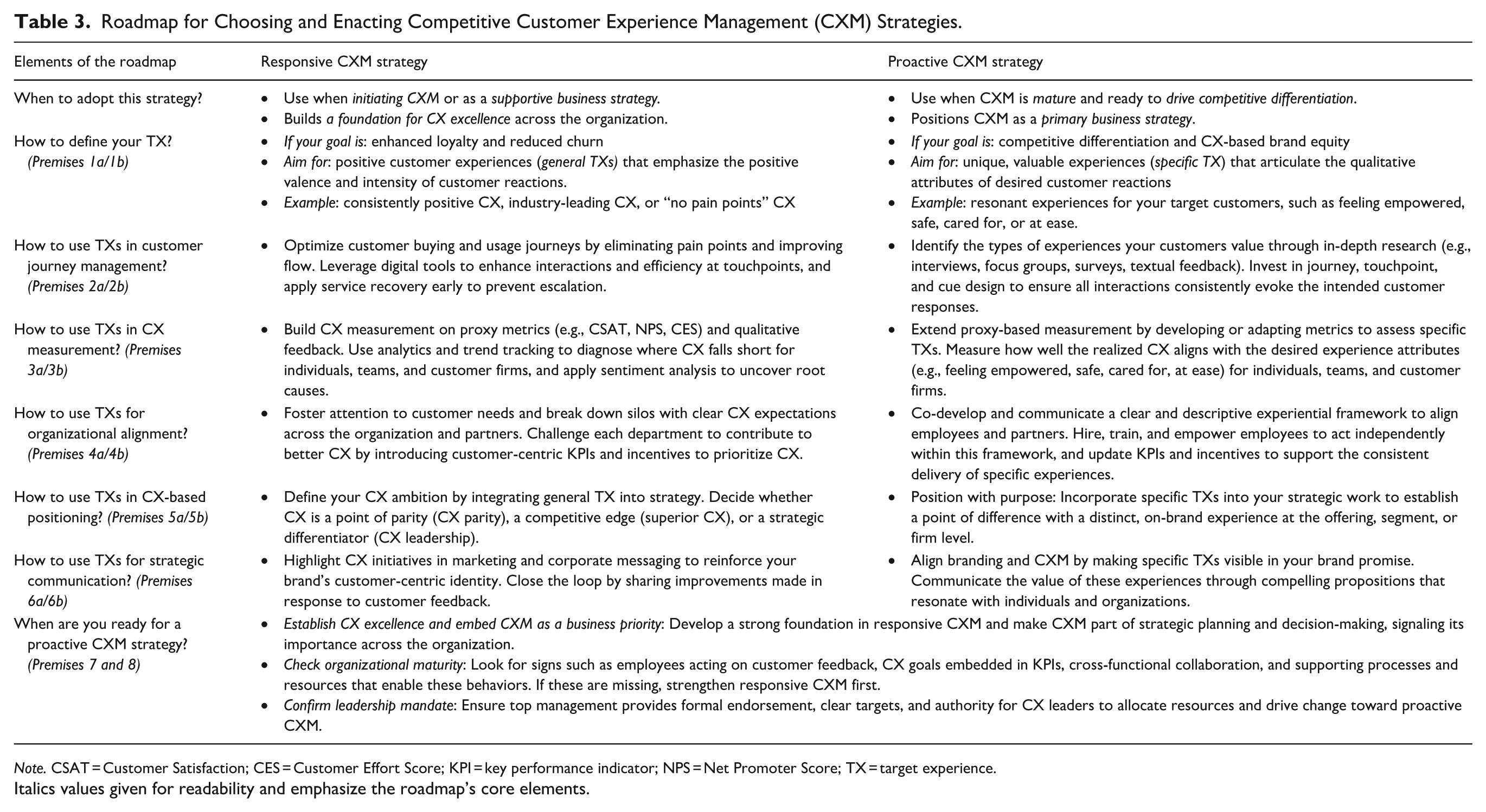
Note. CSAT = Customer Satisfaction; CES = Customer Effort Score; KPI = key performance indicator; NPS = Net Promoter Score; TX = target experience.
Italics values given for readability and emphasize the roadmap’s core elements.
First, the roadmap distinguishes between responsive and proactive strategies, helping management to clarify their strategic intent. Second, it identifies target experiences (TXs) that align with each strategy. Third, it outlines how TXs can be used across five key domains: customer journey management, CX measurement, organizational alignment, CX-based positioning, and strategic communication. Finally, the roadmap highlights the organizational and strategic requirements for evolving from a baseline responsive approach to a more proactive, differentiated CXM strategy.
Limitations and Future Research Avenues
The exploratory design of this study has certain limitations that suggest avenues for future research. First, while necessary for revealing shared patterns, the study’s broad sampling lacks the depth of insight that could be gained by focusing on a particular industry, firm size, product or service offering, or organizational culture. Future research could focus on a different context(s) to provide more specific insights and/or understand the applicability of the study’s findings beyond business markets.
Second, our study relied exclusively on interviews with B2B service provider firms, which limits the perspective to the internal view of CXM. A dyadic perspective is needed to better understand how business customers experience chosen TX approaches. This could uncover tensions between internal strategic intent and external customer perceptions, and highlight challenges in communication, expectation-setting, and orchestration across organizational boundaries.
Third, we note the need for further investigation into the dual identity of TX. While our findings reveal a strong link between TXs and competitive CXM strategies, they do not clarify the direction of influence between the two. In some firms, strategy appears to guide the adoption of TXs in a top-down manner, positioning TX as part of strategic intent. In others, strategy seems to emerge from the use of certain TXs in an initially operative role. This suggests a co-evolution of TXs and competitive CXM strategy in practice. We therefore encourage longitudinal qualitative research to explore how competitive CXM strategies develop over time.
Finally, we call for quantitative research to confirm and extend the findings of this study by building on the premises presented. Specifically, future explanatory work should develop robust measures to validate the identified competitive CXM strategies and examine their relationship with customer outcomes and firms’ financial performance. In addition, future research should explore in greater depth the contextual conditions under which these strategies are most effective. This includes investigating how firm-level, customer-related, competitor-driven, and broader market factors influence the adoption and effectiveness of responsive and proactive CXM strategies.
Supplemental Material
sj-docx-1-jsr-10.1177_10946705261457169 – Supplemental material for From Target Experience to Competitive Strategy: Unpacking Strategic Intent in B2B Customer Experience Management
Supplemental material, sj-docx-1-jsr-10.1177_10946705261457169 for From Target Experience to Competitive Strategy: Unpacking Strategic Intent in B2B Customer Experience Management by Ekaterina Panina, Elina Jaakkola and Harri Terho in Journal of Service Research
Supplemental Material
sj-docx-2-jsr-10.1177_10946705261457169 – Supplemental material for From Target Experience to Competitive Strategy: Unpacking Strategic Intent in B2B Customer Experience Management
Supplemental material, sj-docx-2-jsr-10.1177_10946705261457169 for From Target Experience to Competitive Strategy: Unpacking Strategic Intent in B2B Customer Experience Management by Ekaterina Panina, Elina Jaakkola and Harri Terho in Journal of Service Research
Supplemental Material
sj-docx-3-jsr-10.1177_10946705261457169 – Supplemental material for From Target Experience to Competitive Strategy: Unpacking Strategic Intent in B2B Customer Experience Management
Supplemental material, sj-docx-3-jsr-10.1177_10946705261457169 for From Target Experience to Competitive Strategy: Unpacking Strategic Intent in B2B Customer Experience Management by Ekaterina Panina, Elina Jaakkola and Harri Terho in Journal of Service Research
Supplemental Material
sj-docx-4-jsr-10.1177_10946705261457169 – Supplemental material for From Target Experience to Competitive Strategy: Unpacking Strategic Intent in B2B Customer Experience Management
Supplemental material, sj-docx-4-jsr-10.1177_10946705261457169 for From Target Experience to Competitive Strategy: Unpacking Strategic Intent in B2B Customer Experience Management by Ekaterina Panina, Elina Jaakkola and Harri Terho in Journal of Service Research
Supplemental Material
sj-docx-5-jsr-10.1177_10946705261457169 – Supplemental material for From Target Experience to Competitive Strategy: Unpacking Strategic Intent in B2B Customer Experience Management
Supplemental material, sj-docx-5-jsr-10.1177_10946705261457169 for From Target Experience to Competitive Strategy: Unpacking Strategic Intent in B2B Customer Experience Management by Ekaterina Panina, Elina Jaakkola and Harri Terho in Journal of Service Research
Footnotes
Acknowledgements
We thank the anonymous journal reviewers, the area editor, and the handling editor, Dr. Martin Wetzels, for their role in developing this manuscript. Special thanks go to colleagues Isadora Gasparin for performing the intercoder reliability check and Morgan Shaw for useful comments and proofreading of the different versions of this manuscript.
Author Note
This manuscript was handled by the previous editorial team of JSR.

Funding
The authors disclosed receipt of the following financial support for the research, authorship, and/or publication of this article: The authors wish to express their gratitude for the financial support received from Turun kauppaopetussäätiö, Liikesivistysrahasto (190302 and 200233), and Alfred Kordelinin Säätiö (200306).
Declaration of Conflicting Interests
The authors declared no potential conflicts of interest with respect to the research, authorship, and/or publication of this article.
Supplemental Material
Supplemental material for this article is available online.
Notes
Author Biographies
References
Supplementary Material
Please find the following supplemental material available below.
For Open Access articles published under a Creative Commons License, all supplemental material carries the same license as the article it is associated with.
For non-Open Access articles published, all supplemental material carries a non-exclusive license, and permission requests for re-use of supplemental material or any part of supplemental material shall be sent directly to the copyright owner as specified in the copyright notice associated with the article.
