







Abstract
Consumers increasingly rely on online reviews to make their purchase decisions. Drawing from linguistics and sociology research, the authors posit that comparative reviews, which highlight the similarities and differences between a focal product and its alternatives, may influence consumers’ regulation systems and perceived credibility, thereby affecting product sales. The authors examined 61,480 reviews on e-commerce platforms to explore the effects of comparative reviews and their valence on product sales. By using a supervised learning approach, they identified positive and negative comparative reviews, as well as positive and negative regular reviews, and then applied a two-way fixed-effects model. The results show that comparative reviews positively impacted product sales. Specifically, positive comparative reviews had a greater effect than positive regular reviews, whereas negative comparative reviews had a lesser absolute effect than negative regular reviews on product sales. Moreover, positive comparative reviews exerted a greater absolute effect than negative ones. A follow-up controlled lab study further substantiated the authors’ results and insights. The findings offer new insights and practical guidance for marketers and practitioners in promoting more comparative review posts and optimizing online review presentations.
With advances in e-commerce platforms, online reviews have become a powerful force, shaping consumers’ attitudes and influencing their purchase decisions (Wu et al. 2015; Zhao et al. 2013). Consumers who turn to online reviews before making a purchase decision are often confronted with hundreds or even thousands of reviews, leading to information overload. Gottschalk and Mafael (2017) find that consumers often process review information selectively, focusing on certain cues. Researchers have also examined how various signals embedded in review content, such as length, valence, and the use of specific words (e.g., swear words, humor), affect consumers (Moore and Lafreniere 2020).
Recent studies, particularly in the computational literature, have identified the presence of comparative opinions in user-generated reviews. A comparative opinion is a sentence within a user review that discusses the similarities or differences between a focal product and its alternatives (Jindal and Liu 2006b). An alternative product can be a competing product in the same market segment or a previous version of the focal product. For example, “Mobile Phone X (focal product) is good in terms of the screen compared to Mobile Phone Y (alternative)” is a comparative opinion between the focal product and a competing product. This differs from a regular review focused on a single product, such as “Mobile Phone X is good in terms of screen.” A comparative opinion can reduce potential consumers’ decision-making difficulties and facilitate unbiased judgments by providing key comparison and available options (Varathan, Giachanou, and Crestani 2017). Another example of a comparative opinion between the focal product and a previous version of the same product is “Mobile Phone X (focal product) has a much better screen than its previous generation.” Such opinions can be helpful for consumers deciding between upgrading a product and retaining the old one.
In the context of the online review system, a comparative review is one that contains at least one comparative opinion. To date, certain studies have leveraged comparative reviews to identify products’ competitive relationships, analyze strengths and weaknesses, and achieve product design and operational improvement (Gao et al. 2018; Liu, Jiang, and Zhao 2019). However, the marketing literature has paid little attention to comparative reviews and their influence on consumers’ purchasing intentions. Consumers focus on product attributes that distinguish a product from its competitors, which consequently affects their purchase decisions (Nam, Wang, and Lee 2012). This evidence supports the idea that consumers are motivated to find and process comparative opinions in user-generated reviews, particularly in a highly competitive market. Therefore, even though comparative reviews may constitute a small percentage of user-generated reviews (Jindal and Liu 2006b), they can help address the issue of information overload and provide a crucial means for consumers to distinguish alternative or competing products during their decision-making processes (Varathan, Giachanou, and Crestani 2017; Wang et al. 2017). To the best of our knowledge, few marketing studies have explored the values of comparative reviews. Given that product sales are a crucial performance metric for marketers, it is important to understand whether comparative reviews impact product sales and how they differ from regular reviews.
Consumers commonly encounter both positive and negative product reviews. The effect of review valence on product sales has been a focal point of considerable research (Chevalier and Mayzlin 2006; Park, Lee, and Han 2007). Generally speaking, positive reviews enhance sales, whereas negative reviews can have an adverse effect on them. Although the role of review valence seems clear-cut, its impact can be contingent on various factors within online reviews. For example, when a positive review is perceived as notably untrustworthy, it can negatively impact purchase intention (Reimer and Benkenstein 2016). From a linguistic viewpoint, comparative reviews express stronger emotions and hold greater influence than regular reviews (Simon-Vandenbergen 1997), which could result in different effects of comparative review valence compared to regular review valence. Therefore, further studies are needed to understand how the valence of comparative reviews influences product sales.
To investigate the impact of comparative reviews and their valence on product sales, we carry out a longitudinal study using a large sample of 60 mobile phones. The data set comprises 61,480 online reviews and is sourced from Tmall (https://www.tmall.com), a prominent e-commerce platform hosting Chinese and international businesses, featuring more than 70,000 brands. Daily sales data for each product are provided by an internet company. We first identify comparative reviews using text analysis techniques. Based on the comparative sentences found in these comparative reviews, we categorize the comparative reviews into different valence groups: positive comparative reviews (CR-Ps) and negative comparative reviews (CR-Ns). Next, we use a two-way fixed-effects model to evaluate and contrast the impacts of various types of reviews, including comparative and regular reviews and their respective valences, on product sales. The results indicate that comparative reviews have a positive impact on product sales. Specifically, CR-Ps improve product sales, whereas CR-Ns lower product sales. We observe that compared with positive regular reviews (RR-Ps), CR-Ps have a more pronounced effect on product sales. However, the absolute effect of CR-Ns on product sales is less than that of negative regular reviews (RR-Ns). Moreover, the absolute impact of CR-Ps surpasses that of CR-Ns on product sales. Lastly, we conduct a follow-up controlled lab study to validate our hypotheses regarding their relative effects.
This study makes several significant contributions to the field. First, we conduct a comprehensive exploration of review factors that may impact product sales (Reich and Maglio 2020). Specifically, our research identifies comparative reviews as a crucial type of review that impacts product sales. Second, while previous studies have indicated that RR-Ps have a limited effect on product sales, our results, based on the attribution theory, highlight the vital role that CR-Ps play in boosting product sales. Third, our findings challenge the negativity bias often found in online review studies (Chen and Lurie 2013; Chevalier and Mayzlin 2006). We present evidence that, in the context of comparative reviews, a positivity bias tends to emerge, as theorized by comparison and regulatory focus theories. Finally, this research provides insights for marketers on how to encourage and emphasize comparative reviews to enhance consumers’ decision-making process and, as a result, increase product sales.
Theoretical Background and Hypothesis Development
Comparative Reviews
Comparative reviews articulate the ordinal relationship between two or more products or brands in terms of certain shared characteristics, aiding reviewers in expressing their opinions more distinctly (Jindal and Liu 2006b). Current research on online comparative reviews primarily focuses on techniques to mine comparative texts, encompassing comparative sentence recognition and relation extraction (Jindal and Liu 2006a, b; Wang et al. 2015; Xu et al. 2011). In empirical studies, numerous researchers have employed these techniques in the fields of operation management for purposes such as product competitive advantage analysis, competitor identification, and new product development design (Gao et al. 2018; Liu, Jiang, and Zhao 2019; Ng and Law 2020). For instance, Gao et al. (2018) constructed three types of relation networks based on comparative reviews, which enabled them to analyze market structure, competitors, and product attributes.
Research on comparative texts within the field of marketing has largely concentrated on advertising (Jewell and Saenger 2014; Zhang, Moore, and Moore 2011). Comparative advertising, on the one hand, can offer valuable information and stimulate increased attention (Muehling, Stoltman, and Grossbart 1990). On the other hand, it is often seen as a brand's offensive move against a competing product, which could potentially lower consumers’ purchasing intentions (Chang 2007). As comparative reviews might encompass both positive and negative evaluations of a focal product, their effects are not straightforward and may diverge greatly from comparative advertising, which operates based on a brand's presumably positive perspective of its own product. Qazi et al. (2016) significantly advanced this area by probing into the connection between comparative reviews and review helpfulness. However, given that product sales serve as a paramount measure of brand performance, it is essential to explore how comparative reviews influence product sales.
We aim to understand comparative reviews from a linguistic perspective. Comparative language arises through a morphological process whereby adjectives become quantifiable (Cummins and Katsos 2010). The quantifiable nature of this language imparts a higher degree of power (Pezzuti, Leonhardt, and Warren 2021). Simon-Vandenbergen (1997) suggested that comparative or superlative language conveys a strong commitment to the validity of a statement. This implies that comparative language enhances the certainty of expression, thereby conveying greater power and leading to increased consumer engagement (Pezzuti, Leonhardt, and Warren 2021). In our study, we focus on explicit comparisons in which at least one specific competitor is named. Therefore, such a comparative review provides a clear basis for comparison and constructs a more impactful statement, making it both persuasive and credible. Given that previous research indicates that perceived credibility and persuasiveness of reviews are important factors in consumers’ purchase intentions (Jiménez and Mendoza 2013; Yin, Bond, and Zhang 2020), we propose the following hypothesis:
Attribution of Comparative Reviews
Drawing from the attribution theory, consumers infer the motivations underlying the sharing of product information, thereby assessing the credibility of the information (Friestad and Wright 1994). When consumers ascribe a review to a product experience rather than the reviewer's personality, they perceive the review as more credible and persuasive (Epley et al. 2004). As consumers more readily attribute RR-Ps to personal motifs (e.g., self-enhancement and economic incentives) compared with RR-Ns (Hu and Kim 2018), the credibility of RR-Ps may be significantly discounted.
Most CR-Ps in our study are provided by reviewers with firsthand usage experience of the products they are comparing. This type of information provides more details on the similarities and differences between products. For instance, a review states, “I purchased Mobile Phone X, which is much better than my previous Mobile Phone Y. Y used to require charging several times a day, whereas X's battery can last one day.” From this example, it is evident that reviewers often incorporate multiple signals into a review: referencing past purchase experiences and detailing previous experiences with other products. These combined signals serve to craft an identity of the reviewer as rational, knowledgeable, and experienced. By including these signals and following them with accounts of their experiences with a focal product, reviewers enhance the authenticity of the reviews. Consequently, we posit that potential consumers are more likely to attribute CR-Ps to product use experiences than RR-Ps, which might make the CR-Ps appear more trustworthy and credible. Previous studies have demonstrated that the credibility of reviews is positively associated with review adoption, thereby increasing product sales (Cheung and Thadani 2012). Therefore, we propose the following hypothesis:
As previously discussed, an explicit comparative review suggests that the reviewer has experience with the product category, leading potential consumers to attribute such reviews to the reviewer's experience. However, consumers tend to pay more attention to the information found in negative reviews (compared with positive reviews), as they aim to obtain objective product information and mitigate purchase risks. Negative reviews are often attributed to reviewers’ experiences and are thus perceived as more credible (Epley et al. 2004). Therefore, comparative information plays a limited role in negative reviews. Moreover, consumers may perceive negative expressions differently. Consider two online reviews, one stating, “Mobile Phone X's screen is not good,” and the other claiming, “Mobile Phone X's screen is not as good as that of Mobile Phone Y.” The first review could be interpreted to mean that the quality of X's screen is subpar, while the second could imply that the quality of X's screen is inferior compared with that of Y. To avoid purchase risks, consumers may favor RR-Ns, a phenomenon known as the negativity bias (Rozin and Royzman 2001). However, the negative consumer perception of CR-Ns may be somewhat diminished. Therefore, we propose the following hypothesis:
Comparative Reviews and Self-Regulation
According to the social comparison theory (Festinger 1954), individuals tend to evaluate their behaviors and abilities relative to others, aspiring to secure a superior position in a range of contexts, from everyday social situations to organizational settings and market transactions (Garcia, Tor, and Schiff 2013). In the context of online shopping, consumers seek assurance that their choices surpass those of others through relative comparison (Shao and Li 2021).
Typically, consumers evaluate product information (e.g., online reviews) to help them fulfill their consumption goals. During this process, self-regulation is likely to influence consumers’ evaluations of information. Self-regulation refers to the processes by which individuals set their goals, select behavioral strategies to achieve them, and evaluate progress toward them (Carver and Scheier 2012). In line with the regulatory focus theory (Higgins 1997), individuals strive to achieve their goals through two distinct modes of self-regulatory systems: promotion and prevention.
When individuals focus on their “ideal goals” (e.g., advancement, achievement, and aspirations), they develop a promotion system and orient toward positive end states (Aaker and Lee 2001). In our context, we believe that in the process of comparing, consumers seek a superior product to achieve their “ideal goals” rather than an inferior one to avoid risks, potentially activating the promotion system. Therefore, when consumers compare a focal product with its alternatives, their promotion regulation is invoked to help them make a better choice. As CR-Ps provide information about the superior advantages of a focal product and thus represent opportunities to attain positive outcomes, consumers may pay more attention to these positive reviews. Thus, we propose the following hypothesis:
Our research framework is illustrated in Figure 1. First, to investigate whether and how comparative reviews, along with their valence, affect product sales, we analyzed the reviews from Tmall. Subsequently, we conducted a lab study by manipulating the types and valence of reviews and measuring purchase intention to show support for our hypotheses.
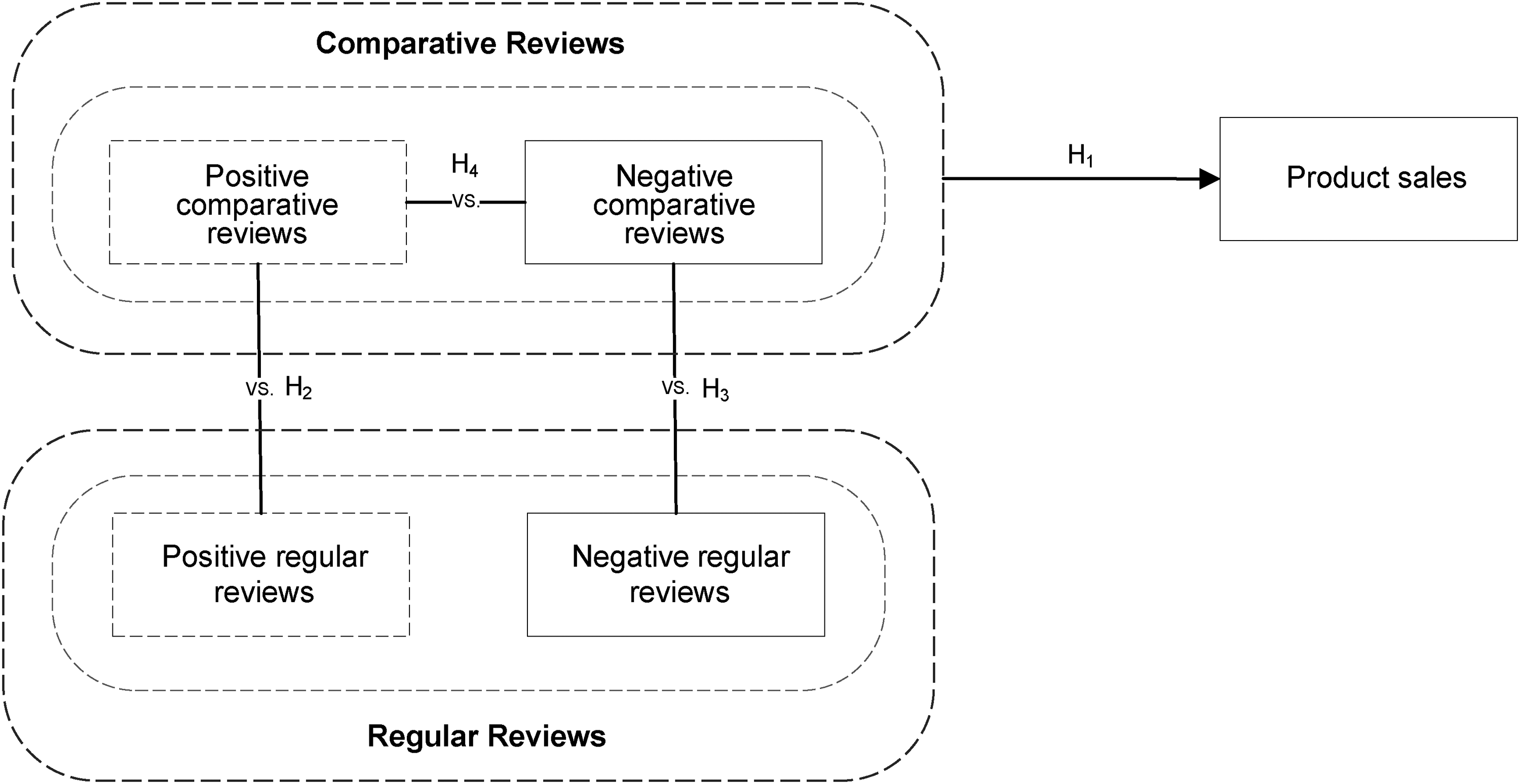
The Research Framework.
An Empirical Study Using Comparative Reviews on an E-Commerce Platform
In this study, we propose the research design shown in Figure 2. First, we crawled the web and collected online reviews and product sales data. Second, typical preprocessing involved review selection, the removal of irrelevant HTML content, removal of stop words, word segmentation, and part-of-speech (POS) tagging. Third, we identified product names through named-entity detection and completed the identification of comparative reviews by integrating class sequential rules (CSRs) with naive Bayesian (NB) classification. Fourth, we determined the sentiments of the comparative reviews using sentiment analysis. Fifth, we performed statistical analysis on the sales data, describing and processing the raw data. Finally, we explored the relationship between comparative reviews and product sales using a two-way fixed-effects model and conducted robustness checks.
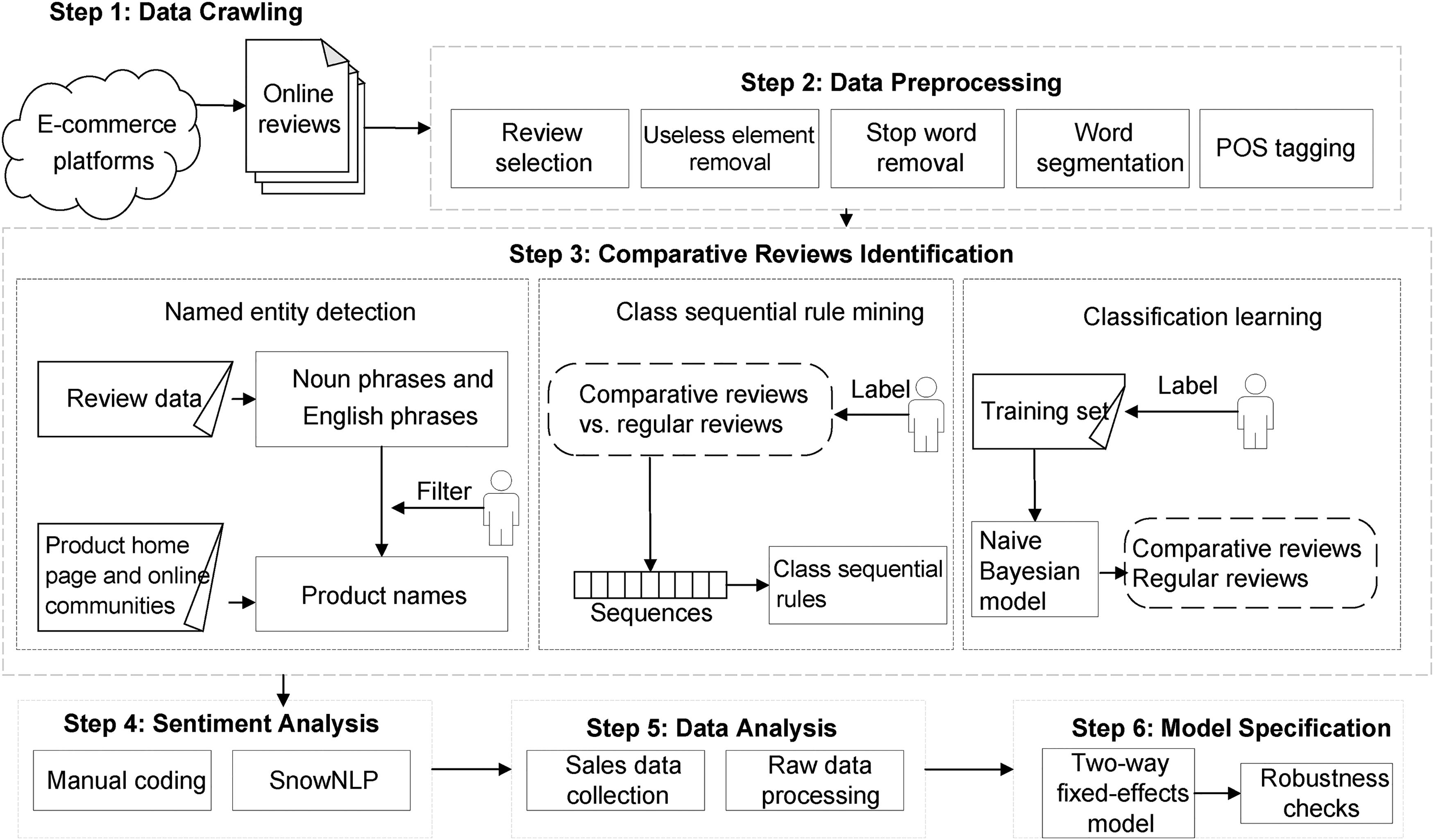
Research Design Using Secondary Data.
Data and Sample
Our data collection period spanned from February 23, 2021, to November 1, 2021. We collected a large sample of granular data on online reviews and sales from two sources: Tmall and an internet company (https://www.dianzhentan.com/) that specializes in providing financial data and analysis in the e-commerce sector. We chose Tmall due to its significant sales volume, which exceeded 3 trillion RMB, accounting for 41.7% of e-commerce sales in China in 2020. We chose the latter source as actual product sales are a crucial indicator that accurately reflects the impact of online reviews.
We selected the mobile phone industry as the context of our study. This is because mobile phone products have high levels of user involvement and technological advancement as well as readily available prices, and thus consumers are likely to read online reviews for these products when making purchase decisions (Risselada, Verhoef, and Bijmolt 2014). According to the Canalys Smartphone Analysis (2021), major brands such as Huawei, Oppo, Vivo, Xiaomi, Samsung, Honor, and Apple accounted for over 89% of the market share in China in 2021. Therefore, we chose these brands as our samples and developed a web crawler in Python to retrieve data on all the products displayed by these brands on Tmall.
Our initial sample encompassed data on 149 mobile phones, gathered based on various dimensions (i.e., the number of daily reviews and product collections, the content of each review, and the posting date of each review). Existing research shows that approximately 10% of online reviews contain comparative relations (Jindal and Liu 2006a, b). This low proportion of comparative reviews significantly limited the scope of data available for the study. In our final sample, we retained data on 60 mobile phones, each with over 30 consecutive days of reviews and an average daily review count exceeding 10, to ensure a substantial number of observations. As product adoption rates typically first increase and then decrease (Young 2009), we believe that the attention a product receives during its early stages is higher, resulting in a larger data pool. If multiple time intervals fulfilled the requirements, we chose the 30 days closest to the product's release date. Finally, we obtained data spanning 30 days for each mobile phone, encompassing 61,480 online reviews. We also collected daily sales data and information on product attributes. In the ensuing analysis, we employed product-level variables to control for product popularity and time variables to control for trends in product sales.
Data Preprocessing
First, we provide descriptive statistics for the online reviews data set. The longest review contains 822 Chinese characters, while the shortest one has only 1. The average review length is 42.5 characters. Although the reviews expressed consumers’ opinions about the products, not all of them were useful, due to some opinions being invalid or extremely short (for example, one-word reviews such as “Good” or “Bad,” and default reviews flagged by the platform systems as “This user did not write anything”; Guo et al. 2020). Consequently, we only considered reviews that consisted of at least 10 characters (Ma et al. 2013), which yielded a total of 58,481 reviews. Second, we removed meaningless elements (i.e., hashtags, URLs, and special symbols) and stop words. Following this, we used the popular Chinese word segmentation program, Jieba, for Chinese word segmentation and POS tagging (Liu, Jiang, and Zhao 2019).
Comparative Review Identification
Named-entity detection
In the comparative review classification, our first step was to identify product names. To achieve this, we crawled the home pages of the selected brands and online communities to collect product names. We also extracted noun and English phrases from online reviews to manually identify product names. This was necessary because many brands often use English phrases as product abbreviations. Furthermore, consumers may use common names to refer to a product in their daily communication. Through this process, we identified a total of 1,888 unique product names.
Class sequential rule mining
We employed sequential pattern mining to identify comparative reviews (Jindal and Liu 2006a). The goal is to identify sequential patterns that fulfill a user-defined minimum support constraint within a set of input sequences. A CSR with a sequential pattern takes the form of X → y, where X denotes the sequential pattern and y represents a class label, with y ∈ Y. A data instance (si, yi), where si is the sequence and yi is the class label, is considered to cover a CSR if
Comparative words serve as the foundation for identifying comparative reviews. Drawing from the labeled sentences and relevant literature (Gao et al. 2018; Li et al. 2017), we incorporated 88 comparative words and added their synonyms from a Chinese thesaurus, resulting in a total of 116 comparative words. In an effort to gather extensive sequential rules for these reviews, we identified 2,279 reviews containing at least two different product names, considering them potential comparative reviews (Liu, Jiang, and Zhao 2019). We chose a 10% subset of these potential reviews as the labeled data set. Each review was then dissected into individual sentences, using punctuation as a separator (Wang et al. 2015). Subsequently, sentences were manually tagged as either “comparative” or “noncomparative.” Every sentence was converted into a sequence, wherein for comparative words, the word and POS were combined as one sequence element. For noncomparative words, only the POS was used. In this context, si refers to the sequence corresponding to a sentence, and yi, where yi ∈ Y, represents its class label, with Y = {comparative, noncomparative}. After constructing the database, we established the minimum confidence threshold of 60% for our experiments, a figure that has been shown effective in prior studies (Jindal and Liu 2006a). In view of the varying frequency of comparative word appearances, we assigned multiple minimum supports, determined by the frequency of these words in the labeled data set, following Jindal and Liu (2006a). Specifically, each rule satisfies

Classification learning
After identifying all class sequential rules, we proceeded to construct a novel feature set for the NB classification model:



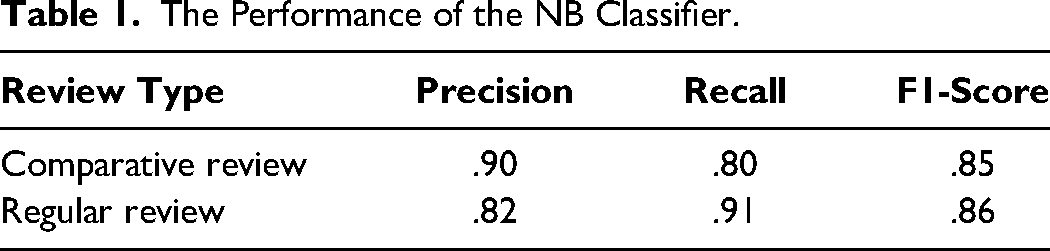
Precision, recall, and F1-score are frequently used to assess classification outcomes (Wang et al. 2017). The NB classification achieved a precision of 90%, a recall of 80%, and an F1-score of 85%. To better evaluate the performance of the NB model, we included the precision, recall, and F1-scores for both comparative and regular reviews in Table 1. Ultimately, we obtained 2,097 comparative reviews.
The Performance of the NB Classifier.
Sentiment Analysis
In linguistics research, it is established that comparative sentences contribute to expression certainty and convey more power than conventional opinion sentences (Jindal and Liu 2006a; Simon-Vandenbergen 1997). Hence, in our study, the sentiment of a comparative review is dictated by the comparative sentences it contains. Specifically, we define a positive comparative sentence as one that suggests that the focal product possesses superior qualitative or greater quantitative attributes than the compared product, has certain attributes not found in the compared product, or matches the compared product's quality in certain aspects. Conversely, a negative comparative sentence states that the focal product's attributes are qualitatively inferior to those of the compared product, lacks certain attributes found in the compared product, or is as substandard as the compared product in certain respects. A review is categorized as positive (negative) if it contains more positive (negative) comparative sentences than negative (positive) ones. For this study, we employed two doctoral students to label the sentiments of the comparative reviews. Their labeling results were highly consistent, with the interrater kappa coefficient being .817. After the initial round of coding, we resolved any labeling discrepancies by involving a third coder to reach a consensus.
For the regular reviews, we used the SnowNLP package to calculate their sentiment scores. SnowNLP is a Chinese text sentiment analysis tool capable of predicting the probability of a sentence being either positive or negative (Wang, Lu, and Tan 2018). The output sentiment scores ranged between 0 and 1. A score closer to 1 indicates a more positive sentiment, whereas a score further from 1 indicates a more negative sentiment. Let Ym denote the overall consumer sentiment for the mth review. As shown in Equation 5, if the output sentiment scored is greater than .5, the sentiment for the mth review is labeled as positive; if not, it is labeled as negative, where m = 1, 2, …, M (Guo et al. 2020). We applied this measurement to determine the sentiments of the regular reviews.
Measures
Sales
Our study used a single dependent variable, operationalized as a product's daily sales volume. The average product sales amounted to 278.28, with a range spanning from 0 and 6,871 for the minimum and maximum daily sales, respectively. Figure 3 presents a histogram depicting the sales distribution. The percentage of products with zero daily sales was less than 5%, while over 80% of the daily sales ranged from 0 to 400.
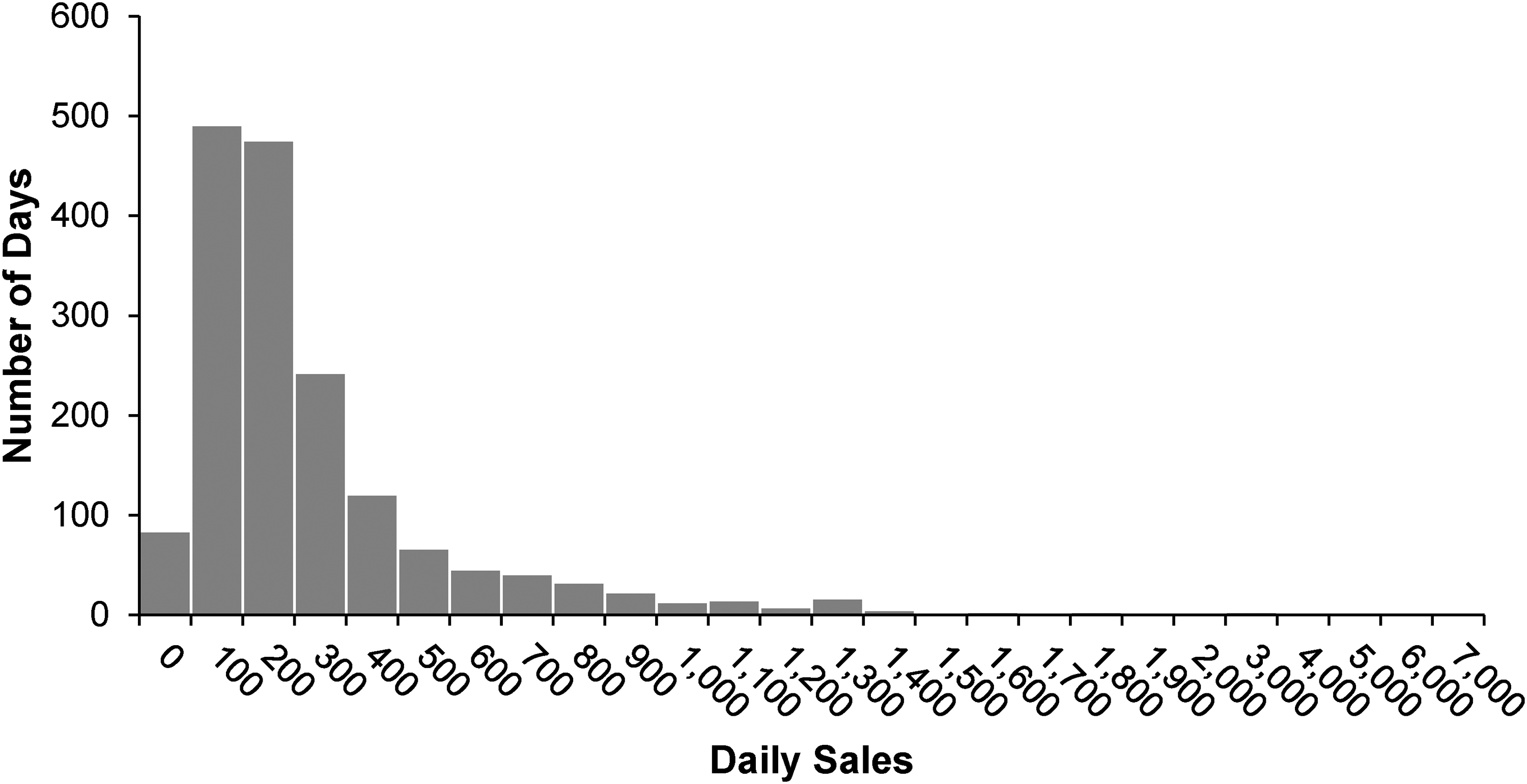
The Histogram of Product Daily Sales.
In the following subsections, we describe our independent variables.
The valence of comparative and regular reviews
First, we categorized the reviews into comparative and regular reviews based on the CSRs, and calculated their daily totals. Using the SnowNLP output as an indicator for review valence, we split the reviews into positive and negative groups. The RR-Ps and RR-Ns were operationalized as their daily counts. Similar measures were adopted for the comparative reviews based on the manual labeling results. Finally, we identified 743 CR-Ns and 1,354 CR-Ps.
Control variables
To explore the impact of comparative reviews on product sales, we controlled for product and time fixed effects. Our control variables include product popularity, product age, daily price, sales promotion activity, cumulative sales, and description rating. Product popularity refers to the cumulative count of individual shoppers who added the product to their favorite shopping list. A product's age was calculated as the number of days since its release (Lu, Wu, and Tseng 2018). During data processing, the product's age was calculated as the elapsed months since product launch and was treated as a continuous variable. To account for the nonlinear trajectory of sales over time, we followed the approach of Duan, Gu, and Whinston (2009) and included quadratic terms of product age as our control variables. Daily price was an observable variable used to control for each product's characteristics and price discounts. Sales promotion activity was operationalized as a dummy variable controlling for nonmonetary sales promotions occurring on a specific day. Cumulative sales were operationalized as the total product sales in the preceding 30-day period. The description rating was the consumers’ rating on whether the product description is consistent with their actual use experiences.
Product fixed effects
Product fixed effects control for product-specific heterogeneity, which is time-invariant. We used μi to capture a product's unobservable characteristics (e.g., the quality of a product).
Time fixed effects
We used day fixed (vt) effects to eliminate temporal variations such as internet use.
Table 2 provides a comprehensive description of the variables. Table 3 showcases Pearson's correlation coefficients among these variables, which are generally significant. The coefficient values were below .7, indicating their suitability for use within the same model. Additionally, we tested multicollinearity among the independent variables using the variance inflation factor (VIF) test. The average VIF was 2.21, with the maximum VIF being 3.73, both falling below the cautionary threshold of 10. Hence, the results indicate an absence of multicollinearity among the independent variables.
Variable Definition and Descriptive Statistics.
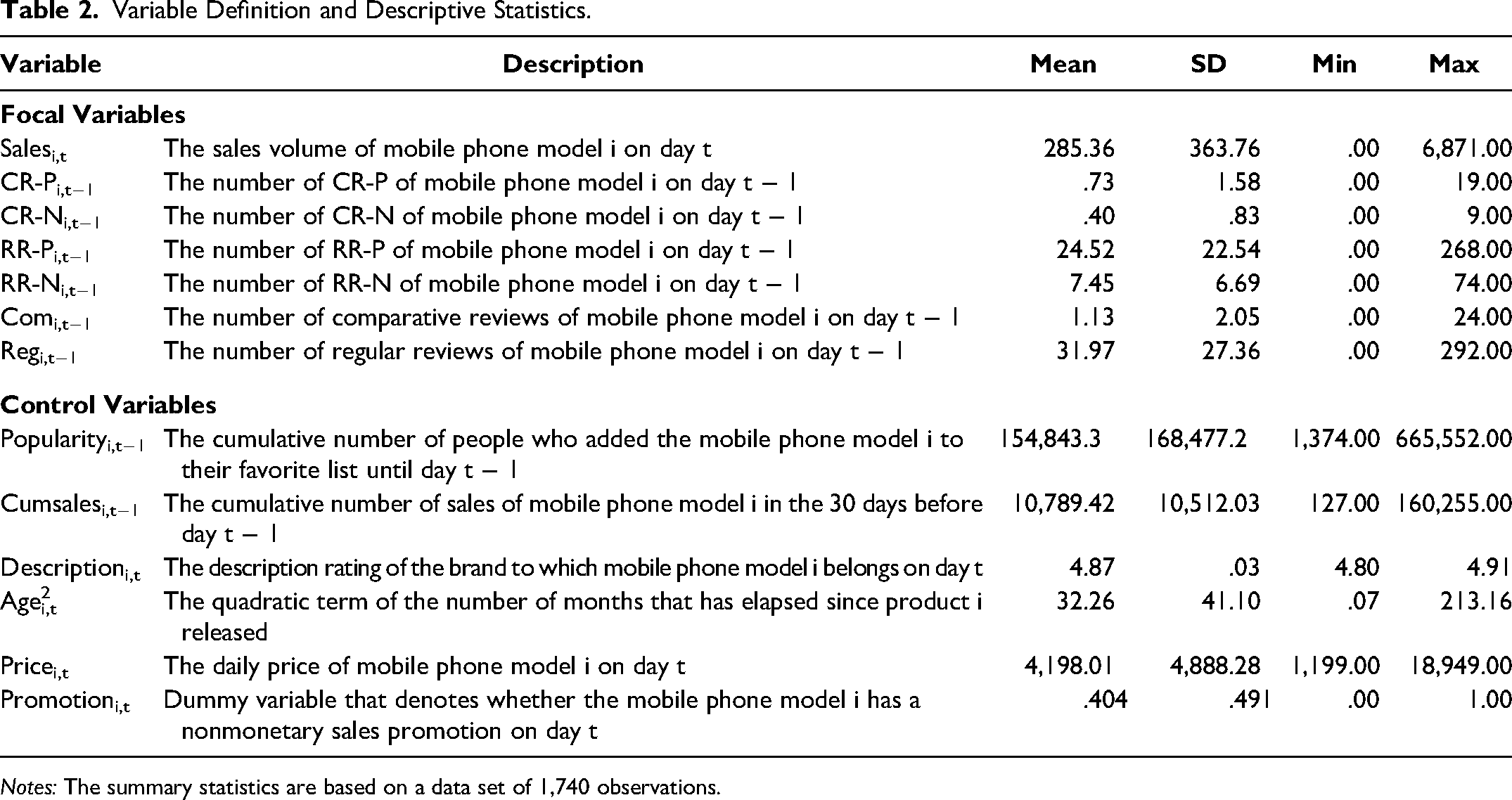
Notes: The summary statistics are based on a data set of 1,740 observations.
Correlation Coefficients.
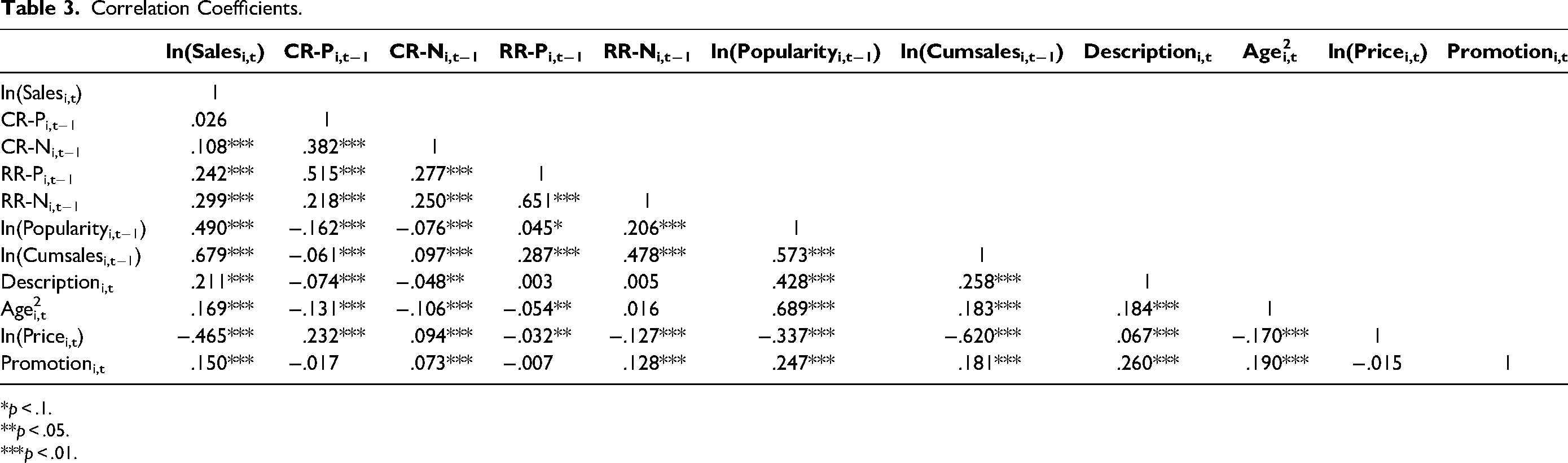
*p < .1.
**p < .05.
***p < .01.
Model Specification
We used the daily number of comparative reviews to evaluate their effects on product sales, as shown in Equation 6. We preferred the fixed-effect model over the random-effect one, as the Hausman test suggests that the fixed-effect model estimates were more suitable than those of the random-effect model (χ2 = 169.68, p < .01). Additionally, in the two-way fixed-effect model, we tested the product fixed effect (F(60, 1,393) = 16.02, p < .01) and the time fixed effect (F(277, 1,393) = 2.34, p < .01) separately. The results show that the two-way fixed-effect model was well-suited to our study and effectively addressed endogeneity concerns.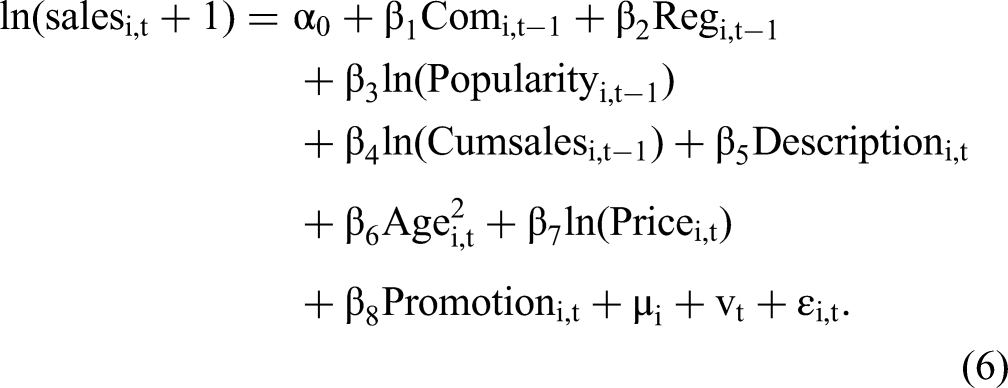
We then categorized the reviews into CR-Ps, CR-Ns, RR-Ps, and RR-Ns. The two-way fixed-effects model specification is presented in Equation 7: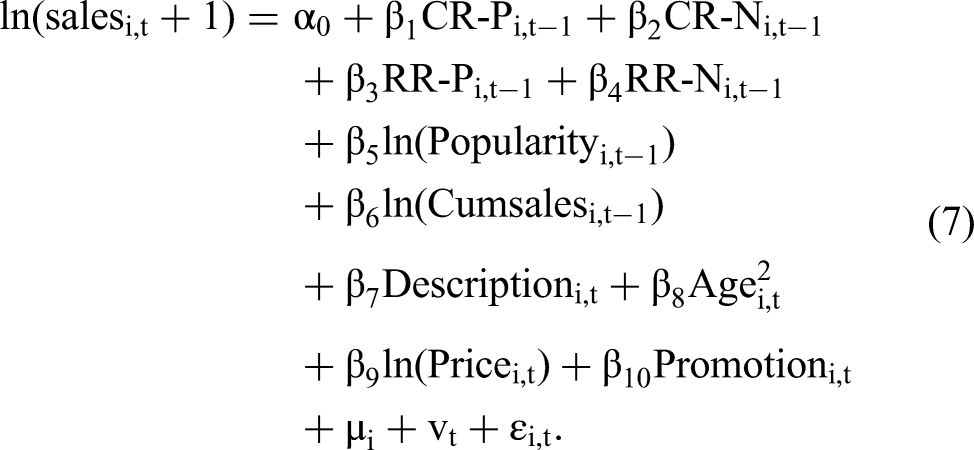
Results
Model-free evidence
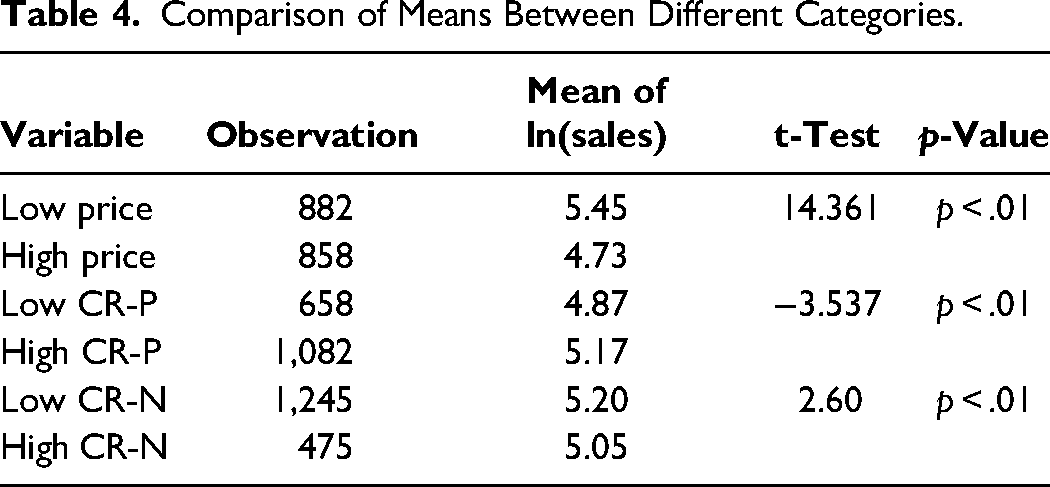
In this section, we utilized descriptive statistics to offer model free evidence on the impact of positive and negative comparative reviews on product sales, as shown in Table 4. We first considered the impact of price on product sales by dividing the products into high-price and low-price product groups using the median price. We further examined the impact of positive and negative comparative reviews on sales by separating positive or negative comparative reviews into high-volume and low-volume groups based on the median number of positive or negative comparative reviews. The descriptive analysis shows that low-price products have a more substantial impact on sales than high-price products. The group with a high volume of CR-Ps has a more significant impact on sales than the low CR-Ps group. The group with a low volume of CR-Ns has a greater impact on sales than the high group. Based on this evidence, we delve further into the hypotheses regarding the impact of comparative reviews on product sales.
Comparison of Means Between Different Categories.
Impact on product sales
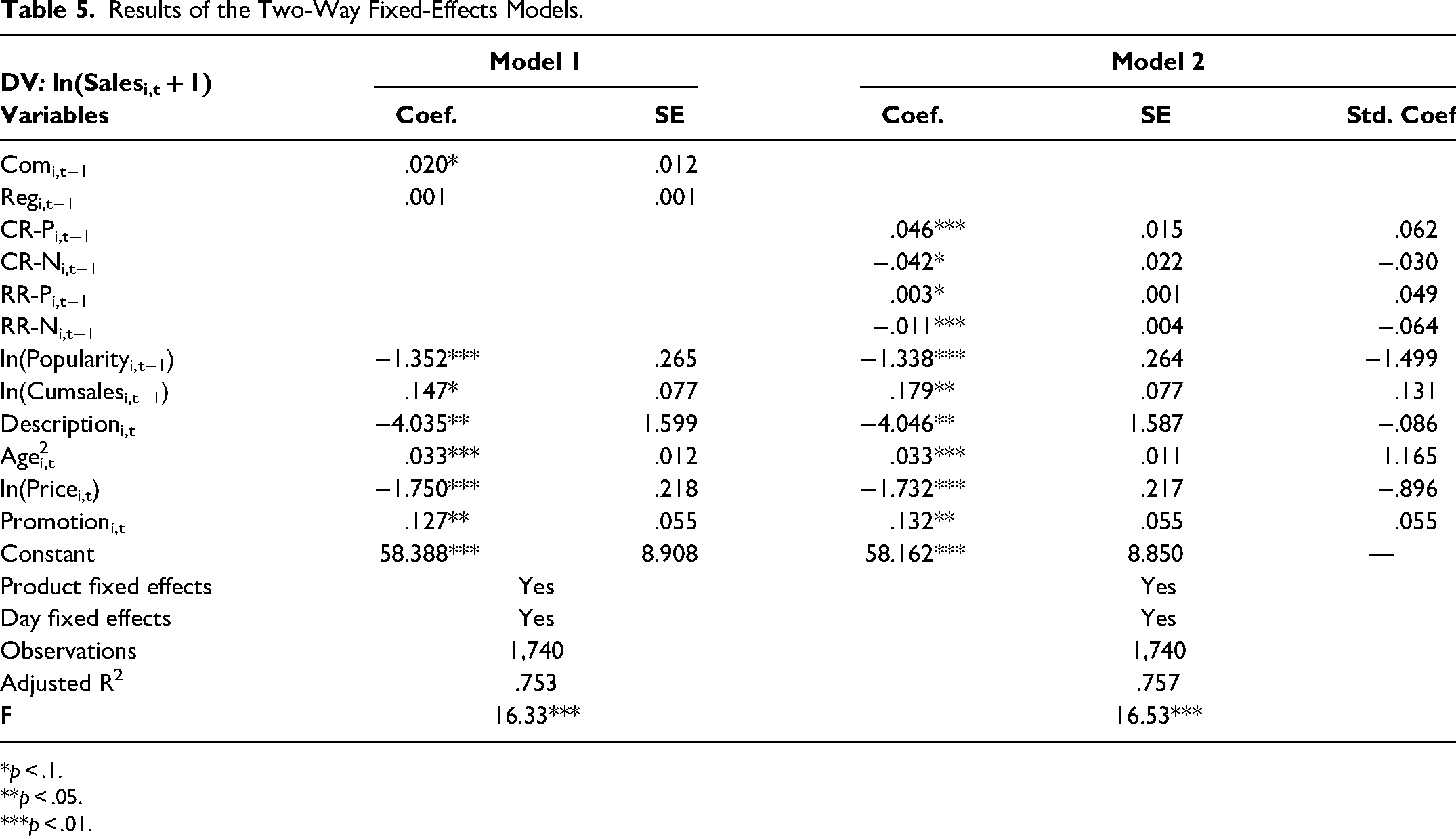
We adopted a two-way, fixed-effects panel regression analysis to evaluate the effect of the valence of comparative and regular reviews on product sales. Table 5 shows the results of the two fitted regression models. The first model (Model 1) includes the total number of comparative and regular reviews, whereas the second model (Model 2) includes the number of CR-Ps, CR-Ns, RR-Ps, and RR-Ns. In Model 1, the number of comparative reviews significantly impacts (β1 = .020, p < .10) product sales, while the effect of regular reviews is not significant. Hence, H1 is supported. The results indicate that relatively rare comparative reviews significantly influence product sales.
Results of the Two-Way Fixed-Effects Models.
*p < .1.
**p < .05.
***p < .01.
In Model 2, the numbers of CR-Ps, CR-Ns, RR-Ps, and RR-Ns all significantly impact product sales (β1 = .046, p < .01; β2 = −.042, p < .10; β3 = .003, p < .10; β4 = .011, p < .01). We standardized the coefficients in Table 5. The results show that CR-Ps have a greater effect on increasing a product's sales than RR-Ps, with standard coefficients of .062 and .049, respectively. The negative effect of CR-Ns on sales is less than that of RR-Ns, as indicated by standard coefficients of −.030 and −.064, respectively. In addition, when we compared the absolute values of the coefficients, it is evident that CR-Ps have a more significant absolute effect on sales than CR-Ns, with standard coefficients of .062 and −.030, respectively. Therefore, the results support H2–H4.
Robustness Check
To further ensure the reliability of our results, we conducted several robustness checks and consistently achieved similar outcomes. First, more than 80% of consumers rely on historical sales data when making purchasing decisions (Dholakia 2011). Past cumulative reviews, being a type of sales information, could also impact product sales. Even though we tested the effect of reviews with a one-day lag, the impact might not have been fully reflected. Therefore, we assembled six data sets, aggregating the reviews based on lag periods from two days to seven days. We confirmed that our main findings remain consistent, irrespective of alternative lag structures. We report the results in Web Appendix A.
Second, given that a major focus of this study is the identification of positive and negative opinions within comparative reviews, we conducted additional robustness checks by measuring review valence at the sentence level. The results, reported in Web Appendix A, continue to support our primary hypotheses.
Third, while comparative sentences form part of an entire review, other elements may also be expressed in varying sentiments within the review (e.g., “I love my new phone, the camera is great, the battery life is long and the color of it seems great. But, the screen of mobile phone X is not as good as that of mobile phone Y.”). Therefore, we measured the comparative review valence based on overall sentiment valence as determined by SnowNLP, as opposed to the sentiment valence of only the comparative sentences. This approach yielded results that align with our previous findings. These results are also documented in Web Appendix A.
Fourth, to delve deeper into the boundary conditions of how comparative reviews affect product sales, we classified comparative reviews based on their types of comparison: whether they were comparing the focal product with past products or current products. For example, the statement “I purchased the mobile phone X, which is much better than my previous mobile phone Y. Y used to require charging several times a day, but the battery of X can last one day” makes a comparison to a past product. In contrast, “Comparing X and Y for a long time, and I finally decide to buy X, because the screen of X is much better than that of Y” makes a comparison to a current product. After rerunning our regression models with these classification groups, the results remained consistent with our previous findings. These results are also detailed in Web Appendix A.
Discussion
Through the examination of the impact of reviews on product sales, complemented by several robustness checks, we have obtained consistent results. Specifically, when comparing the effects of CR-Ps, CR-Ns, RR-Ps, and RR-Ns on product sales, the effect of CR-Ps outweighs that of RR-Ps. We attribute the finding to the attribution theory. This theory suggests that potential consumers associate comparative reviews with reviewers’ purchase experiences, enhancing the perceived credibility of positive reviews. This increase in credibility subsequently leads to an increase in product sales. In addition, the absolute values of normalized coefficients for CR-Ns are significantly lower than those for RR-Ns. The reason may be that consumers attribute RR-Ns to reviewers’ experiences, thereby limiting the effect of the increased credibility of CR-Ns through attribution. Furthermore, CR-Ns merely reveal relative shortcomings of the focal product, which do not necessarily indicate an issue with the product's quality or specific attributes. Consequently, the negative effect of CR-Ns may be diminished.
In addition, prior research examining the effects of online review valence on consumer behavior has yielded mixed results. This study provides evidence that the impact of CR-Ps on product sales outweighs the absolute impact of CR-Ns. The outcome is likely because comparative reviews inspire consumers’ pursuit of superior purchasing choices. Consumers tend to focus more on positive reviews to achieve a positive outcome. As for regular reviews, our findings align with those observed in prior research (Rozin and Royzman 2001).
To further validate the findings of our empirical study, we conducted a controlled lab experiment that gave us complete control over the experimental conditions. We report the details of this experiment in the following section.
A Controlled Lab Experiment
Participants
We used Credamo, a Chinese intelligent survey platform similar to Qualtrics and Amazon Mechanical Turk, widely adopted in rigorous studies published in leading journals (Gong et al. 2020; Huang and Sengupta 2020). We recruited 320 people to participate in the study in exchange for a nominal payment. After excluding 20 participants who failed to pass attention checks, we retained 300 participants for analysis. There were 151 women and 149 men, with the median age group being 18–31 years old.
Design and Procedure
We chose laptops as the target product group for the lab experiment, primarily because laptops are readily available and frequently purchased. Furthermore, previous studies have established that consumers tend to rely on online reviews when deciding to buy high-end products (Mackiewicz 2010; Mudambi and Schuff 2010). We conducted a pretest to identify product attributes mentioned in the reviews. For this pretest, we asked 50 participants to rank laptop attributes in order of importance when they were searching for a laptop online. The results indicated that the laptop's CPU speed (mean rank of 1.8, SD = .84), weight (mean rank of 2.8, SD = 1.64), screen (mean rank of 3.2, SD = .84), and fan (mean rank of 3.8, SD = 1.92) were the most important attributes. Therefore, we included these four attributes to construct the stimuli.
In this study, we employed a 2 (comparative, noncomparative) × 2 (positive, negative) between-subjects experimental design. For each experimental condition, we created a graphical image, which was a screenshot captured from an actual e-commerce website. To limit the influence of brand name and price on participants’ review perceptions, we obscured this information using Adobe Photoshop's filter-glass tool. Then, following the approach used in Qiu, Pang, and Lim (2012), we created a rectangular zone to make the specific review (stimuli) clearly visible, and blurred out the remaining reviews, as shown in Web Appendix B. In terms of the manipulation of comparative information and review valence, we created a positive regular review: The A laptop is easy to carry out, because of the light weight. It has a delicate screen. It runs smoothly and has good software compatibility. Besides, the fan has a low sound which shows a good heat dissipation performance.
This resembled a review from an actual e-commerce website. To compose the negative review, we substituted the positive adjectives with negative ones. For example, we altered “a good heat dissipation performance” to “a bad heat dissipation performance.” For comparative reviews, we incorporated the competing product and comparative words, such as “Compared to B,” “more,” and “less,” into the reviews. In all conditions, the target laptop was designated as “A” and the compared laptop as “B.” These were two fictitious products aimed at controlling for participants’ familiarity with the real product names.
Participants were randomly assigned to one of four conditions. They were first instructed to imagine that they were in the market to buy a laptop and began to search for information on relevant e-commerce platforms. They then searched for Laptop A and read its reviews to gather more information. Next, participants viewed the stimulus image and were informed that it was a screenshot randomly taken from a real-world e-commerce platform.
After processing all the information, they were asked about their purchase intentions for Laptop A. The scale items used for purchase intention, based on Park, Lee, and Han (2007) and Yi (1990), consisted of five items (e.g., “It is very likely that I will purchase this laptop”). These items used seven-point scales with endpoints ranging from “strongly disagree” to “strongly agree” (Cronbach's alpha = .964). We also measured participants’ general attitudes toward reviews, their product familiarity, and subjective product knowledge as control variables (Flynn and Goldsmith 1999). As suggested in previous studies (Purnawirawan, Pelsmacker, and Dens 2012), the scale for general attitude toward online reviews consisted of three items (e.g., “When I buy a product, online consumer reviews are helpful for my decision making”) on a seven-point Likert-type scale ranging from “strongly disagree” to “strongly agree” (Cronbach's alpha = .774). Web Appendix B provides the items of each construct. In addition, participants were asked about their product familiarity and subjective knowledge of laptops using seven-point Likert scales. As a manipulation check, participants indicated how positive versus negative they perceived the review to be (1 = “very negative,” and 7 = “very positive”) and whether the review involved product comparison (1 = “strongly agree,” and 7 = “strongly disagree”).
Results and Manipulation Check
The manipulations of review valence and review types were successful. Participants in the negative review condition perceived the review as more negative than those in the positive condition (Mneg = 2.66, SD = 1.62 vs. Mpos = 6.01, SD = .96; p < .001). Those in the comparative conditions (Mcom = 6.11, SD = 1.04) perceived the reviews as more comparative than those in the regular review conditions (Mreg = 2.72, SD = 1.64; p < .001). Furthermore, there were no significant differences in participants’ general attitude toward reviews (t(298) = .71, p = .478), product familiarity (t(298) = .95, p = .341), and subjective product knowledge (t(298) = .67, p = .51) across conditions (i.e., regular and comparative).
We predicted that purchase intentions would be higher for comparative (vs. regular) reviews in both positive and negative conditions. We performed a two-way analysis of variance with the independent factors of review types, review valence, and the covariate of the general attitude toward reviews. The results showed that the main effects of the review types (F(1, 293) = 26.91, p < .001,
In addition, the interaction effect of review types and review valence was significant (F(1, 293) = 5.92, p = .016,
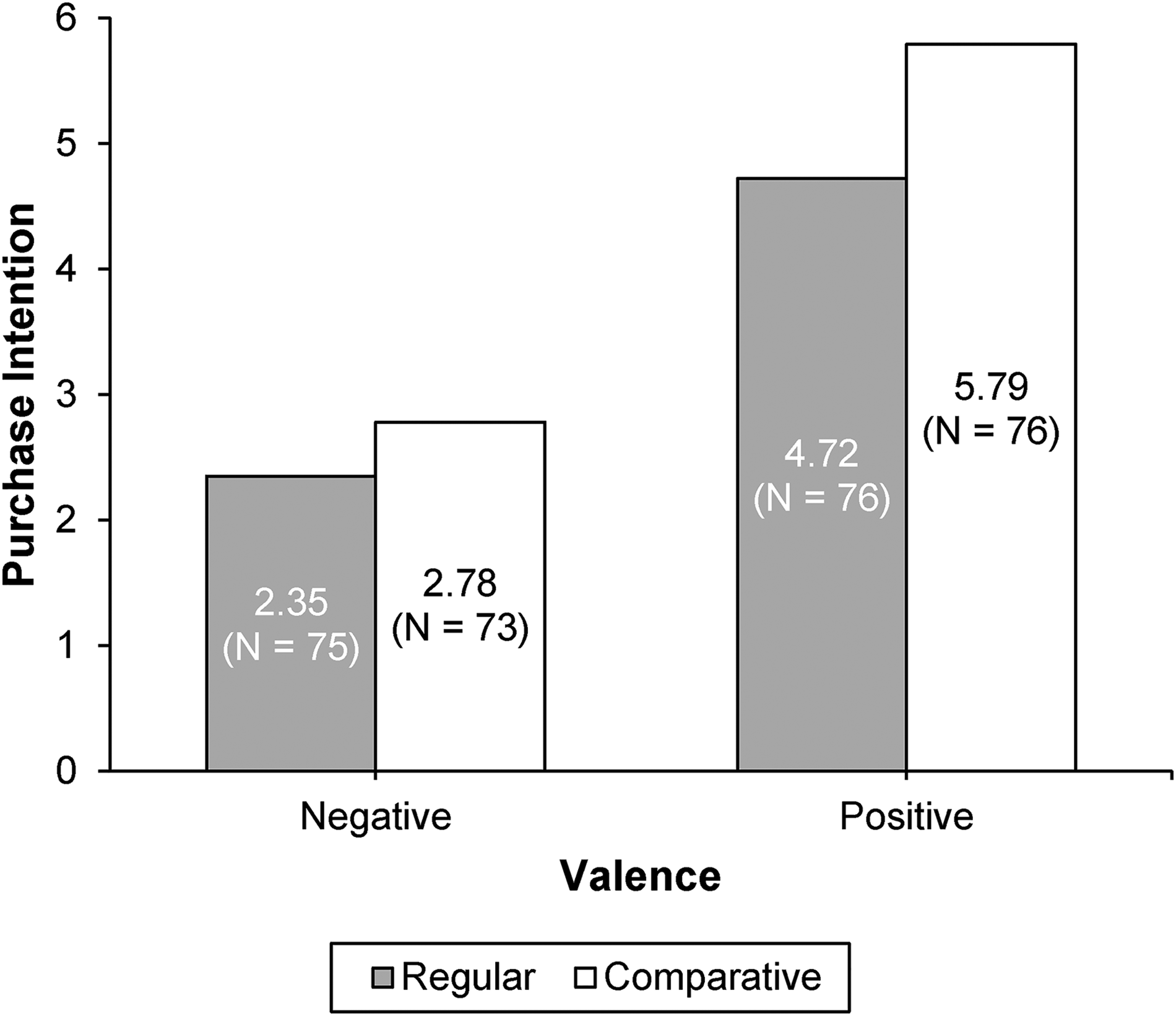
Purchase Intention as a Function of Review Valence and Review Types.
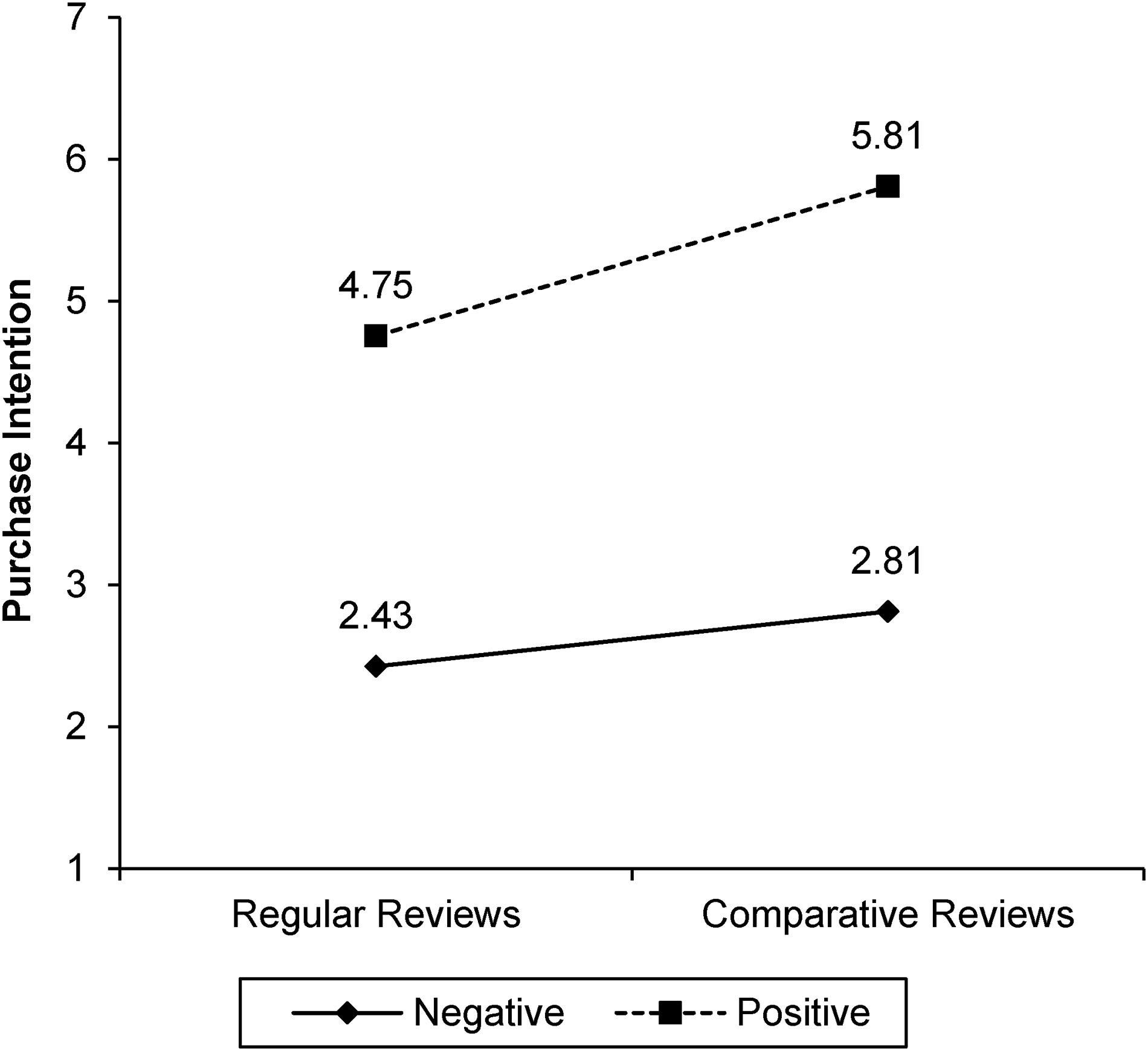
Effect of Review Types on Purchase Intention for Different Review Valence.
Discussion
The results of this study provide evidence that the presence of comparative reviews is positively associated with purchase intention. Furthermore, the interaction effect of review types and review valence on purchase intention is significant. It indicates that the presence of comparative cues increases purchase intention more than negative reviews do. Therefore, this study shows that the impact of CR-Ps on purchase intention exceeds that of RR-Ps. Simultaneously, the negative effect of negative reviews on purchase intention diminishes when comparative cues are present.
Conclusions and Implications
To date, online reviews have been shown to influence consumers’ attitudes toward products and their purchasing behaviors (Chevalier and Mayzlin 2006). However, with the proliferation of online reviews emerging from e-commerce platforms, consumers face information overload, potentially leading to increased cognitive processing costs (Krishnamoorthy 2015). Thus, managerial focus has shifted toward exploring the review characteristics that may affect product sales. In this article, we explicitly measure the effect of comparative reviews on product sales. Accordingly, we contribute to research focusing on both online reviews and comparative texts, offering insights into how marketers can exploit comparative reviews to increase product sales.
Theoretical Implications
First, this research lends empirical support to the value of comparative reviews in marketing. Most studies on comparative reviews have approached from a product operation perspective to understand products’ competitive relationships, thus facilitating product design and improvement (Liu, Jiang, and Zhao 2019). Within the context of online shopping, potential consumers tend to inquire about online reviews of similar products and compare them to form their own judgments (Jin, Ji, and Gu 2016; Xu et al. 2011). Comparative reviews may satisfy consumers’ need for product comparison and enhance decision-making effectiveness by providing more precise and unbiased information on available options. By extracting comparative reviews of mobile phone products from the Tmall platform, our goal was to empirically examine the effects of comparative reviews. The results confirmed that consumers are influenced by comparative reviews and their valence, which subsequently affects product sales. Thus, this study lays the groundwork for utilizing comparative reviews to promote product sales.
Second, this article enriches the research stream on online reviews by comparing the effects of different types of reviews (e.g., regular vs. comparative) and their valence on product sales. When consumers peruse online reviews in the pursuit of making more informed purchase choices, they are likely to encounter both regular and comparative reviews. These different types of reviews may make different contributions. Literature has demonstrated the impact of regular reviews on product sales across multiple dimensions, such as ratings (Hu, Koh, and Reddy 2014), sentiment (Srinivasan, Rutz, and Pauwels 2016), linguistic style (Topaloglu and Dass 2021), and review visibility (Alzate, Arce-Urriza, and Cebollada 2021). Despite the fact that most products have few comparative reviews, our empirical analysis shows that these reviews significantly affect product sales. After further analysis of valence, we find that CR-Ps have a more pronounced effect on product sales than RR-Ps. Therefore, we underscore the importance of considering different review types jointly.
Third, this study contributes to research on the boundary conditions for negativity and positivity biases in online reviews. For regular reviews, some studies have confirmed the negativity bias, indicating that negative reviews are more influential than positive ones in helping consumers avoid purchase risks (Chevalier and Mayzlin 2006; Ho-Dac, Carson, and Moore 2013). However, drawing on social comparison and regulatory focus theories, it is suggested that potential consumers aim to make a superior choice rather than merely avoiding risks to achieve positive outcomes when going through comparative reviews. Hence, they tend to pay more attention to positive reviews than to negative ones. In this context, positivity bias becomes important in comparative reviews. In light of this, our results provide additional evidence that, within comparative reviews, positive reviews exert a greater impact on sales than negative ones. Therefore, we broaden existing research by demonstrating the possible role of comparative reviews in triggering positivity bias and how the bias increases product sales.
Managerial Implications
Our findings offer several managerial insights for marketing managers and online retailers. First, our findings prompt e-retailers to revamp their online review platforms, where the solicitation and display of comparative reviews can influence potential consumers’ purchase decisions. We found that comparative reviews have a greater impact on product sales than regular reviews. Therefore, e-retailers should encourage consumers to contribute more comparative reviews. Rather than composing free-form reviews, reviewers can be asked to provide a review with a specific alternative or competing product in mind. The manner in which reviews are displayed can also play an important role in their influence over consumers. Previous studies have shown that the top reviews that consumers view are the most influential (Lee, Park, and Han 2008). Therefore, by positioning comparative reviews, especially the positive ones, at the top of the review list or marking them as “highlighted” (Reich and Maglio 2020), e-retailers can increase the likelihood of consumers viewing and reading these reviews, thereby boosting product sales.
Second, it is generally acknowledged that consumers often consider positive reviews unauthentic, as marketers incentivize reviewers financially to post them (Hong et al. 2017; Lee, Park, and Han 2008). Our findings show that positive comparative reviews can convey positivity valence to consumers more effectively than regular positive reviews. In practical terms, marketers can get creative in soliciting comparative opinions from consumers. For instance, as many e-commerce platforms (e.g., Amazon, Tmall) offer question-and-answer (Q&A) systems for consumers to discuss products, marketers can utilize these systems to solicit comparative opinions from consumers on questions such as “What features of product X are better than product Y?”
Third, our findings can help marketers to mitigate the excessive impact of negative reviews. Due to time and effort constraints, many consumers focus only on the most helpful reviews, which often tend to be positive reviews and may only extol the advantages of the focal product, potentially misleading consumers (Yin, Mitra, and Zhang 2016). In the interest of providing unbiased information, some studies suggest that marketers should strategically highlight negative reviews (Pan and Zhang 2011; Yin, Mitra, and Zhang 2016). However, the detrimental effect of negative reviews on product sales is evident. Here, we demonstrated that the negative effect of negative comparative reviews was less than that of negative regular reviews. Therefore, our research provides a viable strategy for e-retailers to present unbiased reviews to consumers while minimizing the impact of negative reviews on sales.
Limitations and Future Research
Despite the aforementioned contributions, this article has limitations. First, although we developed our hypotheses based on the attribution theory and regulatory focus theory and provided empirical evidence of the relative impacts of comparative reviews and regular reviews, we did not extensively explore the underlying mechanisms behind the effects. Future research could utilize field studies or laboratory experiments to assess motivation and measure consumers’ attention. This would allow for an examination of how review types and review valence may interact, thus providing more nuanced insights into consumer behavior and delineating the underlying mechanisms.
Second, although we control for the influence of product characteristics through the fixed-effects model, our consideration of the effect of product heterogeneity is somewhat limited. Future studies could explore the implications of various product types and other forms of heterogeneity in more depth. For instance, price is a significant product characteristic that could impact product sales (Yang, Park, and Hu 2018). While we controlled for its effect in our study, investigating how it specifically influences the relationship between comparative reviews and product sales could be an interesting question, deserving of further detailed study.
Third, we manipulated our data set into daily panel data on posted reviews, which complicates the operationalization of related factors at the review level. For example, reviewer identity plays an important role in the relationship between reviews and sales (Forman, Ghose, and Wiesenfeld 2008), a factor that our study did not control for. Additionally, at the review level, instead of categorizing the reviews into four distinct groups, an interaction term could be used to operationalize the variables. However, a significant issue is that it might necessitate choosing another dependent variable, such as review helpfulness, rather than product sales.
Lastly, our empirical study was conducted using data obtained from Tmall in China. Existing literature suggests that the impact of regular reviews on product sales remains consistent across platforms and cultures. Therefore, it is reasonable to hypothesize that our findings would also hold in empirical studies using data from other platforms and countries. Nevertheless, examining whether cultural differences affect how comparative reviews impact consumers, using data collected from platforms in different countries or cultures, would pose an intriguing research question.
Supplemental Material
sj-pdf-1-jnm-10.1177_10949968231196578 - Supplemental material for The Effects of Comparative Reviews on Product Sales
Supplemental material, sj-pdf-1-jnm-10.1177_10949968231196578 for The Effects of Comparative Reviews on Product Sales by Min Zhang, Yuzhuo Li, Lin Sun, G. Alan Wang, and Jiangang Du in Journal of Interactive Marketing
Footnotes
Editor
Arvind Rangaswamy
Declaration of Conflicting Interests
The authors declared no potential conflicts of interest with respect to the research, authorship, and/or publication of this article.
Funding
The authors disclosed receipt of the following financial support for the research, authorship, and/or publication of this article: This work was supported by the National Natural Science Foundation of China, (grant number 72171166, 71972107).

References
Supplementary Material
Please find the following supplemental material available below.
For Open Access articles published under a Creative Commons License, all supplemental material carries the same license as the article it is associated with.
For non-Open Access articles published, all supplemental material carries a non-exclusive license, and permission requests for re-use of supplemental material or any part of supplemental material shall be sent directly to the copyright owner as specified in the copyright notice associated with the article.
