







Abstract
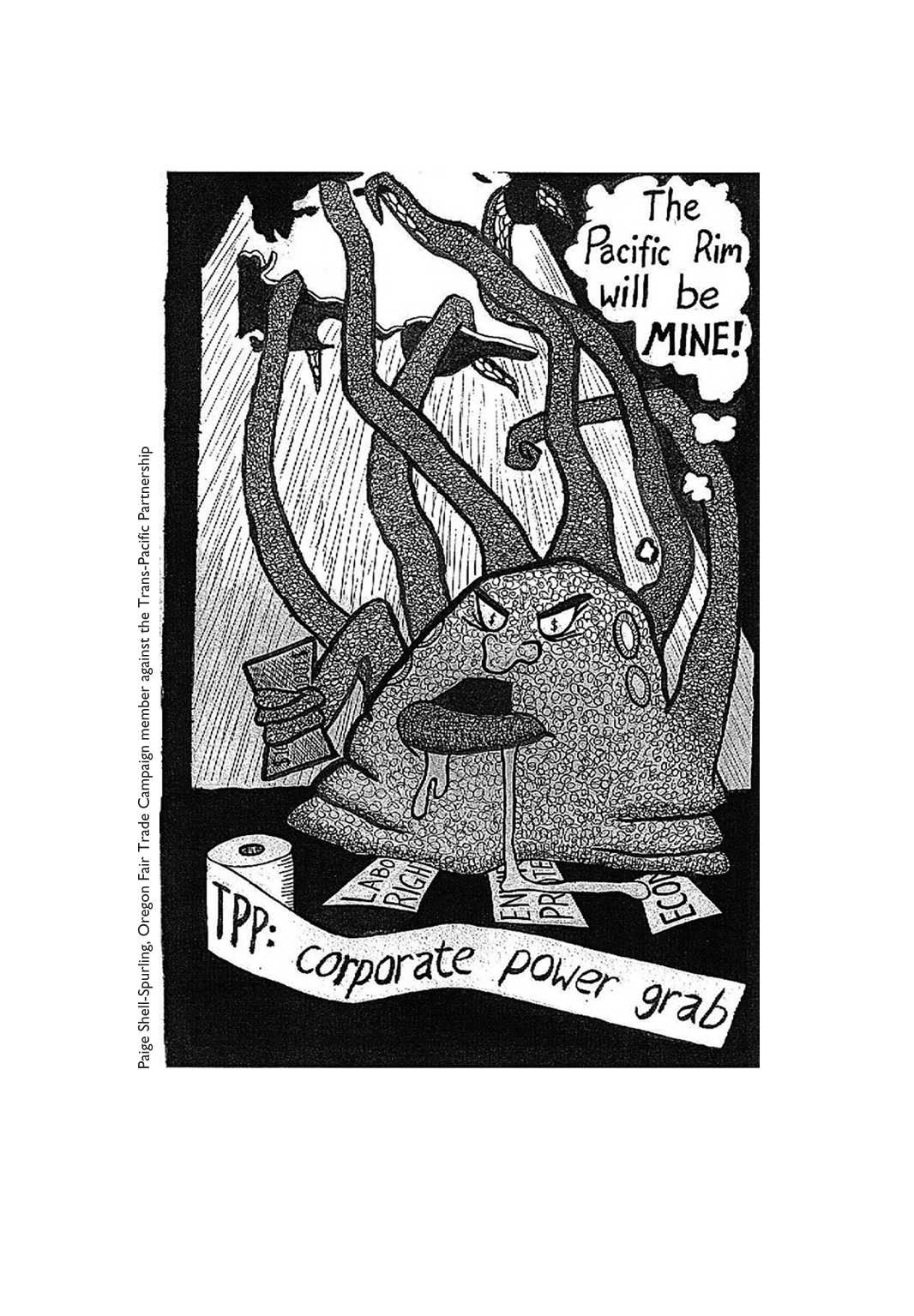
Paige Shell-Spurling, Oregon Fair Trade Campaign member against the Trans-Pacific Partnership
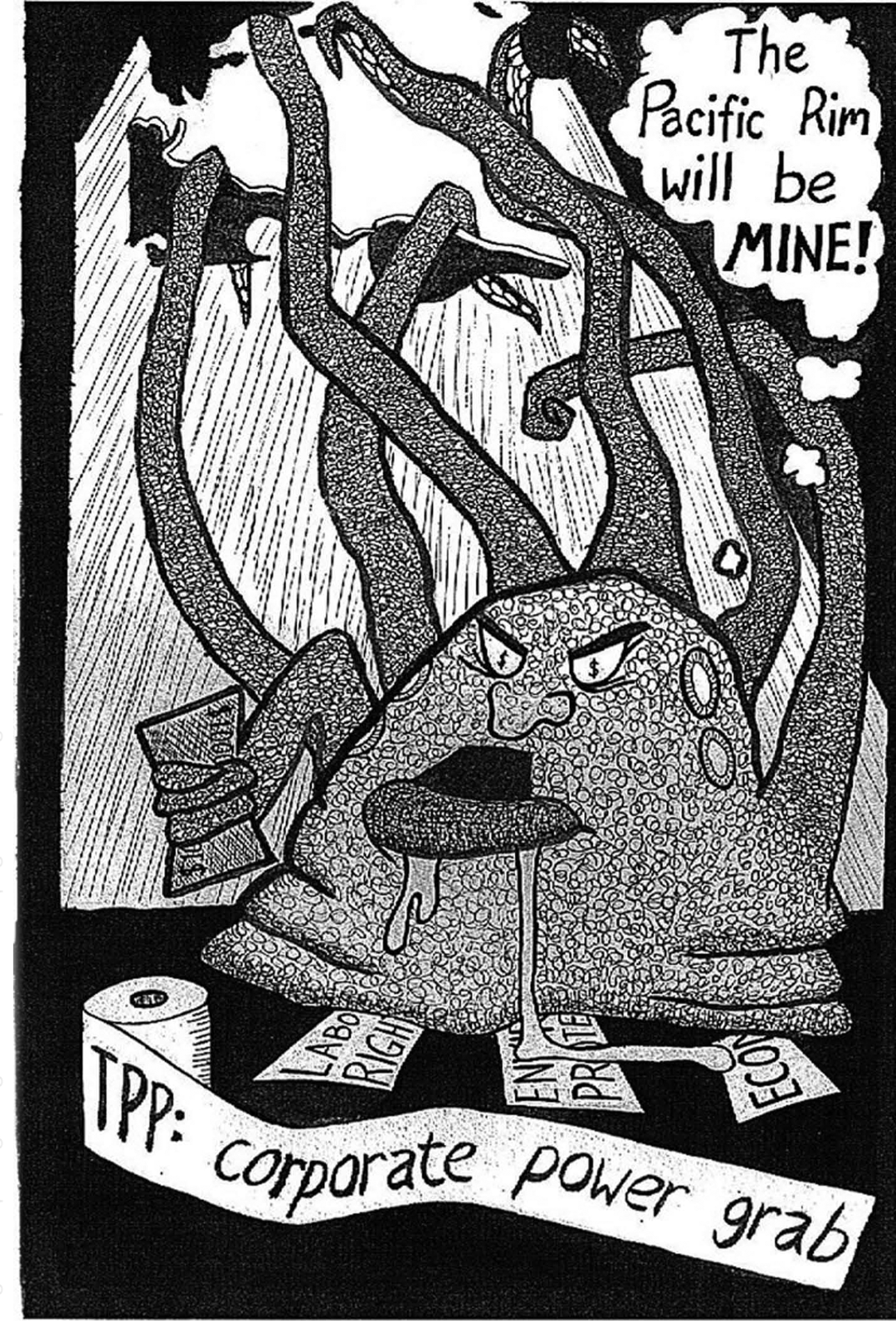
The Trans-Pacific Partnership (TPP) dwarfs the North American Free Trade Agreement (NAFTA) in both its economic scale and its potential to undercut wages and worker power throughout the globe. As a measure of its threat to organized labor in the United States, the AFL-CIO Executive Council adopted a policy statement on the TPP this February asserting that reversing race-to-the-bottom trade deals is “as important as our work to promote freedom of association and collective bargaining.” 1 The disastrous corporate agenda for the TPP is something that working people must—and, thankfully, can—defeat.
A Free Trade Behemoth
The TPP is an international trade and investment pact currently under negotiation between the United States and eleven other countries throughout the Pacific Rim: Australia, Brunei, Canada, Chile, Japan, Malaysia, Mexico, New Zealand, Peru, Singapore, and Vietnam. Just among those twelve, its rules would govern approximately 40 percent of the global economy 2 —magnitudes larger than any similar proposal labor has faced in recent years.
Moreover, the TPP is being explicitly negotiated as what is called a “docking agreement,” which other countries can join over time. In just the last year, Thailand’s Prime Minister announced that he was in discussions with the Obama administration about the pact, the Philippines unveiled a policy “roadmap” for joining the TPP, and South Korea has entertained overtures from U.S. trade officials. Even Chinese officials have said they are considering joining.
To put this in context, the TPP’s docking mechanism could enable corporate interest groups to circumvent the nearly fifteen-year stalemate at the World Trade Organization (WTO). Following the 1999 “Battle in Seattle,” various WTO member countries have blocked many of the worst proposals for expanding corporate power pushed by the United States and others. The TPP enables the Office of the U.S. Trade Representative to cherry-pick those countries that are most accepting of its corporate agenda, to set the rules of the game among those chosen few, and to then pressure and persuade other countries to sign onto the pact one-at-a-time over a period of years. If enacted, the TPP is likely to set the standard for global trade and investment rules for generations to come.
Jobs, Wages, and Tax Revenue Endangered
Congressman Alan Grayson, who was reportedly the first member of Congress to read classified draft texts of the TPP, characterized it this spring as “a punch in the face to the middle class of America.” 3
The threat posed to American labor is evident when one considers the legacy of past free trade agreements (FTAs). Rather than creating jobs as its boosters promised, NAFTA converted a $1.6-billion trade surplus with Mexico in 1993 into a $61.3-billion deficit in 2012 (and, in fact, reached a pre-financial crisis peak of $74.8 billion in 2007). 4 The Economic Policy Institute estimates the trade deficit with Mexico as of 2010 was responsible for a net loss of 682,900 U.S. jobs. 5
The more recent Korea Free Trade Agreement—a Bush-negotiated pact that was opposed by Barack Obama until he entered the White House and reversed his views—has had similar results. In the first twelve months since it took effect in March 2012, the U.S. trade deficit with South Korea grew by a whopping 30 percent. Not only were imports up, but also, exports were actually down by 9 percent. 6 One economist estimates that this already equates to fifty thousand lost U.S. jobs. 7
Considerably larger than either of those pacts, the TPP’s impact on job losses is likely to be massive, with the AFL-CIO already warning that if negotiations continue on their current course, it “could jeopardize millions of good, middle-class jobs.” 8
The only trade policy enacted to date that comes even close in comparison was Congress’ decision to allow China’s entry to the WTO, a move that cost the United States an estimated 2.7 million jobs between 2001 and 2011. 9 Because the TPP could eventually incorporate additional countries throughout the Pacific Rim—including China itself—its potential threat to U.S. jobs is even larger.
Indeed, even if China remains on the TPP’s sidelines, the race-to-the-bottom in wages and working conditions that the pact promises is difficult to overstate. From its tariff reductions and Rules of Origin to its investment and intellectual property rules, the TPP is designed to make it easier for employers to locate jobs in even lower-wage nations like Vietnam, where the average minimum wage is about a third of that found in China’s manufacturing centers. 10 It is a possibility with profound implications for workers’ movements globally.
In the United States, manufacturing jobs have unarguably taken the biggest hits under past FTAs, and in textiles alone, one industry study predicts that the TPP would cost the industry approximately 522,000 U.S. jobs within its first eight years. Numerous reports, however, suggest similar job losses would also occur across Latin America and China should the TPP be enacted.
In addition to manufacturing, service-sector jobs in fields such as computer programming, technical engineering, and call centers are increasingly at risk of being offshored. Even without the TPP, during the brief period of time when offshored service jobs qualified for the Labor Department’s Trade Adjustment Assistance (TAA) program, the sector accounted for more than 42 percent of all TAA certifications. 11
Because Vietnam offers a young, educated, and English-speaking labor pool at an approximately 30 percent wage reduction beyond India and 50 percent beyond Eastern Europe, 12 the country has already reached number eight on the A.T. Kearney Global Services Location Index for top service-sector offshoring destinations. TPP countries Malaysia, Mexico, and Chile have also broken the top ten.
The impact of such massive offshoring goes far beyond those whose jobs are shipped overseas. Offshoring already exerts a severe downward pressure on worker compensation across most professions. A March 2013 study by the Economic Policy Institute estimates that imbalanced trade with less-developed countries reduced the majority of American workers’ wages in 2011 by 5.5 percent.
13
That is a cost of about $3,100 per household—almost as much as most households spent on health care that year ($3,313 according to the Bureau of Labor Statistics), and more than they spent on expenses like gasoline or entertainment. Moreover,
For full-time wage earners without a college degree, annual earnings losses due to trade with low-wage nations are larger than income losses under a hypothetical policy that permanently extends the Bush-era tax cuts by making across-the-board cuts to government transfer payments such as Social Security, Medicare, Medicaid, and unemployment insurance.
14
Of course, offshoring does not just increase unemployment and suppress wages, it also leads to revenue loss for the public sector. Whenever trade-related layoffs reduce the number of individuals paying taxes on family-wage incomes and employers otherwise contributing to the public coffers, there is less money for schools, roads, fire departments, and other critical public services. Public data collected over the past decade show a nationwide correlation between the loss of manufacturing jobs and increases in state budget deficits. 15
Inadequate Labor Standards
Although no proposed text has been publicly released, TPP negotiators from the United States are reportedly pushing for the same labor standards found in earlier pacts (with the possible addition that countries that do not have any domestic labor law in certain areas be required to adopt some of their own choosing). There are no indications that the United States or any other country is supporting the model labor and dispute resolution text for the TPP supported by the AFL-CIO and six other labor federations across TPP countries, which, among other things, would make International Labor Organization (ILO) conventions enforceable. 16
While running for President in 2008, then-Senator Barack Obama promised that, if elected, he would require that U.S. trade agreements enforce the ILO’s core conventions, 17 which protect freedom of association, the right to organize and bargain collectively, and freedom from forced labor, child labor, and some forms of discrimination. Doing so in the TPP would provide workers considerable new leverage in demanding better working conditions and compensation.
For example, as things stand now, workers in Vietnam are forbidden from organizing or joining independent unions of their choice. The unions that do exist in Vietnam must be affiliated with the state-run Vietnam General Confederation of Labor and are often “dominated by management at the enterprise level.” 18 Individuals who participate in wildcat strikes can be held liable for any monetary damages caused to their employer 19 and are subject to termination, arrest, imprisonment, and state violence.
After taking the White House, President Obama pushed through Congress the Korea, Colombia, and Panama Free Trade Agreements that contained language written by the Bush administration specifically barring their use to enforce ILO conventions. 20 Some Democrats have lauded the fact that the pacts included any labor standards at all as a major step forward in the defense of worker rights. However, the record of Colombian labor rights violations under these grossly inadequate worker protections illustrates the consequences. In 2012, with the Colombia Free Trade Agreement in full effect, Colombia remained the deadliest country in the world to be a trade unionist. 21
Moreover, while TPP’s labor chapter will have the most influence over worker rights, other provisions could have an even greater effect on U.S. jobs. One of the major concerns for companies interested in offshoring information and technology (IT) work to Vietnam, for instance, is that despite its low labor costs, the country has almost no intellectual property (IP) guarantees for investors. 22 Under the TPP, Vietnam will likely be required to accept strong IP protections, as well as an investor-state dispute resolution process that gives corporations the right to privately enforce those requirements. 23 The very purpose of these provisions is to increase transnational corporations’ confidence in investing—and relocating jobs—overseas.
Beyond IP and investment, other TPP chapters could also contribute to massive offshoring in the manufacturing and service sectors. In December 2012, a group of twenty-four U.S. Senators wrote to President Obama urging that, among other things, the TPP maintain “Buy American” government procurement requirements, require strong Rules of Origin preventing non-TPP countries from taking advantage of market access offers under the pact, ensure that state-owned and state-supported commercial enterprises in exporting industries not undercut U.S. industrial employers and safeguard against currency manipulation. There is no indication that the Obama administration is trying to meet any of these recommendations.
The Biggest TPP Secret: We Can Win
The Obama administration’s stated goal date for completing the TPP negotiations is October 2013. Whether or not they meet that deadline, large portions of the pact’s text have already been determined. Despite this, U.S. negotiators still refuse to tell the American public what they have been proposing in our names, and negotiators from other countries have signed agreements to do the same.
This secrecy has been a major rallying cry, condemned by nearly a million different individuals and organizations. It is especially offensive in light of that fact that, in the United States, approximately six hundred “cleared advisors,” representing transnational corporations and industry lobbies such as Walmart, Cargill, Chevron, and the U.S. Chamber of Commerce, are granted access to TPP texts that the public is barred from reviewing. While some labor and civil society representatives are also cleared advisors, they are vastly outnumbered and, more importantly, are forbidden from sharing what they learn with anyone, particularly the general public.
This skewed negotiating process is undoubtedly having a heavy influence on the TPP’s contents, and have led union activists to label the pact “a back-room deal for the 1 percent.” The lack of text to share with journalists, Congressional offices, and others likewise helps to keep the TPP itself off of many people’s policy radar.
The TPP is said to include some twenty-nine separate chapters, affecting not just jobs and wages, but also food safety standards, banking regulations, medicine patents, indigenous sovereignty, Internet protocols, energy policy, government procurement, immigration, environmental protections, and more. Organizations and experts who care about these issues, but do not typically work on trade, can be difficult to mobilize without concrete texts to show them.
That said, perhaps the biggest secret about the TPP is that mobilizing against it can be successful. Global justice activists from the labor, environmental, family farm, and consumer movements have a long history of derailing similar corporate power grabs, including the Millennial and Doha Rounds of the WTO, the Multilateral Agreement on Investment (MAI), and the Free Trade Area of the Americas (FTAA).
The key to winning on the TPP is for labor and social justice advocates in each country to shine a spotlight on the pact, introducing accountability for negotiators and their elected bosses. While the TPP negotiations are well on their way to completion, the most difficult and politically-sensitive elements of the pact have yet to be agreed upon.
Sunlight and accountability will make it harder for negotiators in each of the countries involved to sell out working people cheaply and strike bad deals. As then-U.S. Trade Representative Ron Kirk acknowledged in a speech before corporate lobbyists late last year,
The real stumbling blocks to us getting [the TPP] done aren’t as much the difficulty in negotiating with ten other countries, it’s to quiet some of the voices in America that are saying, “Why . . . are you doing this? This is awful. This is the biggest giveaway.”
Unions can help drag the TPP out of the shadows by including information about it in their newsletters, passing resolutions, sharing articles over social media, distributing fact sheets and action alerts, and penning op-eds and Letters to the Editor. Of course, member education is just the first step.
In the United States, the single most effective thing labor advocates and others can do to introduce accountability to the TPP is to prevent Congress from approving new Fast Track legislation for it. Fast Track is a policymaking process that severely reduces the public’s (and its elected representatives’) ability to influence the terms of trade agreements, while magnifying the power of the U.S. Trade Representative and its corporate advisors. It allows pacts like the TPP to be signed by the executive branch before the public has a right to see them, and to then be rushed through Congress circumventing ordinary review, amendment, and debate procedures.
Fast Track “trade promotion authority” expired in 2007, and would need to be reenacted by a vote of Congress to apply to the TPP. With the Chamber of Commerce, Business Roundtable, and other corporate lobby groups joining the Obama administration in pushing for it, casual observers may be inclined to believe that Fast Track is a done deal. In fact, organized labor and its partners have a real opportunity to stop it.
The last Congressional grant of Fast Track authority passed in 2002 by just a three-vote margin in the wee hours of the night. The previous attempt to pass Fast Track legislation during the late 1990s was actually defeated. Other major trade votes over the years have been decided by very tight margins, and the next Fast Track vote could also very much go either way.
The real battleground over Fast Track this time around is in the House of Representatives, where Democrats are in the minority, and the President will be relying heavily on House Republicans for support, which is sure to make the administration’s vote-counting a daunting task. Each and every Democrat who commits to voting “no” before new legislation reaches the floor represents another vote that the Obama administration has to find among a group of politicians that despises it.
Already, more than four hundred organizations, together representing more than fifteen million Americans, have called on Congress to deny Fast Track for the TPP, and to instead replace it with a more democratic process. 24 Over two-thirds of House Democratic freshmen have written to the party leadership voicing their opposition to Fast Track, and a majority of House members overall have signed a letter to the President demanding that protections from currency manipulation be included in the TPP—something he is unlikely to deliver upon. Notably, a number of Republicans have also been questioning the TPP over district-specific commercial concerns.
The groundwork for victory is being laid nationwide. Beyond the efforts on Capitol Hill, a handful of unions, and even more allied organizations, have begun educating their members about the TPP, and have committed to mobilize district-by-district to put real constituent pressure on Members of Congress over Fast Track. This includes scheduling face-to-face meetings with Congress members on trade policy alone, grilling them at Town Hall events and other public venues, organizing targeted phone banks and email action alerts, circulating and delivering postcards or petitions, and being unafraid to publicly call out those who fail to side with us on this critical issue.
To win from here, more of organized labor, especially at the state and local level, will need to make doing this work an urgent priority. Given how much working families—and the labor movement itself—stand to lose, this is a fight whose moment is now.
Footnotes
Declaration of Conflicting Interests
The author(s) declared no potential conflicts of interest with respect to the research, authorship, and/or publication of this article.
Funding
The author(s) received no financial support for the research, authorship, and/or publication of this article.
Notes
Author Biography
 ).
).