






Abstract
“It’s time to move on!” “Get over it!” These are the facile refrains that I have so often heard from business and community leaders chastising Youngstown residents for lamenting the town’s history some thirty years after the steel mill closings. No doubt such remarks are indicative of the country’s progressive frontier mentality and its commitment to modernity and the American Dream.
But old industrial areas, such as Youngstown and Southeast Chicago, do not simply “get over” the havoc created by the collective and individual devastation caused by corporate disinvestment and deindustrialization. Simply put, there is no simple way to dismiss or erase the community’s memory of the impact of deindustrialization on people’s lives.
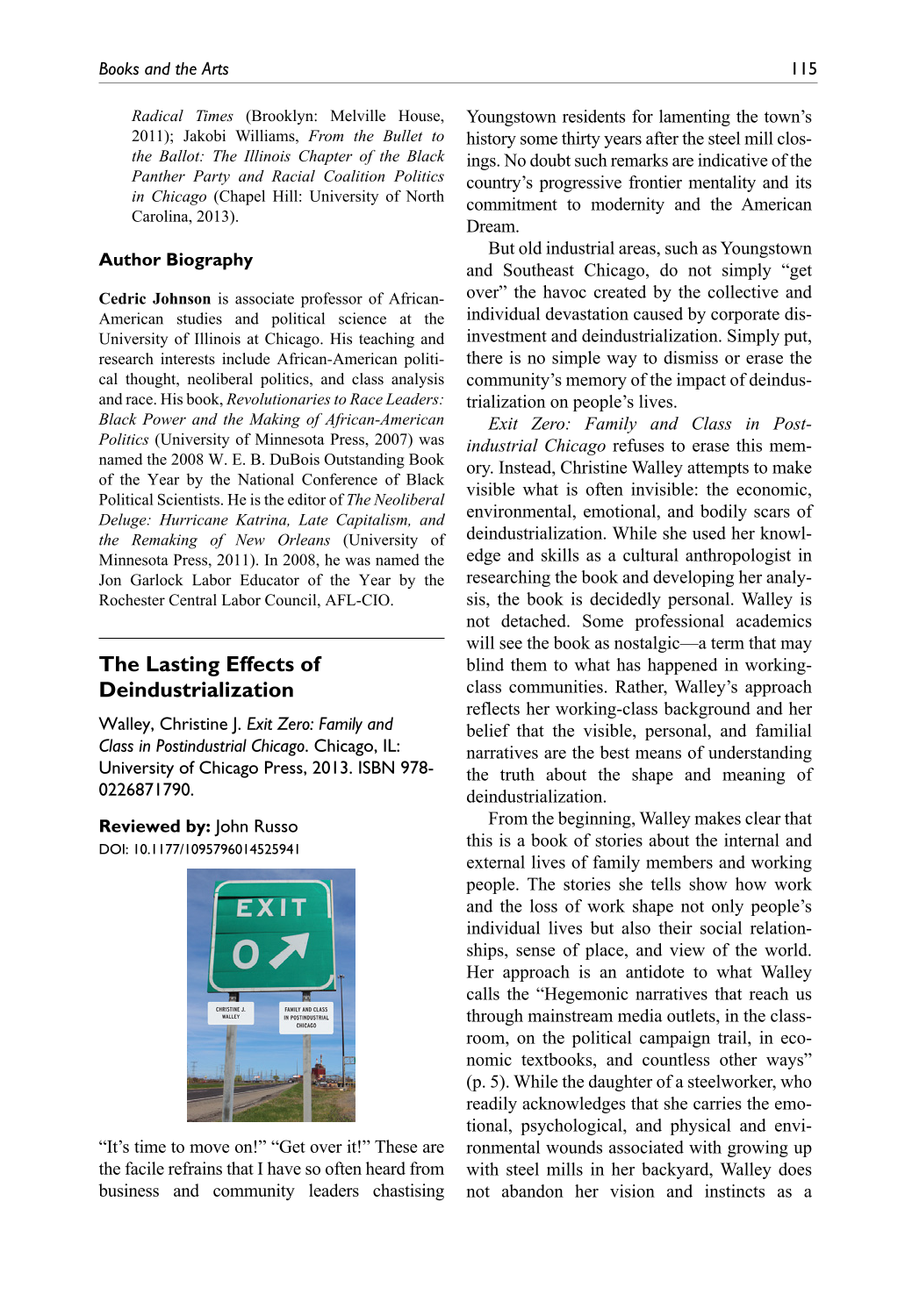
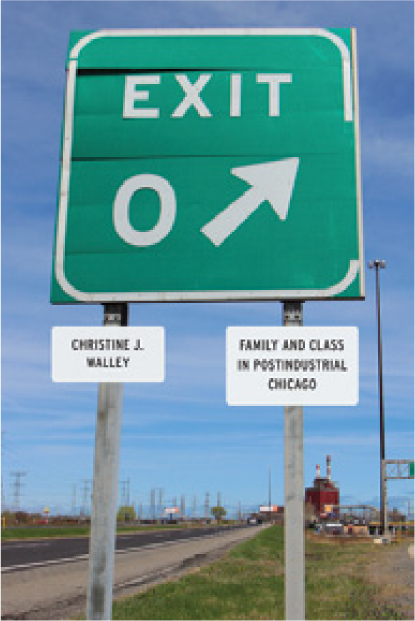
Exit Zero: Family and Class in Post-industrial Chicago refuses to erase this memory. Instead, Christine Walley attempts to make visible what is often invisible: the economic, environmental, emotional, and bodily scars of deindustrialization. While she used her knowledge and skills as a cultural anthropologist in researching the book and developing her analysis, the book is decidedly personal. Walley is not detached. Some professional academics will see the book as nostalgic—a term that may blind them to what has happened in working-class communities. Rather, Walley’s approach reflects her working-class background and her belief that the visible, personal, and familial narratives are the best means of understanding the truth about the shape and meaning of deindustrialization.
From the beginning, Walley makes clear that this is a book of stories about the internal and external lives of family members and working people. The stories she tells show how work and the loss of work shape not only people’s individual lives but also their social relationships, sense of place, and view of the world. Her approach is an antidote to what Walley calls the “Hegemonic narratives that reach us through mainstream media outlets, in the classroom, on the political campaign trail, in economic textbooks, and countless other ways” (p. 5). While the daughter of a steelworker, who readily acknowledges that she carries the emotional, psychological, and physical and environmental wounds associated with growing up with steel mills in her backyard, Walley does not abandon her vision and instincts as a cultural anthropologist. The result is a deeply moving personal and professional account of the impact of social class on an individual and community.
In the early chapters, Walley describes her family’s history in the working-class neighborhood of Southeast Chicago, offering a balanced view of the weakness and strengths of working-class life. She reveals “a strong sense of insularity in the midst of diversity” (p. 22). Here we find great family loyalty and solidarity amid clear racial, ethnic, religious, and gender boundaries associated with family and place. In a community where social class is so complicated with other identities and place, whiteness quickly became acknowledged as an instrument to gain work, housing, respectability, and social and economic mobility.
That upward mobility comes to a halt when Wisconsin Steel in Southeast Chicago, where her father worked, closes. Walley outlines the common narrative associated with deindustrialization: blaming workers, failure to reinvest leading to neglect and obsolescence, asset stripping, leveraged buyouts, deregulation, globalization, and bankruptcy. She does not buy the claim that deindustrialization was just part of the natural economic order. Instead, she shows how people with economic and political power made choices that would benefit a few and impoverish others.
But Walley does not see deindustrialization as simply an economic transformation resulting from corporate decision making. From her perspective, the outcomes of deindustrialization amount to a substantial reworking of the social relations of production, family, and neighborhood. She describes how work, family, and neighborhood dynamics changed as traditional ideas about masculinity, gender, agency, and community were shifted by deindustrialization. In the process, she identifies the traumas caused by economic violence and the deep sense of despair, displacement, and depression found in working-class communities. In time, this leads to voicelessness and a sense of helplessness for the community, and her account makes clear just how fragile personal and community institutions are in the face of an unnatural disaster.
Walley does not spare herself in her analysis. As a teenager, she was lucky enough to win a scholarship to a prestigious private school in Massachusetts. She not only reflects on her sense of shame about intentionally escaping the pall over her family and old neighborhood, but she also describes the emotional and psychological trauma of being working class at an upper-class institution. She knows that she does not have the same social capital and orientation as the other students, and she understands that she does not belong at the school. She does not belong at home, either. When she goes home for traditional holidays and friends, she feels the class guilt of wanting to return to the safe, privileged confines of her boarding school. Underneath her words, you can feel the conflicted teenage Walley quietly saying that ministerial refrain of “There but for the grace of God go I.” While focusing on herself as a young adult on her way to becoming middle class, Walley resists the typical American class narrative, which allows individual success stories to overshadow collective ones (p. 116). She shows that being working class is not a social status to be left behind but an experience that remains in the body and the mind.
In later chapters, Walley examines the lingering effects of deindustrialization on the body and the landscape. Deindustrialized places offer grim reminders of their once-thriving neighborhoods. The rusting hulks of industry persistently remind residents of the decline of local and national economic power and of the lost American Dream. Beneath the constructed/reconstructed landscape, Walley reveals the contamination left behind by steelmaking. Working-class communities often dismissed polluted water and air as part of the cost of economic development. The gaseous soot that accumulated on working-class homes was thought of as “black gold.” It was inhaled and ingested. The health-related illnesses and deaths associated with it were thought of as “acceptable losses” in the drive for middle-class life.
But when the mills closed, the environmental damage did not disappear. As Walley reminds us of “the landscape as a physical and environmental space that has come to be thoroughly bound up with the bodies that have lived there,” it compels us to understand that “our body, not just our psyches have histories” and that “divisions of class, race, and gender are bound up in both” (p. 119). Walley speaks from experience, describing her own history of cancer as due to the environmental effects of growing up in the shadow of the steel mills.
Industrial pollution continues to shape the reuse and redevelopment of working-class communities. Walley shows how local governments and economic development agencies have been limited in what they can do on brownfield sites because of the presence of hazardous substances, pollutants, and containments. In Southeast Chicago, as elsewhere, redevelopment has involved landfills and casinos. Landfills replicate the environmental exploitation of working-class communities, while casinos often exploit with low-wage service jobs and by skimming money from the poor and elderly.
Furthermore, Walley suggests that environmental groups accepted the contamination and chose to let nature slowly reclaim polluted areas or to advocate for the development of parks and recreational areas. They hoped that “greening” the former industrial environment would lead to sustainable development with clean industries and jobs. But in reviewing local environmental literature, Walley finds that working lives seemed to be erased. That is, largely middle-class conservationists and environmentalists seem less concerned about the health issues associated with brownfield sites and communities and more concerned with beautification that would attract the creative class and industries and gentrification. Taken together, Walley suggests, the redevelopment and reclamation efforts show how the degradation of the landscape has been “easily transferred symbolically to people who live there, devaluating and potentially erasing them in the process” (p. 129).
Overall, Exit Zero is an incredibly moving book written by an academic scholar coming to grips with her experience with deindustrialization. My only criticism is that Walley could have provided a deeper analysis of class inequalities and why people “hang on” in such economically declining areas. Furthermore, a discussion of what Walley gave up when she left the working class and absorbed middle-class values would have provided greater context to her discussion of class and place.
During her research for the book, Walley’s husband, Christopher Boebel, filmed a documentary also titled Exit Zero that will be released in Spring 2014. Taken together, the book and documentary could provide a comprehensive study of the meaning of deindustrialization that dramatizes the way the effects of deindustrialization last for decades, what Sherry Linkon has called “the half-life of deindustrialization.” Walley’s and Boebel’s works should have their own half-life as models of interdisciplinary approaches to the study of deindustrialization and its impact on working-class life and culture.