






Abstract

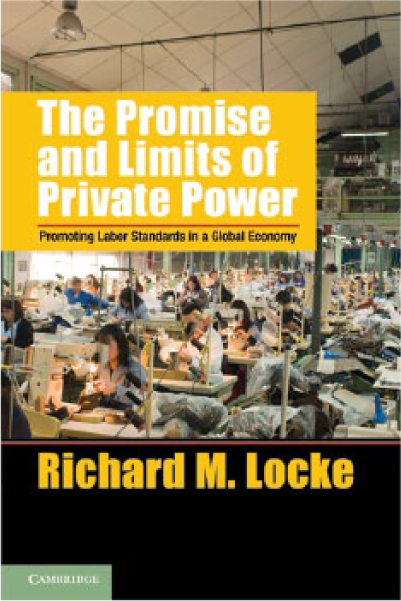
These two books are among a small, but growing, number of new publications dealing with labor in the global economy. While they each address a key issue in the struggle for achieving better labor standards and workers’ rights, there is little in the way of common ground between them that could provide a basis for reviewing them simultaneously. As such, this review will address the strengths and weaknesses of each book on its own.
Richard Locke’s book details the results of exhaustive empirical research conducted in three different economic sectors: athletic footwear, apparel, and computer electronics. In each sector, the author focuses on a leading “global player” with a reputation of leadership in regard to corporate social responsibility: Nike for athletic footwear, ABC for apparel, and Hewlett-Packard in computer electronics. As the author himself notes, the book represents a “unique opportunity” based on “unprecedented access” to supply factories to assess the strengths and weaknesses of corporate schemes for promoting labor standards. This is indeed an extraordinary opportunity. As anyone who has ever done empirical research on working conditions and labor relations on the shop floor knows, denial or restriction of access is quite common; even when it is granted, the researcher is rarely able to spend the time necessary for a critical and independent analysis. At the same time, this kind of access surely requires a balancing act to maintain academic credibility in the face of the company’s interest in “telling its story” and internal interests in covering up.
Richard Locke has mastered this balancing act superbly. His book is an excellent presentation of the efforts and shortcomings of private regulation schemes. In an influential book titled The Market for Virtue, David Vogel argued that there was such a market—albeit limited—that would enable firms to pursue improved labor standards. In contrast, Locke sees consumer demand as undermining efforts to produce virtuously. Buyers such as Nike, ABC, and Hewlett-Packard clearly exercise control over their suppliers, but at the same time they are bound by market demand to respond in ways that have negative impacts on working conditions at suppliers. Locke finds that there is a recognition of this problem in the private regulatory efforts based on compliance to eradicated abuses. But in assessing their results, he finds them to be sobering and limited.
Still, his argument does not end there—he sees an opportunity to combine these schemes with capacity-building measures at suppliers, based on commitment and innovative government practices, to create a win-win situation for buyers and suppliers and to improve working conditions. Improvement in labor standards, he argues, is conditional upon establishing long-term “mutually beneficial” buyer–supplier relationships and embedding this relationship in supportive state regulation.
While I highly recommend this book to anyone interested in the problems of global labor standards and workers’ rights, I have two critical points I would like to address. The first one concerns the relationship between production and the market. Locke shows that despite extensive efforts, the voluntary compliance-based approach to promoting labor standards is insufficient and needs to be strengthened by more buyer-initiated commitment-based policies and flanked by innovative government policies. His critical assessment focuses completely on the issue of how to conceive and pursue improvements in regulating production and supply. But if brands are ultimately subject to the vicissitudes of the market, is there really a promise of improvement? Locke does not address that issue, nor does he develop arguments in support of his assumption that multinational corporations only “respond” to market pressures. I think there is a case to be made that brands are actively influencing consumer behavior and even creating markets.
The second point concerns the role of workers’ voice and unions. In Locke’s book, unions are not part of the regulation process. Indeed, they are almost totally left out of the picture. Even in his presentation of two case studies from Mexico, in which unions were present in both plants, the differing roles of the two unions is not a point of analysis. Of course, where there are no unions, there can be no empirical analysis of their role. Locke does make it clear that corporate-driven private regulation schemes have a bad record when it comes to actually ensuring freedom of association. Even the most successful schemes leave such enabling rights as freedom of association and collective bargaining “outside the pale.” It is the role of the state, he argues, to ensure those rights. True, there is a role for the state, but also for unions as participants in what Locke wants to see developed: “internal self-governance and monitoring mechanisms” (p. 180).
I would also point out the Core Labor Standards of the International Labour Organization (ILO), which all member states of the ILO have pledged to recognize and uphold. These standards include the right to freedom of association and collective bargaining. Beyond state recognition, they are widely referred to in a variety of private and voluntary regulation schemes. The Core Labor Standards have been incorporated into Global Framework Agreements negotiated and signed by over 100 Transnational Corporations and Global Union Federations. So I am wondering why Locke does not consider a possible role for unions—not only at suppliers but also at the lead firms—in achieving global labor standards.
In contrast, Susan Kang focuses on trade union rights as they have been established in international norms. She asks how such international norms can be protected and can even influence domestic practice although under the dominant logic of economic competitiveness, states regard trade unions and trade union rights as a threat. But, she argues, when states are confronted with charges of violating international norms because they have curtailed trade union rights, they generally do not respond by questioning the legitimacy of such norms. Rather, they generally defend their actions as being compatible with the norms. For this reason, Kang argues, trade union rights have retained their validity and acceptance as human rights anchored in a wide spectrum of international norms, treaties, and conventions.
Kang’s second main argument is that states can be brought to redress violations of international norms of trade union rights via a “normative negotiation process,” but only if they see this as in line with their primary material and political interests. In the first three chapters of the book, Kang provides an in-depth and critical analysis of the institutionalization of trade union rights as international norms. Despite this achievement of broad recognition, she points out that “labor rights, including trade union rights, have always been contested because they seek to constrain capitalist production” (p. 18). Even more worrisome today, she warns, is the fact that trade union rights are endangered because state leaders embrace the neoliberal paradigm that regards “trade unions and collective rights to be inflexible relics” (p. 17). Moreover, such trade union rights are not on the level of legal obligations apportioned to civil and political rights; instead, they are recognized as falling under the category of social and economic rights. Such rights require promotion through state action, whereas civil and political rights are deemed to protect individuals from unlawful state action. In addition, trade union rights are clearly not only individual but also collective rights, which is probably their most contested aspect.
Chapters 4 through 6 make up the bulk of the book and are case studies in how international norms established in regard to trade union rights have figured in the protection and improvement of trade union rights in three countries: South Korea, the United Kingdom, and Canada. All three cases are analyzed in depth in terms of a “normative negotiation process” and richly documented. The South Korean case is set in the context of the government’s drive to gain OECD membership, during which time it came under pressure from the OECD and several of its member states, the ILO, and international trade union bodies to democratize the legal and political foundations of trade unionism. In the end, South Korea got its OECD membership by negotiating a deal that left compliance incomplete: trade unions had to accept more flexible labor and employment policies in return for government promises to recognize basic rights.
In the second case, an employer in the UK refused to include union members in a general pay raise for all employees unless they would renounce their membership. Their refusal ultimately led to their being fired. The conflict over this practice broke out initially under a conservative government and was exacerbated by a hastily passed law in direct defiance of a high court order in favor of the fired workers. With the support of the Trades Union Congress (TUC), the union members took their case to the ILO and to the European Court of Human Rights. Only after the Court ruled in favor of the plaintiffs did the new Labour government introduce a bill that ended the worst kinds of practices, but—in a manner similar to the South Korean case—fell far short of full compliance with the Court’s decision. Kang sees the “normative negotiation process” impacting this change as a result of the Court’s recognition of supportive recommendations from multiple international and European institutions.
Finally, in her third case, Kang has chosen a dispute over labor rights in the Canadian province of British Columbia. But unlike the other two cases, this one was resolved judicially within the domestic court system. Although the provincial government did not react to recommendations by international institutions, the author argues that the court ruling in favor of upholding trade union rights indicates that “international criticism did, however, prompt changes at the federal judicial level” (p. 155).
What can the reader learn from this book? As the author rightfully concludes, recognizing trade union rights globally “is not a panacea, but rather an important starting point for effective union politics” (p. 208). But just what those effective union politics might be remains unclear. Unions can hardly be encouraged to push for recognizing international norms, which (according to her able research) have limited impact on state policies. Indeed, all three case studies lead to the conclusion that only under exceptional circumstances can trade union rights, as anchored in international norms, be successfully protected—or won, as the case may be. Are there more cases, or more successful cases? The author does not say, but I would assume that she chose them because they are exemplary.
Overall, I found the approach to the topic rather opaque. Perhaps it was the topic itself that the book addressed in a way that made it seem abstract and intractable. And the title itself raises expectations that are not fulfilled in the book. Since the title speaks of human rights, labor solidarity, and trade unions in the global economy, I expected to learn more about transnational trade union actions to defend human rights and combat violations. But the book was actually a two-part analysis of the international norms and principles in which trade union rights are embedded (part one), and three detailed national case studies in which international trade unions were involved in supporting the rights of national unions (part two). While such an understanding of the complex construction of international trade union rights is basically helpful for academics and union delegates at the ILO, I doubt very much that the case studies can be regarded as role models about how to protect and improve trade union rights.
As I noted at the outset of this review, the differences between the two books in both their approaches and their content militate against their comparison in a review. Their only possible link is in regard to the role of the state in protecting workers’ rights. Neither of the books offers a very optimistic vision of the future of workers’ rights if left entirely up to the state, be it in a developing or a developed country. Non-state actors are needed, either to pressure governments (Kang) or to complement state regulation (Locke). But neither book sees trade unions as the collective organizations of workers playing a significant activist role at the workplace or mobilizing in support of workers’ rights. Whether trade unions and other civil society organizations can build the power basis needed to secure such rights at the workplace and bring the state to proactively support such policies—nationally and internationally—is, after reading these books, still an open question.