






Abstract

What holds the working class together when there is not any work? As factories shut down, class often seems to lose purchase power as a form of identity and belonging. In two new pieces of ethnography, social scientists Victor Tan Chen and Christine Walley show how the American dream—and the class experience tied to it—lives on in the moral imaginations of laid-off workers who bought into the industrial promise and now carry only bad debt. These pieces evoke the historical obligations of American industry to the workers who spent their lives producing its bounty. They also gesture to futures in which their enduring aspirations challenge the whitewashing of the deindustrialization narrative.
In Cut Loose: Jobless and Hopeless in an Unfair Economy, sociologist Victor Tan Chen sets out to compare the effects of social policy on unemployed auto workers across the U.S.–Canadian border. Chen—an associate professor at Virginia Commonwealth University—finds most political differences flattened by emergency policy measures. Instead, he is surprised by the shared self-blame of the seventy-one former auto workers he interviews in Detroit and Windsor, often visiting their homes and meeting their families to investigate “unemployment as it is lived and endured.” His study focuses on the experiences of the unemployed where social policy can intervene, such as through retraining programs, and with institutions that can provide protections—unions and state welfare bureaucracies. He argues these experiences demonstrate the moral power the market holds over the workers it has left behind. He writes, At the level of national policy, meritocratic morality helps make the case for painful austerity measures that further serve the interests of anti-government activists. It transforms economics into a morality play, as ordinary citizens conclude that the present-day malaise arises from the excesses of debt and dissipation in the past.
“I truly don’t know what the hell I want to do,” an unemployed auto worker tells Chen. “I have to do some soul-searching. Do I have time to soul-search? No. I have to get on this next week.” While workers sort the fragments of their shattered dreams, they are getting left behind in what Chen calls a “human capital speed up,” which constantly ups the educational and cultural ante for competing in the flexible labor pool. He finds government investments in retraining and job placement can provide a professional bridge and psychosocial salve for the workers able to access them. But demand far outweighs availability for both these programs and the stable jobs they promise.
Meanwhile, there is some soul-searching to do. Chen shows how industrial workers invested their livelihoods and senses of self-worth in an industrial meritocracy that rewarded the sacrifice of hard work. Unprepared for the steep incline in expectations, these workers find themselves now stuck on the losing side of a meritocratic game in which they are deeply invested. Chen finds they mourn their losses without questioning whether all players had equal opportunity to succeed. And yet privileged access to opportunity has a cumulative intergenerational effect on workers’ ability to compete: the African-American workers Chen interviews are at a distinct disadvantage in terms of available support from their social networks, consequential both to finding jobs and to managing debt. They therefore struggle to hold onto assets acquired from the last harvests of American industry. This is why Chen calls it a “stunted meritocracy”: while individual outcomes are judged as a measure of relative merit, historically disadvantaged and dispossessed groups are always starting from behind.
In Chen’s view, the moral hold of this stunted meritocracy on the working class has weakened resistance to its unfair outcomes along with institutions that have historically worked to level the playing field. Chen argues that Democratic lawmakers in the 1990s made meritocratic morality state policy, offering “market-friendly efforts to help people help themselves, rather than vigorous interventions in the market.” Unsurprisingly, workers place little faith in inefficient government bureaucracies and “profit-hungry” government-contracted private firms. Chen argues that pragmatic workers accept the meager results of social policy as a market reality without further political demand. However, he detects a meritocratic backlash against the collective egalitarianism of the trade union. Chen wonders if “this disdain for protecting the unworthy may explain part of the public’s perception of unions as ‘corrupt,’” finding further that “race can twist notions of deservingness in the workplace as well.” From within the relentless meritocratic competition, workers resent collective protections as cheats in the game.
While Chen identifies policy changes that could alleviate poverty cycles, he believes a substantive intervention capable of breaking them will require a cultural shift away from meritocracy. Considering its impact both on the politics of legitimating wealth consolidation and the psychosocial health of the unemployed, Chen argues we might counter these trends with a morality of grace—“a direct assault on this ideal of deservingness and this idolization of success, both of which stand squarely in the way of a more equitable society.” Rather than resetting or recalibrating society’s moral calculus, grace refuses measurement altogether and eschews the worldly rewards of market competition. Chen argues a moral shift to grace can help us take care of each other when industrial infrastructures fail, a social debt we live with not because we deserve it but because “our failings and vulnerabilities make us lovable.” Grace, Chen suggests, tempers the emotional extremes of high-stakes meritocratic competition that breed bitterness and shame. Seeing no mass political disruption on the horizon, he does not explore the potential of this anger to challenge the game itself.
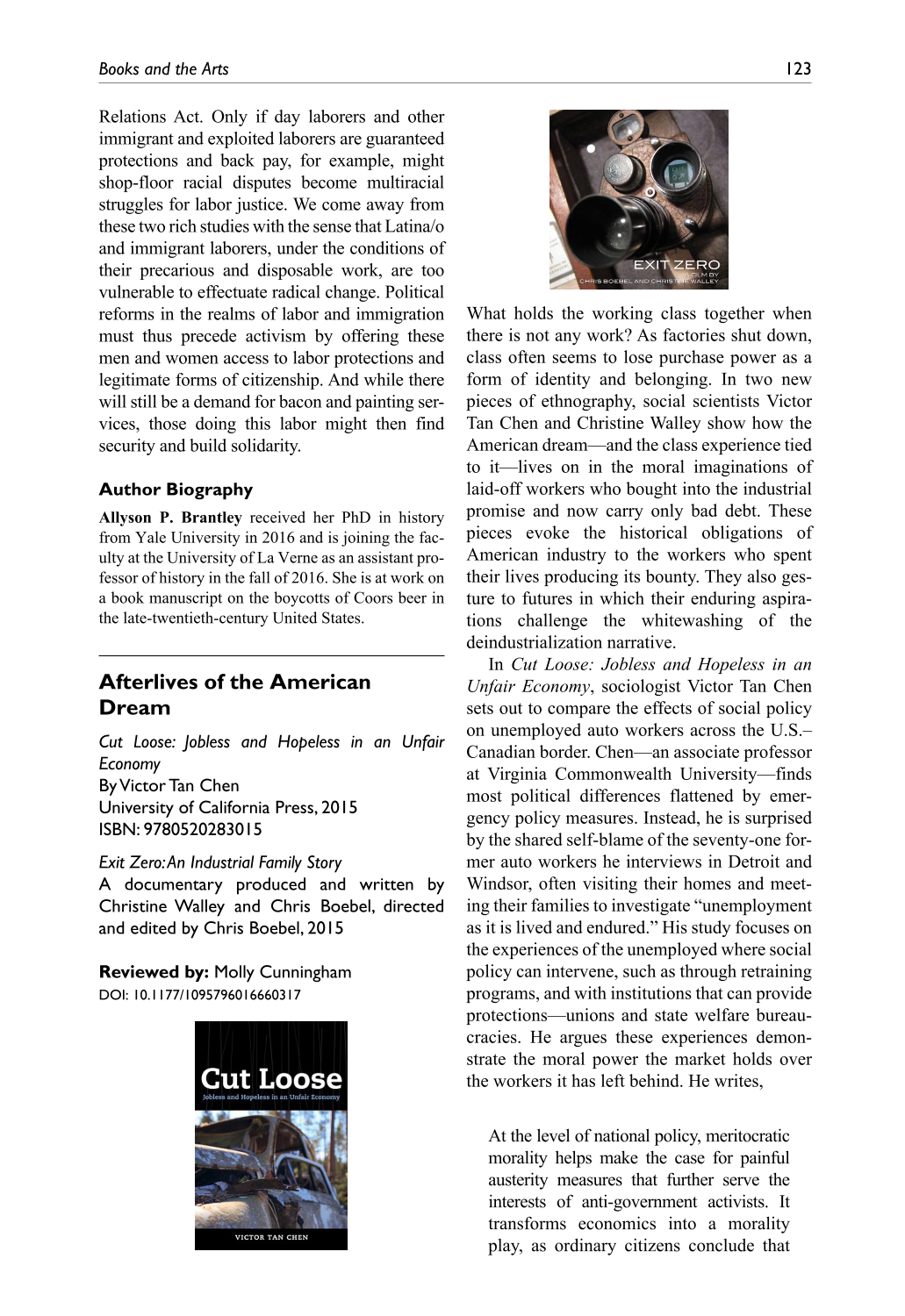
In her film Exit Zero: An Industrial Family Story, based on her recent book of the same title, anthropologist Christine Walley returns home to the Southeast Chicago neighborhood where the closure of the local steel mill ruptured the lives of the working families that once powered it. Working with her husband, Chris Boebel who co-writes and directs the film, Walley travels across four generations, exploring the archives and creating her own. Through ethnographic footage, home movies, and newsreels, she seeks to explain the rupture of Wisconsin Steel’s liquidation and memorialize the American dreams it interrupted. “Deindustrialization,” she contends, is not an inevitable story about the demands of free-market growth or the inefficiencies of organized labor.
So she returns to the story told in American industry’s heyday, after her grandfather’s generation had won the struggle for a seat at the bargaining table. We hear the postwar optimism in Wisconsin Steel’s promotional material, trading on “the industrial family that serves the nation.” Walley traces the extrication of capital from Wisconsin Steel, from the company’s escape from pension obligations through the liquidation of the mill. While the paper trail explains the financial reasoning and legal mechanisms behind the factory’s shuttering, it does not explain the traumatic shock to workers like her father. He only grasps conspiratorial fragments of the complicated technical story, yet he repetitively returns to the breakup. Watching footage of the Memorial Day Massacre of 1937, her father identifies more with the police in the protests. “No need for the shooting,” he says. “Tear gas would’ve done better . . . they’d really run then.” “Each of us only lives in our own time,” Walley explains, sympathetic to the gap in her father’s generational experience, mourning the loss of a good job, pension, and pride, the world he was born into and promised—a world away from the struggle through which it was won.
Walley finds a stable intergenerational link in her mother, who maintains the refuge of home and reproduces the traditions of their insular Swedish-American community. While the industrial game is over for her father, the home is what is left. While her mother was thrust into thirty years of temp work to keep it, it feels to Walley like her world has never changed. For an adolescent Walley, this segregated “closed society” was a trap. She found her own promise for upward mobility in a socioeconomic diversity scholarship to an elite boarding school. As a university professor (now with her husband, at the Massachusetts Institute of Technology), she can come home to visit, but she can never return.
Walley survived the factory’s aftermath not only by escaping the long dead end of her community’s American dream but also by beating a rare reproductive cancer that nearly took her life. “All I know is when you seen all the smoke in this area, you knew there was a paycheck on the table,” her father reminisces. “The kids were eating. The more smoke the better.” Walley takes us from the wasted dreams left by the mill’s closure to the toxic waste it left accrued in bodies and lingering in local ecologies. She knows her story would not hold up in court. But the stories emerge anyway: there are blocks in Southeast Chicago where every family has experienced cancer.
Walley reaches into the past not only to understand the present but also to ask where to go next. She doubts the free-market promise of deindustrialization, which sells it as an opportunity to clear away the past and herald a new economy. Only casinos have brought new jobs to post-industrial Southeast Chicago, where the American dream gives way to high-risk gambling habits and low-wage service work. Instead, Walley explores alternative visions produced by community activists, taking her audience along on a tour. “Their vision blends past, present, and future,” traveling from the historical site of the mill, the almost entirely automated field of solar panels that has sprung up in its wake, and a community garden. “Communities aren’t static,” activist Peggy Salazar tells us, “Today my community has many immigrants. The difference is we don’t have the same number of opportunities.” As Latino immigrants arrive in Southeast Chicago, Walley contends, “Like always, that’s where new life in the neighborhood can really be found. There are still dreams here.”
Walley wants the dreams of working-class people to matter again. In a world where the working class is not coming together in the factory day-to-day, the Exit Zero project is bringing industrial family stories together in an interactive website designed to accompany the film. Like the youth working contaminated soil, Walley seeks to remediate histories of industrial injury to cultivate new futures. She gets out her great-uncle Gust’s early industrial-era camera to film her young son, adopted from Korea, creating new scenes of family conviviality unimagined by Gust.
Wisconsin Steel closed in 1980, a full generation before the 2008 collapse of the North American auto industry. Taken together, Chen’s book and Walley’s film conjure the powerful afterlife of working-class aspirations that persist long after the factory gates close in places such as Detroit, Windsor, and Southeast Chicago. They give us a sense of the multigenerational toll of deindustrialization on families and communities that have fought for inclusion in the American dream. The industrial family has got some soul-searching to do. But who has got the time?