







Abstract

Bernie Sanders speaking at Iowa State University, Ames, Iowa, 2016.
Photography: Alex Hanson
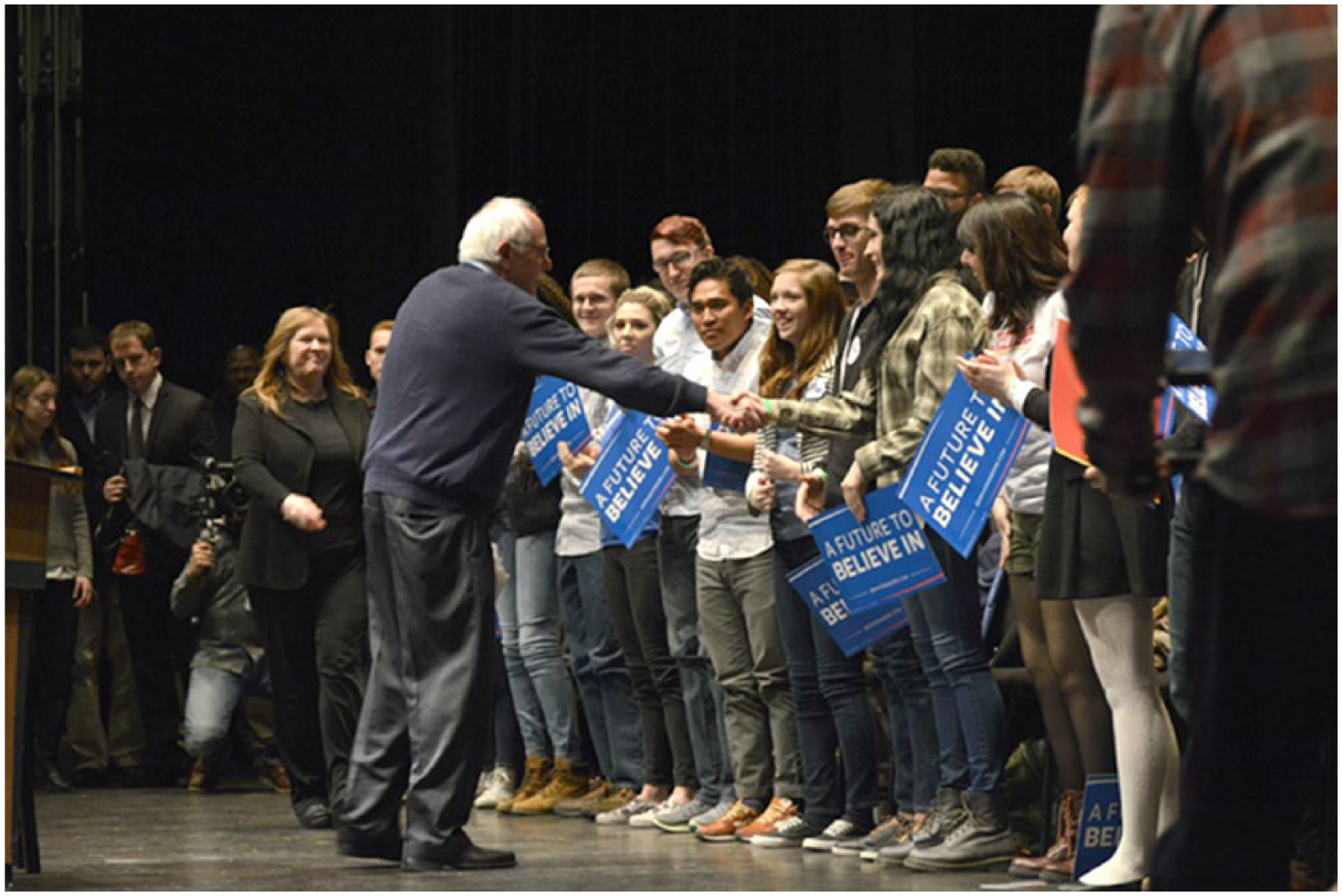
The Bernie Sanders presidential campaign, contrary to all expectation, became the most important left insurgency in the United States in nearly half a century. A year ago, even his most optimistic supporters might have hoped that Sanders would enliven the presidential debates by challenging Hillary Clinton on issues of Wall Street power and big money corruption, and perhaps garner a quarter to a third of the primary vote. Instead, Sanders won primaries and caucuses in twenty-three states and amassed more than twelve million votes and nearly 43 percent of the pledged delegates. And all this while unapologetically and unabashedly proclaiming himself a “democratic socialist,” relegitimizing a systemic critique of U.S. capitalism for the first time since the one-two punch of Cold War reaction and neoliberal triumphalism froze out the left from mainstream American discourse two generations ago. The power of Big Banks, job-killing trade deals, ending the corrosive influence of big money in elections, eliminating private insurance companies from the health care system, and the merits of a “political revolution” became staples of prime-time presidential debates. Once stunning poll numbers now seem commonplace: 43 percent of Iowa caucus-goers, including roughly a third of Clinton supporters, described themselves as “socialists”; a New York Times poll late last year that said that 56 percent of Democratic primary voters had a “positive view of socialism”; and Sanders’ overwhelming support among young voters, by margins as high as 84 percent in Iowa and New Hampshire, but that percentage even reached the low sixties in states like South Carolina, where he was otherwise crushed. Indeed, Sanders’ remarkable popularity among “millennials” prompted John Della Volpe, the director of a long-running Harvard University poll of young people, to tell the Washington Post that Sanders is “not moving a party to the left. He’s moving . . . the largest generation in the history of America . . . to the left.” 1 Something significant has definitely happened.
At this writing, just after the Democratic Convention, it appears likely that Hillary Clinton, despite her historically high unfavorable ratings, will defeat Donald Trump in the November election. But the unexpected breadth and fervor of the Sanders movement signifies that the shifts in U.S. political discourse engendered by the financial collapse of 2008 and the Occupy Wall Street movement in 2011 are enduring. Bernie Sanders did not produce this moment—after all, he has been saying the exact same things about American society for more than forty years. But as in any movement moment, when the zeitgeist shifts and a leader’s vision gives voice to the hopes of tens of millions of people, the unthinkable suddenly becomes possible.
Despite its enormous promise, the movement has displayed critical limitations. Although Sanders worked hard to enrich his campaign’s analysis and message on issues of concern to people of color, the primacy he gave to questions of class, economic inequality, and corporate power evidently prevented many African Americans and Latinos from seeing themselves in his campaign. This is confounding given that African Americans were especially hard hit by the ravages of the neoliberal, trickle-down economics that Sanders attacks. Black family wealth, already only a fraction of their white counterparts, was halved after Wall Street melted down in 2008, and poor people of color were disproportionately victimized by the predatory loans that fed Wall Street’s speculative bond machine.
But African-American primary voters overwhelmingly supported Hillary Clinton. One leading Pennsylvania African-American faith leader explained to me that many black voters, especially older women, viewed their support for Hillary as upholding a “social contract” that was forged in 2008: after they abandoned Hillary for Obama that year, it was understood that eight years later she would have “her turn.” Younger activists of color, even some who support Sanders, say they did not “Feel the Bern” because of his initial stumbling response to the challenges of Black Lives Matter (BLM) protestors. And civil-rights advocate Michelle Alexander, who eviscerated the Clinton policy legacy in a Nation magazine article titled “Why Hillary Clinton Doesn’t Deserve the Black Vote,” attributed African Americans’ 2016 allegiance to the Clintons to a widely held feeling that Bill Clinton was the first President
who actually treated black folks like they were real people, who could be viewed and treated as human beings . . . who actually would sit down to eat with them and sing in their church and acted like he enjoyed it, who recognized us as human beings.
2
Race remains at the core of the American tragedy, and the struggle of BLM will not be subsumed in a broader movement. The potential of a continuing post-Sanders radical mobilization for economic justice, racial justice, and democracy will only be realized if it integrates the social critique and constituencies mobilized by BLM and movements for immigrant rights. The support Sanders received from leading black intellectuals, artists, and elected officials, like Alexander, journalist Ta-Nehesi Coates, philosopher Cornel West, past-president of the NAACP Ben Jealous, and Republican Keith Ellison (D-MN) suggest that bridging the gap between the Sanders campaign and the emergent black mobilization is by no means out of the question. Here, the labor movement, which despite all its flaws and limitations, remains by far the largest multiracial institution of working people in our society, could play a crucial role in ensuring that whatever consensus-building effort that follows the Sanders campaign reflects the increasingly diverse face of American society.
***
Today’s labor movement has been largely shaped by its experiences of defeat, on multiple battlefronts over the last thirty years—at the bargaining table, in State Houses, in the courts. In recent years, this prolonged existential crisis has bred some innovation and success, most dramatically in the Service Employees International Union’s (SEIU) four-year-old “Fight for $15 and a Union,” which has sharpened and politicized the discourse about income inequality and stagnant wages that erupted in Occupy Wall Street (not to mention delivering billions of dollars in raises to tens of millions of low-wage workers across the country).
The broad acceptance of $15 an hour as the new standard for the minimum wage—a notion that was ridiculed by many of its current proponents just two years ago—illuminates the critical power of ideas in opening up space for organizing as well as political and legislative advancement. When fast-food workers and their supporters won the ideological battle about what constitutes an adequate minimum subsistence level of compensation, change came with surprising suddenness.
Historian Nelson Lichtenstein has written that
trade unionism requires a compelling set of ideas and institutions, both self-made and governmental, to give labor’s cause power and legitimacy. It is a political project whose success enables the unions to transcend the ethnic and economic divisions always present in the working population.
3
But labor’s ideological breakthrough in the “Fight for $15” is an exception that proves the rule. By the time the “corporate right” fashioned its relentless and well-planned ideological and practical attack on the labor movement, starting in the mid-1970s, decades of complacency and anti-communism had stripped the labor movement of its capacity to respond on an ideological plane. In his famous letter in 1978, resigning from the “Labor-Management Group” after the Business Roundtable-sponsored filibuster buried “Labor Law Reform” in an overwhelmingly democratic Congress, United Auto Workers (UAW) President Doug Fraser lamented the outbreak of a “one-sided class war” waged by a politically resurgent corporate elite. The unspoken and probably unintended implication was that class war was an alien concept to a labor movement that had come to see itself as the junior, but accepted and well-established, partner in a long term “social compact.”
Missed Opportunities
Thus, it was hardly surprising that when the Sanders campaign’s stunning success confirmed the existence of a mass base of tens of millions of Americans for a new brand of radical, oppositional politics, most of the labor leadership was unmoved. This was the legacy of three generations of labor political pragmatism, even as tens of thousands of rank-and-file union activists flocked to support the first politician in many years who so clearly articulated a class-based attack on the prevailing order. Sanders’ adherents are a politically diverse and sometimes contradictory group, but at the heart of his campaign lies a deeply felt rage against a political system rigged to serve the interests of Big Banks, Big Carbon, and the rest of the corporate elite. This movement is instinctively supportive of the struggles of unions and working people against their employers, as evidenced in the warm welcome Verizon strikers received at Sanders rallies across New York City in the days before the New York primary.
And, as it turns out, language matters a lot. Before the Sanders campaign, I minimized the significance of candidates or elected officials explicitly describing themselves as socialists. After all, many of the “progressives” on the New York City Council, in the New York State Legislature, and elsewhere across the country, hold views on issues that are virtually indistinguishable from Sanders’ and could be counted on as equally reliable allies and champions. But calling these views as a whole “socialism” makes explicit a critique of capitalism and its shortcomings that cannot be grasped when the word itself is absent. It suggests that the reforms for which we fight are more than just an attempt to ameliorate the ills of a market-driven society; it says that it is the very system that is the problem and that must be changed. It begs the question of what precisely an alternative system might look like. But the invocation of “socialism” opens the social and political imagination to dreams of real alternatives. Historian Steve Fraser has written that “language, as a philosopher once put it, is the house of being.” Decades of Cold War and neoliberalism rendered the American left homeless, unable to muster the radical hope that Fraser argues was the driving force behind the great reforms of the Progressive Era and New Deal. 4 Bernie Sanders has begun to erect the scaffolding for constructing a new radical imagination.
This ideological reorientation is far more important to the possibility of reviving the labor movement than most labor leaders would acknowledge. Only such a shift offers labor the “compelling set of ideas and institutions, both self-made and governmental, [that could] give labor’s cause power and legitimacy” again. 5 This was the missed opportunity of the 2015-2016 election cycle. As Sanders’ crowds grew across the country, and his forthright critique of trade deals, bank bailouts, and campaign finance corruption attracted millions, most of the labor leadership—ever the conscientious custodians of pragmatism—elected to “go with the frontrunner.” There were a few exceptions of course, including my union, the Communications Workers of America (CWA), as well as National Nurses United (NNU), the American Postal Workers Union (APWU),the Amalgamated Transit Union (ATU), later the west coast International Longshore and Warehouse Union (ILWU), the New York State Nurses Association (NYSNA), and the Transport Workers Union (TWU). And Sanders succeeded beyond anyone’s wildest expectations in shifting the national discourse in the direction of labor’s concerns, despite the lack of support from most of the labor movement. How much more seismic would his campaign have been if even a handful of other major unions had joined the cause, creating greater credibility, providing additional resources, and perhaps helping to establish, most important, more organic connections to workers of color.
What’s Next?
The Sanders campaign unleashed a remarkable upsurge of decentralized, largely self-organized, progressive activism. In so doing, it kindled hopes that a post-Sanders movement could lay the foundation for a reinvigorated new left in U.S. politics, both inside and beyond the voting booth. But translating the energy, excitement, and activism of a presidential campaign into a new political formation or movement will not be easy. Recent experiences confirm this—from Jesse Jackson’s Rainbow Coalition to Howard Dean’s brief insurgency—to the hopes aroused by the Obama campaign. None of these endeavors actually built an independent, democratically accountable organization that could provide a durable platform for independent issue campaigns or candidacies.
The Sanders phenomenon, however, differs from these predecessors in important ways. For one thing, the radicalism of the candidate’s politics and the historical context of his candidacy—in the aftermath of one of the great global crises of capitalist legitimacy—point toward ongoing mobilization outside normal political channels. Second, the candidate himself has resolutely reinforced the necessity of building such a movement, repeating at rally after rally that the “political revolution”—those words in themselves a remarkable addition to the conventional U.S. electoral lexicon—can only be achieved through the creation of an ongoing movement. Third, the disappointment in Obama, whose campaign felt at times like a movement even if its politics were inchoate, suggests that the mistaken demobilization that followed 2008 may be avoided.
The Sanders campaign made it possible to imagine building a movement powerful enough to end oligarchical control of our democracy, to avert the planet from climate disaster, to wrest control of the economy from the stranglehold of Wall Street, and to implement the criminal justice reforms, jobs, and education programs that will begin to repair the damage inflicted by four hundred years of institutionalized racism. What follows are thoughts about issues that should be considered as we enter the next phase of the Sanders movement.
1. A new national left party or a single unified organization is unlikely to emerge from the Sanders movement, but let us build something.
The Occupy encampments changed the global political discourse, but the movement’s longer term potential was squandered by its rejection of organization building, an anti-leadership obsession with “horizontality,” and an aversion to program. Preoccupation with “holding space” and with decentralized direct action made it impossible to create the Occupy equivalent of the Student Nonviolent Coordinating Committee (SNCC) or Students for a Democratic Society (SDS)—an organization that could have carried forward the anti-Wall Street mobilization even after state violence dismantled the encampments. We should not make those mistakes again.
However, some optimistic Sanders partisans express a hope that the multiple organizations and individuals who have been galvanized by the campaign can coalesce into a single new progressive organization that unites the left and takes it to a new level. But in an era when institutions from Congress to the labor movement are deeply distrusted and when the notion of struggling toward ideological unity seems foreign, if not archaic, trying to coalesce the heterogeneous forces backing Sanders into a single organization could prove to be a daunting and possibly counterproductive project. Existing organizations will be reluctant to relinquish identities and infrastructures that have been built up over decades of work.
Our goal should be a new level of coordination on the left, in terms of both issue mobilizations and key electoral races. Sanders or key campaign leaders should convene a new “coordinating committee” comprised of the unions and other organizations that endorsed him: CWA, NNU, ATU, MoveOn.org, Democracy for America (DFA), the APWU and west coast ILWU, the Working Families Party (WFP), Progressive Democrats of America, Democratic Socialists of America, and a host of local unions and local groups. The various self-organized networks that sprang up in support of the campaign—Labor for Bernie, People for Bernie, and Millennials for Bernie—would also be part of the coalition. Representatives of unions and social movements, as well as leading independent-of-color intellectuals and activists—including those who might not have endorsed Sanders—should be invited. These groups could provisionally unite around a limited number of national campaigns or mobilizations that would build on the progressive political momentum ignited by the Sanders campaign.
2. The question of race must be dealt with upfront.
To gain credibility among constituencies of color that were reluctant to back Sanders, the new formation must unify the agendas of the Occupy, BLM, and immigration rights movements. It must prominently engage key community and political leaders of color like Representatives Keith Ellison and Raúl Grijalva (D-AZ), Ohio State Senator Nina Turner, and New York City Council member Jumaane Williams (who led the legislative fight against “stop and frisk”), former NAACP leader Ben Jealous, and intellectuals like Michelle Alexander, who is probably one of the most significant influences on millennial activists, both white and black. And from the start, the post-Sanders formation must take up issues that are immediately relevant to constituencies of color—police accountability, stopping the attack on Voting Rights, or comprehensive immigration reform, to suggest just a few examples.
3. The new movement should mobilize around a limited agenda that takes on issues of economic and racial exploitation, on one hand, and the reclamation of our democracy, on the other.
Such an agenda should be clearly understood as an effort to hold the new President and elected Democrats at every level accountable to the yearnings of tens of millions of Americans for racial and economic justice. This issue mobilization must begin by uniting forces both inside and outside the Sanders campaign to kill the Trans-Pacific Partnership (TPP) trade agreement once and for all. This is not only the right policy but critically important for the electoral success of the Democratic Party. So-called “free trade” embodies the deep contradiction between the neoliberal bankers and technocrats, on the one side, who have dominated Democratic Party economic policy making since the Clinton administration, and its traditional working-class base, on the other. It is also now the Democratic Party’s most vulnerable Achilles’ heel with white working-class voters, whose sense of betrayal and economic hopelessness drive Trump’s right-wing, nationalistic populism and reduce Clinton’s support among these voters to abysmally low levels. Sanders has already pushed Clinton to rhetorical opposition to the TPP; in the months after a convention roiled by widespread hostility to the TPP, there will be enormous pressure on Clinton the candidate, as well as Clinton the president-elect, to sustain clear and unequivocal opposition to its passage.
In 2009, rather than mount mass mobilizations that would have invested Obama’s “hope and change” with real progressive content, labor substituted visits to the White House for street heat. The test of the post-Sanders movement will come in 2017, when it will face the challenge of pushing Clinton to the left and charting a new political agenda for the Democratic Party. It is not hard to imagine a short list of issues around which a new left could organize. A national campaign for a Wall Street “speculation tax” to fund free public higher education or investment in tens of millions of infrastructure jobs would extend the challenge to Wall Street power that lies at the heart of Sanders’ narrative. Communities of color could be galvanized by a national campaign to restore Section 5 of the Voting Rights Act, echoing and broadening Sanders’ demand for a renewed political democracy. And at the local level, let us mount state-based campaigns for the public financing of elections of district attorneys—the elected officials who are at the heart of the pitched debate about the unfairness of the criminal justice system. Such a campaign might have huge appeal to grassroots movements like BLM. The details of the issue agenda should be vigorously debated, and I claim no monopoly on the correct answer. What is critical is not only trying to bring together the organizations and constituencies which supported Sanders, along with those who did not, but also seek a leftward shift in the American political discourse, around a limited set of campaigns that can build on the gains of 2016. By going on the offensive—and thereby defusing a likely right-wing counteroffensive to set the terms of debate in 2017—a broad progressive formation can redefine the national agenda around issues of race and class inequity and inaugurate a new era of progressive reform.
4. A massive program of grassroots political and economic education must be launched.
In the waning decades of the nineteenth century, the Populist movement deployed a small army of “lecturers” who traveled across the Plains talking to farmers about issues of debt, credit, monetary policy, and the power of Wall Street over their lives. This popular education helped build the mass base for a reform agenda that ultimately culminated in the sweeping changes of the New Deal. Our movement requires a similar commitment to mass popular education.
In recent years, a number of organizations have experimented with various grassroots popular education programs: Minnesotans for a Fair Economy, various affiliates of National People’s Action (NPA), and my own union, the CWA, are good examples. In the CWA, we have worked with author and activist Les Leopold to develop a participatory curriculum that explains the hyperfinancialization of the neoliberal era, and explores how those developments intersect with institutional racism. Relying on the “small group activity method,” the union has trained sixty rank-and-file activists—including some from allied groups like Citizen Action of New York and Make the Road New York—to lead these workshops. The anti-Wall Street curriculum complements two-day boot camps led by the CWA’s national political department, which aim to develop politically aware activists at the grassroots level across the country. In Minnesota, the vibrant Minnesotans for a Fair Economy coalition has used popular education techniques to reveal the institutional connections binding together the Twin Cities ruling class. These simple exercises—using networks to illustrate these links—can be conducted with literally thousands of activists at a time. This program has helped activists from multiple organizations and struggles to unite in significant challenges to the city’s major power brokers.
One major initiative of any post-Sanders formation should be the convening of groups that are engaged in, or interested in, creating these programs of mass popular education. Groups can share and debate both curricula and teaching methods. Organizers of this effort should seek funding from unions and foundations. Historically, this kind of education was a function of the parties of the left. In their absence, other forces will have to assume responsibility.
5. An openly socialist current should be built within the new movement.
Senator Sanders’ refusal to retreat from his identification with democratic socialism certainly ranks as one of the most remarkable features of the campaign. To those of us who can remember “Commie” as a schoolyard epithet and “duck and cover” air raid drills, let alone labor’s bitter internecine battles over U.S. imperial misadventures in Vietnam and Central America, Sanders’ open embrace of socialism and the absence of “red-baiting” in the campaign has been almost beyond imagination.
The grassroots organization that appears to have experienced the greatest membership growth as a direct result of the Sanders campaign has been the Democratic Socialists of America, which traces its roots to the breakup of the old Socialist Party in the 1950s and is the largest remaining socialist organization in the country. In his account of the decline of American resistance to organized wealth and power in the “second Gilded Age,” in The Age of Acquiescence, Steve Fraser argues that “the capacity to envision something generically new, however improbable, has always supplied the intellectual, emotional and political energy that made an advance in civilized life, no matter how truncated, possible.” In this telling, the reforms of the New Deal were driven by the utopian dreams of millions of Americans who believed capitalism must be transcended and would have been impossible absent the presence of a “multifaceted and long-lived culture of resistance that was not afraid to venture onto new terrain, to question the given.” 6 In this new moment, while progressive unions and their allies fight for a twenty-first century Glass-Steagall Act, socialists would demand nationalization of banks. While more mainstream progressives call for a “Wall Street sales tax,” socialists might demand a maximum wage or a wealth tax. More mainstream activists will demand debt-free college education, while socialists would demand free tuition and free mass transit. Whether socialism exists today as a practical alternative form of social organization, or simply as a compelling moral critique of a racialized, financialized capitalism that is leading us to climate disaster, the revival of the idea of socialism facilitates the imagination of radical alternatives to the status quo. For the resuscitation of that hope, we owe an enormous debt of gratitude to Bernie Sanders.
6. The “political revolution” must be driven down to the level of school boards, city councils, county legislatures, state government, and Congress.
The goal is not to take over the Democratic Party, but to build an infrastructure—an independent political party—comprised of activists and elected officials, both inside and outside the Democratic Party, which can carry the agenda of the Sanders campaign forward. For the last two decades, the Working Families Party (WFP), now operating in eleven states, has worked to build the political capacity to challenge corporate, right-wing Democrats, and to help defeat right-wing Republicans in general elections. Operating as a coalition of unions, community organizations, and independent progressives, a model that can leverage substantial resources, the WFP has had its greatest success at the state and local level. The WFP’s endorsement of Sanders was its first such national endorsement and created some tension with several of its labor affiliates, most of which had endorsed Clinton. Nevertheless, the WFP’s political and ideological agenda is tightly aligned with that of Sanders; in a sense, Sanders is the national candidate who embodies the WFP’s foundational aspirations.
The WFP is not entirely unique. The Maine People’s Alliance, California Calls, Take Action Minnesota, the Richmond Progressive Alliance, and the Sacramento Progressive Alliance, similarly pursue an ideologically driven electoral agenda in their respective communities. No one expects the Sanders campaign to morph into the WFP at the state and local level. But the critical races that determine progressive power at the state or local level are fought far from the glare of the media attention that accompanies a presidential campaign; the euphoria of the twenty-five thousand person rally and the superstar candidate give way to the unglamorous realities of knocking on doors, raising money, and soliciting endorsements. In the long run, something like the WFP, if not new branches of the party itself, will have to be created in localities and states across the country to conduct the hard work of electing progressives, running winning issue campaigns, and then electing more progressives based on that issue success.
Hope for the Future
Forecasting historical opportunities is a risky business. But taking the long view, it is arguable that the Sanders campaign has signified a critical political crossroads. The forty-year neoliberal ascendancy imploded in the financial meltdown of 2008. An unprecedented level of mass rejection of the political establishment expressed itself in the populist revolts that roiled both major parties in the 2016 primary season. Elites and their policy prescriptions confront a sweeping crisis of legitimacy.
Movements, Frances Fox Piven has argued, do not travel in straight lines. They ebb and flow, sputter and erupt, unpredictably. Five years later, we continue to live in the Occupy moment, and the breadth of Sanders’ appeal reveals that anger at the economic and political status quo seethes like a lava flow across the landscape. Until now, with the notable exceptions of the Fight for $15 and the intense mobilization against the TPP trade deal, labor has contributed relatively little to stoking the flames of insurgency. But it is out of precisely such moments that workers’ revolts acquire the force and legitimacy that enable new movements to be built. It is impossible to predict what lies ahead, but a withering labor movement must seize whatever opportunities now present themselves, thanks to Senator Bernie Sanders.
Footnotes
Declaration of Conflicting Interests
The author(s) declared no potential conflicts of interest with respect to the research, authorship, and/or publication of this article.
Funding
The author(s) received no financial support for the research, authorship, and/or publication of this article.