






Abstract

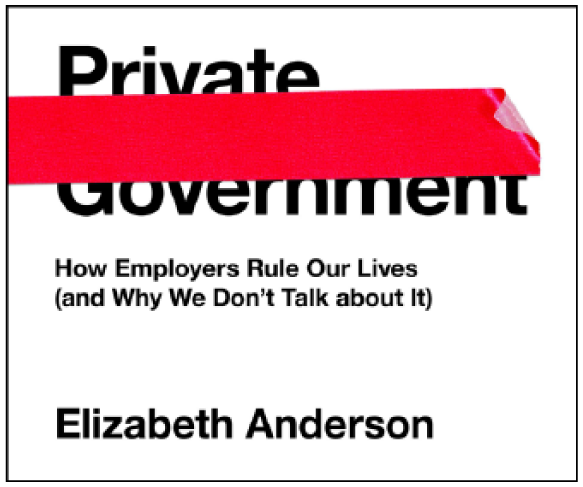
Private Government, a new book centered on the work of Elizabeth Anderson, is a provocative study of the modern workplace and its historical antecedents. The book’s focus is on two essays, or lectures, authored by Anderson, a leading political philosopher. The general theme is how the “free market” shed its progressive—at times even radical—cast and developed into a regime of “private government” and “dictatorship” in and about the modern workplace. Augmenting Anderson’s lectures are four critical commentaries by Ann Hughes, a historian of early modern England; David Bromwich, professor of English; Niko Kolodny, a philosopher; and Tyler Cowen, an economist. These are followed, in turn, by detailed responses from Anderson.
This structure represents a somewhat unusual way to treat a topic such as this one, and some readers may find it a bit awkward to navigate. Nevertheless, it is used effectively to frame a rather engaging, at some points even heated, debate on the merits of Anderson’s central thesis.
Anderson’s argument is a variation on an initially familiar Marxian theme regarding capitalism’s evolution from a revolutionary to a reactionary social system. What marks Anderson’s project as different is how she brings to bear her insights as a philosopher. Although this perspective does not eliminate all suspicions that this project is at once derivative and ungrounded in parallel debates, it lends the book its still-considerable originality. And it helps to broach important questions about the nature of capitalism and, especially, the condition of work in contemporary society.
Central to Anderson’s thesis is, as she puts it at the outset of her first lecture, the notion that the “ideal of the free market used to be a cause of the left.” It was, she says, an ideological pillar of “egalitarianism.” In support of this claim, Anderson invokes the history of the Leveller movement, as well as a critical rereading of the work of Adam Smith, John Locke, Thomas Paine, and even Abraham Lincoln. Her idea is to identify in their commitment to the free market ideal nothing less than the ideological foundation of a significant challenge to entrenched authority structures, steep hierarchies, and various kinds of monopoly that reigned all around them. For Anderson, this multifaceted program embraced not only the simple material concerns of “distributive justice” but also, more important, the structures of social status and authority. And it was in this fashion revolutionary.
According to Anderson, beginning about a century and a half ago, the social function of this ideal changed, along with the political legacy of figures like Smith in particular. And the reason for this could be found in capitalism itself, and in particular in the industrial revolution. With industrialization, the idea of the free market shed its old function as an effective frame for indicting entrenched hierarchies and assumed a new role: as a way of validating the prerogatives of the capitalists, whose power and status had dramatically increased, and whose ranks were now dominated by immensely wealthy firms and individuals. At the same time, the options available to workers that once made liberal markets a viable alternative, in fact and ideologically, to the oppressive capitalist workplaces, disappeared. Thus, she says, did a figure like Karl Marx emerge in this latter time to propound a view of the free market that was not so much rooted in different values than Smith’s, but rather in a different historical vantage that privileged him to see how much of a contradiction the free market had become.
Anderson’s reference to Marx is not only appropriate but inevitable, given the degree to which his dialectical elaboration of the history of capitalism recognized the coexistence within capitalism of the revolutionary and the reactionary. As all his major works make clear, this was true for Marx not only of economic institutions but also of juridical and ideological forms. Nor has Marx been alone in this perception—one also thinks of figures such as Karl Polanyi, Franz Neumann, and even Max Weber.
What is more unique to Anderson’s project is her insistence that this change in the function of the free market ideal increasingly puts its original aspirations in conflict with the reality of capitalist rule, and her contention that this system of capitalist rule is an overwhelming affront to these liberal aspirations. In this vein, Anderson likens the contemporary workplace to nothing less than a “communist dictatorship”—such is, she says, the extent of the power that employers wield over workers. In support of this claim, Anderson evokes how contemporary employers relentlessly monitor their workers, lord over their personal lives, subject them to all manner of caprices, and deny them the most basic human dignities—often for the obvious purpose of intensifying their exploitation, but sometimes for no particular reason at all. It is in this way that the modern workplace has come to constitute a mode of private governance, contradicting the original ideal of the free market just as surely as it aligns with contemporary notions of the concept. And it is in this respect that the broader problem of social inequality, now the belated concern of so many, transcends any simple accounting of the distribution of wealth.
For Anderson, the particular work that this perverted notion of the free market does in supporting this regime becomes clear in how it validates certain propositions: that every expansion of traditional state authority is an imposition on liberty, that every reduction in state authority represents an increase in liberty, and similarly, that the private sphere, including the world of private employment, is a realm of liberty, under threat from state authority that is necessarily the negation of such liberty. Anderson exposes this simplistic but commonplace narrative as nonsense. As her apt analogy to the history of marriage and domestic relations makes clear, not only is the unregulated private realm in many ways anathema to liberty, but also state authority can serve to enhance liberty in such places.
For the most part, Anderson’s rejoinder to contemporary representations of the free market is compelling, as is her overall account of the concept’s evolution in the trajectory of capitalism. But Anderson’s argument may yet leave a critically minded reader with questions about how the authority of the state might actually improve the condition of workers.
In her second lecture, Anderson briefly invokes the idea that an effective response to the problem of governance must involve increasing workers’ “voice.” But achieving this, she notes, is problematic given the weakness of American labor unions and because American labor law prohibits company unions—precluding systems of workplace “codetermination” which could, she contends, effectuate such voice. Here, her argument falters, though—in two ways. First, while it is true that labor law is not especially supportive of such practices, this has less to do with its bar on company unions—which does not categorically prohibit codetermination—and more to do with how courts have defined so-called mandatory subjects of collective bargaining. This body of law limits the prerogatives of unions to compel employers to allow them to participate in managing businesses. Codetermination is therefore usually possible only at the invitation of employers outside of the context of collective bargaining, which does tend to violate the company union provision.
Second, and perhaps more important, it is not at all clear that the practice of codetermination, however it might be regulated by the law, would actually redress the problem Anderson wants it to redress. The problem is something central to Anderson’s own argument: that workers are subjects of a system of private governance based in employers’ enormous advantages in power and control. While the history of company unions in the United States before they were prohibited is a complicated one, the overall legacy of schemes that entail employers’ involvement in unions reflects their consistent use in accomplishing exactly the kind of employer domination and control that Anderson would have similar institutions ameliorate today.
Anderson also endorses a workers’ “bill of rights” as a means of undermining employer governance. But is this expression of faith in legal reform at all compatible with the nature of capitalism, or even with Anderson’s own understanding of the capitalist workplace? A real virtue of Anderson’s lectures is their sensitivity to the dynamics of power and control, and her chapters in the book do a good job of documenting how such power has inexorably manifested itself in the realities of the modern workplace. Nevertheless, her contributions seem curiously indifferent to the possibility that these prerogatives might be so fundamental to the very nature of capitalism as to defy any meaningful attempts at reform. This was of course the basis of Marx’s rejection of the notion that capitalism could ever be the ground of human freedom. But one does not have to be a Marxist to take this stance. Consider, for instance, labor historian Selig Perlman’s memorable dictum, made well after he left behind his dalliance with Marxism, that capitalism is not an economic or juridical system so much as “a social organization presided over by a class with an ‘effective will to power,’ implying the ability to defend its power against all comers.”
Once one gets past the unique New Deal moment, there is nothing about American labor relations to suggest that Perlman (or Marx) was the least bit wrong. Adding even more support to such insights are the realities of more recent reforms, including, for instance, something as popular among labor’s champions as the legal prohibition of workplace discrimination on the basis of race, sex, and the like. For as a critical review of these measures reveals, one of their principal functions has been to initiate and validate practices by which employers control their workers and elevate their own standing at the expense of workers’ freedoms and their solidarity with each other. It seems a mistake to imagine a social system marked by capitalist governance of the workplace would not also feature effective capitalist governance of the political and legal system, including whatever mechanisms might ostensibly be used to reform the workplace.
A parallel point can be raised about Anderson’s apparent inclination in the second lecture to attribute employer governance, in part at least, to the workings of the law, in particular via the notorious doctrine of “employment-at-will.” On one level, this assertion seems unquestionably valid. The everyday practices of private governance in the workplace depend, as Anderson recognizes, on the amazingly one-sided prerogatives inscribed in this notorious Victorian doctrine. These prerogatives carry a false air of fairness that resides in the parallel prerogatives—especially the right to quit work—that the doctrine ostensibly accords to workers. Anderson demolishes these notions. To say this, she notes, “is like saying that Mussolini was not a dictator because Italians could immigrate.” But in doing so, she raises—but does not address—a key question: whether doctrines like employment-at-will really do give employers power over workers, or whether what they do is formalize power that derives from employers’ nature as capitalists in a capitalist society.
Anderson’s interlocutors also raise a number of interesting points about her project. Hughes, the historian, suggests that “the Levellers and their seventeenth century social context were not quite as portrayed in Anderson’s first lecture.” Although she broadly confirms Anderson’s depiction of the Levellers and their movement, Hughes notes that the Levellers were not egalitarians in the relatively simplistic way that Anderson suggests they were, either with regard to women and servants (to whom, for example, they were not inclined to extend suffrage) or in their view of property and trade. In a roughly similar way, Bromwich questions the degree to which early champions of the free market like Locke and Smith shared the egalitarian values that motivated Marx. Nor is he convinced that they shared Marx’s appreciation of just how destructive the dynamics of commodification, which are presupposed by the logic of the free market, actually were bound to be.
Kolodny begins his chapter by praising Anderson’s earlier work reconceptualizing inequality as a matter of social relations and applauding its relevance to this project. But he poses trenchant questions about the implications of such a perspective for the present work. In particular, Kolodny invites the reader to wonder whether the dysfunctions of workplace governance are as significant as those of political governance. The point is useful for its challenge to Anderson: Is she able to show that the alienation or oppression of labor is in fact the deepest sort of affront to a human being? Does the argument require this?
Cowen is by far the most critical of Anderson. He insists that she invert the logic of her entire project and privilege the supposed “practical trade-offs” of employer governance over the “philosophical” values that, he alleges, prejudices her against the virtues of capitalism. In this spirit, Cowen asserts that employers’ expansive “firing discretion”—which Anderson views as central to their capacity to unjustly govern the workplace—repays the very workers it dominates in such forms as the benefits of greater economic efficiency and the restraint of “racist” coworkers. Never mind whether these claims are empirically true, which is quite questionable, or whether the actual motive behind them matters at all. Cowen’s challenge can be countered, if not dismissed entirely, for its false assumption that practical trade-offs are not themselves laden with philosophical suppositions—and vice versa. For whatever reason, Anderson does not quite do this. Instead, in what is nonetheless one of the more engaging parts of the book, she unmasks Cowen for what, apparently, he does not care about and for his outrageous and unrealistic assumptions about the realities of work.
As she notes, Cowen’s casual conclusion that the various “perks” and benefits workers receive are somehow worth what they endure reveals “that he has little notion what work is like for those at the bottom of the workplace hierarchy.” Half of American workers, she observes, make about $29,000 a year—which she reckons is “about one-tenth of Cowen’s salary.” “Among restaurant workers,” she notes, “90 percent report being subject to sexual harassment.” She points to the poultry industry, where a majority of workers are denied adequate bathroom breaks, with many required to wear diapers on the job. She describes how employers’ threats of retaliation against their workers make a mockery of health and safety regulations. She describes how managers at Walmart routinely “scream at” workers to “get them to work harder.” To Cowen’s claim that workers are “somehow compensated with higher wages for putting up with gross insults to their dignity, standing, and autonomy,” Anderson invokes the “staggering scale of wage theft,” providing data that show it to eclipse the value of conventional theft by a wide margin each year. These arresting observations about just what private governance actually entails and why it is so oppressive not only serve as an effective rejoinder to Cowen, but they also leave one to wonder whether they might have been more effectively made earlier in the book.
Readers who take up this book expecting a thorough historical or sociological account of either the realities of authority in the workplace or its ideological basis in the free market ideal may be disappointed. However, those who are open to a provocative, if sometimes provisional, discussion of the dysfunctions of the modern workplace and the contradictions of the ideology that supports these dysfunctions will find in this volume a stimulating discussion. The volume largely transcends the misleading and increasingly pointless practice of accounting how much freedom American workers enjoy by all the options they have, or how the indignities they face are somehow set straight by the number of smartphones or automobiles they buy with their earnings.