







Abstract

Ed Fischer. www.Cartoonstock.com
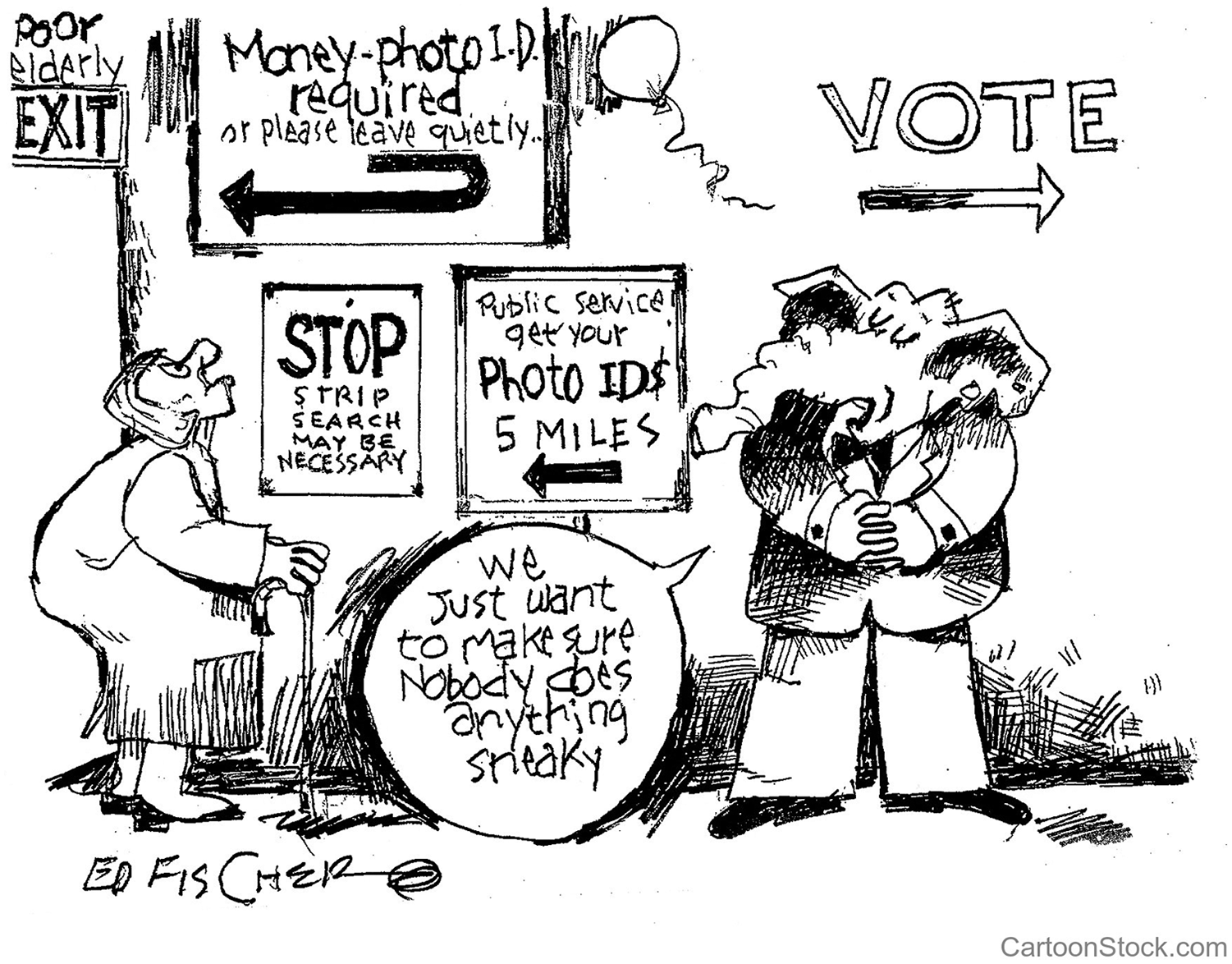
Lots of issues have gotten play so far in the debates about 2020. Guns, health care, immigration, and women’s access to reproductive care have taken center stage and not without reason. But, oddly, one really big core issue has hardly come up at all—protecting the suffrage.
That’s a bit perplexing. After all, many of the big changes being talked about on stage are dependent on a strong, functioning representative democracy. And if the last few years have proven anything, it is that American democracy is far more frayed, and far more fragile, than Americans realized. Thanks to gerrymandering, the flood of money into politics, and often brazen efforts to suppress the vote, those that govern have come to look less and less like the people being governed. In 2018, for example, Democrats won 54 percent of the state house vote in Wisconsin, but received barely a third of seats. 1 A similar anti-democratic dynamic played out in North Carolina, where Republicans were able to keep sizeable majorities in that state’s legislative chambers despite winning a minority of the vote. 2 Democrats were similarly aggressive in rigging maps in states, like Maryland, where they had control of the map-drawing process. 3
This weakening of democratic institutions is exacerbated by the fact that a key watchdog is no longer around. Prior to 2013, the Voting Rights Act required fifteen, mostly southern, states, in whole or in part, to get federal government pre-approval for voting law changes because of a documented history of past discrimination (a process known as “preclearance”). 4 After the Supreme Court gutted that requirement in its Shelby County v. Holder decision, the impact was almost immediate. Indeed, a recent study from New York University’s Brennan Center for Justice found that states previously subject to preclearance (under the Voting Rights Act) have purged voters from their electoral rolls at a rate 40 percent higher than other states. 5
The domination of politics by large donors—often operating through shadowy organizations designed to hide their identity—has, likewise, led to a politics that 70 percent of American voters said in a recent poll “seems to only be working for insiders with money and power.” 6 Following the Supreme Court’s decision in Citizens United v. Federal Election Commission, the amount of federal campaign spending by the hundred largest donors increased from $73 million in 2010 to $380 million in 2012, and over $900 million in 2016. 7
And while partisan power grabs, the corrosive effect of money in politics, and active efforts to suppress the vote get the headlines, the problems faced by American democracy go beyond that. A whole host of longstanding practices mean that participating in democracy is far harder than it should be. The absence of early voting in many parts of the country and antiquated and often confusing voter registration laws are just two examples of obstacles keeping many Americans away from the polls in an increasingly mobile and busy society.
All this would have been anathema to John Adams and the founding generation who, despite anti-democratic instincts in other areas, thought that democratic bodies should be an “exact portrait, a miniature” of the people as a whole. 8 If your interests are at the table, then so should you be and as the mood of a community changes, so should representative institutions. After all, the whole reason that Americans have elections every two years (far more frequently than in many countries) is to allow shifting public sentiment to be reflected in governing bodies. In reality, that’s something that now happens only in extraordinary political waves like 2018. 9 In short, we are long overdue as a nation for a robust conversation about making our democracy less creaky and more representative.
A Democracy Moment—And Its Discontents
The good news is that there is no shortage of sensible, tested ideas for protecting the suffrage. Indeed, the last few years have been something of a democracy moment. In 2018, a record five states passed bipartisan redistricting reforms, and other states looked poised to join them by the time maps are next redrawn based on the 2020 census. 10 The year 2018 also saw the passage of a constitutional amendment in Florida restoring the right to vote to 1.4 million people with felony convictions in their past. 11 And sixteen states and the District of Columbia have now adopted automatic voter registration (AVR), a transformative reform that shifts responsibility for registering voters to the government. 12 And in Congress, a sweeping package of democracy reforms (H.R. 1—House Resolution 1)—covering everything from money in politics to voter registration to the way district boundaries are drawn—passed the House of Representatives in March 2019 with the support of every Democratic member. 13
But these positive developments have not come without significant pushback. In Florida, Republican lawmakers passed legislation to limit the restoration of voting rights under the amendment approved by voters. Likewise, two lawsuits in Michigan are trying to have the state’s new independent redistricting commission struck down or weakened. 14 And at the federal level, H.R. 1 seems doomed to die in the Senate with the refusal of Senate Majority Leader Mitch McConnell (R-KY) to allow it to come up for a vote or even a committee hearing. 15
The next few years, indeed, seem destined to be an existential moment for the heart and soul of American democracy, where tools at every level—state, federal, and local—will need to be deployed to ensure that the nation’s institutions are representative. Literally, everything else being debated in the American body politic depends on it.
Six Big Fixes for American Democracy
There are many ideas for fixing democracy on the table, notably in the broad package of reforms pending in Congress as H.R. 1, but these six key proven reforms, in particular, would go a long way in tackling many of the biggest weaknesses in American democracy, five of which could be passed by states as well as Congress.
Reform Redistricting
Making it harder to gerrymander is critical to the future of American democracy. Gerrymandering is not new, but it is getting worse, aided by the availability of more sophisticated map-drawing tools and, more importantly, ever more robust data about voters. Reforms have proven popular whenever they have been put before voters, but there are few seeming avenues for reform in states like Texas, which are among the worst offenders. And in June 2019, the Supreme Court ruled that partisan gerrymandering claims were “political questions” that were beyond the reach of federal courts. 16 While state courts in Pennsylvania and North Carolina have struck down gerrymandered maps under their state constitutions, many states are likely to be far more conservative. 17
Even so, there are many ways to tackle gerrymandering. H.R. 1, for example, would require all states to use independent redistricting commissions for congressional redistricting. 18 Each of these commissions would consist of fifteen members (with equal numbers of Democrats, Republicans, and independents/third party members) and maps would be drawn using strict criteria that prioritize preservation of communities, ban partisan gerrymandering, and enhance protections for communities of color. The public would be allowed to review and comment on maps as well as submit their own proposals (online as well as in person), and no map could be passed into law unless it has support from Democrats, Republicans, and independent/third-party members. And if the map drawing process goes awry, H.R. 1 would provide an expedited right of action in federal court to obtain judicially ordered fixes. While H.R. 1 currently applies only to congressional districts, some scholars have suggested provisions of the U.S. constitution could be used to require use of commissions for the drawing of state legislative districts as well. 19
But while commissions should be an important long-term goal at both the state and federal levels, they also require time to set up and if reforms are not passed before the end of 2020, it will be too late for this cycle. As a bridge to fuller reforms, the next Congress, if reform-minded members are in the majority, should pass a straightforward statutory ban on partisan gerrymandering along with uniform rules that states must use in redistricting, regardless of who draws the maps.
Reduce the Influence of Big Money in Politics
Because of the Supreme Court’s decision in Citizens United, wealthy donors now have unprecedented power in American politics. In 2018, super political action committees (PACs) that can raise and spend unlimited amounts of money poured more than $3 billion into federal elections, a third of which came from just eleven donors. 20 Another $1 billion came from dark money groups that kept their donors secret, but which we know are funded by many of the same groups that fund super PACs. 21 By contrast, small donors (defined as donors who give $200 or less) accounted for less than a fifth of campaign donations in 2018. 22
H.R. 1 would transform how campaigns are financed by matching small-dollar donations in congressional races 6 to 1, building on successful programs like the public financing program used in New York City since the 1980s. In contrast to the proliferation of big money in federal races, participating candidates in New York City in 2009 and 2013 took in 60 percent of their funds through small donors and the public match. 23 These small donors are far more representative of the city in terms of race, income, education level, and where they live than in municipalities without public financing. More important, because small donations are so valuable under a matching system, candidates spend far more time courting them and talking to voters. According to recent Brennan Center research, small donors in the South Bronx, in one of the city’s poorest neighborhoods, made almost ten times as many donations in city races, where there was matching, as they did in state assembly races, where there was no small-dollar matching. 24 A commission in New York State is currently considering adopting small-dollar public financing for state elections. Other states should follow suit.
Make Voter Registration Automatic
Nearly one in four eligible Americans is not registered to vote. 25 Many others have out-of-date registrations because they have moved and have not updated their registrations—a process that in states like Texas puts the onus on a voter to complete and then mail in a paper form.
Automatic Voter Registration (AVR) is a simple but transformative policy that would automatically register eligible citizens to vote when they interact with designated government agencies, unless they specifically opt out. When eligible citizens give information to the government—for example, to get a driver’s license, receive Social Security benefits, apply for public services, register for classes at a public university, or become naturalized citizens—they would be automatically signed up to vote. If adopted nationwide, AVR could add as many as 50 million eligible voters to the rolls. 26
Oregon and California were the first states to adopt AVR in 2015. This system of voter registration, which has proven remarkably successful, is now used in sixteen states plus the District of Columbia. 27 In Oregon, registration rates quadrupled at DMV offices. 28 In Vermont, registrations jumped 62 percent in the first six months after AVR was put in place. 29 And the benefits have not just been in increased registrations. Virtually every state that has transitioned to electronic transfer of registration information has reported substantial savings from reduced staff hours processing paper. 30 Eliminating paper also improves accuracy, reduces voter complaints about registration problems, and reduces the need to use provisional ballots. 31
Make It More Convenient to Vote
Holding elections on a single workday in mid-November is a holdover from the nineteenth century and a very different country than the one we live in today. It no longer works for many Americans, who must find time to cast a ballot between jobs, childcare, and the myriad of obligations of everyday modern life.
Thirty-nine states currently offer some opportunity for voters to vote in person before Election Day without needing an excuse. 32 In more than a dozen states, this early voting period is substantial. 33 But in blue states like Rhode Island and red states like South Carolina, there is no opportunity to vote before Election Day unless a voter qualifies for an absentee ballot because he or she will be out of town, is over 65, or a limited number of other acceptable excuses. 34 This has often meant long lines on Election Day and has made it difficult for election officials to spot problems like voting machine glitches or improperly executed voter purges. 35
Moreover, the absence of a national standard means that even in states with early voting, the hours are often inconsistent or subject to cutbacks for political reasons. Over the past decade, multiple states have reduced early voting days or sites used disproportionately by African Americans, and federal courts have struck down early voting cutbacks in North Carolina and Wisconsin because they were intentionally discriminatory. 36
While expanding early voting should continue to be a priority at the state and local level, creating a uniform practice as a matter of federal law would end efforts to backtrack or game the system for the benefit of preferred candidates or political parties. H.R. 1, already passed by the U.S. House, would do this by requiring that states offer at least two weeks of no excuse early voting and equitably distribute early voting sites. 37
Make Elections More Secure
Last but not least, it is critical to upgrade American election infrastructure and to put in place “gold standard” processes to audit election results. In 2018, forty-five states used voting equipment that is no longer manufactured. Old machines and software are at a higher risk of malfunction, more vulnerable to cyberattacks, and less likely to have a proper paper backup. As of June 2019, twelve states (Delaware, Georgia, Indiana, Kansas, Kentucky, Louisiana, Mississippi, New Jersey, Pennsylvania, South Carolina, Tennessee, and Texas) still use paperless electronic machines as the main polling-place equipment in at least some counties and towns. 38
At least $1 billion is urgently needed for equipment upgrades. 39 In addition, all states should adopt risk-limiting audits to provide a high level of statistical confidence in reported election results. These audits use paper records to efficiently detect and correct any election abnormalities, whether caused by programming errors, corrupt software, or more malicious actors. 40
Restore the Voting Rights Act (VRA)
Restoring the full power of the VRA is an urgent priority for the next Congress. The VRA of 1965 is often cited as the single most effective piece of civil rights legislation in American history, winning reauthorization in 2006 with overwhelming bipartisan support. 41 Between 1998 and 2013, when the Supreme Court struck down the Act’s preclearance provisions, the VRA blocked eighty-six discriminatory voting laws from going into effect and caused hundreds more to be withdrawn after Justice Department inquiry. 42
The effect of eliminating preclearance requirements has been a predictable flood of discriminatory voting rules. Shortly after the Supreme Court’s Shelby County decision, Alabama, Arizona, Florida, Mississippi, North Carolina, Texas, and Virginia moved ahead with restrictive voting laws or practices, including a voter ID law in Texas later struck down as intentionally discriminatory, that previously would have been subject to federal review before they could go into effect. 43 While other provisions of the VRA allow private parties to sue to challenge discriminatory voting laws, they are not a substitute for preclearance because they are far more lengthy and expensive—and often do not yield remedies until an election (or several) is over. Congress has the power to address these problems by updating the VRA’s coverage formula to encompass states with a recent history of discrimination in voting.
Democracy Reforms: A Top Priority for 2020
Many pressing issues are taking center stage at this year’s Democratic presidential debates. Securing the suffrage has not been one of them, but American voters and political forces like the labor movement should make the defense of the suffrage a top priority. After all, many of our biggest problems—whether climate change or pay gaps or health care—will likely take far longer than the lifespan of one two-year Congress or even the next president’s time in office to solve. And central to solving those problems over the long term is having a healthy, representative democracy—one that looks like America and that responds to political pressure from ordinary Americans, not just rich donors.
The 2020 election could prove to be one of those rare moments where the stars align to create a legislative majority for progressive structural change. But as 2008 teaches us, such majorities can be exceedingly fleeting. It would be foolish to not use the opportunity to strengthen the foundations of democracy with reforms that are popular and proven.
Footnotes
Declaration of Conflicting Interests
The author(s) declared no potential conflicts of interest with respect to the research, authorship, and/or publication of this article.
Funding
The author(s) received no financial support for the research, authorship, and/or publication of this article.
