







Abstract
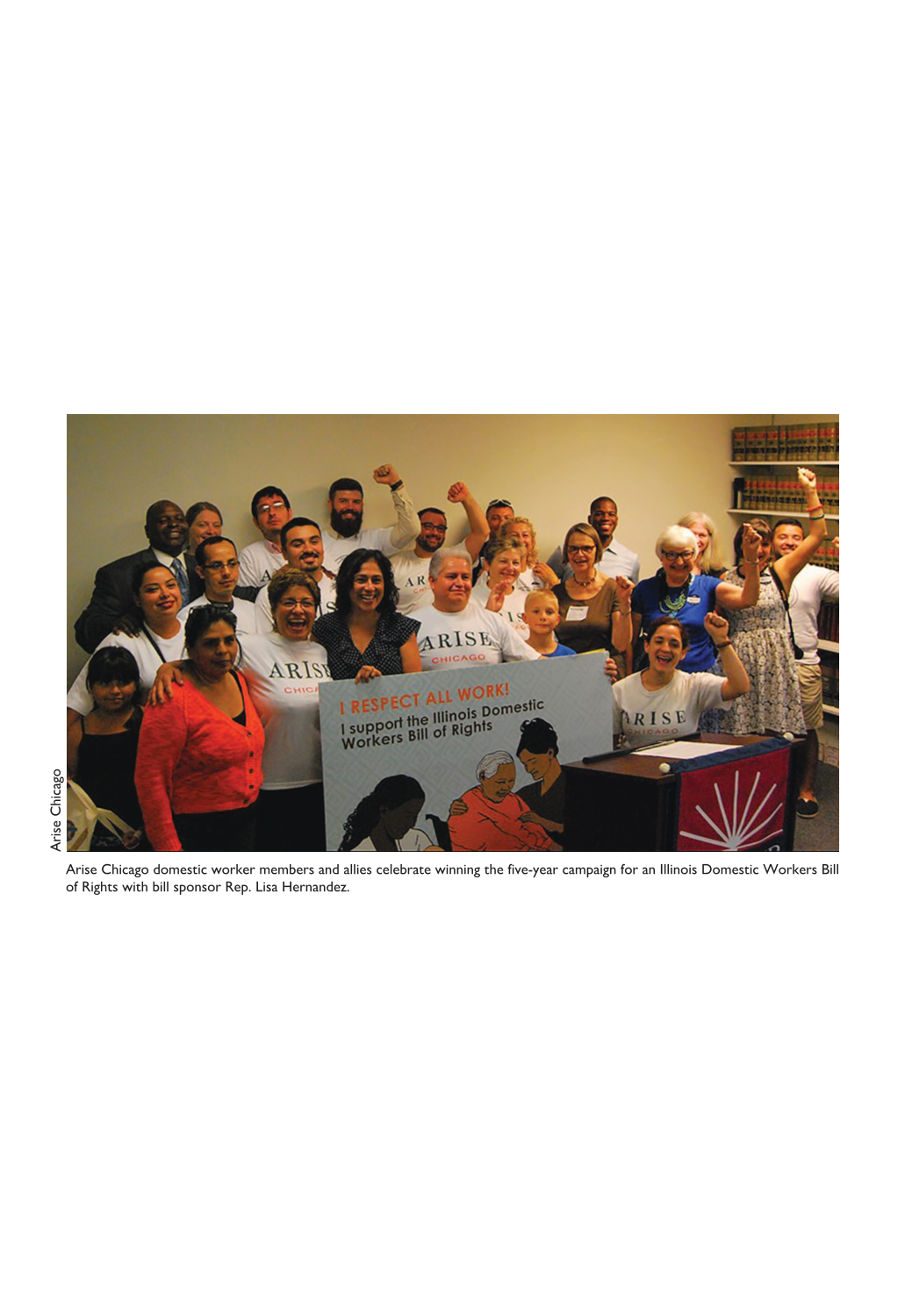
Arise Chicago
Arise Chicago domestic worker members and allies celebrate winning the five-year campaign for an Illinois Domestic Workers Bill of Rights with bill sponsor Rep. Lisa Hernandez.
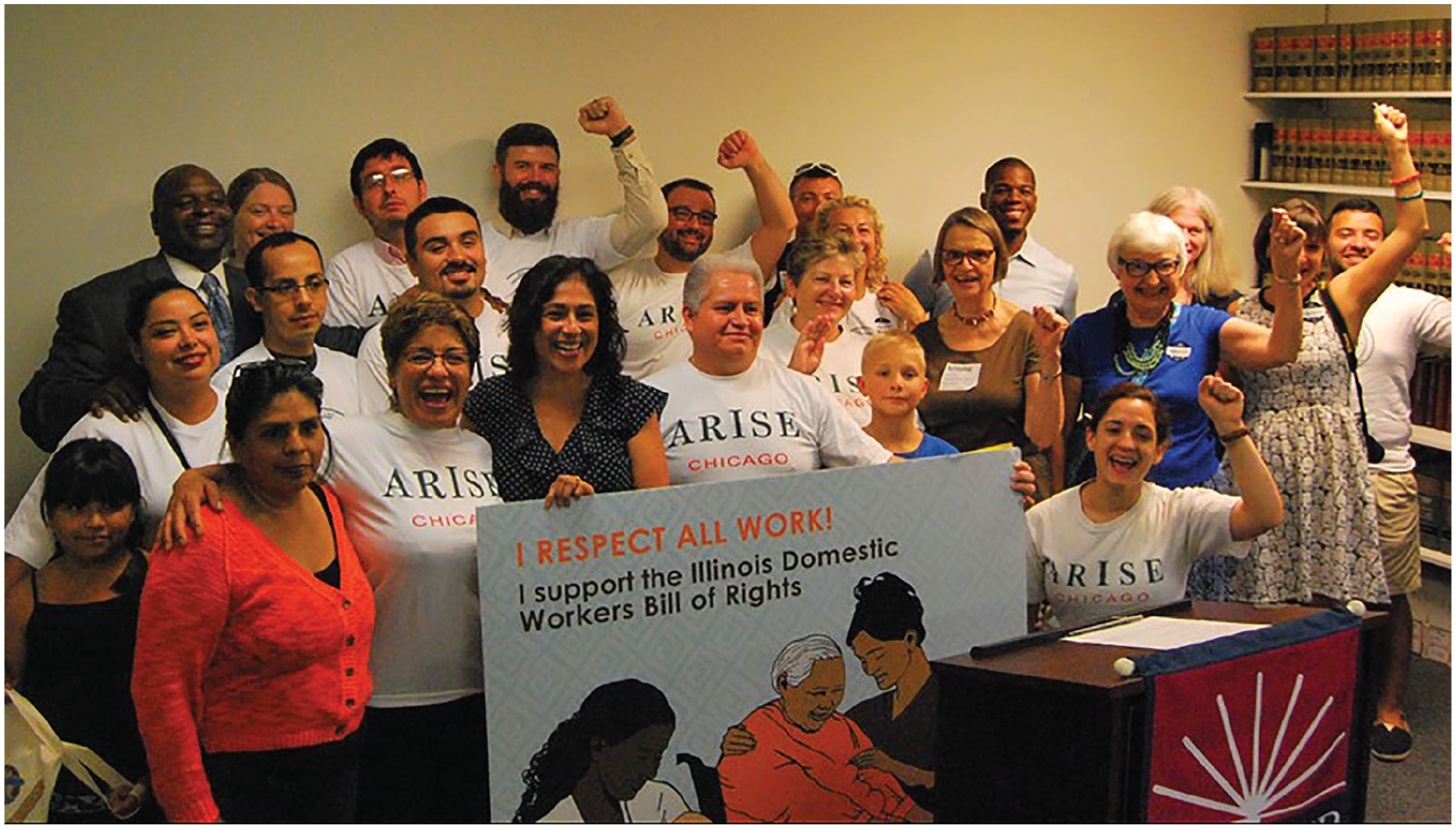
Domestic workers, located largely in the informal economy, take care of individuals’ homes and loved ones. They are essential to sustaining society, communities, and individual families. Yet, domestic workers are underpaid, undervalued, and exploited, largely due to their exclusion from state employment laws and federal labor protections, including protections provided by the Occupational Health and Safety Act (OSHA) and the National Labor Relations Act (NLRA). As a workforce, these 2.2 million home health aides, childcare workers and house cleaners are majority women of color. 1 Roughly 46 percent of domestic workers are foreign-born and 36 percent are undocumented immigrants—although these estimates are low, given that these workers tend to be undercounted in labor surveys. 2 Domestic workers earn an average of $12.01 an hour and are three times more likely to live in poverty than other hourly workers. 3 To remedy the harsh working conditions common among these workers, Domestic Workers United and the New York Domestic Workers Justice Coalition successfully campaigned for the first Domestic Workers’ Bill of Rights, which was passed in New York State in 2010.
Reflecting on this victory nearly a year later, National Domestic Workers Alliance (NDWA) Executive Director Ai-jen Poo discussed the organizing strategies that helped to win foundational labor protections for domestic workers. In “A Twenty-First Century Organizing Model: Lessons from the New York Domestic Workers Bill of Rights Campaign” (New Labor Forum, volume 20, winter 2011), Poo emphasizes the importance of building a strong base of domestic worker activists and allies; humanizing domestic workers by calling attention to legislators’ personal connections to care workers; and highlighting structural inequities that domestic workers experience. 4 In her article, Poo also raised these questions: “How will the new benefits and protections be enforced, and how might they be extended to domestic workers nationwide?” 5 A Domestic Workers’ Bill of Rights passed in 2016 in the state of Illinois sheds light on these questions. While the campaign in Illinois was ultimately successful, it was a fraught process.
The issues confronting organizers across states and cities are similar in some respects, but the challenges organizers face vary from campaign to campaign, most notably with respect to the political context. In 2016, when the Illinois legislation was passed, the state had a divided government, with Democrats in the State House and Senate and a Republican governor. 6 In general, the state was regarded as liberal, though not necessarily progressive. How these factors influenced the campaign in Illinois might offer a better model for other Midwestern industrial states than campaigns conducted in states with a more progressive bent, including New York, California, and Massachusetts. Overall, an analysis of the Illinois campaign demonstrates the necessity of contextualizing organizing strategies within a particular political landscape.
A Study of the Illinois Campaign
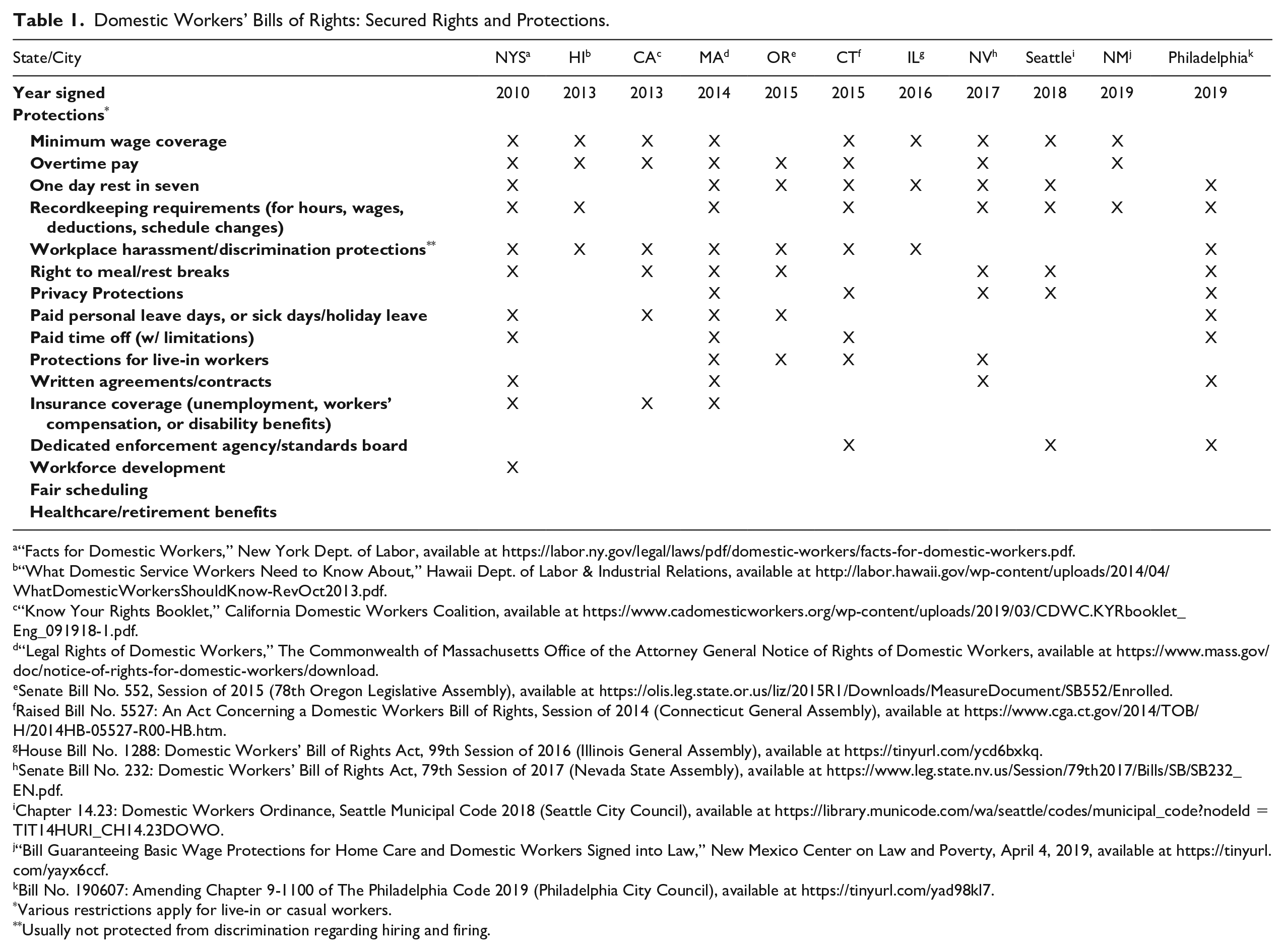
From late fall 2019 through the winter of 2020, I spoke with fourteen stakeholders in the Illinois coalition, including labor organizers, academics, lawmakers, a policy advocate, and a domestic worker-activist, to understand the challenges involved in the passage of the Illinois Domestic Workers’ Bill of Rights, and, by extension, the obstacles to the passage of necessary labor protections in other parts of the country. The Illinois bill was originally drafted in 2013. Comparing the language of the original draft with the version that passed in 2016 reveals the consequences of negotiations between lawmakers and advocates. (See Table I for context on Illinois’stripped-down bill as compared to the other eight states and two cities that have passed relatively stronger bills).
Domestic Workers’ Bills of Rights: Secured Rights and Protections.
“Facts for Domestic Workers,” New York Dept. of Labor, available at https://labor.ny.gov/legal/laws/pdf/domestic-workers/facts-for-domestic-workers.pdf.
“What Domestic Service Workers Need to Know About,” Hawaii Dept. of Labor & Industrial Relations, available at http://labor.hawaii.gov/wp-content/uploads/2014/04/WhatDomesticWorkersShouldKnow-RevOct2013.pdf.
“Know Your Rights Booklet,” California Domestic Workers Coalition, available at https://www.cadome
“Legal Rights of Domestic Workers,” The Commonwealth of Massachusetts Office of the Attorney General Notice of Rights of Domestic Workers, available at https://www.mass.gov/doc/notice-of-rights-for-domestic-workers/download.
Senate Bill No. 552, Session of 2015 (78th Oregon Legislative Assembly), available at https://olis.leg.state.or.us/liz/2015R1/Downloads/MeasureDocument/SB552/Enrolled.
Raised Bill No. 5527: An Act Concerning a Domestic Workers Bill of Rights, Session of 2014 (Connecticut General Assembly), available at https://www.cga.ct.gov/2014/TOB/H/2014HB-05527-R00-HB.htm.
House Bill No. 1288: Domestic Workers’ Bill of Rights Act, 99th Session of 2016 (Illinois General Assembly), available at https://tinyurl.com/ycd6bxkq.
Senate Bill No. 232: Domestic Workers’ Bill of Rights Act, 79th Session of 2017 (Nevada State Assembly), available at https://www.leg.state.nv.us/Session/79th2017/Bills/SB/SB232_EN.pdf.
Chapter 14.23: Domestic Workers Ordinance, Seattle Municipal Code 2018 (Seattle City Council), available at https://library.municode.com/wa/seattle/codes/municipal_code?nodeId=TIT14HURI_CH14.23DOWO.
“Bill Guaranteeing Basic Wage Protections for Home Care and Domestic Workers Signed into Law,” New Mexico Center on Law and Poverty, April 4, 2019, available at https://tinyurl.com/yayx6ccf.
Bill No. 190607: Amending Chapter 9-1100 of The Philadelphia Code 2019 (Philadelphia City Council), available at https://tinyurl.com/yad98kl7.
Various restrictions apply for live-in or casual workers.
Usually not protected from discrimination regarding hiring and firing.
Throughout my conversations with stakeholders, it became clear that the Illinois domestic workers’ campaign faced challenges from legislators on two fronts: recognizing domestic workers as employees and legislating within the private sphere of the home. This opposition translated into policy, institutionalizing limitations on the rights of domestic workers. Interrogating these limitations nationwide appears to be more critical than ever, as the Biden administration has expressed support for the rights of domestic workers to higher wages and labor protections, including their right to unionize. 7 An acceptance of these rights in both conservative and liberal states is critical to the success of a National Domestic Workers Bill of Rights, which was introduced in both houses of Congress in 2019. This national bill is likely to gain traction, given that Vice President Harris was a principal sponsor of the bill. 8
Contextualizing the Illinois Domestic Workers’ Campaign
A heightened awareness of structural racism, highlighted by the unequal effects of the Covid-19 pandemic and by movements like Black Lives Matter, has brought growing attention to how domestic workers’ labor is devalued yet essential. Because domestic workers face higher levels of poverty and lower access to employment benefits, such as health care and paid leave, than other workers, 9 they are disproportionately affected by the pandemic. Black, Latinx, and Indigenous women who have been fighting for labor protections in the care economy are the very same women who have experienced exacerbated health risks and economic uncertainty due to the multi-layered relationship between the coronavirus pandemic and racial injustice. 10 In this context, the limitations of the Illinois bill draw sharp attention to the urgent need for more robust protections.
The NDWA and its affiliates across the United States are actively reinvigorating the labor movement by employing broad-tent organizing that encourages workers to mobilize at the intersections of their lives as Black women, Latinx undocumented and immigrant women, and workers in the precarious informal economy. 11 The NDWA’s organizing strategy involves building a foundation for legislative advocacy at the state and municipal level by connecting grassroots organizations to one another and supporting them at the local level. In Illinois, these organizations include Arise Chicago, Latino Union, and AFIRE Chicago. These groups have allied with the NDWA to, as organizer Lisa Moore puts it, “establish a floor of basic protections” for domestic workers. 12 Such grassroots coalitions are well positioned to understand the political environment of their cities and states and the particular political dynamics that make passage of strong domestic worker bills of rights more difficult. Indeed, the Illinois coalition faced specific political challenges, particularly refusal on the part of legislators to recognize domestic workers’ employee status and perceived costliness of the bill. Overall, this resistance resulted in a major scaling down of the bill as it went through the legislative process. The final bill included little beyond removing the exclusions that had prevented domestic workers from coverage under very basic labor legislation, such as the state’s minimum wage law and its Human Rights Act. As a consequence, the approximately 85,000 domestic workers in Illinois 13 were left without protections addressing their unique working environment in employers’ private residences—like rest breaks, privacy rights, and written contracts.
Knowing Your Audience: Negotiating for Rights in a “Liberal” State
Any coalition attempting to secure labor protections for those who fall outside traditional work settings confronts two questions that must be reconciled: what constitutes a “basic” set of protections; and what set of demands can be negotiated successfully? This tension is the challenge facing any group struggling to secure labor protections for domestic workers (or others in the informal economy). Knowing when to hold out for a comprehensive bill and when to compromise depends on understanding the political makeup of a particular state.
As Anna Jakubek, a lead organizer at Arise Chicago, remarked, “in the beginning, the first [Illinois] Domestic Workers’ Bill of Rights was awesome . . . and included a lot of provisions,” while the final legislation was “bare minimum,” nothing more than removing the exclusions that had prevented domestic workers from protections under existing labor law. In addition to including domestic workers in the state’s minimum wage laws and its Human Rights Act, the bill also offered protection under the One Day of Rest in Seven Act and the Wages of Women and Minors Act. The bone of contention was policymakers’ concerns about more specific demands in the original bill. As Republican State Senator Dale Righter pointed out, he and his colleagues agreed that something should be done about domestic workers’ exclusion from laws, but they saw the original bill as too far-reaching and a peculiarity among other state laws in its apparent attempt to “dictate the terms of a contract between an employer and an employee.” Democratic former Majority Leader of the Illinois House, Barbara Flynn Currie, added that including too many specifications was seen as “very cumbersome” and risked the state being too heavily involved with the relationship between a homeowner and those caring for their home and children. Thus, while lawmakers on both sides of the aisle agreed that domestic workers deserved basic protections, they were not all convinced of the need for specific protections that working in an intimate role in a private home require.
This reluctance to accept the private home as a place of employment can be traced back to a pervasive devaluation of “women’s work” that partially stems from a long legal history of excluding paid domestic labor from regulation applied to traditional workplaces. As legal scholar Professor Donna Young contends, nineteenth and twentieth century courts consistently ruled in ways that affirmed domestic labor as “just part of women’s natural proclivities,” with limited labor market value. 14 Also underlying this assumption that domestic labor is not real work is a deep-rooted legal notion that categorizes the private home “as a near-sacred forum into which there should be no governmental intrusion.” 15 These social and legal beliefs that devalue paid domestic labor and overemphasize the sanctity of the private home must be overcome in order to secure safeguards that domestic workers require as they work behind closed doors.
Beyond Basic Protections: Considering the Unmet Needs of Domestic Workers
Because domestic workers perform their labor within the household, they are more susceptible to hidden forms of abuse. In fact, in their attempt to assess domestic workers’ main concerns, coalition members were surprised to learn that recourse for sexual harassment was their top priority. Anna Jakubek spoke of domestic workers who have experienced employers “leaving pornography” lying around and “walking naked in the house” as examples of less-obvious—less overt—forms of sexual harassment that are not easily reportable. This “hidden” form of sexual harassment leaves workers in complicated positions, as they risk getting fired with no recourse and losing crucial wages. The original Illinois bill included protections to address these unique vulnerabilities, including contracts with scheduling rules, specifications that live-in workers be guaranteed a separate bedroom with a lock on the door, and anti-sexual harassment language, all of which were ultimately removed from the final bill.
Nik Theodore, a professor at the University of Illinois at Chicago and co-author of “Home Economics: The Invisible and Unregulated World of Domestic Work,” a 2012 report on domestic workers that has informed domestic worker bills across the country, points out the irony of the situation. He explains that Illinois legislators were opposing critical safeguards for workers who have been traditionally excluded from all labor rights because they “can’t afford [to give domestic workers ] more [rights] than what anybody else has.” Special protections for a wide variety of workers already exist, like regulations on hours and specific safety codes for truck drivers and pilots; thus, domestic workers could be afforded worker protections suitable to their unique working environment—including health and safety protections—if sufficient political will to regulate paid work performed in the home existed.
For Theodore, opposition to protections “designed around the peculiarities of the occupation” is the result of the “devaluation of women’s work, plus the racism and sexism” that so often contribute to women of color being segmented in low-paid jobs with poor working conditions. In the end, the Illinois coalition had to choose whether to hold out for a stronger bill or accept a watered-down version of the legislation. In this case, removing exclusions from existing laws and recognizing domestic workers as a workforce was the preferable choice for coalition members who were keenly aware that they were negotiating with, as Theodore put it, “a democratic legislature, but . . . not a progressive legislature.”
Initiating a Cultural Shift: Seeing the Home as a Place of Employment
Surprisingly, there was no hard opposition to passage of the Illinois bill from formal employer or business organizations. According to interviewees, legislators were the main opponents of the bill because they were struggling with the notion that domestic workers should be considered employees. This had much to do with their personal connections to domestic workers in their own homes. More than this, however, the reluctance to grant employee status to domestic workers can be attributed to the devaluation of care work globally, especially when performed by women of color. 16 Specifically in the United States, the legacy of exclusion goes back to New Deal era legislation that excluded predominantly Black and Latinx domestic and agricultural workers from coverage under the NLRA of 1935. At the time, members of the Roosevelt administration argued that “the law would be far simpler to administer, and therefore far more likely to succeed, if the two occupations were left out of the bill.” 17 Marginalized by this “pragmatic” argument, domestic workers were not only removed from federal labor protections but eventually excluded from state employment laws as well.
According to one Chicago-based advocate I interviewed, domestic worker advocates needed to change the mindset that domestic workers and their employers have a “different kind of relationship,” not requiring formal labor protections. Arise’s communications director Shelly Ruzicka shared the story of a coworker who grew up in a Chicago suburb, highlighting how far some clients will go to distance themselves from the “employer” title: He knew other people who had people cleaning their homes and [the workers] were all, [or] mostly Polish. And [employers] would say: “my Polish lady.” They wouldn’t say “my cleaning lady.” My Polish lady. Bizarre. Especially when you’re paying someone individually, people don’t think of themselves as employers.
A consequence of this inability to accept oneself as an employer—including on the part of legislators—translates into a reluctance to see the private household as a place of employment. Demonstrating this point, Nik Theodore characterized a common belief about the domestic work employee-employer relationship: You’re a member of the family, you know, we love you. And, as I remember, we wrote in the report, of course, when you’re in an intimate setting, like a household, bonds of affection and maybe even love are going to form.
This attitude toward domestic work allows it to be characterized as a sector that cannot be legislated, because it is rooted in love and care. However, the intimate nature of domestic work tends to increase the likelihood of manipulation in the workplace, as many employers who use the “family” rhetoric are also patronizing in their relationships to domestic workers. The relationship between domestic workers and their employers too often mirrors the class-based, racial hierarchies that exist everywhere across the globe, including in the United States. This means that issues of class and white supremacy are deeply embedded in “maternalism”—a term employed by Dr. Judith Rollins in her seminal work Between Women: Domestics and Their Employers to describe the power imbalance between domestic workers and employers. The maternalism relationship is exemplified by expressions of “love,” gift giving, and affection that is more akin to “adult-to-child” or “human-to-pet kind of caring but, by definition . . . is not human-to-equal-human caring.” 18
A Persistent Issue: Enforcement of the Bill
For the Illinois bill to get passed, a cultural shift had to occur in the minds of legislators, enabling them to view domestic workers as employees. Yet, even when this change was underway, domestic workers in Illinois were denied protections specific to their working environment on another ground. In addition to resisting employee status, legislators—as well the state Department of Labor—also pushed back on the bill, based on the cost of enforcement. Representative Currie described the Labor Department’s resistance, which was based on the Labor Department’s claim that they did not take “positions on the merits of a program” but rather followed instructions from the governor’s office to “oppose anything that’s going to cost money—because we don’t have any money.” According to several members of the coalition, they used financial data from New York to show that enforcement would not be too expensive. Though these data were not made public, they were circulated internally. They showed that the number of claims made by domestic workers for withheld wages and overtime in New York was low, perhaps because so many domestic workers are not aware of their rights. In any case, these data helped the coalition convince legislators that the bill was not costly and, therefore, worth passing. Bill sponsor Illinois State Representative Elizabeth Hernandez confirmed that demonstrating that the “bill is not going to be overly burden[some] on the budget” was important and that “if you get across where it’s minimal costs, that gives it much more weight, [and] it gives it much more support.”
A focus on the cost of enforcement does not bode well for Illinois domestic workers, who depend solely on state enforcement agencies to inform them of their rights and to adjudicate the cases they bring forth. Ultimately, by rooting the bill’s passage in the low number of claims made elsewhere, the Illinois legislature made clear that it had little desire to see the law in wide use. This has implications for bills in other parts of the country, where the issue of enforcement costs could foster resistance to recognizing domestic workers as employees with rights under the law. However, there is an alternative model: the concept of joint enforcement. Joint or co-enforcement is a principle by which government agencies partner with worker advocacy and community-based organizations in adjudicating claims, educating workers and employers about workplace rights and labor laws, and evaluating the effectiveness of existing protective legislation. 19 This collaborative model is included in the National Domestic Workers’ Bill of Rights now pending. 20 It would make enforcement more efficient and less costly for government. On the state level, California has also embraced co-enforcement, enacting legislation that includes funding (of up to $5 million) for community-based organizations to conduct outreach and education efforts to strengthen enforcement and better understand domestic workers’ needs. 21
The general consensus, regarding the Illinois Department of Labor’s opposition to the bill, was that it was solely about budgetary restrictions. Nevertheless, Analía Rodríguez, executive director of the Latino Union of Chicago, remarked that the administration was making a political decision when it chose to allow passage of the bill only after it was perceived as sufficiently cheap. Her point underscores the fact that government funding allocations are inherently ideological. Budget line items indicate what governing bodies value. This maxim—that budgets are moral documents—rings especially true in the case of domestic workers, as advocates fight to secure resources that will protect a purposefully excluded, particularly vulnerable population of workers.
Promising Organizing Models from the Domestic Worker Movement
To grasp the importance of protections that were erased from the original Illinois bill, imagine how those protections would have affected domestic workers today, during the pandemic. When Covid-19 lockdowns began in March 2020, they would have had rights to paid time off to care for ill loved ones. Black, Latinx, and Indigenous domestic workers in Chicago and across Illinois, who have been harshly impacted financially by this pandemic, would have the right to wage protections and recordkeeping requirements that could assist them in establishing eligibility for income support programs, such as expanded unemployment insurance.
This was the case in New York City, where domestic worker advocates dealt with a more responsive City Council. In addition to other protections, domestic workers in New York City became eligible in September 2020 for coverage under the Paid Safe and Sick Leave Law, allowing them to accrue this leave at the rate of one hour for every thirty hours worked, up to a maximum of forty hours per year. 22 This coverage in combination with protections under New York City’s Human Rights Law for independent contractors and freelancers demonstrates the effectiveness of collaboration between the NDWA and their local affiliates in dealing with local government. 23 It also reflects a deep knowledge of the political landscape of New York and its agencies. 24
Every piece of legislation for the common good should be an improvement on earlier bills, each becoming more comprehensive as more activism takes root. The Illinois bill did not do this—there were stronger bills that preceded it. Nevertheless, an analysis of the Illinois campaign provides a necessary perspective on the status of domestic workers’ rights and advocacy in the Midwest, where there has been comparatively little research done. Deep engagement with the grassroots and political organizing processes of this and other successful domestic workers’ campaigns will allow activists to identify patterns and pursue strategies for successful passage of stronger bills in their own cities and states. Understanding the specific political landscape, the organizing capacity of a region, and the social and legal histories in which bills are presented is critical for future organizing efforts.
Looking more broadly at domestic workers’ organizing efforts, we should recognize that many domestic workers are also undocumented workers with a precarious place in the labor market. This highlights the urgency of integrating immigrants’ rights and racial justice movements within the contemporary labor movement. That is one way to demonstrate the inclusivity of the domestic worker movement and to address the whole person in pursuing workplace rights. Ultimately, integrated organizing strategies amplify the voices not only of domestic workers but also of Black women and others who have been historically silenced and who have long been at the center of social justice movements. 25
Footnotes
Declaration of Conflicting Interests
The author(s) declared no potential conflicts of interest with respect to the research, authorship, and/or publication of this article.
Funding
The author(s) received no financial support for the research, authorship, and/or publication of this article.
