







Abstract

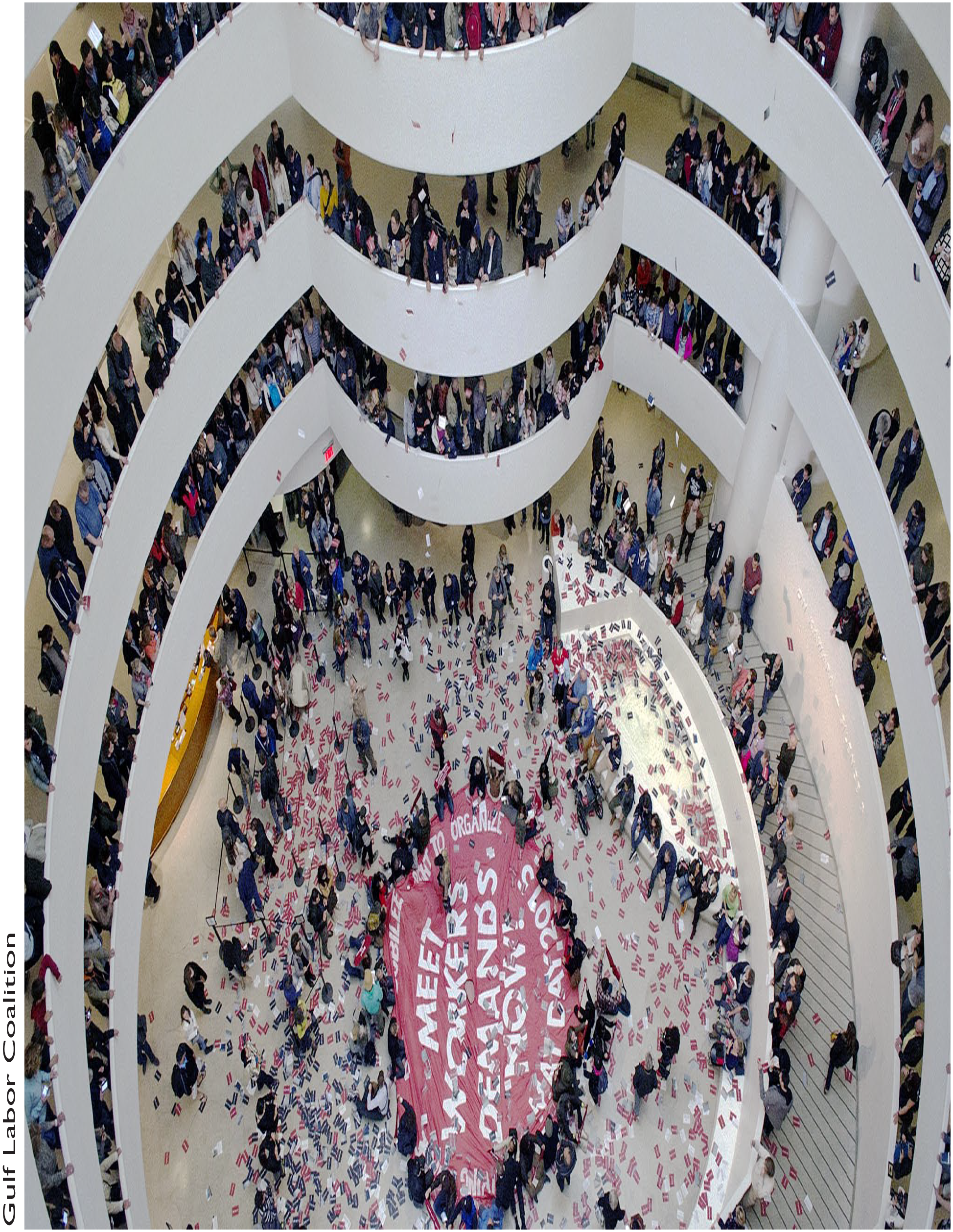
May Day 2015. The Global Ultra Luxury Faction (G.U.L.F.) of the Gulf Labor Coalition stages a solidarity action with migrant workers in Abu Dhabi at the Guggenheim Museum in New York City.
Gulf Labor Coalition
Decolonizing is hard work. Nor is there any clear end to it. Ousting the occupier was only the beginning, and, arguably, colonialism’s cultural residue—deeply imprinted through the scourge of racial hierarchy—has been the most difficult to erode. We will be grappling with its ongoing legacy for the long term. But there can be no doubt about the stepped-up momentum in recent years. Decolonial initiatives are afoot in every institution, especially education and the arts, and are now beginning to scratch away at the business sector, where every notable firm assures us, with great gravitas, that Black Lives Matter. The outcomes affect every aspect of our lives, including the struggle to earn a living.
Museums, in particular, have emerged as a frontline venue for organizing, from employee unionization to the restructuring of collections and the push for stronger community participation. Although museums are intensely public repositories of history and culture, their mantle of sanctity and prohibition—“Please Do Not Touch”—has protected them from too much damaging scrutiny until recently. Now that the decolonization movement has entered their hushed precincts, full-scale audits are under way. Because their collections and archives are bulging with colonial plunder, large museums in Europe and the United States are under the most pressure to rethink their acquisitions and ways of operating. The ruckus over repatriation of the Benin Bronzes, pilfered by British forces from Benin City (in present-day Nigeria) in 1897, and distributed today among scores of museums and private collections, has captured headlines, eclipsing the long-standing face-off over the return to Greece of the Elgin Marbles, which were transported to the United Kingdom piece-by-piece between 1801 and 1812 and which remain in the British Museum to this day. According to the Sarr–Savoy report on the restitution of African cultural heritage, commissioned by French President Emmanuel Macron, more than 90 percent of African cultural heritage is located outside of the continent, and restitution initiatives are aimed at returning the most prized artifacts, such as the Rosetta Stone or the Nefertiti bust.
Returning the loot is the most tangible way of repairing past harms, but it is also the most straightforward of the decolonial demands being made of museums. Slightly more tricky but perfectly feasible moves include overhauling exhibition displays and guides, removing toxic board members and donors whose wealth derives from exploitative business practices, or purging their names from dedicated spaces, and establishing a more fully interactive relationship with communities on their doorstep who have a right not only to be represented but also to more fully participate in the conception and operation of events and shows. 1
Not to be ignored are the labor rights of employees themselves. The last two years have seen a wave of organizing at some of the country’s leading museums and arts institutions: Boston’s Museum of Fine Arts, the New Museum, Guggenheim Museum, Whitney Museum, Tenement Museum, MoMA PS1, and Brooklyn Academy of Music, all in New York, and the Milwaukee Art Museum, the Frye Art Museum in Seattle, San Francisco Museum of Modern Art (SFMOMA), the Vancouver Art Gallery, MOCA in Los Angeles, and the Penn Museum of Archaeology and Anthropology. So, too, organizations like W.A.G.E. (Working Artists and the Greater Economy) have been successful in extracting agreements from museums and large galleries to pay participating artists a fair wage, pegged to their budgets and employee salary ladders. 2
These efforts are in sync with the organizing gains among creative workers (among the most precarious members of the workforce) at digital news sites or through the Freelancers Union, a membership organization that provides benefits and advocates on behalf of some 500,000 independent workers. But these efforts are also being driven by the exposure of new kinds of class paternalism at the institutional core of museums, as the market in art and antiquities occupies an ever-greater share of attention and investment from high-rollers.
So far, we have only seen baby decolonial steps from museum directors who, these days, behave more like CEOs and are paid like them: a sprinkling of “diversity hires”; broader representation on boards and in the selection and curating of exhibits; a stab at more community-oriented programming; and a fledgling effort, in some museums, to relabel permanent exhibits to present a slightly less embarrassing version of history. (Dioramas and murals, for example, are now being “contextualized” with a disclaimer, suggesting that they depict historical events from a settler perspective and may not be accurate.) More than likely, administrators hope that these cosmetic reforms will serve to shore up the status quo, or in the words of the aristocrat Tancredi (in The Leopard, by Giuseppe Tomasi di Lampedusa), “everything must change so that everything stays the same.”
More transformative moves are needed. If museums are to more directly serve as a common meeting house for arts communities and the public, they will have to learn how to exchange knowledge rather than just share or broadcast it through the class-soaked channels of curatorial expertise, long the exclusive preserve of white, upper-class males. They will also have to accept the impermanence of artifacts that were not conceived or crafted to last forever, let alone be designated as high-security art objects. The fierce commandment to preserve a selective version of the past has always been used as a means to narrate the story from the victor’s perspective. It is a clear impediment to the task of repairing history’s colonial harms, among which were the rejection of objects deemed unfit for preservation. Arguably, museums will be better equipped to make these adjustments in mentality and practice if they empower worker and stakeholder collectives to make decisions and set standards.
No doubt, the biggest obstacles are economic in nature. The siren call of tourist revenue and the seductive pull of the commodity market in art and artifacts will have to be resisted. They exert far too much influence over decision-making. So, too, “artwashing”—the custom of using art and culture to launder ill-gotten gains and predatory business practices—will have to be rooted out. The most high-profile examples are the sponsorship of exhibitions by corporate brands and tycoons (BP, Mobil, Shell, Exxon, or the Sackler, Koch, and Walton families) whose values are starkly at odds with the creative humanism on display. But these are just the surface symptoms of a deeper pattern of enmeshment with high capital. As the upper precincts of the art world have been captured for ultra-luxury consumption by tycoons, oligarchs, and speculative investors, museums have increasingly been pulled into this circuit as expedient vehicles for amplifying the monetary value of assets prized by private collectors.
Targeting the Museum
Institutions rarely undertake fundamental overhauls without strong pressure from external voices of conscience. Groups of individuals with creative capital—artists, writers, and, yes, labor advocates—can play that role, functioning as catalysts to accelerate the forward thrust of the decolonial movement. My own participation in this work dates to 2011, when I helped to establish the Gulf Labor Coalition, an international group of artists and critics formed to combat the abuse of migrant workers in the United Arab Emirates (UAE). 3 We chose to target the lavishly funded effort of the Abu Dhabi authorities to license some of the world’s top museum brands—the Guggenheim, Louvre, and the British Museum—for a new cultural quarter under construction on Saadiyat Island in the UAE. These new branches were being acquired to add luster to the Emirate’s strenuous efforts to promote the national brand at the same time as they would help sell luxury villas on the island. In common with other Gulf countries, the UAE relies on vast numbers of mistreated migrant workers from South Asia to build out the infrastructure of its fast-growth emirates. Its kafala (sponsorship) system of worker recruitment, labor camps, and punishing working conditions all have colonial roots in a region with a long history of authoritarian rule, implanted by foreign powers and perpetuated internally by absolute monarchies. Under the kafala regime, workers arrive heavily indebted and tied to their sponsor or employer—with few labor protections, they are subject to harsh work discipline and surveillance, and are beaten and deported if they complain or go on strike.
“High Culture/Hard Labor” is the slogan we gave to the Saadiyat formula of arts-driven growth, and it rests on a simple moral principle—no one should be asked to exhibit, curate, or perform in a museum built on the backs of abused workers. 4 Adopting the playbook of anti-sweatshop campaigners who sullied the brands of top garment producers—beginning with Nike in the 1980s—by exposing the misery of their subcontracted workforce, we decided to leverage the museums’ high-profile names in an effort to raise labor standards for the UAE’s migrant workers. Because most of the Gulf Labor core members were based in New York City, we had more local traction with the Guggenheim than with the Louvre or the British Museum. So, we concentrated on publicly pressuring the Guggenheim leadership in New York to adopt a model set of worker standards for others to follow.
The campaign took many forms: an international boycott of the Guggenheim Abu Dhabi that attracted thousands of signatories from artists, critics, and curators; direct dialogue with the museum’s leaders and trustees along with the Abu Dhabi officials tasked with delivering Saadiyat Island’s cultural quarter; coordination of non-governmental organization (NGO) and trade union partners to put pressure on the museum; field research in Abu Dhabi to take testimony from workers; publications and publicity in a variety of forums; a yearlong program of commissioned artworks, called “52 Weeks”; and direct action that involved a series of spectacular occupations of the Guggenheim in New York and Venice. 5 The occupations were carried out by Gulf Labor’s direct-action wing, G.U.L.F. (Global Ultra Luxury Faction), composed of comrades who had been active in Occupy Wall Street spin-offs like Occupy Museums and Strike Debt. 6
Not surprisingly, the activities of our group ran up against government repression in the UAE. Several members—Walid Raad, Ashok Sukumaran, Guy Mannes-Abbott, and I—were barred from entering the UAE. As a result, it was no longer possible to establish and develop relationships on the ground with workers, although some Gulf Labor members were able to interview workers in India who had been deported from the UAE for organizing. In the United States, the museum leadership broke off dialogue after we brought to the negotiating table the heavy guns of international unions and NGOs: Human Rights Watch, Amnesty International, the International Federation of Trade Unions, the Building and Woodworkers International, and the Delhi-based Society for Labor and Development. Despite this rupture in discussion, construction of the Guggenheim Abu Dhabi was frozen soon after, and, as of this writing, has not resumed. The authorities learned that there is a price to pay for labor rights abuses after all.
Shortly after the Guggenheim Abu Dhabi project ground to a halt, the architect Michael Sorkin and I ran a related campaign along with members of the Finnish arts community to oppose the Guggenheim’s plans for another museum branch in Helsinki. We staged an architectural competition as an alternative to the official competition run by the Guggenheim and mobilized trade unions to lobby the city council to reject the museum’s chosen plan. 7 In the course of both wins, in Abu Dhabi and Finland, the creativity of our tactics was recognized by our labor and human rights NGO partners who were not institutionally equipped to launch such initiatives.
In the aftermath of the Gulf Labor Coalition’s work, a core group of G.U.L.F. activists—Amin Husain, Nitasha Dhillon, Yates McKee, and myself—formed a new organization called Decolonize This Place. This group took its name from a spring 2016 protest at a Brooklyn Museum show (called “This Place”) about Israel/Palestine, but it took formative shape when Artists Space, a non-profit gallery and arts organization in Lower Manhattan, invited us to take up a three-month residency in the fall of that year. Eschewing a standard exhibitionary model, we set up the gallery as a space for intersectional organizing among grassroots groups in New York City. Our long-term goal was to build connections between and among five pillars of organizing—Indigenous insurgence, Black liberation, global workers, Free Palestine, and opposition to urban gentrification. The initial targets of our actions included the Brooklyn Museum, Artis—an organization that sends artists and curators on tours of Israel–and, most conspicuously, the American Museum of Natural History (AMNH), the nation’s premier ethnographic institution.
The AMNH is a colonial artifact trapped in an earlier time when scientific racism was normative. Its dioramas and cultural halls had barely been touched since the early twentieth century, when they were heavily influenced by the imperialist legacy of Teddy Roosevelt and other champions of white supremacy, and when the museum served as an epicenter of the eugenics movement. Unlike many natural history museums elsewhere, it had not taken one step down the path of decolonization, and so millions of visitors, including New York City’s schoolchildren, annually experience cultural harm from exposure to displays that place the culture of colonized peoples alongside dioramas of animal habitats; for example, the Hall of African Peoples directly and unambiguously connects to the Akeley Hall of African Mammals.
Beginning in 2016, each year on Indigenous People’s Day, we staged an Anti-Columbus Day Tour of the museum, providing a critical alternative to the framing of the institution’s artifacts. 8 Adding our voices to the international movement to remove colonial statues, we also called for the city to dismantle a monument to Theodore Roosevelt, featuring the former president on horseback, flanked, in subservient fashion, by the figures of an African and Native American on foot. By the time of the fourth annual action, this popular tour was attracting as many as a thousand participants. In talks with museum officials, we urged the formation of a Decolonization Commission, with representation from community stakeholders. To date, there is no such commission, but in June 2020, New York City Mayor Bill de Blasio agreed to remove the statue, and the museum mounted an exhibit to “contextualize” Roosevelt’s racist views and the museum’s own “imperfect history.” Repatriation of some Native artifacts is under consideration.
But the overriding problem with the “natural history” presented by the AMNH is that the art and culture of Global South populations is included under the rubric of Nature. By sharp contrast, the Metropolitan Museum of Art, sitting on the other side of Central Park, enshrines European and North American cultures, along with their Greco-Roman-Egyptian “forebears,” under the rubric of Art. For each museum to provide a more defensible version of global cultural history, the two institutions would need to collaborate on a bold exchange of their respective contents, arranged in new ways to tell better stories. To acknowledge the original occupants of the land, they should also collaborate with the city on a “land back” initiative to re-establish some version of Indigenous access and control over an area of Central Park between the two museums.
After the AMNH actions, Decolonize This Place turned its attention to a chronic problem—the reliance of museums on affluent board members, whose wealth is drawn from industries that harm many of the communities served by the institutions themselves: weapons manufacturing, mining extraction, private prison expansion, and development projects that gentrify neighborhoods, among many others. In 2019, we conducted a lengthy campaign at the Whitney Museum, involving weekly actions inside the museum lobby. It resulted in the ouster of Warren Kanders, one of the museum’s major benefactors and vice-chair of its board. Kanders is the CEO of Safariland, a manufacturer of military and police equipment. His direct association with tear gas and material used in the repression of protestors and other civilian populations all over the world was a liability in the eyes of artists and their communities who had firsthand experience of police repression or whose conscience was pricked by his record of artwashing these industrial practices through his philanthropic involvement with the museum. 9
The campaign win followed the successful efforts of PAIN (Prescription Addiction Intervention Now), a group of artists who have successfully targeted the opioid-profiteering Sackler family’s patronage of several museums. 10 Other precedents include the Art Not Oil Coalition in the United Kingdom, which employs a variety of tactics to protest oil industry sponsorship of the arts, 11 and Occupy Museums’ 2014 protest against the creation of a four-block-long plaza in front of the Metropolitan Museum of Art, named for donor David H. Koch. 12
Spoils of Modernity
Most recently, Decolonize This Place has been a central participant in the Strike MoMA campaign, 13 an initiative of the International Imagination of Anti-National Anti-Imperialist Feelings (IIAAF) arts collective. Strike MoMA is a direct-action initiative by artists targeting New York’s Museum of Modern Art, and was sparked by public criticism of board chair Leon Black’s cozy relationship with the disgraced Jeffrey Epstein. A well-heeled financier with a coveted art collection that includes one of the prized versions of Edvard Munch’s The Scream, Black was forced to step aside in an effort by the museum to ride out the scandal. As with most elite cultural and educational institutions, the MoMA trustees are beneficiaries of corporate wealth and power that is at odds with the liberal, humanist values espoused by the institutions themselves. They can and do exert undue influence on curation, acquisitions, and programming in ways that reflect the interests of their donor class.
Strike MoMA has called attention to the “interlocking directorates” at the top—trustees who also sit on the boards of companies and financial firms and whose power derives from their commanding positions in the corporate economy and the world of high culture. 14 Traditionally, the involvement of ultra-wealthy in the cultural sector has been a source of soft power, but now that art collecting is a key source of wealth in itself, there is less daylight between the two. Artworks, like Black’s The Scream, circulate between their own private collections and the exhibitions of elite museums, acquiring value en route, while the galleries are made available as after-hours venues for high-society galas and soirees.
In the spring of 2021, Strike MoMA presented ten weeks of virtual and onsite protests, workshops, panel discussions, mixed-media messaging, and “Ruins of Modernity” tours of midtown Manhattan skyscrapers that drew attention to the MoMA trustees who also serve on corporate boards. In the wake of the Israeli attacks on Gaza in May 2021, these Strike MoMA actions also addressed war crimes committed by the Israeli Defense Forces, drawing attention to board members (Paula Crown, Ronald Lauder, Daniel Och, and Steven Tananbaum, in addition to Black himself) with direct ties to the promotion of Zionist indoctrination programs like Birthright or to the Israel military itself. Similar links were developed, through trustees, to the popular uprising in Colombia, the grassroots fight against gold mining in the Dominican Republic, and the austerity regime imposed on the people of Puerto Rico. The only response to our actions from Glenn Lowry, the museum’s director, came in a leaked email to staff in which he accused the protesters, bizarrely, of wanting to “[disassemble] MoMA and all museums so they no longer exist.” Arrogantly eschewing all forms of direct dialogue, his more revealing reaction was to beef up security measures and staff around the perimeter of the museum, which already boasts an array of high-tech fortress gates that rise into place after MoMA closes.
The mobilization of guards and gates is only the thin end of a security wedge that is central to the philosophy and economy of the art world. Curator and filmmaker Awam Ampka recently pointed out that, ironically, many of the looted artifacts being repatriated by Western museums to African countries in the name of decolonization were not meant to be carefully conserved; they were originally crafted to perform a cultural or religious function and it was assumed they would degrade over time. 15 The urge to quarantine, hoard, and safeguard these objects to preserve their life only kicked in when they entered a Western art system tied to external valuation. The professions of art conservation and restoration emerged historically to perform that role. Their applied expertise dovetails with the connoisseurs who authenticate artworks to boost the economic and social value of art and artifacts, and, ultimately, to serve the speculative market.
For the moguls who see the art world as an acquisition field of shiny assets in need of protection, the provision of these security services—from the conservationists and authenticators to the guards at museums, galleries, and freeports—may seem rational and necessary. But the prioritization of security is not culturally self-evident. It is the mark of a market society that depends on the condition of relative scarcity without which commodities have no value. Those who want arts and culture to live among us, as part of a commons, need to insist on alternative values; art is most cherished when it circulates in our daily lives, and, like us, it passes away, and that is okay. A more formal way of putting this is to prefer usufructuary rights—conferring temporary use of someone else’s property—over proprietary ones. This distinction has always been key to colonial economies aimed at expropriating Native or common resources, and it is central to the intellectual property system that perpetuates colonial inequalities to this day: for example, the TRIPS (Trade-Related Aspects of Intellectual Property Rights) agreement at the cold heart of Covid-vaccine colonialism, which protects the revenue rights of pharmaceutical patent holders.
Agitation about the expediency of culture for the wealthy and powerful is hardly news, but its decolonial turn has opened up a new front of activism and utopian striving. Strike MoMA asks us to imagine a post-MoMA artworld in which museums divorce themselves from the ultra-rich, renounce the superstar mentality, and join the solidarity economy where creative people seek to support themselves through mutual aid and where institutions are peoples’ forums, not entrenched bastions of privilege.
Footnotes
Declaration of Conflicting Interests
The author(s) declared no potential conflicts of interest with respect to the research, authorship, and/or publication of this article.
Funding
The author(s) received no financial support for the research, authorship, and/or publication of this article.
