







Abstract
Keywords
Aaron Lenchner
Joe Biden promised to be the most pro-union U.S. president in history, 1 and he certainly has made pro-worker and union-friendly appointments to many critical federal agencies, including the National Labor Relations Board (NLRB). However, as American labor leaders and their legal counsel know only too well, employers continue to avoid unionization and collective bargaining obligations by means of a fatally flawed labor law system enabling them to violate all standards of neutrality during a union organizing campaign, deny access to organizers on company property, convoke anti-union captive audience meetings without any effective right of rebuttal, engage in the firing of pro-union employees with virtual impunity, and resist good faith bargaining toward a first contract. These structural flaws certainly have been exploited by Amazon in the United States, and most notably at the Bessemer, Alabama, fulfillment center, despite President Biden’s earlier public support for the workers’ freedom of association rights at that facility. 2
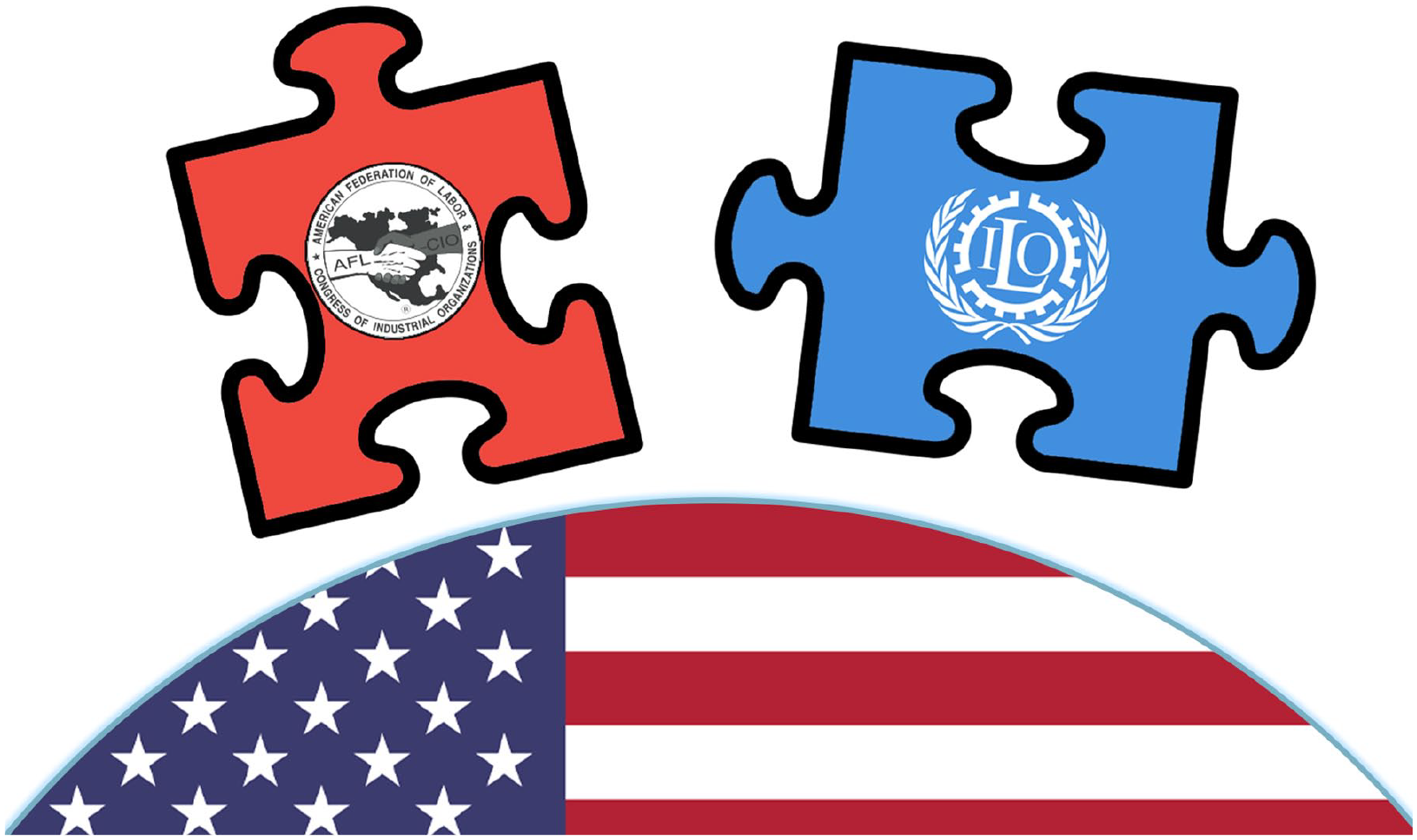
Given the uphill battle to unionize in the United States, can the International Labor Organization’s (ILO) system of standards serve as a viable tactic? The short answer to this question is, “Yes.” This is so, even though ILO standards have little, if any, enforceability, and despite the failure of the United States to ratify the relevant conventions. Although such a reality accounts for the scant attention paid to the ILO by U.S. labor leaders, lawyers, and organizers in general, with the notable exceptions of certain AFL-CIO officials and staff, as well as a few other major unions, now is the time for bold and new strategic thinking that marshals the authority of the organization and its norms.
The ILO normative system deserves the attention and commitment of time and resources by more American unionists and their legal counsel for the following reasons:
Even if ILO norms are not self-enforceable, U.S. labor, including the AFL-CIO in league with the global trade union movement, need to press for their maximum inclusion in other international systems to achieve enforceability. The AFL-CIO and the International Trade Union Confederation (ITUC) have long advocated such a position in relation to trade agreements and international financial institutions, and with some degree of success.
The conclusions and recommendations of the ILO normative/supervisory system have the force of moral suasion and can be used to shame and cajole governments and employers (including the U.S. government and U.S. employers). Although complaints in the ILO supervisory system are directed against member states and not employers, the unchecked anti-union behavior of particular companies certainly can be part of the fact patterns reviewed.
ILO norms could have more teeth if incorporated into private contracts and collective agreements. Such an approach requires even more creative and dedicated advocacy and negotiation to confront the predictable employer demand that any judicial recourse to effectively enforce such content be waived or dismissed.
Although U.S. ratification of additional ILO conventions, including those most relevant to trade union rights, is a bureaucratic and political obstacle course with little hope of success, the American labor movement should press the issue publicly, and especially with the “most pro-union U.S. president in history.” Such a public campaign will demonstrate both domestically and internationally how the United States needs to both reform its flawed labor law regime and practice what it preaches globally.
The ILO Normative System and Its Origins
The chief motivations for the ILO’s creation in 1919 were preventing nations in the global community from achieving unfair comparative advantage in trade by rigging their labor markets by means of labor rights violations; 3 avoiding another Great War by means of social and economic peace achieved through tripartite social dialogue joining workers, employers, and governments; 4 and the scare of worldwide class war (also motivating ILO tripartism) following the Bolshevik Revolution. 5
The creation of the ILO represented the transition of tripartism waged for war to tripartism waged for peace. Indeed, it is tripartism which makes the ILO unique in relation to all other United Nations (UN) and international agencies. Its governance structure consists not only of member state governments but also of employers’ and workers’ organizations (namely, trade unions). And when the United States hosted the extraordinary International Labor Conference in New York City in 1941, necessitated by the war conditions in Europe, President Franklin D. Roosevelt (FDR) made the following comment, recalling the founding of the ILO in 1919: I will remember that in those days the ILO was still a dream. To many it was a wild dream. Who had ever heard of governments getting together to raise the standards of labor on an international plane? Wilder still was the role that the people themselves who were directly affected—the workers and the employers of the various countries—should have a hand with government in determining these labor standards.
6
As FDR correctly observed, workers and employers, as well as governments, govern the ILO and are the legislators of the international labor law the organization has produced.
In addition to tripartism, the normative regime of international labor standards is what makes the ILO distinct from all other UN and international organizations. Moreover, the ILO is the only League of Nations legacy organization to have survived, and it antedates the creation of the UN by twenty-six years. For all these reasons, the ILO is considered a specialized agency of the UN. There are currently 187 member states in the organization. 7
ILO standards and jurisprudence constitute the primary foundation for all international labor law. The world relies on ILO norms as the authoritative reference. 8
ILO norms consist of conventions, recommendations, protocols, declarations, and resolutions. And ILO jurisprudence includes: the observations of the Committee of Experts (CEACR), 9 which is comprised of twenty eminent jurists from every region of the world; the observations and conclusions of the Standing International Labor Conference (ILC) Committee on the Application of Standards (CAS); 10 the conclusions and recommendations of the Committee on Freedom of Association (CFA); 11 and the conclusions and recommendations of the Governing Body (GB). 12 The GB is the chief executive body of the ILO. It is composed of fifty-six titular members (twenty-eight government representatives, fourteen employer representatives, and fourteen worker representatives). 13
The CFA is one of the most important supervisory bodies in the ILO and is dedicated to genuine compliance on the part of member states with the principles of freedom of association and collective bargaining, respectively, guaranteed by ILO Conventions 87 and 98. Created by the ILO’s GB in 1951, the CFA has a tripartite structure, consisting of three members from governments, three representatives of the employers’ group, and three from the workers’ group. An independent jurist with expertise in the field of international labor law presides. 14
Conventions and protocols are considered binding on an ILO member state upon ratification.
15
Recommendations, declarations, and resolutions are not ratifiable instruments per se, and, therefore, are not binding. And what does that mean in practice?
According to Brazilian jurist Luiz Eduardo Gunther, who thoroughly examined ILO normative jurisprudence and its application and significance to his own country, the ILO convention is a “treaty—a law of multilateral character.” 16 And once an ILO member state ratifies a convention, it binds itself, according to international law, to the entire “obligation of the norm,” complying with all the “conditions stipulated.” 17
But even if international law considers the ratification of such instruments to have a binding effect, there is the ongoing challenge of self-enforceability. The UN does not and cannot dispatch blue helmets to a country failing to comply with a ratified ILO norm. Such is the perennial “Westphalian dilemma”—namely, the binding nature of international labor law ultimately depends on the goodwill of the sovereign member state.
No Place to Hide—The Limits to American Exceptionalism in the ILO Normative System
The United States has ratified only 14 of the 190 ILO conventions, and of those, only 10 are currently in force. 18 The United States has one of the lowest ratification rates of any member state in the ILO. And the United States has ratified only two of the eight fundamental (or core) ILO conventions: Convention 105, on the abolition of forced labor, and Convention 182, on the prohibition of the worst forms of child labor. 19
What accounts for the United States being such an outlier? It is due to an historic American resistance to ratifying ILO conventions and other human rights treaties. There is a long-standing American fear of “ceding the nation’s independence” to foreign and international regimes, notwithstanding global capital and multinational enterprises violating national and local sovereignty on a regular basis.
Even considering those treaties and conventions which the United States has ratified, international and constitutional law expert Frederic Kirgis of Washington and Lee University Law School has noted the following: provisions in treaties or other international agreements are given effect as law in domestic courts of the United States only if they are “self-executing” or if they have been implemented by a separate act (such as an act of Congress) having the effect of federal law.
20
In 1988, the U.S. Senate formalized the radical outlier position of the United States vis-à-vis the ILO by passing a resolution stipulating the following:
An agreement to the substance of the 1988 resolution was the concession the AFL-CIO had to make at the time to achieve employer consensus on getting Convention 144 ratified by means of an eighty-one to two approval vote in the U.S. Senate. 22 (Convention 144 is the tripartite consultation convention adopted by the ILO in 1976, 23 which “requires governments to establish effective machinery to ensure tripartite (government, worker, employer) consultation on ILO-related issues, including reviewing the possible ratification of other ILO standards.”) 24 Ironically, the condition precedent for the ratification of this particular convention mandating tripartite social dialogue on ILO questions was an exceedingly high price for the American labor movement to pay. It meant that the future ratification of other ILO conventions, including those guaranteeing trade union rights, would be even more difficult.
There is an obvious contradiction, if not hypocrisy, when the United States presses for the inclusion of ILO standards in bilateral and multilateral trade agreements, as well as preferential trading systems, yet fails to ratify the relevant conventions. Nevertheless, the American labor movement has turned to the ILO supervisory system at certain points in recent history by calling out systematic violations of trade union rights in the United States, and before the CFA, in particular. 25
The CFA examines complaints submitted by either workers or employers concerning a member state’s non-compliance with the principles of Conventions 87 and 98. The committee can review the compliance by all member states with the principles of freedom of association and collective bargaining, even without their ratification of Conventions 87 and 98. That is because both norms are inherent to the ILO Constitution, meaning that all member states are subject to the ILO’s supervision regarding them.
26
However, they are not
Accordingly, the United States is subject to the CFA’s jurisdiction, even with its failure to ratify either Convention 87 or 98. The Committee’s conclusions and recommendations, albeit “soft law” and without self-enforceability, are nevertheless important judgments and commentary on the member state’s shortcomings.
Conventions 87 and 98 constitute the “Magna Carta” of international trade union rights, 27 and there is little question that the U.S. labor law regime violates both norms de jure and de facto. The American union movement has exposed this reality over decades by submitting complaints before the CFA, with the committee rendering critical findings, including recommendations to U.S. authorities to remedy the shortfalls. 28
For example, in 1990, the United Food and Commercial Workers (UFCW), with the support of the AFL-CIO and the International Federation of Commercial, Clerical, Professional, and Technical Employees, filed a complaint before the CFA alleging that U.S. labor laws and their enforcement “do not adequately protect trade unions’ and workers’ rights, including freedom of association and the right to organize, against the anti-union conduct of certain employers.” 29 The factual basis of the submission involved the anti-union conduct of Delhaize-Food Lion, “a transnational enterprise based in Belgium operating food stores in the United States.” This anti-union conduct included employer interference (with threat of arrest) of UFCW informational pickets in front of Food Lion stores located in Washington, D.C., Maryland, and Virginia, as well as the denial of access of UFCW organizers to Food Lion employees. 30 The UFCW argued that the existing National Labor Relations Act (NLRA) and its enforcement failed to adequately prevent and remedy such unlawful anti-union practices, and that Section 10 (j) of the NLRA (stipulating permissive injunctive relief in cases of employer unfair labor practices) and 10(l) (providing for mandatory injunctive relief in cases of union unfair labor practices) made for unequal treatment and protection of U.S. workers and their unions, violating the principles of Conventions 87 and 98. 31
The CFA concluded that the U.S. government should review and revise its laws and their enforcement “to guarantee access of trade union representatives to workplaces,” and that injunctive relief should be provided on an equal basis in the context of the NLRA. 32 The committee also requested that the U.S. government “draw the attention” of companies violating trade union rights in the United States to the “conclusions in this case.” 33 Such an ILO decision, even without the force of sanction, could be useful for future union campaigns, not to mention the many other CFA findings involving the United States.
If Conventions 87 and 98 were ever ratified by the United States, international law would dictate the overhauling of a great part of U.S. labor law empowering employer opposition to the unionization process, due to the binding obligation of the norms resulting from ratification. This point has not been lost on the U.S. Council for International Business (USCIB), which undoubtedly would resist such an effort. 34 For example, a faithful application of ratified Conventions 87 and 98 means eliminating all employer interference in the organizing process, including the use of captive audience meetings.
The Self-Enforcement Challenge Regarding ILO Standards
Even if the United States were to ratify more ILO conventions, there is the ongoing dilemma of the ILO normative regime lacking enforcement. The ILO is without the power to impose sanctions or penalties by itself.
U.S. Federal District Court Judge Peter Messitte (Maryland) offered a compelling insight on the effort to overcome the enforcement challenge in a speech delivered a decade ago—namely, ILO standards negotiated as conditions in private agreements might be enforceable according to the law of contracts, depending on the national, state, and local jurisdictions. Such an observation raises an intriguing question concerning the enforceability of global framework agreements (GFAs) which refer to ILO conventions and are negotiated between global union federations (GUFs) and multinational enterprises. 35 Judge Messitte suggested that ILO jurisprudence, rather than national and local labor law, might guide the interpretation of ILO norms within such private accords. 36
Even with the ILO regime lacking self-executing and self-enforcing powers, its standards and jurisprudence are still the credible reference for the global community, and the political and moral force of the system can be leveraged by both the United States and global labor movements to help achieve their objectives. The conclusions and recommendations of the ILO normative system can therefore serve as a “power of persuasion” and a “shaming tactic” to pressure governments and employers to do the right thing. 37
With Joe Biden declaring himself the most pro-union president in U.S. history and with U.S. Labor Secretary Marty Walsh announcing the creation of the M-POWER initiative, a U.S. government program designed to fund the exercise of organizing and collective bargaining rights abroad, 38 the American labor movement should urge the current administration to get serious and move forward U.S. ratification of all the ILO core conventions, including the Magna Carta of trade union rights—Conventions 87 and 98. This also would mean overhauling the 1988 Senate resolution precluding the ratification of any convention if existing federal and state laws are not already in 100 percent conformity with the international norm. Such an effort would give the U.S. government more credibility internationally, especially when it advocates for global labor and human rights.
Although the political obstacles are overwhelming, a robust public campaign calling for the ratification of Conventions 87 and 98 would reveal to the American people and the world the veritable crisis of trade union rights in the United States—which is unquestionably a human rights crisis. The struggle is worth the effort, even if actual ratification is currently a bridge too far. And the American labor movement making more strategic use of the existing ILO “soft law” regime certainly is warranted in the meantime.
Footnotes
Declaration of Conflicting Interests
The author(s) declared no potential conflicts of interest with respect to the research, authorship, and/or publication of this article.
Funding
The author(s) received no financial support for the research, authorship, and/or publication of this article.
