






Abstract
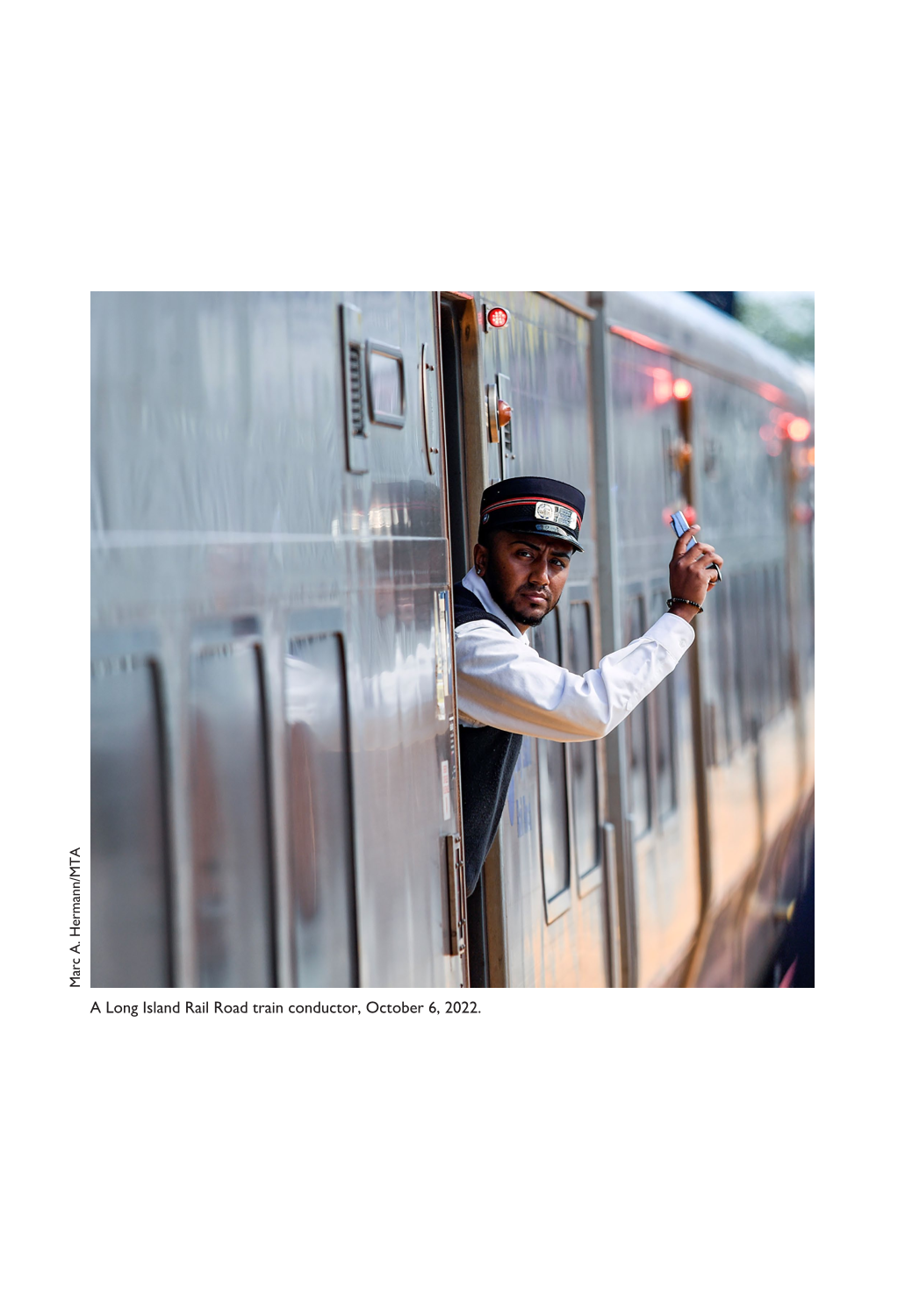

A Long Island Rail Road train conductor, October 6, 2022.
During the past year, we have been reminded of the fact that a law now almost a century old—the Railway Labor Act (RLA)—continues to prevent some of our most essential workers from using their most basic power, their ability to engage in collective action to improve their wages and working conditions or defend the common good. That reminder was put in stark relief in December 2022, when the RLA, which was signed in 1926 by one of the last century’s most conservative presidents, Calvin Coolidge, was invoked by President Joe Biden, the most vocally prolabor president in history. With congressional backing, Biden used the law to impose a settlement that offered railroad workers only a single sick day per year (up from zero in their previous contract)—a settlement that four unions had already voted down. The unions had no recourse, short of breaking the law and triggering an existential showdown with the federal government.
Bearing the political imprint of the times in which it was written, the RLA was designed to prevent disruptions in the national transit system just as it did last December. Despite its title, though, the act includes others under its purview in addition to railroad workers. Even as the rail confrontation was playing out, the RLA was also shaping the dynamics of a dispute in its other jurisdiction, the airline industry. On October 31, 2022, in frustration after three years of negotiations seeking a new contract, 96 percent of Delta Air Lines’ roughly fifteen thousand pilots participated in a vote in which they authorized a strike by a 99-1 margin. Yet, like the rail workers, the pilots were restrained by the RLA from acting. Before they could walk out, the RLA’s National Mediation Board (NMB) would have had to conclude that all further attempts at mediation were futile and then the pilots would have had to sit through a 30-day cooling off period, at the end of which the government might still intervene to impose a settlement if the pilots struck. None of that proved necessary. Two days after the imposition of the railway settlement, Delta and its pilots reached an agreement.
These cases showed that the aging RLA continues to do what it was designed to do: prevent strikes. At the same time, these examples revealed the costs of its strike-avoiding bias. In the case of the railroad workers, the act made it nearly impossible for unions to challenge the chief cause of their unrest, the spread of the Tayloristic management strategy known as “precision scheduled railroading,” under which rail carriers had tried to eliminate paid sick days altogether (that’s why there were none guaranteed in the contract that had preceded the settlement imposed by Biden and the Congress). In the case of the Delta pilots, the law’s restraints against collective action weakened the union’s ability to push for a quicker settlement or to gain more leverage over the settlement’s ultimate terms, which might well have been better than that 30 percent increase over four years that they ultimately won had the pilots exercised a credible strike threat.
And the beat goes on. Already in 2023, the RLA has constrained the efforts of pilots at American Airlines, Southwest, and FedEx, all of whom also took lopsided strike votes. It is also dictating the arcane legal structure that the Association of Flight Attendants-CWA (Communications Workers of America) must navigate in order to organize Delta flight attendants. The law has all but removed the option of collective action from all these workers.
A review of the RLA’s history clarifies its importance as both Exhibit A in a case for the thorough overhaul of our ancient labor laws and a reminder that such an overhaul will not happen unless labor actively disrupts the status quo.
The Origins and Evolution of the RLA Regime
Throughout the years leading up to the passage of the RLA in 1926, railroad worker militancy was the main spur toward the enactment of federal laws regulating labor relations. As the essential workers staffing the circulatory system of an industrializing nation, railroad workers were early to organize and exercise their power to act collectively. Locomotive engineers formed a union in 1863, conductors in 1868, firemen in 1876, and brakemen (later known as trainmen) in 1883. When railroad workers acted collectively, as they did during Great Strike of 1877 and the Southwestern railroad strike of 1887, their walkouts spilled across state lines and impacted the entire nation.
The first federal law dealing with labor dispute resolution—the Arbitration Act of 1888—had its origins in response to these upheavals. It empowered the president to appoint investigatory boards to end work stoppages, encouraging voluntary arbitration between unions and the rail companies. When that law obviously failed to prevent the massive Pullman strike and boycott of 1894, Congress passed the Erdman Act in 1898. It strengthened the voluntary arbitration provisions of the Arbitration Act, set up a clear mediation process, and declared it illegal for rail employers to discriminate against workers on the basis of union membership. Unfortunately, the Supreme Court struck down that act’s anti-discrimination provision in Adair v. U.S. (1908), contributing to its failure as a dispute resolution mechanism.
During the progressive era, it was workers’ willingness to threaten collective action that finally produced lasting legislative breakthroughs. The Illinois Central’s shopmen’s strike of 1911 was among the developments that spurred passage of the Newlands Act in 1913, which established a permanent three-person board of mediation while retaining the voluntary arbitration procedures of the Arbitration and Erdman acts. It too failed. Only when rail unions decided to bypass the Newlands Act’s machinery and threaten a national strike in 1916 to demand an eight-hour workday was a durable victory won. On the eve of U.S. entry into World War I, during the opening days of Woodrow Wilson’s campaign for reelection to the presidency, the four Railway Brotherhoods—engineers, conductors, firemen, and brakemen—threatened a strike that forced quick passage of the Adamson Act on September 1, 1916. It was the most significant advance to that point in labor’s half-century-long fight for eight hours, and vestiges of that breakthrough remain codified in federal law to this day in 49 U.S. Code § 28301. 1
World War I provided another opportunity for railway workers to use the threat of collective action to win improvements. Railroad shopcraft and maintenance-of-way workers were not covered by the Adamson Act and their discontent became palpable as a strike wave swept across the nation in the first six months of U.S. participation in the war, causing the loss of over six million workdays to nearly three thousand walkouts. Hoping to insulate the nation’s vital rail network from the unrest, Wilson used executive authority to put the railways under federal control in December 1917 by creating the U.S. Railway Administration (USRA) and appointing his son-in-law, Secretary of the Treasury William Gibbs McAdoo, as its Director General. McAdoo promptly assuaged workers’ mounting grievances: the USRA ignored the Adair decision and issued an order that forbade railroads from discriminating against union members, guaranteed eight-hour workdays to railway workers who had been left out of the Adamson Act, and launched three separate boards, each including union representation, to settle disputes on the operating lines, in repair shops, and among maintenance-of-way workers. Under the USRA’s purview, union membership swelled. Moreover, USRA policies influenced the National War Labor Board (NWLB), which was created a few months later to promote labor peace in wartime workplaces through the extension of “industrial democracy.” 2
Threats of disruption in the face of war had been the key to workers’ gains, but that leverage was lost with the signing of the Armistice in November 1918. As the economy demobilized, wartime agencies such as the USRA and NWLB were quickly swept aside. By 1920, the Esch-Cummins Act restored railroads to private control and created a new oversight entity, the Railroad Labor Board (RLB). President Warren G. Harding appointed the former Republican governor of Tennessee, Ben Walter Hooper, to chair the RLB in 1921. The contrast with McAdoo could not have been clearer; Hooper soon approved wage cuts that drove the recently unionized shopcraft workers into a massive strike on July 1, 1922, which Hooper then helped to quash with the aid of U.S. Attorney General Harry M. Daugherty. Daugherty obtained the most sweeping anti-strike injunction to that point in U.S. history, prohibiting workers from taking virtually any action in furtherance of their strike, effectively breaking the last big U.S. rail strike. 3
As the dust of the shopmen’s strike settled, President Harding’s death in 1923 propelled Vice President Calvin Coolidge into the White House, and Coolidge’s ascension set the stage for the passage of the RLA. Having won national fame by breaking the Boston police strike of 1919, Coolidge wanted a law that would prevent upheavals like the shopmen’s strike from recurring. He put Secretary of Commerce Herbert Hoover in charge of negotiating a compromise between unions and carriers over the provisions of that law. Importantly, that compromise was negotiated during a period of retreat for organized labor. The shopmen’s defeat had followed a string of broken strikes in steel, coal, electrical manufacturing, and meatpacking. Moreover, the compromise was hammered out when open shop Republicans controlled both Congress and Supreme Court. The RLA’s deficiencies would owe much to this unfavorable context. 4
The basic trade-off of the RLA, clearly visible at its signing in 1926, has continued to our time: it created a system where the presence of unions was protected as long as they abided by rules that made it nearly impossible for them to engage in collective action. The sweetener for unions was written into the third part of Section 2 of the act, the first federal law to limit employers’ use of company unions. It allowed each side in a labor-management negotiation to select its own representatives free of “interference, influence, or coercion” by the other side. Unions read the provision as forbidding employers from forcing company unions upon their employees. The U.S. Supreme Court agreed with that reading. 5 The effect of the act and its judicial interpretation was to promote collective bargaining in which workers were represented by independent unions—a precedent of enormous magnitude.
Yet that precedent was won at the cost of a system that made striking all but impossible. The law empowered the president to appoint a nonpartisan Board of Mediation that could attempt to negotiate resolutions to unresolved labor conflicts. If mediation failed, the board could ask the president to appoint an emergency board that would be required to submit a report on the dispute to the president within thirty days. During that period, and for thirty days afterward, a “cooling off period” was in force. While the parties were not required to adhere to the findings of emergency boards, as happened when the four unions voted down the mediated settlement during the 2022 railway crisis, the government still retained powers, as the Biden administration demonstrated, to compel the acceptance of settlements.
Thus, while the RLA did not forbid strikes per se, it ended up effectively banishing them from the nation’s railroads. Only one national rail strike has occurred since 1926. It happened during the postwar strike wave of 1946 when engineers and trainmen walked off the job only to return to work within hours when President Harry S. Truman threatened to conscript them into the military.
There was an upside for labor in the RLA, to be sure. Unions gained a secure foothold on the nation’s railroads thanks to the 1926 law. They expanded that foothold to build their membership during the salad days of the New Deal and World War II, when union density was heading toward its postwar high of 35 percent. But they operated under an RLA system that denied workers any real leverage in pushing back against the system’s failures. Unions constantly chafed at the limitations of the RLA, including its slow machinery. In the 1940s, to cite one example, the Brotherhood of Railroad Trainmen complained that it took as long as nine years to resolve grievances under the system. In one particularly egregious case, a pay claim filed against the Central New England Railway in 1932 was not settled until 1945. Still, there was little unions could do but grumble about such injustices.
Nor did policymakers or railroad executives feel much pressure to dramatically improve the system, for they well knew that unions were not only learning to live under it, they were developing an interest in perpetuating it. The truth was that unions had won a degree of security within the system, and they preferred enduring the RLA’s limitations to risking the unknown. So it came to be that the basic structure of the system was not only preserved, but extended by Congress to the nation’s airlines in 1936.
A Regime in Deepening Crisis
Yet, as time passes, the costs of the RLA defects are ever more clear. Evidence that has been accumulating for years is making it increasingly evident that the compromise struck in 1926, which always tilted more in management’s favor than labor’s, is becoming less and less tenable for both workers and the nation. Undeniably, employers have become more adept at exploiting the slanted system. Since the inception of the act, employers’ incentive to bargain in good faith has been weakened by their knowledge that labor had no credible opportunity to improve its bargaining leverage through a strike. Employers’ incentive to bargain in good faith deteriorated further in the years since the 1970s as the “maximizing shareholder value” ethos swept through corporate boardrooms and the deregulation of railways and airlines increased competition, led to bankruptcies and consolidations, and generally ratcheted up employers’ efforts to improve profits by squeezing labor. 6 Gaming the RLA system became a key management tool.
During his tenure as a senator, Joe Biden himself called attention to the problem more than thirty years ago during a brief strike by the Machinists against CSX. When union members struck that single carrier on June 24, 1992, other rail carriers simply shut down their operations in order to create a national stoppage, knowing that the government would quickly step in and impose a settlement that would be to the advantage of all the carriers. That is exactly what happened two days later. Tellingly, Biden was one of the few in Congress to vote against that settlement. “We need to restore a measure of balance to these negotiations,” he implored. Sadly, that balance has yet to be restored, as President Biden himself confirmed thirty years later by imposing his 2022 settlement. 7
Not only has the balance of power not improved, the inability of workers to act collectively under the RLA system has become an increasing liability because it has left them nearly powerless to resist the imposition of precision scheduled railroading (PSR). Over the last decade, PSR, a version of the notorious “stretch out” that textile employers once inflicted on workers (by running looms faster and pushing two workers to tend the same number of looms that three once tended), has seen rail carriers try to run trains continuously with as little down time and as few crew members and maintenance workers as possible. Using PSR techniques, rail carriers cut staffing by 30 percent in six years, increased freight tonnage, dramatically lengthened trains without increasing the numbers of crewmembers that move them—and doubled their profits. Naturally, PSR’s “efficiencies” have made railroads a darling of Wall Street. In the first half of 2022 alone, the largest freight carriers reported $10 billion in stock buybacks and dividends. 8
It was their embrace of PSR that led railroads to try to eliminate paid sick days, the key sticking point in the 2022 negotiations. With crew margins cut to the bone, carriers could not tolerate having workers who do not show up for scheduled shifts, so management sought to disincentivize absences from work, no matter how sick workers felt. Acting under the constraints of the RLA, unions were at least able to put the sick-day issue on the table in 2022. Yet the RLA deprived them of the power to challenge the cause of the sick-day dispute: railroad managers’ desire to run the railroads as they please and their confidence that the government will prevent workers from challenging that prerogative. Months after the imposed settlement in 2022, the Biden administration claimed credit for negotiating behind-the-scenes addendums to some of the railway contracts that have now extended the number of paid sick days to four for many workers. 9 While this is certainly an improvement (one that would not have come under a Republican administration), it does not alter the grinding logic of PSR or the fundamental imbalance of power under the RLA.
This is unfortunate not only for railway workers but for all of us. The continued survival of PSR is a menace both to those who labor under its dictates and to the communities through which trains roll. It is no coincidence that longer, heavier trains piloted by overworked, overstressed skeleton crews, traversing tracks maintained by slimmed down teams of maintenance-of-way workers, are producing toxin-dumping derailments like the one that spilled and burned one hundred thousand gallons of hazardous chemicals in East Palestine, Ohio on February 3, 2023. Safety, like workers’ health, takes a back seat to increased profits. Workers, who could fix this problem by using collective action to force a resolution, are instead restrained by a decaying legal structure that was produced in an era long vanished, a structure that shambles on, zombie-like, toward its 100th birthday.
Drawing Lessons, Looking Ahead
The 2022 dispute and the dynamics of labor relations under the RLA present, in fractal form, the problem at the heart of our entire system of labor relations. Workers’ situations under the RLA are not unique. Private sector workers covered by the National Labor Relations Act’s jurisdiction and public sector workers covered by state and local bargaining laws are also struggling with similar dynamics. They are all entangled in legal systems that were designed decades ago in contexts now long gone. Warning signs abound, pointing to the advanced decay of these structures.
Perhaps the most ominous warning sign is the degree to which workers have seen their capacity to act collectively eroded under all these broken systems. As the RLA was invoked to prevent a rail strike last year, there were only twenty-three major work stoppages (events that involved at least one thousand workers each) in which a total of one hundred twenty-six thousand workers participated. This was actually a slight uptick from 2021’s figures (sixteen major stoppages involving eighty thousand workers). But the 2022 figures scarcely marked a reversal of the decades-long decline in workers’ job actions. Compared with 1972 figures, the major strikes of 2022 had only one-ninth as much impact on national work time, and that bleak comparison would look even worse if 2022 figures had not been inflated by the huge strike of the University of California graduate assistants, which contributed more than a third of total major work stoppage participants. 10 Although recent organizing at Starbucks, Amazon, Apple, and other twenty-first century open shop advocates has been inspiring, it seems increasingly unlikely that we will see a breakthrough for organized labor in these or other private sector settings unless unions can reverse this decades-long erosion of workers’ ability to engage in successful collective action.
It is heartening that a growing chorus of voices are calling for an overhaul of our broken labor laws, which have abetted the decline in impactful strikes. Yet it would be magical thinking to believe that lobbying for labor law reform and electing sympathetic leaders such as Joe Biden will be enough to win that overhaul. Collective action must play a role. Whether the strikes of 2023 can begin to create an impetus for real change remains to be seen. But if the history of the RLA teaches us anything, it is that change will not come without a credible threat of disruption. Indeed, we should remember that railroad law—the ur-story of U.S. labor law—originated as a response to workers acting collectively, often in defiance of the prevailing laws of their time.
Footnotes
Declaration of Conflicting Interests
The author(s) declared no potential conflicts of interest with respect to the research, authorship, and/or publication of this article.
Funding
The author(s) received no financial support for the research, authorship, and/or publication of this article.
