







Abstract

Roof of a data center featuring cooling towers and backup generators in Mesa, Arizona.
Rsparks3, Wikimedia Commons
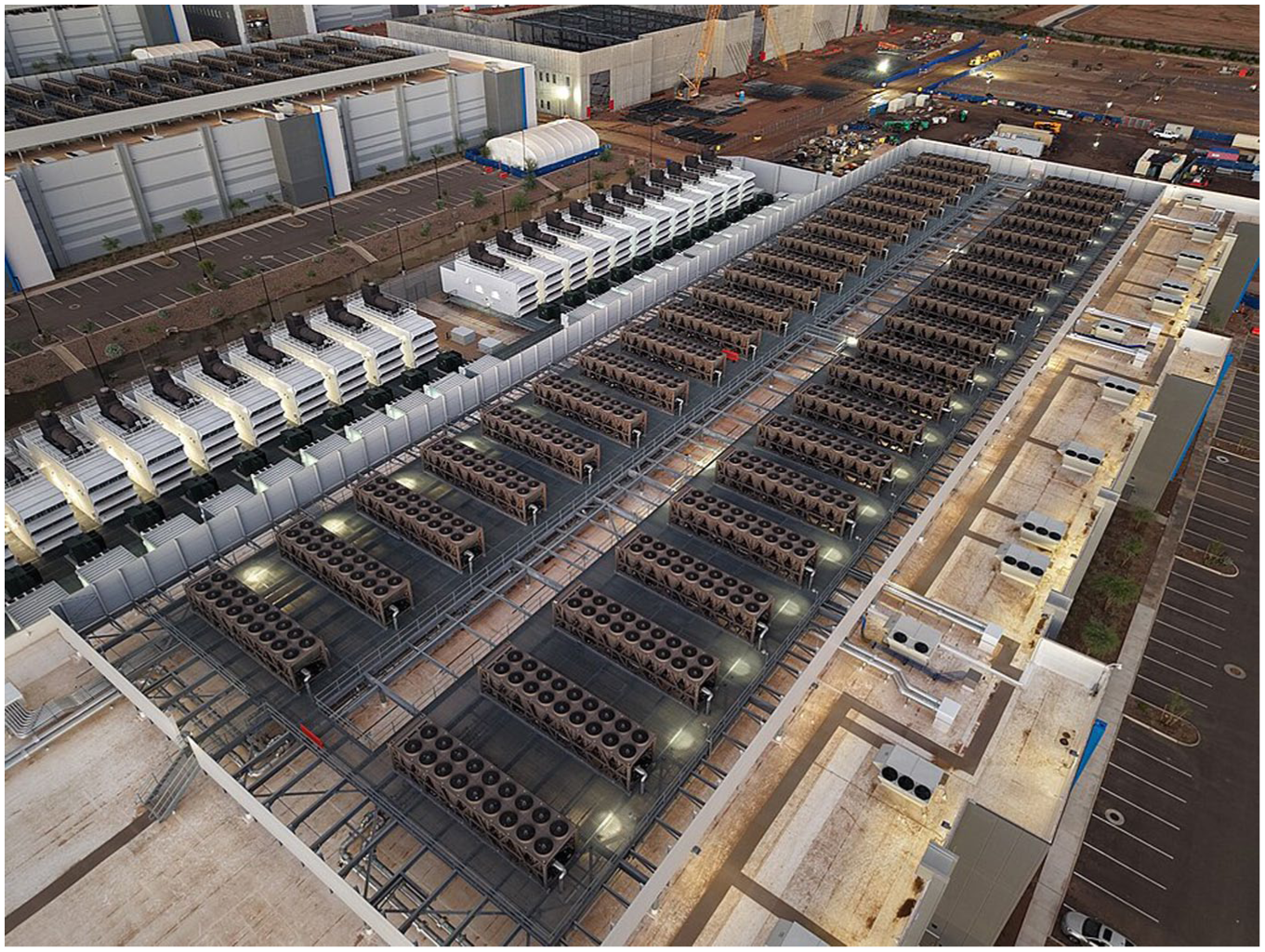
In Louisiana, the electric utility Entergy is building three new gas-fired power plants to power one massive artificial intelligence (AI) data center to be operated by Meta Platforms.
1
In Utah, Caterpillar is installing 4-GW gas generators greater than the entire power demand of the city of Austin, Texas
2
to power a data center campus.
3
Elsewhere in Texas, a newly formed real estate investment trust backed by former U.S. energy secretary Rick Perry plans to build the largest data center complex in the world, powered by four new nuclear reactors and three new natural gas plants.
4
This growth in data centers not only is undermining the limited progress that has been made on climate change but also calls into question even more sharply the dominant narrative that endless economic growth is compatible with addressing the climate crisis.
The explosive growth in data centers is creating demands on the U.S. electrical grid that are unprecedented in recent memory, bringing two decades of flat electricity demand to an abrupt end. 5 This growth in data centers not only is undermining the limited progress that has been made on climate change but also calls into question even more sharply the dominant narrative that endless economic growth is compatible with addressing the climate crisis.
Across the United States, data centers are driving a boom in natural gas-fired power plant construction, as electricity demand is projected to rapidly increase to serve the demands of the large language models behind AI. The waiting time to purchase large natural gas turbines is now five to seven years (up from 2.5 to three years just a couple years ago), 6 and small turbine manufacturers like Caterpillar are seeing their stocks surge in response to new demand. 7
Estimates vary widely, but Lawrence Berkeley National Laboratory estimates that data centers could account for anywhere between 6.7 to 12 percent of U.S. electricity consumption by 2028. 8 While renewable energy is also benefiting from the AI boom, the power demands of data centers are growing so rapidly that every interest—from pipeline companies 9 to turbine manufacturers to coal plant operators 10 —is getting in on the action.
Data Centers versus the Climate?
In response to its new energy demands, the tech industry has quickly backtracked on its climate and sustainability pledges. 11 Now, it touts AI as a “solution” to the climate crisis 12 without a shred of supporting evidence. Former Google CEO Eric Schmidt admitted, “We’re not going to hit the climate goals, anyway.” 13
The boom in natural gas is threatening the meager climate progress we have made in the United States to enrich tech oligarchs peddling a technology that may never deliver on its promises. It is becoming increasingly clear that we are in an AI investment bubble that is driving company valuations far above what they are worth. 14 OpenAI continues to raise eye-popping amounts of cash 15 despite losing billions of dollars each quarter. 16 There is also new evidence that the technology they are selling is overhyped. An MIT study of corporate pilot projects on adopting AI technology found that only 5 percent of the pilots resulted in savings. 17
This makes it difficult to predict how many of the currently planned data centers will get built. What is clear, however, is that utilities and data center developers are planning forecasts of AI energy demand to materialize—and building gas plants. Even if fewer gas plants are ultimately built than AI boosters currently imagine, or if some gas plants end up underutilized, every new gas plant built is one too many from the standpoint of the climate crisis. And this investment boom represents a massive misdirection of capital that could have been used to invest in the transition away from fossil fuels.
The seemingly overnight explosion of data centers and their enormous energy demands have sharpened the long-standing contradiction between solving climate change and perpetuating endless economic growth.
Data centers’ ultimate energy demands may be uncertain, but what is certain is that climate change is accelerating. 18 The goal of getting to net zero greenhouse gas emissions by 2050—a long-established climate policy goal—already would have required a herculean effort in the United States even before data centers supercharged electricity demand forecasts. A Princeton University study that evaluated pathways to net zero by 2050 found a need to install historically unprecedented amounts of renewable energy every year, as well as large-scale investments in transmission, transportation, and other sectors. 19 That study, published in 2021, did not anticipate the surge in data centers and their energy demands. In other words, an already daunting task now appears even further out of reach.
While climate advocates decried the Keystone XL pipeline as “game over for the climate” 20 in 2011, no similar rallying cry has emerged against data centers, which use far more energy than the oil that would have flowed through that pipeline. 21 Indeed, many environmental advocacy organizations have seemingly bought into the “need” for AI, with some going even further down the path of accepting the industry’s narrative that AI will be good for the overall transition to renewable energy. 22 Perhaps this reflects, in part, the fact that some of the biggest names in climate philanthropy have deep ties to Big Tech. 23
The argument that data centers do not represent a threat to climate progress because they could all be powered by renewable energy and storage does not reflect reality. First, if all data center demand were met with renewable energy, this would require building out a tremendous amount of renewable energy capacity, none of which would go toward the urgent need of decarbonizing existing energy use. In other words, from a climate perspective, we would make a huge effort to remain in the same place. As it stands now, we are moving backward because the energy demand from data centers is not being met by renewables alone. And the useful life of the natural gas infrastructure being built to power it will extend well beyond the 2050 goal for decarbonizing our economy.
Nevertheless, the idea that AI is compatible with climate progress because data centers could be powered by renewable energy goes hand-in-hand with the dominant approach to climate change from the Democratic Party and the mainstream environmental advocacy community: this is a problem that can be solved with technological change alone. They posit that we can maintain a growing economy and solve climate change by switching our electricity, transportation, and other energy demands to renewable energy.
Getting to Net Zero Climate Emissions
Regardless of whether all the proposed data centers and gas plants get built, we should use this moment to take stock of the fact that this dominant approach to solving climate change is not working. The technocratic approach is supported by energy modeling exercises showing different pathways to decarbonizing our energy supply while maintaining our lifestyles and economic growth. 24 These models generally follow a similar outline to get to net zero emissions. They require converting most of our transportation and heating needs to run on electricity, with electricity increasingly generated from renewables. This would clearly require aggressive policy action to make sure that this expanded electricity demand is met exclusively by renewable energy, and not also by gas and other fuels (as we are seeing now with data centers).
Getting to net zero by 2050 would require a massive high voltage transmission buildout (tripling to quintupling the existing network, according to the previously mentioned Princeton study) and building out wind and solar energy at unprecedented rates over the next twenty-five years. 25 According to the Intergovernmental Panel on Climate Change, getting to net zero will also require carbon dioxide removal technologies, such as adding carbon capture to power plants. 26
Blocking data centers is the leading edge of this fight, but the challenge goes deeper. We need to rethink the technocratic vision for solving climate change or perhaps abandon it entirely.
We would have to build out a large amount of physical infrastructure very quickly, often in Republican-led states that are more oriented toward expanding fossil fuel use than dealing with climate change. Imagine, for example, the likely backlash to a concerted effort to build transmission lines for renewable energy through Indiana, a state in which seventy-two of ninety-two counties have already placed moratoriums or bans on renewable energy development, citing land-use concerns. 27
There are other sources of greenhouse gas emissions beyond cars, heating, and electricity that are less talked about because they are even more difficult to eliminate, including emissions from aviation, shipping, and agriculture. Decarbonizing these sectors by 2050 is likely to be even more challenging, as it will require technologies that are not yet at commercial scale.
Looking at what it would take to get to zero emissions by 2050 in the United States, we would clearly need coordinated federal policy action on a sustained basis for the next twenty-five years. We got a brief taste of this during the Biden administration, although what they put into motion was not enough. 28 It is hard to imagine how anyone looking at the political trends—polarization, widening wealth inequality, rising political violence, and increasing dominance of billionaire interests in both parties—could argue that the United States is on the cusp of achieving the level of political stability required to implement a multi-decade climate policy.
Climate Change versus Economic Growth
The seemingly overnight explosion of data centers and their enormous energy demands have sharpened the long-standing contradiction between solving climate change and perpetuating endless economic growth. The dominant response to this contradiction has been to argue that we can stay the course of endless growth and just add more renewable energy. Once again, as the late social theorist Fredric Jameson famously said, it is easier to imagine the end of the world than the end of capitalism.
Yet the grassroots movement against data centers is growing. Communities have beaten back data center proposals in Virginia, Indiana, Missouri, and elsewhere. 29 These fights would be strengthened by an unapologetic opposition to AI data centers by the progressive community on environmental, labor, and anti-authoritarian grounds. Data centers and AI are neither inevitable nor socially necessary. Many labor unions have expressed concerns about the imposition of AI in the workplace and put forward principles designed to safeguard workers from discrimination, surveillance, work degradation, and job loss, and they are fighting to implement these principles through contracts and worker-management committees. 30 Some unions, including the Writers Guild of America and SAG-AFTRA, have won specific AI protections in their contracts, like preventing AI output from being recognized as “literary material” (and thereby protecting human writers’ compensation and credits) and requiring an actor’s permission for the creation of digital replicas of their voice or image. 31 Yet with overall union density at just 10 percent, and under 6 percent in the private sector, it is difficult to see how the labor movement on its own will be able to win the battle to control corporate adoption of AI and prevent its many negative impacts on workers. The labor movement needs to articulate a broader social vision and find common cause with those who oppose AI on broader social grounds. After all, why should certain communities be expected to hand over their land, water, and electricity to facilitate a technology whose leading selling point is eliminating jobs? Why should we be prioritizing a technology that facilitates surveillance, not only to discipline workers, but to discipline entire populations? 32 And why should we blow our limited carbon budget building gas plants to power such a potentially destructive technology? Conversely, why should we use renewable energy to power AI instead of using it to reduce our existing emissions?
Blocking data centers is the leading edge of this fight, but the challenge goes deeper. We need to rethink the technocratic vision for solving climate change or perhaps abandon it entirely. The left must develop a vision of where we want to go in the twenty-first century that speaks to peoples’ economic and social needs while grappling with the reality of climate disasters that will increasingly disrupt our lives. We must confront the deeply disheartening reality that our current strategies to get to zero emissions by 2050 are not working and not likely to work.
We need to replace the technocratic approach with a vision of a wholly different economy and way of life, one that is necessarily less resource-intensive, simpler and based on meeting human needs, not growth for the sake of growth. Upending the logic of economic growth is no small task, but it is one that can be chipped away. It requires developing new structures and institutions to reclaim basic needs from the logic of capital accumulation; that is, meeting basic levels of housing, food, water, electricity, and healthcare locally, rather than depending on predatory capitalist markets that take social goods like housing and turn them into opportunities for financial profiteering. Having these needs met outside of capitalism would both strengthen communities and dramatically transform the conditions for labor, paving the way for deeper conversations about the nature of work in a truly sustainable economy. Things that are not sustainable will not be sustained. Sooner or later, ecological consequences will put a stop to our endless growth in resource consumption on a finite planet—and all signs point to sooner. The question is whether we will experience a brutal form of degrowth under capitalism, or whether we can collectively plan for and execute a softer landing. We need to fight data centers and their outrageous power demands. However, we also need to reflect on what is a vision we can realistically offer to counter Big Tech’s nightmare vision of state surveillance amid climate chaos.
Footnotes
Declaration of Conflicting Interests
The author declared no potential conflicts of interest with respect to the research, authorship, and/or publication of this article.
Funding
The author received no financial support for the research, authorship, and/or publication of this article.
