






Abstract

Miguel, a 3½-year-old boy with autism, is beginning his 1st year in an inclusive preschool. His parents had always been actively involved in Miguel’s education since he began receiving early intervention services in the home setting at the age of 2. Now, that their son turned 3, and special education services were to be provided in the classroom, they were nervous about how the change would affect their son and their ability to stay involved. Despite the transition support provided by the early intervention team, the family still had a lot of questions. How would the teacher know what things really motivated their son? Would the teacher continue to share helpful ideas for things to do at home? How much information would be shared? The parents understood that the focus of Miguel’s education would now be in the classroom rather than at home, but more than anything, they were hopeful for opportunities to remain involved in their son’s learning and be part of the team. So, they were more than willing when the teacher asked if they would be interested to come in and talk about their son’s goals and brainstorm some ideas for working together on supporting his progress. Miguel’s teacher shared that the best learning in the classroom often happens throughout the day during natural routines and activities. Many routines that occur in the classroom are often similar to common routines at home. Things like washing hands, eating meals together, cleaning up toys, and reading books can all offer repeated opportunities for learning. Miguel’s teacher felt that, through collaboration, the two could work together on providing learning opportunities during these common routines. Miguel’s parents felt empowered when they were given simple ideas to help support Miguel’s education throughout their typical day.
It is always exciting when you see a student begin to progress and learn new skills. However, it can be disconcerting when the family has a different experience. Likewise, a family may be having positive experiences at home, whereas the child is struggling with the new structure and routines that come with the classroom setting. To truly support a young child’s development, a teacher needs to be supported with a full team that includes the child’s family as equal and active partners. Unfortunately, collaboration between teachers and parents can often be more limited to strategies representing parents as the recipients of information, such as daily or weekly progress notes, as opposed to more advanced strategies that represent parents as decision makers and resources in the elaboration of learning. Although there is general consensus on the positive impact of developing collaborative partnerships between the home and school, current practices and beliefs in collaboration remain varied (Bailey, 2001; Bailey et al., 2006; Blue-Banning, Summers, Frankland, Lord Nelson, & Beegle, 2004; Dinnebeil, Hale, & Rule, 1996; Turnbull et al., 2007). Nonetheless, intervention is likely to be more effective when parents and teachers work collaboratively to support the child across settings (Bailey et al., 2006; Pretti-Frontczak & Bricker, 2004; Sandall, Hemmeter, Smith, & McLean, 2005; Turnbull et al., 2007). The Division for Early Childhood of the Council for Exceptional Children (DEC) and the National Association for the Education of Young Children (NAEYC) agree that “collaboration among key stakeholders (e.g., families, practitioners, specialists, and administrators) is a cornerstone for implementing high quality early childhood inclusion” (DEC/NAEYC, 2009, p. 2). Although parent involvement is often a broadly defined term, Bailey (2001) identified three critical themes of parent involvement and family support: (a) parent involvement must be individualized based on family resources, priorities, concerns, and culture; (b) parents should participate as active partners in planning for their child and for themselves; and (c) services must empower families as advocates, recognizing that they are the ultimate decision makers and long-term care providers for their children. A collaborative approach to activity-based planning across settings incorporates families as equal partners in every step of the learning process.
“Collaborative planning for an activity-based approach to intervention allows teachers and parents to work together on shared goals within the natural contexts of daily routines and activities.”
Empirical support for embedding learning opportunities within daily routines and activities has existed for more than 20 years (Bricker & Sheehan, 1981; Daugherty, Grisham-Brown, & Hemmeter, 2001; Fox & Hanline, 1993; Horn, Lieber, Li, Sandall, & Schwartz, 2000; Kohler, Anthony, Steighner, & Hoyson, 2001; McBride & Schwartz, 2003). Teachers and parents have each been successful in affecting child outcomes through the application of activity-based intervention (Dunst et al., 2001; Kashinath, Woods, & Goldstein, 2006; Kohler et al., 2001; Wolery, Anthony, Caldwell, Snyder, & Morgante, 2002). However, there is a need for a collaborative framework that bridges the learning opportunities that can occur at school and at home. Teachers and parents can plan similar learning opportunities throughout the day using a collaborative approach to activity-based intervention. Collaborative planning for an activity-based approach to intervention allows teachers and parents to work together on shared goals within the natural contexts of daily routines and activities. Rapport is established by discussing ongoing and day-to-day activities as well as the child’s strengths and interests. The partnership is fortified through the sharing of ideas for increasing learning opportunities and supporting the child’s development throughout the day.
Building Rapport Through the Identification of School and Family Routines
Effective partnerships with families begin by establishing rapport, developing trust, and building shared responsibility for a mutual goal (Sandall et al., 2005). Teachers can set the stage for developing partnerships by not only sharing information about what goes on in the classroom, but also by gathering information on typical family routines. Corresponding forms are provided in Appendix A to guide educators in this conversation. Communication begins by determining with whom the child interacts on a regular basis. Then, common routines are broken down into different categories: caregiver routines, play routines, preacademic routines, and community and family routines (Woods & Kashinath, 2007). Following the general descriptions of a typical day, the parent should be encouraged to share additional details such as how the child participates within the various routines, and which routines are the most enjoyable based on child and parent interests. When parents are prompted to expand while discussing family routines, teachers are able to get a better picture of what goes on at home. Simultaneously, it is important for the teacher to share details relating to the typical classroom routines, including with whom the child prefers to interact and which routines are the most enjoyable. The teacher and parents can compare experiences and search for possible similarities that occur across settings. Selecting similar routines on which to focus provides a common ground and facilitates communication.
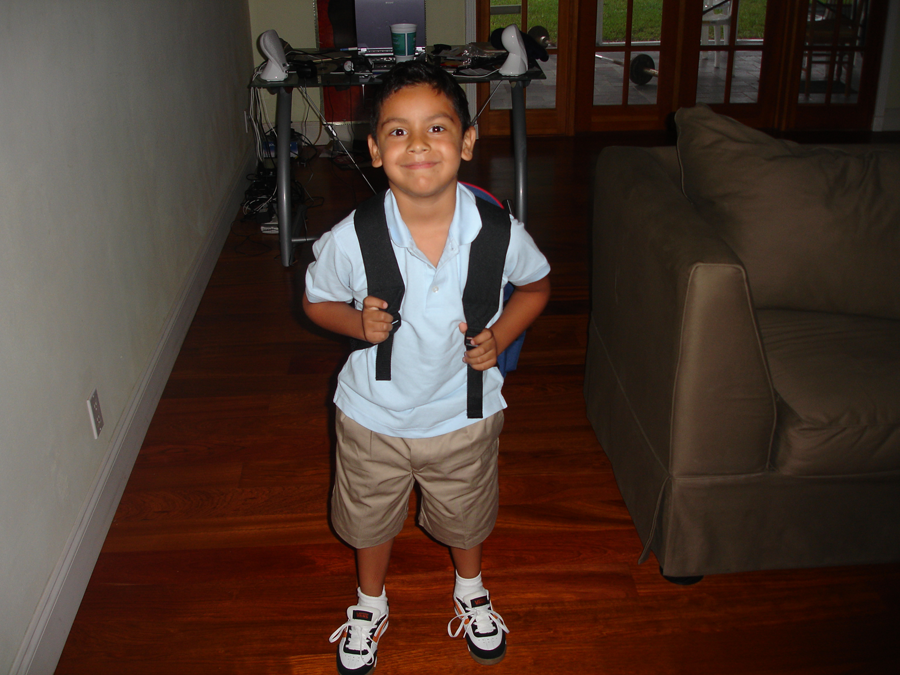
The teacher really made an effort to get to know Miguel and his family, and asked all sorts of questions about how Miguel interacts and participates in family routines. Based on the family’s priorities, they picked one goal from his Individualized Education Plan (IEP) on which to really focus as a team: expanding Miguel’s communication skills.
Identification of a Shared Goal
Once communication has been established and there is a general understanding of the typical day at school and at home, it is important to discuss common challenges and priorities to identify a shared goal. For Miguel, the most critical concern was related to his communication skills. His mother and teacher selected the related IEP goal and discussed it in detail to ensure that everyone was on the same page. Collaborative discussions should include (a) developing a mutual and clear definition of the goal and (b) generating several examples of how the child would demonstrate that goal correctly within the context of typical routines (see Appendix B). By generating examples and optimal scenarios, one not only ensures understanding but also helps parents to pinpoint exactly what they would like to see their child doing. Miguel’s mother identified that during snack time her son could request things like, “Mommy, I want the big plate,” or comment, “This is my blue plate.” Keep in mind, as you progress within your planning of how to address the selected IEP goal within additional routines, it is important to discuss, define, and generate examples of the mutual goal within the context of the new routine.
Planning Learning Within a Routine
When a clear definition and understanding of the shared goal is established, it is time to begin focusing on possible learning opportunities within the selected daily routines. To reduce confusion, it can be helpful to begin by focusing on a single goal within the context of a single routine and then slowly expand the collaborative planning to additional routines and eventually additional goals. Miguel’s parents met with their son’s teacher to talk about how they could support Miguel’s communication during typical routines that happen at school and at home. They started off by talking about what goes on during snack time. The next time they meet, they will discuss learning opportunities during story time. Appendix C provides an example to help breakdown the current routine, as it exists, prior to planning. By selecting initial routines that are similar and occur at school and at home, the collaborative process is supported because ideas that are generated can often be applicable to the teacher and the family. Oftentimes, it is easy to develop learning opportunities just by generating examples of how the goal might be met during any given routine. For example, if Miguel’s mom says that one way for him to correctly use descriptive words during snack is to say “Can I have the green apple?” then the teacher can suggest offering choices between green and red apples during snack to encourage the goal. Similarly, the teacher can share examples of how she might encourage the same goal during similar routines in the classroom. For instance, Miguel might be requesting green or red grapes when choices are offered. Collaborative brainstorming should occur that generates examples of the goal within the context of the routine. When planning for a routine such as story time, the teacher and parent may be reading different books; however, each can benefit from similar strategies to keep the child engaged in the story while promoting the shared goal. For example, the teacher may share how she is going to consider Miguel’s interest by finding books about animals to work on using descriptors to identify the colors of each animal. Miguel’s parents can do the same at home with other animal books. Discussion of the current routine helps to identify new learning opportunities. Small adjustments are made to expand or enhance the routine and address the child’s individualized educational goal.
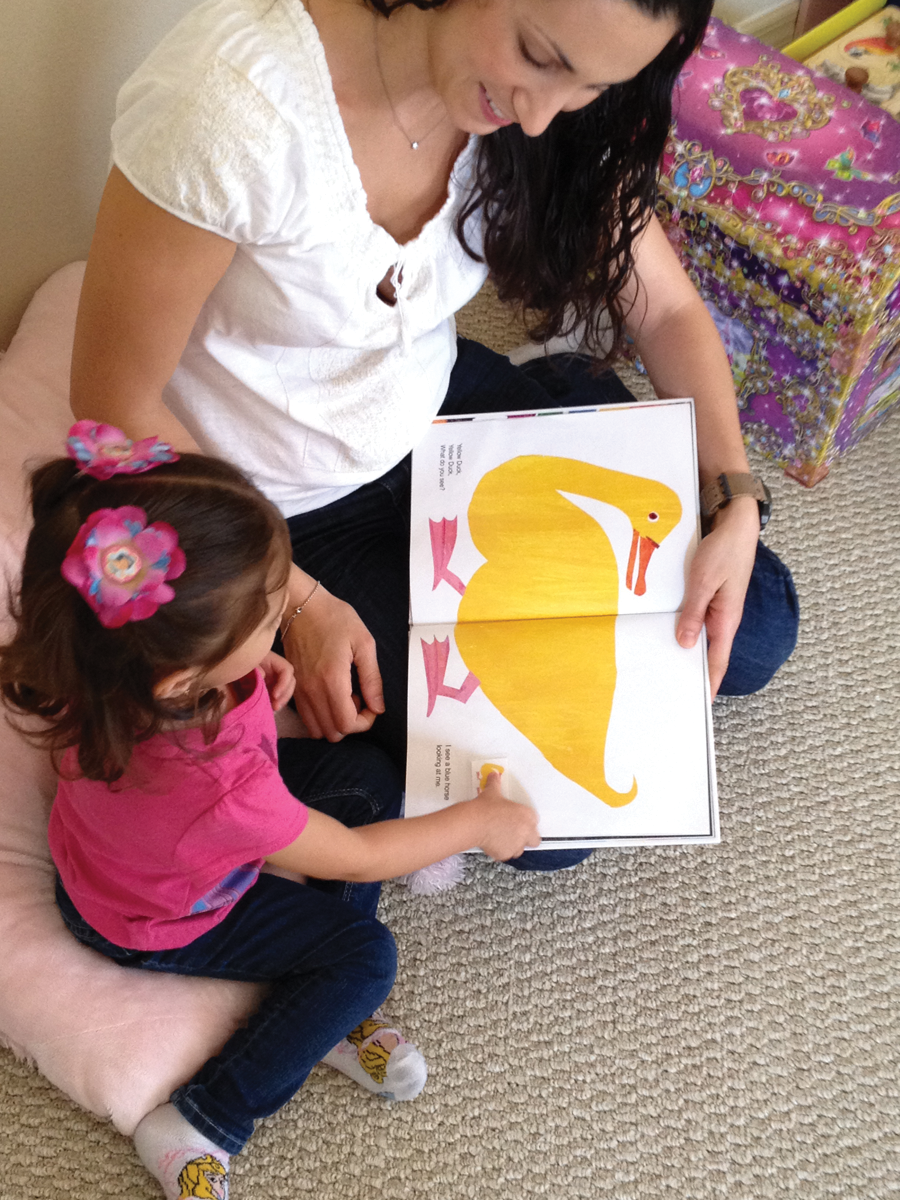
“Planning can be expanded beyond the classroom to include parallel learning opportunities in the home setting.”
Putting It All Together
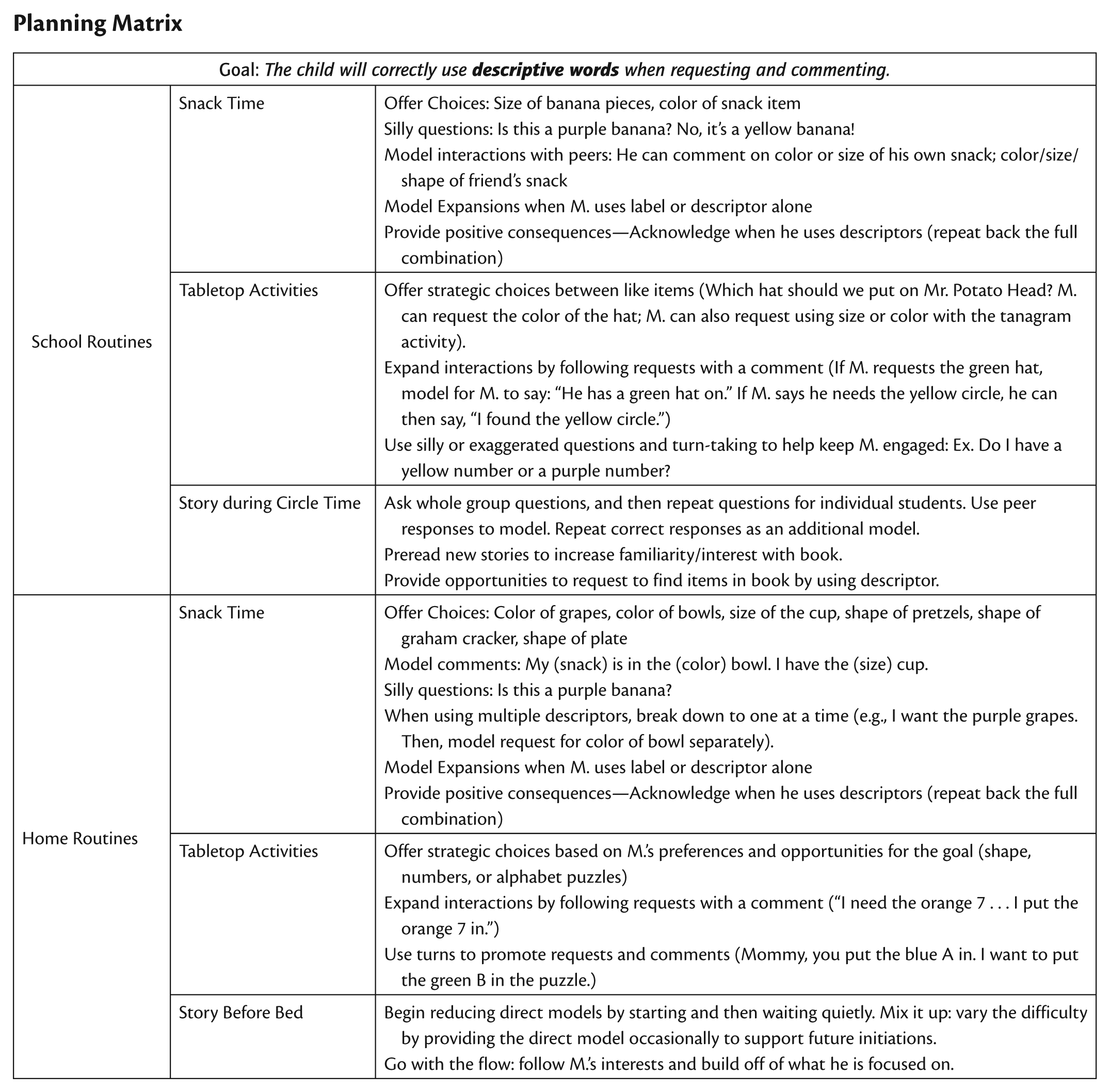
Finally, a planning matrix or summary sheet that serves as a visual reminder to guide interactions within the routines can be developed. The chart, or planning matrix, provides specific examples of simple strategies for addressing the mutual goal during each routine and in each setting. A variety of templates exist for developing planning matrices, which break down each educational goal across daily activities and routines (Cross, Salazar, Dopson-Campuzano, & Batchelder, 2009; Filler & Xu, 2006-2007; Grisham-Brown, Hemmeter, & Pretti-Frontczak, 2005; McWilliam, 2010; Noonan & McCormick, 2006; Pretti-Frontczak & Bricker, 2004; Sandall & Schwartz, 2008). However, the collaborative planning matrix provided in Appendix D illustrates how planning can be expanded beyond the classroom to include parallel learning opportunities in the home setting. Development of the planning matrix provides documentation for the collaborative efforts and summarizes possible learning opportunities that can be provided within each routine to support the shared goal across settings. Language within the collaborative planning matrix should be family friendly and free of formal terminology. The matrix notes, however, should be written to reflect the tone and language used within your collaborative planning meetings. In the end, by getting to know typical family and school routines, identifying similar routines that occur across both settings, pinpointing a mutual goal for the student, brainstorming ways to support the child’s goal throughout the day within the context of typical routines, and ultimately creating the collaborative planning matrix, a strong alliance and equally empowering relationship is developed between the teacher and family.
Miguel’s parents felt so empowered, knowing that they were an important member of their son’s educational team. They were able to support their son’s communication without disrupting family routines and ultimately enhanced their interactions at home. At the same time, they knew they were helping their son to expand his language skills in the classroom as well.
Conclusion
As young children transition into the school system, the focus of intervention often changes from being home-based and family-centered to school-based and child-focused (Branson & Bingham, 2009). Collaborative planning for activity-based intervention across settings can provide a bridge between the school and home. Although instruction and application in routines is provided primarily in the classroom setting, building partnerships with families through collaborative planning allows for increased parent involvement and encourages learning to continue and generalize beyond the classroom. The partnership mutually empowers the teacher and the family to provide a coordinated means for supporting the needs of the child. Furthermore, supports are provided in all of the settings in which the child participates. Because instructional planning goes beyond the classroom setting, the collaborative partnership expands upon and strengthens what the teacher and parent are each able to implement individually. Through collaborative planning for an activity-based approach to intervention, teacher–parent partnerships and communication are fostered, instruction is enhanced, and ultimately, child outcomes are improved.
Footnotes
Appendix
Planning Matrix
| Goal: The child will correctly use |
||
|---|---|---|
| School Routines | Snack Time | Offer Choices: Size of banana pieces, color of snack item |
| Silly questions: Is this a purple banana? No, it’s a yellow banana! | ||
| Model interactions with peers: He can comment on color or size of his own snack; color/size/shape of friend’s snack | ||
| Model Expansions when M. uses label or descriptor alone | ||
| Provide positive consequences—Acknowledge when he uses descriptors (repeat back the full combination) | ||
| Tabletop Activities | Offer strategic choices between like items (Which hat should we put on Mr. Potato Head? M. can request the color of the hat; M. can also request using size or color with the tanagram activity). | |
| Expand interactions by following requests with a comment (If M. requests the green hat, model for M. to say: “He has a green hat on.” If M. says he needs the yellow circle, he can then say, “I found the yellow circle.”) | ||
| Use silly or exaggerated questions and turn-taking to help keep M. engaged: Ex. Do I have a yellow number or a purple number? | ||
| Story during Circle Time | Ask whole group questions, and then repeat questions for individual students. Use peer responses to model. Repeat correct responses as an additional model. | |
| Preread new stories to increase familiarity/interest with book. | ||
| Provide opportunities to request to find items in book by using descriptor. | ||
| Home Routines | Snack Time | Offer Choices: Color of grapes, color of bowls, size of the cup, shape of pretzels, shape of graham cracker, shape of plate |
| Model comments: My (snack) is in the (color) bowl. I have the (size) cup. | ||
| Silly questions: Is this a purple banana? | ||
| When using multiple descriptors, break down to one at a time (e.g., I want the purple grapes. Then, model request for color of bowl separately). | ||
| Model Expansions when M. uses label or descriptor alone | ||
| Provide positive consequences—Acknowledge when he uses descriptors (repeat back the full combination) | ||
| Tabletop Activities | Offer strategic choices based on M.’s preferences and opportunities for the goal (shape, numbers, or alphabet puzzles) | |
| Expand interactions by following requests with a comment (“I need the orange 7 . . . I put the orange 7 in.”) | ||
| Use turns to promote requests and comments (Mommy, you put the blue A in. I want to put the green B in the puzzle.) | ||
| Story Before Bed | Begin reducing direct models by starting and then waiting quietly. Mix it up: vary the difficulty by providing the direct model occasionally to support future initiations. | |
| Go with the flow: follow M.’s interests and build off of what he is focused on. | ||
Author’s Note
You may reach Marisa J. Salazar by e-mail at