






Abstract

It’s writing time, and “Big Paper” is underway in an inclusive, rural kindergarten classroom in the Midwest. The special education teacher, general education teacher, and speech-language pathologist circulate among small groups of students. Many of the students are seated at tables covered with paper, while other children are scattered around a large piece of paper on the floor at one end of the room. The adults observe and visit with the students as they draw and write on the pieces of paper. The children have a variety of writing tools (markers, pencils, letter stamps with large handles, communication devices) to choose from at their workspaces. The kindergarten teacher stops at a table to visit with some students to see what they have chosen to write about. One child is talking about her family trip to a national park as she draws with a marker. Another girl is using a pencil to draw her “whole family,” about 10 people. A third child is drawing her family and a rainbow with crayons. An adult at the table is assisting one of the students, Mark. She presents him with writing tools, asking him whether he’d like to use one to draw his dad. Mark tips his head back, activating a switch that voices, “Yes” indicating that’s what he wants.
These children are engaged in Big Paper, a type of writing activity that provides children with and without disabilities a venue to develop as authors, collaborators, and critics. Mark, the boy at the table in this vignette and other vignettes discussed in this article is a kindergartener who spends the majority of his school day in a general education classroom. His educational team uses a variety of person and assistive technology supports to accommodate for the vision, communication, and motor difficulties that create a challenge for him to independently explore his environment and participate as actively in kindergarten as he might otherwise. Big Paper is one classroom activity that provides an avenue to target some of the team’s goals for his development, particularly at this time, his communication skills. The team was working with Mark to practice using a communication system incorporating a low-tech augmentative and alternative communication (AAC) device that would hopefully allow him to improve his ability to respond to questions, indicate his choice, and initiate communication with adults as well as peers. Since Mark was not observed to verbally express information and had difficulty using his vision and his hands to explore his environment, the communication system consisted of a communication book, two voice output switches (accessed with his head), and a partner. The communication partner named each item within each column, and Mark used his switches to indicated if that was the vocabulary word he wanted or if wanted the next item to be named. The process of the partner naming vocabulary and the student indicating the desired item is called partner assisted scanning (Burhkart & Porter, 2006). The opportunity also provided him a means to observe peers’ language use during the interaction. Finally, the adults modeled communication with his communication device by using it while they explained the task and commented on the work of other students’ work.
“Writing is also an integral aspect of a child’s overall literacy development.”
Introduction
Writing is critical to young children’s development in many ways. It strengthens abstract thinking, activates metacognition, spurs creativity, and encourages social negotiation (Dyson, 2003; Owocki, 1999). Writing is also an integral aspect of a child’s overall literacy development (Sulzby, 1985). Because listening, speaking, reading, and writing develop concurrently; engaging in writing activities on a regular basis contributes to children’s oral communication and reading skills (Boyle, 2011; Jacobs, 2010; Larkin, 2009; Shanahan, 2005; Teale & Sulzby, 1989; Wiseman, 2003). In fact, research demonstrates that some children learn to write before they learn to read (McGill-Franzen, 2006).
In 1998, The International Reading Association and the National Association for the Education of Young Children (IRA/NAEYC) issued a joint position statement concerning the importance of developmentally appropriate literacy activities for young children, with writing taking a prominent role. Specifically, creating opportunities for children to see adults and peers communicate their own thoughts and ideas in print was recommended, even for preschoolers. For kindergarten and primary-grades students, the IRA/NAEYC joint guidelines expanded to highlight the need for children to explore a range of types of writing. Equally significant, research has suggested and viewed the act of extending the social context so often found in early learning spaces to writing as beneficial and perhaps even instrumental to developing writing skills (Calkins, 1994; Graves, 1983; Nystrand, 1986). Recent research supports those policy recommendations, finding that children often use oral communication, drawing, and writing interconnectedly when writing together, which creates a more developed story than what students are able to write on their own (Boyle, 2011; Jacobs, 2010; King, 2012; Larkin, 2009; Wiseman, 2003). Wiseman (2003) described the environment most conducive to the writing process for young children as “creative, messy, collaborative, and talkative; the room buzzes with voices and movement.” (p. 804). Nolen (2007) described these classrooms as being a “literate community,” meaning “classrooms in which literacy activities establish and maintain relationships among individuals” (pp. 210-211).
The literature is clear that composing is an activity children desire to do, that happens best when children can interact with one another, and that positively impacts a host of other skills including academic, social, and cognitive (Graves, 1983; Nolen, 2007; Teale & Sulzby, 1989). However, many educators of young children continue to limit (or omit) writing time due to their uncertainty regarding how best to teach writing and integrate it into the school day. Some teachers of young children provide little time for the child-constructed and open-ended writing opportunities children need, instead focusing on letter formation and beginning spelling work. For children with disabilities, the situation is even bleaker. Children with developmental disabilities have markedly fewer opportunities for literacy learning than their nondisabled peers (Kliewer, 2008; Koppenhaver & Erickson, 2003; Mirenda, 2003). However, research has demonstrated that children with complex learning challenges can grow in their literate profiles when given the same sort of learning opportunities as their nondisabled peers (Broderick & Kasa-Hendrickson, 2001; Erickson & Koppenhaver, 1995; Kliewer & Landis, 1999). It is important to remember that sometimes the additional support of technology is required for students to actively participate in writing (Erickson & Koppenhaver, 2007; Staples, Pugach, & Himes, 2005). Furthermore, a joint position statement of the Division for Early Childhood of the Council for Exceptional Children (DEC) and the NAEYC regarding inclusion discussed the importance to ensure that access, participation, and supports are addressed for all students during the class day (DEC/NAEYC, 2009).
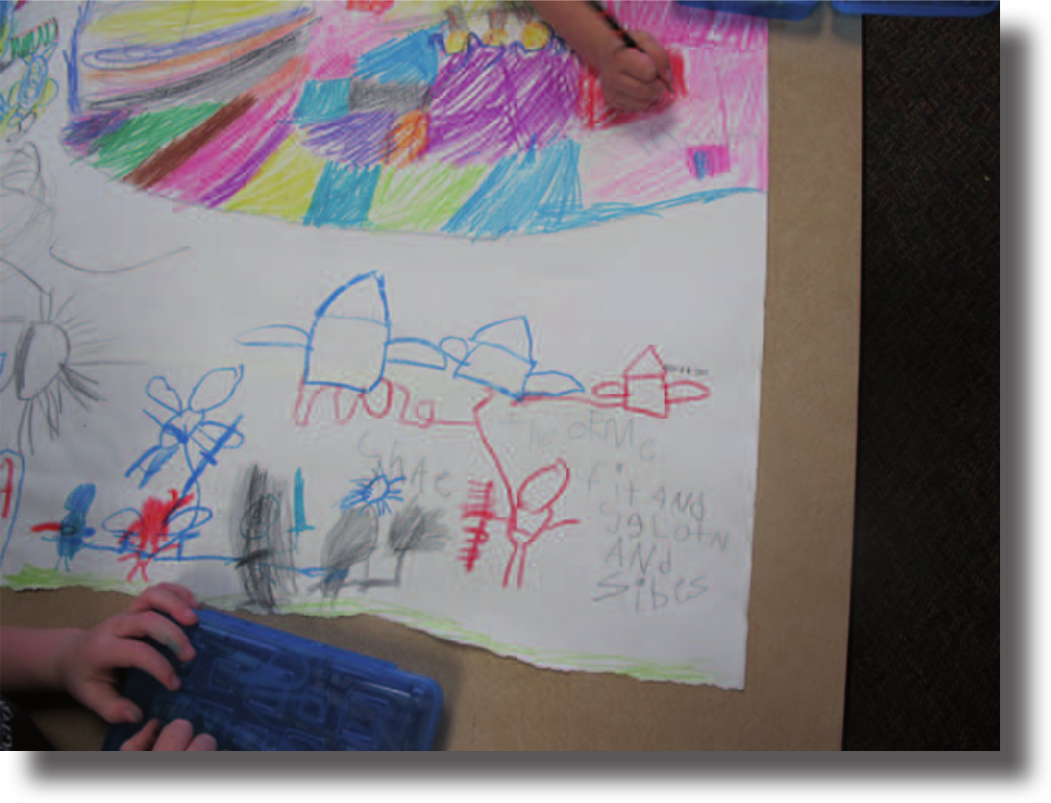
This article describes an authentic, social, inclusive writing activity for young children (preschool to second grade) with and without disabilities engaged in what the second and third authors called Big Paper. In addition to detailing the activity, recommendations for maximizing the participation of all students and monitoring student progress will be provided.
The Activity
History
Big Paper began with a teacher in a Head Start preschool classroom as a way to engage all of her students, some of whom had behavioral, intellectual, and/or mild physical disabilities, in an inclusive, constructive, developmentally appropriate writing activity. The Big Paper writing activity met many recommended parameters, such as supporting the interactive nature of emergent literacy by combining the opportunity for writing, reading, and language during one activity; providing small group (language rich) interactions with peers and adults to explore writing; and providing the opportunity for exposure to a variety of types of writing (Calkins, 1994; DEC/NAEYC, 2009; Graves, 1983; IRA/NAEYC, 1998; Nystrand, 1986). In addition, by incorporating universal design features such as communication tools, a range of writing implements, and an open writing space, Big Paper easily allowed for the active, authentic participation of all children in the classroom meeting access, support, and participation highlighted in the DEC/NAEYC (2009) position statement.
The children in the teacher’s preschool classroom responded so positively to the activity that it became a regular occurrence. An action research project (Huber, 2010) and subsequent ongoing qualitative research in preschool and primary classrooms that include children who are English Language Learners and/or have moderate to severe developmental disabilities substantiates the communication and writing opportunities of this activity for children from preschool through second grade.
Implementation
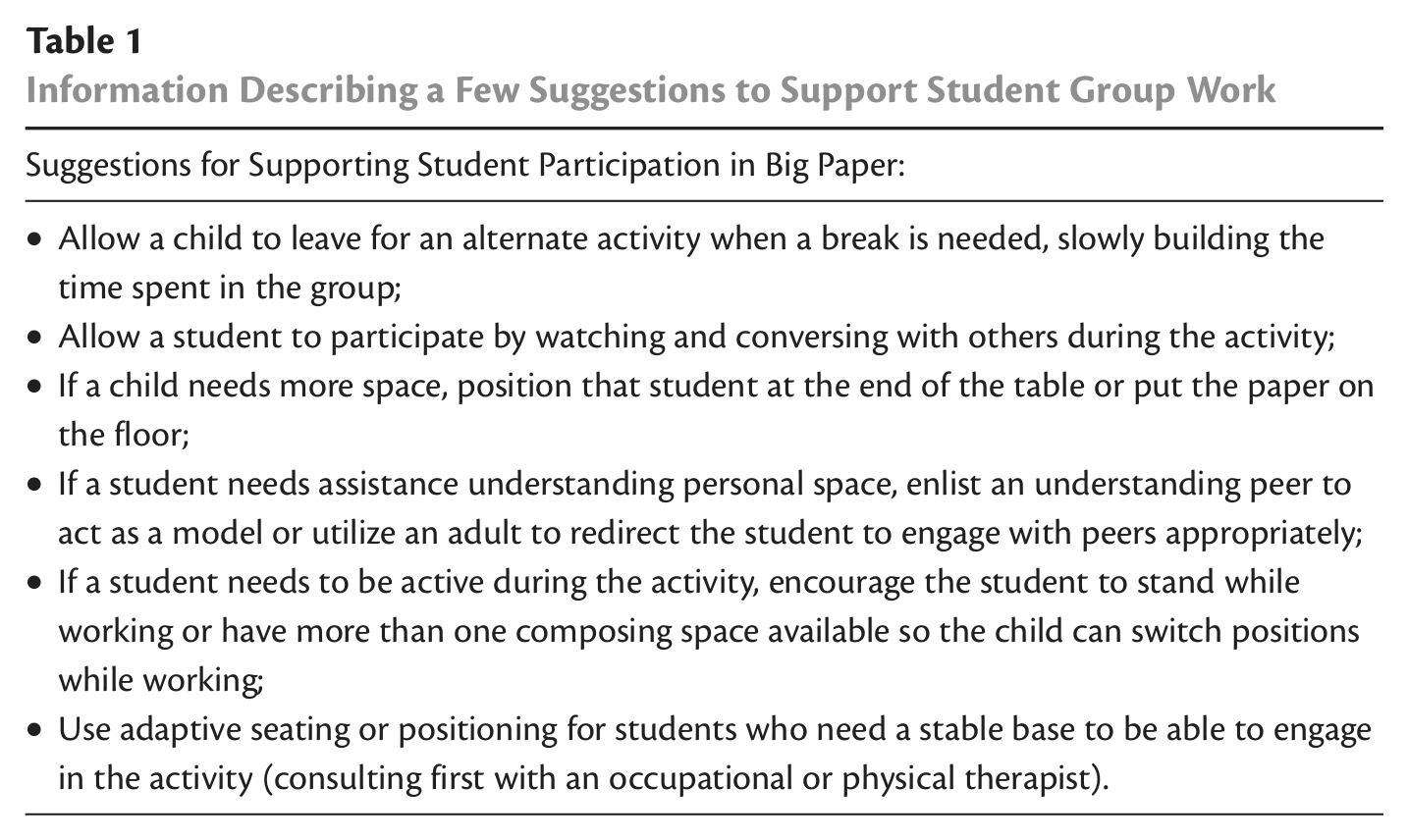
Simple in preparation and implementation. Big Paper allows children to be “engaged in experiences that make academic content meaningful and build on prior learning” (IRA/NAEYC, 1998, p. 2). To promote the interaction and language development of all children, including those who might be English Language Learners or who have complex communication needs (CCN), children are seated around large pieces of newsprint or bulletin board paper. The paper can be spread across a large table or placed on the floor, depending on students’ access needs and teachers’ preferences. The children are encouraged to talk and collaborate with one another as they work with a variety of tools (e.g., crayons, markers, letter stamps, colored pencils, communication devices, alternative pencils) to create individual or shared compositions. Ideally, to capitalize on the social, collaborative nature of this activity, no fewer than four to five children are gathered around the paper at any one time. If there is concern that a group of this size may be challenging or new for some students, a few adjustments could be explored to offer support. Table 1 lists several example strategies. When all students in a classroom are participating in the activity, there may be four or five pieces of Big Paper throughout the room. The number of adults in the room may also vary. Although there were a total of four adults in the initial vignette, the activity can be completed with as few as one or two.
Information Describing a Few Suggestions to Support Student Group Work
Children are free to draw and/or write on topics of their choosing, resulting in graphic and text-based renderings derived from their experiences, interests, and culture that often overlap with those of their peers, increasing the likelihood peers will show interest in or comment on one another’s work (Dyson, 2008). Teachers may also, on occasion, suggest a topic based on a recently read book or shared classroom experience.
There are few directions given to children before beginning this activity. Some children know what they want to communicate in print. Others glean ideas by first watching their peers. Still others begin with one idea that evolves into something else. Children will naturally seek out teachers’ approval and want to show off their work, so simply making supportive comments is often enough to keep children engaged in their own writing or that of their peers. Careful comments such as “Tell me about your writing,” or “I love the detail you’ve got here,” and “What else are you going to write?” provide adults an opportunity to expand children’s understanding of composition (e.g., readers appreciate detail and humor and action, annotating drawings can lend clarity to compositions) while affirming, encouraging, and celebrating the authors’ intentions and compositions. In these ways, adults serve as essential facilitators rather than directors during Big Paper, allowing the writing to be open ended and “child constructed” rather than “teacher directed.”
“Adults serve as essential facilitators rather than directors during Big Paper, allowing the writing to be open ended and ‘child constructed’ rather than ‘teacher directed.’”
Pieces of paper are replaced as they are filled, with the length of the Big Paper session determined by the children’s continued interest. It is common at the preschool and early elementary levels for this activity to last between 20 and 40 min. After the writing portion of the activity is complete, children share their compositions with their peers, who remark on aspects they like or might want to know more about. Sharing or conferencing about writing teaches children what peers’ value in writing and what they need to know to understand others’ writing (King, 2012; Nolen, 2007).
As a follow-up to the Big Paper activity, a teacher may revisit those graphic compositions on subsequent days, using them as plans or storyboards to encourage children to construct new text or add to existing text. For example, at one table, four boys drew and wrote about a group of army men who were captured, but then escaped by using a key in a box that would unlock a cage. The classroom teacher brought out the paper on a later date and asked the boys to write text to accompany the drawings and short text on the Big Paper. Other instances of extension activities could include one or more of the following: teachers leading a shared writing or language experience activity resulting in a group or class story (either dictated or students working together) from the ideas on the Big Paper; authors sharing their piece or describing their thinking behind their creation; students acting out the story (if a story was present); or classes decorating the room with the Big Paper products to stimulate conversations about the drawings/writing during other times of the day.
“In order for all children, including those from linguistically diverse backgrounds and those with complex learning challenges, to reap maximum benefit from a Big Paper writing session, they must be able to participate with peers in the writing activity as well as the communication about the writing.”
Maximizing Participation and Benefit
In order for all children, including those from linguistically diverse backgrounds and those with complex learning challenges, to reap maximum benefit from a Big Paper writing session, they must be able to participate with peers in the writing activity as well as the communication about the writing (DEC/NAEYC, 2009; NAEYC, 1995). That is not to say that children with complex needs should be excluded from Big Paper. As Koppenhaver, Coleman, Kalman, and Yoder (1991) so aptly stated, the idea that any child, “is too communicatively, cognitively, or motorically impaired to benefit from experiences with written language” (p. 38) is not supported by research and so “written language activities should not be withheld while speech, language, and cognition reach a prerequisite level” (p. 42). Before beginning Big Paper, educators should plan for and collaborate to ensure that access, participation, and supports have been addressed for all students (DEC/NAEYC, 2009).
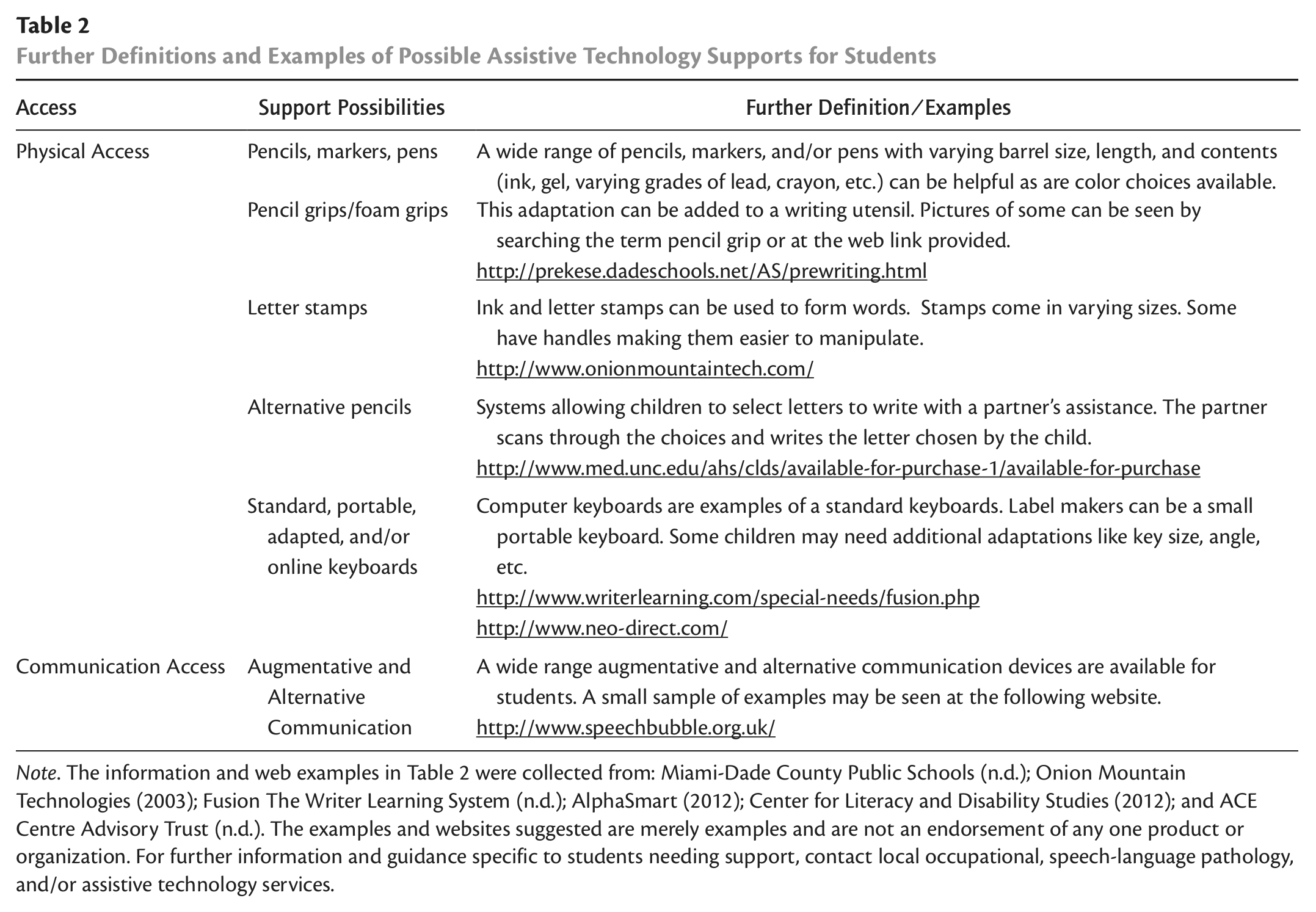
Fortunately, a variety of tools can be utilized to enable students with even the most complex needs to actively participate in both the composing and social interaction that are so fundamental to the Big Paper activity. To participate fully, the students must have a way to express ideas through writing, such as with modified writing implements. For instance, children unable to hold a writing tool of any kind might benefit from an alternative pencil such as those developed at the Center for Literacy and Disability Studies (2012) at the University of North Carolina at Chapel Hill. One example of an alternate pencil is a laminated alphabet board that, when used with a partner, can provide the child with a way to write the letters of their choosing. The writing partner scans through the letters and the child indicates which letters and with what frequency he or she would like to write. Other physical access options could include more complex technology such as computers, portable keyboards, or adapted keyboards. Table 2 lists additional examples of assistive technology support possibilities.
Further Definitions and Examples of Possible Assistive Technology Supports for Students
Note. The information and web examples in Table 2 were collected from: Miami-Dade County Public Schools (n.d.); Onion Mountain Technologies (2003); Fusion The Writer Learning System (n.d.); AlphaSmart (2012); Center for Literacy and Disability Studies (2012); and ACE Centre Advisory Trust (n.d.). The examples and websites suggested are merely examples and are not an endorsement of any one product or organization. For further information and guidance specific to students needing support, contact local occupational, speech-language pathology, and/or assistive technology services.
Because an essential aspect of Big Paper is the conversation that happens among children and between adults and children (Nystrand, 1986), it is crucial children have a means to interact with others. Commenting, asking questions, and coming up with ideas for writing are integral to the Big Paper writing sessions. As children begin to draw, they often talk to one another, sharing what they are drawing/writing, commenting on one another’s writing, and conversing about/negotiating shared compositions. The conversations mediate meaning for children, helping them generate ideas, plan what they want to write, and revise their work (Dyson, 1989; Hubbard, 1989; Matthews, 1999). Interactions are improved when (a) children have access to communication systems, (b) teachers as well as peers acknowledge all communication attempts even if meaning is not clearly understood (Cress, 2006; Cress & Marvin, 2003), and (c) teachers model communication using the students’ communication systems (Blackstone, 2006; Burkhart & Porter, 2006; Goossens, Crain, & Elder, 1992).
A communication system can be defined as all forms of communication an individual uses to convey a message (Beukelman & Mirenda, 2005). That can include communication created with one’s own body such as gestures, vocalizations, speech, facial expressions, and/or words using sign language. It can also include additional aids, like photos, line drawn pictures, and communication devices (ranging from low-tech books with line drawn pictures to computers with voice output) for children with CCN. Each system will vary and is developed based on individual need. A speech-language pathologist, an occupational therapist and assistive technology team member can assist classroom teachers in determining a method for a child to communicate and participate in the academic setting at hand.
Acknowledging all communication attempts requires watching and listening to the student carefully, especially if the student has CCN. Some initial communication attempts may be very subtle nonverbal attempts. For example, Mark changed his body position and tilted his head when he was interested in something. The adults and/or peers then began to ask if he had something to share when this was noticed. They used his communication system to help him share and expand his message with symbols.
“Commenting, asking questions, and coming up with ideas for writing are integral to the Big Paper writing sessions.”
Modeling the function of the communication systems by using them when talking with the student can help him learn how to use the AAC system (Blackstone, 2006; Porter & Burkhart, 2010; Goossens et al., 1992). For instance, the adult may use speech and symbols to make a statement like, “You’re smiling.” They could ask a question like, “What are you thinking?” The words in italics are the symbols selected during the verbal message. As individuals become more comfortable modeling the use of symbols while they speak, they may touch more symbols representing more words within the message.
As the Big Paper activity continued with the four children seated at the table, the adult used Mark’s communication device by pulling off, touching, and naming the symbols needed to ask him what he wanted to write about. She then systematically continued to scan through Mark’s communication system so he could tell her which pages to navigate and what he wanted to write about. He indicated by telling her with his switches, “No” meaning to move to the next symbol and “Yes” meaning that is the symbol he wanted (sometimes resulting in turning to another page if he selected “Turn the page” or “Go to categories” etc.). He expressed that he wanted to write about people, specifically his family. She further navigated through his system to ask what writing utensils, colors, and pictures he wanted her to use while he “dictated” his message using symbols. In addition, she scanned through his vocabulary so he could dictate what he wanted her to write as he developed messages about his family. She used his device to express examples of what she might say or what peers were writing as a model. She also observed nonverbal and verbal communication to ensure if peers or if Mark were attempting to communicate with each other so that both parties were aware and had an opportunity to respond.
What Teachers Can Learn From Writing
Through observation during Big Paper writing sessions and artifact review after the fact (e.g., samples of written work, video, language sample transcription), professionals can learn a great deal about a child’s understanding of and facility with the writing process, fine motor development, knowledge of print concepts, social interaction skills, and language development. The writing process is complex, yet there are indicators children are improving in their ability to navigate it. Analysis of written work may show increasing variety of topic, complexity, understanding of audience, or detail in drawings. Observing children during writing allows educators to assess what children know about writing left to right, making letters versus drawing, forming letters, and how letters comprise words and spelling patterns.
The social nature of the activity provides the ability to observe and/or transcribe interactions with adults and peers. The transcriptions are written samples of the language used during the interaction. One can monitor how students initiated conversations, asked questions, clarified messages, shared information, resolved conflicts, and retold stories. The length of conversations, the length of messages, and the tools (speech, gestures, picture, etc.) the child uses to communicate can also be monitored.
When Mark began participating in this activity early in the school year, he did not reach out to select markers or to assist with drawing. He also did not share the content of his message with symbols in his communication device. He did not use switches to augment his participation. He did vocalize and gesture for a short period of time before indicating he wanted to leave. Collected video, teachers’ notes, and the speech-language pathologist’s language sampling provided the educational team with documentation of changes in Mark’s participation; specifically, Mark’s use of switches at his head to direct a communication partner to navigate symbols to identify writing topics, speak messages, and/or on occasion ask questions about a peer’s work. For instance, after an assistant had just been conversing with a child at Mark’s table about her drawing, Mark’s body language, sitting straight up, turning his head a bit in that direction, and remaining still, led his assistant to ask him if he had something he wanted to say to his friend. He said, “Yes” with his switch indicating he did. Through partner-assisted scanning he asked the girl, “Where” she was in her picture. The girl then explained her drawing to Mark.
Conclusion
Communicating one’s thoughts and ideas through print is important, yet challenging work (Boyle, 2011; Jacobs, 2010; Larkin, 2009; Sulzby, 1985; Wiseman, 2003), and so perhaps requires a more open medium than teacher-directed tasks often allow. Vygotsky (1978) stated, “The best method (for teaching reading and writing) is one in which children do not learn to read and write but in which both these skills are found in play situations” (p. 118). In other words, children may learn best, and demonstrate what they know, when their “work” feels more like creative play. Teachers may teach most effectively, when they facilitate learning during child-constructed, socially rich learning endeavors such as Big Paper. Examination of Big Paper revealed children attending to and engaging in the activity by exploring writing, storytelling, and multiple modes of communication. Children with significant developmental disabilities demonstrated sophisticated thinking and composing behavior that made clear their increasing understanding of and facility with the purposes of written communication. Educators have the opportunity to use Big Paper as a developmentally appropriate literacy activity (IRA/NAEYC, 1998) for all students by addressing access, participation, and supports (DEC/NAEYC, 2009). Big Paper, although not a writing program in and of itself, may be a starting place for teachers questioning how to introduce writing as well as a relevant addition to classrooms with strong writing programs already in place.
Footnotes
Authors’ Note
The content of this article was derived from work supported in part by a contract from the Iowa Department of Education, using funds made available by the U.S. Department of Education under IDEA and a Fund for the Improvement of Education (FIE) award (grant number U215K100109) from the U.S. Department of Education. The contents of this article do not necessarily represent the policy of either the Iowa Department of Education or U.S. Department of Education. Endorsement by either entity should not be assumed. You may reach Evette Edmister by email at