






Abstract

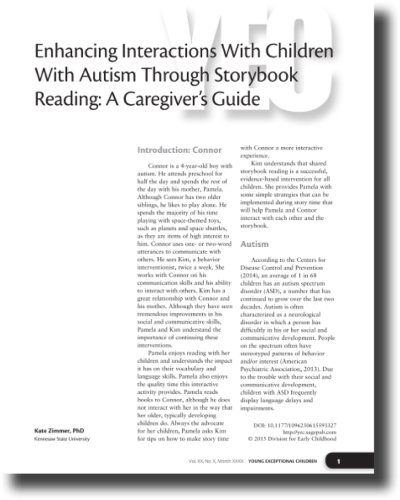
Kate Zimmer’s article (“Enhancing Interactions With Children With Autism Through Storybook Reading: A Caregiver’s Guide”) encourages practitioners to provide information on effective instructional strategies that could increase positive interactions during shared book reading between children who have an autism spectrum disorder (ASD) and their family members. Building from the content and resources of the article, here are some ideas for how to enhance emergent literacy experiences for young, diverse learners and extend the application of instructional strategies from school to home environments.
“Here are some ideas for how to enhance emergent literacy experiences for young, diverse learners and extend the application of instructional strategies from school to home environments.”
Broaden your knowledge of instructional practices, such as shared book reading, that are linked to increasing children’s early literacy skills by reading the National Early Literacy Panel’s (NELP, 2008) report Developing Early Literacy. Choose the level of information that is right for you!
https://www.nichd.nih.gov/publications/pubs/documents/NELPReport09.pdf (231-page full report)
https://www.nichd.nih.gov/publications/pubs/documents/NELPSummary.pdf (8-page executive summary)
Explore the types of questions you ask during shared storybook reading. Ask a colleague to observe you, or set-up an audio or video recorder to document the questions asked during a read-aloud. Examine the types of questions you use more or less frequently or questions that may not be used at all, drawing on Table 4 from the article as a reference. Consider how your current questioning patterns provide children with numerous opportunities to respond and be successful. Going one step further, examine how you are using wait time, modeling responses, supporting extended conversation strings, or providing children with feedback.
“Use the article as an invitation to explore the extent to which educators share knowledge about instructional strategies with families.”
Guide students/participants to consider the congruence in recommended practices for young children with ASD and other aspects of diversity, such as young children who are learning English and one or more other languages. Consider pairing this article with Gillanders and Castro’s “Storybook Reading for Young Dual Language Learners” (http://www.naeyc.org/files/yc/file/201101/GillandersOnline0111.pdf). Ask students/participants to create a graphic organizer that represents the similarities and differences in suggested strategies for children who have an ASD and children who are dual language learners. Students/participants can expand or revise the visuals as they learn additional instructional strategies for teaching early literacy skills to children from other cultural, linguistic, and ability diverse backgrounds.
Require students/participants to develop a selective list of books based on a child’s interests. Other components of this activity or assignment could include the following:
Using the checklist presented in Table 2 to evaluate potential books to be included. Require students/participants to supplement the list with additional known criteria for selecting high-quality children’s literature.
Creating a discussion guide for family members for each identified book. The guide could highlight new vocabulary and comprehension questions that families can explain and ask. For an additional challenge, require students/participants to include kid-friendly definitions and answers alongside the suggested vocabulary and questions.
Consider sharing the following free resources with students/participants to assist in the curation of themed books:
Read & Shine (go to http://www.readandshine.com, then go to “Reading Lists” to find books grouped by age and/or topic)
Reading Rockets (http://www.readingrockets.org/books/booksbytheme). Note: Reading Rockets also includes a Book Finder tool to assist in creating a customized booklist at http://www.readingrockets.org/bookfinder
Use the article as an invitation to explore the extent to which educators share knowledge about instructional strategies with families. Questions that may be considered include (a) how can we discover the types of strategies that families might find most beneficial? (b) what strategies do we feel are most important for families to learn? (c) what modes of communication might be most successful for reaching the families in our school community?
Ideas for how to understand and use the Developing Early Literacy report practices to increase opportunities for literacy learning throughout the school day may be found in this publication:
https://www.nichd.nih.gov/publications/pubs/documents/NELPEarlyBeginnings09.pdf
Footnotes
Author’s Note
You may reach Lori Erbrederis Meyer by e-mail at