






Abstract

In Ms. Jay’s inclusive preschool classroom, two girls were playing in the house area. As they began to argue, Ms. Jay tried to support them, “It sounds like you have a problem, can we solve it together?” “It’s my turn with that baby—I want it!” Angie said as she pointed to a baby doll held by Sam. “Not fair! I had it first!” said Sam, holding it tighter. Ms. Jay asked to hold the doll and picked up another one from the cradle. “Look here’s another baby, can you play with this one?” Ms. Jay asked, offering it to Angie. “I don’t want the Black baby doll,” Angie said frowning and turning her back, “They’re always on sale.”
In early childhood (EC) and early childhood special education (ECSE) settings, comments like these can stop educators in their tracks. What do we say to the children? While EC/ECSE educators may recognize young children are grappling with ideas about racial identity and fairness, they may feel unsure of how to respond, may be hesitant about what is appropriate to introduce, may question their own competence in facilitating racial dialogue, and/or may express concern about supporting curriculum that is accessible to all children. As former inclusive educators and current EC/ECSE scholars, we have witnessed these comments from young children in our own classrooms and have felt unsure about race conversations with children. In this article, we describe an inclusive, anti-bias approach for teaching and learning about race in EC/ECSE. To this end, we (a) discuss the importance of addressing race in EC/ECSE classrooms; (b) introduce an inclusive, anti-bias framework for teaching and learning about race in EC/ECSE; and (c) use an example from practice to illustrate and unpack each component of the framework.
Why an Anti-Bias Approach to Teaching and Learning About Race?
Research shows that young children notice racial differences, construct racial categories, and make racial evaluations. By age 3, White children can demonstrate prejudicial attitudes and discriminatory behaviors toward individuals of color (Aboud et al., 2012), and children of color may demonstrate preferences for lighter skin (Kaufman & Wiese, 2012) or internalize racial biases (Jordan & Hernandez-Reif, 2009). Yet, young children do not develop these ideas in a vacuum. Instead, young children are actively learning about race (and how race intersects with other identities) through interactions and observations in inequitable social contexts (Park, 2011). For instance, because the majority of recently published picture books featured White characters (Koss, 2015), a trip to the public library may implicitly communicate to young children that “whiteness” is superior. Furthermore, young children may witness or experience racially biased disciplinary actions, such as the disproportionate suspension and expulsion of African American children from preschool (Kirwan Research Institute, 2014). As young children enter racially stratified educational systems with differential racial compositions (Orfield, 2009), opportunities (Carter & Welner, 2013), and resources (Ladson-Billings, 2006), they may interpret that racial unfairness is normal.
“Young children will not have strategies for interrupting racism if we do not teach them to recognize it.”
In EC/ECSE settings, how educators engage young children in learning about race matters. Without tools to interpret everyday racial messages, young children may internalize misconceptions, learn racial hierarchies, or assume that talking about race is taboo (Boutte, Lopez-Robertson, & Powers-Costello, 2011). Professional organizations note the importance of fostering children’s sense of belonging (Division for Early Childhood of the Council for Exceptional Children [DEC] & National Association for the Education of Young Children [NAEYC], 2009), engaging in inclusive efforts to prevent discrimination (Council for Exceptional Children, 2008), and examining, responding to, and challenging bias (NAEYC, 2016). In the context of racially inequitable systems, such professional values are particularly important with regard to children’s learning about race and racism. To see the aforementioned professional commitments through, EC/ECSE educators cannot be silent about race and fairness. Said differently, young children will not have strategies for interrupting racism if we do not teach them to recognize it.
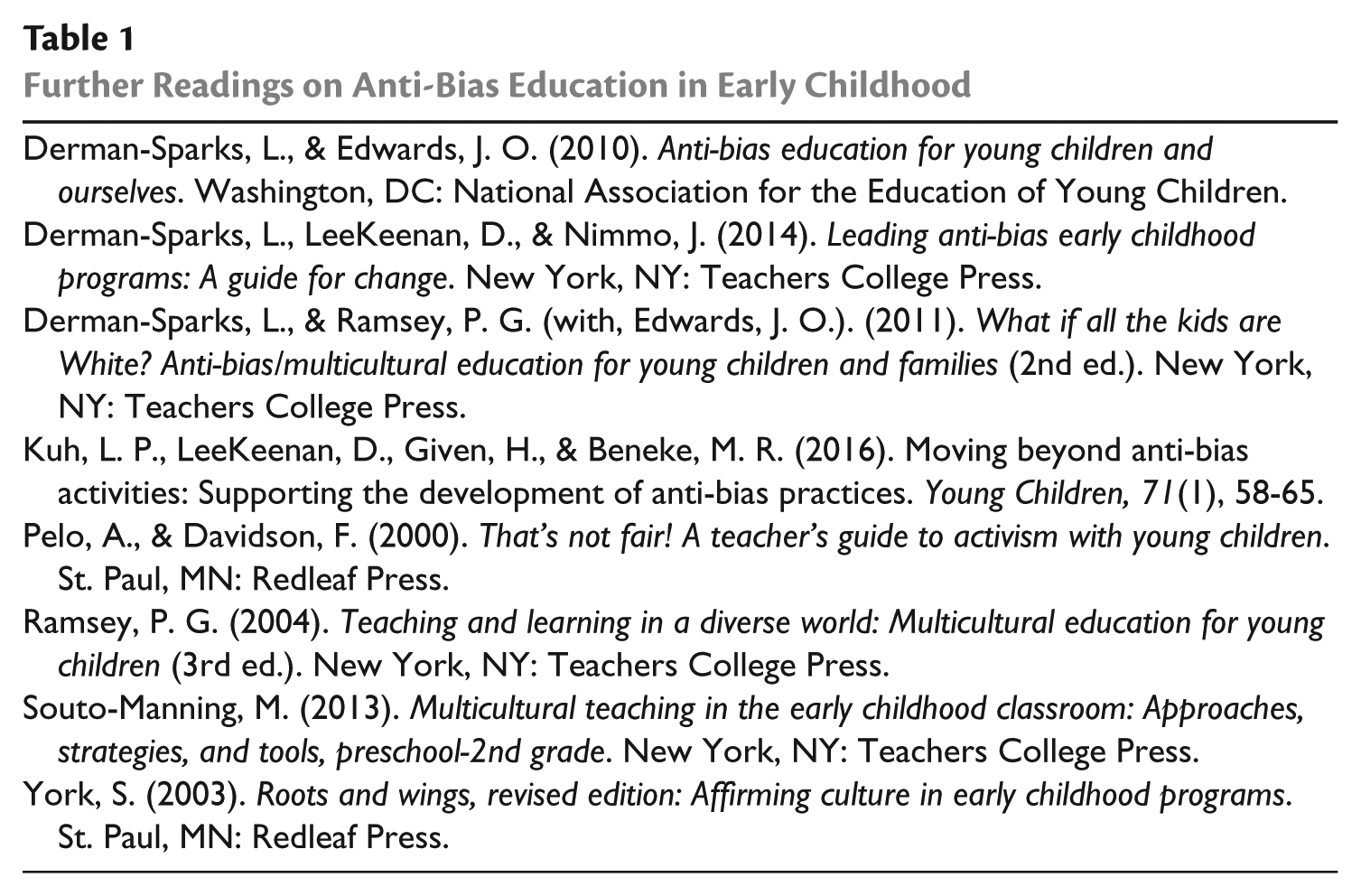
An anti-bias approach is one way for early educators to support all young children’s learning about race and fairness. Anti-bias education aims to teach all children to be proud of their identities, to respect a range of human differences, to recognize unfairness and bias, and to act against prejudice and discrimination (Derman-Sparks & Edwards, 2010; see Table 1 for additional readings).
Further Readings on Anti-Bias Education in Early Childhood
This approach is supported by research which indicates that teaching young children about race and racial bias can positively impact their attitudes regarding people of color and people whose racial identities differ from their own (Johnson & Aboud, 2017; Qian et al., 2019; Xiao et al., 2015). Anti-bias education is important for all children and shows promise in inclusive EC/ECSE contexts (Kuh, LeeKeenan, Given, & Beneke, 2016; Sapon-Shevin, 2017). Taking an anti-bias approach involves ongoing teacher inquiry and responsiveness to young children’s emotional expressions and cognitive understandings about race. Such responsive interactions can have a positive impact on how young children understand racial identities (Qian et al., 2019), communicate these ideas with others through language and play (Leman & Lam, 2008), and employ strategies to advocate for racial fairness (Derman-Sparks & Phillips, 1997). Thus, an anti-bias approach both aligns with and complements the DEC’s (2014) Recommended Practices for young children’s social-emotional development and communication development (i.e., INT1, INT2, INT3).
“Importantly, anti-bias teaching and learning about race in EC/ECSE does not begin or end with a particular lesson. Instead, anti-bias education is an ongoing process of observation, critical reflection, and action.”
A Framework for Anti-Bias Teaching and Learning About Race in EC/ECSE
Importantly, anti-bias teaching and learning about race in EC/ECSE does not begin or end with a particular lesson. Instead, anti-bias education is an ongoing process of observation, critical reflection, and action. Given that many educators have learned not to talk about race or racial inequity (Boutte et al., 2011), this iterative process can be both difficult and uncomfortable. Educators may feel that they do not have enough racial knowledge to engage in this work, do not know the correct language to address children’s comments or questions about race (e.g., Angie’s comment about playing with the Black baby doll in the vignette), or are not equipped with tools to provide all children access to these conversations. Yet it is impossible to ever be fully prepared for these conversations, and anti-bias teaching and learning about race is important for all early educators to engage in. Early educators can expect and embrace the complexity of this work by positioning themselves as learners alongside children and families. When engaging in anti-bias teaching and learning, it is essential to proactively partner with families in this work. Educators can create multiple formal and informal opportunities for families to regularly learn about anti-bias education, ask questions, and provide input (Derman-Sparks, LeeKeenan, & Nimmo, 2015). Families can be active participants in their children’s learning when educators communicate prior to—and concurrently with—ongoing classroom discussions rather than after the fact (Beneke, Park, & Cheatham, 2014).
To support early educators to engage in this work, we offer the Inclusive Framework for Anti-Bias Teaching and Learning About Race in EC/ECSE (see Figure 1), which we have adapted from our work with colleagues (see Derman-Sparks et al., 2015; Kuh et al., 2016).
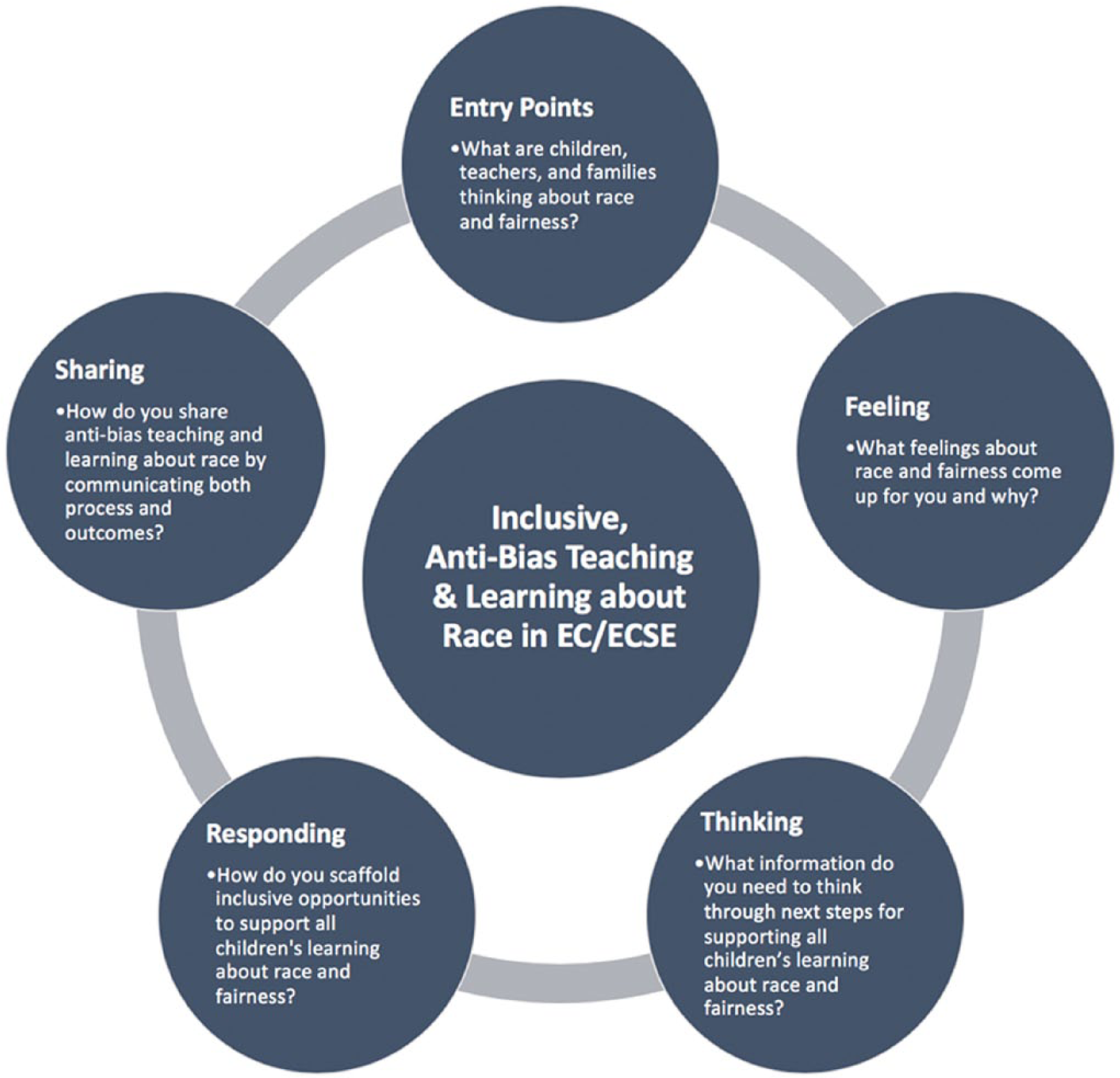
An Inclusive, Anti-Bias Framework for Teaching and Learning About Race in EC/ECSE
This flexible framework builds on and extends previous anti-bias work by focusing on ways educators can engage young children with and without disabilities in anti-bias teaching and learning about race in their local contexts. While we present each aspect of the framework (i.e., entry points, feeling, thinking, responding, sharing) sequentially, educators may enter the framework at any point (e.g., an early educator might begin with a feeling about an observation on the playground, which may lead to an entry point).
Entry Points
In her racially diverse and inclusive classroom, Ms. Jay had been looking for ways to talk about race and fairness with children. The children’s disagreement about the baby dolls was a clear entry point in which children were expressing ideas about race and its intersection with class. Angie was an African American girl talking about a baby doll with dark skin. Ms. Jay considered what Angie might be hearing and seeing in her world, and what Angie’s words might mean about her developing sense of self.
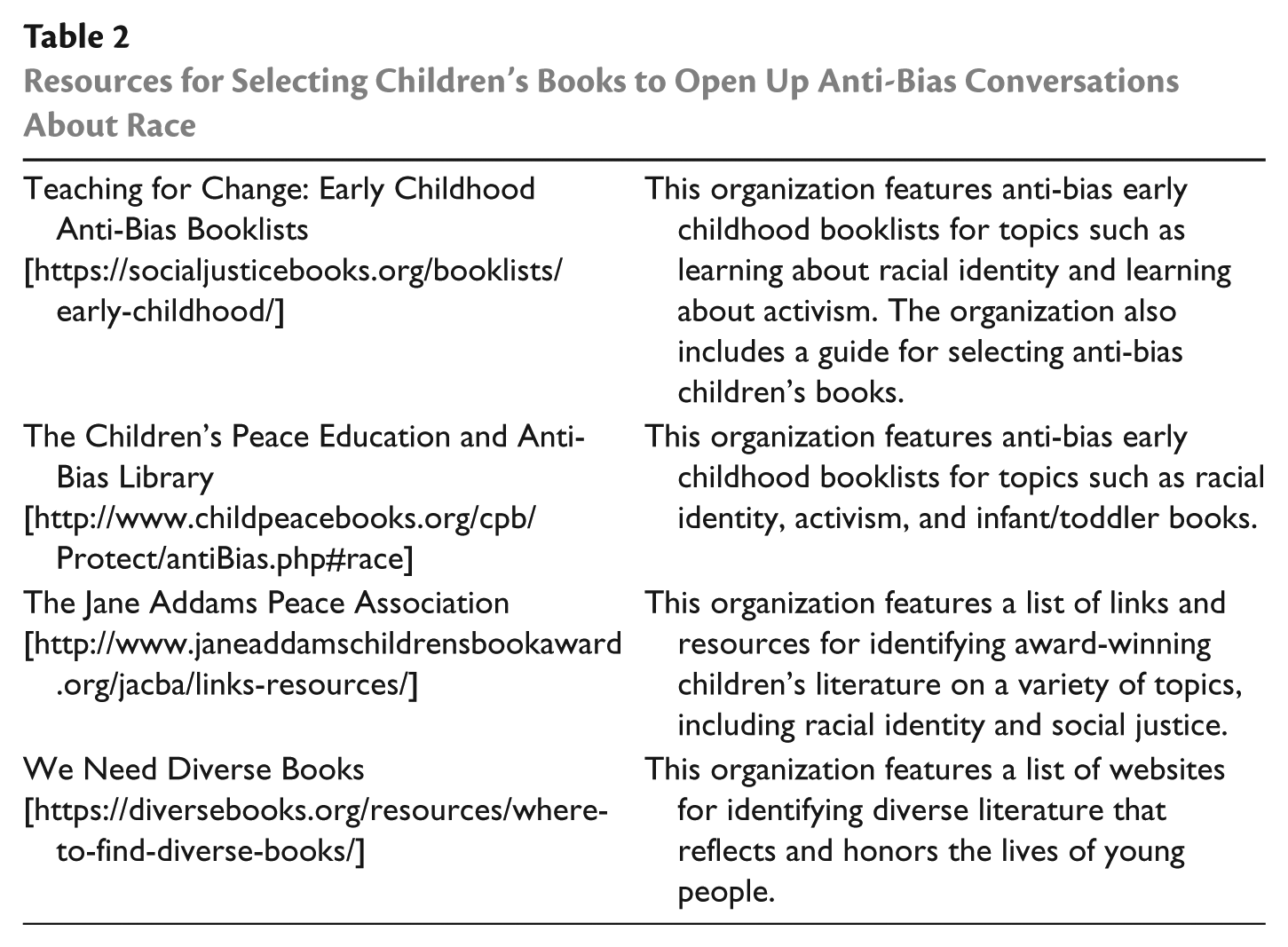
Entry points into anti-bias teaching and learning about race with young children occur all the time. Early educators can identify entry points by considering what children, families, and/or educators are thinking about. An entry point may surface from young children’s comments or questions, as they did when Angie commented about the Black baby doll. Children may also provide entry points by their selection of materials (e.g., skin tone colors in their drawings) or the decisions children make in their play (e.g., “I am the only one who can be a princess, because my skin is light like Elsa’s.”). Alternatively, educators may intentionally read picture books about racial identity and ask questions to understand children’s perspectives about race (see Table 2). Finally, an entry point may emerge from conversations with families. For example, at morning drop off, a mother might mention that her child was raising questions about news coverage of a Black Lives Matter protest. Whether initiated by children, educators, or families, entry points represent opportunities for both short-term and long-term learning about race and fairness with young children.
Resources for Selecting Children’s Books to Open Up Anti-Bias Conversations About Race
Given that many White educators have learned to avoid conversations about race and fairness (see Bonilla-Silva, 2017), identifying entry points may take some work. Research shows how early educators may evade entry points into talking about race based on their own professional knowledge, racial identities, and/or previous experiences (Miller, 2015; Nash et al., 2018). If EC/ECSE educators assume that young children do not notice race (e.g., Boutte et al., 2011) or are not ready to discuss racial unfairness (e.g., Husband, 2012), they may not be listening for anti-bias teaching opportunities. If educators have not considered how racism operates in their own lives (e.g., LeeKeenan & Nimmo, 2016), they may not see how racial bias affects young children. Moreover, if educators feel uncomfortable talking about race, they may control classroom dialogue, limiting the extent to which young children express their developing racial understandings (e.g., Beneke & Cheatham, 2019). As educators examine the framework (Figure 1), it can be valuable to notice if they cannot identify an entry point. Such an observation can be a fruitful opportunity to interrogate the ways in which one’s own racial identity and/or previous experiences might be contributing to hesitations to engage in this work.
Feeling
In response to Angie’s comment, Ms. Jay felt frustrated, sad, and anxious about what to do next. She worried Angie was receiving negative messages about Blackness and its value. As a Brown woman and one of two teachers of color in her school, Ms. Jay often thought about how racial representation may impact children in her class. This situation felt especially familiar, since as a child Ms. Jay remembered asking why there weren’t any dolls that looked like her. She had wished her skin was whiter. Decades later, Ms. Jay now questioned if her own classroom was reinforcing these same painful messages. Looking at the one Black doll in her room, Ms. Jay felt guilty that she may not have done enough to support her students.
Anti-bias education is rarely emotion-free. Although EC/ECSE professionals may feel they need to maintain the appearance of being calm and positive (Madrid, Baldwin, & Frye, 2013), encountering bias in the classroom can trigger a host of uncomfortable emotions, including guilt, shame, anger, hurt, or denial. If Ms. Jay had not slowed down to process her emotions, she may have resorted to quick fixes or avoidant responses, such as minimizing the event or its meaning (e.g., “Angie couldn’t have meant anything by it.”). Yet gaining awareness of emotional responses and reflecting on discomfort can support educators to address race in classrooms (Ohito, 2016). Benesch (2017) describes the kind of work that educators engage in as emotion labor (i.e., negotiating tensions between experienced feelings and professional expectations). Emotion labor is an ongoing part of anti-bias education and does not end after the initial emotional reactions or discomfort of the moment.
When educators grapple with uncomfortable feelings such as uncertainty, anxiety, or frustration, they engage in emotion labor. Given that many White educators have been learned to avoid talking about race (Boutte et al., 2011), making mistakes that could be read by others as being racially biased can feel like a real threat to one’s personal and professional identity. White educators must realize that their own sense of what feels comfortable is not always a reliable compass when it comes to supporting young children’s learning about race and fairness. Indeed, making mistakes can be an important opportunity for learning. Contrastingly, educators of color may feel fatigued by regularly being asked to lead racial conversations (Matias, 2016), and wish to avoid these topics. However, to support young children in learning about race and fairness, it is important that both White educators and educators of color engage in anti-bias education. Trusted colleagues (see Kuh, 2016) may help educators work through difficult emotions and understand what is holding them back from anti-bias work. Practicing mindfulness (e.g., pausing and breathing, staying present) can help bring awareness and acceptance to feelings of discomfort that arise in challenging conversations about race, unfairness, and taking action (Berila, 2016; Hick & Furlotte, 2009). Journaling can provide an outlet for educators to express their feelings and questions. Regardless of the strategy employed, it is important that EC/ECSE educators process their emotional reactions to bias.
Thinking
Ms. Jay debriefed the incident with her teaching team. One White teacher expressed that she did not believe children were aware of race, yet others shared more anecdotes. Adrienne, a Korean-American girl with black hair and speech delays, only ever drew herself with yellow hair. James told Edward that his mother couldn’t be his real mom as he was Brown and she was not. It was clear that children were aware of race and drawing their own conclusions. Together, Ms. Jay and her team came up with questions about children’s thinking and considered how they might find answers. They read research on racial identity development, discussed the importance of positive racial representation, and how to make this idea accessible to all children. Ms. Jay decided to talk to Angie’s grandfather to learn what Angie was saying and seeing at home. When they talked, Angie’s grandfather shared concerns that Angie saw very few people who looked like her—at home, she was the only Black girl in her housing unit.
When thinking through anti-bias teaching about race with young children, it is useful to collect information from multiple perspectives. Focused observations during choice time may reveal that children are playing in racially segregated groups. Following up with children involved in a classroom event, such as the argument about baby dolls, may yield further context and perspective. Conversations with colleagues can shed light on incidents of bias or exclusion of which one teacher alone may not be aware. Reaching out to family members, as Ms. Jay did, can also provide information about how families may (or may not) be teaching their children about race (Hughes et al., 2006; Vittrup, 2018). For example, Angie’s grandfather may have had direct conversations with Angie about his concerns, he may have intentionally communicated to her how loved and valuable she is, or he may have shared their family’s own stories of social justice activism. Knowing this could help Ms. Jay’s teaching team position Angie as a leader and a resource for the whole group. Efforts at thinking through the issues, contexts, and potential resources are an important step toward planning anti-bias curriculum about race and fairness.
Responding
Ms. Jay’s initial feelings about the magnitude of Angie’s comment had caught her off-guard. “What do you mean by that?” Ms. Jay asked. Angie repeated herself and crossed her arms. In the moment, Ms. Jay supported the children to take turns sharing the White baby doll, but she knew this was not enough. After thinking with other members of her team, Ms. Jay decided to lead a class meeting, using pictures of herself and her own mixed-race family. She said, “What do you notice about me and my family?” Children began sharing different words to describe Ms. Jay and her family, including “woman,” “teacher,” “White,” and “Brown.” Ms. Jay said, “Yes, there many ways to describe me. When I was a child, and I looked through classroom books, I saw characters who were women, teachers, and White. But I never saw characters who were also Brown like me.” Using emotion visuals, Ms. Jay asked children to identify how they might feel if their favorite book characters never looked like them. Several children pointed to the sad face, while others immediately stated that was “unfair.”
The next day, children were examining books in the classroom library. One child said there were no books with a “girl with a talker [speech device] like Adrienne.” Another child noted there were many princesses but they all were White. To provide Adrienne access into thinking about racial representation, Ms. Jay shared a social story about how a child felt sad when movie characters who shared his skin color were only ever portrayed as “being mean.” Ms. Jay introduced the class to artwork by portrait artist Kehinde Wiley, whose paintings of Black and Brown men were on display at a local museum. Ms. Jay organized a field trip to the art museum, where children viewed many portraits, including those by Kehinde Wiley. She explained, “Kehinde Wiley wants people who look like him to see themselves when they go to art museums.” In subsequent weeks, Ms. Jay invited children to create self-portraits with a variety of materials (e.g., paint, collage, simple computer drawing application, taking digital photographs) and through multiple activities (e.g., studying themselves in mirrors, mixing skin tones with paint and brainstorming names for the newly mixed colors, examining printed copies of paintings that included individuals from a variety of racial backgrounds).
“As teachers think about how all children can be supported in learning about race and fairness, it is important to recognize the individual needs of each child within the group. Thus, anti-bias learning should begin and end with considerations of how each child in the classroom community can take an active role.”
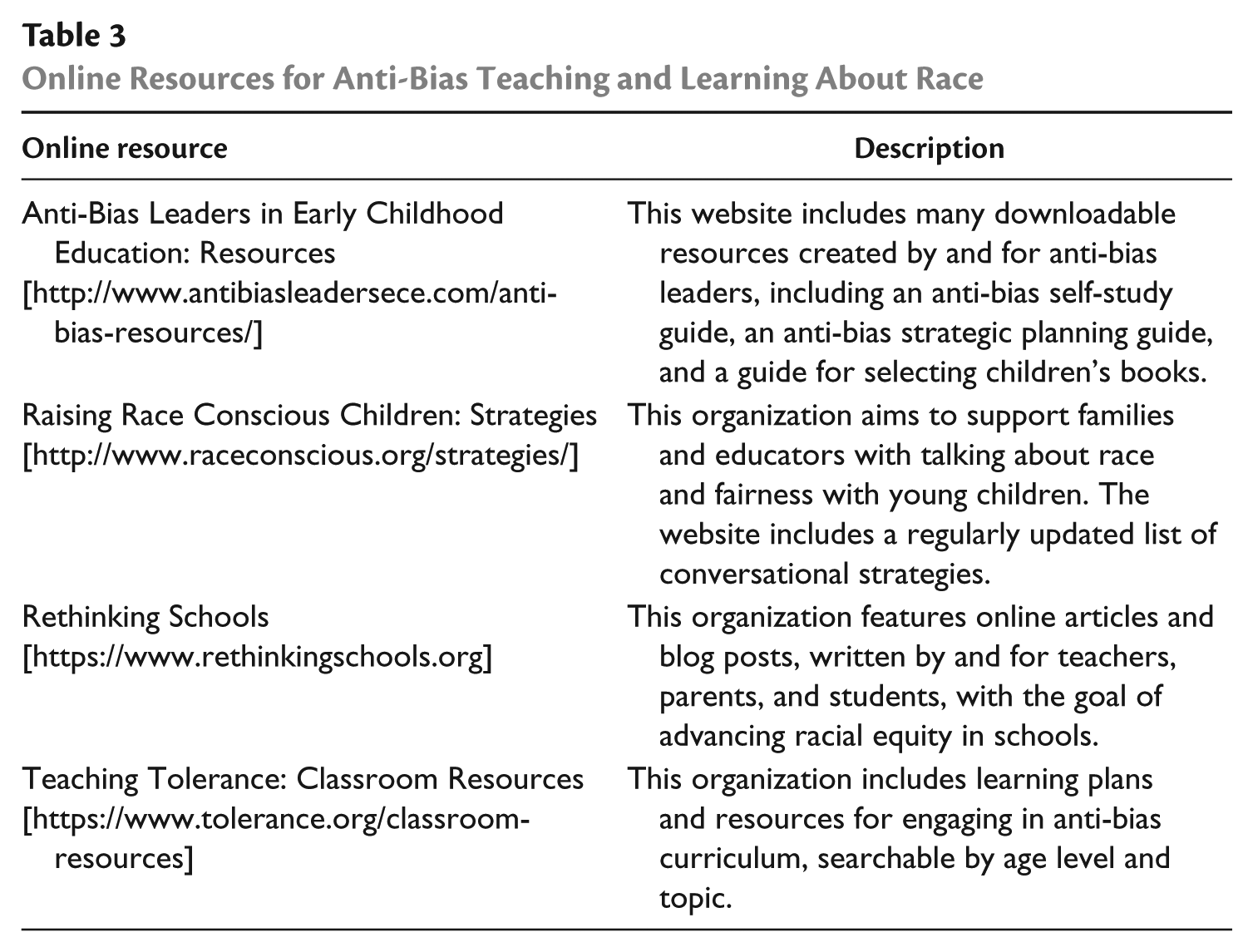
Inclusive educators can and should have both short- and long-term anti-bias responses to events that arise in the classroom. While Ms. Jay’s immediate response dealt with the conflict between the two children, the multiple sources of data her team gathered helped them set goals for themselves and the whole group. The teaching team determined that materials in the classroom environment led children to over-value Whiteness and the team drew upon freely available resources (see Table 3) to consider how to respond. Ms. Jay’s long-term responses attempted to address inequities in racial representation by providing multiple entry points (e.g., pictures of herself and her family, emotion visuals, puppets, social stories, digital software), so that all children could actively explore self-representation to foster self-love and inclusion.
Online Resources for Anti-Bias Teaching and Learning About Race
As teachers think about how all children can be supported in learning about race and fairness, it is important to recognize the individual needs of each child within the group. Thus, anti-bias learning should begin and end with considerations of how each child in the classroom community can take an active role. In addition to the social story, how might Ms. Jay have engaged Adrienne, the Korean-American girl who used a speech device to communicate and always drew herself with yellow hair? Educators could reinforce the message that Black is beautiful through multiple entry points, such as reading books that portray protagonists with diverse hair colors and textures, introducing a puppet who has black hair but wishes she was blond and asks another puppet for advice, inviting children to act out scenarios about what to say if they notice a peer teasing someone about their hair, or exploring the beauty and richness of the color Black through collage. When educators provide all children with ongoing, varied experiences, they can promote positive racial identity development and appreciation of racial diversity. To determine what topics to introduce and how to make activities inclusive, educators can document children’s responses in the moment and in follow-up activities. As EC/ECSE educators determine next steps in deepening children’s anti-bias learning, documentation can help teachers assess whether there are changes in children’s talk, behaviors, and/or play themes.
Sharing
Ms. Jay wanted to share classroom learning about race and fairness between children, staff, and families. Once children had generated several self-portraits, Ms. Jay invited them to choose which image they felt should represent them in their own preschool “art gallery.” Ms. Jay invited families to see the children’s important work. Staff read books about race during snack time and wrote down children’s comments, which they shared and debriefed. They added a new anti-bias section to the newsletter to update families on what the teachers were discussing, what children were wondering, and books they were planning to read.
Sharing about ongoing anti-bias teaching and learning, through both process and product, can allow educators and children to receive feedback from others and to self-reflect. For example, sharing questions about anti-bias learning at staff meetings can offer opportunities for educators to receive insightful feedback. Sharing anti-bias learning processes in regular communication with families (e.g., newsletters, notes home, daily check-ins) can provide families with opportunities to extend topics. For instance, families can continue talking to their child about a book read at Story Time on the bus ride home, or at the dinner table. Families can be encouraged to share their own observations of children’s expanding vocabularies about race and fairness, as well as to bring up their own questions, concerns, hopes, or insights with teachers.
There are also many ways to share products of anti-bias learning. A culminating gallery event may be difficult for families to attend, and teachers could instead support children to make a book with all of their portraits for the classroom library, providing each child a copy to take home. Early educators might share documentation with families via email of children’s engagement (e.g., photos of children examining racial representation in classroom books, transcripts of classroom dialogue about museum artwork). In sharing anti-bias teaching and learning about race, it is important for the whole community to notice changes that lead children toward anti-bias goals: positive racial identity development, increased comfort and knowledge about racial diversity, and recognition of/action against racial unfairness.
Conclusion
Anti-bias teaching and learning about race is both possible and important in EC/ECSE. Educators may feel varying degrees of discomfort in addressing racial bias based on their own racial identities and previous experiences. Yet regardless of background, EC/ECSE educators can utilize the previously discussed framework to support their anti-bias teaching and learning about race and may enter the framework at any point. To engage young children in navigating issues of race and unfairness, educators can position themselves as learners. Self-reflection about how educators’ own thinking unfolds throughout the process, including how their own identities and emotion labor influence their practice, will lead educators to ask new questions of themselves and of children.
Footnotes
Authors’ Note
You may reach Margaret R. Beneke by e-mail at