







Abstract

Louise and Ben, co-teachers in an inclusive preschool classroom, have a lively, creative, and very diverse class of 3- to 5-year-old children. Several learners have recently immigrated and are learning English, several other children qualify for special education services and have Individual Education Plans (IEPs), and two children recently transitioned from Part C to Part B services and are new to the preschool structure. Louise and Ben are specifically struggling with circle time and how to support a diverse range of young learners during this routine. They know circle time is important but worry that not all children are able to fully participate or access the instruction. While some children participate by singing songs, attending and commenting on books, and sharing their ideas during discussions, other children engage in challenging behavior, have a difficult time transitioning to the circle time area, or simply sit quietly on their mats without actively participating. The teachers recently participated in a webinar on Universal Design for Learning (UDL) in Preschool and are eager to try out some new strategies. They choose to start small with UDL implementation and begin by developing a lesson plan for circle time, the first activity of their day, focusing on ways to implement UDL within this routine.
Circle time is a common part of the day in many early childhood programs. This important routine can encompass instruction on curricular concepts, provide a space to introduce new topics, and build membership and community within inclusive classrooms. Lesson plans or strategies for circle time instruction are also a part of many early childhood curricula (e.g., The Creative Curriculum, High Scope, OWL [Opening the World of Learning]), and researchers have discussed strategies for embedded instruction (Barton et al., 2011), self-regulation (Tominey & McClelland, 2011), and curriculum modifications (Sandall et al., 2019) during this routine. Circle time can also comprise a significant part of the preschool day; research on this routine demonstrates that it typically takes 15 to 20 min, adding up to 45 to 60 hour across a 180-day school year (Stipek, 2018). It is clear this common routine is an important component in early childhood classrooms.
Despite the fact that circle time is a frequent activity, and in some cases, a foundational aspect of the preschool classroom, many researchers and stakeholders have discussed its pitfalls, emphasizing barriers to young learners’ meaningful participation. Specifically, there are critiques and debate about this routine addressing the instruction, and perhaps redundant focus on calendars (Beneke et al., 2008; Witt, R., 2017), unnecessarily lengthy circle times (Wiltz & Klein, 2001), and discussion of certain adult-directed circle time components eliciting challenging behavior (Ndoro et al., 2006; Zaghlawan & Ostrosky, 2011). Some researchers have even explored children’s perspectives on the circle time routine. Wiltz and Klein (2001) interviewed 122 preschoolers across a variety of programs about their experiences at circle time, finding that the majority of children disliked circle time because “it took too long.” However, there is disagreement about challenging behavior during this routine, with some researchers noting that children engage in higher rates of challenging behavior during teacher-led activities (Zaghlawan & Ostrosky, 2011), although other studies have found higher levels of child compliance to teacher directions during circle time compared with other routines (Ndoro et al., 2006). In one of the few exploratory studies on circle time, Zaghlawan and Ostrosky (2011) found that songs and academic instruction were the most common circle time activities, and that children’s challenging behavior was highest during attendance, discussions, and calendar routines—activities with fewer opportunities for active participation. In their descriptive study, Bustamante et al. (2018) found the importance of teachers providing more opportunities for children to actively engage in teacher–child interactions. In short, the limited research around circle time suggests that regular opportunities for learners to actively engage with this routine is crucial to its success.
Regardless of its documented or debated shortcomings, circle time continues to be a common part of many early learning programs (Bustamante et al., 2018). Yet, we know that within inclusive classrooms serving a diverse range of young learners, not all children are able to actively engage in this routine without thoughtful modifications, accommodations, and instruction (Reszka et al., 2012). Simply placing children with and without disabilities in the same setting will not lead to the development of meaningful relationships or promote the participation of all learners (Barton & Smith, 2015). Given the range of abilities, languages, and experiences of young children participating in inclusive early childhood programs today, it is no surprise that a “traditional” circle time routine may not be accessible, meaningful, or interesting for all children. The purpose of this article is to discuss ways early childhood providers can create active learning opportunities during circle time, ensuring that all young learners can participate. The UDL framework (CAST, 2018) is especially useful in considering ways teachers can promote participation, access, and inclusion.
“Given the range of abilities, languages, and experiences of young children participating in inclusive early childhood programs today, it is no surprise that a “traditional” circle time routine may not be accessible, meaningful, or interesting for all children.”
Circle Time UDL Strategies
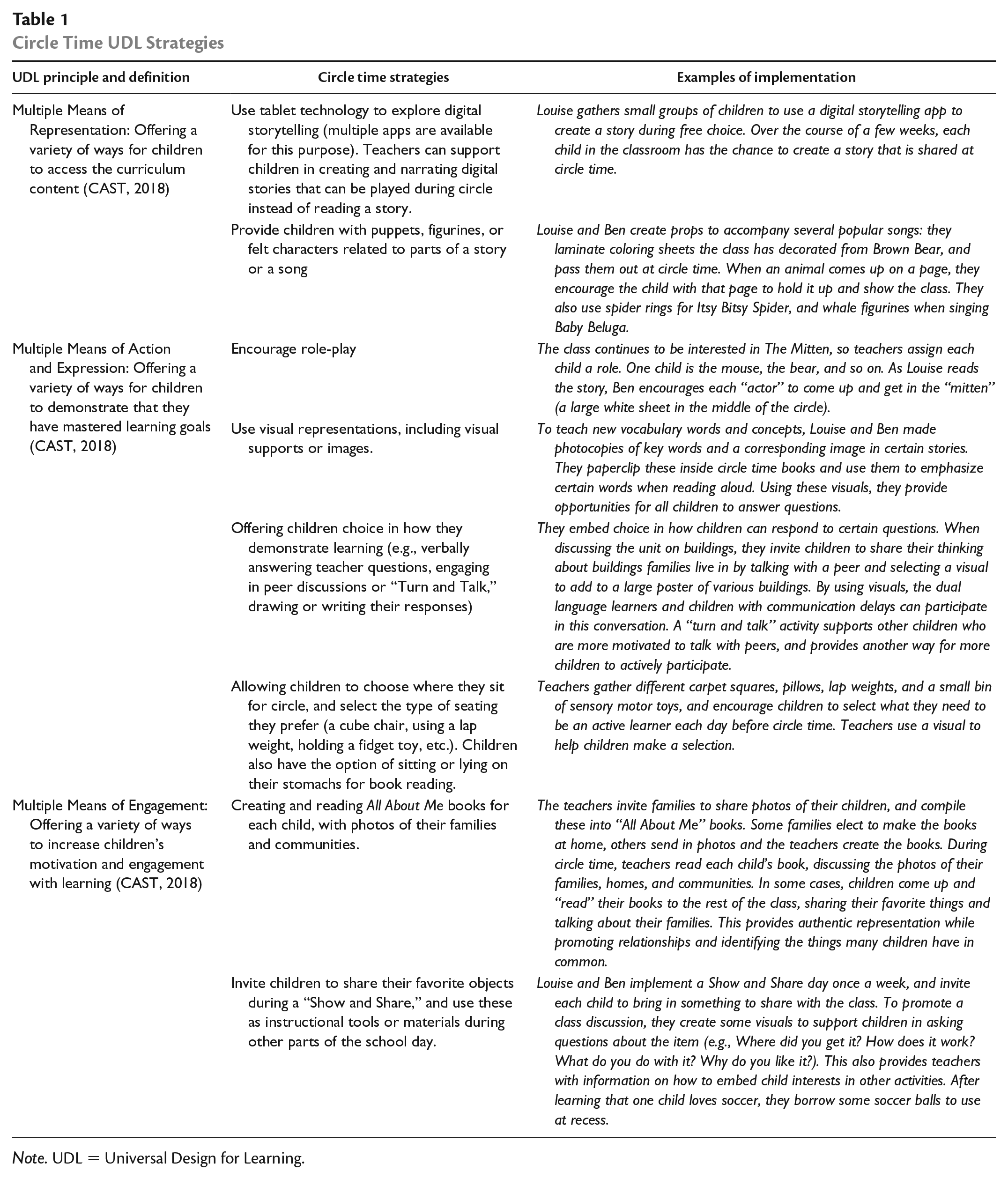
Note. UDL = Universal Design for Learning.
UDL
UDL is intentional and proactive planning and instructional implementation that meets the needs of all learners in the inclusive classroom through multiple means of representation, multiple means of action and expression, and multiple means of engagement (CAST, 2018). This framework is designed for all young learners, not just those with disabilities or delays. UDL fits within Tier 1 of a Multi-Tiered Systems of Support (MTSS) framework, which provides evidence-based supports for all learners in the classroom through individualized data-based decision-making (Greenwood et al., 2019). UDL ensures the curriculum and environment meet the needs of all learners, thus reducing the need for further interventions (CAST, 2018), and clearly aligns to several Division for Early Childhood of the Council for Exceptional Children (DEC) Recommended Practices as outlined in Figure 1.

UDL alignment with DEC recommended practices
Because UDL was created for all learners, its implementation will support the unique learning needs of dual language learners (Rice Doran, 2015), children with disabilities (Cook & Rao, 2018), and gifted or highly capable learners (Hughes, 2019), as well as their typically developing peers. In addition, UDL leads to both academic and social gains (Chai & Chen, 2019). It is likely that many early childhood classrooms are already utilizing some aspects of UDL, although teachers may be unaware of how their current practices align to the systematic framework. For example, teachers may already allow children to choose their centers during free play (Lohmann et al., 2018), pair visual guides with oral instructions (Chai & Chen, 2019), or model how to complete a task before asking young learners to do it independently (Gauvreau et al., 2019). In short, there are natural alignments between UDL and best practices in early childhood. This article provides ways teachers can use the UDL principles to increase young learners’ participation, access, and inclusion during circle time. It is important to note that UDL is not the same as differentiation; inclusive preschool classrooms must use both UDL and differentiated instruction to meet the unique needs of all learners (Chen & Dote-Kwan, 2020). In addition, many supports utilized in the early childhood classroom may serve to meet more than one UDL principle as outlined in Figure 2.
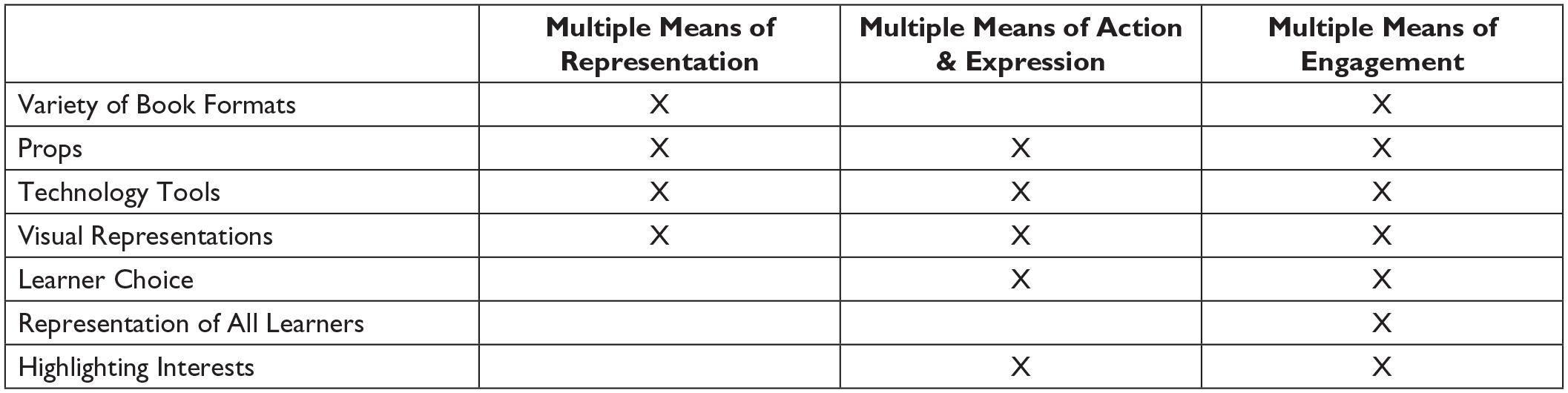
Examples of activities for meeting the UDL principles in the preschool classroom
UDL and Circle Time
Louise and Ben decide to use the UDL framework as they plan an upcoming circle time focused on emotions. As co-teachers, they collaborate on lesson planning and implementation, so they both take responsibility for a portion of the lesson plan. For their first attempt at using UDL in lesson planning, they choose to start small with the intention of building upon this initial framework in future lessons targeting other activities.
Multiple means of representation
Multiple means of representation refers to the range of ways learners can access content and instruction. We know that young children differ in the ways they process and perceive information, regardless of whether or not they receive special education services. To ensure all learners can fully participate in classroom routines, teachers should provide multiple ways of presenting information. Given the focus on literacy during circle time (Ezell & Justice, 2005), teachers can consider including multiple means of representation by providing a range of different books and printed materials, and by including props related to a book or song. In the example lesson plan (see Figure 3), we see each learner being provided with a copied page of the book they are reading as a group. By doing this, each child is able to engage with the text individually.
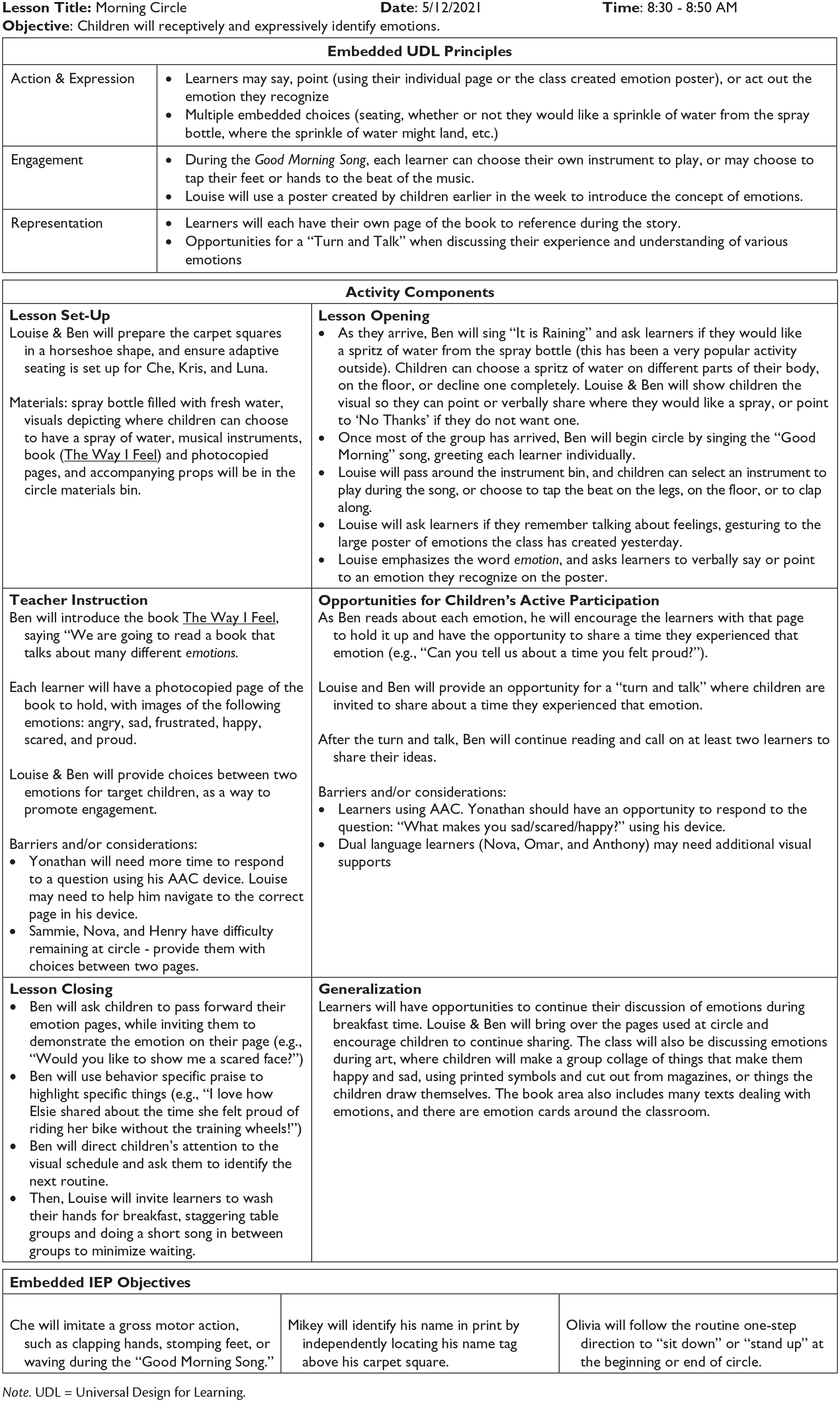
Sample circle time lesson plan that utilizes UDL framework
Offering a variety of book formats during shared reading
To use read alouds as a prime example for UDL, a teacher may read a large copy of a favorite book, but distribute smaller board books to certain learners for them to engage with at their own pace. Alternatively, a teacher may teach print awareness, oral language skills, and phonological awareness by playing an audiobook with sound effects and music while turning the pages of the larger copy at the front of the circle time (Haley-Mize & Reeves, 2013). Another option includes using technology such as digital boards, electronic books or tablets to “play” a story, or to utilize digital storytelling discussed more below.
Utilizing props
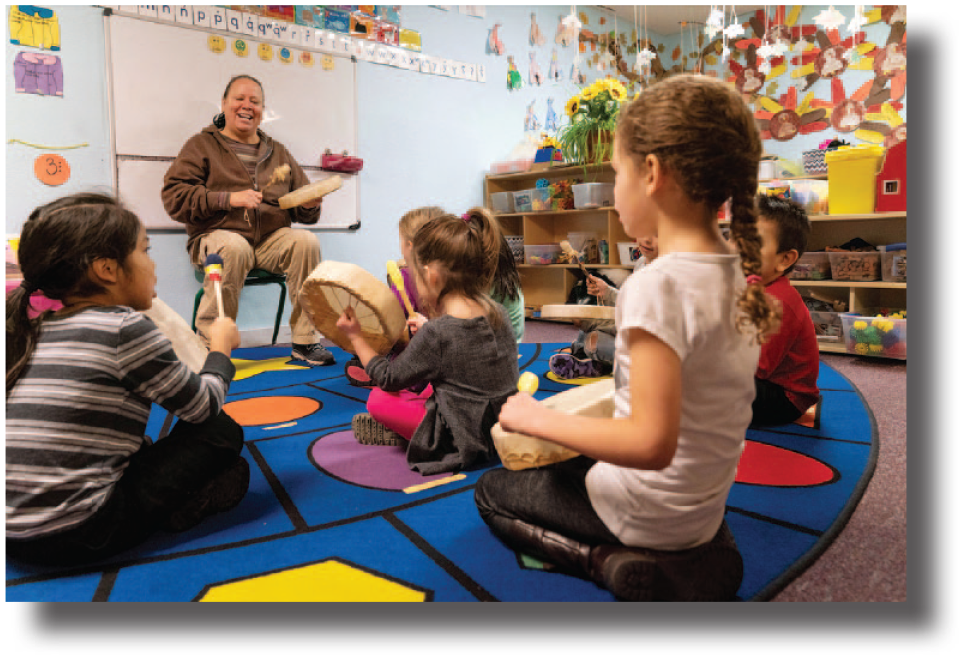
A related strategy involves the use of props (Blackmore et al., 1995), which may take the form of distributing figurines (such as toy buses when singing The Wheels on the Bus), felt characters to be placed on a felt board during a story, musical instruments used during songs, or to create puppets for children to hold up during certain parts of a song or book. By providing young children different ways to both listen and engage with a story, teachers can promote higher levels of engagement and curricular access for all learners. These props can be pulled from classroom materials, such as animals or figurines from the block area, or may be created by teachers from low-cost materials such as magazines, photos, or photocopied pages of books. In the example lesson plan, we see the teachers encouraging children to select a musical instrument to play during the “Good Morning” song, enabling children to access this routine by singing, playing their instrument, or imitating a peer or teacher’s actions.
Multiple means of action and expression
The UDL principle of multiple means of action and expression refers to providing learners with ways to express their understanding and learning. Research shows that during circle time, children have limited opportunities to actively engage with content aside from call and response (Bustamante et al., 2018). During circle time, strategies for including multiple means of action and expression include integrating technology, using visual representations, and offering learners choice in how they participate. Providing options in how children demonstrate their learning and understanding encourages them to reflect on their preferences, practice autonomy, and inculcates self-determination (McCormick et al., 2003). Providing choice benefits both learners and teachers (Courey et al., 2013).
Using technology
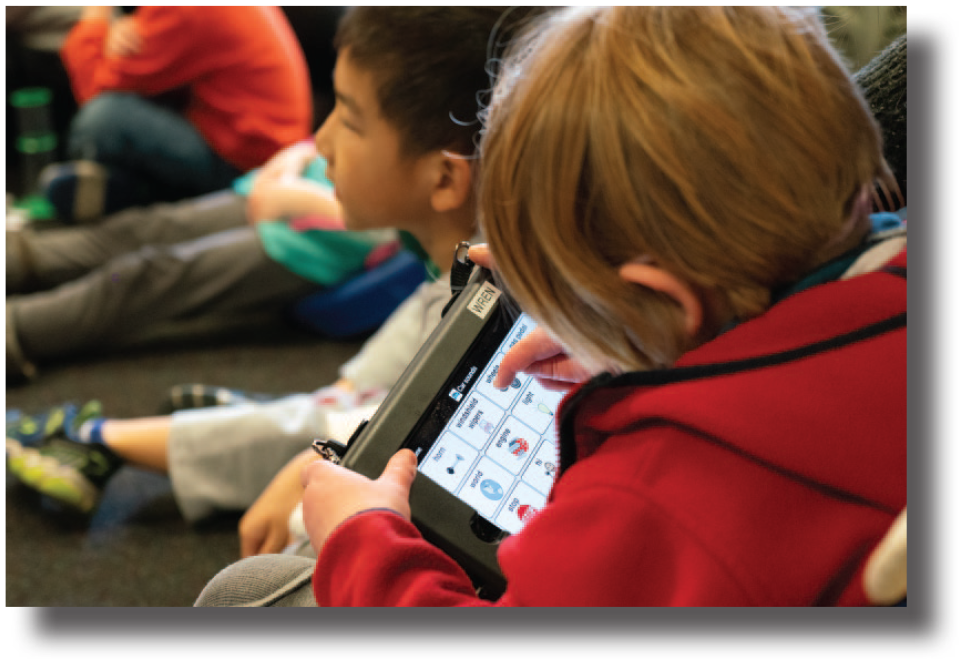
Integrating technology such as tablets, smart phones, computers, interactive whiteboards, and audio/video recordings engages children, can increase motivation (Wang, 2010), and is a recommended strategy in early childhood classrooms (NAEYC & the Fred Rogers Center for Early Learning and Children’s Media, 2012). For example, using the built-in camera on a tablet, learners can create videos of themselves leading songs and activities and show these during circle time, or use websites such as Story Bird© or Flip Grid© to create and share visual stories with their classmates, demonstrating their knowledge (there are many different free and subscription websites that support this engagement). In addition, teachers could explore digital storytelling and provide opportunities for children to create stories of their own to be shared at circle time. Furthermore, leveraging tablets or smart boards enables children to demonstrate their ability related to counting, sorting, or other concepts by touching sections of the screen rather than using traditional materials. Finally, for learners using assistive technology (AT) devices, circle time offers a natural opportunity for participation and demonstration of their knowledge and skills. Teachers should be sure to program the device with all necessary words to ensure the child can fully participate.
Visuals
Using visual representations is another way of increasing student understanding and encouraging children to demonstrate what they are learning. These supports have consistently been used in early childhood classrooms to promote social interactions (Gauvreau, 2017), provide explicit prompts and cues (Narkon & Wells, 2013), support behavior (Gauvreau & Schwartz, 2013), and align with the DEC (2014) Recommended Practices. During a story time activity at circle time, teachers can offer children picture cards or photos representing the characters, plot, conflict, or other important aspects of the story and encourage children to use these to share their ideas related to the text. Children can hold up the visuals to answer questions or follow along with the story (e.g., a teacher might ask, “Who has the animal with wings?” when reading Brown Bear, Brown Bear or create shapes for the monster’s facial features in Go Away Big Green Monster and encourage children to lay them on a felt board as they come up in the story). Older children or those who need an additional challenge can retell the story using visuals. Similarly, during music or singing aspects of circle time, visuals can be used as a way for children to make choices or direct others (e.g., using visuals for each song or music choice, to stop a movement song, such as the Freeze Dance, or speed up/slow down a song or finger play).
“Children’s motivation and engagement will increase through the use of circle time materials that reflect the families, communities, and cultures represented in the classroom.”
Choices in participation
Providing a variety of choices for children during this routine is arguably the easiest way to incorporate UDL. When teachers provide choices, children’s interest in learning and self-determination skills are both enhanced (Jolivette et al., 2002). Choice is a powerful antecedent strategy, linked with fewer instances of challenging behavior and increases in children’s motivation for participation and willingness to follow teacher requests (Blair et al., 2010; Jolivette et al., 2002). Choice also provides opportunities for children to advocate for their needs (Katz & Assor, 2007). We suggest that choices at circle time go beyond the inclusion of a “Song Chooser” or “Book Chooser” and provide ways for all learners to assert autonomy. When children arrive at circle time, they can be given the choice of where or how to sit (e.g., a choice of sitting, kneeling or lying on their stomachs, or using adaptive seating options such as cube chairs or bean bags), or how they might participate in a song (such as the example of musical instruments in the lesson plan) or counting activity (counting the days in the calendar by clapping, tapping their feet, tugging their ears, etc.).
Multiple means of engagement
The UDL principle of multiple means of engagement ensures that the curriculum includes a variety of ways for children to engage in the learning and provide several ways of sustaining children’s motivation (CAST, 2018). During circle time, teachers can use a range of strategies for meeting this principle, including ensuring all circle time materials reflect children’s backgrounds and home cultures, and utilizing materials that reflect children’s interests (DEC, 2014).
Representation of all children during circle time
Children’s motivation and engagement will increase through the use of circle time materials that reflect the families, communities, and cultures represented in the classroom (Gerzel-Short et al., 2019). Teachers must ensure that classroom materials represent children and families from a variety of backgrounds. Teachers can ask children and their families to share their traditions during circle time and to incorporate children’s home languages through songs and stories (Lohmann et al., 2018). Inviting families into this routine by asking them to share a song, book, finger play, or other aspect of their family’s culture with the rest of the class is a meaningful way to celebrate and honor families and home communities, and align with UDL.
Highlighting children’s interests
When concepts are taught in a manner that involves their interests and preferences, children’s motivation and engagement in learning increases (Ainley, 2006; INS1 in DEC, 2014; Sandall et al., 2019). During circle time, teachers can read children’s favorite books or sing their favorite songs, count their favorite objects, incorporate their favorite characters within learning materials, and observe or ask for children’s suggestions regarding monthly learning themes. By centering child preferences in both circle time materials and content, educators can promote active learner engagement (Ainley, 2006; Sandall et al., 2019).
Louise and Ben spent a few days reflecting on the children in their class and ways of implementing UDL principles. To support the children having difficulty transitioning to circle time, they introduce bubbles, a beloved outside activity (Multiple Means of Engagement: Highlighting Interests) and welcome children over to the circle time carpet by blowing bubbles toward each child, asking them whether they’d like bubbles on their shoes, hands, or head (Multiple Means of Engagement: Providing Choice). To support their dual language learners, they learn to sing the “Good Morning Song” in Spanish, the home language of three children (Multiple Means of Representation: Representation of all children). To help children actively participate in songs, they gather some props—small flashlights for children to turn on during Twinkle Twinkle Little Star, and other figurines (Multiple Means of Representation: Utilizing Props) and collect a bin of musical instruments for children to play. As music is so popular, they find several beloved books on CD and play these while turning the pages of a larger book. The background music, interesting sound effects, and multimedia aspect of shared reading pique the interest of several children who otherwise had not been participating during literacy activities (Multiple Means of Action and Expression: Using Technology). Finally, to expand on the unit on emotions, they find several short online video clips from the group’s favorite shows and movies (e.g., Frozen 2, Toy Story 4, and Lego cartoons) that illustrate characters experiencing certain emotions, and use these as a way to have a group discussion about why the characters may be feeling a certain way. After several weeks, they notice that children transition to circle time without issue and are more engaged in all components of this routine. Children are participating more independently, and teachers are easily able to embed more instruction targeted at individual children’s IEP goals as everyone is more engaged. Through using UDL and providing multiple means of engagement, representation, and action and expression, they no longer need to create individualized interventions to help each child succeed during this routine. Instead, they are able to meet the needs of most children through the UDL framework. Based on the success they have seen during circle time, Louise and Ben are excited to incorporate the UDL principles in other routines throughout the school day.
