







Abstract
With increasing demand for early childhood professionals and inclusive opportunities for children with disabilities in the state, the special education (SPED) faculty at State University recognized the need for a new early intervention and early childhood special education (EI/ECSE) educator preparation program. The department already offered SPED Undergraduate and Master’s degrees leading to a K–12 SPED license or dual licensure in K–12 SPED and Elementary Education. While the K–12 age band overlapped with the early childhood (birth–third grade) age range, preschool and early intervention was not addressed. Faculty decide to develop an EI/ECSE track within the SPED degree program that would allow students to meet the requirements for the state’s EI/ECSE (birth–third grade) license.
According to the Educator Supply and Demand Report (American Association for Employment in Education, 2016–2017), there is a considerable shortage of ECSE teachers in nearly all regions of the United States. Institutes of Higher Education (IHE) are responsible for helping address these shortages and preparing educators to meet the needs of the increasingly diverse population of young children and families. Similarly, ever-evolving social contexts and field knowledge require IHE faculty and staff to periodically examine and revise existing EI/ECSE programs. Using the Initial Practice-based Standards for Early Interventionists/Early Childhood Special Educators (Division for Early Childhood [DEC] of the Council for Exceptional Children [CEC], 2020; hereafter referred to as the EI/ECSE Standards) when developing and revising EI/ECSE educator preparation programs can help programs address the field’s current evidence base and priorities while still being responsive to unique local, state, and university contexts.
The purpose of this article is to describe how the EI/ECSE Standards can be used to support educator preparation program development and revision. Figure 1 provides an overview of the process that will be described, with the three steps used to frame our discussion: (a) examining existing courses, (b) developing new courses, and (c) planning and sequencing field experiences. For each step, we discuss how to identify or create meaningful content, learning activities, and assessments. Although we primarily address program development, this process can be adapted for program revision, such as when state licensure requirements change or personnel preparation standards are updated. Throughout, we emphasize the importance of collaboration, praxis (critical reflection followed by action), and the pursuit of equity.
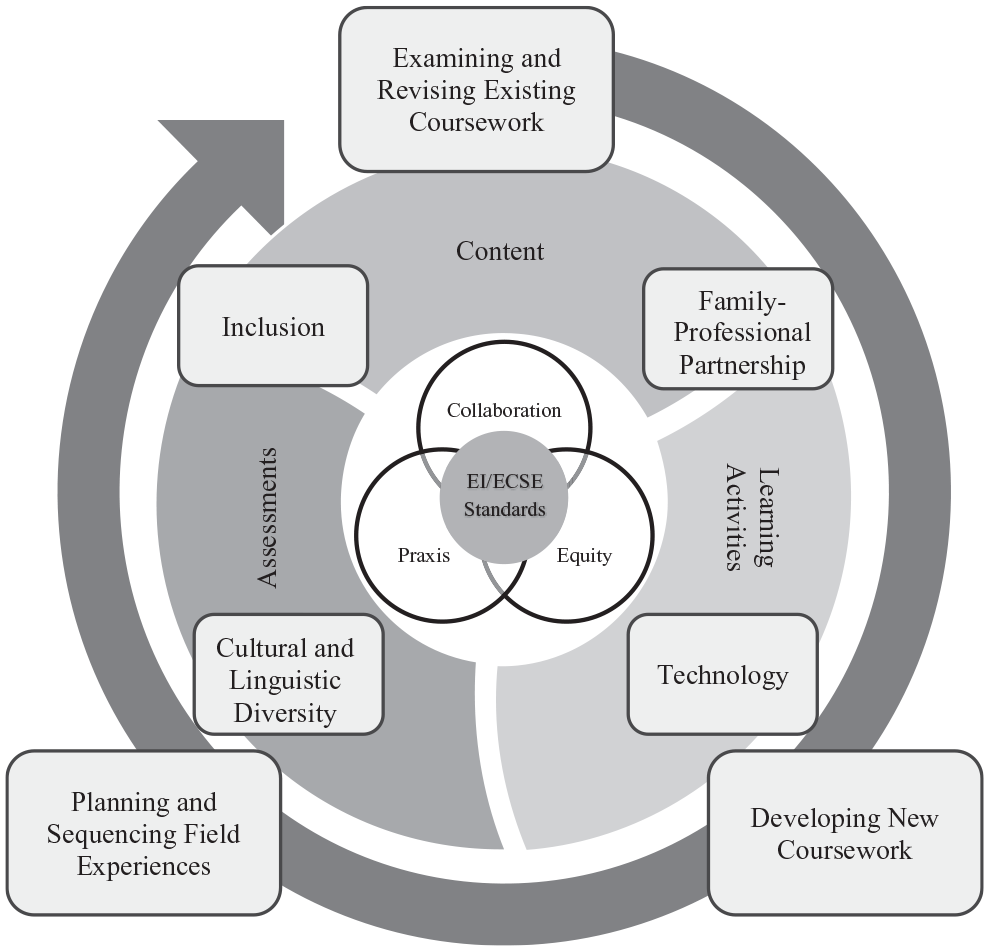
A framework for program development/revision using the EI/ECSE Standards
Examining Existing Coursework
A program development workgroup of SPED and EI/ECSE faculty (hereafter referred to as EI/ECSE Workgroup) convene to begin the program development process. While the EI/ECSE workgroup understands the need to support unique knowledge and skills for future EI/ECSE educators, they know that they cannot create more than a few new courses, based on available faculty and resources. The workgroup is also interested in furthering partnerships across the School of Education and University. Therefore, they decide to survey existing courses across the University to determine the extent to which the courses could address the EI/ECSE standards, fulfill license requirements, and contribute foundational knowledge about child development and early education.
Whether creating or revising an EI/ECSE program, an important initial step is to survey existing coursework and learning opportunities. While the EI/ECSE Standards reflect unique knowledge and skills for working with young children with disabilities and their families, it may not be feasible to create all new courses to address licensure requirements. Furthermore, students may be limited in how many credits can be dedicated to their major program of study due to university general education requirements, and local community needs may dictate unique sets of knowledge. Some aspects of the knowledge and skills necessary for EI/ECSE professionals are common across SPED (e.g., understanding types and purposes of assessment) or early childhood education (ECE; for example, providing opportunities for meaningful play).
Content and Learning Activities
The EI/ECSE Standards can serve as an initial framework for surveying the content of existing courses. Table 1 provides an example of how the EI/ECSE Standards can be distributed across various types of coursework. For example, EI/ECSE Standard 1 could be primarily addressed in a general child development or ECE course that discusses theories and philosophies of early learning and development (marked “O,” outside discipline or department course, in Table 1). Some standards may be addressed using a combination of courses. For instance, general information about developing and administering formal and informal assessments and basic psychometric principles (EI/ECSE Standard 4) could be addressed in a K–12 SPED course that covers progress monitoring, function-based assessment, and standardized assessments (marked “S,” special education course, in Table 1). However, EI/ECSE eligibility determination and certain considerations for individualized assessment (EI/ECSE Standard 4) may need to be taught in an EI/ECSE-specific course (marked “E,” EI/ECSE course, in Table 1). Similarly, an ECE course can provide information about curriculum-based assessment and how to use authentic assessment for instructional planning (EI/ECSE Standard 4). An EI/ECSE course, however, would uniquely address using this information to develop individualized child- and family-based goals/outcomes.
Example of EI/ECSE Standards Assigned to Coursework by Semester and Type of Course
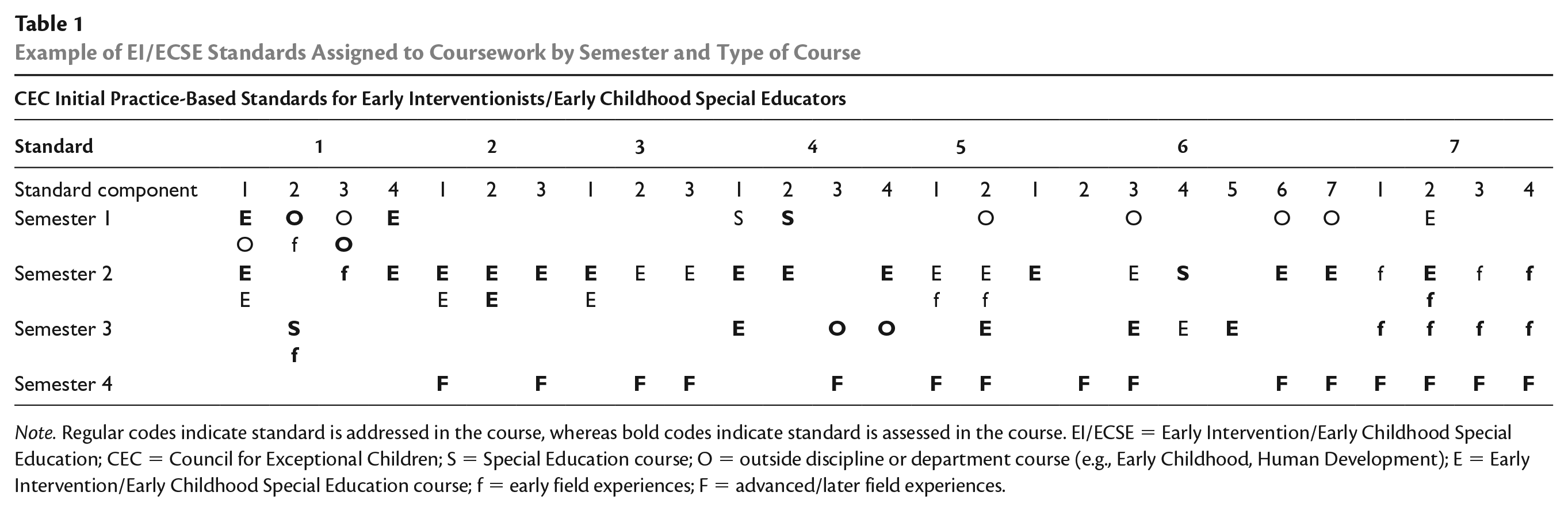
Note. Regular codes indicate standard is addressed in the course, whereas bold codes indicate standard is assessed in the course. EI/ECSE = Early Intervention/Early Childhood Special Education; CEC = Council for Exceptional Children; S = Special Education course; O = outside discipline or department course (e.g., Early Childhood, Human Development); E = Early Intervention/Early Childhood Special Education course; f = early field experiences; F = advanced/later field experiences.
In addition to the core content addressed in an existing course, associated learning activities are also relevant when determining whether a course supports the knowledge and skills reflected in the EI/ECSE Standards. Accordingly, IHE faculty and staff may consider whether a course includes a field experience, application-focused activities or assessments (e.g., developing lesson plans, simulated experiences), and/or opportunities to learn from nonfaculty community members and professionals (e.g., interviews with, or guest lectures by, family members, practitioners, administrators, and related service providers). Such expansive experiences are beneficial for preservice educators’ learning (McDonald et al., 2013) and are opportunities to incorporate EI/ECSE content without significantly altering a course. It is recommended that any standards addressed in courses outside the EI/ECSE program’s home department are intentionally built on within courses within the department due to unique considerations and processes when working with young children with disabilities and their families.
Including courses from multiple disciplines in an EI/ECSE program has significant benefits. First, doing so provides preservice educators with valuable opportunities to learn about the perspectives and areas of expertise of other professionals and practice the collaboration skills necessary for effective teaming (EI/ECSE Standards 3). In addition, courses outside of EI/ECSE can provide preservice educators with foundational information to support their abilities as inclusive educators. For instance, gaining general curricular knowledge and learning about asset-oriented pedagogy can help EI/ECSE professionals contribute to multitiered systems of support and adjust instructional practices for multiply-marginalized young children (e.g., children of color with disabilities; Bartlett & Mickelson, 2019; Pugach et al., 2020). EI/ECSE Standard 5 reflects the need for EI/ECSE professionals to identify and implement evidence-based early childhood curriculum and plan universally designed, developmentally and individually appropriate learning opportunities.
“Courses outside of EI/ECSE can provide preservice educators with foundational information to support their abilities as inclusive educators. ”
Finally, including courses from multiple disciplines can provide EI/ECSE preservice educators with content that is particularly relevant to their local context, enabling reflection and responsiveness to the children and families with whom they will work. Multiple standards address cultural and linguistic responsiveness (e.g., EI/ECSE Standards 1, 2, 3). For example, EI/ECSE Standard 1 dictates that EI/ECSE preservice educators be prepared to understand and utilize families’ social, cultural, and linguistic backgrounds as they plan and implement instruction. Developing these abilities may be supported by courses or learning experiences that are not EI/ECSE-specific, such as content regarding local Indigenous histories and cultures or a course discussing the influence of race on education. Thus, requiring preservice educators to take courses outside of EI/ECSE encourages both a depth and breadth of knowledge that is useful for effectively serving young children with disabilities and their families.
Course-Embedded Assessment Opportunities
When surveying existing courses, IHE faculty and staff should differentiate what content a course addresses and what knowledge and skills are assessed. When a program pursues accreditation through Council for the Accreditation of Educator Preparation (CAEP), they must produce various types of assessment results demonstrating that preservice educators have gained the knowledge and skills reflected in the EI/ECSE Standards by the end of their initial preparation program. Even if a program is not pursuing CAEP accreditation, state licensing bodies typically require educator preparation programs to indicate how learning will be assessed. Therefore, it is essential that faculty provide preservice educators with formative assessment and feedback throughout their program. IHE faculty and staff should ensure that students have multiple opportunities to demonstrate their learning that aligns with the EI/ECSE Standards, including standards addressed by non-ECSE courses (see Table 1).
Collaboration With Course Faculty
When considering whether to include an existing course in an EI/ECSE program, it is important to communicate with the instructor who most often, or most recently, taught the course to ensure accurate and thorough information guides decision-making. Although obtaining a course syllabus is necessary, it is often not sufficient to fully understand course content, activities, and assessments. Discussions with instructors can address course prerequisites or enrollment limitations, overarching perspectives or frameworks, learning activities, assessments, and any field or applied experiences. Table 2 provides sample questions to facilitate discussions with instructors and support collaboration. Collaboration opportunities may include EI/ECSE faculty consulting with instructors to ensure children with disabilities are reflected in course content, providing content or resources (e.g., readings, guest lectures, narrated PowerPoints), or brokering new community partnerships so field placements include settings that serve children with disabilities. Non-EI/ECSE instructors could also provide such consultation or content so that EI/ECSE courses intentionally build on what students learn in other courses.
“IHE faculty and staff may also consider national trends and local needs in relation to the EI/ECSE Standards when determining new coursework. ”
Questions to Guide Discussions Regarding Existing Coursework
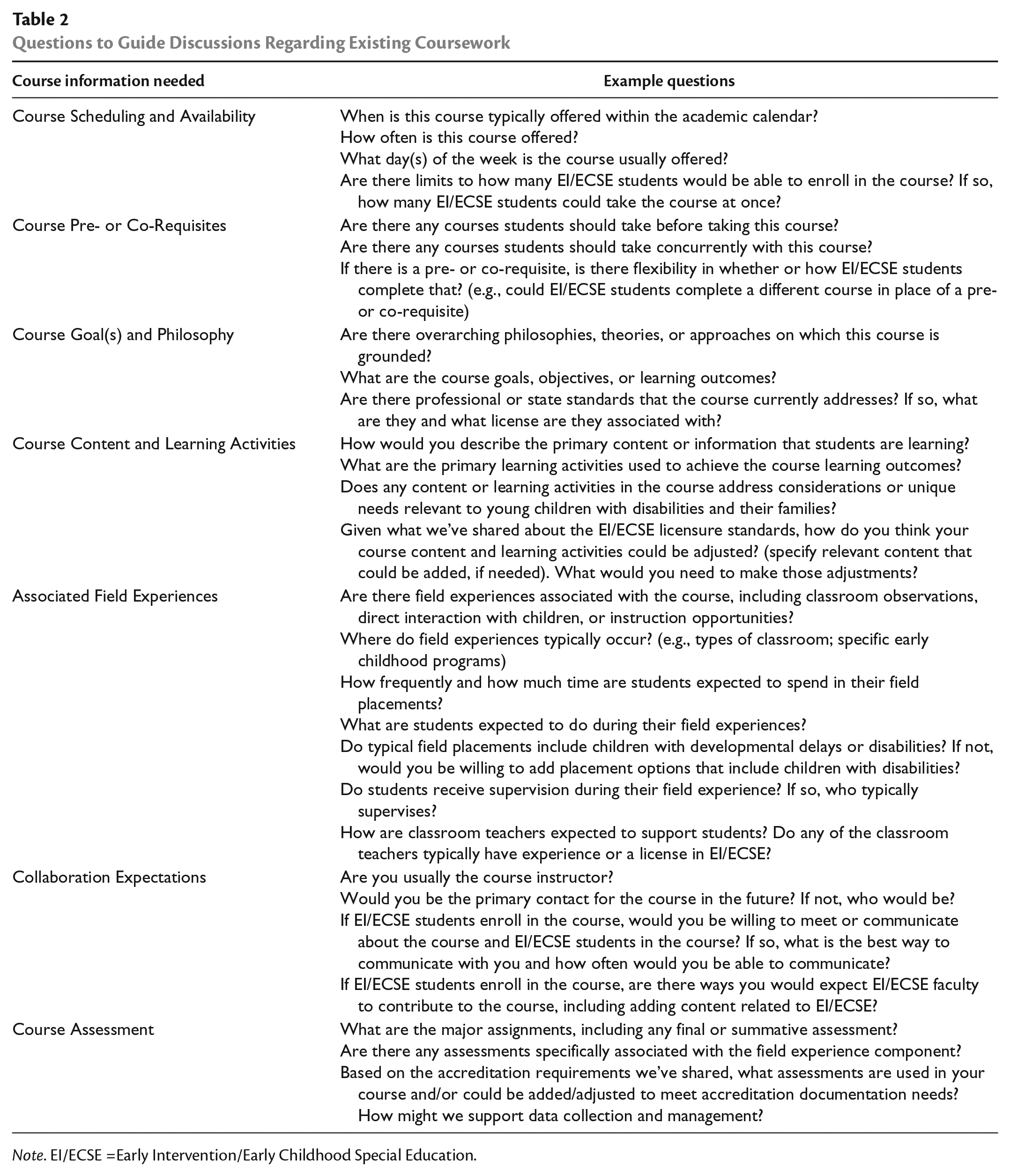
Note. EI/ECSE =Early Intervention/Early Childhood Special Education.
Developing New Coursework and Learning Activities
The EI/ECSE Workgroup identifies several existing courses that preservice educators can take in the Departments of Curriculum and Instruction, Human Development and Family Studies, and SPED. Following a review of course syllabi and discussions with department chairs and instructors, the workgroup is confident that the selected courses provide students with foundational knowledge about child development, assessment, collaboration, and curricular planning. However, there are several EI/ECSE Standards that are not fully addressed. The workgroup shifts their attention to course development.
New Coursework
Whether you are creating or revising an EI/ECSE program, it is likely that new courses or learning opportunities need to be developed. During the course development stage, the EI/ECSE Standards can serve as a framework to help determine content, learning activities, and assessments. New courses may need to be developed because some EI/ECSE-specific content is not addressed by existing courses, such as family–professional partnership processes and practices that are unique to EI/ECSE (e.g., collaborating during assessment processes to determine child goals and/or family outcomes). Using family-centered and family capacity-building practices to facilitate meaningful partnerships with families is a cornerstone of effective and inclusive EI/ECSE service provision (e.g., DEC, 2014; Pearson et al., 2019) and is embedded across the standards (e.g., EI/ECSE Standards 2, 3, 4, 5, 6). Therefore, partnering with families may be a key topic area for a new EI/ECSE-specific course.
IHE faculty and staff may also consider national trends and local needs in relation to the EI/ECSE Standards when determining new coursework. For example, research has shown that there is a national shortage of EI providers (CEC, 2020b). Moreover, the DEC and Infant and Toddlers Coordinators Association (ITCA) service coordination position statement noted that service coordination is the only mandated EI service under Individuals with Disabilities Education Act (IDEA), yet there is a need to strengthen the field’s understanding and support of service coordination (DEC & ITCA, 2020). Thus, if existing courses do not explicitly address EI service provision, including service coordination models used in state or local programs, an EI course may need to be developed to address field and local needs while also meeting EI/ECSE Standards (e.g., Standards 1, 2, 3).
Finally, new courses may be created to further emphasize the values and priorities that undergird EI/ECSE practice. Three themes are embedded throughout the EI/ECSE Standards: inclusion, responsiveness to cultural diversity, and the use of technology and interactive media (DEC, 2020). For example, an EI/ECSE overview course could be critical to introduce preservice educators to the concept of inclusive education and jumpstart their ability to reflect on and take actions to dismantle ableism and other forms of marginalization affecting young children with disabilities and their families. Confronting ableism and valuing all children’s social identities and belonging must drive inclusive and equitable practice (Beneke et al., 2019).
Retrieved from https://www.pexels.com/photo/girl-inpink-dress-showing-her-hand-with-paint-8612961/. No attribution needed.
In addition to the officially identified themes, collaboration is emphasized across multiple standards, particularly collaboration with families (e.g., EI/ECSE Standards 2, 5, 6). Notably, preparing educators to partner with families of color, multilingual families, and families experiencing poverty is a persistent growth area in EI/ECSE personnel preparation (Banerjee & Luckner, 2014; Pearson et al., 2019). Therefore, an EI/ECSE course on partnership and collaboration may focus on helping preservice educators understand how to collaborate with families, and other professionals, in responsive and effective ways. Alternatively, incorporating or emphasizing such content may be a particular focus during program revision.
Core Learning Activities
To fully address the standards and program needs, the EI/ECSE Workgroup develop four new courses: Overview of EI/ECSE, Partnering with Families and Other Professionals in EI/ECSE, Inclusive Strategies for Infants and Toddlers with Disabilities, and Inclusive Strategies for Preschool and Early Elementary Students with Disabilities. All courses are designed to address specific knowledge and skills within the EI/ECSE Standards as well as local EI/ECSE service provision models and needs. After determining how the standards will be distributed across the new courses, the EI/ECSE Workgroup starts to develop core learning activities.
Beyond determining what courses need to be developed, the EI/ECSE Standards can be used to determine specific course objectives and/or learning outcomes that can subsequently inform learning activities and assessments. The curriculum modules developed by the Early Childhood Personnel Center (ECPC, 2020b) provide sample syllabi and learning activities for each EI/ECSE Standard. IHE faculty should plan for multiple types of learning opportunities that facilitate preservice educators’ knowledge acquisition and application. For instance, to address EI/ECSE Standard 2, a newly developed course could require preservice educators to conduct an interview with the family of a child with a disability. In addition to learning about the experiences of families, the interview could provide preservice educators with practice identifying family strengths, goals, priorities, and resources (EI/ECSE Standard 2). Based on the interview, preservice educators could design a family resource that considers the diverse social, cultural, and linguistic characteristics of families. Such an activity would help preservice educators examine their own assumptions and biases about families; prepare them to communicate with families in clear, responsive, and comprehensive ways; and encourage them to approach communication with families as a mutual exchange of information. Moreover, the family resource could serve as an opportunity for formative assessment. Publicly available online videos and case studies could be an alternative to directly interacting with children and families, particularly early in preparation programs. The ECPC (2020b) course development resources include case studies to support learning about professionalism, collaboration, family-centered practices, and evidence-based practices.

Retrieved from https://www.pexels.com/photo/photo-of-people-looking-at-each-other-3184300/. No attribution needed.
Because EI/ECSE coursework may be developed to build on existing coursework, learning activities in EI/ECSE courses could utilize or build on prior learning activities or assessments that preservice educators completed. For example, an existing ECE course may address EI/ECSE Standard 5 by requiring preservice educators to design a classroom and plan a week of lessons that support children’s learning. An EI/ECSE course could subsequently ask preservice educators to reflect on, and revise, the classroom environment that they designed in the ECE course and add lesson adaptations and modifications for a set of case study children with disabilities from a variety of cultural and linguistic backgrounds. In this way, the learning activity would build on preservice educators’ existing curricular knowledge, facilitate reflection and action regarding inclusive education and equity (praxis), more holistically meet the guidelines of EI/ECSE Standard 5, and address EI/ECSE Standard 6.
“Critically reflecting on one’s biases and systemic inequities that affect classroom practice is an essential first step to engaging in culturally responsive and inclusive practices.”
Once courses are developed, the process initially used to survey existing courses can be applied to ongoing program review and revision. Periodic review offers the opportunity to (a) confirm standards are fully addressed as instructors or course content shifts; (b) ensure preservice educators’ knowledge is being built on, or bridged, as they progress; and (c) create or revise learning activities as standards, license requirements, or local needs evolve. The questions in Table 2 can be adapted to facilitate ongoing program review and teacher educator reflection.
Planning and Sequencing Field Experiences
Field experiences are a key opportunity for students to apply content they previously or concurrently learn in coursework (Nagro & deBettencourt, 2017). The EI/ECSE field experience standard can help guide the sequence and structure of these experiences. Specifically, this standard dictates that preservice educators access a series of intentionally sequenced field and clinical experiences across the early childhood age ranges (birth–3 years, 3–5 years, 5–8 years) appropriate to their licensure. Field experiences should take place within a variety of collaborative and inclusive settings and include preservice educators increasingly taking responsibilities aligned with their licensure and future roles. For example, early experiences may focus on preservice educators observing and reflecting on others’ teaching practices, whereas later experiences provide opportunities for them to be primarily responsible for the education of young children. Professionals who have relevant expertise and provide services that align with preservice educators’ licensure and future roles should supervise field experiences.
Preservice educators can also continue to develop reflection skills and engage in critical praxis throughout field experiences (Nagro & deBettencourt, 2017; Pantić & Florian, 2015). EI/ECSE Standard 7 denotes the importance of preservice educators developing a reflective practice. In addition, critically reflecting on one’s biases and systemic inequities that affect classroom practice is an essential first step to engaging in culturally responsive and inclusive practices as well as partnering with families (Beneke et al., 2019; Madison, 2019; Pearson et al., 2019), skills that are incorporated in multiple standards that may be addressed during field experiences (e.g., EI/ECSE Standards 2, 5, 6; see Table 1). Finally, identifying one’s areas of expertise and where professional development or self-advocacy is needed supports professional growth throughout one’s career (De Arment et al., 2013; Madison, 2019). Field experiences could incorporate reflection opportunities in various forms, such as reflection papers, self-assessment checklists, and collaborative exercises with peers and supervisors.
The EI/ECSE Workgroup shifts their attention to planning field experiences. The workgroup reviews the existing field experience associated with a course that preservice educators will take through the Department of Curriculum & Instruction during their first semester in the EI/ECSE program. That field experience requires preservice educators to observe in a preschool classroom for four hours and then serve as a “classroom helper” under the direction of the lead teacher for at least 10 hr. Although the instructor who regularly teaches the class has typically partnered with the University’s affiliated preschool and several local community-based centers for the course, the EI/ECSE faculty connect the course instructor with a Head Start program and two local public schools with inclusive preschool classrooms to serve as placements. The new partnerships ease the instructor’s burden of finding additional field placements for the EI/ECSE preservice educators who will now take the course. In addition, the partnerships ensure placement options that include children with disabilities from a variety of cultural and linguistic backgrounds and supervising teachers who have experience serving them within inclusive classrooms. Finally, the EI/ECSE faculty and course instructor agree to collaboratively revise the observation template and reflection prompts to facilitate all preservice educators’ identification of, and reflection around, inclusive practices.
Early field experiences can help ensure that EI/ECSE preservice educators have a strong foundational understanding of child development, early education, and general curricular approaches (e.g., EI/ECSE Standards 1 & 5). Because preservice educators may take coursework outside of the EI/ECSE program’s home department that addresses such content, EI/ECSE program faculty and staff can collaborate with partner instructors to adjust field experience placement options, expectations, learning activities, supports, and assessments in ways that are responsive to children with disabilities and their families (see Table 2). For example, if a field experience requires preservice educators to complete activity templates when observing in a classroom, EI/ECSE faculty and staff may help the instructor revise the template to reflect inclusive practices (e.g., visual aids, adapted materials or equipment, communication support strategies), the use of activities that combat ableism (e.g., helping children recognize and combat unfairness, giving children accurate language for differences; Lalvani & Bacon, 2019), and classroom materials that honor diverse abilities and backgrounds (Souto-Manning et al., 2019). Such adjustments can help preservice educators learn how to support children with various support needs within inclusive settings starting with their earliest field experiences.
Finally, early field experiences should include opportunities for formative assessment that allow EI/ECSE preservice educators to demonstrate knowledge and skills aligned with the relevant standards and receive feedback prior to placements requiring additional roles and responsibilities (Nagro & deBettencourt, 2017). In addition to instructors providing feedback on assignments and learning activities, formative assessments may incorporate feedback from supervising teachers and/or university supervisors. For example, midterm evaluations could be completed to review preservice educators’ knowledge and skills associated with the EI/ECSE Standards and local priorities, plan action steps, and share resources. The evaluation form could then be adapted for successive field experiences to continue supporting self-reflection and growth. Importantly, such evaluations should facilitate critical dialogue and reflection, engaging with, rather than dismissing, the knowledge and experiences preservice educators bring to their programs, particularly those from marginalized backgrounds (Souto-Manning, 2019).
“Evaluations should facilitate critical dialogue and reflection, engaging with…the knowledge and experiences preservice educators bring to their programs, particularly those from marginalized backgrounds.”
The EI/ECSE Workgroup decide to develop an infant/toddler early intervention practicum for the preservice educators’ second semester of the EI/ECSE program, a preschool ECSE practicum associated with an ECSE methods course during the third semester, and a final early elementary student teaching experience for the fourth, and final, semester. Preservice educators will complete a state-required portfolio during their student teaching that will detail their planning and instruction as the temporary classroom lead teacher.
Advanced field experiences should build on what preservice educators have previously learned, allow knowledge application, and involve directly serving young children with disabilities and their families. Student teaching, in particular, where preservice educators are in their placement full-time or nearly full-time, is an opportunity for preservice educators to attain or apply knowledge and skills that are difficult to achieve in shorter experiences. Consequently, advanced field experiences may be more focused on instruction and individualized supports that are responsive to children’s identities, abilities, and needs (Standards 5 & 6), and utilizing assessment to inform decision-making (EI/ECSE Standard 4). For instance, a student teaching experience may include preservice educators engaging in an iterative cycle of planning, feedback, implementation, and reflection. In addition, IHE faculty may incorporate opportunities for collaboration with families and other professionals during advanced field experiences, including collaboration to support individualized planning (EI/ECSE Standards 2). In developing these experiences, IHE faculty should ensure that opportunities for preservice educators do not disrupt services for children and families (see Table 2 for additional considerations).
Advanced field experiences should allow preservice educators to successfully complete any required assessments for licensure. In addition to any required license exams, a culminating project, such as a teaching portfolio, can serve as a useful summative assessment. A teaching portfolio provides an opportunity for preservice educators to select artifacts gathered throughout their program or student teaching experience, such as lesson plans, de-identified assessments, and observation feedback. The preservice educator can compose descriptions of the field experience context, their planning processes, and how they were responsive to children with disabilities and their families to provide equitable inclusive opportunities. Finally, the portfolio can include the preservice educator’s reflections on their practice, including strengths, challenges, and goals. The teaching portfolio may be evaluated using a standards-aligned rubric or other licensure guidelines to serve as a key assessment for program evaluation.
Using Multiple Sets of Standards
Given the many variations in state licensure structures and standards as well as university program configurations, there are many ways that programs may differ in their application of the EI/ECSE Standards. While it is beyond the scope of this article to address all such considerations, the need to use multiple sets of standards may particularly affect how personnel preparation programs use the described program development and revision process. The EI/ECSE Standards can be used alone or in conjunction with other sets of standards for licensure or accreditation purposes. Standards crosswalks can be useful to help IHE faculty and staff understand when and how multiple sets of standards overlap, allowing them to plan curriculum more efficiently. The ECPC, DEC, and National Association for the Education of Young Children (NAEYC) developed a standards crosswalk comparing the EI/ECSE Standards and ECE Professional Standards (ECPC, 2020a). That crosswalk may be particularly useful for blended ECE-EI/ECSE preparation programs. IHE faculty and staff can follow a similar format to compare the EI/ECSE standards with other standards (e.g., state licensure, K–12 SPED) or locally identified educator preparation needs, as applicable to their program, before they begin program development or revision. Subsequently, programs can use their crosswalk to inform implementation of the steps described here.
Closing
The EI/ECSE Standards can be used as a tool to help IHE faculty and staff shape program development and revision. Program development and revision are cyclical and iterative processes that must be continuously responsive to a variety of factors, including personnel preparation standards, local needs, and license requirements. Ultimately, IHE faculty and staff should ensure coursework, learning activities, and field experiences build on each other to prepare preservice educators to serve young children and families with a variety of abilities, support needs, and identities, promoting inclusive and equitable opportunities for all.
