







Abstract

Sarah recently graduated from a master’s degree program focused on training her to support young children with delays/disabilities and their families. One of the requirements was to complete a practicum with an Early Intervention teacher, traveling to visit families in their homes and communities. She had just started a new job as an EI provider, serving in the the role of a special instructor and was excited to apply what she learned. Carol is an occupational therapist with 12 years of experience working in EI. Sarah and Carol were both assigned to support Brendan, a 23-month-old, and his family. Brendan lives with his parents, grandparents, and younger brother. His family had immigrated from the Philippines 5 years before he was born.
Brendan’s pediatrician referred him to EI after meeting at-risk criteria on a screener during a routine check-up. Following an intake, two independent EI providers conducted an evaluation. They identified Brendan had challenges with self-care (e.g., using utensils independently) and social–emotional needs. At the eligibility meeting, the team determined he would benefit from occupational therapy (OT) and special instruction (SI) services. Then, at the Individualized Family Service Plan (IFSP) meeting, they listened to challenges of the Flores Family, particularly Brendan’s tendency to cry and scream during transitions. The team wrote several outcome statements with one focused on success during daily routines. They also decided on a service delivery plan, which included visits from Carol one time per week and Sarah one time per month.
At the end of the meeting, Carol and Sarah scheduled their first visits to Brendan’s home a few days apart. As they left, Sarah contemplated how to establish a stronger connection with Carol. So far, she had observed the other providers using primarily a multidisciplinary teaming approach, visiting individually with caregivers, either at home or in the community, with limited collaboration. Sarah recalls her training program and emphasis on teaming and collaboration as essential components of EI to ensure the best possible support for children and families.
Effective collaboration among team members is a fundamental responsibility for all Early Intervention (EI) professionals (Workgroup on Principles and Practices in Natural Environments, 2008). EI can be described as a particular type of service and support for infants and toddlers with delays/disabilities under three and their families provided through Part C of the Individuals with Disabilities Education Act (IDEA, 2004). Effective collaboration requires professionals to engage in joint decision-making and planning with EI team members to achieve common goals (Division for Early Childhood, 2014b). Successful relationships hinge on professionals being willing to share a vision, trust one another, and respect differences in values or culture. This often includes individuals who convey their expectations, contribute their expertise, and learn from one another (Friend & Cook, 2016; Sandall et al., 2019).
“Effective collaboration among team members is a fundamental responsibility for all Early Intervention (EI) professionals”
All EI activities, including evaluation and assessment, IFSP development, and service delivery, are team-based, meaning that all members, including the family, are meant to contribute equally and make decisions collaboratively. EI teams consist of caregivers, a service coordinator, and at least one provider, such as a special instructor or speech-language pathologist. Which professionals are included on the team depends on the strengths and needs of the child and caregivers, the service(s) most appropriate to support the family in working toward the IFSP outcomes, and the skills and expertise of the providers (Raver & Childress, 2015; Sheldon & Rush, 2013). Whatever the makeup, collaboration is essential to ensure appropriate services are well-coordinated for families (Summers et al., 2001).

Professionals can draw insights into collaboration from sources highlighting knowledge and skills all early interventionists should possess. The Division for Early Childhood (DEC) Recommended Practices (RPs) offer guidance to providers supporting young children with delays and/or disabilities regarding specific behaviors they should use support teaming and collaboration (TC). The TC RPs (DEC, 2014b) include professionals engaging in joint planning and implementing supporting/services with all team members (TC1), using effective communication (TC3), and identifying one primary liaison between the family and other members (TC5). When exploring TC, it is also helpful to recognize the importance of the child’s caregivers as critical players in the process. The Family RPs suggest professionals build trust with caregivers through sensitivity and responsiveness toward the cultural, linguistic, and socioeconomic diversity of families (F1). They indicate information should be shared through methods all team members can understand (F2). They also recommend working jointly with families to create goals, plans, and practices (F4).
The Early Childhood Personnel Center Cross-Disciplinary Collaboration and Coordination competencies are another resource emphasizing working together to develop, implement, and monitor IFSPs as well as the critical need for teams to solve problems and determine mutually agreed-upon interventions (Early Childhood Personnel Center [ECPC], 2020). Moreover, discipline-specific resources (e.g., American Physical Therapy Association, American OT Association) emphasize team-based decision-making, coordination of services/supports, open communication, equal participation, and interprofessional collaboration.
Special instructors like Sarah are EI professionals with education or infant mental health degrees, specializing in Part C requirements, skill assessment, and supporting caregivers (DEC, 2014a). They may have completed academic programs aligned with the EI/Early Childhood Special Education (ECSE) Practice-based Standards (The Council for Exceptional Children [CEC] and Division for Early Childhood [DEC], 2020) aimed at preparing students to engage in recommended practices. Notably, Standard 3 emphasizes the need for professionals to collaborate with all individuals using culturally and linguistically responsive strategies.

Despite the current EI/ECSE Standards, collaboration among professionals working in EI remains challenging (Steed & Stein, 2021). Policy constraints, allowable billable activities, and staffing shortages can pose barriers to collaborative activities, especially communication. Protecting the privacy of education records (through the Family Educational Rights and Privacy Act) indicates the need for communication to occur on an employer-owned device or through an employer-verified secure system (e.g., a mobile app).
Transdisciplinary teaming, the best practice method for supporting children and families in EI, involves one provider leading and integrating input from all team members to create a unified plan (Sheldon & Rush, 2013). This approach necessitates role release, characterized by mutual support, learning, and the exchange of ideas, methods, and procedures among team members. Transdisciplinary work requires providers to examine their own biases (e.g., professional hierarchy and experience) and remain open and adaptable to perspectives different from their own, fostering innovative solutions for individualized challenges with families (Cohen et al., 2023). Overcoming challenges together is an inherent aspect of the work carried out by EI team members; therefore, professionals need to use evidence-based practices to support collaboration.
TC will be unique to the members of the collection of individuals working together; however, a provider like Sarah might find it advantageous to reference a set of strategies when determining how to collaborate effectively with others. In this article, we present 10 elements, guided by research and recommended practices, which can support effective TC.
Elements to Support Effective Teaming and Collaboration
As Sarah’s caseload begins to grow, she starts to recognize that her stress and anxiety levels have increased. At the end of each day, Sarah finds herself exhausted and looking at a list of tasks she needs to complete. She especially feels she needs to connect more with other providers, like Carol, but teaming and collaboration tasks often get pushed to the end of the list.
Element 1: Establish a Mindfulness Practice
New early intervention providers like Sarah often face intense pressure to enhance collaboration with colleagues serving the same families, which can be overwhelming and detrimental to their well-being, leading to stress and burnout. Mindfulness, as advocated by Erwin et al. (2015), is an element that helps professionals be nonjudgmental, remain composed, and approach discussions with compassion and openness. Mindful practices can be used to improve attention and recognize implicit biases, including those related to race, ethnicity, age, gender, LGBTQIA+, community, or ability. Overcoming these biases is essential for effective collaboration in EI. In addition, using compassion-based programs like Cultivating Healthy Intentional Mindful Educators (CHIME) has been shown to reduce emotional reactivity and exhaustion in educators supporting young children (Hatton-Bowers et al., 2023).
Sarah is determined to decrease her stress and anxiety, especially related to engaging with team members. Sarah recalls completing a training that focused on the impact of mindfulness on strengthening her participation in stressful situations. She decides to focus on using mindful breathing and listening. She finds a website with content that guides her through a six-minute practice focused on using techniques without judgment, criticism, or interruption.
Element 2: Be Sensitive to Diverse Backgrounds
Being sensitive to and supportive of the needs of diverse families from different cultural, linguistic, and socioeconomic backgrounds are critical elements to engaging in quality TC practices. Hanson (2013) suggests learning to be sensitive toward families by imagining you are suddenly transported to another country where you are less familiar with the customs, services, and regulations; you are now in a place where you do not speak the language fluently. In some cases, the services may even violate your cultural preferences or practices. An initial step toward navigating your way through this country may be to learn about the culture, tradition, and language(s). Team members should also explore the diverse needs and backgrounds of the professionals they work with daily. This knowledge can build relationships, reduce misunderstandings, and promote members that respect and learn from one another. In EI, creating an inclusive environment where everyone feels valued and heard in supporting the young child is needed for effective TC. Ultimately, being sensitive to diverse backgrounds requires ongoing effort. Still, the rewards are profound, leading to stronger connections and a more equitable workplace and society.
Sarah notices a reduction in stress after a few days of practicing mindful breathing before entering home visits. As she prepares for her visit with Brendan’s family, she considers their Filipino background, acknowledging potential cultural and language preferences. Recognizing the possibility of immigrant status-related barriers, she listens mindfully and learns that Filipino families often live with multiple generations and that it is important to incorporate all family members in his care. Sarah observes Brendan’s grandmother and her silence during the IFSP meeting and plans to inquire if she speaks English or needs an interpreter. She recognizes a need to provide support that incorporates the Filipino culture, language, and background (DEC RP F2).
As Sarah continues to listen, she explores her implicit biases related to Carol and other professionals. She has not engaged with many occupational therapists, and she doesn’t know much about the profession other than she thinks they tend to recommend sensory strategies. She finds that Carol seems to be approaching EI service delivery through an older form where individuals collaborate less. Then, Sarah thinks—Are these my implicit biases related to working with others? What do I know about Carol and can I be more open to learning from her? Sarah also recognizes that they have different training backgrounds and strategies for addressing challenging behaviors.
Element 3: Reflect on Current Knowledge and Skills
Before TC planning in EI, reflection is a crucial step for professionals. They must reflect to assess their current knowledge and collaborative skills. Knowledge involves understanding DEC’s Teaming and Collaboration RPs and grasping the complexities of Part C service provision. Collaborative skills encompass applying evidence-based strategies, like effective communication and openness to learning. To assess their knowledge and skills, professionals can use tools like the Early Childhood Recommended Practices Modules’ Knowledge Check (e.g., Module 4: Teaming and Collaboration Lesson 2) or the Early Childhood Technical Assistance Center (ECTA) TC Performance Improvement Checklists to evaluate skills related to DEC RPs 1, 2, 3, and 4. These checklists (e.g., Communication for TC, Collaboration to Learn and Grow) gauge the use of active RP ingredients like effective communication and fostering open and honest dialogue. Long-time EI professionals can enhance their TC experiences by reflecting or using tools such as those from CONNECT Modules (e.g., Handout 3.6) and Teaming Tidbits Learner’s Guides. This reflective approach helps professionals refine their TC competencies and align with RPs.
Element 4: Strengthen Teaming and Collaboration With Professional Development
In addition to recommended practices, EI providers have an array of resources at their disposal to bolster efforts. After reflection on their current knowledge and skills, providers should establish goals and customize professional development (PD) to address areas of improvement. PD involves learning and strengthening new and existing skills through continuing education and career training. PD options may include completing asynchronous modules, reading practical journals (e.g., Young Exceptional Children), joining communities of practice, or seeking out a seasoned mentor. Furthermore, performance-based (i.e., modeling with practice, coaching, feedback, and self-evaluation) PD is considered an evidence-based option for training adults to implement strategies to support children with disabilities (Ottley et al., 2023).
In addition to the PD options discussed, professionals should include learning to use the strategy of debiasing (i.e., learning to stop the behaviors that unconscious biases can cause). Studies have shown that individuals can be taught to accept the impact of their own biases lowering the brain’s anxiety response through heightened awareness (Desbordes et al., 2012). Debiasing may include a person recognizing her bias and then acting in an unbiased way by engaging in other nonbiased behaviors. Continuous learning is paramount for all EI providers to engage in high-quality practices (see Table 1 for a list of learning modules).
Teaming and Collaboration Professional Development Resources
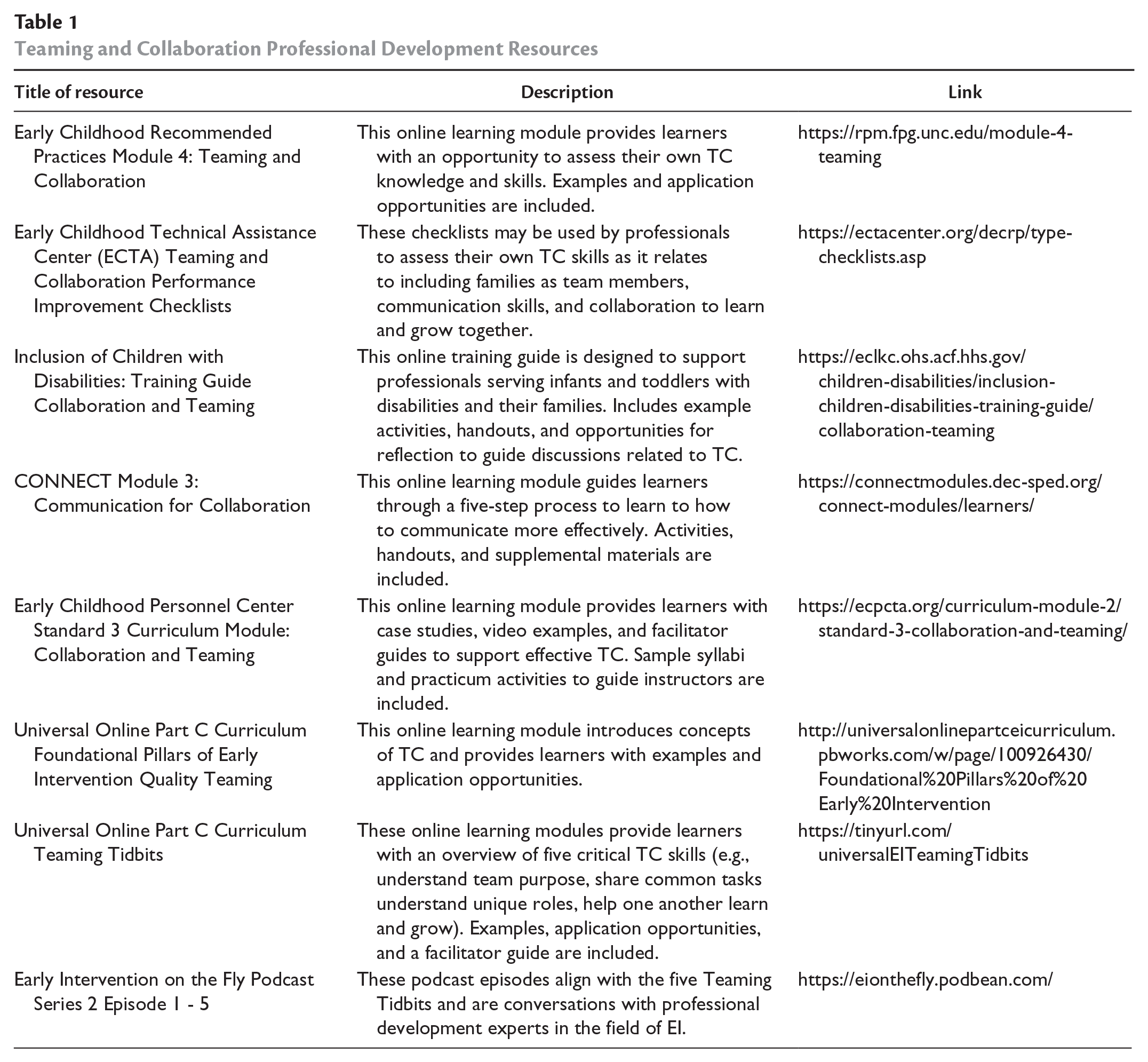
Sarah revisited notes from her graduate program and selected PD on collaboration which was recommended by her professor. She focuses on the Teaming Tidbit modules from the Universal Online Part C Curriculum, gaining insights into how providers handle challenges and collaborate effectively. Sarah recognizes that she needs to determine how to better collaborate with Carol, so she completes the Communicate Openly and Honestly Tidbit. This review boosts Sarah’s confidence in collaborating before their meeting and reminds her she needs to get to know Carol, clarify the conversation topic, plan for the meeting, and consider what might be helpful to communicate effectively (DEC RP 3).
Element 5: Prepare to Collaborate
It can be helpful to prepare ahead of time to collaborate, including making notes and documenting a brief agenda including the purpose and what may be accomplished. In Sarah’s case, preparing to have a conversation about differences in background and training and how these inform choices about intervention strategies may be beneficial. Asking team members to be ready to share their perspectives is an open and honest way to facilitate respect. When all individuals are open to learning from each other, it is easier for problems to be solved together (Steen, 2017).
Sarah prepares for her meeting with Carol outlining an agenda, including discussing Brendan and how they can develop a plan to support together. She wants to learn from Carol to understand her past experiences with immigrant families. She wonders if there are strategies that are helpful with Filipino families. Sarah believes that she and Carol have different training backgrounds. She does not know about Carol’s background or how she makes decisions related to behaviors because she has not talked with her yet. Sarah added an item to her agenda to ask Carol to share about how she decided to become an OT and where she completed her training. Sarah sends Carol a quick email sharing what she hopes to accomplish as they collaborate.
Element 6: Find Time and Space to Collaborate
Building and sustaining relationships, vital in personal and professional realms, can challenge busy providers. Time is a critical element that must be carved out of team members’ schedules to strengthen collaboration, especially when serving the same family. Prioritizing time to TC should be built into any EI professional's work schedule. Options of ways to engage may include casual meetings at a local coffee shop, scheduled phone calls, online meetings, or joint visits with the family. After establishing rapport, maintaining consistent, open communication and an atmosphere where team members feel safe sharing queries, comments, and feedback is critical (Sheldon & Rush, 2013).
After practicing mindfulness exercises at home, Sarah contacts Carol, suggesting an early morning meeting before visiting their families. Sarah expresses a desire to discuss Carol’s recommendations for Brendan and share her ideas, aiming for collaboration to support the family. Carol agrees to meet on Thursday morning for coffee.
Element 7: Use Evidence-Based Practices During Collaborative Interactions
One of the most challenging aspects of teaming and collaboration (TC) is the interactions where practitioners representing multiple disciplines work together as a team to plan and implement supports/services (DEC RP TC1). Researchers have found that some practices are more likely to build team capacity to jointly solve problems and plan and implement interventions than others including being open and honest with one another and engaging in frequent interactions. Furthermore, EI caregivers and professionals indicate that shared values, decision-making processes, and diverse perspectives are needed to build successful long-term collaborative partnerships (Dinnebeil et al., 1999).
During their meeting, Sarah practiced mindful listening and non-judgmentally as Carol discussed her visits and suggested caregiving strategies. Carol shared that she tried to listen to Mrs. Flores was often tending to the baby during visits, and Brendan’s grandmother taking care of him, reflecting on the strong family bonds in Filipino households. Sarah then chose transparency, admitting her eagerness to learn from Carol. Carol reciprocated, expressing her desire to learn from Sarah regarding managing challenging behaviors. Carol also suggested the Project ImPACT approach for supporting imitation, play, and social-communication needs in the family. Sarah was thrilled with their successful exchange, realizing their shared enthusiasm for mutual learning and child-directed play. Instead of immediately sharing her thoughts, she focused on understanding Carol’s perspective first. They set a follow-up video meeting for the next week to continue planning, laying a strong foundation for collaboration (DEC TC RP 1).
Element 8: Document the Plan Developed by Team Members
Effective EI hinges on continuous learning and collaboration to support the child and their family (Workgroup on Principles and Practices in Natural Environments, 2008). Professionals must craft a learning plan, emphasizing collaboration with the family, information sharing, and practical strategies (DEC, 2014a). Team members like Sarah and Carol, who have conducted separate home visits, should exchange their initial observations and assessments, promoting a deeper understanding of biases, diverse perspectives, and cultural considerations, including respect for the family’s traditions and values (DEC RP F1).
Crucially, service delivery relies on caregiver actions between visits, as caregivers play a vital role in supporting their children in daily routines (Childress, 2021). Providers can assist caregivers by documenting a plan during and after each session, outlining strategies and the professional’s support role between visits. The plan can serve as a central reference for agreed-upon strategies and may contain implementation steps and examples (DEC RP TC3). Professionals may consider the use of electronic sharing methods aligning with program policies such as Google documents so that the plan can be easily updated. Furthermore, the plan must incorporate and respect the family including their linguistic preferences, recognizing that not all English-speaking families can read or write in English (Banerjee & Guiberson, 2012). Sharing a plan of similar strategies all team members agree upon also aligns with the transdisciplinary approach, during which one provider assumes a primary coaching and coordination role, while others provide consultation and other types of support.
During their visit to Brendan’s home, Sarah and Carol discussed their strategies and sought input from his mother (DEC RP 1). She noted that he responded well to some of Carol’s strategies, particularly swinging in a blanket. Sarah suggested combining their approaches with a reminder preparing Brendan for transitions and Mrs. Flores providing calming squeezes or swinging in a blanket afterward. They agreed on this combination, aiming to give Brendan positive attention throughout the day when he transitions successfully. It was also decided Mrs. Flores would track his behavior using a kitchen calendar with a “X” for successful transitions away from the TV. At the end of the visit, she mentioned her mother would be taking over caring for the boys during the day in a few weeks. She primarily speaks Tagalog (Filipino language) and may benefit from an interpreter.
Element 9: Establish Communication for Teaming and Collaboration
Communication between EI professionals may be one of the most important elements that makes collaboration occur smoothly. Team members have reported frequent, transparent communication and protocols that facilitate consistent, honest exchanges that allow for everyone involved to stay informed, share successes, and address issues quickly (Dinnebeil et al., 1999).
This involves planning for TC activities, including information sharing and selecting modes like email, text, calls, or video conferencing based on privacy policies, available technology, and personal preferences (DEC RP TC3). Furthermore, team members can document progress, share information, and engage in exchanges with team members using password-protected communication apps (Gauvreau & Sandall, 2017). Team members may also consider enhancing communication efforts to strengthen caregiver utilization of strategies between visits. Research suggests that when professionals communicate between visits caregivers with young children make more meaningful progress over time than those who do not receive enhancements (Bigelow et al., 2020).
Sarah, Carol, and Mrs. Flores opted for group texting to share information and updates. They planned to schedule quarterly joint visits to collaborate and assess the plan. When Sarah began working as an EI provider, she was happy to find out her employer provided phones to communicate with team members. She texted the group after and quickly summarized the strategies they had discussed. She also emailed Carol separately to discuss ideas for teaching his caregivers to use child-directed play. They agreed to meet via web-conference the following week (DEC RP TC3).
Element 10: Monitor Progress as a Team
Monitoring progress is a vital element necessary for teams to track the achievement of child and family outcomes (IDEA, 2004). Professionals can collectively monitor progress by observing and tracking behavioral changes. Mastery of skills and goal attainment indicate successful services and teamwork. These data can be used to adjust the plan and update outcomes when achieved. Feedback on strategy usage in daily routines from the caregivers can also guide adjustments (Keilty, 2016). Members may also consider monitoring the progress of TC goals (e.g., one member contacts the family each week to check in).
During Sarah’s next visit, Mrs. Flores displayed XX’s on the calendar, indicating successful transitions for Brendan, with only a few challenges. She felt confident using the strategies and would like to check in occasionally. Next, she would like Brendan’s grandmother to learn to use the strategies. Sarah remembers that she will need to secure a translator to ensure his grandmother is fully included. With the addition of another member, she wonders if this may be a suitable time to suggest using the transdisciplinary teaming approach. She thinks that as her collaborative partnership with Carol grows, and they learn from one another, it may be appropriate to decrease her presence at the home over time (DEC RP TC5).
Strengthening TC in Early Intervention
Teaming and collaboration in EI are complex and require providers from different disciplines to work together to achieve the best outcomes for young children and their families. We have presented elements, supported by literature, experts, and RPs in the field, which may strengthen TC practices. As with any team member, Sarah has a journey ahead of her to feel confident in her ability to collaborate with colleagues and families in EI, but she has taken some initial steps. Most importantly, recognizes that for collaboration to be successful it requires consistent attention as a part of service delivery.
