







Abstract
Antonio is a 3-year-old who was recently diagnosed with autism. He attends preschool for 4 half-days a week and enjoys dinosaurs, vehicles, and the classroom sensory table. Antonio has recently started speaking and can say around 20 words in English and Spanish of items that he will request by name (e.g., ball). When requesting items that are not within his vocal repertoire, he uses the sign for MORE. His teacher, Mrs. Beck, met with Antonio’s parents to discuss his language learning targets. The parents would like Antonio to expand his vocal repertoire to include (a) other parts of speech beyond nouns (e.g., verbs, adjectives) and (b) additional pragmatic functions beyond requesting (e.g., rejecting, labeling, gaining attention). While Antonio and his parents are bilingual (i.e., English and Spanish), they would like the school-based intervention to focus on English words.
Introduction
For children developing typically, early vocabulary words include nouns, action words, descriptors, sound effects, and social words derived from personally meaningful routines and contexts (Laubscher & Light, 2020). Beginning communicators use early words for a variety of purposes such as requesting or rejecting items and actions, labeling objects, greeting others, answering questions, or gaining attention. Typically, a child begins to combine early words into two-word phrases between the ages of 18 to 24 months, when they move from having a vocabulary size of around 50 words at 18 months, to 200 to 300 words at 24 months. Early word combinations typically involve simple semantic relations such as agent+object (e.g., kick ball), attribute+entity (e.g., red ball), or possessor+possession (e.g., my ball). Children begin using three- or four-word phrases around the time when about half of their total utterances consist of two-word combinations.
Language Development in Children With Autism
During their early years, children with autism
1
may not meet the same communication and language milestones as their peers (Wodka et al., 2013). Many children with autism experience language delays and may rely on one-word or phrase speech, rather than using grammatically fluent speech (Anderson et al., 2007; Wodka et al., 2013) that is often present in typical language development. In addition, 20% to 30% of children with autism may continue to be minimally vocal and may require the use of augmentative and alternative communication (AAC) systems (Anderson et al., 2007; Wodka et al., 2013). Although the communication and language skills of children with autism might not emerge on the same timeline as peers developing typically, interventions for children with autism (whether focusing on natural speech or AAC), should consider the sequence in which language and communication and skills typically develop. Identifying and adjusting supports based on child development, strengths, and needs are aligned with the Division for Early Childhood’s (DEC, 2014) Recommended Practices (RP), within the domains of Environment (E4 and E5), Instruction (INS1, INS3, and INS10), and Interaction (INT3). “Although the communication and language skills of children with autism might not emerge on the same timeline as peers developing typically, interventions for children with autism (whether focusing on natural speech or AAC), should consider the sequence in which language and communication and skills typically develop.”
Barriers to Current Language Interventions for Children With Autism
Unfortunately, interventions for beginning communicators with autism do not always align with early language development in typically developing children. For instance, rather than aiming to expand personally relevant vocabulary prior to introducing grammatical words or phrases, some intervention approaches for beginning communicators focus primarily on teaching high-frequency “core” words derived from language samples of children 24 months or older who are developing typically (Laubscher & Light, 2020). Words commonly included in core lists include grammatically functional words (e.g., the, a) as well as words that add meaning but are often not context-specific such as more, want, or go. Although beginning communicators do use some core words, a larger percentage of their vocabulary consists of personally relevant words (Laubscher & Light, 2020), such as dog or dada. An overreliance on core words may limit a child’s ability to add context-specific meaning to their communication attempts. For example, a child who learns to say I want to request may be unable to communicate what specific item, activity, or action they desire in a given situation. Children with autism and other developmental disabilities may also overgeneralize the use of core words (e.g., using the sign MORE to initiate a request for an action the first time rather than requesting the recurrence of the action).
Although some intervention approaches for beginning communicators with autism do make use of personally relevant vocabulary rather than focusing on core vocabulary only, they often focus primarily on teaching item requests. This initial focus may be because children with autism may more easily acquire imperative functions of language such as requesting or rejecting that rely on motivation, in comparison to declarative language functions that rely more heavily on social reinforcement and joint attention skills (Harbison et al., 2017; La Valle et al., 2020). Despite these challenges, it is critical that early language interventions focus on expanding word classes (e.g., introducing action words, descriptors, and social words in addition to nouns) and communicative functions (e.g., rejecting, labeling, gaining attention) to ensure that children with autism can communicate for a variety of purposes (DEC RP—Assessment; A3; Instruction INS3). Intervention for children at the one-word stage (including children who use AAC) should aim to increase personally relevant vocabulary and introduce developmentally appropriate high-frequency core words that can add meaning (e.g., OPEN). As a child’s vocabulary expands, intervention can then focus on introducing early semantic relations and multi-word phrases or sentences that start to build syntax skills. “It is critical that early language interventions focus on expanding word classes (e.g., introducing action words, descriptors, and social words in addition to nouns) and communicative functions (e.g., rejecting, labeling, gaining attention) to ensure that children with autism can communicate for a variety of purposes.”
Mrs. Beck sets up a meeting to collaborate with Antonio’s educational team (e.g., speech–language pathologist, behavior specialist, occupational therapist, paraprofessional) to discuss her concern of Antonio’s communicative repertoire. Mrs. Beck shares that Antonio is rapidly increasing the number of nouns he is saying, which is very exciting! However, she poses to the team that she would like to target vocabulary that includes other parts of speech (e.g., verbs, adjectives) and communicative functions (e.g., commenting, describing). The team agrees with Mrs. Beck’s suggestion and begins to brainstorm (DEC RP—Teaming and Collaboration TC2). The team decides to begin intervention during free time the following Monday, as Antonio prefers to spend that time playing with Mrs. Beck. They select a few personally relevant vocabulary words related to his play interests. When selecting an instructional method to support Antonio’s language development, they decide to use a naturalistic developmental behavioral intervention framework (DEC RP—Teaming and Collaboration TC1).
Naturalistic Developmental Behavioral Interventions
Recent intervention protocols, such as naturalistic developmental behavioral interventions (NDBIs), have begun aligning communication intervention practices for those with autism with the typical trajectory of language development. NDBIs refer to evidence-based interventions for young children with autism and other developmental disabilities that combine developmental and behavioral sciences to enact a natural approach to early intervention, resulting in increases in early communication and language skills (Bruinsma et al., 2020; Dubin & Lieberman-Betz, 2020; Sandbank et al., 2020; Schreibman et al., 2015). These approaches are often a result of cross-discipline collaboration between practitioners from different theoretical backgrounds, such as speech-language pathologists and behavior analysts. Recent research has revealed a compelling evidence base supporting the effectiveness of practitioner and parent implementation of NDBIs for improving language and social communication outcomes for children (D’Agostino et al., 2020; Sandbank et al., 2020). NDBIs are strength-based and child-centered interventions that incorporate strategies to capitalize on natural and motivating moments (e.g., mealtime, play) and environments (e.g., home, school) to build language. Furthermore, NDBIs are delivered by natural implementers (e.g., caregivers, teachers, clinicians) who are involved in the child’s life and can provide increased opportunities for learning throughout the child’s day (Schreibman et al., 2015). Individualized learning targets are also created in collaboration with stakeholders based on functional skills aligned with the developmental sequence and data from various assessments. In addition, NDBIs hold promise for their ability to incorporate neurodiversity-affirming, familial, and cultural values (Wang et al., 2022). For example, NDBIs can be adapted to support the culture and language of Hispanic/Latinx families from both English-speaking and Spanish-speaking backgrounds (Dubay et al., 2018; Gevarter et al., 2022; Pickard et al., 2023). Adaptations can include translating materials, using culturally appropriate and sensitive language, involving extended family members, and collaborating with families to select culturally affirming goals, routines, and intervention plans (Sands et al., 2021).
Although there are a variety of manualized NDBI programs (e.g., The Early Start Denver Model, Project ImPACT), a core principle that all NDBIs encompass is that the child initiates or leads some portion of the activity or learning episode (Bruinsma et al., 2020). This can range from balanced turn-taking between the child and adult to having the entire teaching episode be child-led. Additional strategies that are common within NDBIs include communication temptations, modeling, prompting, imitating, expanding language, and natural consequences (Dubin & Lieberman-Betz, 2020; Schreibman et al., 2015). NDBIs can be used with all forms of communication including vocal speech, gestures, and AAC.
Application to Practice: A Three-Step Approach
In this paper, we will discuss how NDBI strategies can be used before and after the child communicates to expand the communicative repertoire of those with autism by first creating communication opportunities, next prompting or encouraging child communication (if needed), and finally responding to child communication. It is important to note that NDBIs are child-led, which means that the communication partners strategy use and response rely on the actions, engagement, and responses of the child. While the focus of this paper is on young children with autism, children with other developmental disabilities may also benefit from this approach. Figure 1 shows a graphic representation of the typical sequence of NDBI techniques, and Figure 2 shows a graphic representation of when and how communication partners should follow the strategies and respond to the child by following their lead.
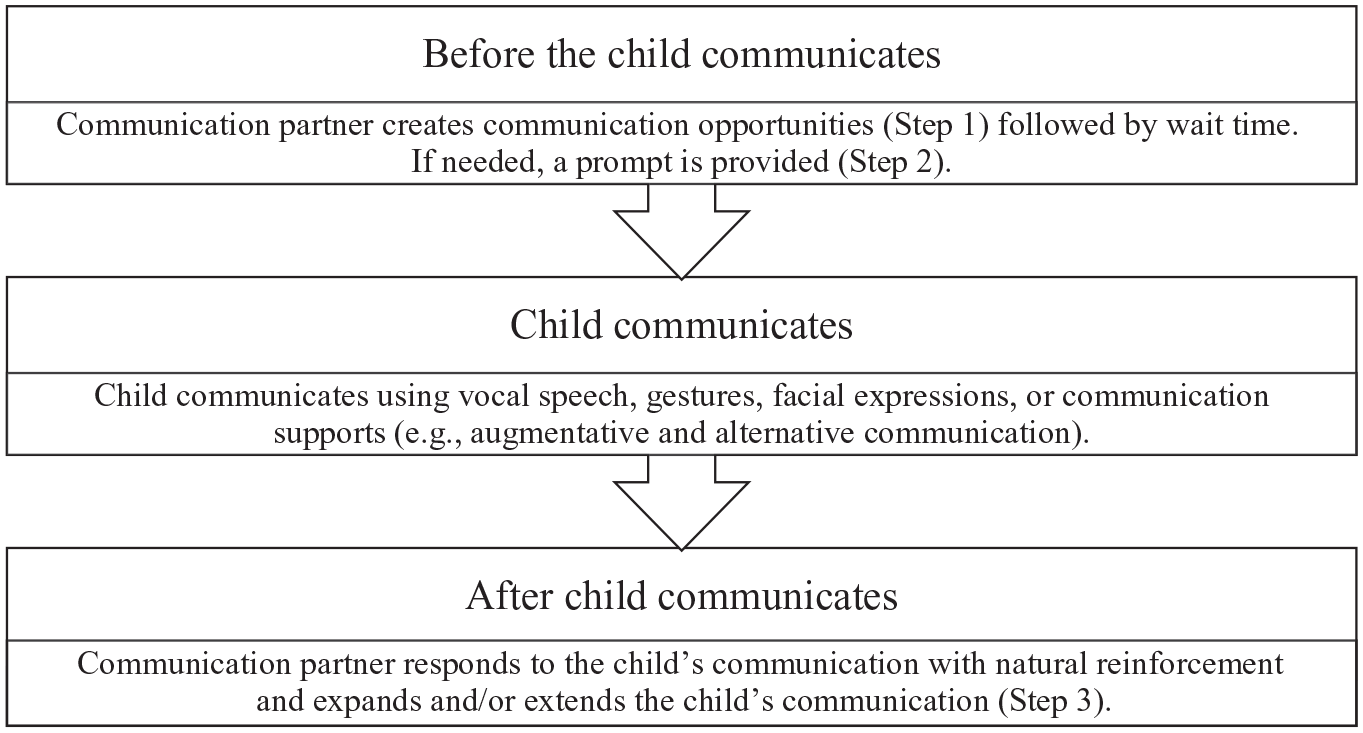
General Process in NDBI Interventions
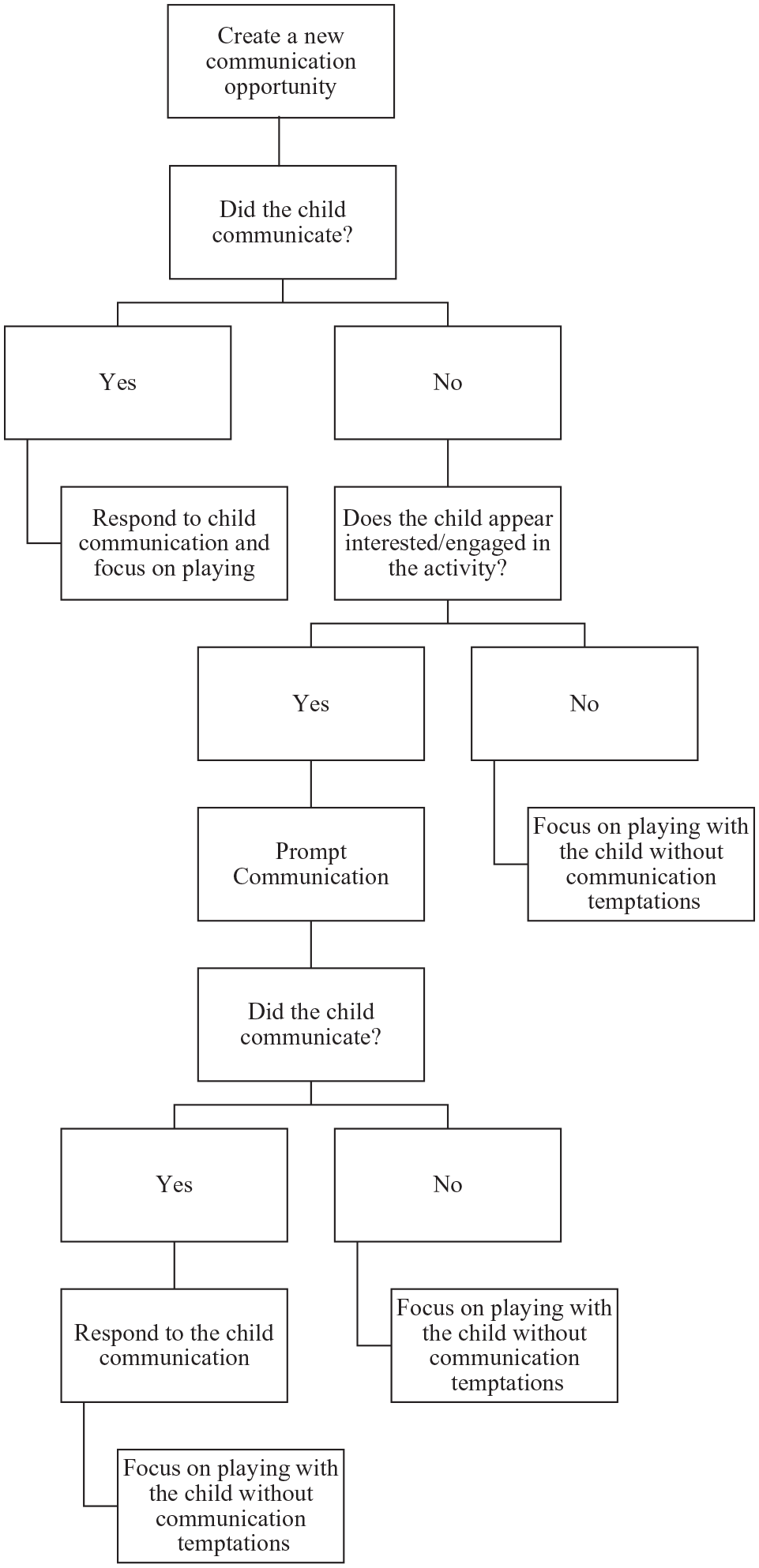
Flowchart on Using NDBI Strategy in Autism Language Interventions
Step 1: Creating Communication Opportunities
Communication temptations involve a communication partner arranging the environment and using language in ways that will create opportunities for a child to engage in a communicative act (DEC RP—Instruction INS1 and INS6; Schreibman et al., 2015). Many communication temptations focus on creating opportunities to request items (e.g., placing preferred items out of reach). However, they can also be used to encourage the use of different other pragmatic functions (e.g., rejecting, answering questions) or multi-word phrases (e.g., plane flying). To maintain naturalness and motivation, the communication partner should balance the use of communication temptations with authentic play interactions (e.g., imitating the child’s play; See Figure 2). Also, external and internal factors may influence the interactions between the communication partner and child. For example, if a child is ill or tired, the communication partner should adjust their approach accordingly (e.g., provide fewer communication temptations). Table 1 provides a list of different communication temptations and examples of how they could be used to elicit a variety of word classes/functions or to build multi-word utterances during natural routines.
Step 1: Strategies to Create Communication Opportunities or Temptations
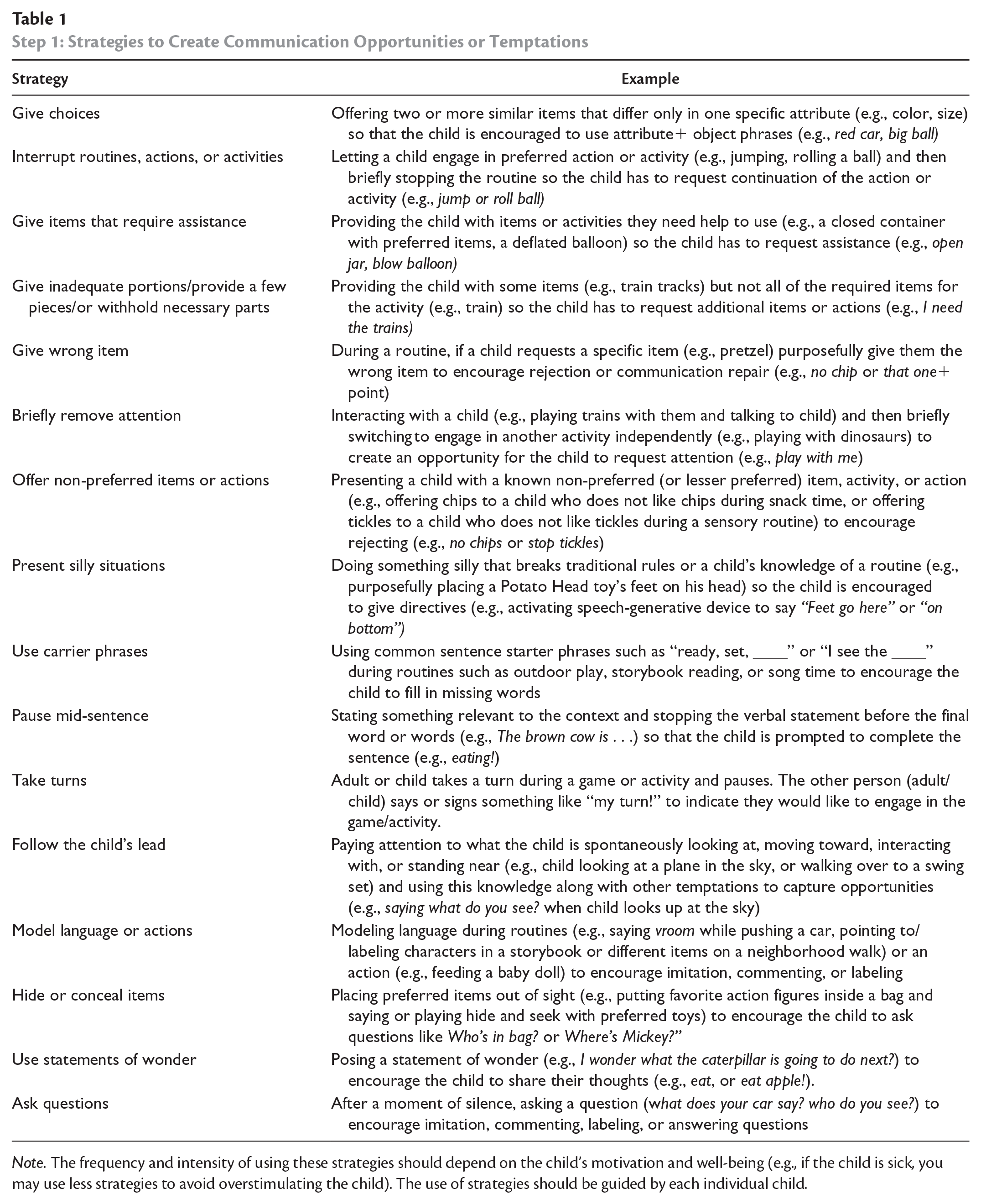
Note. The frequency and intensity of using these strategies should depend on the child’s motivation and well-being (e.g., if the child is sick, you may use less strategies to avoid overstimulating the child). The use of strategies should be guided by each individual child.
The following Monday, intervention began. For ease of implementation, Mrs. Beck decided to focus on Creating Communication Opportunities that week. At the beginning of the free play time, Antonio takes the teacher’s hand and walks over to the water table. Mrs. Beck gets low to be at the same eye level as Antonio and begins imitating his splashing. Mrs. Beck stops splashing by holding her hands just above the water. Antonio requests her to continue by signing, “MORE.” Mrs. Beck splashes the water and models language by teaching a verb: “Splashing! We are splashing! Splash, splash, splash!.” After a few minutes, Mrs. Beck noticed that Antonio was not responding to her attempts to Create Communication Opportunities. Following Figure 2, she decides to evaluate the situation. She notices that Antonio was looking at the dinosaurs and vehicles. Mrs. Beck decided to follow Antonio’s lead by transitioning to the dinosaurs and vehicles and pause the use of Communication Opportunities for a few minutes. Mrs. Beck incorporated choice temptations to focus on expanding language using adjectives (e.g., big, little). She would offer him different size dinosaurs or cars, and when he chose one via pointing or saying one word, she modeled language such as “big+dino!.”
Step 2: Encouraging or Prompting Communication
Once a communication temptation is used during an interaction, the communication partner should wait at least 3 to 5 seconds (sometimes it may need to be longer, depending on the child’s needs and situation) to see if the child communicates. If the child does not communicate, the communication partner should evaluate the child to understand if they are engaged in the activity. If the child remains engaged and seems to be enjoying the interaction, the communication partner can provide a prompt to encourage communication. Prompts can range from structured (e.g., telling the child to say a particular word or phrase) to seamlessly being integrated into a part of the play activity (e.g., providing an expectant look with shrugged shoulders and flat palms on either side of their face). Prompts to the child can be nonverbal (e.g., pointing to a toy), verbal (e.g., telling the child tell me which one you want!), a combination of both verbal and non-verbal (e.g., pointing to the cow figurine than the child’s AAC device and saying, say, “brown cow”!), or a hierarchy (e.g., using least-to-most prompting). Regardless of the prompt that is selected, it is critical that the communication partner fades the prompts (i.e., progressively and systematically removing the prompt) to ensure the child can independently engage in the communicative response in the future. Furthermore, it is essential that the communication partner individualize the prompts used to ensure it is non-aversive to the child’s interests, skills, and needs (DEC RP—Instruction INS3). Table 2 shows a list of different prompts and examples on how they can be used to encourage the child to communicate. “It is important to note that a child may communicate something that seems to be out of context. It is critical for the communication partner not to discourage or ignore these communication attempts, but rather, attempt to understand the meaning of what the child said and connect it to the context in which the communication occurred.”
During week 2, Mrs. Beck introduces Encouragement and Prompts after Creating a Communication Opportunity (See Table 2). While playing with vehicles, Antonio and Mrs. Beck wind their cars up and crash the cars together. Mrs. Beck creates an opportunity using the carrier phrase “ready, set . . .” before Antonio begins laughing and lets go of his car. Mrs. Beck lets go of her car and says “go!.” They do this a second time. On the third attempt, Mrs. Beck says “ready set . . .” and waits 4 seconds. Antonio says the word “go” for the first time! Together they release their cars, which crash into one another, and two of them begin laughing together.
Step 2: Strategies to Prompt or Encourage Communication
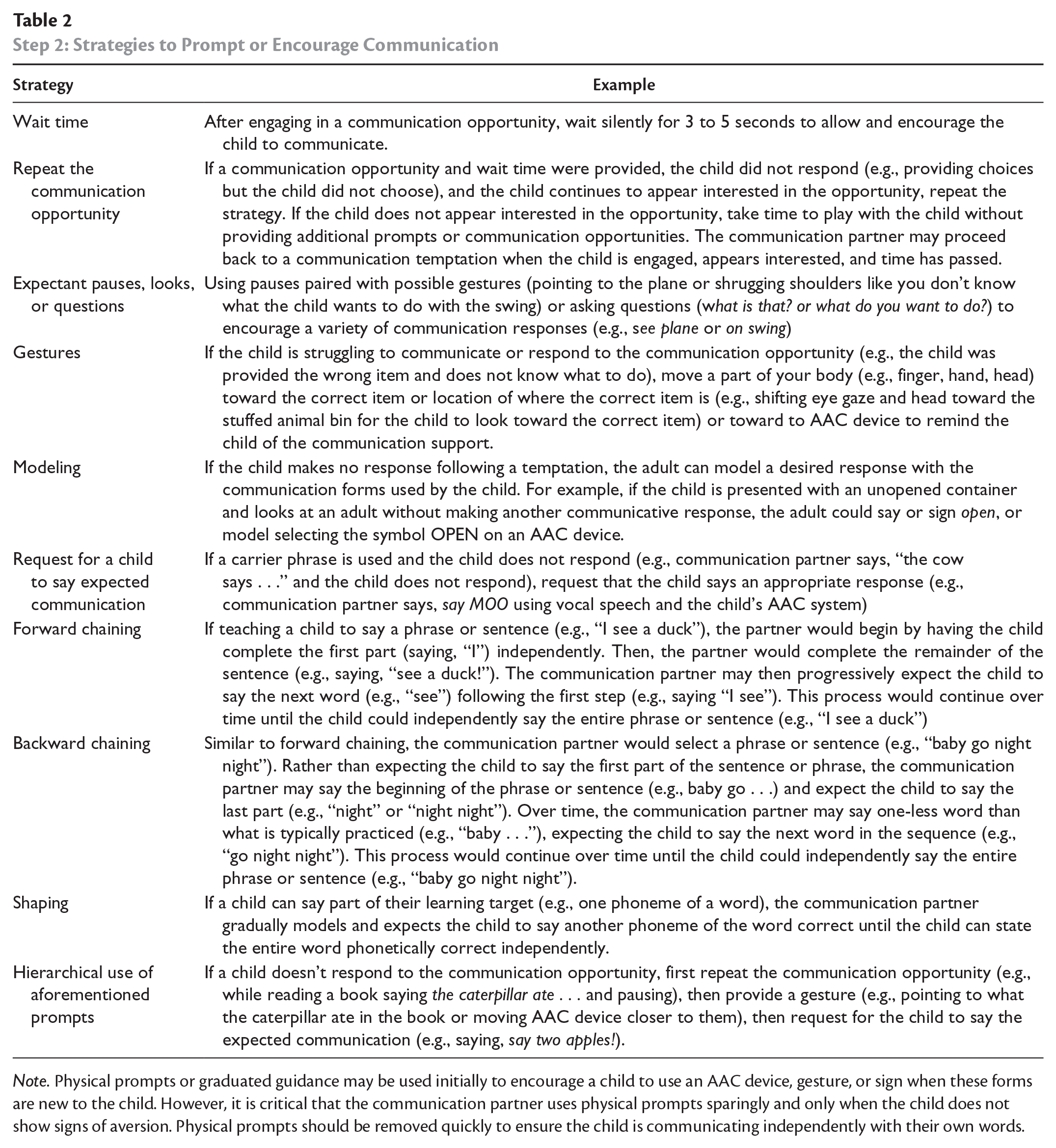
Note. Physical prompts or graduated guidance may be used initially to encourage a child to use an AAC device, gesture, or sign when these forms are new to the child. However, it is critical that the communication partner uses physical prompts sparingly and only when the child does not show signs of aversion. Physical prompts should be removed quickly to ensure the child is communicating independently with their own words.
Step 3: Responding to Child Communication
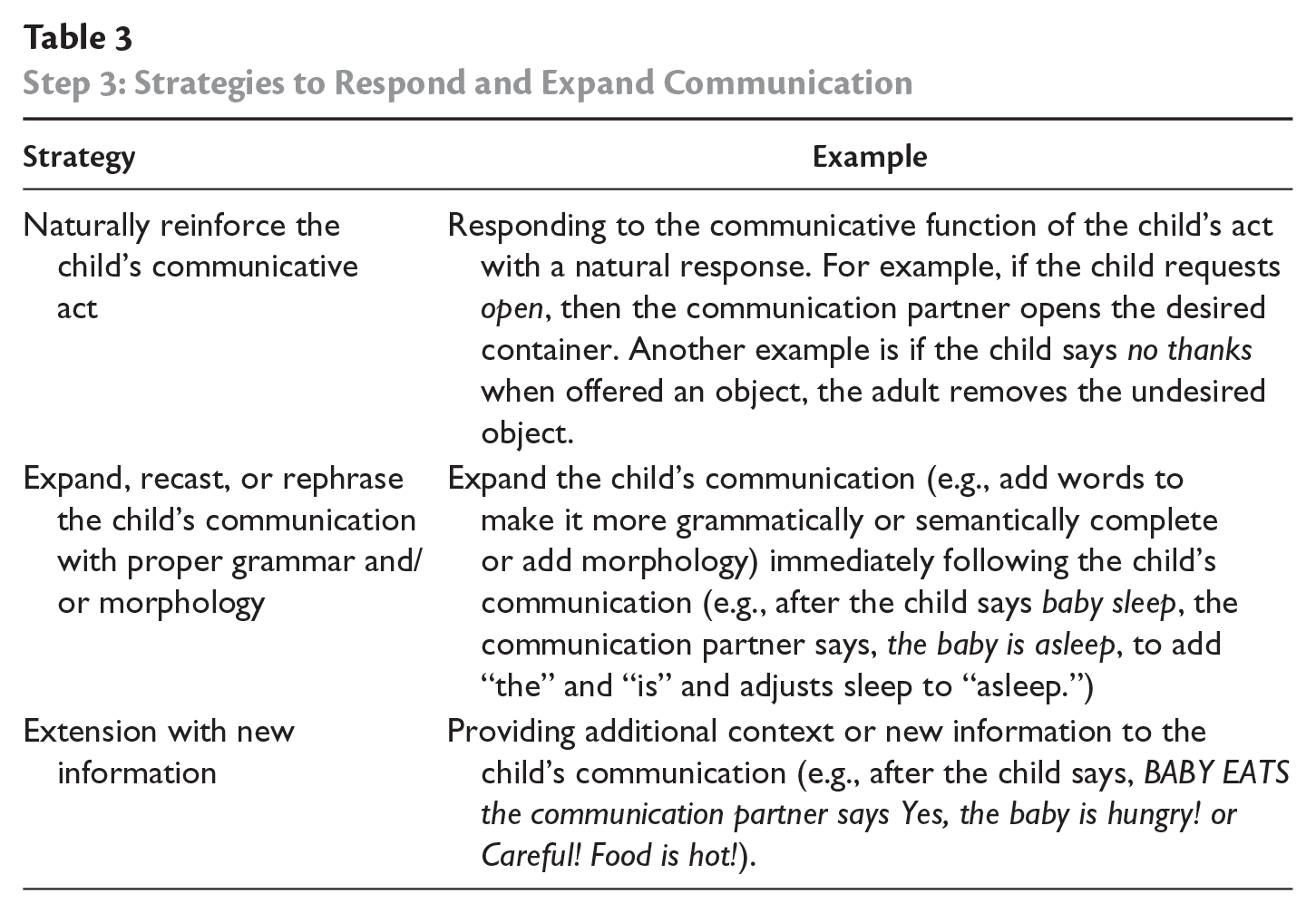
When the child communicates (spontaneously or in response to a communication opportunity or prompt) the communication partner will respond to the child’s communication (DEC RP—Interaction INT3). Like creating communication opportunities and encouraging or prompting the child to communicate, responses may be vocal speech, gestures, actions, or a combination. The adult should respond with a natural consequence (e.g., if a child requested something the communication partner should provide that item or action). The child’s language can also be expanded or recasted (i.e., adding a word to the child’s communication to make it more grammatically complete) or extended (i.e., adding new information to the child’s communication) by the communication partner. For example, if the child is playing with a figurine and says, jump up, the communication partner could expand by saying he jumped, or extend by saying he jumped up and touched the sky! It is important to note that a child may communicate something that seems to be out of context. It is critical for the communication partner not to discourage or ignore these communication attempts, but rather, attempt to understand the meaning of what the child said and connect it to the context in which the communication occurred. Table 3 shows a list of ways communication partners can respond to child communication.
Step 3: Strategies to Respond and Expand Communication
Antonio walks over to where the dinosaurs are and discovers they are in a clear bin with a lid. He hands the bin to Mrs. Beck and signs MORE. Mrs. Beck pauses and says, “say open” followed by 5 seconds of silence with an expectant look. To Mrs. Beck’s surprise, Antonio says “owen.” Mrs. Beck immediately says, “yes! Open!” while opening the bin of dinosaurs. After playing for a few minutes, Mrs. Beck evaluates how engaged Antonio is with the activity (See Figure 2) and uses a carrier phrase by saying, “this one is . . .” and waiting 3 seconds. Antonio looks at Mrs. Beck with no response. Mrs. Beck then says, “this one is . . . big or small?” while using gestures mirroring the words big and small. Antonio smiles and gestures for small. Mrs. Beck smiled and said “You’re right! This one is small.” She then extends the conversation by saying, “Your dino is big!.”
“The language and communication of the child (e.g., syntax forms, number of words being combined, parts of speech used) should be regularly evaluated as it relates to culturally appropriate typical language development, and the child’s interests, skills, and environments.”
Next Steps
Throughout the process of using NDBIs, it is critical for the communication partner to continuously reevaluate the intervention. Specifically, the language and communication of the child (e.g., syntax forms, number of words being combined, parts of speech used) should be regularly evaluated as it relates to culturally appropriate typical language development, and the child’s interests, skills, and environments. Multidisciplinary team efforts will provide additional feedback and views of this information. Joining together in a collaborative and supportive way will allow for the child to receive a robust intervention program that is socially valid and appropriate for their individual needs, interests, and desires.
Collaborating as a team is critical for child success (DEC RP—Teaming and Collaboration TC1 and TC2) and generalization across people, contexts, and settings. This requires collaboration between all members of a child’s intervention team (e.g., SLP, early childhood educator, family, translators). As such, practitioners may need to engage in parent instruction and follow-up coaching to ensure the child is receiving continuous and consistent support across a variety of contexts, settings, and people. Parents can successfully be instructed and coached on NDBI strategies, leading to increases in the child’s social communication skills. The practitioner may have to instruct and coach the parent on how to shift between creating communication opportunities, selecting an appropriate prompt, and providing a response to the child with ease. Figure 2 shows a flowchart on how the strategies fit together within communication exchanges.
Mrs. Beck and Antonio’s educational team set up a meeting with Antonio and his parents to create an implementation plan (DEC RP—Family F4 and F6). Prior to the meeting, Mrs. Beck and the educational team video-recorded examples of how to Create Communication Opportunities, Encourage or Prompt Communication, and Respond to Communication. They view the videos together, which also highlight some of Antonio’s new language skills. As they create a family Activity Planning Matrix, the team asks Antonio’s parents for input on which strategies and goals would work best in the home environment. Antonio’s parents are overjoyed and eager to try the strategies selected. With some encouragement and feedback from Mrs. Beck, his parents take turns trying the new NDBI strategies they learned (DEC RP—Family F6). His parents also ask if Antonio’s grandmother can use these strategies in Spanish, as they are a multilingual multigenerational family. The educational team encourages the family to speak in both languages with Antonio, provides additional resource materials in Spanish, and schedules a follow-up meeting to include Antonio’s grandmother (DEC RP—Instruction INS11 and INS12).
The team and family decide to meet quarterly to discuss progress and reevaluate how the intervention programming is going. During these meetings, the team adjusts their learning targets as Antonio’s language skills develop and identify new contexts and activities as Antonio’s interests change.
Considerations and Limitations
Practitioners have several areas to consider upon implementation of the proposed protocol. First, it is critical to note the importance of individualizing programming based on the child’s needs, strengths, skills, and family’s priorities and concerns (DEC RP—Assessment A4; Family F3; Instruction INS1 and INS 3), especially around echolalia. It is important to note that while alternative language development theories have been suggested for children with autism who use phrase speech or delayed echolalia, more research is needed to support these theories. In the absence of such research, evidence-based methods can be adapted to meet individual needs and support a strengths-based approach to echolalia. Second, most research on early childhood interventions has included White, Middle to Upper Class, English-speaking people (Adams et al., 2024). Therefore, we argue, again, that individualization on the part of the child’s intervention team is paramount for child success. To quote Crabbs and Freeman’s (2024) editorial piece, “DEC is a system within a system and part of a larger ecosystem of organizations, with people who affect the lives of children and families . . . [and] is working to serve all children with disabilities and their families” (p.57). With that, it is important for the practitioner to consider this limitation of research in early childhood special education and collaborate with and learn from families to understand the applicability and feasibility of the intervention plan as it pertains to that family’s concerns, priorities, and life circumstances (DEC RP-Family F3, F4, and F6). Finally, it is critical for the practitioner to collect data and find resources to assist with implementation. We recommend readers view D’Agostino et al. (2023) and Bruinsma et al. (2020) for resources for implementation (e.g., guidelines, checklists, websites) and Frost et al. (2020) and Raulston et al. (2024) for fidelity, data collection, and progress monitoring resources.
Conclusion
Embedding NDBI strategies within naturally occurring settings that are not rote or structured can provide children with autism with opportunities to practice language during naturally occurring interactions. This socially valid and research-supported approach to intervention has the potential of aligning language intervention for children with autism with typical language development. By incorporating an NDBI approach within early language interventions, children with autism have the potential to build their expressive vocabulary (e.g., communicating with personalized and relevant words) and language skills (e.g., adding semantic relations to their language).

Antonio and Mrs. Beck Playing With Dinosaurs

Antonio’s Educational Team Meeting
Footnotes
Authors’ Note
You may reach Ciara L. Ousley by email at Cousley2@unl.edu.

1.
The term “autism” will be used to refer to children who have received a diagnosis of autism spectrum disorder. Readers should note that many autistic stakeholders prefer identity-first language, but many people with autism also prefer person-first language (Taboas et al., 2023).