






Abstract
The purpose of this study is to provide a better understanding of the perceived online control effects on consumers’ behavior in the travel industry. The article uses a laboratory experiment to investigate how perceived consumer navigational control affects consumer behavior. An online travel store of a fictitious company was developed as the experimental stimulus. The findings imply that perceived navigational control affects consumers’ levels of pleasure and trust during the online navigation. In turn, pleasure and trust affect consumers’ attitude toward the online store and satisfaction. Surprisingly, consumers’ attitude is not directly affected by their perception of the level of navigational control over the travel website. Finally, gender moderates the relationship between the perceived navigational control and consumers’ attitude toward the travel website. Managerial implications regarding the development of travel websites and research opportunities are discussed.
Introduction
The increasingly growing and competitive market of online travel raises considerations about the dynamics of travel websites regarding not only their qualities but also the interaction effect between travel websites and online consumer behavior (Law & Hsu, 2006; Tang & Jang, 2012). Recent studies show that consumers’ perceptions about the ease of use of the layout (Manganari, Siomkos, Rigopoulou, & Vrechopoulos, 2011), the navigational functionality (M.-J. Kim, Chung, & Lee, 2011), and the playfulness (Morosan & Jeong, 2008) of travel websites influence consumers’ attitude and overall responses toward the shopping trip. However, despite the growth of online travel research, a limited number of studies focus on the comprehension of consumer behavior in regard to consumers’ perceptions about the qualities of online travel stores (Morrison, Taylor, & Douglas, 2004, Rong, Li, & Law, 2009). The present study examines perceived consumer navigational control as a driver of consumer responses toward travel websites.
Perceived control has been defined as the degree of control that a consumer feels during an interaction with a service provider, either through an employee or through a technology-based self-service setting (e.g., Dabholkar, 1990). Perceived user control in self-service settings is defined as the ability to rule the flow of the transaction and the level of interactivity experienced (Collier & Sherrell, 2010). In the context of the online store environment, perceived control can be viewed as the amount of control that a consumer feels she or he has in using the online store (Csikszentmihalyi, 1997; Field, 1996). In the current research, perceived consumer navigational control is conceived as the extent to which online shoppers feel that the online store environment (i.e. virtual layout, web atmospherics, the structure and flow of the transaction, interactivity, and complexity features) facilitates their navigation and the shopping goal achievement (Luna, Peracchio, & de Juan, 2002).
The notion of control is central in online commerce (Song & Zinkhan, 2008; Vrechopoulos, 2010) and in particular in travel websites because of certain restrictive qualities (e.g., small interface, inability of the consumer to feel or touch the products, limited interaction with the personnel), which may constrain not only consumers’ actual control over the environment but also their perceptions regarding the level of the control. At the same time, the nature of the online environment allows e-tailers to suspend some of the typical restrictions of the conventional store. For example, e-tailers can facilitate the unrestricted consumers’ navigation within the store, the creation of high levels of interactivity, and telepresence. Thus, the provision of navigational control to consumers is particularly important in the online environment, as the nature of the medium enables the provision of one-to-one control, with no necessary interaction between the degrees of control provided to different users and no conflict in the way each user decides to use the control provided to him or her.
Consumers’ perceptions about the control they have during the online navigation are predictors of online consumer behavior (van Dolen, Dabholkar, & Ruyter, 2007), whereas control over information can lead to lower levels of uncertainty (Weathers, Sharma, & Wood, 2007). Not only does control have a positive influence on consumers’ responses but the lack of navigational control, through restrictive navigational cues, also results in negative emotion, lower website attitude ratings, and intentions to avoid the online store (Dailey, 2002). Despite the research stream that supports the benefits of giving control to consumers, other scholars claim that marketers should control consumers’ online navigation in order to communicate a consistent message (Hanson, 2000). One should also note that online consumers, compared to off-line ones, desire significantly higher levels of control over the shopping environment (Poole & O’Cass, 2002), and consumers’ perceptions about their navigation in travel websites have carryover effects in their shopping experience (M.-J. Kim et al., 2011). Thus, it becomes apparent that the examination of perceived control is very relevant and timely for online travel contexts.
As noted above the current research focuses on the effects of perceived and not actual control. Prior research has highlighted the value of studying the effects of perceived control and not limiting research attention on the effects of actual control (Hoadley, Xu, Lee, & Rosson, 2010; Klein, 2003). In the literature, the notion of actual control refers to the user’s potential to modify the online environment, whereas perceived control refers to the extent to which users acknowledge the levels of actual control provided to them. That is, although an online store may be designed to provide a certain type (e.g., informational control, navigational control) and level (e.g., low or high control condition) of actual control, users may have expanded or limited perceptions of the level and type of control that the online store provides. Klein (2003) manipulated users’ actual control over the form, but manipulation checks revealed that users had expanded perceptions of control, as respondents in the high control condition over the form reported higher levels of control over the content also (though control over the content was not provided to them). Although perceived behavioral control is often used in the literature as a proxy of actual control (Ku, 2011), research demonstrates that consumers make imperfect evaluations of their level of control (Gino, Sharek, & Moore, 2011). In the field of tourism marketing, Lam and Hsu (2004) found that tourists’ perceived behavioral control affects their travel intention. Dabholkar and Sheng (2009) were the first to empirically test the notion of consumer online control in the context of travel websites. Although there is some preliminary evidence about the effects of perceived online control, there is very limited understanding regarding the impact of control on consumer behavior variables such as online pleasure, trust, and satisfaction in travel websites. Thus, there is a need to study not only the effects of actual control during online navigation but also the effects of perceived control on consumer behavior. Elaborating on these propositions and findings, the present study investigates the role of the perceived consumer control in the context of online travel. Specifically, the current study has two basic goals: (a) to examine the effects of perceived online control on consumer pleasure, attitude, trust, and satisfaction and (b) to identify gender differences regarding the impact of perceived online control during the navigation in a travel website.
Background Literature and Research Hypotheses
The Role of Perceived Online Control
Prior research shows that among other benefits (e.g., cost reduction, convenience, and ease of use) control is a common benefit of using an online channel (Furash, 1999; Kimball, Frisch, & Gregor, 1997). Thus, perceived control is a pertinent notion when one considers studying online users’ attitude and behavior (Bobbitt & Dabholkar, 2001). Perceived online navigational control is about how easy or difficult consumers feel in controlling their navigation in an online store. That is, higher levels of control signal consumers’ confidence in mastering the online navigation (e.g., consumers easily navigate between the consecutive steps of the booking process, they feel they know how and where to locate information they seek after, and they experience high levels of self-efficacy and feel secure about the outcome of the air ticket online booking procedure).
Online consumers’ may exert control over the online information, the online content, the online design or any design, and navigational features of the online store. Menon and Kahn (2002) note that “on the Internet, consumers have full control over choice of website to visit and the information they seek . . .” (p. 37). Joines, Scherer, and Scheufele (2003) claimed that users’ interactive control motivations predict online shopping. Although there is some evidence regarding the effects of online control, there is very limited understanding regarding the impact of perceived navigational control on consumer affect and cognition. The question remains as to whether consumers’ perception of navigational control has carryover effects on subsequent behavior in a travel website. The conceptual model builds on this question by studying the effects of perceived online control during the online shopping experience on shaping consumers’ pleasure, attitude, trust, and satisfaction (see Figure 1).
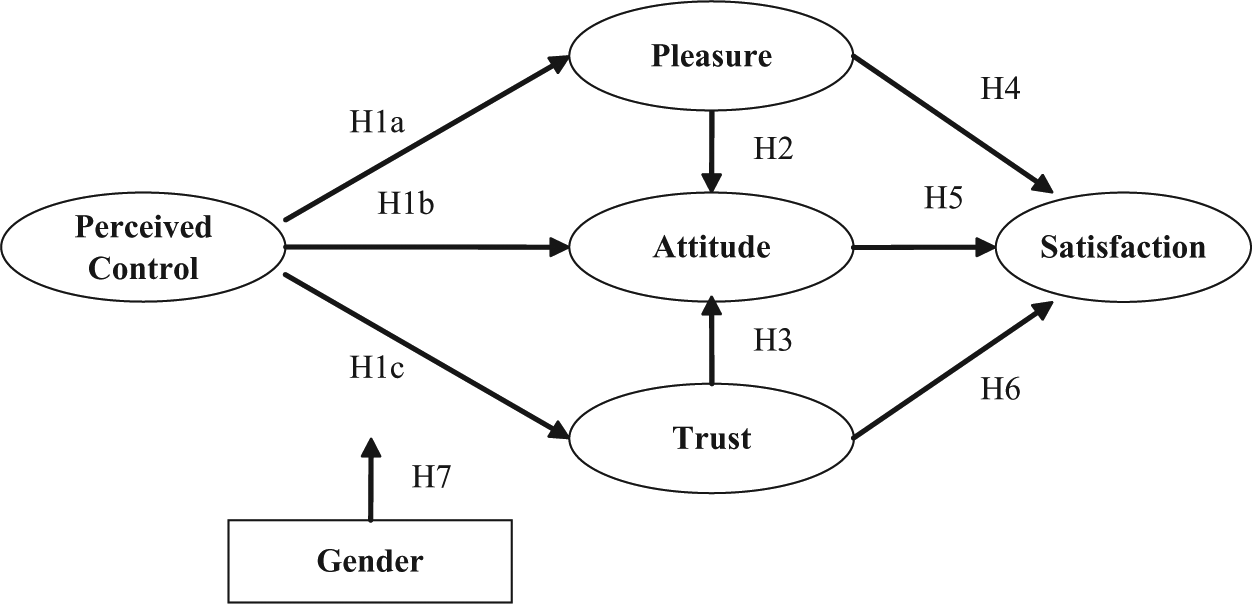
The Research Model
Pleasure, Attitude, and Trust
Prior findings support that pleasure is an outcome of the exposure of individuals to online stores (de Wulf, Schillewaert, Muylle, & Rangarajan, 2006). Consumers’ pleasure in online contexts—that is the extent to which consumers’ feel happy and joyful during the online navigating experience—is an important predictor of consumers’ satisfaction (Eroglu, Machleit, & Davis, 2003; Mummalaneni, 2005). At the same time, the literature provides empirical evidence about the effects of consumers’ perceptions of the online navigation on the levels of pleasure experienced during their shopping trip (Manganari et al., 2011), whereas previous research stresses the need to test the effects of online control on both consumers’ cognition and affect. However, the literature on online travel mainly focused on the cognitive aspects of consumer behavior and tends to overlook consumers’ affective states and their impact. To fill this research gap, the present article considers consumers’ perception of control as an antecedent of pleasure.
The notion of consumers’ attitude toward the store has been extensively studied in both off-line and online marketing literature. Although consumers’ pleasure solely captures consumers’ emotional state during the online navigation in a travel website, consumers’ attitude toward the travel website refers to their overall liking or disliking of the travel website. In other words, attitude refers to consumers’ overall assessment of a travel website based on their navigational experience (Fiore, 2002) and in the case of the present research based on the level of control experienced. Dabholkar and Sheng (2008, 2009) have linked online control with consumers’ attitude, whereas Luna et al. (2002) argued that a positive attitude toward a website acts as a prerequisite for consumers’ willingness to revisit it.
Consumers’ trust in online travel stores has lately received research attention (Fam, Foscht, & Collins, 2004). In this article, trust refers to consumers’ feeling of security and confidence toward the online travel store’s reliability (de Wulf et al., 2006). Given the goal-oriented nature of online flight booking along with the necessary provision of personal data (i.e., bank account details and cardholder information) for the completion of the booking process, trust in the travel website is of pivotal importance for online travel firms. Consumers’ perception about the navigational functionality of a travel website was found to affect consumers’ trust, which in turn influences their loyalty (M.-J. Kim et al., 2011). Although the link between online control and attitude has been previously examined, to our knowledge, the present study constitutes the first attempt to test the impact of perceived control on pleasure and trust in an online travel environment.
Satisfaction With the Travel Website
The significance of exploring the drivers of consumers’ online satisfaction in the tourism industry has been highlighted in the literature (Law & Bai, 2008; Park & Gretzel, 2007). The notion of satisfaction refers to consumers’ overall feelings about a product or a service after it has been purchased or consumed. Anderson and Srinivasan (2003) defined online satisfaction as “the contentment of the customer with respect to his or her prior purchasing experience with a given electronic commerce firm” (p. 125). Bai, Law, and Wen (2008) showed that online tourism stores’ qualities influence consumers’ satisfaction and stressed the need for further investigation between consumers’ perception about the online store and their responses. Understanding the antecedents of online satisfaction is a major concern for travel e-tailers, as satisfaction positively affects consumers’ loyalty and intention for positive word-of-mouth (M.-J. Kim et al., 2011; Litvin, Goldsmith, & Pan, 2008).
Research Hypotheses
In off-line research, perceived control influenced consumers’ affective responses to a service encounter (Hui & Bateson, 1991; Hui & Toffoli, 2002). Perceived control has also been found to positively influence consumers’ evaluations of services and satisfaction in online contexts (Yen, 2005) and consumers’ online intentions and behavior (Lee, Murphy, & Swilley, 2009; Pavlou & Fygenson, 2006). Luna et al. (2002) focused on the impact of perceived control and claimed that website characteristics influence the level of control during online navigation in a camera e-tailer, which in turn influences consumers’ attitude toward using the website. Similarly, Dabholkar and Sheng (2008, 2009) proposed and empirically verified that when consumer face download delays, perceived control will have a positive effect on consumers’ attitude toward using the website.
Although the relationship between online control and pleasure has not been empirically verified, the literature in off-line environments provides empirical evidence on the positive relationship between the control consumers feel in a retail environment and the level of pleasure they experience (van Rompay, Galetzka, Pruyn, & Garcia, 2008). Taking into account that online consumers consider control more important online than off-line, one should expect that the levels of control experienced online should have an impact on consumers’ pleasure.
Finally, overall website quality was found to influence the levels of trust toward the online retailer (Chang & Chen, 2008), whereas Collier and Sherrell (2010) supported the link between perceived consumer control and trust in the context of self-service entertainment technologies. Therefore, it is assumed that if an online shopper feels in control when navigating the online travel store, she or he will develop higher levels of pleasure, a more positive attitude toward the online store, and higher levels of trust toward the e-tailer compared with feeling a lack of or limited control. Thus, Hypothesis 1 is formulated as follows:
Hypothesis 1a: Perceived control during the online shopping experience positively affects consumers’ pleasure with the travel website.
Hypothesis 1b: Perceived control during the online shopping experience positively affects consumers’ attitude toward the travel website.
Hypothesis 1c: Perceived control during the online shopping experience positively affects consumers’ trust in the travel website.
Pleasure during the online navigation has been empirically linked to various attitudinal and behavioral outcomes. Pleasure ranges from extreme pain or unhappiness to extreme happiness or ecstasy (M. Huang, 2003). Eroglu et al. (2003) supported the finding that the level of pleasure experienced during an online shopping trip positively affects shoppers’ attitude toward a high-quality shirts e-tailer. Similarly, Fiore (2002) showed that pleasure from a fashion apparel catalogue page affects consumers’ global attitude and their willingness to buy the product. H. Ha, Janda, and Muthaly (2010) empirically verified the link between online trust and attitude, whereas Bart, Shankar, Sultan, and Urban (2005) showed that online trust has a significant influence on behavioral intention. Based on prior research insights, we expect that the levels of consumers’ pleasure and trust during the online navigation will positively influence consumers’ attitude toward travel websites. Therefore, we hypothesize the following:
Hypothesis 2: Consumers’ pleasure during the online navigation positively affects their attitude toward the travel website.
Hypothesis 3: Consumers’ trust during the online navigation positively affects their attitude toward the travel website.
Eroglu, Machleit, and Davis (2000), in their seminal study, found that the level of pleasure experienced during an online shopping trip positively affects consumers’ satisfaction and their overall approach behavior. Similarly, Mummalaneni (2005) found that pleasure influences consumers’ satisfaction, expressed intention of loyalty, and the number of items purchased. In this research, attitude refers to consumers’ overall affect-based assessment of the online store based on their shopping experience (Fiore, 2002).
In the context of e-tailing, the online environment influences consumers’ attitude toward the online store, which in turn affects consumers’ satisfaction (Eroglu, Machleit, & Davis, 2001). E. Huang (2008) maintained that consumers’ attitude is a significant predictor of e-satisfaction. When consumers shape a positive attitude toward a website, they intend to return to it (Cases, Fournier, Dubois, & Tanner, 2010; Hausman & Siekpe, 2009). In turn, consumers’ attitude toward the online store influences approach/avoidance behavior (Dailey, 2002). The role of trust in predicting satisfaction with the online store has gained limited research attention. Jarvenpaa, Tractinsky, and Vitale (2000) showed that trust influences consumers’ attitude, which in turn affects their willingness to shop from an online store. Therefore, we hypothesize that consumers’ higher levels of trust toward an e-tailer will also lead to grater satisfaction with the travel website. Thus, we postulate that consumers’ pleasure, attitude toward the travel website, and trust are directly linked with their satisfaction.
Hypothesis 4: Consumers’ pleasure positively affects their satisfaction with the travel website.
Hypothesis 5: Consumers’ attitude positively affects consumers’ satisfaction with the travel website.
Hypothesis 6: Consumers’ trust positively affects consumers’ satisfaction with the travel website.
Finally, the present study examines the differences attributed to the respondents’ gender. There is empirical evidence regarding not only the differential decision-making process adopted by men and women (e.g., Mattila, 2010) but also their distinct reactions in using the Internet and during the online navigation (Cyr & Bonanni, 2005; Danaher, Mullarkey, & Essegaier, 2006; Mattila, 2010; Moss, Gunn, & Kubacki, 2008). Prior research has demonstrated, that women make more negative evaluations of their skills in the online environment compared with men (Hargittai & Shafer, 2006; Sanchez-Franco, Villarejo-Ramos, & Martin-Velicia, 2009), feel less in control as online users (Whitley, 1997), and are more interested in risk-reduction (E. E. K. Kim, Mattila, & Baloglu, 2011). Thus, one may assume that the above inclinations may render women’s perceptions of control more influential for their subsequent behavior during the online navigation (Venkatesh, Morris, & Ackerman, 2000), especially in an online travel store where the completion of the transaction involves the provision of personal and accurate information.
Dabholkar and Sheng (2009) supported that the effect of perceived control was stronger for women, compared with men, regarding their attitude and their intention toward using the website. Garbarino and Strahilevitz (2004) found that in the context of e-tailing, women experience higher levels of risk, compared with men. Their study also revealed that the effect of perceived risk reduction on willingness to buy online is stronger for women compared with men, whereas Im, Kim, and Han (2008) showed that the effect of ease of use on intention is also moderated by gender. Additionally, the effect of perceived ease of use on enjoyment is stronger for women compared with men (I. Ha, Yoon, & Choi, 2007). We, therefore, postulate that the level of perceived control experienced by women during the online navigation is a stronger predictor of their subsequent reaction (e.g., attitude, pleasure, trust), compared with men.
In this research line, the current study extends the moderating effect of gender to the relationship between the perceived control of the online store and consumers’ pleasure, attitude, and trust. Specifically, we hypothesize that the effect of perceived control on consumers’ pleasure, attitude, and trust will be stronger for women compared with men. Thus, the following hypotheses are proposed:
Hypothesis 7a: The effect of perceived control during the online shopping experience on shoppers’ pleasure will be higher for women compared with men.
Hypothesis 7b: The effect of perceived control during the online shopping experience on shoppers’ attitude will be higher for women compared with men.
Hypothesis 7c: The effect of perceived control during the online shopping experience on shoppers’ trust will be higher for women compared with men.
Operationalization
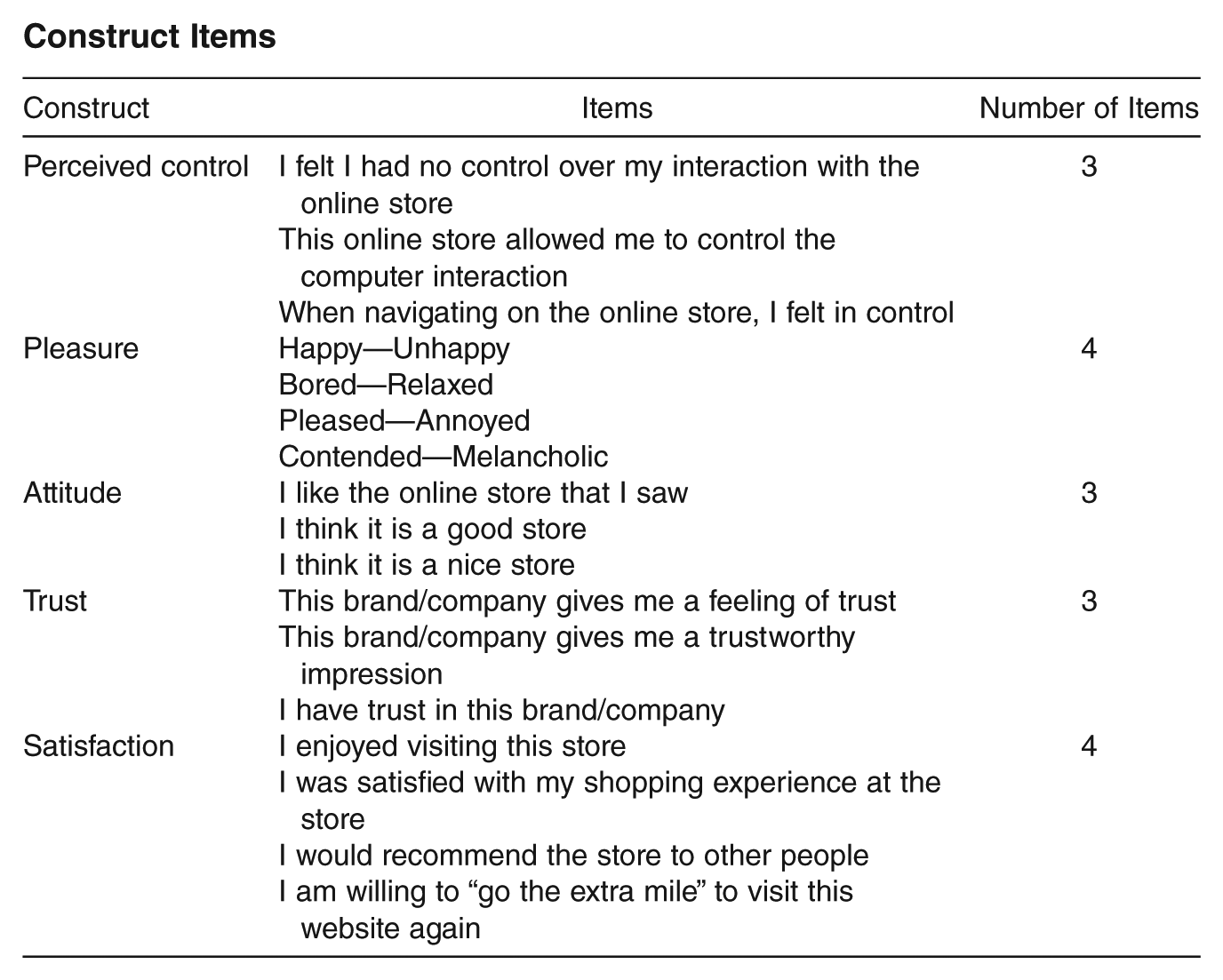
Perceived online control was measured based on the scale developed by Webster, Trevino, and Ryan (1993), whereas consumers’ trust scale was adapted from de Wulf et al. (2006). Pleasure is measured with Mehrabian and Russell’s (1974) 7-point semantic differential scale, and consumers’ attitude scale is adapted from Chattopadhyay and Basu (1990). Finally, satisfaction was drawn from prior research of Eroglu et al. (2003). The appendix presents the construct items.
Research Setting and Sampling
This study uses a laboratory experimental design in the context of the online travel industry. An online store for a fictitious air travel company, named iFLY, was developed to eliminate the effects from prior experience and brand effects. The experimental travel website contained all the basic functions of a real airline website. That is, respondents could navigate in the store web pages to read information about the company and its mission, the destinations, the terms and conditions of booking a flight, and contact details. Generally, the development of the online travel store follows the design concepts proposed by Vrechopoulos, O’Keefe, Doukidis, and Siomkos (2004). There were two domestic destinations (i.e., Athens and Thessaloniki) and three international ones (i.e., London, Paris, and Rome).
An off-line mode was preferred to ensure consistency of speed. The researcher who was in charge of the data collection followed a standardized procedure and ensured that the same conditions were kept during the data collection period (i.e., greeting and guidance of the respondents; maintaining consistency of conditions inside the lab regarding noise, etc.; keeping the same number of respondents simultaneously participating in the experiment; allowing no interaction between the respondents during their participation; assigning subjects to groups at random, etc.) to rule out the effects of extraneous factors (Kerlinger, 1986).
Only respondents with prior Internet use experience were eligible to participate in the experiment. Each participant was given an instructional leaflet, the research questionnaire, and a personalized Visa card from a fictitious bank to make his or her purchases from the specific online store. Subjects were asked to suppose that they had at their disposal ˆ300 and that they could spend this amount of money to buy airline tickets from the specific online store. Participants were instructed to browse the online store for as long as they needed. After they entered the online store, respondents had access to information about the company (i.e., mission of the company, flight destinations, terms and conditions, and contact details) and they could proceed to the online flight booking. The completion of the purchase was achieved after the confirmation of the flight details and the provision of personal information (i.e., name, card number, date of expiration of the credit card, etc.), as in real online flight booking. The data collection took place in a university laboratory in Athens (Greece) and lasted 3 weeks. After the completion of their shopping trip, the subjects filled out the questionnaire. A prize draw was offered as an incentive for participation.
A total of 241 students from a business school (sampling frame) participated in the laboratory experiment. Of the participants, 50.6% were male and 49.4% were female. The majority (54.8%) were between 21 and 24 years old, 30.3% between 18 and 20 years, 13.7% between 25 and 29 years, and a mere 1.2% were older than 29 years. Students were both undergraduate (51.5%) and postgraduate (49.2%). The majority (64.7%) of the respondents claimed that they have conducted online purchases in the past. Out of them, 55.5% had previously booked a flight online, whereas 44.5% had no prior experience with online flight booking.
Results
Assessment of Reliability and Validity
A confirmatory factor model was created to provide construct validation support. The measurement model was checked to evaluate reliability and validity of the constructs. Overall, the measurement model exhibited substantial good fit with the data collected (χ2 = 241.99, degrees of freedom = 109, comparative fit index = 0.95, incremental fir index = 0.95, parsimony goodness-of-fit index = 0.63, root mean square error of analysis = 0.07). Construct reliability was assessed through Cronbach’s alpha (Cronbach, 1951; Nunnally, 1978) and composite reliability after Fornell and Larcker (1981). To improve reliability, items where removed when necessary to refine the scale.
In accordance with Nunnally (1978), Cronbach’s alpha was greater than .70 for all measures, whereas the rho coefficients for internal consistency are above the threshold of .60 (Bagozzi & Yi, 1988). The following step involved the estimation of average variance extracted (AVE) to assess convergent validity. The AVE for each construct is greater than the variance attributable to its measurement error (i.e., .50).
Finally, discriminant validity is assessed after Fornell and Larcker (1981). The AVE for each construct exceeds the absolute value of the squared correlations involving the construct. Thus, results demonstrate convergent (Chin, 1998) and discriminant validity. Table 1 provides summary statistics.
Assessment of Reliability and Validity
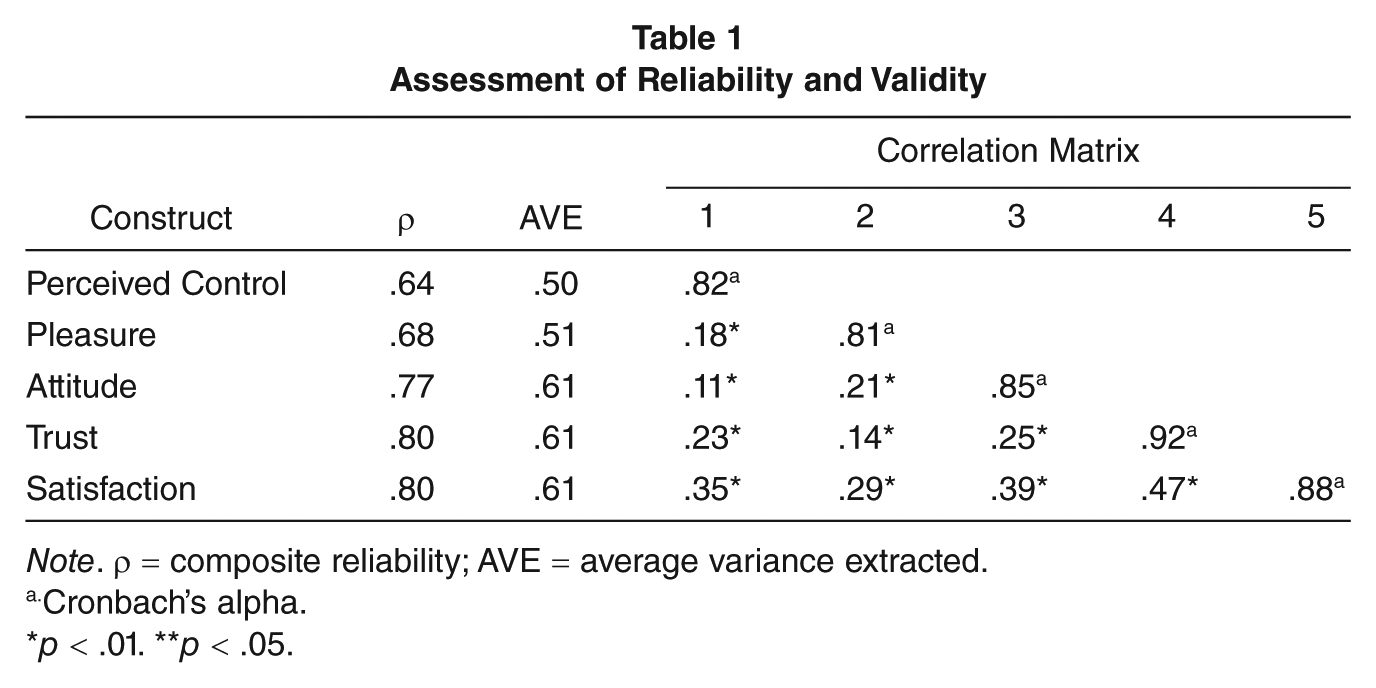
Note. ρ = composite reliability; AVE = average variance extracted.
Cronbach’s alpha.
p < .01. **p < .05.
Model Testing
The study uses structural equation modeling to test the research hypotheses. The model fit is assessed against widely published and recognized criteria (Hair, Anderson, Tatham, & Black, 1998). Measures of absolute fit (χ2 = 264.53, degrees of freedom = 112), comparative fit (comparative fit index = .94), incremental fit (incremental fit index = .94), parsimonious fit (parsimony goodness-of-fit index = .64), and root mean square of approximation (.07) reflect a satisfactory fit between the model and the data (Bagozzi & Yi, 1988; Jöreskog & Sörbom, 1993). Thus, the conceptual model is a satisfactory representation of the sample data. All but one of the paths featured strong, positive, and significant values. Table 2 summarizes standardized path coefficients.
Structural Standardized Estimates
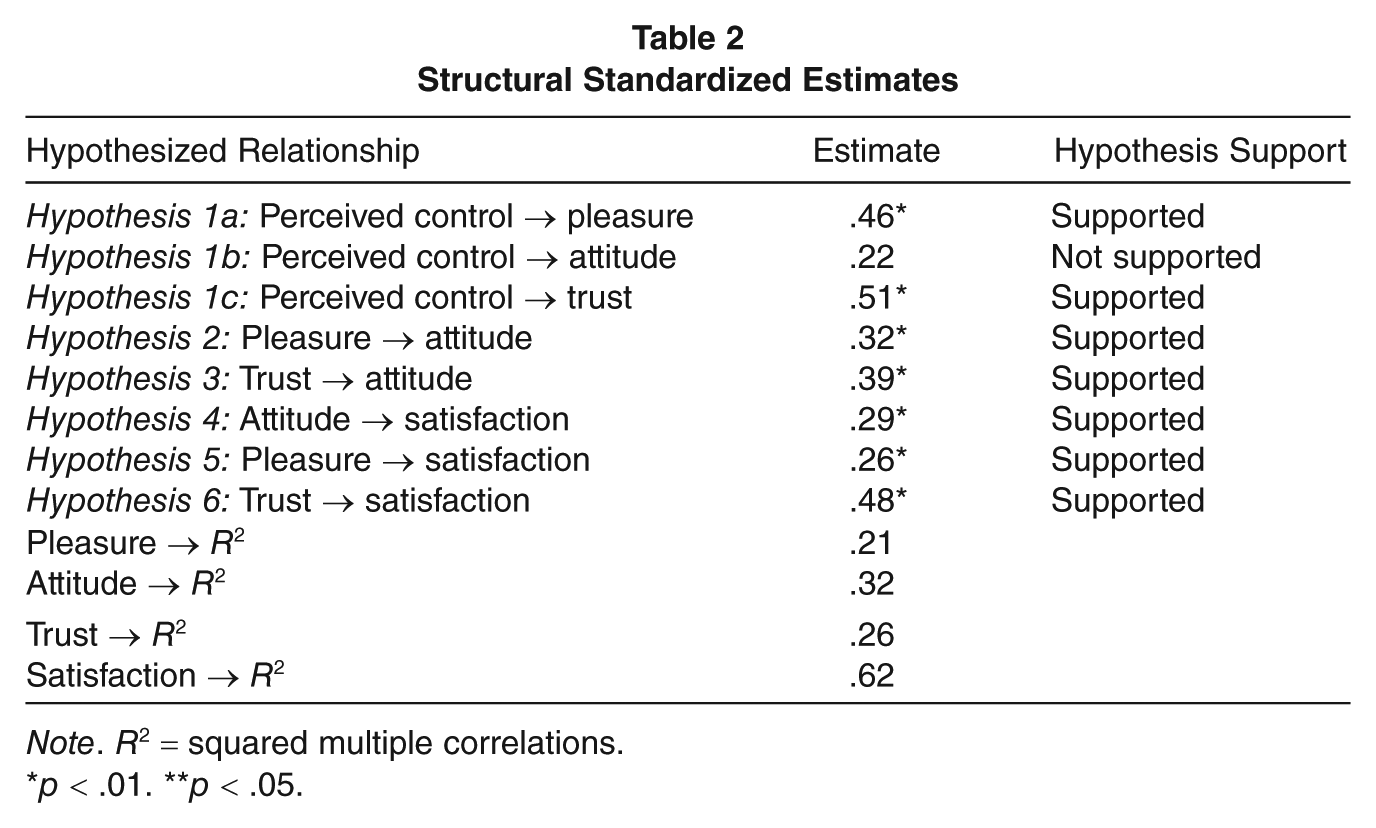
Note. R2 = squared multiple correlations.
p < .01. **p < .05.
The impact of the perceived control on consumers’ pleasure and trust is statistically significant, but the effect of perceived control on consumers’ attitude was not significant. Thus, the results support Hypotheses 1a 1c but not Hypothesis 1b. Both pleasure and trust are important predictors of consumers’ attitude toward the e-tailer, indicating substantial support for Hypotheses 2 and 3. Finally, consumers’ pleasure, attitude and trust positively influence consumers’ satisfaction with the shopping trip. Hence, the results confirm Hypotheses 4, 5, and 6.
Testing for Moderating Effects
Multigroup confirmatory factor analysis was conducted to test the moderating effect of gender in the research model (Baron & Kenny, 1986). Multigroup analysis within structural equation modeling pinpoints statistically distinct group differences. The sample was classified into two groups: male and female. Rigorous pretests were done to verify that the changes in regression coefficients are because of group differences and not because of measurement error (Jöreskog & Sörbom, 1993). After establishing measurement invariance in the measurement model, structural invariance is examined. Table 3 shows the results of hypotheses testing in terms of the changes in standardized β coefficients (from the male to the female group) in the presence of the moderating effect. Results indicate that gender moderates the relationship between the perceived control and consumers’ attitude. Contrary, results reveal no evidence of the moderating effect of gender in the relationship between the perceived control and pleasure and trust. Hence, the findings provide support for Hypothesis 7b but not for Hypotheses 7a and 7c.
Standardized Structural Coefficients
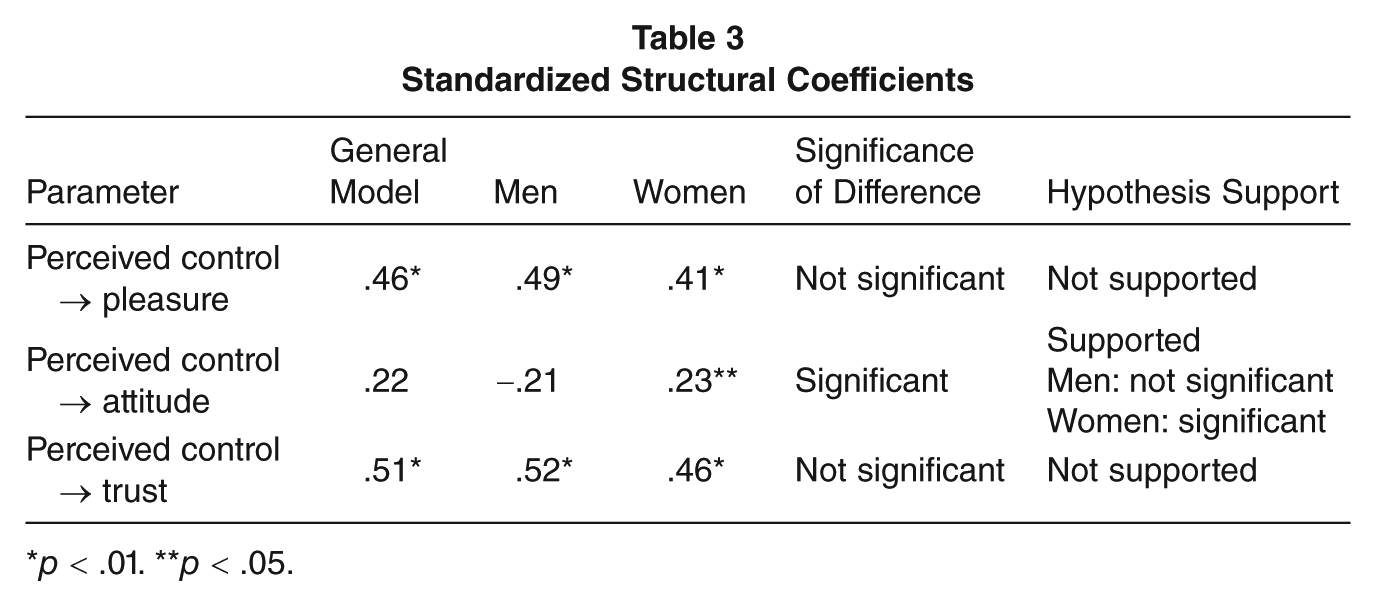
p < .01. **p < .05.
Notably, the effect of perceived control on consumers’ attitude is statistically significant for the female respondents but not for male respondents.
Discussion
The empirical study shed light on the effects of perceived online navigational control on consumer behavior. The results generally confirm the research model. Specifically, consumers’ perceived control during the online navigation influences their pleasure and trust, which in turn influence consumers’ attitude. Interestingly, consumers’ attitude is not directly affected by perceived online control. Although the link between online control and trust has been previously tested in other contexts (Collier & Sherrell, 2010), the significance of this relationship in the travel industry is particularly interesting, as building online trust toward a travel store is important not only for established online travel stores that have already managed to build a long-term relationship with consumers but also particularly for new entrants in this fast-growing market (Koo, Mantin, & O’Connor, 2011). This is the first empirical study that verifies the importance of online pleasure as a result of consumers’ perceived control and as a predictor of attitude and satisfaction in the context of travel websites. This finding advances the theory, by identifying the significance of affect in a goal-oriented shopping context. Contrary to Dabholkar and Sheng (2009), results show that consumers’ attitude is not directly affected by the perceived online control during their navigation in the travel store. One possible explanation of this contradicting finding may be attributed to the different perspectives of perceived control used in these studies. Specifically, Dabholkar and Sheng examined online control in the context of online delays, whereas the present study examines perceived navigational control. Further investigation in different types of perceived control (i.e., informational control, control over the content, active control) could enhance our understanding about the impact of consumer online control. Overall, the empirical findings highlight the importance of perceived control during an online shopping trip. Notably, the study reveals that consumers’ attitude toward the online store, pleasure, and trust are predictors of consumers’ satisfaction with the shopping trip.
The finding that gender moderates the impact of perceived control on attitude suggests that the impact of perceived control on attitude is significant for women as opposed to men. This finding is consistent with Dabholkar and Sheng (2009), who argued that perceived control was a stronger predictor for female reactions, compared with male reactions, and is conflicting at the same time as in the current study perceived control failed to predict attitude toward the travel website for male respondents.
Implications for Marketing Strategy
A number of salient and straightforward managerial implications emerge from the findings of the study. In the field of tourism research, Au Yeung and Law (2006) claimed that the online user interface and navigation are important determinants of website success, whereas Dabholkar and Sheng (2009) supported that online environments may create a feeling of lack or limited control to consumers. Online retailers in the travel sector should focus on enhancing consumers’ perception of control during the online shopping trip. By enabling consumers to become actors in the online store, through the transfer of control, it is possible to have a positive effect on their perceptions, attitudes and behavior. E-tailers should consider while designing online stores that perceived control may concern multiple facets of online navigation (e.g., atmospherics, layout, content, presentation, etc.). Depending on the desired store image and the product category (e.g., e-ticket, hotel booking), e-tailers may provide different levels and types of consumers’ control. The provision of online control from e-tailers to consumers should be customized (e.g., each consumer can have the level of control desired). Especially for repeat or loyal customers, so that their profile (e.g., gender, age, preferences) is available, online travel stores may customize the online interface in a way that enhances the level of navigational control, taking also into account gender effects as provided by the present study. Nonetheless, this process requires marketers to understand the optimal levels of user control that not only enable a virtual experience but also minimize distraction and potential information overload.
Comparing these findings with current business practice regarding travel and tourism websites, it is observed that several companies have already proceeded to the provision of certain control features to their customers or online users. Indicatively, the “personalize your web site” options (e.g., select product display techniques, colors, etc.) available in many commercial tourism websites today constitute a representative example. However, since relevant academic research on this emerging topic of online consumer control is still on its infancy, it is clear that such business initiatives are not based on theoretical grounds and, therefore, involve high risk. Managers of online retail stores should consider whether to provide such control or not, to which target customers, under which situational factors and circumstances, and for which products and services (i.e., sections/pages of the web store). Similarly, since “consumer control” as a service may potentially constitute a store selection criterion (Manganari, Siomkos, & Vrechopoulos, 2009; Vrechopoulos, 2005) it is important that e-tailers invest in exploring how, when, and for which customers and products/services should navigational control be provided. Finally, firms should shift their focus from applying cutting-edge technologies in their travel websites that may create a feeling of lack of control to consumers to applying user-friendly technologies that create a feeling of control toward the completion of the online purchases.
Lueg, Ponder, Beatty, and Capella (2006) report that “Internet retailers should increase Internet shopping involvement by creating more interactivity on the Web site” (p. 149). Online control is a notion that is highly associated with online interactivity, flow, and telepresence. To that end, providing customers permission to manipulate the online store environment (i.e. control) contributes to creating higher level of desired interactivity.
Limitations and Future Research
Two limitations in the research design should be noted while applying the findings. The student sample can be regarded as a limitation in the attempt to generalize the findings and implications to the population of online shoppers. However, although the utilization of a student sample has been questioned in the tourism literature (Miao & Mattila, 2007), a number of researchers consider it as a common research practice especially for the web. Second, the use of a laboratory (instead of field) experimental approach was preferred because of the actual control it provides to the researcher over the online store environment (i.e. high internal validity). Still, it should be noted that experimental environments are not as realistic as studying real consumers’ reactions and therefore results should be generalized with caution. However, as it also stands in conventional retailing, it is quite difficult to convince a real retailer to offer his or her store for experimental purposes (i.e., field experiments).
The results of this study could be validated in the future by using a nonstudent sample to encompass a wider customer group. This would enable a segmentation analysis and drawing of conclusions regarding the importance and the effects of control for different consumer segments that would be shaped based on psychographic, demographic, and behavioral characteristics. Future research can also embrace the examination of the importance of perceived control over the online store for different types of shopping orientations (e.g., experiential vs. utilitarian). Another future research question could focus on the combined effects of different types of control (e.g., control over the content, over the navigation, over the atmospherics of the store, over the amount and presentation of information) in different product categories (e.g., flight booking, travel package, car rental) or for different types of travelers (e.g., business traveler, leisure traveler). Another interesting research direction involves the measuring of the effects of control and lack of control over the online store on consumers’ intention for loyalty and word-of-mouth communication.
The moderating effects of gender reinforce the need to test the belief that “technology is gender neutral” (Wilson, 2004) and to study how and when gender differentiates consumers’ online behavior (Moss, Gunn, & Heller, 2006; Moss, Gunn, & Kubacki, 2007). Finally, the effects of perceived control should be studied in the presence of not only other navigation-related variables (e.g., ease of use, entertainment, usefulness) but also other more “traditional” store selection attributes (e.g., special offers, variety of products, price, quality of service, etc).
Footnotes
Appendix
Construct Items
| Construct | Items | Number of Items |
|---|---|---|
| Perceived control | I felt I had no control over my interaction with the online store | 3 |
| This online store allowed me to control the computer interaction | ||
| When navigating on the online store, I felt in control | ||
| Pleasure | Happy—Unhappy | 4 |
| Bored—Relaxed | ||
| Pleased—Annoyed | ||
| Contended—Melancholic | ||
| Attitude | I like the online store that I saw | 3 |
| I think it is a good store | ||
| I think it is a nice store | ||
| Trust | This brand/company gives me a feeling of trust | 3 |
| This brand/company gives me a trustworthy impression | ||
| I have trust in this brand/company | ||
| Satisfaction | I enjoyed visiting this store | 4 |
| I was satisfied with my shopping experience at the store | ||
| I would recommend the store to other people | ||
| I am willing to “go the extra mile” to visit this website again |
Authors’ Note:
The authors would like to gratefully acknowledge the editor, the associate editor, and the three anonymous reviewers for their comments and suggestions on the article.