







Abstract
The purpose of this exploratory study is to analyze the emotional dissonance among frontline hospitality employees, based on the habituation theory, by examining the responses of brain regions of interest to customers’ incivility. A survey and functional magnetic resonance imaging (fMRI)—measuring brain responsiveness—data were collected to compare the life/occupational stress between the frontline hospitality (i.e., customer interacting jobs) and nonhospitality (i.e., minimal or no customer interaction) employees and analyze the responses of brain regions of interest. Although the data from the survey suggested no significant difference between the two groups of employees, the fMRI analysis found significant habituation of the brain regions of interest among the frontline hospitality employees. The analysis outcomes confirm habituation theory and suggest managerial implications such as managing stress or burnout from emotional dissonance and improving employee welfare/fitness to relieve stress from emotional dissonance. The findings suggest the call for more in-depth analysis regarding emotional dissonance.
Introduction
Previous studies have suggested that frontline employees who interact with customers on a regular basis experience burnout due to the emotional nature of their work (e.g., stress from interactions with customers; Han et al., 2016; H. Kim & Qu, 2019; H. J. Kim, 2008). The burnout is particularly significant when employees constantly encounter customer incivility, which can increase emotional dissonance. Emotional dissonance occurs when the emotions displayed externally conform to the organizational norm but conflict with one’s true feelings (Rafaeli & Sutton, 1987). Theoretically, emotional dissonance stems from facets of emotional labor (i.e., display rules vs. job strains). Emotional labor is defined as “the management of feeling[s] to create publicly observable facial and bodily display” (Hochschild, 1983, p. 7).
Frontline employees must treat customers with hospitality by using appropriate paralanguage (e.g., appropriate facial expressions) while experiencing emotional dissonance (Rafaeli et al., 2012). This could mean that employees smile while interacting with difficult customers, but they experience stress internally. Additionally, T. D. Wilson (2002) and Freud (1924, 1951) suggested 90% of the human mind stays at an unconscious level. This suggestion would mean that prior repeated negative interactions would stay at the unconscious level, affecting the stress of frontline employees. The stress could become chronic because frontline employees are repeatedly exposed to demanding and difficult customers (H. J. Kim, 2008). As a result, their vulnerability to chronic stress stemming from emotional dissonance increases and possibly progresses to the extreme (e.g., burnout, alcohol abuse).
Theoretically, repeated stress from emotional dissonance has been suggested to induce habituation (unresponsiveness) in the brain’s responses. Conversely, habituation may progress to dishabituation (e.g., emotional burnout) through stronger/prolonged stimuli (Farber, 2015; Grissom & Bhatnagar, 2009). Although this theory could be imperative in measuring the impact of emotional dissonance on the internal emotions of frontline hospitality employees, it has not been examined empirically or theoretically.
The mechanisms involving the internal emotions of frontline hospitality employees can be measured by examining the brain regions of interest. Chronic stress may lead to stimulation in regions such as the prefrontal cortex and amygdala (Oliveira et al., 2016). Researchers are yet to utilize an experimental approach to examine the discrepancy between paralanguage (i.e., display rules) and the responses of brain regions of interest among hospitality employees experiencing customer incivility. Several studies have suggested the impact of customer incivility on emotional dissonance, burnout, job satisfaction, role stress, and excessive workloads (Abraham, 1999; Kern & Grandey, 2009; H. Kim & Qu, 2019; Lee & Ok, 2012; Min et al., 2015; N. L. Wilson & Holmvall, 2013). However, all these studies were conducted using quantitative surveys and did not analyze or confirm the internal emotions and brain activities of employees.
Utilizing functional magnetic resonance imaging (fMRI) can overcome the limitation of quantitative survey data analysis; fMRI can be used to understand the mechanisms involving internal emotions. Although hospitality employees show the highest substance and alcohol abuse rate compared with other industry employees in the United States (Bush & Lipari, 2015), emotional dissonance, which would be at the core of these issues, has never been studied using neuroimaging. Therefore, the purpose of this exploratory study was to analyze the emotional dissonance among frontline hospitality employees by examining the responses of brain regions of interest. Specifically, this study analyzed whether or not and which parts of the brain were habituated or dishabituated in frontline hospitality employees who experience customer incivility. The contributions of this exploratory research are derived from its experimental analysis using fMRI, provide theoretical and empirical implications regarding emotional dissonance with habituation theory, and suggest indicative/preventive measures for stress and anxiety for frontline hospitality employees.
Literature Review
Emotional Dissonance
Theoretically, some of the representative conceptual underpinnings of emotional labor can provide the fundamentals of emotional dissonance. Emotional labor works as a key to achieve performance goals of service-oriented employees when interacting with customers. The employees may try to change the mood by reappraising the situation (deep acting) or fake their expressions (surface acting; Hochschild, 1983). Surface acting would be especially prominent when the employees interact with difficult or complaining customers (e.g., following organization norms of paralanguage). Additionally, as previously discussed, either type of acting would influence the unconsciousness of the human mind and manifest as stress whenever the employees are exposed to customer incivility.
Hochschild (1983) dramaturgically positioned customers, employees, and the workplace as the audience, actors, and the stage, respectively. In this setting, actors may utilize display (i.e., display rules) as an expressive device to reach the goal of a business transaction (Grove & Fisk, 1989). They suggested the positive impacts of emotional labor on job dissatisfaction and burnout. However, this theory does not specify emotional dissonance as a consequence of emotional labor. Ashforth and Humphrey (1993) focused on the task effectiveness of emotional labor and disregarded relevant stress and health-related issues. They suggested that service-oriented employees might handle emotional dissonance effortlessly once they become accustomed to it. In contrast, Morris and Feldman (1996) theorized that emotional dissonance was a key dimension as a state of being as a consequence of the process of emotional labor. They suggested that psychological and health issues, such as burnout and job dissatisfaction, are outcomes of emotional dissonance. For example, burnout is defined as a change of behavioral and attitudinal patterns of job performance in a negative way (Swider & Zimmerman, 2010). It has been suggested to comprise three subcomponents: emotional exhaustion, depersonalization (excessively detached behavior), and reduced personal accomplishment (devaluing personal accomplishment; Maslach et al., 2001). Especially, emotional exhaustion would be significantly related to emotional dissonance in that constant exposure to the emotional dissonance would make employees experience emotional exhaustion. However, these theoretical backgrounds could not provide a theoretical mechanism about how the outcomes resulted in emotional dissonance (i.e., the potential of internal emotions progressing to more serious issues).
Control theory provides narratives on dramaturgically positioned emotional labor in a conceptual model (Figure 1). The theory provides “a process-based view of behavior based on the reciprocal effects of a person interacting with his or her environment across changing circumstances” (Diefendorff & Gosserand, 2003, p. 947). Control theory has its center of motivation (internal) and behavioral self-regulation (external) controlling the discrepancy between the internal and external. Initially, an employee would establish self-perceptions (Perceptual Input) for display rules (Standard/Goal; see Figure 1). In the comparator, the employee may find a discrepancy between the perceptual input and standard or goal, and he or she can use emotional regulation (as Output in Figure 1; referred as “cognitive change”; Lord & Hanges, 1987) to align with or conform to the display rules. After adjusting and readjusting the discrepancy, the employee is still often exposed to affective events (e.g., negative feedback/incivility) as an environmental disturbance (see Figure 1). The series of such events could have an “impact on environment” (e.g., change of policies and display rules; see Figure 1), especially in the prior phases during which perception of discrepancy between perceptual input and display rules, and cognitive change; emotional dissonance would result.
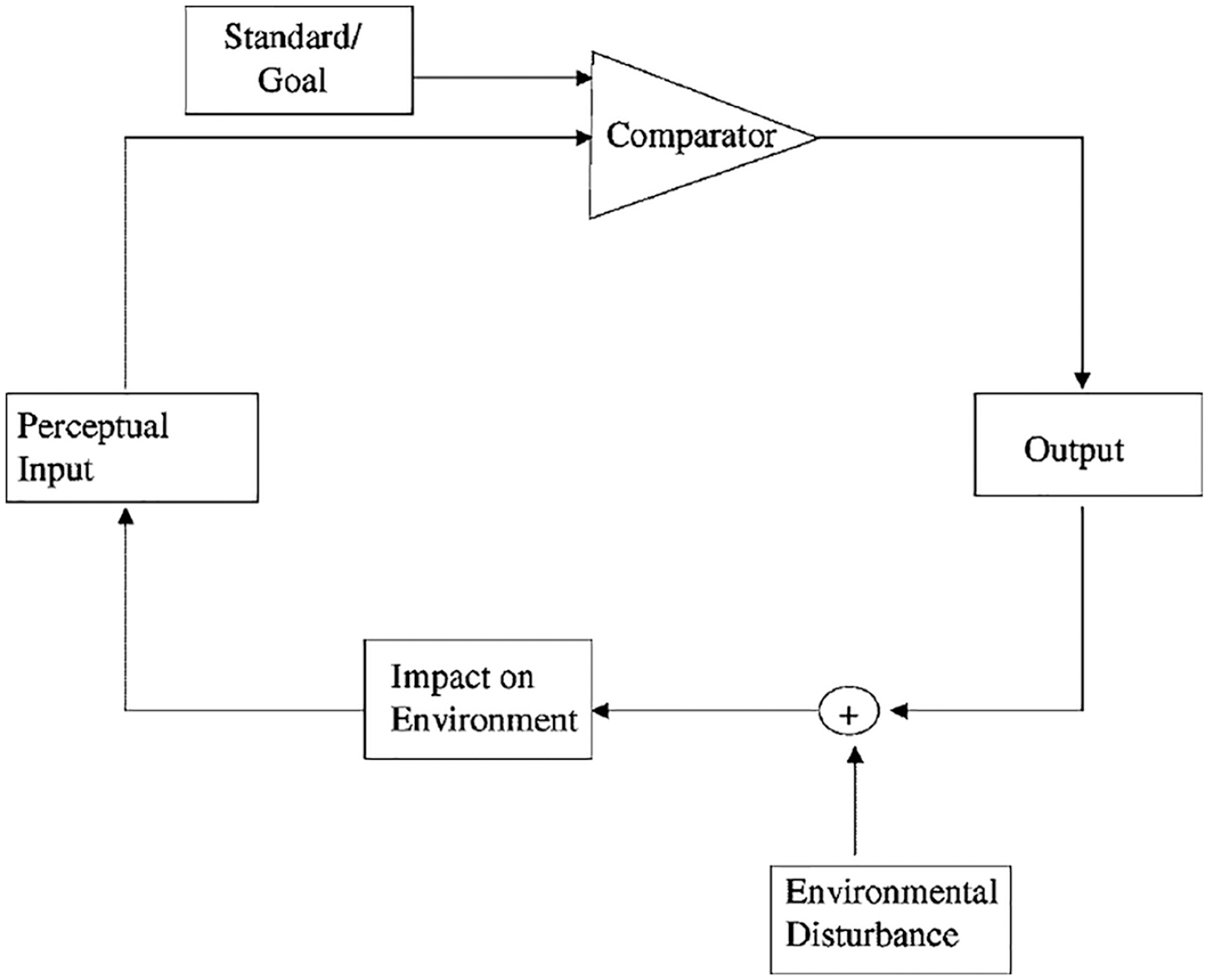
Control Theory Model
Although the theory provides an effective narrative about the phases of emotional labor and the discrepancy regarding emotional dissonance at the conscious level, it still does not explain the labor subconscious/unconscious levels. For example, when explaining the theory, Diefendorff and Gosserand (2003) presumed, as an example, that a salesperson could “effortlessly” display context-sensitive emotions once he or she has gone through adjusting the discrepancy. However, without understanding the impact of the subconscious/unconscious mind (e.g., prior experiences and perceptions from initial experiences), it would be difficult to tell whether the person can authentically “effortlessly” display context-sensitive emotions. Additionally, as discussed, it has been suggested that 90% of the human mind exists at a subconscious or unconscious level affecting the conscious level. This subconsciousness/unconsciousness would mean that understanding the internal human mind at the subconscious and unconscious levels would be critical to develop a generalizable emotional labor theory.
Empirically, several studies have suggested the impact of customer incivility on burnout, job dissatisfaction, role stress, and excessive workload (H. Kim & Qu, 2019; Lee & Ok, 2012; Min et al., 2015; N. L. Wilson & Holmvall, 2013). However, none of the studies explored the influence of emotional dissonance on internal emotions as a mechanism that could potentially progress to burnout and stress. In the field of psychology, emotional dissonance has been examined (Kern & Grandey, 2009; Sliter et al., 2012; van Jaarsveld et al., 2010). However, these studies were conducted using a quantitative survey of target populations and did not analyze or confirm the mechanism of employees’ internal emotions.
Habituation and Emotional Dissonance
Habituation theory can plausibly explain emotional dissonance. Habituation is defined as a “response decrement as a result of repeated stimulation” (Harris, 1943, p. 385). It has been suggested as a natural phenomenon of a living entity responding to stressors from the behavioral down to the molecular level. It is considered a consequence of hypothalamic–pituitary–adrenal activation that occurs in response to stressors (Thomson & Spencer, 1966). Grissom and Bhatnagar (2009) provided the operational definitions of habituation response relevant to this study as follows: First, habituation occurs in response to repeated stimuli that could be highly probable in that frontline hospitality employees constantly encounter difficult or uncivil customers (H. J. Kim, 2008). Second, more intense and rapid habituation can occur throughout the learning process from a previous habituation. For example, at a conscious level, frontline employees are emotionally well prepared for difficult or uncivil customers within a shorter time span because of their previous experiences. In contrast, at the subconscious/unconscious level, the employees might perceive stress from previous or repeated exposure to customer incivility (i.e., habituation). Third, habituation is reversible, meaning when the stimuli (e.g., emotional dissonance) is withheld, the habituation can be undone. All the operational definitions of habituation responses are compatible with emotional dissonance. It is plausible that all three responses occur in a sequence (repeated customer incivility → more prompt psychological readiness for incivility → emotional dissonance → burnout when reaching a tipping point). Due to the emotional nature of services in the hospitality business, frontline employees could be assumed to stand somewhere between being stressed and the tipping point (i.e., habituation → dishabituation). So far, although it has highly service-oriented characteristics, neither emotional dissonance nor habituation of brain regions of interest has been examined in the hospitality field.
Previous studies have suggested the higher probability of burnout and stress among hospitality employees (H. Kim & Qu, 2019; Min et al., 2015). Thus, it is possible that the brain regions of interest among frontline hospitality employees could be significantly habituated by emotional dissonance. In some neuroimaging studies, habituation has been examined (Fischer et al., 2003; Grissom & Bhatnagar, 2009; Mitchell et al., 1985). However, they did not explore emotional dissonance (fear), nor did they focus on service-oriented employees (experiments used mice instead). Additionally, no study has provided empirical or theoretical suggestions on the brain regions of interest that can be habituated during emotional dissonance. Therefore, frontline hospitality employees could show significant habituation during emotional dissonance when encountering customer incivility. In line with the suggestions of theoretical examinations and previous studies, the following null and alternative hypotheses on emotional dissonance and habituation in frontline hospitality employees are proposed:
Methodology and Analysis
Instrumentation and Participants
The study instrumentation incorporated both a survey questionnaire to measure and compare daily/occupational stress between hospitality and nonhospitality employees (Cohen et al., 1983; Smith, 2000) with a 5-point Likert-type scale (i.e., 1 = Never, 5 = Always) and fMRI scan to evaluate the habituation in the brain regions of interest. The analysis outcomes between the two instrumentations were then compared. The participants included both hospitality and nonhospitality employees. The hospitality employees had a minimum 1-year full-time job experience in a customer-interacting (e.g., waiter, waitress, front desk staff) hospitality position. The nonhospitality employees were in occupations with no or minimal customer interactions (e.g., computer programmers, lab technicians, etc.). Demographics showed that the average age of the participants was approximately 31 years (hospitality = 31.94, nonhospitality = 30.06), and the ratio of gender was 50:50 between males and females in the two groups. All the participants in both categories had a minimum of 1 year of full-time job experience (M = 3.53 years; Table 1).
Demographics and Stress Comparison

Note: HOSP = hospitality; Non-HOSP = nonhospitality
Frontline hospitality employee group. bNonhospitality employee group. cReported numbers are combined frequencies of the two groups. dReported numbers are combined means and standard deviations of age and job experiences of the two groups. eReported numbers are means and standard deviations of full-time job experience years. fIndependent-sample t test showed no significant difference between the hospitality and nonhospitality groups in stress.
The prescreening to ensure safety excluded some of the initial participants because of their psychiatric, neurological, and medical conditions; medication; or substance abuse. For example, some of the participants were excluded because they had ferrous metal or pacemakers in their bodies. All the participants were required to sign an informed consent form prior to their participation. The final sample size for the two groups was 42 combined (hospitality = 21, nonhospitality = 21), and each group satisfied 80% power at the single voxel level for typical activations (p < .05; Desmond & Glover, 2002).
Procedure
On arrival at the fMRI center, an experimenter first briefed the participants on the entire procedure. After the briefing, the participants completed an informed consent form containing the specifications of the study required by the IRB (institutional review board). Next, although prescreening was done for every participant before scheduling, each participant filled out the safety screening sheet once again for confirmation (policy of the fMRI center). The participants were then asked to fill out a questionnaire regarding daily/occupational stress. After filling out the questionnaire, each participant stored their belongings in a designated locker and stood at the gate of the fMRI room. The center staff once again asked if the participants had anything in their pockets and confirmed that they had no metal in their body that they were aware of and also did a few other checks. Once the participant passed all these processes, he or she entered the fMRI scanner, and the experiment began.
The participants in the fMRI scanner were shown a variety of faces expressing angry, neutral, or happy emotions. All images were balanced across gender and actors such that each actor appeared three times during the sequence expressing each emotion once (Figure 2). All stimuli were acquired from the Karolinska Directed Emotional Faces database (Lundqvist et al., 1998). There were a total of three scanning runs. Participants would first see a cue (2s) telling them to either smile or not smile while viewing the next face. They then saw a fixation cross (jittered to last ~3s) and then saw an angry, neutral, or happy face (4s). They were instructed to indicate whether the face was angry (1), neutral (2), or happy (3) by inputting their response into a button box. They saw 30 faces during each scanning run (10 angry, 10 neutral, and 10 happy) for a total of 90 faces (30 angry, 30 neutral, and 30 happy). Data from all the 42 (hospitality = 21, nonhospitality = 21) participants were used for the data analysis.
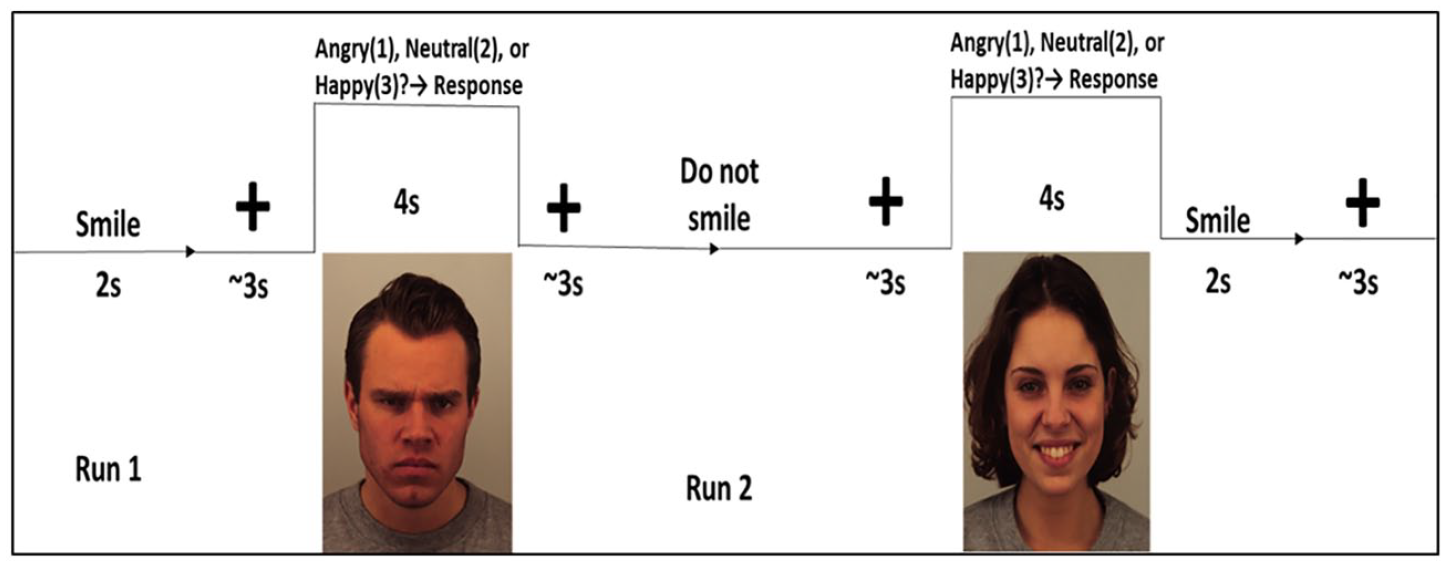
Schematic Representation of Functional Magnetic Resonance Imaging (fMRI) Data Acquisition Procedure
Analysis
First, a comparison for daily/occupation stress was performed with an independent t test. There was no significant difference between the two groups for stress (Table 1). For the fMRI data, an analysis pipeline was used in the previous studies for both preprocessing and univariate analysis (O’Bryan et al., 2018). The primary contrast of interest was comparing differences in activation between the hospitality and nonhospitality groups when viewing the angry, neutral, or happy faces. When viewing angry faces, there was a significant deactivation (habituation) in various regions of the brain in the hospitality group: posterior cingulate cortex (x = −6, y = −30, z = 44, voxel = 590, p < .01), middle frontal gyrus (x = −28, y = 10, z = 54, voxel = 1,150, p < .01), middle temporal gyrus (x = −48, y = −48, z = 2, voxel = 425, p < .05), and precuneus (x = −2, y = −58, z = 56, voxel = 692, p < .01) supporting the hypothesis (Figure 3 and Table 2). These results potentially suggest habituation in these regions for hospitality employees when interacting with angry customers. There was no significant cluster in the nonhospitality group compared with the hospitality group when looking at angry faces. There were also no significant differences between the two groups when viewing neutral or happy faces.

Habituation Among the Frontline Hospitality Employees Responding Angry Face Customers
Clusters Significantly Habituated for the Hospitality Frontline Employees

Discussion
Theoretical Implications
The outcomes of the analysis support the hypothesis on habituation occurring during emotional dissonance among frontline hospitality employees. First, there is no significant difference in terms of daily/occupational stress between hospitality and nonhospitality groups. Additionally, habituation in the brain regions of interest in the hospitality employee group proved to be significant. This result might be attributed to the fact that stress (or habituation) may not be quantifiable or that the participants were unaware of the stress they experienced from customer incivility. As a result, habituation progressed to dishabituation (Romm, 2018). In other words, the discrepancy in the data from the survey questionnaires and the fMRI-BOLD (blood oxygen level dependent) may indicate that frontline hospitality employees are unconsciously progressing toward dishabituation (burnout) potentially leading to possible alcohol or substance abuse (Turner et al., 2017).
The analysis results support the hypothesis that brain regions of interest were significantly habituated among frontline hospitality employees who are exposed to customer incivility. These regions include the posterior cingulate cortex, the middle frontal gyrus, the middle temporal gyrus, and the precuneus. Each region is known to be related to social/occupational cognition and function. The posterior cingulate cortex is known to be related to regulating the focus of attention. Particularly, it has been shown to be significantly related to Alzheimer’s disease (Leech & Sharp, 2014). The middle frontal gyrus is known for reorienting attention (properly changing the focus of attention whenever necessary; Mai & Paxinos, 2012). The middle temporal gyrus is related to the function of sound recognition and semantic memory (i.e., memory of events or facts; Acheson & Hagoort, 2013). Finally, the precuneus has been suggested to regulate the shifting of attention to different spatial locations (e.g., searching for an item in a particular space; Cavanna & Trimble, 2006). These results indicate that constant exposure to customer incivility can lead to functional/neural damage in the brain regions of interest. Considering that alcohol and substance abuse can accelerate the neural damage potentially increasing one’s risk for Alzheimer’s disease (Nordström, 2003), managers in the hospitality industry would have to proactively implement appropriate managerial approaches to prevent habituation from progressing to dishabituation (i.e., burnout, anxiety). If left unmanaged, the resulting damages could lead to psychological or behavioral extremes, such as alcohol and substance abuse.
Managerial Implications
The analysis outcomes imply the need for appropriate managerial approaches to counter emotional dissonance and its extended impacts on stress and burnout. Primarily, it would be desirable to implement employee wellness programs, such as fitness and/or meditation programs. Employee fitness programs have been found to significantly increase productivity and lower stress (Hoert et al., 2016). Thus, it would be possible that the wellness program can mitigate habituation among frontline hospitality employees.
Additionally, a business cannot be sustained without the efficient management of the service profit chain (internal marketing positively affecting business profit) in the hospitality industry. Considering the high turnover rate of hospitality employees (Grindy, 2017), the hospitality business needs to take managerial actions in order to prevent habituation from progressing to dishabituation. As managerial actions, training would give the frontline employees to effectively handle customer incivility and lessen the chance to experience emotional dissonance/habituation (Grandey et al., 2004). Empowerment also has been suggested to be an effective managerial approach (Guo et al., 2016). Systematic empowerment would give employees discretion to solve/handle customer complaints/incivility right away so that the employees would not necessarily experience the habituation. Hospitality industry employees show the highest alcohol and substance abuse rates than any other industry employees in the United States (Bush & Lipari, 2015). It would also be beneficial for this group of employees to be educated on the risks of alcohol and substance abuse during habituation and the potential impairment of brain functions.
Limitations and Future Study
The limitations of this study provide opportunities for future research. This study examined the mechanisms involving the impact of emotional dissonance on habituation and explained the possibility of progression to dishabituation. However, how and what triggers this progression of habituation to dishabituation and, finally, to alcohol and substance abuse remain unclear. Those triggers could provide a clearer picture of what needs to be done to prevent frontline employees from progressing to extreme cases. The findings would also help address human resource and financial issues (e.g., turnover, insurance) in the hospitality industry.
Additionally, measurement materials to examine the multiple constructs of customer incivility could be developed and adopted for future studies. Since the focus of this study was on measuring/examining emotional dissonance and not on developing measurement materials of customer incivility, Karolinska Directed Emotional Faces database (Lundqvist et al., 1998) was adopted as a measure of customer incivility. For more accurate measure, the development of generalizable materials of customer incivility would improve measurement accuracy and be another extensive study.
Summary
The purpose of this exploratory study was to analyze the emotional dissonance among frontline hospitality employees by examining the responses of brain regions of interest to customers’ incivility based on the habituation theory. A survey and fMRI data were compared to determine if there were differences in the life/occupational stress between the frontline hospitality and nonhospitality (i.e., minimal or no customer interaction) employees and to analyze the responses of brain regions of interest. Although the survey data analysis suggested no significant differences between the two groups of employees, the fMRI analysis found significant habituation of the brain regions of interest among the frontline hospitality employees. The outcomes would mean that the frontline employees are progressing toward emotional burnout and anxiety. The analysis outcomes confirm habituation theory and suggest managerial implications such as the need to manage stress or burnout from emotional dissonance, to provide education on increasing dependence on drug/alcohol abuse, and to improve employee welfare/fitness to relieve stress/burnout from emotional dissonance.
Footnotes
This research was funded and supported with fMRI by Texas Tech Neuroimaging Institute (TTNI) and Dr. Eric Walden, Director of TTNI.
