







Abstract
Given the importance of booth attractiveness at trade expositions, this study sets out to develop a scale measuring booth attractiveness (Study 1) and to examine its effectiveness in motivating attendees’ purchasing behavior (Study 2). Study 1 includes three steps: (1) item generation through a thorough review of the literature, focus group, and comments from experts, (2) item purification with exploratory factor analysis using 122 samples, and (3) reevaluating items with confirmatory factor analysis using 129 samples. A six-dimensional scale of booth attractiveness was developed in Study 1. Based on the theory of mental budgeting, Study 2 was conducted to examine the effects of booth attractiveness on the mechanism of attendees’ purchasing behavior using 323 samples. Results of Study 2 suggest that booth attractiveness could directly motivate impulse buying or indirectly through mental budgeting. Impulse buying, then, results in post-purchase guilt and anticipated satisfaction. Meanwhile, postpurchase guilt reduces anticipated satisfaction.
Highlights
This study developed a 24-item six-dimensional scale of booth attractiveness.
Booth attractiveness motivated attendees’ impulse buying and mental budgeting.
Impulse buying caused attendees’ postpurchase guilt and anticipated satisfaction.
Attendees’ postpurchase guilt reduced their anticipated satisfaction.
Introduction
Trade expositions (also known as trade shows) are considered as influential activities for marketing. Firms often participate in trade shows to promote new services and products, improve their financial performance, and understand emerging consumer trends (Shi et al., 2021). Focusing on attendees’ perspective, most extant studies are concerned with attendees’ experiences and perceived value at exhibitions, their visit motivation and loyalty toward exhibitions, as well as judgments about the destination competitiveness of the host venue (Choe et al., 2014; J. Lee et al., 2016; Y. Lee & Kim, 2018). From the practitioners’ perspective, event companies such as EventMB (2020) have pointed out the key for business success through effective booth design that can attract attendees. However, in hospitality literature, a knowledge gap exists around clarifying what attracts attendees to booths (Bauer & Hantel, 2021). Bauer and Hantel (2021) highlighted booths as the “focal points in exhibitors’ trade show marketing, as well as platforms for meeting different target groups” (p. 1), and identified the needs for research investigations on booth attractiveness. Given that numerous booths are competing with one another in a single exposition, it is critical for exhibitors to understand how to catch attendees’ eyes and stimulate their desire to purchase at their booths (Bloch et al., 2017). Therefore, to foster knowledge creation in expositions, a study of booth attractiveness has its academic and theoretical values.
This study conceptualizes booth attractiveness based on Gopalakrishna and Lilien (1995), who examined the efficiency of a booth to attract target attendees. Other booth-related studies have suggested several factors, including but not limited to product display, booth staffing, and booth layout, that can enhance booth attractiveness (Bloch et al., 2017; Gilliam, 2015; Y. Lee & Kim, 2018; Tafesse & Korneliussen, 2012). Yet a systematic examination of booth attractiveness is missing from the current literature. Particularly, a parsimonious measurement scale for booth attractiveness is needed with a broader applicability for different types of trade shows (Bloch et al., 2017; Gilliam, 2015). This has been identified as a knowledge gap by prior research and warrants further investigation (Gilliam, 2015; Tafesse & Skallerud, 2017).
Taken together, there are two purposes in the present study. First, this study aims to develop a scale that can be used to conceptualize and measure booth attractiveness. Following Churchill (1979), this study adopts a three-stage process in scale development: item generation, item purification, and reevaluation of items. Second, to validate the scale of booth attractiveness in predicting attendee attitudes and behaviors, this study proposes and examines a structural model for booth attractiveness. The booth attractiveness studied in this study is on the setting of B2C (business-to-consumer) exhibitions, where exhibitors set up booths to attract retail consumers. Building on the theoretical support of mental budgeting (Thaler, 1985), a model examining the outcomes of booth attractiveness is empirically examined. Based on the findings, the valid and reliable scale of booth attractiveness presented here should prove valuable for industry and academy alike.
Literature Review
Trade Expositions
Since Kerin and Cron (1987) pointed out the lack of knowledge creation on trade expositions in marketing research in the 1980s, the relevant research has significantly increased in the past a few decades (Milner, 2009; Tafesse & Skallerud, 2017). Most studies of trade expositions focus on attendees’ behaviors, perceptions, and experiences (Gottlieb et al., 2014; Jung, 2005; Lim, 2013; Milner, 2009; Rittichainuwat & Mair, 2012). For instance, Jung (2005) examined attendees’ perceived service quality of trade expositions. Milner (2009) explored industrial travel expositions and the behaviors of attendees. Additionally, Lim (2013) investigated the perceived time pressure as well as value perception, while Rittichainuwat and Mair (2012) focused on attendance motivations. Gottlieb et al. (2014) also developed a framework to examine the perceived effectiveness on attendees in a B2C context. The success of trade expositions has been investigated as well. A series of studies has contributed to the understanding of the performance evaluation for expositions (Gopalakrishna & Lilien, 1995; C. H. Lee & Kim, 2008; Lin et al., 2018; Tafesse et al., 2010) as well as destination selection for expositions (Jin et al., 2013; Jin & Weber, 2016; J. Lee et al., 2016). By interviewing meeting planners, Kewei et al. (2019) further explored service failure recovery cases at meeting venues.
Dimensions of Booth Attractiveness
Conceptualization of booth attractiveness starts with exploring environmental stimuli. Berlyne (1971) indicated that the attractiveness of environmental stimuli depends on showing complexity. An optimal level of complexity of the stimuli leads to maximum attractiveness. On the other hand, stimuli deviating from this optimal level are often considered as less attractive by individuals (Berlyne, 1971). Furthermore, research suggests that an environment that induces positive cognitive appraisal, positive emotions, and has the ability to encourage approaching behaviors tends to be considered as more attractive (Orth & Wirtz, 2014). Several studies have identified people’s willingness to approach an environment as one of the key determinants of attractiveness (Orth & Wirtz, 2014). Based on the literature review, the present research argues that there are four potential dimensions of booth attractiveness: booth layout, booth staff, booth decoration, and booth-related psychological stimuli.
Booth layout
Booth layout refers to a trade exposition attendee’s mental reflection of general clarity toward a booth, which includes legibility, spatial order of products, and overall quality of the spatial design (Bauer & Hantel, 2021). Besides, the emphasis of location in hotel properties supports the importance of booth layout in a trade exposition (Gopalakrishna & Lilien, 1995). Researchers suggested that exhibitors can strategically enhance booth efficiency by utilizing location and size of a booth (Gopalakrishna & Lilien, 1995). Salem et al. (2010) added that how products are displayed within a booth, is also a critical factor to booth attraction. Moreover, a study on industrial trade expositions revealed that attendees would be more likely to visit a booth simply due to its interesting look (Milner, 2009). Overall, the design and appearance of a booth, and its product arrangement are common factors for catching the eyes of attendees.
Booth staff
Booth staff include personnel who stay at a booth to serve attendees during an exposition. In retail contexts, staff that are cooperative and nicely dressed are ambassadors for a store to attract customers (Baker et al., 1994). In the restaurant industry, friendly servers can motivate customer engagement and support the building of customer relationships (Wang & Lang, 2019). In trade expositions, Milner (2009) indicated that attendees’ positive evaluations of booth staff included keywords such as “politeness” and “advice” (i.e., quality of the staff’s introduction of the products on offer). Quality of booth staff’s contact with attendees is another success factor for booths to attract attendees (Williams et al., 1993). To improve contact quality with exposition attendees, exposition exhibitors should assign enough staff members to a booth, offer staff training, and make sure staff members have enough professional knowledge to answer attendees’ questions (Gopalakrishna & Lilien, 1995; Williams et al., 1993). Based on the above, we propose booth staff as one dimension of booth attractiveness.
Booth decoration
Booth decoration refers to the quality of a booth’s appearance, which is normally evaluated by attendees’ perceived visual displays (e.g., lighting and color) within a booth and/or psychological feelings (e.g., novelty and complexity) gained through booth decoration (Bloch et al., 2017; Gilliam, 2015). For booth decoration, exposition exhibitors typically utilize their internal resources (i.e., staff of their company) or seek professional design companies externally (Gilliam, 2015). Bloch et al. (2017) explained that booth decoration contains various elements such as color, materials, and lighting, pointing out that an effective booth decoration must create synergy among these decoration elements in a manner that attracts target attendees. The process of putting together booth decoration, as suggested by Turley and Chebat (2002), should include goal assessment to explore target attendees’ desires, needed atmospheric outcomes, and budget.
Booth-released psychological stimuli
Booth-released psychological stimuli refer to attendees’ perceived psychological stimuli released by a booth, such as time-limited promotions or special discounts. A study conducted by Lim (2013) examined a travel fair. Findings showed time pressure as a significant factor in influencing attendees because promotions at trade shows are only available temporarily (vs. long term). Focusing on retail trade shows, Tafesse and Korneliussen (2012) likewise demonstrated the effect of time pressure on attendees’ perceptions of product value as well as their purchasing behaviors. Hence, the present research argues that “time-limited promotions” can attract attendees to a booth. In fact, researchers have indicated that “time-limited promotions” is one of the key features of a trade exposition, and it is widely adopted by exhibitors to draw attention (Lim, 2013; Tafesse & Korneliussen, 2012). Additionally, special discounts exclusive to trade expositions have been shown to affect visitors’ psychological stimuli (Shi et al., 2021). Due to the bandwagon effect (Shaikh et al., 2017), crowds around a booth could also arouse attendees’ psychological stimuli toward the booth in question.
Hypotheses Development
Theory of mental budgeting
Mental budgeting, also known as mental accounting (e.g., Thaler, 1985) is a cognitive form of bookkeeping that people use to track expenses for the purpose of consumption control (Cheema & Soman, 2006). Research on mental accounting has been focused on showing that labels matter and people use resources differently depending on how those resources are labeled. For example, to the likelihood of purchasing a vacation package is higher when people receive money as a gift than as a bonus from work (Henderson & Peterson, 1992). Heath and Soll (2006) suggested that two kinds of labels are often generated that affect consumer decisions: (1) they label money as relevant for a certain type of goods (i.e., budget-setting process: a goods-oriented thinking on purchases) and (2) they consider the goods as relevant for a particular pool of money (i.e., expense-tracking process: a money-oriented thinking on purchases). These two processes together compose the theory of mental budgeting. Expenses in a given category are assigned to a mental account, and they are monitored and tracked to avoid overspending (Cheema & Soman, 2006).
The effect of mental budgeting has been examined in hospitality and tourism (Brida & Tokarchuk, 2015; Jang et al., 2007; Kim & Jang, 2013, 2014). For example, Brida and Tokarchuk (2015) applied the theory of mental budgeting to study visitors’ spending at a Christmas market in Merano. Results of their study indicated that visitors who did not plan their expenditure reported significantly lower actual spending than the ones who planned their expenditure. Such a finding showed that mental budget can serve as a reference point which allows purchases until the budget limit is reached. Jang et al. (2007) investigated the effect of mental budgeting in a context of restaurant membership fees. Their findings indicated that customers’ preference to attend a competitor’s membership program is low unless the new offering is either an excellent deal or free because they consider membership fees to be in the same product category.
Booth attractiveness, mental budgeting, and impulse buying
Mental budgeting is often used as a mechanism for self-control (Homburg et al., 2010). However, prior research has shown that the process of budgeting is malleable. Ambiguity often exists when interpreting the costs and benefits of a certain transaction. For instance, an expense can be assigned to different categories (e.g., food vs. entertainment) by consumers and it can be either specific (e.g., dining out) or general (e.g., living expenses) (Read et al., 1999). These ambiguities give consumers the opportunity to label expenses differently to justify a desired course of action, and such ambiguities may exist when a booth is attractive with multiple purchase options and stimuli. According to Cheema and Soman (2006), consumers often engage in creative bookkeeping to identify loopholes and to bypass the self-control imposed by their mental accounts. They interpret attractive expenditures in a way that allows them to legitimize spending. Thus, this research argues that when attendees face a booth that is more attractive, it is much easier for them to come up with reasons to justify an increase in mental budgeting. Therefore, we propose the following hypothesis.
Event companies (EventMB, 2020) highlight how to make a booth attractive for increasing attendees’ impulse buying. It seems that under high booth attractiveness, attendees may lose mental control and loosen their awareness of operating mental budgeting, resulting in impulse buying behaviors. Factors influencing consumer impulse buying behaviors have been widely examined in both the marketing literature as well as the hospitality and tourism literature (e.g., Chang et al., 2014; Mattila & Wirtz, 2008). Researchers have found that impulse buying is influenced by several factors such as the shopping environment, individual’s personal traits, product design, and demographics (e.g., Beatty & Ferrell, 1998). For example, Chen and Wang (2016) examined antecedents such as impulsivity trait, subtractive option framing (vs. additive option framing), and price reduction framing (vs. percentage off), and found that these factors lead to a higher level of impulse buying behaviors. Additionally, Mattila and Wirtz (2008) investigated the effects of store environmental stimulation and two social factors (employee friendliness and perceived crowding) on impulse buying. Results of their study indicated that environmentally induced affect can cause impulse buying. Furthermore, Chang et al. (2014) found that the ambient/design characteristics of a store have a direct on consumers’ positive emotional responses and further on impulse buying behavior. Following a similar logic, this research argues that situational factors such as booth attractiveness positively influence impulse buying. When the booth is attractive, the shopping environment induces more excitement and arousal, which further contributes to impulse buying (Chang et al., 2014; Mattila & Wirtz, 2008).
Prior research suggests that when consumers can utilize the ambiguity of mental budgeting to legitimize their choices, they will be more likely to indulge in otherwise undesirable behavior (Cheema & Soman, 2006). With a clear classification of expenses and mental accounts, consumers have less opportunity to move money between accounts without it being considered as a clear “violation.” However, shopping at places like a trade exposition makes it difficult for consumers to engage in a planned shopping activity as they do not have enough information about the goods to rationally plan their purchases (Brida & Tokarchuk, 2015), leading to a higher level of ambiguity when it comes to mental budgeting. Therefore, we argue that when an attendee can adjust his or her mental budgeting due to the attractiveness of a booth, he or she is more likely to forgo some self-control (Miao & Mattila, 2013), which makes them more susceptible to impulse buying. The presence of the attractive booth triggers mental rebudgeting, which further increases impulse buying so that consumers can maximize perceived benefits (Wu et al., 2013).
Impulse buying, postpurchase guilt, and anticipated satisfaction
Impulse buying, considered as a self-regulation failure, often causes negative emotions (e.g., guilt). For example, Dahl et al. (2003) found that most guilt-inducing situations were associated with one’s failure in regulating his or her behavior or reach a certain goal. Guilt, a feeling of regret or remorse, involves preoccupation with a particular transgression (Yi & Baumgartner, 2011). It occurs when people hope they had acted in a different way or could undo some aspects of their undesirable behaviors (Tangney et al., 1996). Feelings of guilt is an emotional response to impulse buying. It can be attributed to various reasons such as lack of justification for actions, hindsight bias, emotional distress, and violation of personal standards (Kubany et al., 1996; Miao, 2011). Prior research has identified a broad range of consumption episodes that lead to the feeling of guilt, including consuming indulgent food, overspending, and buying nonenvironmentally friendly products (e.g., Saintives, 2020). In this research, we argue that impulse buying at an exhibition is positively associated with attendees’ feeling of guilt because it spoils their plans, including both financial and nonfinancial plans, which makes them doubt the appropriateness of the purchase.
Prior research has demonstrated a strong relationship between consumption-induced emotions and consumers’ postconsumption behaviors (Vieira, 2013). Guilt, as one of the key consumption emotions, has influence on a variety of consumer responses such as attitude, satisfaction, decision making, coping strategies, and preferences (e.g., Dahl et al., 2003; Saintives, 2020). Particularly, prior research has examined the effect of postpurchase guilt on anticipated satisfaction (e.g., Saintives, 2020). Anticipated satisfaction is when consumers assess their likely satisfaction with the item purchased (Shiv & Huber, 2000). It’s a mental imagery-related process where consumers imagine the actual consumption of a product and vicariously experience the product use and the self-relevant consequences (e.g., Adaval & Wyer, 1998). Saintives (2020) examined the effect of purchase channels on consumer guilt and found that guilt negatively influences individuals’ anticipated satisfaction. According to the theory of “affect-as-information” (Schwarz & Clore, 1983), consumers rely on their feelings (i.e., guilt) to form evaluations because they perceive that these feelings contain valuable information. That is, taking mental budgeting as an ongoing concept to longitudinally guide attendees’ minds, feelings of guilt may exist because attendees’ mindset on mental budgeting continue to operate before and after purchases. According to the theory of affect-as-information (Schwarz & Clore, 1983), guilt has the potential to serve as a strong emotional factor in attendees’ evaluation process of the products and services purchased, leading to a lower level of anticipated satisfaction. Therefore, we propose,
Impulse buying as a consumption experience also has rich affective implications, including both negative and positive emotions (Miao, 2011). In addition to negative emotions such as guilt, prior research has also suggested that impulse buying can be related to positive affect such as excitement and pleasure. For example, Santini et al. (2019) found that impulse buying elicits the sensation of having made a pleasurable purchase, which leads to a positive evaluation of the product and the company. Similarly, this study argues that impulse buying is positively associated with anticipated satisfaction. After the impulse purchase at the booth, attendees are likely to experience positive emotions triggered by the shopping process as well as the products purchased, which leads to a stronger belief that they will likely enjoy the usage of the products even before the actual consumption.
Study 1: Scale Development of Booth Attractiveness
Step 1: Item Generation
Following Churchill (1979), we applied a multistudy approaches to generate potential items for measuring booth attractiveness. To begin with, we extracted 30 items from previous studies (Table 1; e.g., Bitner, 1992; Bloch et al., 2017; Gilliam, 2015; Gopalakrishna & Lilien, 1995; Jung, 2005; Milner, 2009; Tafesse & Korneliussen, 2012; Wang & Lang, 2019), and, following agreement within the research team, these items were sorted into four dimensions: (1) booth layout, (2) booth staff, (3) booth decoration, and (4) booth-released psychological stimuli. Then, the research team formed a focus group consisted by five experts (including one professor in event management teaching exhibition related courses, one senior tour guide with over 5 years attending tourism exhibitions, two doctoral students with more than 3 years working in exhibition industry, and one master’s student studying tourism who had internship experience in exhibition) to assess the initial pool of items. These five experts provided comments on selection and modification of the items. Six items were deleted based on the focus group discussion, narrowing the pool into 24 items. To double-check face validity of the items, the authors sent these 24 items via emails to three other industrial experts with over 5 years of work experiences in organizing trade expositions. Based on comments received from these three industrial experts, we deleted two items, narrowing the pool into in 22 items. These 22 items of booth attractiveness were sorted into four dimensions, including (1) booth layout (nine items), (2) booth staff (five items), (3) booth decoration (five items), and (4) booth-released psychological stimuli (three items).
Exploratory Factor Analysis Results in Study 1 (Sample 1, n = 122)
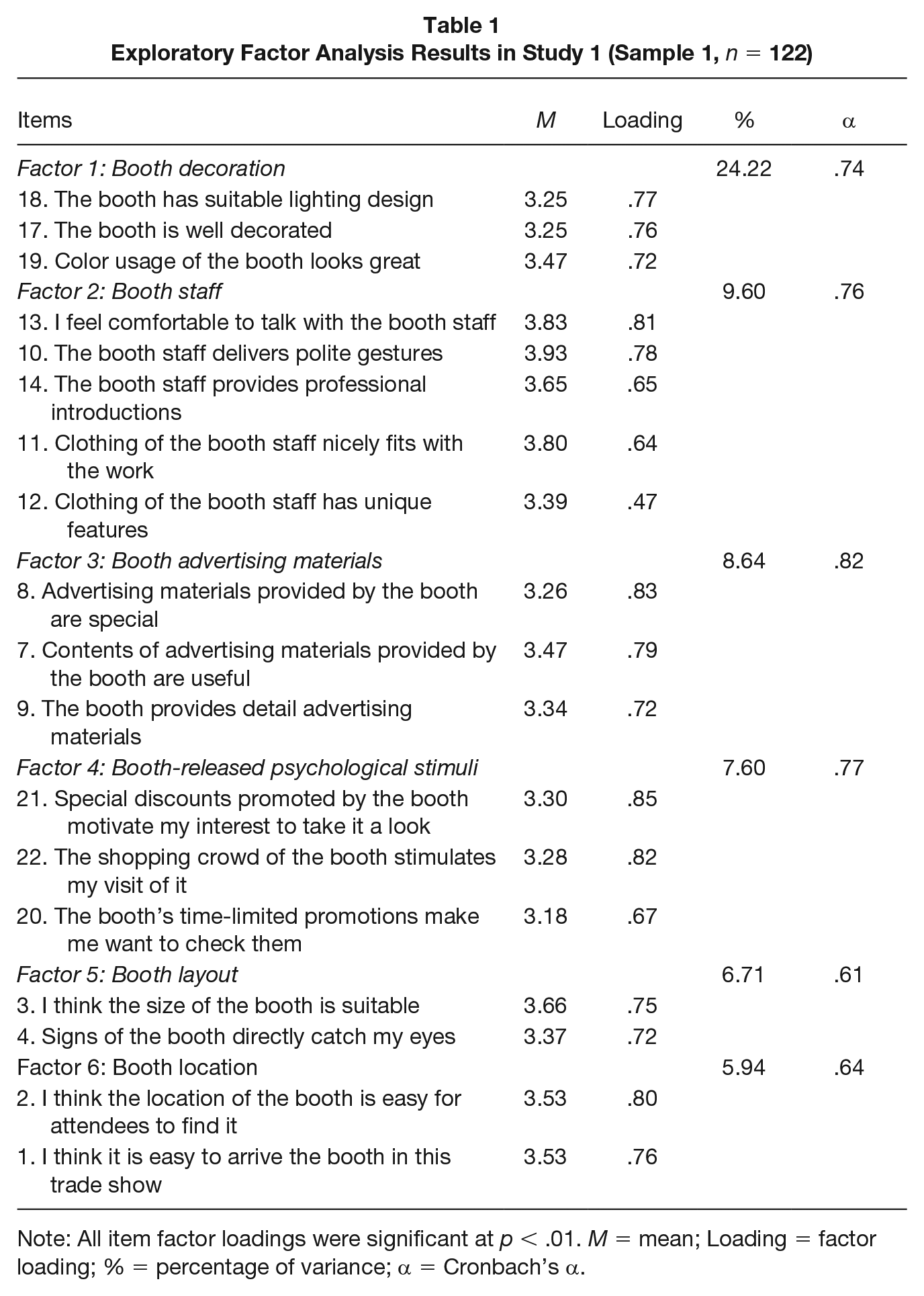
Note: All item factor loadings were significant at p < .01. M = mean; Loading = factor loading; % = percentage of variance; α = Cronbach’s α.
Step 2: Item Purification
We designed a survey with the 22 items developed from Step 1. As a pilot test, this study invited 33 tour guides to modify and edit the survey items. A 5-point scale, ranging from strongly disagree (1) to strongly agree (5), was used to rate these scale items. The research setting was a tourism exhibition held in Xiamen City, China, and the target participants of the survey were attendees who had purchased products or services at the case exhibition before answering our survey. Three trained research assistants distributed paper surveys in person at the main exits of the case exhibition. A total of 122 complete survey responses were obtained from March to April in 2016. Following power analysis (MacCallum et al., 1996), the sample size is acceptable for exploratory factor analysis (EFA).
An EFA with varimax rotation and a principal component was conducted (Anderson & Gerbing, 1984). Following Anderson and Gerbing (1984), we retained items that have eigenvalues larger than one and with factor loadings higher than 0.4 on one factor, while lower than 0.4 on all other factors. Four items were then deleted. EFA results are shown in Table 1. Bartlett’s test of sphericity and the Kaiser–Meyer–Olkin (KMO) measure were used to check that the collected data had enough inherent correlations for running an EFA (Hair et al., 2006). The Bartlett’s test of sphericity was significant (p < .001) and KMO index was 0.755, justifying the use of EFA (Hair et al., 2006). From the screen plot, we found that the optimal solution is a six-factor solution with 18 items. Besides, 62.72% of the total variance can be accounted by the combined factor loadings. Each of the 18 items had a significant factor loading (p < .01). The Cronbach’s alpha of these factors ranged from .61 to .82. We then name these six factors: (1) booth decoration, (2) booth staff, (3) booth advertising materials, (4) booth-released psychological stimuli, (5) booth layout, and (6) booth location.
Step 3: Reevaluating Items
We used confirmatory factor analysis (CFA) for reevaluating the factor structure of the scale. The CFA model was a first-order six-factor oblique model. Discriminant and convergent validities of the scale were also tested. To ensure generalizability of the scale, the settings for data collection were three trade expositions in China, including one tourism exhibition in Xiamen City, one tea trade exposition in Chengdu City, and one coffee and bakery trade exposition in Wuhan City. Focusing on the same target participants as the previous step, four trained assistants distributed paper surveys in person to attendees at these three trade expositions. A total of 129 valid responses were collected from April to June in 2016. With degrees of freedom (df) of 116, following power analysis (MacCallum et al., 1996), the sample size is adequate for CFA.
Using Mplus 7, we confirm the factor structure of the scale by CFA with maximum-likelihood estimation. A satisfactory result (χ2 = 198.31, df = 116, χ2/df = 1.71, p < .01; comparative fit index [CFI] = .93, Tucker–Lewis index [TLI] = .91, standardized root mean squared residual [SRMR] = .07, root mean square error of approximation [RMSEA] = .07) (Kline, 2011) was found from the initial check with the 18-item six-factor model. CFA results shown in Table 2. Factor loadings of these items ranged from 0.46 to 0.91 (all significant at p < .01). Factors’ composite reliabilities were higher than .69, and their values of average variance extracted (AVE) were greater than 0.53 (Hair et al., 2006). Following Fornell and Larcker (1981), good discriminant validity exists when the coefficient for a correlation between a pair of factors stay lower than each factor’s squared root of the AVE. As presented in Table 3, we had adequate discriminant validity. Based on these CFA results, reliability and validity were secured in our scale (Bagozzi & Yi, 1988).
Results of Confirmatory Factor Analysis in Study 1 (Sample 2, n = 129)
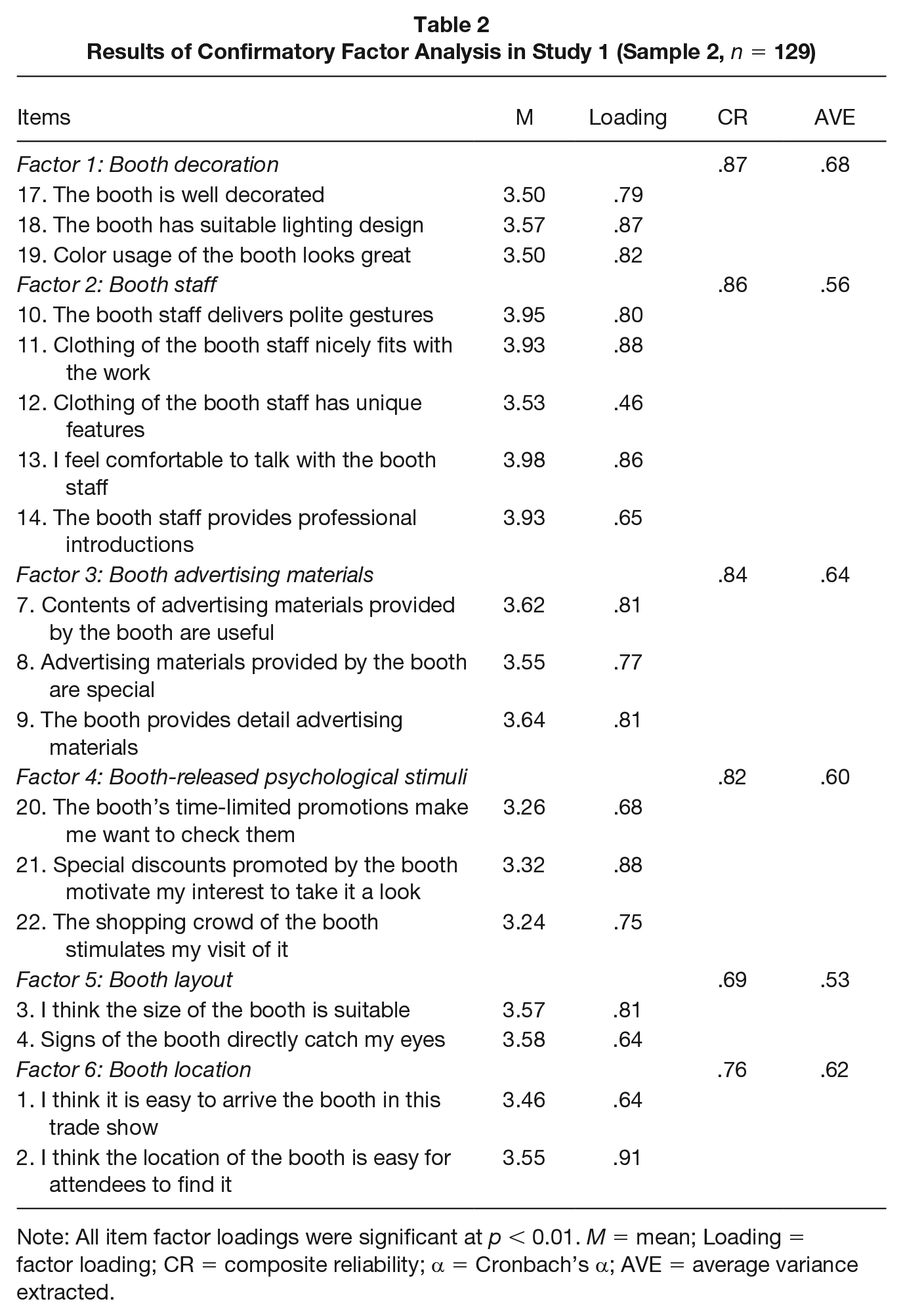
Note: All item factor loadings were significant at p < 0.01. M = mean; Loading = factor loading; CR = composite reliability; α = Cronbach’s α; AVE = average variance extracted.
Correlations and Squared Roots of Average Variance Extracted (AVE) in Study 1 (Sample 2, n = 129)
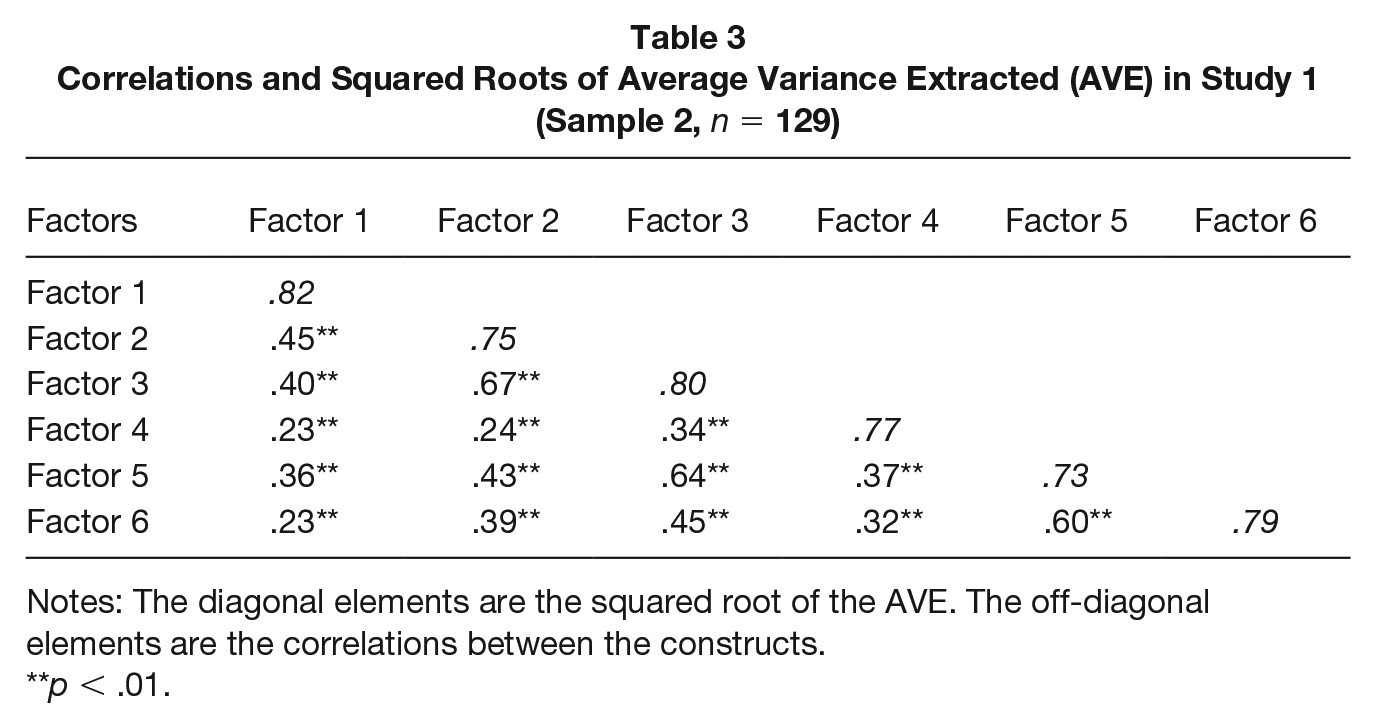
Notes: The diagonal elements are the squared root of the AVE. The off-diagonal elements are the correlations between the constructs.
p < .01.
Summary of Study 1
A scale of booth attractiveness was developed in Study 1. Based on N. Lee and Cadogan (2013), we conceptualize booth attractiveness as a second-order reflective construct with six dimensions. Compared with former empirical findings at trade expositions (Gottlieb et al., 2014; Oromendía et al., 2015), our scale offers a systematic assessment of attractiveness for trade exposition booths. In addition to the prior concerns of booth layout, staff, decoration, and location (Bitner, 1992; Bloch et al., 2017; Choe et al., 2014; Gilliam, 2015; Gopalakrishna & Lilien, 1995; Gottlieb et al., 2014; Jung, 2005; Milner, 2009), the scale developed in this study contributes new insights to the literature by adding dimensions of both booth advertising materials and booth-released psychological stimuli.
Study 2: Model Testing
Data Collection and Sampling
Research settings of this study were four trade expositions in China, including one tea and beverage trade exposition and one tourism exhibition in Xiamen City, one coffee and bakery trade exposition in Wuhan City, and one tea trade show in Chengdu City. Target participants of this study were those who attended one of the four trade shows and had purchased something at the trade exposition booth(s). With the support of four trained assistants, paper surveys were distributed to attendees in person from June 2016 to May 2017. Using random sampling, these assistants waited at the exits of these trade shows and asked attendees who had just made purchases at the trade exposition to participate in our survey. Participants were guided by the assistants to report their experiences and evaluations based on one booth at which they engaged in purchasing behavior and stayed for the longest time. After deleting incomplete responses, a total of 323 (out of 450) usable samples were collected for a usable response rate of 71.78%. Based on power analysis (MacCallum et al., 1996), with df in our structural model, 323 is enough for running structural equation modeling (SEM).
Measures
All the scale items in this survey, except for anticipated satisfaction, were rated by a 5-point Likert-type scale, ranging from strongly disagree (1) to strongly agree (5). An expert panel consisting of the same five individuals as Study 1 were invited to provide comments for revising the questionnaire. Booth attractiveness was measured by the 18-item six-dimensional scale developed from Study 1. Mental budgeting was measured by four items from Wu et al. (2013). Impulse buying was measured by four items from Beatty and Ferrell (1998). Postpurchase guilt was measured by three items adopted from Kugler and Jones (1992). Anticipated satisfaction was assessed by three items by Shiv and Huber (2000), and the items were rated from 1 to 5 for polar options. The survey questionnaire also covers demographic and exposition-related information, including age, gender, monthly income, education, visit frequency to the exposition, the purpose of attending the exposition, number of companions at the exposition, number of booths at which they had bought products or services at the exposition, total amount of consumption at the exposition, amount of money for the booth at which the attendee spent the most, and whether it was their first time to purchase from this exhibitor. In data analysis, we applied the two-step approach from Anderson and Gerbing (1988). During the first step, we ran a CFA with Mplus and descriptive statistics with SPSS to ensure reliability and validity of our measures. During the second step, we ran SEM using Mplus to test our proposed hypotheses.
Results
Of the 323 usable responses, 54.49% were female, 57.28% earned an undergraduate degree, 26.01% had monthly income of RMB 4,000 to 5,500, 34.37% attended the exposition to acquire a specific product or service, 43.44% were first-timers at the sample exposition, and 33.53% came with two companions. Besides, 32.07% purchased from one booth at the exposition, 25.07% from two booths, and 14.58% from three booths. Additionally, it was the first time for 70.55% to purchase from booth exhibitors at the exposition. These participants had average age of 34.28 years, with average spending of RMB 1458.12. The average amount of money spent at the booth where the participants spent the most was RMB 867.16.
Table 4 shows the correlation table and Table 5 shows the CFA results. The results of CFA showed the fit to the data was acceptable (χ2 = 847.43, df = 448, p ≤ .000; RMSEA = .05; SRMR = .07; CFI = .91; TLI = .90) (Kline, 2011). The Cronbach’s alphas for all 10 constructs ranged from .74 to .89 and the CR of these constructs ranged from .82 to .92, thus ensuring reliability (Hair et al., 2006). The AVE of all constructs ranged from .55 to .80 and the squared root of the AVE of each construct was higher than its correlation with other constructs, thus demonstrating high validity (Hair et al., 2006). Based on the above, all measurement scales had adequate reliability and validity.
Correlations and Squared Roots of Average Variance Extracted (AVE) in Study 2 (Sample 3, n = 323)
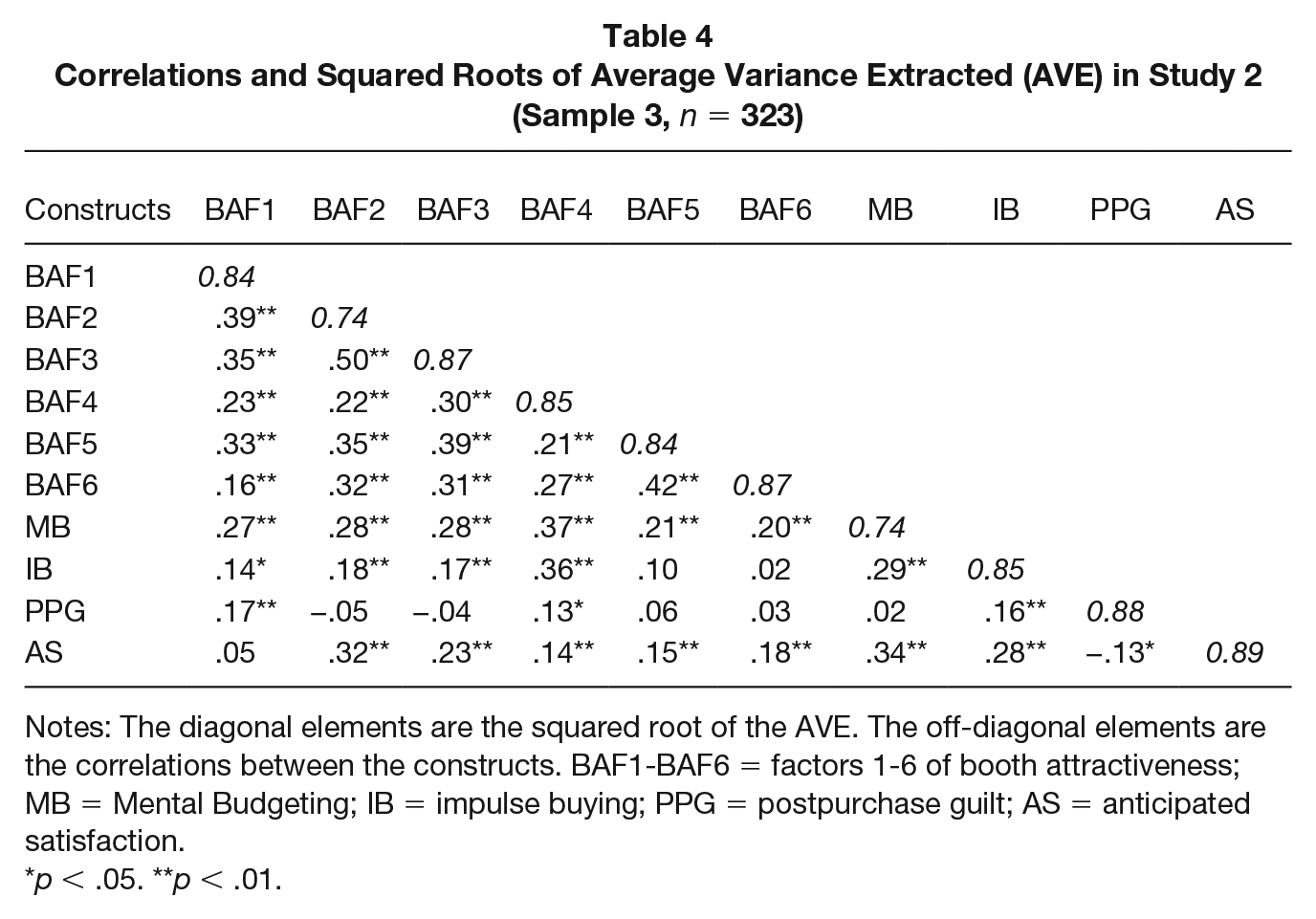
Notes: The diagonal elements are the squared root of the AVE. The off-diagonal elements are the correlations between the constructs. BAF1-BAF6 = factors 1-6 of booth attractiveness; MB = Mental Budgeting; IB = impulse buying; PPG = postpurchase guilt; AS = anticipated satisfaction.
p < .05. **p < .01.
Confirmatory Factor Analysis Results in Study 2 (Sample 3, n = 323)
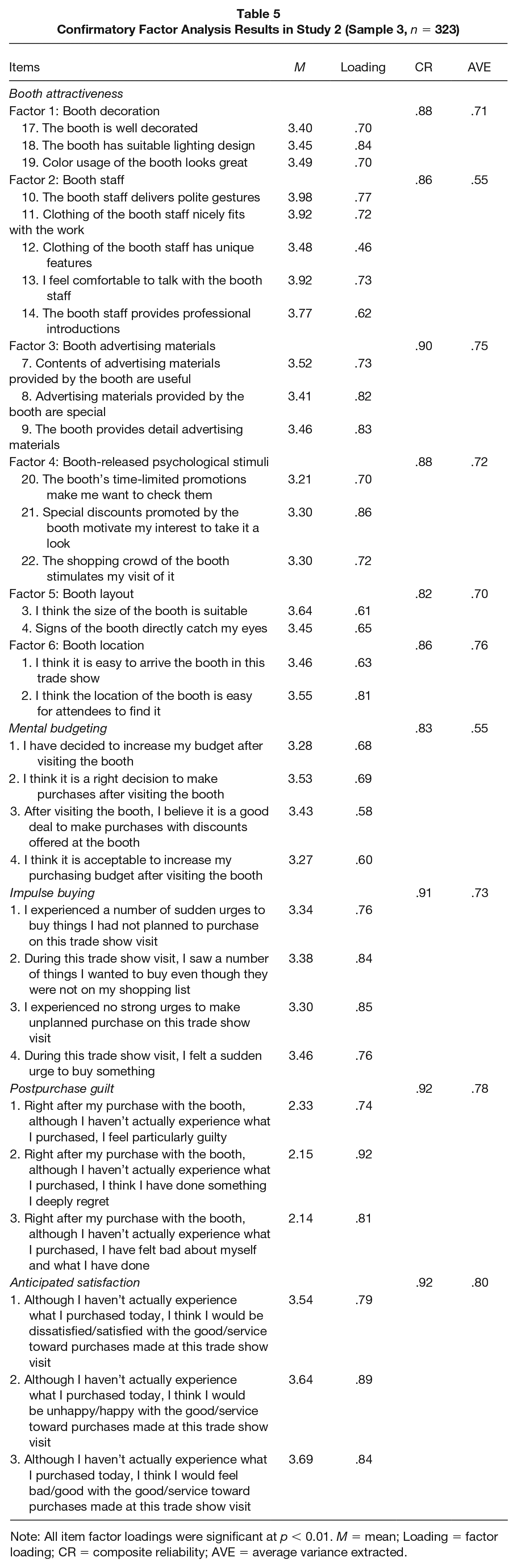
Note: All item factor loadings were significant at p < 0.01. M = mean; Loading = factor loading; CR = composite reliability; AVE = average variance extracted.
We test the hypotheses with SEM. The model fit indices were acceptable (χ2 = 878.89, df = 452, p ≤ .001; RMSEA = .05; SRMR = .08; CFI = .90; TLI = .89) (Kline, 2011). As predicted, booth attractiveness exerted positive influences on mental budgeting (β = .52, p < .001) and impulse buying (β = .17, p < .05), supporting Hypotheses 1 and 2. Hypothesis 3 was supported as well because mental budgeting was positively related to impulse buying (β = .24, p < .01). Besides, impulse buying was positively related to postpurchase guilt (β = .19, p < .01) and anticipated satisfaction (β = .36, p < .001), supporting Hypothesis 4 and Hypothesis 6. Moreover, Hypothesis 5 was supported by the significant negative relationship between postpurchase guilt and anticipated satisfaction (β = −.23, p < .001).
Summary of Study 2
Findings of Study 2 confirmed a booth attractiveness-driven model of purchase at trade expositions. Booth attractiveness, comprised of six dimensions established from Study 1, was significantly and positively associated with mental budgeting and impulse buying. Meanwhile, mental budgeting improved impulse buying. Later, impulse buying significantly enhanced postpurchase guilt and anticipated satisfaction while post-purchase guilt reduced anticipated satisfaction. All six proposed hypotheses were supported. Implications are addressed in the next section.
Discussion
Results from Study 1 indicated that booth attractiveness is a second-order reflective construct composed of six dimensions, including (1) booth decoration, (2) booth staff, (3) booth advertising materials, (4) booth-released psychological stimuli, (5) booth layout, and (6) booth location. In Study 2, our results indicated that booth attractiveness has a positive effect on mental budgeting, confirming prior research regarding the flexibility of mental budgeting (e.g., Cheema & Soman, 2006). Booth attractiveness is also positively associated with impulse buying, supporting the view that when the shopping environment creates more excitement and arousal, customers are more likely to engage in impulse buying behaviors (e.g., Chang et al., 2014). Furthermore, we found a positive relationship between mental budgeting and impulse buying. According to prior research, when customers forgo a certain level of self-control, they are more susceptible to impulse buying (Miao & Mattila, 2013). Our results echo this stream of research.
The effect of booth attractiveness in a postpurchase stage was examined as well. Our findings show that the impulse buying behavior triggered by booth attractiveness leads to both positive outcomes such as anticipated satisfaction, as well as negative outcomes such as the feeling of guilt. These findings lend support to the research suggesting the complexity of impulse buying in inducing affect-rich implications (Miao, 2011). Finally, this research found that postpurchase guilt negatively affects attendees’ anticipated satisfaction. This result is consistent with the theory of “affect-as-information” (Schwarz & Clore, 1983), such that consumers tend to use feelings to inform their anticipated satisfaction (Saintives, 2020). Significant theoretical and practical implications are discussed next.
Theoretical Implications
First, this study provides a comprehensive measurement scale for attractiveness of trade exposition booths. While certain aspects of attractiveness such as booth decoration, staff, layout, and location have been identified and examined in prior research, the present research extends the literature by incorporating two new dimensions: booth-released psychological stimuli and booth advertising materials. We identified that booth-released psychological stimuli could be experienced through three features of the exhibition: (1) time-limited promotion, (2) special discounts, and (3) perceived crowding. The addition of these two dimensions extends the theoretical interpretation of environmental stimuli (Berlyne, 1971) for booth attractiveness, enriching booth attractiveness from a static concept to a dynamic concept, which incorporates interactions with attendees’ psychological feelings. That is, booth attractiveness shouldn’t be evaluated solely by exhibitors’ and designers’ aesthetic tastes. From attendees’ perspective, psychological stimuli evoked by a booth should be considered as well to evaluate booth attractiveness.
Second, results of the present research suggest that impulse buying has a positive influence on both anticipated satisfaction and guilt. It might seem contradictory that impulse buying induces both positive and negative responses. However, research in social psychology and consumer research has provided ample evidence that people can simultaneously experience mixed emotions. For instance, Miao (2011) found that impulse buying can result in either a dominant feeling of pleasurable guilt or guilty pleasure. Moreover, prior research indicated that impulse buyers gain satisfaction and pleasure not only via the purchased products but also via the purchase process itself (Miao & Mattila, 2013; O’Guinn & Faber, 1989). Our study extends the literature by identifying anticipated satisfaction and guilt as specific outcomes of impulse buying. Additionally, although the role of impulse buying has been examined in contexts such as restaurants and food consumption (e.g., Miao, 2011; Miao & Mattila, 2013), its impact on other segments of the hospitality and tourism industry has received scant attention. To the best of our knowledge, this is the first study examining the effect of booth attractiveness on impulse buying and its consequences, thus making a major contribution to the event and exhibition management literature.
Third, the role of mental budgeting is examined in this research and our results show that booth attractiveness positively influences mental budgeting, which in turn affects downstream behaviors such as impulse purchasing. The positive relationship between booth attractiveness and mental budgeting indicates that both physical elements (e.g., booth layout, booth decoration, etc.) and psychological stimuli (e.g., time pressure, perceived crowding, etc.) could significantly alter attendees’ mental budgeting process. While prior research on mental budgeting mainly focuses on financially related variables (e.g., price increase; Homburg et al., 2010), this study contributes to the literature by identifying nonfinancial variables and their impact on consumers’ mental budgeting process. The examination of the relationship between mental budgeting and impulse buying bears important theoretical implications as well. Although the impact of impulse buying on mental budgeting has been explored before and researchers have shown that impulse buying has a positive effect on mental budgeting (Wu et al., 2013), this research demonstrated that the relationship between impulse buying and mental budgeting could be bidirectional, such that the increase of mental budgeting could also influence subsequent impulse buying behaviors. Such a finding advances the literature in consumer decision making in general, and mental budgeting and impulse buying in particular.
Managerial Implications
To begin with, this study provides exhibitors a critical tool for measuring and evaluating the attractiveness of their booths. Exhibitors are suggested to evaluate booth attractiveness from the six dimensions in our developed scale. Taking booth staff as an example, exhibitors need to evaluate whether the staff working at the booth are friendly, polite, and professional, as these attributes have a significant impact on attendees’ perceptions and evaluations. Additionally, staff appearance, such as whether their clothing fits the work environment, is worthy of attention.
Rather than simply using it as a tool for evaluation, exhibitors can utilize the results of the present research to further enhance the attractiveness of their booths by manipulating these six dimensions. For instance, creative signs, suitable lighting design, and careful selection of color could all help increase consumers’ positive reactions. Strategies such as offering time-limited promotions and special discounts at the booth could be employed to positively influence mental budgeting and impulse buying as well. Our findings also direct exhibitors’ attention to elements that are often ignored (e.g., booth advertising materials). Exhibitors need to ensure that the content of advertising materials displayed at their booths is useful, special, and informative. This measurement scale is of importance to exhibition organizers, too, as they could apply the scale to aid exhibitors. Exhibition organizers can help choose booth location, providing suggestions on booth layout and decoration to help increase the attractiveness of individual booths.
Finally, this research highlights both the positive and negative effects of impulse buying on attendees. It is important for exhibitors to recognize that attendees who shopped at a booth could experience feelings of guilt and anticipated satisfaction simultaneously. Exhibitors need to consider not only the short-term financial gains but also the long-term relationships with attendees. Therefore, exhibitors should strive to help alleviate feelings of guilt while enhancing anticipated satisfaction. For example, to lessen guilt, exhibitors can focus on emphasizing how good of a deal the attendees received through this purchase. It provides a stronger justification for attendees’ mental budgeting and impulse buying. In addition, exhibitors could accentuate the benefits of the products before the attendees leave the booth to help enhance their anticipated satisfaction.
Limitations and Suggestions for Future Research
Although this study has contributed valuable implications to event management, there are still some limitations to be considered when developing future event research. First, model testing for our booth attractiveness scale did not include service recovery measures. According to service recovery issues in the event industry identified by Weber and Hsu (2021), future studies are encouraged to examine relationships between booth attractiveness and service recovery measures at trade exposition settings. Second, samples in this study were all collected in China. As pointed out by Mair and Weber (2019), different cultural perspectives should be incorporated in event research. Therefore, future studies should explore cultural differences in trade exposition attendees’ perceived booth attractiveness. Third, future studies are encouraged to plan a longitudinal data collection capturing both before and after purchases at exhibitions. One feasibility for collecting longitudinal data would be using mobile apps (McLean, 2018) to track and survey exhibition attendees’ actual attitudes and behaviors.
