







Abstract
We examine internal and external factors that build or thwart the career adaptability resources of migrant hotel workers. Drawing on qualitative data at two points in time over a 12-month period during COVID-19, results show that while some migrant workers changed roles and exited hotels, for most, job changes were a shorter-term, separation phenomenon, with migrants transitioning back to their employer within a year. Psychological, social, and human capital resources facilitated career adaptability, while psychoemotional support from managers and peers fostered the confidence of temporary migrants, and facilitated positive affect, which was integral to their openness to exploring alternate hospitality careers. Inhibitors to career adaptability included a lack of agency among temporary migrants, and career entrenchment of mid-career permanent migrants. Our model provides a fine-grained, holistic understanding of the antecedents of career adaptability, enriching career construction theory by clarifying the contexts that drive career adaptability in the evolving, COVID-19 context.
Keywords
Introduction
The hospitality sector was, and remains among, the sectors hardest hit by COVID-19. Although some restrictions are being relaxed, many hospitality firms remain unable to operate at full capacity due to social distancing and ongoing border closures with concomitant adverse consequences for consumer demand. As a result, numerous businesses shut down, or operated at reduced capacity, resulting in job cuts and furloughing of workers, leading to unemployment, underemployment and uncertainty amongst employees regarding earnings, employment status, and career progression (Lee et al., 2021). To ease this situation, on the one hand, hotels reportedly helped employees find alternate hospitality jobs (Manoharan et al., 2021), while on the other hand, employees may, through their own volition, have adapted their careers in response to COVID-19. Many employees, especially those who are proactive and adaptable, have sought employment opportunities not only outside their current companies but also in alternate professions and industries (Lee et al., 2021). It was reported that 700,000 hospitality workers separated from their jobs on average every month in 2021, and the industry was finding it hard to bring back these workers due to the unfavorable working conditions in the industry like low wages and long hours (“Why workers are fleeing the hospitality industry,” 2022). Accordingly, career adaptability has become among the most significant issues in contemporary hospitality management.
Career adaptability is defined as individuals’ psychosocial resources “for coping with current and anticipated tasks, transitions, traumas in their occupational roles” (Mark et al., 2012, p. 662). While there is substantive literature on the concept in the vocational psychology literature (Rudolph et al., 2017), with few exceptions, career adaptability is not well understood in hospitality and tourism, leading to calls for further research (Karatepe & Olugbade, 2017; Lee et al., 2021; Rasheed et al., 2020). There is also a lack of research on the career adaptability of migrant workers in COVID-19 (Rudolph et al., 2021), who tend to be from marginalized backgrounds in precarious employment via contract or parttime, temporary jobs with no benefits. In Australia, migrant workers constitute 39% of the hospitality workforce (Australian Bureau of Statistics [ABS], 2020). Skilled migrants are an integral part of the accommodations sector of which 12% of workers are temporary migrants (Harris, 2021). Given that the hospitality sector is a significant employer of migrant workers (Manoharan et al., 2021), the purpose of this study is to explore the factors that influence migrant hotel workers’ career adaptability during the ongoing crisis of COVID-19.
Understanding the career adaptability of migrant hotel workers in this context is important for two reasons. First, from a human resources perspective, understanding and facilitating the career adaptability of employees during crises fosters good employee relations that may enable future recruitment and retention efforts. This is especially salient in the hospitality industry, where employee turnover is very high (Afsar et al., 2018). Second, understanding and developing the career adaptability of immigrant employees builds reputation and goodwill for hotel organizations from a social responsibility perspective.
As noted earlier, there are a large number of migrant workers in hospitality and many are inherently vulnerable. This vulnerability stems from sociocultural factors like unfamiliarity with the host culture, underemployment, lack of social support, and inaccessibility to government benefits, showing the brunt of the job losses among migrant workers in this sector (Askola et al., 2021). As such, examining the career adaptability of hospitality migrant workers during an ongoing crisis assists not only with employers’ workforce management, but also with employees’ career capital development.
The literature has emphasized personal attributes—such as Big Five personality, proactive positionality, dispositional positivity, and future orientation (Rudolph et al., 2017)—that function to shape career adaptability. How contextual factors (e.g., work-related contexts and broader societal or economic situations) drive the development of career adaptability is not well understood empirically, nor are personal stress-inducing circumstances (e.g., career challenges, transitions, traumas) which may trigger one’s need for career adaptability resources (Rudolph, 2019). However, such external factors play a critical role in influencing individuals’ career adaptability (Newman et al., 2021; Wehrle et al., 2019). Neglecting them prevents us from developing a holistic picture of enablers and barriers to building career adaptability among hotel migrant workers. In addition, despite recent advancements in career adaptability in the hospitality literature, studies are predominantly based on quantitative, cross-sectional approaches (Lee et al., 2021; Rasheed et al., 2020), which do not allow us to observe how career adaptability is shaped or changes over time. Hence, research may miss capturing the dynamic nature of career adaptability (Akkermans et al., 2020), and further exploration that extends a cross-sectional perspective is warranted.
To address these areas, we conducted a qualitative study, with data collection at two time points over a 12-month period, to investigate migrant hotel workers’ career adaptability, capturing both internal and external factors influential in building career adaptability resources. Although COVID-19 is ongoing and far from over with different variants exerting various pressures in different parts of the world, the 1st year post-COVID is crucial to check on the career adaptability of migrant workers as a year is enough time to adjust to the new reality of lost jobs, furloughs, and career transitions. In this way, our research carries important theoretical and practical contributions. First, by explicating the individual-level and contextual factors influencing the career adaptability of migrant hotel workers into an integrative model, we provide a fine-grained, holistic understanding of the antecedents of career adaptability. In doing so, our research enriches career construction theory by clarifying the contexts that drive the career adaptability development, in particular the evolving, previously unexplored context (e.g., COVID-19). We also respond to calls for further work on this under-researched area, that is, the contexts driving career adaptability development (Karatepe & Olugbade, 2017; Lee et al., 2021; Rasheed et al., 2020). Second, by using follow-up data, this study could reveal how COVID-19 affects hospitality workers’ career trajectories and career adaptability resources over time. As scholars have recently advocated, empirical research beyond the immediate effects of COVID-19 needs to incorporate the intermediate effects on careers to facilitate organizations and employees in preparing a way out of the pandemic (Rudolph et al., 2021). With a prolonged investigation over 1 year, the present study echoes this need by generating potential insights that assist hospitality managers in medium-term talent management and retention, in times of crisis, and beyond.
Literature Review
Career Adaptability
The dynamic changes to the world of work require individuals to continuously construct their careers to survive and thrive in challenging vocational and occupational contexts such as the hospitality sector. The core tenet in this process is that people need to be adaptable to changes in the job and career environments that are less predictable. Reflecting these perspectives, career construction theory (Savickas, 2002, 2005) addresses the contemporary, developing needs of modern employees who may undergo various job- and career-related changes across the life span (Sou et al., 2021). According to career construction theory (Savickas, 2013), individuals exercise authority over their careers by adaptively utilizing a set of psychosocial resources facilitating self-management of work-related transitions. Under Savickas’s (2013) model of adaptation, differences exist in individuals’ willingness (“adaptivity”) and ability (“adaptability resources” or “career adaptability”) to act in a manner that addresses changes in their environment (“adapting responses”). Comprising a phased sequence of interrelated processes, adaptivity impacts career adaptability which, in turn, causes adapting responses and, eventually, adaptation results. Based on Savickas, this sequential, dynamic process involves the roles of various individual (internal) attributes and contextual (external) characteristics in directing people to adapt to their environments.
Central to this theory is the construct of career adaptability. In the course of career construction and development, individuals craft their career roles to respond to the variation of career environments on an ongoing basis (Savickas et al., 2009). This adaptation-focused response needs them to build strong career adaptability that constitutes “a self-regulatory, transactional, and malleable competency that enables workers to successfully solve unfamiliar, complex, and ill-defined problems throughout their careers” (Rudolph, Lavigne, & Zacher, 2017, p. 17). In addition, these competencies or resources shape a person’s psychological and behavioral adjustment to the environment and assist them in attaining career goals, thereby leading to sustainable, positive career development in the long run.
Career adaptability can be viewed as an integral construct comprising four major composites or dimensions (i.e., concern, control, curiosity, and confidence), which reflect self-regulation strengths in navigating issues present in the world of work (Savickas & Porfeli, 2012). Career concern denotes one’s care about the future of his or her career and helps people think about and prepare for upcoming career tasks and situations. This adaptability dimension, which prompts individuals to look ahead and plan for future careers, involves the capability to establish meaningful links among past, present, and future career activities (Koen et al., 2012; Savickas, 2005). Career control refers to the individual’s capability to take control over career futures by holding accountability for shaping the self and the environment as demonstrated by self-discipline, effort, and persistence. One example for control is decisiveness and self-dependency in making career decisions (Koen et al., 2012). Career curiosity involves people’s curious exploration of various occupational roles and situations for developing positive selves and alternative scenarios (Jiang, 2017; Jiang, Hu, & Wang, 2018). For instance, it might be expressed in terms of exploring information on work and career opportunities that fit their strengths, values, and interests (Hui et al., 2018; Ocampo et al., 2020). Career confidence is individuals’ self-efficacy in effectively coping with difficulties, obstacles, transitions, risks, and challenges to pursue career aspirations (Hui et al., 2018; Savickas & Porfeli, 2012). It also captures people’s positive personal beliefs, in the coping and problem-solving process, that they are capable of successfully performing tasks, learning skills, and working up to their ability to turn the negative into the positive in the career journey (Savickas & Porfeli, 2012). These four components collectively reflect one’s overall career adaptability, which depends not only on the presence of these adaptability dimensions but also on how the resources indicated by such dimensions are utilized when adjusting to career environments (Jiang, 2017; Koen et al., 2012).
Due to the key functions of career adaptability in helping manage career changes, transitions, and trauma (Savickas, 2002, 2005), researchers have consistently treated it as an essential self-regulatory capability that enables people to get through career obstacles, shocks, and disasters (e.g., Akkermans et al., 2020; Rummel et al., 2019). A major reason is that individuals with stronger career adaptability generally have a greater tendency to achieve desired outcomes that are relevant to careers, work, and life. For example, results of meta-analyses suggest that career adaptability can lead to higher levels of career satisfaction, work performance, income, and life satisfaction (Rudolph, Lavigne, & Zacher, 2017). These potential positive outcomes resulting from career adaptability can lend people more opportunities or capacities to stay resilient and optimistic (Maree, 2017; Rossier et al., 2017; Tolentino et al., 2014) when confronted with unplanned challenges incurred by career crisis or shocks. COVID-19 is a recent example that has created career shocks for numerous people, due to its constraints on the capacity—and its shifts of the focus—of some industries, workplaces, and individual workers (Akkermans et al., 2020b; Hite & McDonald, 2020). Under this circumstance, career adaptability is a vital personal resource that assists affected employees in navigating through involuntary job changes, such as reduced working time, furloughs, and redundancy (Lee et al., 2021). Thanks to its role in leading one to a positive direction, there is consensus that career adaptability drives people to see, seize, and capitalize on opportunities in unexpected changes and recover from unforeseeable, negative career situations (Rudolph, Lavigne, & Zacher, 2017).
Career Adaptability of Hospitality Workers
COVID-19 has had an unprecedented impact on the hospitality sector (DeMicco et al., 2021; Pan et al., 2021). Workers have experienced increasing career challenges, which are anticipated to persist for many years even after the pandemic (Salem et al.i, 2021; Zhang et al., 2021). These include job cuts, unemployment, financial hardship, and changes in work conditions. Since the pandemic is altering the way the industry is to operate and is leading many jobs to be redesigned or disappear, workers are likely to face a future world of work that is drastically different to before COVID-19 (Sharma et al., 2021). Self-management of both phases, that is, getting through difficulties during COVID-19 and shifting the focus to recovery, requires workers to adapt to swift changes or transitions. Career adaptability is a critical facilitator for hospitality and tourism workers to survive in and after this crisis (Lee et al., 2021), and may be more salient as compared to workers in many other industries.
Career adaptability is critical to reduce negative—or increase positive—employee outcomes, particularly under supportive organizational environments (Guan et al., 2015). In a study of frontline hotel employees Karatepe and Olugbade (2017) showed that coworker and supervisor support enhance career adaptability, but also prompt turnover intentions. Rasheed et al. (2020) found that happiness resulting from greater career adaptability helps mitigate an employee’s intention to leave their organization, but only when they perceive career opportunities exist with their employer. If perceived career opportunities are low, employees will search for alternative career opportunities outside of their organizations, despite high levels of happiness caused by career adaptability. Lee et al. (2021) caution that career adaptability can be a double-edged sword leading to higher turnover intentions when individuals receive weak work social support, as they feel less obligated to stay with their current organization. However, perceptions of career opportunities may vary depending on employees (Rasheed et al., 2020), as does the impact of supervisor/co-worker support (Lee et al. 2021), underscoring the need for additional research on factors influencing career adaptability (Lee et al., 2021; Rasheed et al., 2020).
The hospitality literature has documented a very limited number of antecedents that potentially influence hospitality workers’ career adaptability. For instance, Lee et al. (2021) found a proactive personality to be a significant individual factor that enables hotel employees to improve career adaptability, having verified earlier findings in the general population (e.g., Jiang, 2017) to hospitality contexts. Safavi and Bouzari (2019) report that the effect of psychological capital on the career adaptability of hotel frontline employees is also positive and significant.
While scholars have attended to the influence of contextual factors, they currently are limited to organizational systems or practices. For example, Safavi and Karatepe (2018) reported that high-performance work practices provide an enabling context that allow hotel workers to build career adaptability resources. Given the importance of career adaptability in fostering positive employee outcomes (Guan et al., 2015), the relative lack of studies attending to its influential factors in the hospitality industry also means that ongoing research in this area would advance our domain-specific knowledge regarding how or when career adaptability can be shaped in hospitality.
Career Adaptability of Migrant Workers
Migrants encounter heightened challenges in career, work, and employment settings compared to local employees, primarily due to barriers related to language, culture, and other demographic characteristics (Magnano et al., 2021). Prior research has highlighted the importance of career adaptability in the work-life of those individuals employed outside of their country of origin. For example, for employees working in a host country, career adaptability is positively related to cultural intelligence (Presbitero & Quita, 2017), which facilitates their integration into the workplace and the broader community (Jiang, Le, & Gollan, 2018; Le et al., 2018). Wehrle et al. (2019) found that when effectively using career adaptability resources, individuals residing outside of their home country (e.g., refugees) are more likely to rebuild their career and work trajectories in an alien country. This line of work generally supports the argument that career adaptability can facilitate migrant workers in conquering work- and career-related challenges.
To date, empirical studies dedicated to investigating the factors of migrant workers’ career adaptability is still in incubation. These studies spread across various types of international migrants (e.g., skilled migrants, refugees, and expatriates) who are employed or preparing for employment. For instance, researchers have reported that individual factors such as cultural intelligence (Earley, 2002; Presbitero & Quita, 2017) and the exercise of personal agency (Verwiebe et al., 2019) are salient enablers of career adaptability in expatriates and refugees, respectively. Scholars have also confirmed several external factors that may enhance or hamper migrants’ career adaptability. For example, Venugopal and Huq (2021) found that stress-inducing factors, such as lack of recognition of overseas qualification and/or work experience and the difficulty in maintaining a work–life balance, can inhibit the acquisition of career adaptability resources in the host country. Beyond these factors, Dunwoodie et al. (2020) identified social capital, such as trusted and engaged social networks, as a resource that assist immigrants (e.g., refugees) in adapting to the career contexts. While this body of literature offers some interesting insights, factors of career adaptability in immigrants or refugees may not be directly applicable to hospitality workers. Thus, targeted research is needed to focus on migrants working in hospitality to confirm unique factors that drive their career adaptability.
Recent scholars also underscore that COVID-19, which goes beyond the normal challenges most migrant workers used to face, carries critical, new implications for the career adaptation and management capabilities of the migrant population (Cho, 2020; Guan et al., 2020). As a result of the pandemic and associated career shocks, migrant workers’ career needs and expectations may change, as may the constituents of their career adaptability resources and the factors affecting these resources. This perspective is largely consistent with Salazar’s (2020) emphasis on the tourism-related sectors that the management of careers needs to be featured within the contemporary, updated understandings of vocational mobility in a specific context (Baum, 2016). Flagging COVID-19 as a key context, Salazar (2020) suggests that the current and future nexus between the migration workforce and the tourism industry will be characterized by escalating, long-term challenges that impact the resilience and adaptability of migrant workers, consequently jeopardizing the viability and sustainability of many tourism organizations. While the scattered debate has been ongoing since early 2020, empirical knowledge regarding the specific factors that may enable or prohibit migrant workers’ career adaptability in the pandemic context remains scant. Thus, our study explores the individual-level resources and contextual factors that influence migrant hotel workers’ career adaptability to the COVID-19-related career shock. In doing so, it aims to offer updated, innovative insights into what drives hotel migrant workers’ career adaptability over time.
Research Methods and Procedures
Qualitative research is appropriate where variables have not yet been identified or a theory not yet developed (Morrow, 2007). As this research seeks to identify and explicate the under researched phenomena of the individual-level and contextual variables affecting migrant workers’ career adaptability, and how workers transition their careers to the shocks entailed by COVID-19 in the near and intermediate term, we adopted a qualitative, follow-up data collection research design. Thus, the research is positioned at the end of the research methodology continuum based on an interpretative perspective that aims to furnish rich insights into contemporary social phenomena (Creswell & Creswell, 2003). Semi-structured interviews are appropriate for researching the plethora of possible resources and factors that underlie and explain the career adaptability of under-researched migrant hotel workers in the under-explored COVID-19 context.
Sampling Process and Data Collection
To select participants, we utilized purposive sampling, which is “used to select respondents that are most likely to yield appropriate and useful information” (Kelly, 2010, p. 317). The criteria for selection were twofold: (1) a migrant worker, defined as a worker who was born outside Australia and whose first language was not English; and (2) a migrant worker currently employed in Australia’s hotel sector, or, as a result of COVID-19, has stopped working in the hotel sector. We incorporated migrant status and additional sampling criteria (e.g., gender, hospitality vs. non-hospitality qualifications, career stage, non/managerial workers, tenure with current employer, and in the hotel sector) to facilitate a diverse sample holding a variety of points of view.
Participants were initially recruited via the authors’ professional networks in hotels, and subsequently via snowballing. This involved asking participants if they were aware of other migrant hotel workers interested in participating in the research and was effective for identifying and sampling hard to reach populations (Parker et al., 2019), including furloughed migrant hotel workers. The combination of sampling techniques resulted in 25 interviews with migrant hotel workers, which is between the 15–60 participant norm for workplace research, but below the recommended 50 participants from across organisations (Saunders & Townsend, 2016). However, Saunders and Townsend (2016) caution that 50 participants is only an estimate, and recognize that the actual number may vary according to the saliency of data, the so-called “gold standard” for qualitative research (Guest et al., 2006). Consistent with this principle (Huang & Miao, 2016), data from interviews were collected and analyzed iteratively until new interviews were no longer introducing new themes (i.e., theoretical saturation was reached; Glaser & Strauss, 2017). This was reached following analysis of data from 21 interviews. To confirm theoretical saturation, a further four interviews were conducted and analyzed (a total of 25), with findings reiterating themes from earlier data analysis.
The sample is not intended as a representative population of migrant hotel workers but is a purposive sample from which a framework of career adaptability can be distilled. This framework identifies and delineates the factors that contribute to explaining migrant workers’ career adaptability during COVID-19. This research is intended as an exploratory study and does not seek to generalize to all migrant workers in hotels. As a qualitative investigation, it does not allow for statistical inferences about the career adaptability of migrant hotel workers, nor for quantification of the relative importance of factors that influence career adaptability. The study requires quantitative and confirmatory follow-up research to validate the factors (see the section Future Research below).
Semi-structured interviews were conducted as they ensured uniformity in subject areas examined across the sample, whilst providing flexibility for the interviewer to clarify responses by probing and seeking further detail, and to explore matters as they arose (McIntosh & Morse, 2015). To ensure interviewees’ responses represented reality versus what participants might feel obligated to say (Hunt & Boxall, 1998), we asked interviewees for specific examples to illustrate their answers.
The interview protocol comprised three sections. The first section provided an introduction and sought data in respect of participants’ demographics and work history, in order to provide a context for understanding responses. In the second section, we explored the impact of COVID-19 on current employment (e.g., employed, furloughed, number of hours worked, pay, etc.) as of June 2020. The final section sought data related to career adaptability. This section centered on individuals’ expectations in respect of their future careers, pre-COVID-19 (i.e., before the pandemic started), and following the onset of the COVID-19 pandemic in Australia. Questions included career goals and plans at the time of interviewing and in the future, and factors impacting career adaptability. Questions in the latter two sections were designed to elicit responses on the study’s key variables: career expectations and plans, career adaptability, the impact of COVID-19, and the individual and contextual factors influencing career adaptability.
To check the clarity and sequence of the questions, the interview protocol was reviewed by two academics and a human resource expert from the Australian Hotels Association. The removal of a direct question in respect of compensation was recommended, as participants may have felt uncomfortable divulging this data. We substituted a question that asked respondents whether their pay had changed (i.e., increased or decreased) since the beginning of the COVID-19 crisis (see online supplement for the interview protocol). By transcribing and reviewing interview transcripts prior to the next interview, we ensured that the researchers were able to adjust the interview protocol to better capture the nuances of participants’ experiences for the remaining interviews (Smith et al., 2009).
We interviewed participants during June 2020, and interviews ranged from 23 to 45 min. Although from non-English speaking backgrounds, all participants held the necessary conversational English needed to respond to the interview questions. We encouraged participants to seek clarification both prior to and during interviewing if a question lacked clarity. We then followed up with participants a year after the initial interview (June 2021), in order to obtain data on changes, if any, to career outcomes. While the COVID-19 pandemic resulted in an acute and rapid employment loss (e.g., temporary or permanent job loss) and other negative employment changes, our interest was the career adaptability of migrant workers and the trajectories of their careers beyond this early/initial stage of the pandemic. Thus, the initial data collection was supplemented by subsequent data collected 12 months later (i.e., June 2021) through telephonic calls to focus on career adaptability and career outcomes over the longer term, consistent with recent calls for further research to track the employment of furloughed employees (Chen, 2021; Kniffin et al. 2021).
Sample
The sample comprised migrants with different visa statuses: 11 respondents were temporary migrants, 10 were permanent residents, and a small proportion were citizens (4; Table 1). Thus, temporary migrants and permanent residents were almost equally represented. Similarly, there were almost as many migrants in operational roles as in management roles (12 and 13, respectively) in housekeeping (10), F&B (7), kitchen (4), front office (2), and maintenance (1). Males and females accounted for 14 and 11 of respondents in the sample, respectively. The length of participants’ experience in the hotel industry varied substantially (from 12 months to several decades), as did their tenure at their current hotel (from several months to several years). While participants came from a range of countries, a significant number were from India (17), reflecting that India is the second largest source of migrants to Australia, with temporary, sponsored, skilled migrants from India predominantly employed in the Australian hospitality industry (Department of Home Affairs, 2020). Vietnam, Pakistan, and Nepal are also significant sources of migrants and are represented in the sample (Department of Home Affairs, 2020).
Participant Profiles.
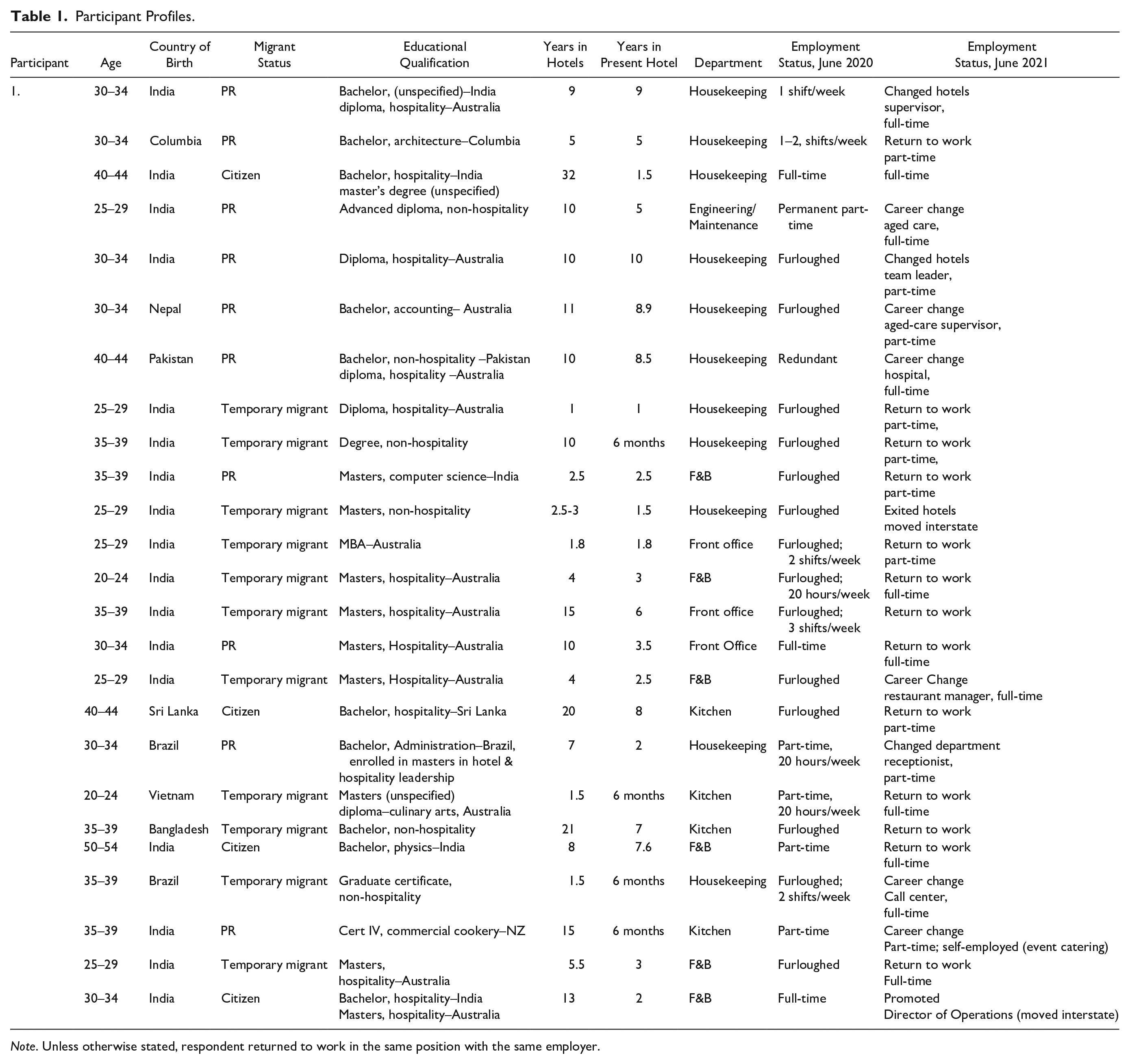
Note. Unless otherwise stated, respondent returned to work in the same position with the same employer.
Data Analysis
Interviews were audio recorded and subsequently transcribed. To ensure anonymity, participants’ names were pseudonymized. The analytical process began with the authors reading and rereading the individual interview transcripts, to obtain an intimate understanding of each transcript on a stand-alone basis. In the next phase, the focus was on interpretation, specifically identifying the individual and contextual factors important to career adaptability, before investigating how these salient factors influence career adaptability.
Individual transcripts were first analyzed to derive patterns (themes) using the constant comparative method. This involved searching for “recurring regularities” (Patton, 1990)—particularly repeated expressions in interviewees’ verbatim expressions. The identification of key patterns, or themes, is not solely dependent on the frequency with which a pattern (theme) emerges, but the extent to which the pattern is salient to the phenomenon under examination (Braun & Clarke, 2006). Thereafter, we combined themes across the entire interview data and identified overarching themes.
Despite participants’ diverse national backgrounds, there was strikingly similar language in their verbatim expressions, with the same or very similar terminology used by participants. For example, in relation to the theme of psychological resources, “optimistic,” “positivity,” and “positive attitude” were terms or phrases that cut across respondents, as did “confident” and “self-belief.” Likewise, “hardworking,” “conscientious,” “diligent,” “resilient,” and “determined” were terms commonly used among interviewees. Thus, the identification of categories of meaning across transcripts meant their coding into the themes of psychological resources was relatively straightforward, as was human capital resources.
Initial themes emerged inductively from the data (inductive logic), and were also informed by the literature (deductive logic), as we iterated between data and literature (Timmermans & Tavory, 2012). We continuously refined and further developed themes and the study’s framework (see Figure 1; Fereday & Muir-Cochrane, 2006; Sandberg & Alvesson, 2011). Thus, we employed abductive logic (Langley, 1999), an intermediate position between induction and deduction.
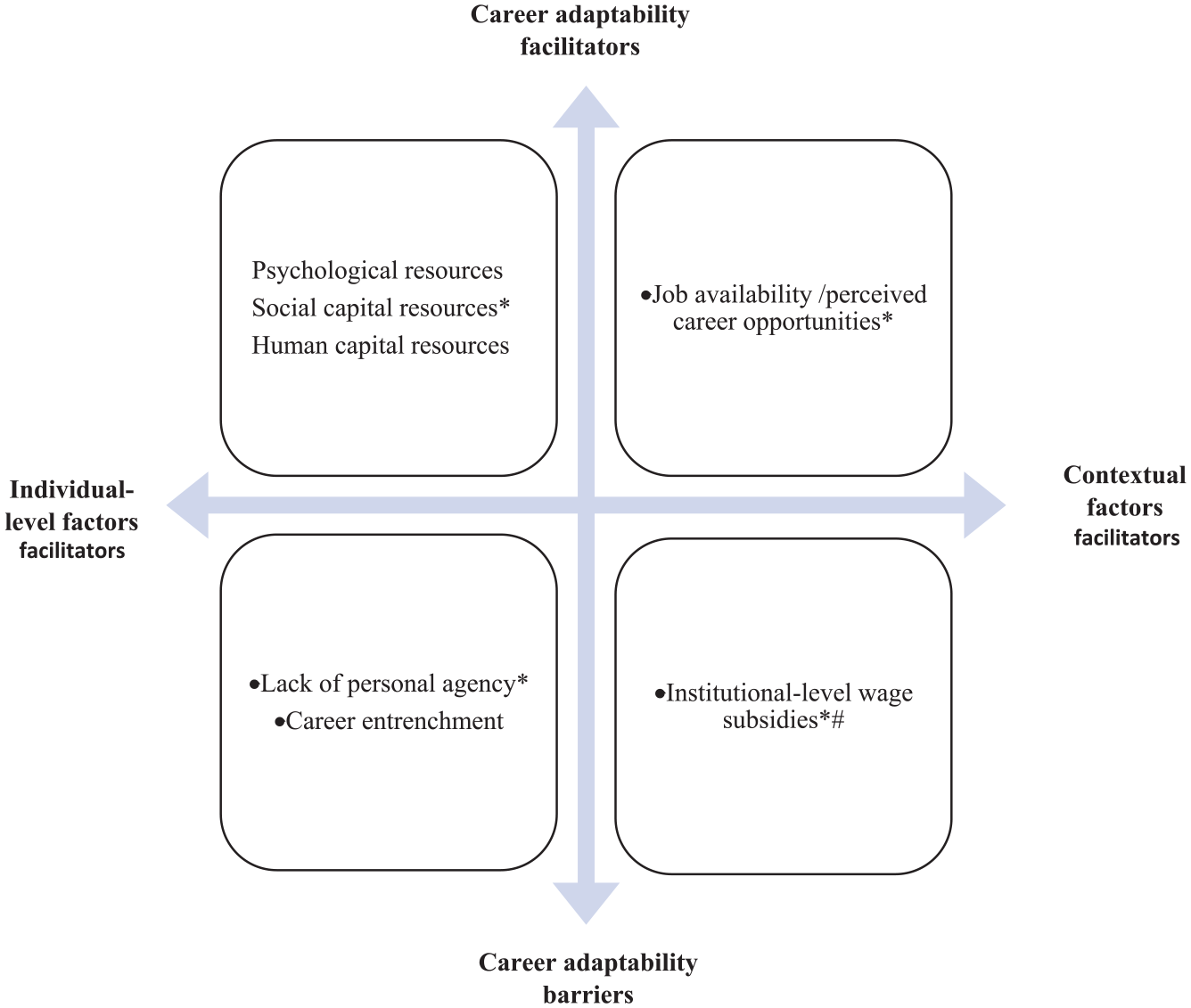
Individual-Level and Contextual Factors Enabling and Inhibiting Career Adaptability: Migrant Hotel Workers.
To illustrate, recurring terms and phrases in interviewees’ verbatim expressions initially suggested a “social capital” theme. Upon returning to the literature (e.g., Higgins et al., 2010; Lee et al., 2021; Theorell et al., 1990), we further categorized this factor into “industry networks” which provide instrumental career support and opportunities, and “social or psychosocial support,” which denotes friendship and caring beyond the workplace (Higgins et al., 2010). At this round, differences between interviewees according to migrant status emerged across data. Thus, we recoded interviews according to migrant status, with temporary migrants’ transcripts systematically interrogated alongside permanent residents and citizens’ interviews. Iterating between interview data (inductive logic) and the literature (deductive logic) was also critical to understanding how salient factors influence career adaptability; for example, how psychological resources and social support among temporary migrants facilitated career adaptability and how temporary migrant status intersected with a lack of personal agency and institutional-level wage subsidies to inhibit career adaptability. We explicate and illustrate this interplay of factors in Section 4. We interrogated the data for differences by other variables (e.g., employee vs. manager, part-time vs. full-time etc.), with migrant status also influencing perceptions of job availability and perceived career opportunities, and career stage emerging as integral to explaining career entrenchment.
In the final phase of analyses, we summarized the salient categories to aggregated dimensions (Figure 1), which reflect the individual-level and contextual factors that facilitate or are a barrier to career adaptability. Psychological resources, social capital resources, and human capital resources were the individual-level factors that facilitated career adaptability, and job availability and perceived career opportunities were the contextual factors; lack of personal agency and career entrenchment were individual-level factors that constituted barriers, and institutional-level wage subsidies was the contextual factor. We provide quotations from interviewees’ transcripts to illustrate and corroborate findings.
Trustworthiness
Two different researchers analyzed and interpreted the data, facilitating a valid and trustworthy interpretation of the data. The first author coded the transcripts before the second author independently went over the themes and quotations. We compared the resulting analyses to further develop and unify the themes. We discussed and resolved any disagreements. Thus, we achieved corroboration through the convergence of interpretations—researcher triangulation—a generally accepted way of providing qualitative studies with a degree of validity and confidence in the research findings (Eisenhardt, 1989).
Findings
Impact of COVID-19 on Migrant Workers’ Careers: 6 Months and 1 Year On
At the time of interviewing in June 2020 (Time 1), only three migrant workers continued working full-time, nine migrants were working less than their regular hours with commensurate reductions in income, 12 had been furloughed, and one migrant had lost their job (Table 1).
A year on (June 2021; Time 2), the proportion of migrant workers working full-time had increased to 12. Ten respondents were employed on a part-time basis, working the same, or more hours than 12 months earlier. Thus, all employees who were initially furloughed (12) had resumed work (Table 1). However, 11 migrant workers changed roles (e.g., lateral transfers from housekeeping to the front desk, promotion to operations manager) and/or employers, including six who left hotels for similar positions in related hospitality businesses (e.g., stand-alone restaurant, event catering), or careers outside of hospitality (e.g., aged-care, hospitals, and a call-center). Thus, COVID-19 was a catalyst for alternative jobs in and external to hospitality. Participants were also unanimous in their conviction that COVID-19 had negatively impacted career trajectories, delaying career progression, particularly promotions.
Factors Facilitating Migrant Workers’ Career Adaptability to COVID-Related Career Shock
Intangible resources comprising psychological resources, human capital resources, and social capital resources, together with contextual factors, particularly job availability, and perceived career opportunities, emerged as factors that facilitated migrant workers adapting their career to the COVID-related career shock. Differences were also evident among migrants depending on their migrant status (i.e., temporary migrant vs. permanent resident) which we highlight below.
Psychological resources
Migrant workers leveraged psychological resources to adapt their career, including “self-efficacy” (Respondent 18), “will power” (Respondent 23), and a “high level of resilience” (Respondent 15), that combined synergistically to help workers to take responsibility for, and control over, their careers by establishing goals, with participants expressing career “confidence even in these circumstances” (Respondent 24). For example, drawing on self-efficacy and “a high level of resilience and determination,” Respondent 15 perceived the disruption that manifested in organizational changes as a result of COVID-19 as an opportunity for advancement, whereby he crafted his job by seeking and taking on more challenging projects: “It is the new normal and it’s important that individuals, like myself, focus on taking on anything that comes our way, and learning and embracing change—this challenge—and then move ahead, to take on the next role.”
“Positivity” (Respondent 25), “optimism” (Respondent 10), and “conscientiousness” (Respondent 1) constituted key psychological resources underpinning migrant workers’ career adaptability, particularly the dimensions of career concern, control, and confidence. Participants were motivated to tackle COVID-related career challenges, were decisive, and exhibited conscientiousness and positive attitudes, including beliefs in their ability to succeed in transitioning their careers, as illustrated by Respondent 1, who changed employers: “I am very motivated and very positive. . .. I will give 100%. I can succeed. I see myself [as] a successful person. I am optimistic, a very fast learner, very dedicated and very hard working, whatever I do.”
Human capital resources
Hospitality-specific knowledge, skills, and abilities (KSAs) also facilitated career adaptability, particularly the dimensions of career concern, confidence, and control, by enabling migrant workers to plan confidently and decisively for their future careers. Drawing on his “diploma in hospitality,” “customer service skills,” and “experience,” Respondent 7, a permanent resident, stated that it was his belief that he “will be able to secure a good position as a menu assistant, then a supervisor and manager, [but] in hospitals.” Thus, hospitality KSAs constituted “portable skills” which denote that KSAs are acquired and demonstrated in often very different contexts and are transferable to other contexts (Sullivan, 1999). Equally importantly, the knowledge gained through the experience of migrating provided a basis for learning and future actions for the “new normal” (Respondent 8). KSAs, particularly experience with learning and change, served as important human capital that facilitated career adaptability, particularly career confidence and control, as Respondent 18 explicated: Being an immigrant from Brazil, I had to learn a new language, [learn] everything new. Thus, I have a lot of strengths in managing change. I embrace change. In order to stay in the company, I will do almost anything. . .learn in different ways which some people might not be able to.
Thus, learning through migration positively impacted migrants’ ability to adapt to their careers (Sullivan & Al Ariss, 2021).
Social capital resources
Migrant workers’ social capital resources, comprising instrumental support from industry networks and/or social support, also undergirded career adaptability. Industry networks emerged as important among permanent residents, while industry networks and social support underlie temporary migrants’ career adaptability.
Industry networks. Permanent residents’ industry networks facilitated career adaptability—particularly career concern, control, and confidence—manifest in workers envisioning career opportunities, owning the future, and anticipating success. Respondent 5 illustrates this pattern: “I am a very socially active person. I am connected to other people in the same industry who will boost my career opportunities.”
Hotel managers also leveraged their industry networks to provide migrant workers—particularly temporary migrants who were furloughed—with career-related information and opportunities for alternate careers, facilitating exploration of career options. For example, Respondent 25, a manager, stated that he was “in touch with [his] team constantly [making] numerous phone calls, getting them out of hotels and working for restaurants, because restaurants are actually starting to operate quite normally.” A recipient of such support, Respondent 22, pointed to her “supervisor [as] helping me a lot; she tried to figure out other places for me to work.”
Social support. Beyond facilitating career exploration, managers and co-workers provided psychosocial support, comprising helpful social interactions both within and external to the workplace (Theorell et al., 1990). Respondent 15, a manager, illustrate this pattern: “I offered support to each team member when we stood everyone down. . .any support.” The provision of socioemotional support provided reassurance, bolstering temporary migrants’ confidence in the long-term security of a career in hotels post-COVID-19. The effect was to engender the belief in their ability to control their future career and successfully overcome obstacles (career control and confidence) as Respondent 13, a furloughed temporary migrant highlights: “I was anxious and uncertain about my future career. The support that management are giving me assured me I am not going to lose my job. I am going to get the job back.” Peers also provided support, sharing information and experiences which helped to alleviate anxiety and uncertainty in respect of job security, and instill confidence in careers in hotels: I was worried about my job, anxious about when things were going to be back to normal in hospitality. I have got a large friendship circle in the same industry, and everybody was going through the same situation. It made me feel it is not just me alone who is struggling, as I had support from my peers. (Respondent 24)
Managers consistently went “above and beyond” their formal role, by engaging in proactive, prosocial behavior which positively affected temporary migrant workers’ lives. For example, a F&B manager (25) “offered his support to each and every team member, financial support, support in any possible way, even telling staff to come and live with [him] for a while.” He pointed to temporary migrants, in particular, “who were really feeling it, not having Job Keeper.”
1
As managers alleviated workers’ economic uncertainty and improved their lives, employees expressed gratitude and demonstrated a positive effect that, paradoxically, facilitated their openness to, and exploration of, career options outside of hotels (Klehe et al., 2012). Respondent 16, a temporary migrant, illustrates this point: I never thought I would leave hotels. My plan was to become an operations manager, then a general manager. But currently I am looking for jobs in restaurants. I don’t take it as a demotion because of longer term gains—I get to stay and get back to hotels when business picks up.
Thus, the career adaptability of temporary migrants is the result of the interplay between social capital resources (i.e., social support) and psychological resources (i.e., positivity).
Job availability and perceived career opportunities
Contextual factors influencing migrants’—particularly permanent residents’—career adaptability, included limited opportunities in hotels and, conversely, job availability and perceived career opportunities in sectors outside of hotels. This prompted permanent residents, particularly those with non-hospitality qualifications in so-called refugee jobs—comprising work that is below migrants’ qualifications and experience (Treuren et al., 2021)—to deliberate on and explore career choices (career curiosity) and plan for future career developments (career concern). For example, as the sector’s recovery was expected to take a significant amount of time before employment returned to pre-pandemic levels, Respondent 6, who had a degree in accounting, was “driven by a strong determination [to] change career,” which he planned for by exploring information on alternate career opportunities that fit with his desire for long-term job security: I am a manager, working for a company which works with different hotels. Clients are cutting costs which means services we provide to them will be less, which means they won’t want a manager, just a supervisor. I would rather have a low position in another industry if I gain security. I can explore industries and start my career again in a different field—health.
In contrast, temporary migrants expressed confidence in transitioning back to their careers in hotels, on the premise that the hotel sector would recover in the short-term, as Respondent 13 illustrates: “It’s going to take 2 to 3 months at least [before] things are back to normal. . .. When things get back to normal, I am going to get back my job.”
Factors Inhibiting Migrant Workers Career Adaptability to COVID-Related Career Shock
The main inhibitors to career adaptability were lack of personal control or agency among temporary migrants, and career entrenchment of mid-career migrants.
Lack of agency among temporary migrants
The overarching factor inhibiting temporary migrant workers’ career adaptability, particularly the ability to control their career, was a lack of agency. This, in turn, was a consequence of migrants’ temporary migrant status, who furloughed and, by virtue of their temporary migrant status, were ineligible for Australian government wage subsidies. As a result, hotels were incentivized to retain wage-subsidy eligible Australian permanent residents, and disincentivized to employ temporary migrant workers, whose positions were not subsidized. Respondent 11, a temporary migrant, illustrates this pattern: “The government does not provide any help for my visa type. I am not getting any shifts. They’re calling those [employees] who get the Jobkeeker payment. If they call me, they have to pay me to work.”
The net effect was that, despite displaying acute (career) concern for their future career, temporary migrants had limited personal control over their ability to plan a career trajectory (career control), nor anticipated success in overcoming obstacles (career confidence; Savickas, 2005). Respondent 9 illustrates this pattern: “I am continuously applying for jobs [but] that is not working for me because I have been doing that for months.”
Career entrenchment among mid-career migrants
A further barrier to migrant workers’ career adaptability, particularly career control and career confidence, was career entrenchment, which refers to employees’ feelings of “immobility resulting from substantial economic and psychological investments in a career that make change difficult” (Carson, Carson, Phillips & Roe, 1996, p. 274). This was evident among mid-career migrant workers who were captive to their past career choices, as reorienting their career in a new direction would entail a loss of benefits accrued from career investments (Carson et al., 1995); emotional costs (Carson & Carson, 1997); and limited perceived career alternatives (Carson et al., 1995). Thus, career entrenchment was a constraint on career adaptability, as Respondent 3 illustrates: “All these years I am thinking about growing further in hospitality. It’s the career you love, your career pathway. . .always networking with other hotel managers. . .. My network’s in hospitality. I don’t have any networks outside hospitality.”
Likewise, Respondent 20 failed to display curiosity and explore possible future scenarios, despite acknowledging that being stood down provided him with “plenty of time to look for a different career.” He pointed to his 20-year investment in a hospitality career as the reason he “should go back to the hospitality industry,” underscoring career entrenchment as a barrier to career adaptability.
Discussion
The results indicated that, while 11 migrant workers changed employers and/or jobs, including six who exited hotels, for most workers, particularly temporary migrants, job changes were a shorter-term, separation phenomenon (Rudolph et al., 2021), with most workers transitioning back to employers within a year. This finding aligns with research that suggests that individuals adapt their careers based on the external environment on an ongoing basis (Savickas et al., 2009). Further, findings indicate that navigating through these career transitions required important intangible, individual-level resources, with career adaptability also influenced by contextual factors.
In terms of individual resources, findings show that migrant hotel workers leveraged psychological resources including self-efficacy, resilience, positivity, optimism, and conscientiousness, to facilitate career adaptability. This finding is broadly consistent with research in general (Luthans et al., 2010; Rudolph, Lavigne, Katz & Zacher, 2017) and hospitality research in particular, which points to psychological resources including self-efficacy, resilience, hope, and optimism (Safavi & Bouzari., 2019) and personality factors (i.e., proactive conscientiousness; Lee et al., 2021; Rasheed et al., 2020) as important antecedents of career adaptability. In terms of human capital resources, hospitality specific KSAs constituted portable skills (Sullivan, 1999), facilitating migrant workers’ career adaptability. Learning and managing change as a result of migration experiences emerged as a new individual-level resource unique to migrant workers which they leverage to enable career adaptability.
While extant literature indicates that social capital resources are also important for career adaptability (Lee et al., 2021) by disaggregating social capital resources into industry networks and psycho-emotional support (Higgins et al., 2010), we provide new information on the types of social capital resources which influence career adaptability and which differ according to migrant status. While the personal industry networks of permanent migrants provided career information and opportunities that facilitated career exploration or curiosity, managers and coworkers provided psycho-emotional support to furloughed temporary migrants, which engendered their confidence in a hospitality career. At the same time, and somewhat paradoxically, hotel managers leveraged their industry networks for employment opportunities for furloughed temporary migrants, outside of hotels. Our findings also reveal new knowledge in respect of how career adaptability develops as a result of the interplay between psychological resources and social capital resources, with the psychosocial support, particularly proactive, prosocial behavior by managers facilitating a positive effect among temporary migrant workers, which was integral to their openness to exploring alternate hospitality careers.
Our study underscored the importance of contextual factors (Johnston, 2018), particularly job availability and perceived career opportunities, in line with Rasheed et al. (2020). Our findings extend this work, by revealing that perception of career opportunities varied according to migrant status, with permanent migrants expecting the hotel sector’s recovery to take significant time, while temporary migrants perceived it would recover in the short term. As a consequence, temporary migrants expected to transition back to their jobs in hotels in the short term, while permanent residents, particularly those with non-hospitality qualifications in refugee jobs (Treuren et al. 2021), perceived that a lack of opportunities, particularly for progression, adversely impacted their attitude to a hospitality career (Rudolph et al., 2021), and led them to deliberate, explore, and capitalize on career opportunities outside of hotels.
The main barrier to temporary migrant hotel workers’ career adaptability was a lack of personal control or agency. As a large employer of temporary migrants (Askola et al., 2021), the economic shutdown caused by COVID-19 led many hotel employers to disproportionately furlough temporary migrant workers who, as outlined above, were not eligible for the government-level wage-subsidy, while retaining wage-subsidy eligible workers. The effect was to curtail the agency of temporary migrant workers (Wright & Clibborn, 2020), as employers were incentivized to employ workers on the wage subsidy, and disincentivized to employ workers who were not. Thus, the interaction between hotel workers’ temporary migrant status and contextual institutional-level wage subsidies meant that temporary migrants experienced diminished personal agency, inhibiting their adaptability during the pandemic. By differentiating between the migrant status of hotel workers, and the constraining and enabling influence of wage subsidies (i.e., the context) on their career adaptability, we provide insights into contextual effects on migrant workers’ personal agency, the hallmark of the new career in today’s labor market (Akkermans & Kubasch, 2017). This novel finding underlines the importance of environmental context, and the interplay between individual and contextual factors (Sullivan & Al Ariss, 2021).
Finally, career entrenchment also emerged as a barrier to career adaptability among mid-career migrant workers who, entrenched in their careers in hotels by career investment (Carson et al., 1995), emotional costs (Carson & Carson, 1997), and perceived limited alternative careers (Carson et al., 1995), were unable and/or unwilling to pursue other career options. While Zacher et al. (2015) found that career adaptability negatively impacts career entrenchment, our results provide empirical support for the proposition that the link between career entrenchment and career adaptability is likely to be reciprocal.
Theoretical Implications
Our research makes several important contributions to the hospitality literature. First, the extant literature on predictors of career adaptability has tended to be quantitative (Johnston, 2018) and focused on individual factors (Safavi & Bouzari, 2019), particularly the Big Five personality traits (Rudolph, Lavigne, & Zacher, 2017) and proactive personality (Hou et al., 2014; Jiang, 2017), together with demographic variables (e.g., gender, age etc.). Except for organizational support (Lee et al., 2021; Rasheed et al., 2020; Karatepe & Olugbade, 2017), and practices (Safavi & Karatepe, 2018), contextual variables have received comparatively little attention (Autin et al., 2017), leading to calls for further research (Chen et al., 2020). By explicating the individual-level and contextual factors influencing the career adaptability of migrant hotel workers into an integrative model, this research provides a fine-grained, holistic understanding of the antecedents of career adaptability. In doing so, it enriches career construction theory by clarifying the contexts that drive career adaptability development, in particular the evolving, previously unexplored, COVID-19 context. It also responds to calls for further work on the contexts driving career adaptability development (Karatepe & Olugbade, 2017; Lee et al., 2021; Rasheed et al., 2020) which are underexplored.
Relatedly, the study adds to an emerging stream of research that examines hospitality workers (Safavi & Bouzari 2019; Safavi & Karatepe 2018; Karatepe & Olugbade, 2017; Lee et al., 2021; Rasheed et al., 2020) and, specifically, an under researched and marginalized category of worker (Salazar, 2020; Sullivan & Al Ariss, 2021; Rudolph et al., 2021): migrant hotel workers. By disaggregating migrants according to the type of migrant, the research provides an understanding of the influence of the migrant status of hotel workers on career adaptability, which hitherto has not been investigated.
Second, by using follow-up data, this study revealed how COVID-19 affected hotel workers’ career trajectories and career adaptability resources over time. As scholars have recently advocated, empirical studies beyond the immediate effects of COVID-19 need to include the intermediate effects on careers to aid employers and employees in preparing for a way out of the pandemic (Rudolph et al., 2021). With data collected at two time points over 12 months, the present study generates insights that may assist hotel managers in medium-term talent management and retention, in times of crisis, and beyond.
Practical Implications
The study offers valuable practical implications for hotel managers. It shows that although six participants exited the sector, the remaining furloughed and underemployed participants returned to their employer within 12 months, with career adaptability integral to these transitions. Not only is the return beneficial to employees, but it also helps employers save on the costs of hiring new employees, and provides access to experienced, furloughed employees, thus highlighting the importance of fostering career adaptability among all employees. The attention of hospitality managers is directed to the factors that enable career adaptability; our findings provide a starting point for career guidance, counseling, and training interventions to foster and develop migrant workers’ career adaptability (Johnston, 2018). As psychological and human capital resources facilitated career adaptability, managers can leverage employees’ existing psychological resources and hospitality-specific knowledge, skills, and abilities during times of crisis and other transitions in employees’ careers.
Managers can also develop training programs to improve migrant workers’ career adaptability. Individual career adaptability can be assessed (see Rottinghaus et al., 2012) and is the basis for training programs, which can be delivered in a day, and offered to new recruits with further training for employees who have completed the basic training (Koen et al., 2012). Further, by assigning employees to different hotel departments (i.e., job rotation), employees develop new and diverse KSAs, increasing their career adaptability, enabling them to better manage career challenges, while also developing KSAs to take on different jobs in the future (Chong & Leong, 2017) benefitting individual employees and employers.
Training programs designed to develop workers’ psychological capital resources, especially resilience, self-efficacy, and optimism, can also be implemented, enhancing career adaptability enabling migrants to deal successfully with career uncertainty and transition in future crises. Similarly, as social capital resources are an antecedent of career adaptability, training programs that enhance the development of migrant workers’ social capital will also help them better weather the vagaries of seasonal and crisis-related shocks to employment, thus coping with temporary or permanent loss of jobs via career adaptability. In addition, individual career adaptability may form part of the selection criteria of hotels which consider career adaptability resources valuable (Chong & Leong, 2017). Given that psychological capital resources also facilitate career adaptability, staffing criteria may also emphasize self-efficacy, resilience, positivity, optimism, and conscientiousness.
Migrant hotel workers are from diverse backgrounds, with wide-ranging qualifications and KSAs, which contributed to six participants transitioning their careers outside hotels. In line with prior work (Manoharan et al., 2021), this research indicates that managers supported migrant employees’ job search outside of hotels, by leveraging their industry networks. Managers should emulate this approach internally, by identifying internal vacancies that align with migrant workers’ qualifications and KSAs, helping migrant workers to achieve career goals inhouse while reducing employee turnover. Recruitment policies should be formulated that require job vacancies to be advertised internally first and then posted externally. This is increasingly important, given that the sector is now facing workforce shortages.
Limitations and Future Research Directions
Our study is subject to limitations, which provide avenues for future research. First, although the data provided valuable, reliable, and novel insights into the resources and factors that influence migrant hotel workers’ career adaptability over time, our sample size is relatively small. Second, the sample is from a specific national (Australian) context, which is subject to country-specific influences, particularly institutional drivers, thus limiting the generalizability of our findings. However, in several areas like western Europe and the United States, migrant labor is common in the hospitality sectors. Finally, Australia is generally acknowledged to have managed COVID-19 successfully, which likely had a positive impact on job availability influencing migrant hotel workers’ career adaptability and employment outcomes. As different variants of the disease ebb and peak, and snap border closures persist following new outbreaks, risk-management policies that impact migrant labor change across countries, and hence a generalized prediction of the ongoing effect on the careers of migrants is difficult.
To overcome the small sample size, future research can extend this work with a large sample especially in other contexts. Further, quantitative research is needed to test the framework. Although our interviewers are experienced scholars, there is often a social desirability bias which is a limitation of most qualitative and even some quantitative primary data collection methodology. Additional research to extend this study to include migrant workers in hotels in other countries and migrant workers in other hospitality contexts would add value to validate the results or provide nuance to sectoral differences, if any. Therefore, longitudinal and ongoing research to understand the impact of changing contextual factors on migrant employees’ career adaptability and trajectories over the longer term will be a useful contribution to practice and theory.
Conclusion
Notwithstanding the above limitations, our study fills an important gap not only in the hospitality literature—where the concept of career adaptability, although important, has not been adequately examined—but in the general management literature by examining migrant labor in a novel industry and geographical context within a crisis. While COVID-19 is a current and ongoing situation, the hospitality industry has been subject to other crises like SARS, terrorist attacks, global financial crises, as well as recurrent natural disasters, which affect the demand for labor and impact vulnerable migrant employees, thus rendering understanding of factors that impact their career adaptability and eventual well-being important for both corporate and societal reasons.
Supplemental Material
sj-docx-1-jht-10.1177_10963480221118820 – Supplemental material for A Framework of Facilitators and Barriers to Career Adaptability: Migrant Hotel Workers During COVID-19
Supplemental material, sj-docx-1-jht-10.1177_10963480221118820 for A Framework of Facilitators and Barriers to Career Adaptability: Migrant Hotel Workers During COVID-19 by Janice Jones, Ashokkumar Manoharan, Zhou Jiang and Manisha Singal in Journal of Hospitality & Tourism Research
Footnotes
Declaration of Conflicting Interests
The authors declared no potential conflicts of interest with respect to the research, authorship, and/or publication of this article.
Funding
The authors received no financial support for the research, authorship, and/or publication of this article.

Supplemental Material
Supplemental material for this article is available online.
Notes
Author Biographies
References
Supplementary Material
Please find the following supplemental material available below.
For Open Access articles published under a Creative Commons License, all supplemental material carries the same license as the article it is associated with.
For non-Open Access articles published, all supplemental material carries a non-exclusive license, and permission requests for re-use of supplemental material or any part of supplemental material shall be sent directly to the copyright owner as specified in the copyright notice associated with the article.
