






Abstract
Creating and delivering memorable experiences for tourists constitute the essence of tourism and tourism management. Technological developments, such as virtual reality (VR), enable tourists to achieve a more unique tourism experience by intensifying engagement and extending experience co-creation in an interactive and simulated environment. This study examines how VR influences the tourism experience and behavioral intentions associated with boundary conditions. Based on a survey in China, the results indicate significant positive relationships among VR presence, flow, tourism experience, and behavioral intentions. Novelty seeking moderates the relationship between VR enjoyment and flow. The findings of this study suggest that VR is a promising tool for tourism in the pre-travel stage.
Highlights
Virtual reality (VR) is a promising tool for tourism during the pre-travel stage.
VR presence and VR enjoyment confirm its value as a utilitarian and hedonic experience, respectively, and positively influence tourism experience and behavioral intentions.
Novelty seeking significantly moderates the relationship between VR enjoyment and flow, affecting tourism experience.
Introduction
Over the past few decades, technological innovation has significantly changed our lifestyle and given rise to disruptive innovations in hospitality and tourism (Bastidas-Manzano et al., 2021; Khan, 2020). In terms of technologies, virtual reality (VR) has been proposed as a highly promising tool in experience design and optimization (Bastiaansen et al., 2022; Han, 2019). VR directly affects the five senses of the user and provides an immersive feel of a virtual environment. This is a significant difference between VR and other technologies. The high level of immersion and involvement offered by a virtual environment allows for an interactive communication process.
Recently, VR applications have emerged to enhance and create memorable immersive tourism experiences on- and off-site (Huang et al., 2016). The outbreak of the COVID-19 pandemic has resulted in travel restrictions and decreased travel demand. It has severely affected the global tourism industry. Given the pandemic-related restrictions, rapid growth in VR technology has provided an opportunity to experience tourism (Lee & Kim, 2021). Therefore, the ability to visit a destination through VR may help tourists develop realistic expectations of the tourism experience (Guttentag, 2010).
Understanding the nature of the tourism experience is significant for scholars and practitioners because providing tourists with memorable experiences constitutes the essence of tourism and tourism management (Law et al., 2011). To enhance the tourism experience, it is crucial for businesses to extend to the virtual space to intensify engagement and offer higher value propositions to tourists (Neuhofer et al., 2014). Despite its growing significance, only a few studies have investigated the impact of VR technology on tourism (Lee, 2022; Yung et al., 2021). Existing studies have focused either on the technology acceptance model or presence theory to explain the influence of VR on attitudinal and behavioral responses (Xi et al., 2020). Alternatively, they have applied existing knowledge and theories to test how VR applications mediate or moderate tourist experience (Merkx & Nawijn, 2021).
This study attempts to verify how VR influences tourism experience and behavioral intentions in the pre-travel stage under boundary conditions. Stimulus-organism-response (S-O-R) theory may be helpful in exploring the factors associated with VR (Kim et al., 2019). It has been broadly used to predict user behavior related to information communication technology (ICT) (e.g., Chang et al., 2014; Kim et al., 2019). In line with S-O-R, we investigate the effects of VR presence (utilitarian perspective) and enjoyment (hedonic perspective) on flow, tourism experience, and behavioral intentions. This helps identify and explain the mechanism underlying the observed relationships among VR, flow, tourism experience, and behavioral intentions. Thus, we attempt to fill an important research gap and contribute to research on emerging digital tourism (Bastidas-Manzano et al., 2021; Lunardo & Ponsignon, 2020).
In the tourism context, novelty seeking is “an important motivator of travel” (Kim & Kim, 2015, p. 511). It represents a traveler’s propensity to seek diversity in the choice of destinations and services (Enrique Bigné et al., 2009). Moreover, novelty seekers tend to be positively predisposed to new technologies (Dabholkar & Bagozzi, 2002). Practitioners and destination management offices (DMOs) are required to better understand and utilize novelty seeking in VR tourism. Although some studies have investigated how novelty seeking can affect flow (Blomstervik & Olsen, 2022; Chen et al., 2020), existing literature has overlooked the role of novelty seeking in the VR tourism context. This study investigates the moderating role of novelty seeking in the relationship between VR and flow during the pre-travel stage.
This study seeks to provide several valuable insights. First, it fills the literature gap regarding the impact of technology on tourism experience and behavioral intentions. Additionally, it examines the role of VR technology in tourism development and strengthens the empirical and theoretical foundations of the impact of VR on real-life travel. Second, it provides evidence concerning the pivotal moderating effects of novelty seeking in VR tourism. Finally, practical implications related to the use of VR and novelty seeking to promote destinations, are suggested for tourism marketers and DMOs.
Theoretical Backgrounds And Hypotheses Development
VR in Tourism
Rapid technological developments have dramatically changed almost all aspects of our lives, including innovative products, services, and activities (Guo et al., 2021). Particularly, ICT has altered the ways tourism products and services are managed and promoted. This implies corresponding changes in how travelers become inspired, plan to travel, and book and experience travel (Buhalis & Law, 2008; Neuhofer et al., 2014; Rincon et al., 2017). Emerging digital technologies, such as VR/AR/MR, are recognized as products of technological disruption in the tourism experience. They combine real and virtual worlds and create a new environment where digital and physical elements coexist (Hoyer et al., 2020).
According to Lee and Kim (2021), given its rapid growth and various applications, VR is one of the most exciting topics in tourism research. Generally, VR describes a system that provides a synthetic experience, it has been proposed as a tool to elevate experiences in tourism (Barnes, 2016). In contrast to other technologies, it can provide users with an extraordinary tourism experience prior to their actual traveling, either a real attraction or a fictional destination. Scholars often use the term VR to describe people’s desire to escape from the real world and go anywhere or do anything at will (Desai et al., 2014). In the tourism context, it creates a virtual environment through the provision of synthetic or 360-degree, real-life captured content, presented using a VR system. This facilitates various purposes, such as information exchange, planning, management, marketing, entertainment, education, accessibility, and heritage preservation, either before, during or after travel (Beck et al., 2019; Law et al., 2011). Practitioners often use VR technology to encourage users to explore and experience marketing stimuli prior to the actual experience (Li & Mao, 2015). This can provide tourism information similar to physical visitation and remove the distance barriers faced by potential tourists (Lee & Kim, 2021). Moreover, mobile devices can help incorporate VR into reshaping tourists’ experiences (Loureiro et al., 2020; Tussyadiah et al., 2018).
Taking advantage of VR technology in tourism may be recognized as important for building a new travel and tourism industry (Guo et al., 2022). An obvious characteristic of VR is “presence.” Schubert et al. (2001) have argued that presence is the psychological state in which a user feels lost or immersed in the mediated environment. The degree to which one feels physically present in a virtual environment is the essence of immersive technology (Hoffman et al., 1998). A strong sense of presence implies the great potential for VR in the tourism sector (Oncioiu & Priescu, 2022). Following Tussyadiah and colleagues (2018) and Wirth and colleagues (2007), this study measures presence based on the self-reported mental states of subjects when they are immersed in the VR environment. This is a two-dimensional construct that includes self-location and possible action. These two dimensions confirm that VR tourism is an effective, helpful, informative, and practical experience gained through the functional and efficient benefits of experiential activities (Lee & Kim, 2021).
Utilitarian value comes from functional benefits, whereas hedonic value results from the fun and excitement related to the experience (Holbrook & Hirschman, 1982). Individuals desire enjoyable experiences in the process of purchasing or using a product or service (Lee & Kim, 2021). Enjoyment is a vital hedonic element that elucidates human behavior in relation to the use of technology (Kim & Hall, 2019). According to the literature on technology acceptance, perceived enjoyment is defined as the extent to which a system or service is perceived as enjoyable. The effects of perceived enjoyment have been observed in ICT and tourism (Chen et al., 2014; Kim et al., 2013; Lee et al., 2012). In the context of ICT, enjoyment plays an essential role in better understanding users’ behavior (Kim et al., 2017). In the tourism context, enjoyment also plays a significant role in predicting VR users’ behavioral intentions toward the destination (Huang et al., 2016). Previous studies have indicated that enjoyment is a key hedonic factor in understanding virtual experiences related to the interactions between humans and computers (e.g., Huang et al., 2016; Kim & Hall, 2019; Tussyadiah et al., 2018); therefore, this study considers it a hedonic input variable.
VR and Flow
Flow has been described as the process of optimal experience and is defined as “the holistic sensation that people feel when they act with total involvement” (Csikszentmihalyi, 1975, p. 36). Flow is positively influenced by hedonic and utilitarian factors (Jamshidi et al., 2018). In the context of tourism technology, flow is conceptualized as immersion, involvement, and a focus on technology use (Kim et al., 2017). When using VR, users immerse themselves in the senses of presence and enjoyment; hence, presence, enjoyment, and flow are considered key concepts to explain immersive experiences. Presence (external stimuli) describes immersion into a virtual environment, and focuses more on technological characteristics. However, flow refers to immersion or involvement into a certain activity (Weibel et al., 2008) that focuses more on task characteristics. Van der Heijden (2004) suggested that perceived enjoyment elaborates the extent to which consumers obtain entertainment by searching for hedonic information technology systems. Weibel and Wissmath (2011) found that presence and flow are distinct but related constructs that are involved in immersion experiences. Faiola and colleagues (2013) established that flow and presence are significantly associated with participants in the game “Second Life.” Jin (2011, 2012) established presence as an antecedent to flow. The enhanced sense of presence, especially the sense of self-location during a virtual tour, positively affects flow experience (Huang & Liao, 2017).
Given that flow is a gratifying experience, flow and enjoyment should be related. Enjoyment is an integral component of the VR experience, which is why it is a key factor in determining an individual’s positive emotions. Flow is derived from the enjoyment of the interactions between personality attributes (Moneta, 2012). Kim and colleagues (2017) argued that enjoyment significantly influences the flow experience of users. The literature on virtual worlds suggested that flow can provide new insights for understanding virtual experiences. Lowry and colleagues (2013) identified that enjoyment stimulates flow state and plays an essential role in enabling the flow state. If enjoyment increases during VR gameplay, individuals become immersed in the virtual environment and reach high levels of flow. Based on the literature review, we propose the following hypotheses:
H1: VR presence has a positive effect on flow.
H2: VR enjoyment has a positive effect on flow.
Tourism Experience and VR
Otto and Ritchie (1996) defined tourism experience as a subjective mental state experienced by tourists during a service encounter. They subsequently developed a scale to measure the quality of tourism service experience. Pine and Gilmore (1998) were the first to present the four realms (4E) of tourism experience: entertainment, education, esthetics, and escapism. Inspired by these studies, Oh and colleagues (2007) developed an elaborate scale to measure tourism experiences and tested it for B&B accommodation. The literature on tourism experience has already provided evidence regarding the outcomes of emotions and behavioral intentions. Most studies have examined the effects on memories, satisfaction, behavioral intentions, destination image, place attachment, loyalty, and evaluation of resort hotels, cruises, theme parks, heritage tourism, nature-based tourism, rural tourism, wine tourism, and honeymoon tourism (e.g., Chen et al., 2021; Kastenholz & Gronau, 2020; Kim, 2018; Loureiro, 2014; Stone et al., 2021; Zhang et al., 2018).
A wide range of factors influence tourism experience, including the factors under the direct control of service providers, the socio-psychological state that a tourist brings to a site (e.g., mood, disposition, needs), extraneous events (e.g., climate, social group interactions), program or site attributes, and geography. Additionally, technology is substantial and important in the creation of tourism experience (Stipanuk, 1993), because it provides insights on the crucial influence of technology-based systems on tourism experience.
The tourism experience has changed with the development of IT. The use of smart tourism technologies enriches tourism experiences and satisfaction by facilitating novelty seeking, especially in the pre-trip planning stage (Goo et al., 2022). Digital reality technologies can help “people to imagine their presence at ‘possible new worlds’ that free them from here and now” and deliver social experiential value (Hoyer et al., 2020, p. 63) and, more importantly, provide an opportunity to promote real experiences at destinations (Walters et al., 2022). Bogicevic and colleagues (2019) argued that a heightened sense of presence could explain how VR stimuli motivate tourism brand experience, suggesting that a positive sense of presence could spill over to tourism brand experiences. Jung and colleagues (2016) showed that VR/AR social presence exerts a positive impact on visitors' education, esthetics, entertainment, and escapism experiences. The enhanced sense of presence provides exciting visiting experiences (Bogicevic et al., 2019).
Perceived enjoyment has been suggested to be an important post-adoption factor that influences users’ evaluation of experience through hedonic information technology (van der Heijden, 2004). Tussyadiah and Zach (2012) empirically showed that geo-based technology enables tourists to enjoy their travels and gain a meaningful tourism experience. In VR/AR technology, Tussyadiah and colleagues (2018) verified that perceived enjoyment positively contributes to the overall tourism experience. VR is especially helpful in experience marketing (Xi et al., 2020). It offers future tourists better opportunities to experience and sample potential holiday destinations (Oncioiu & Priescu, 2022). Moreover, VR presence and enjoyment confirm the positive values of VR from the utilitarian and hedonic perspectives. Hence, we propose the following hypotheses:
H3: VR presence has a positive effect on tourism experience.
H4: VR enjoyment has a positive effect on tourism experience.
Flow and Tourism Experience
Researchers have used flow theory to study activities ranging from sports, games, and music, to hobbies and human–computer interactions (Hoffman et al., 1998; Trevino & Webster, 1992). Flow is known to increase users’ learning and positive experiences with a high degree of user engagement and motivation in a computer-mediated environment (Lee & Kim, 2021). Previous studies have noted that utilitarian (e.g., excellence, efficiency, and economic value) and hedonic values (e.g., intrinsic enjoyment, escapism, and entertainment) are associated with flow experiences (Senecal et al., 2002).
In nature-based tourism, Kim and Thapa (2017) found that flow experience is positively related to satisfaction. Hoffman and Novak (2009) studied conceptualization and measurement of flow in online environments. In addition, several studies (e.g., Asakawa, 2004; Catton & Mitchell, 1983; Csikszentmihalyi,1975; Skadberg et al., 2005; Tsaur et al., 2013) have reported on the relationship between flow and different aspects of tourism experiences. Technologies can create various experiential values and accordingly enhance holistic experiences (Guo et al., 2021). Immersive experiences enhance experiential value and increase tourist satisfaction (Chung et al., 2017; Lunardo & Ponsignon, 2020). Research suggested that the multisensory stimulation provided by VR/AR/MR devices can evoke a richer sensorial and virtual world, which creates an emotional connection that complements the physical world (Hoyer et al., 2020). Consequently, flow is a key factor in amplifying the VR tourism experience (Lee & Kim, 2021). Based on the literature review, we propose the following hypothesis:
H5: Flow has a positive effect on tourism experience.
Tourism Experience and Behavioral Intentions
The strong positive effects of tourism experience on behavioral intentions have been well-recognized in previous studies (Keng et al., 2007). Existing literature has supported that various dimensions of tourism experience contribute to positive memories, satisfaction, and behavioral intentions. Tung and Ritchie (2011) stated that entertaining experiences can result in positive memories and behaviors, such as revisits and recommendations to friends and family. Loureiro (2014) also demonstrated the relationship between tourism experience and likelihood of recommending or returning for future vacations. Chen and Chen (2010), Ali and colleagues (2016), Fernandes and Cruz (2016), Kim (2018), Zhang and colleagues (2018), Chen and colleagues (2021), and Rasoolimanesh and colleagues (2021) suggested that the higher the perceived experience quality, the more the positive behavioral intentions tourists have. This is reflected in factors such as revisit intentions to destinations and willingness to recommend and spread positive word-of-mouth. Hence, we propose the following hypotheses:
H6: Tourism experience has a positive effect on travel intention.
H7: Tourism experience has a positive effect on recommendation intention.
Moderating Role of Novelty Seeking
Novelty seeking is an important quality of individuals that is described as the drive to search for novel stimuli. It is gaining attention in tourism literature with an increased number of publications (Blomstervik & Olsen, 2022). Wei and colleagues (2019) and Skavronskaya and colleagues (2020) explored the link between memorable tourism experiences and novelty. They examined novelty from the perspectives of behavior, personality, cognition, and neuropsychology. Blomstervik and Olsen (2022) integrated different theoretical perspectives, presented the progress of novelty in tourism, and identified relevant antecedents (e.g., personality, external factors, self-constructs) and consequences (e.g., satisfaction, loyalty, sensory experience). Several studies identified the role of novelty seeking in influencing tourists’ behavioral intentions and its positive impacts on (re)visit intentions (Chang & Lu, 2018; Chen & Yoon, 2018; Mun et al., 2018; Nguyen et al., 2020) or negative impacts on them (Assaker & Hallak, 2013; Assaker et al., 2011).
S. Kim and Kim (2015) examined the moderating effect of novelty seeking, and found that it weakens the relationship between overall satisfaction and revisit intention. However, other studies have reported that novelty seeking strengthens the relationships between satisfaction and tourists’ intentions to search for similar alternatives or provide recommendations to others. Wong and Zhao (2016) investigated the moderating effect of novelty seeking on the relationships between geographic convenience, tourists’ visit frequency, and travel spending. They found that the effect of geographic convenience is significant only for low novelty seekers, whereas the frequency-of-visit effect is more salient for high novelty seekers. Assaker and Hallak (2013) also investigated the moderating effects of novelty seeking on the relationships between destination image, place attachment, satisfaction, and intentions.
Novelty seeking and the use of tourism technologies are closely related in several ways. First, tourism technologies can enhance novelty seeking experiences during the pre-travel planning stage (Goo et al., 2022). Individuals with a high propensity to seek novelty have a stronger intrinsic motivation to use technology-based products and seek new stimuli (Borhan et al., 2019). Certainly, the use of tourism technologies helps them engage in novelty seeking activities via virtual travel before planning their physical trips (Atsiz, 2021; Zhang et al., 2022). They are more involved in and focused on the experience if VR technology fulfills their novelty seeking needs. Consequently, through novelty seeking, individuals’ feelings of presence and enjoyment may reach an optimal experience in the flow state, which will ultimately influence their tourism experience and behavioral intentions during the pre-travel stage. Some studies have found that novelty seeking can affect flow (Blomstervik & Olsen, 2022; Chen et al., 2020) and especially drive a positive flow state. However, research on whether the relationship between VR and flow is affected by novelty seeking is yet to be conducted. Therefore, this study uses novelty seeking as a moderator and empirically tests the boundary conditions of the influence of VR presence and VR enjoyment on flow. Accordingly, we propose the following hypotheses:
H8. Novelty seeking moderates the relationship between VR presence and flow.
H9. Novelty seeking moderates the relationship between VR enjoyment and flow.
Methods
Measures
The questionnaires were translated into Chinese and subjected to a back-translation procedure. A pre-test was conducted to gather information to improve quality and efficiency. Suggestions were subsequently incorporated into the survey using measures’ revision and purification. Finally, 44 items were retained (with four items deleted) and measured using a 7-point Likert scale ranging from 1 (strongly disagree) to 7 (strongly agree).
VR presence was conceptualized and operationalized based on Wirth and colleagues (2007). It was operationalized as a second-order variable, consisting of the following two first-order constructs: self-location and possible actions. Each construct was measured using four items. VR enjoyment was measured using a four-item scale developed by Tussyadiah and colleagues (2018). This study adopted the four items flow scale developed by Huang and colleagues (2012). Tourism experience was measured as a formative construct consisting of the following four first-order dimensions: education, esthetics, entertainment, and escapism. Each construct was measured using four-items adapted from Oh and colleagues (2007). Travel intention was adopted from Huang and colleagues (2012), and recommendation intention was adapted using three items from Loureiro (2014). Novelty seeking was measured using a nine-item scale developed by McIntosh and colleagues (1995). Consistent with previous research, demographic variables were obtained and controlled in the analysis, including gender, yearly household income, and prior experience.
Sample and Data Collection
Consistent with the previous studies on user experience in virtual environments (Huang et al., 2016; Tussyadiah et al., 2018), the participants were recruited from a university. Given that people then preferred to travel domestically instead of going abroad on the account of the COVID-19 pandemic, Qinghai Province in China was selected as the target destination. Following a brief demonstration of the device controls, the participants were asked to use Google Cardboard to experience a place using smartphones. They were rewarded with gifts after completing the questionnaire.
The questionnaire survey was implemented as follows. First, the purpose of the study was specified to the respondents. A rich explanation of the significance of this study was presented. Two screening questions were used to select suitable respondents, and only participants who answered “no” to both questions were qualified for the survey. Confidentiality was assured to reduce bias and participants were reminded that there were no right or wrong answers.
Results
Profile of Respondents
A total of 318 surveys were conducted, and 306 valid responses were used for the analysis. The sample consisted of 139 males and 167 females; 223 of them had not been to Qinghai, 132 (43.1%) had never used VR before, and around 37% had experienced VR one to three times prior to the survey. The annual household income of most respondents (68%) was 60,000 to 100,000 RMB (8,500 to 14,500US$).
Measurement Validations
PLS-SEM was used to analyze the data and test the model. Item reliability was assessed by examining the loadings of the measures. All items were reliable with loadings from 0.72 to 0.91. Construct reliability was analyzed using composite reliability and Cronbach’s alpha. The results indicated that all constructs were reliable, with each surpassing 0.70. The measures also demonstrated acceptable convergent validity, because the AVE was higher than 0.5. Moreover, discriminant validity was confirmed because the square root of AVE was higher than that of the correlations (Fornell & Larcker, 1981). The results of reliability and validity tests are presented in Table 1 and the correlation matrix is presented in Table 2. Moreover, for the formative second-order construct (tourism experience), all the weights of the first-order constructs were found to be statistically significant for the designated second-order construct.
Item Loading, Cronbach's Alpha, CR, and AVE of First Order Construct.

Note. CR = composite reliability; AVE = average variance extracted.
Second order construct.
Correlation Matrix.
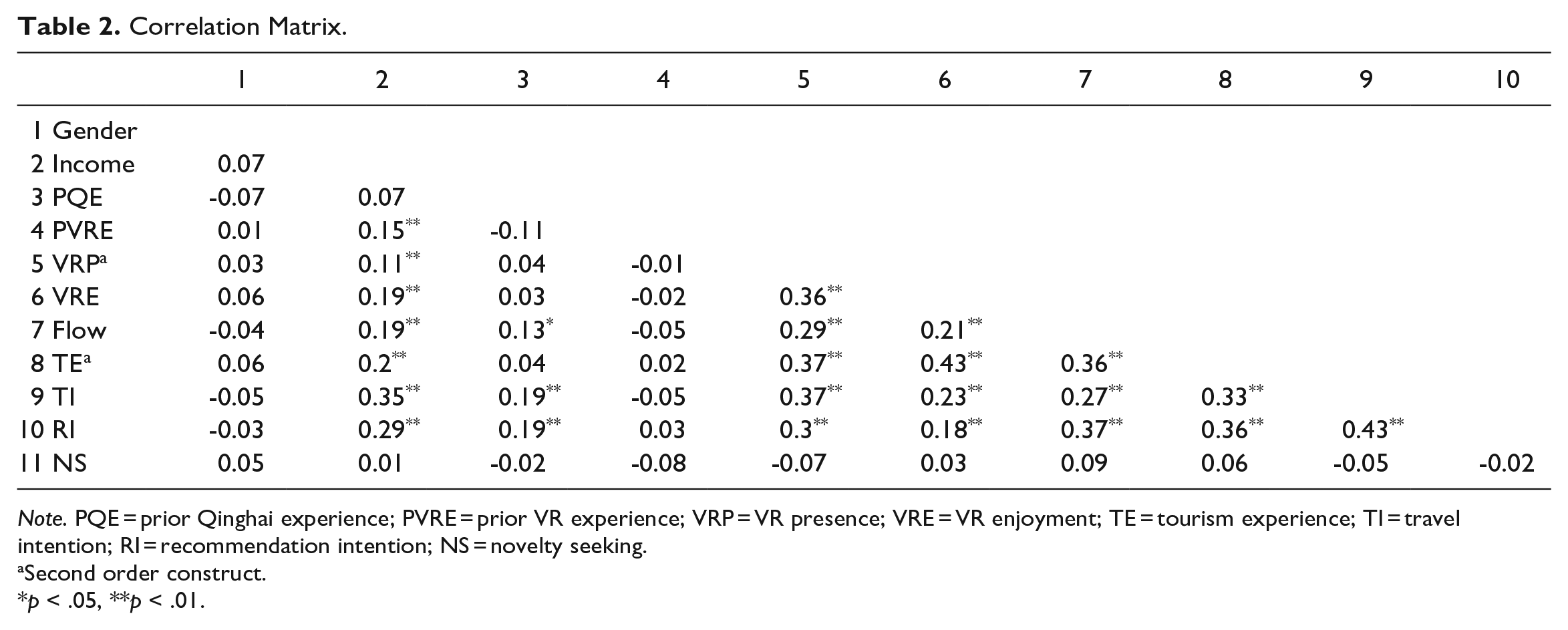
Note. PQE = prior Qinghai experience; PVRE = prior VR experience; VRP = VR presence; VRE = VR enjoyment; TE = tourism experience; TI = travel intention; RI = recommendation intention; NS = novelty seeking.
Second order construct.
p < .05, **p < .01.
Most researchers agree that common method variance (CMV) is a potential problem in behavioral research. Accordingly, precautions were taken to address CMV (Podsakoff et al., 2003). Harman’s single-factor test and correlation matrix were used to assess CMV severity. The results of Harman’s single-factor test revealed that a factor had less than 50% (23.3%) of its variance. Additionally, all values in Table 2 were below the 0.9 cut-off value as suggested by Park and Tussyadiah (2016). Thus, CMV was not an issue in this study.
Hypotheses Tests
Standardized path coefficients provided evidence of the quality of the inner model, and their significance was assessed using resampling procedures (Hair et al., 2012). The results showed that the relationship between VR presence and flow (β = 0.25, t value = 4.90, p < .001) was significantly positive, supporting H1. However, VR enjoyment was not significantly related with flow (β = 0.08, t value = 1.55, p > .05); therefore, H2 was not supported. In addition, the positive direct effects of VR presence (β = 0.19, t value = 3.35, p < .001) and VR enjoyment (β = 0.28, t value = 4.59, p < .001) on tourism experience were significant, supporting H3 and H4. The relationship between flow and tourism experience (β = 0.23, t value = 4.11, p < .001) was significantly positive, indicating that H5 was supported. Tourism experience also had a positive effect on travel intention (β = 0.28, t value = 5.74, p < .001) and recommendation intention (β = 0.33, t value = 5.84, p < .001), supporting H6 and H7.
Statistical interaction is another term used for moderation (Hayes, 2018). The interaction term (PRE*NS) was not significant at β = 0.10, t = 1.70, p > .05; thus, H8 was not supported. Although VR enjoyment had no significant effect on flow (β = 0.08, t = 1.55, p > .05), the interaction term was significant at β = 0.31, t = 6.39, p < .001; therefore, H9 was supported. Flow was regressed onto covariates (gender, income, prior Qinghai and VR experiences), VR enjoyment, novelty seeking, and the interaction term (EN*NS). The Johnson-Neyman (J-N) technique was used to identify regions in the range of novelty seeking where the effect of VR enjoyment on flow was either significant or insignificant. Figure 1 shows that when the value range of novelty seeking is outside [5.32, 5.84], the simple slope p < .05 demonstrates a significant positive association between VR enjoyment and flow; however, if the value range of novelty seeking is within this region, this relationship is not significant. Accordingly, when novelty seeking is above 5.84, greater VR enjoyment is perceived and a greater flow state is achieved. When novelty seeking is below 5.32, higher VR enjoyment is perceived, but a lesser flow state is experienced. This may be attributed to low novelty seekers possibly focusing more on high expectations of enjoyment, which leads to a lesser flow state. The findings indicated that novelty seeking moderates the relationship between VR enjoyment and flow, in terms of higher novelty seeking. This indicates a stronger association between VR enjoyment and flow.
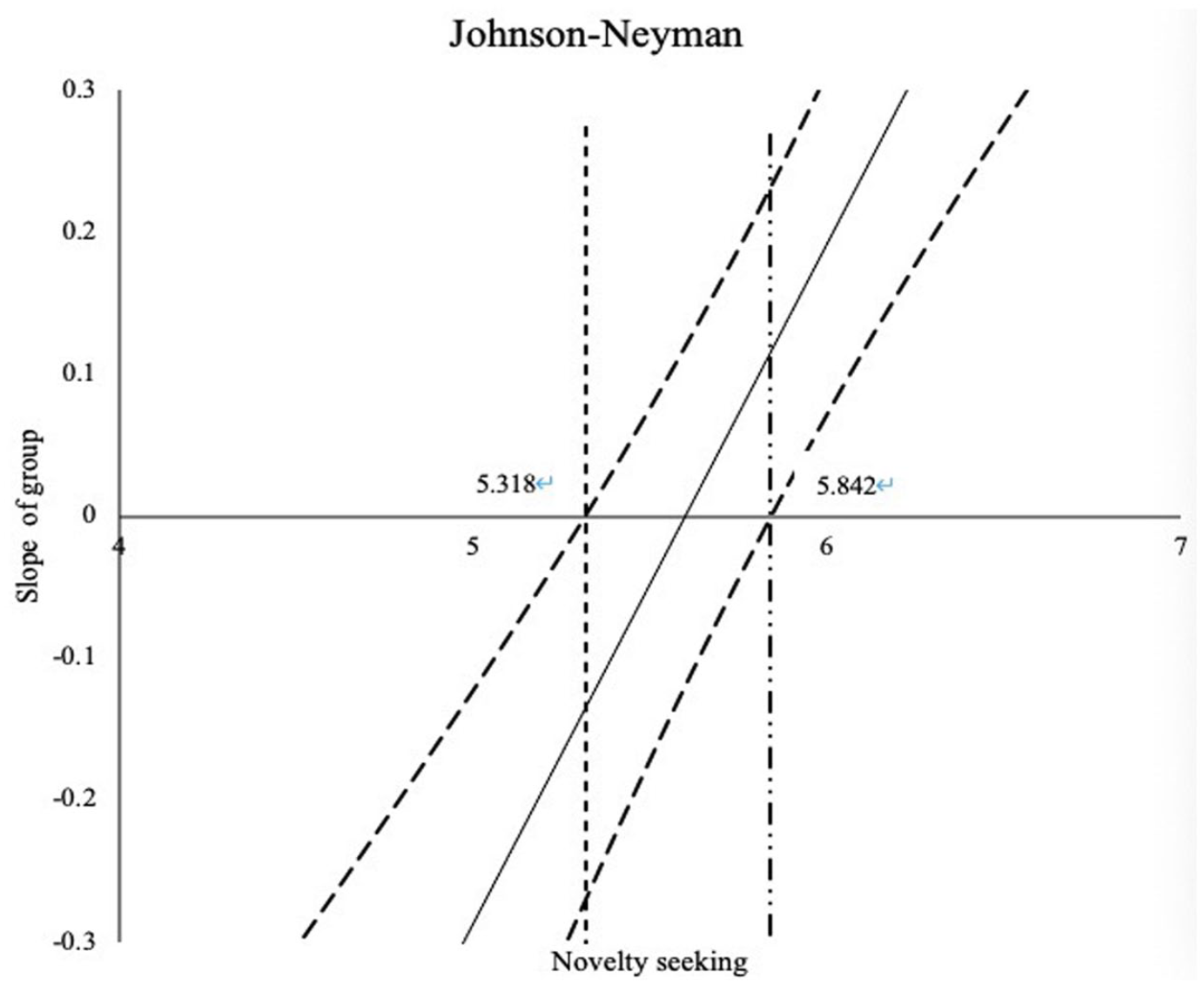
Significant and Insignificant Regions in the Range of Novelty Seeking.
A conservative approach using a standardized root mean square residual (SRMR) value of less than 0.08 was used to indicate a good model fit for PLS-SEM (Hair et al., 2017). The results in Figure 2 indicate a good model fit with an SRMR value of 0.05 and a Gof value of 0.42. Each of the endogenous variables has ample variance explained as R2 for flow (27.3%), tourism experience (28.6%), travel intention (23.7%), and recommendation intention (21.4%). All values of Q2 were positive and higher than 0, indicating that the model has predictive relevance to the exogenous construct (Hair et al., 2017).

Structural Results.
Conclusion and Discussion
Imagining and combining technological capabilities to facilitate experiences is a key success factor in experience innovation, regardless of the industry (Prahalad & Ramaswamy, 2003). Given the introduction of VR technology in tourism, research on VR has been conducted to verify its effects on tourists’ reactions (Lee et al., 2020; Shen et al., 2021). This study examined the role of VR technology on the formation of flow, tourism experience and behavioral intentions during the pre-travel stage. Consistent with the existing literature (Bastiaansen et al., 2022; Han, 2019; Lee & Kim, 2021), the results indicated that VR has a positive effect on tourism experience, and is a highly promising tool in the pre-travel experience design and optimization process. Resulting from VR presence, the flow state and tourism experience were found to reinforce the generation of travel and recommendation intentions.
VR presence and VR enjoyment confirm the positive value of VR as a utilitarian and hedonic experience. The obvious feature when first using VR is presence. This immersion experience helps people immediately concentrate their attention on the activity and provides them with an optimal experience; therefore, VR presence has a positive direct effect on flow. Under ordinary conditions, flow is positively influenced by hedonic and utilitarian features. Although VR is enjoyable by itself, our results indicate a non-significant effect of VR enjoyment on flow, even though the participants had high novelty seeking scores. This can be attributed to the student sample. The relationship between VR enjoyment and flow is moderated by novelty seeking, and young students are generally novelty seekers. They are more likely to be influenced by novelty because their intrinsic motivations drive them to search for novel stimuli during the experience process. During the pre-travel stage, the joy of using new technology-based products (VR) to experience a destination makes them excited and less likely to engage in a flow state.
Novelty seeking is usually directly associated with behavioral intentions and decision making regarding a real destination. However, this study verified that novelty seeking has a remarkable influence on the virtual environment by moderating the relationship between VR enjoyment and flow. This has a significant effect on the tourism experience and ultimately impacts individuals’ decision making. As an intrinsic motivation, novelty seeking helps participants focus on novel stimuli when they first experience the destination through VR. However, as time passed, the participants became more absorbed in the environment or scenes than in the VR technology. Fascinating scenery and distinguishing culture help people enjoy the present and lead them to a flow state. Therefore, this interaction (VRE* NS) was significant. As mentioned in Bideci and Albayrak (2018), individuals from the younger generation expect more hedonic, personalized, interactive, and destination-related experiences. From a novelty seeking perspective, the participants' initial hedonism slowly declines over time. Low-quality content (repetitive content) and poor-quality devices (pixels per inch) may provide informants with less interactive and non-personalized experiences. This may decrease their immersion in the virtual environment and negatively affect their flow state so that the interaction effect (VRP* NS) is not significant. This study demonstrated that the moderating effects of novelty seeking can enhance the impacts of VR enjoyment on flow. It elaborated the entire influence process under boundary conditions in a virtual environment during the pre-travel stage.
Tourism experience, which includes education, esthetics, entertainment, and escapism experiences, positively affects behavioral intentions. Thus, the results of this study are consistent with those of Hosany and Witham (2010), who found that dimensions of entertainment and escapism were the most important components of tourism experience. An S-O-R model was tested to predict potential tourists’ behaviors after the VR tourism experience. It is highly effective in explaining the relationships among the stimuli, processes, and responses (Jani & Han, 2015). VR presence should be treated as a stimulus, consistent with Huang and colleagues (2012) and Jung and colleagues (2016). The degree of immersion in a VR environment leads to flow state and tourism experience.
Implications
This study provides several theoretical contributions to the existing literature. First, it extends the literature on the influences and consequences of VR. VR technology has an impact on tourism experience and behavioral intentions. This study contributes to the literature on tourism experience by investigating the impact of VR on tourism experience and behavioral intentions during the pre-travel stage. This sets it apart from prior studies.
Second, this study enriches the current literature by exploring the moderating role of novelty seeking during the pre-travel stage in the context of VR tourism. It also provides empirical groundwork for further studies. Although prior studies have identified the relationships among novelty seeking, flow, and behavioral intentions in decision-making (Blomstervik & Olsen, 2022; Chang & Lu, 2018; Chen & Yoon, 2018; Chen et al., 2020; Mun et al., 2018; Nguyen et al., 2020), few studies have investigated the moderating role of novelty seeking during the pre-travel stage in the VR tourism context. The hedonic perspective of VR is remarkable in the moderating effect of novelty seeking. Therefore, novelty seeking has a moderating effect on travelers' reactions to different situations. It is particularly important in the choice of destinations and decision-making. Given that tourists are commonly driven to seek new experiences during their trip (Chang et al., 2006; Weaver et al., 2009), the results exemplify the arguments by Li and Chen (2019), who suggested that intrinsic motivation has a moderating effect on reactions to different situations.
Third, this study empirically verifies that tourism experience is an important predictor of behavioral intentions. Similar to Lagiewski and Kesgin (2017), this study confirms that exposure to digitally enabled experiences increases real visits. The findings of this study can increase knowledge on the positive effects of tourism experience and behavioral intentions during the pre-travel stage.
Additionally, this study provides practical implications for tourism marketers and DMOs. Creating meaningful tourism experiences is a key factor in tourism marketing and customer retention (Chen et al., 2020). VR technology allows users to have a realistic tourism experience at their desired location (Lee & Kim, 2021). It has become a popular technology that offers an interactive environment to its users. The application of VR technology allows tourism service providers to leverage the full capabilities of the technology to provide services to customers. Therefore, tourism marketers and DMOs should explore the important technological factors that influence the pre-travel tourism experience. Consumers can experience attractions or destinations prior to their physical visits (Lee & Kim, 2021; Tussyadiah et al., 2018). This will stimulate behavioral intentions and provide a competitive way to promote destinations, eliminate challenges, and explore more opportunities in the tourism industry.
Second, this study used an online VR video platform using Google Cardboard. However, poor-quality devices and low-quality content may decrease consumers’ immersion in VR. Therefore, to meet such market demands for enhanced experiences, practitioners should pay more attention to the quality of VR devices and content. Accordingly, they must offer technology-driven, hedonism-oriented, and immersive personalized experiences.
Finally, practitioners can benefit from marketing segmentation with novelty seeking consumers. In the retail industry, consumers’ predisposition to try new products, services, and ideas depends on their variety-seeking behavioral traits (Khare et al., 2010). This study also confirms that novelty seeking is a significant motivation related to the desire for new experiences and trying new products (Chang & Lu, 2018; Chark et al., 2020; Chen & Yoon, 2018; Khare et al. 2010; Kim & Kim, 2015). Therefore, practitioners should make full use of new technology to attract travelers and pay close attention to their experience duration during the pre-travel stage. Apart from the use of new technologies, practitioners should draw consumers’ attention to their unique tourism-related products and services, such as fascinating scenery and distinguished culture. Accordingly, new travel attractions involving beautiful scenery, local crafts and handiwork, local cuisines, and new foods should be developed and shown. Enjoyment of colorful content during the pre-travel stage can increase tourists’ knowledge about places, people, and things, and enhance the opportunity to meet people from different ethnic backgrounds. Providing targeted travelers with a good grasp of the destination information can intrinsically arouse their travel intentions and positive word-of- mouth.
Limitations and Directions for Future Research
This study has several limitations that provide areas for future research. First, it was conducted using a sample of university students from China; therefore, the results may have limited generalizability. It would be interesting to replicate these findings with different samples, particularly prospective international travelers with different cultural backgrounds. Future studies may need to apply this model to other cultures or countries with cultural differences.
Second, the quality of the devices or VR content may not always satisfy users. VR technology and media richness support can help promote the tourism industry (Lee, 2022). Future studies may need to improve content quality using superior VR applications, such as MR, AR, and other advanced technologies. Tourism businesses and destinations can take full advantage of these technologies to provide attractive content with high-quality memorable experiences. Furthermore, to productively utilize innovative technology, more research is needed to explore its effects, particularly the possible negative effects of VR on the tourism industry. Ultimately, VR technology will surely experience great progress and changes in the future.
Footnotes
Declaration of Conflicting Interests
The authors declared no potential conflicts of interest with respect to the research, authorship, and/or publication of this article.
Funding
The authors received no financial support for the research, authorship, and/or publication of this article.
