






Abstract
This conceptual paper examines the interplay between Porter’s Diamond, the role of government, and varying political ideologies on automated technology regulation in the global hospitality industry. The way in which these factors influence a global organization’s ability to achieve competitive advantage through the use of technology are examined. Specifically, mercantilist, liberal, social democratic, and communist ideologies are explored in relation to how they support or dissuade regulation, and their respective and collective impacts on competition. Additionally, the sources of government regulation, including global, bloc, country-level, and sub-country levels are discussed in relation to automated technology regulations. Ultimately, this study offers suggestions for competition as a result of existing and potential automated technology regulations for the hospitality industry, and suggests areas of study and questions for further consideration.
Keywords
Highlights
Automation technologies (ATs) will greatly influence the competitiveness of the hospitality industry.
The prevailing institutionalized political ideologies in various markets, and conflicting and inconsistent policies across governmental levels, will influence the regulation of ATs for various hospitality entities.
Global firms must reconcile area specific regulations that will influence how ATs are implemented and executed with consumer expectations of AT performance to create a competitive advantage.
Introduction
Automation technologies (ATs) are increasingly being incorporated into hospitality operations in myriad ways. From contactless self-checkin kiosks to AI-enabled voice activated assistants and room sanitizing robots, to booking management systems (Shi et al., 2021), the hospitality industry is subject to AI-driven transformation (Van Esch et al., 2022). These technologies are used to create unique experiences, to surprise and delight guests, and to create a competitive advantage to individual firms (Shiwen et al., 2022). However, the adoption and implementation of ATs does not occur in a market with a singular cultural ideology (Shiwen et al., 2022), or void of regulation.
Despite the seemingly pervasive implementation of ATs because of labor shortages and social distancing policies due to the Covid-19 pandemic and a call for more touchless accommodations and interfaces (Van Esch et al., 2021), extant literature has examined the effectiveness of these technologies as a competitive advantage with mixed results (see Io & Lee, 2020; Qiu et al., 2020). The added benefits of contactless, on-demand services for guests and short-staffed hotels also come at the potential cost of privacy, hacking, and other issues, particularly for international hospitality organizations. To that end, it is important to understand what governmental regulations might serve to mitigate or promote the use of these technologies.
Robotics and AI scholars have examined concepts of robot regulation in the framework of the existing legal parameters of a given jurisdiction, which largely encompasses liability if things go awry with the AI enabled systems, in addition to the rights and legal status of the robots (Leenes & Lucivero, 2014; Pagallo, 2013). There is presently little consensus on how best to regulate ATs in the global market (Abbott, 2020), and more research on the impacts of government and policies has been called for in the hospitality literature (Mohammed et al., 2015). While some recent legal scholars have noted the benefits of using laws and regulations to provide the necessary parameters that enable ATs to enhance human labor capital (Pasquale, 2020), others have noted the complexity that regulating these technologies across governments poses (Abbott, 2020). Given the divergence in thought and approach to ATs and regulation, the impact of the inconsistencies across nations and their subsequent influence on the competitiveness of the hospitality enterprises remains underexplored.
While allowing for purely market forces to determine what is available may prove too volatile, those who would support this tactic also assume that regulations permit political leaders to “attentively pick the gifts of the evil deity” (Palmerini et al., 2016, p. 80). The rapid incorporation of such technologies into the workplace has instigated a concern with the legal issues of the new technologies and their regulation (Buiten, 2019; Chatterjee, 2020; Smuha, 2021). Recently—and even preceding the COVID-19 pandemic—AT has become increasingly visible in nearly all aspects of the hospitality, travel, and tourism related industries (S. Ivanov et al., 2017). Such technologies are used in hotels, restaurants, events, airlines, cruise lines, and other components of the industry, in both customer- (Arici et al., 2023; Lee, 2016; Oh et al., 2016) and employee-facing capacities (Shiwen et al., 2022). While the increased use of such technologies in industry is inevitable, their incorporation requires a great deal of consideration regarding the costs and benefits of the adoption of technologies, including the cost of human labor, the initial investments to pay for a changeover, and updating costs (Dogru et al., 2023; S. Ivanov & Webster, 2017; Li & Singal, 2022).
Accordingly, the use of ATs may be viewed as a competitive necessity or advantage for many hospitality firms (S. Ivanov, 2019). Porter (1990) proposed a four-pronged model (or diamond) that suggests four determinants of competitive advantage for an industry or segment of an industry, in a nation or region: (1) firm strategy, structure and rivalry; (2) demand conditions; (3) factor conditions; and (4) related supporting industries. The role of government and an element of chance have also been suggested additions to complete the diamond, as regulations and intervention by governmental authorities and unforeseen events (e.g., a pandemic) can greatly influence competition within industries.
Thus, the purpose of this conceptual paper is to illustrate how political philosophies, levels of government, and regulation influence international competitiveness, creating an ecosystem in which hospitality enterprises function. This study begins with an examination of Porter’s Diamond. It then highlights the role of government and its influence on competition with the support of the model. Next, this paper explores critical political philosophies and how these various ideologies influence regulations. An overview of mercantilist, liberal, social democratic, and communist perspectives and their perspectives upon regulation are discussed, followed by a review of the sources of government regulation, and AT regulation. Finally, suggestions for competition resulting from existing and potential AT regulations for the hospitality industry are provided.
Theoretical Support
Porter’s Diamond and its Uses
A critical organizational framework used in business to understand competition of countries and industries is Porter’s Diamond (Porter, 1990). The model itself is used in business to understand market competition (Apriani et al., 2022; Tsai et al., 2021). Porter (1990) modeled the conditions of industries to identify competitive strategies to be adopted and subsequently create advantage and progress. This model led to the creation of a framework applicable to international markets and competition (Dunning, 1993; Rugman & Verbeke, 1993).
The original model was comprised of four elements that influence competition within industries. The first is firm strategy, structure, and rivalry, and includes the forces that regulate firm existence, in addition to their internal competitors or rivals. The second, the demand conditions, encompasses the internal demand for specific goods or services in a market. Next are factor conditions, comprised of the factors of production, including the requisite labor force and infrastructure. Finally, there are the related supporting industries, which include the supply side of the equation and the international standards for competition in the market (Porter, 1990). More recently, the roles of government and chance were added as factors that influence competition within industries. Several hospitality studies have subsequently incorporated the use of Porter’s Diamond to provide theoretical support for the competitive advantages of nations or firms (Estevão et al., 2018; Fortes et al., 2018; Nunes et al., 2018).
Notably, Porter’s Diamond allows organizations to create strategies by recognizing the structures of, and techniques employed by, their competitors. It helps firms identify regional advantages that can be leveraged to create an advantage in larger markets and capture greater market share. For example, government factors and factor conditions were shown to be outcomes of competitiveness across the Portuguese hotel sector (Nunes et al., 2018).
In a competitive global industry such as hospitality, it is vital that firms develop strategies to gain competitive advantage. Thus, Porter’s Diamond model encourages firms to innovate and know the major players, suppliers, and buyers in their competitive set, in addition to staying abreast of trends, lest they fall behind or worse. Additionally, to truly capitalize on the advantages suggested and afforded by the model, it is important to understand the role government plays at the myriad levels at which it operates, to gain and keep an advantage.
Government, Competition, and Porter’s Diamond
Although Porter (1990) made no direct reference in his original diamond to explain the role of government in competitiveness, he made distinct references to the role of government in the text. Porter explains,
Managers are pressing for more government support for particular industries. Among governments, there is a growing tendency to experiment with various policies intended to promote national competitiveness—from efforts to manage exchange rates to new measures to manage trade to policies to relax antitrust—which usually end up only undermining it. (1990, p. 74)
Therefore, although the original diamond failed to make a distinct category to illustrate how chance and government influence the four original considerations, most modern interpretations include these two considerations in the model (Fainshmidt et al., 2016; Tsai et al., 2021).
Table 1 below outlines the major components of the model, illustrating how government may impact each of the components of Porter’s Diamond. For example, government can play a role in terms of influencing the business environment, and subsequently influencing the strategy, the structure, and the rivalry of firms. Government also plays a major role in terms of factor conditions, influencing labor markets, technological implementations, infrastructure, and money supply. In addition, government strongly influences demand, through taxation, subsidies to individuals, and other ways of shaping demand, including mandates. For example, mask mandates during the recent covid pandemic undoubtedly positively impacted mask sales, illustrating that political mandates can increase market demand. Those same mandates served to influence individuals’ comfort with patronizing and working at an organization that was people-facing during a time of uncertainty, thus impacting the labor force of the hospitality industry. Another long-standing example specific to the United States are minimum wage requirements, and the ways in which they differ from state to state. Demand for labor is likely to be greater in U.S. states that have lower minimum wage requirements, and finding skilled labor to fill open positions may prove more challenging for businesses in these states. Ultimately, this also influences the appeal of implementing ATs, demonstrating how government can influence all the related and supporting industries of a particular industry.
Government and Relationship to Competitiveness.

The influence of government upon chance is that government plays a major role in terms of mitigating for all sorts of disasters, whether they are political, economic, or natural in nature. Governmental planning can play a major role in terms of mitigating or helping industry in many different circumstances. For example, as of 2021, the United States has no overarching federal law that specifically protects and ensures data security, privacy, and cybersecurity. However, at the sub-country level, at least 45 individual states and Puerto Rico have implemented cybersecurity laws (National Conference of State Legislatures [NCSL], 2021). In conjunction with some extant federal restrictions, the result is a range of regulations that vary substantially both in jurisdiction and scope across organizations and industries.
The role of government illustrates that government may also have an impact on what seems to be itself, but this is simply the overlapping and sometimes conflicting layers of governance. In effect, there may be instances when global regimes or blocs limit government authority or its influence, like under the North American Free Trade Agreement (NAFTA). NAFTA rules dictated that gasoline with additives that were thought to be carcinogenic could be imported to Canada and sold in the Province of Ontario, despite Ontario democratically arriving at a law forbidding the additives (Soloway, 1999).
In sum, government (shorthand for regulations coming from various levels of authority) will influence all the elements of Porter’s Diamond clearly and directly, while sometimes conflicting with and contradicting other levels of regulation. The nature and logic of governmental influences will be a direct function of the nature and logic of the interventions, a reflection of ideologies.
Political Philosophy and its Impact Upon Regulations
Political economy is a substantial academic field that analyzes the relationships between the economy, the individual, government and policies that is generally thought to have emerged out of the “classical” thinking of Adam Smith and David Ricardo, while conservatives and Marxists later came to become involved in criticisms of these classical thinkers (Mosco, 2009, p. 21). Since political economy is not a new field, and since the political and the economic are closely related, it is a field that is multidisciplinary and difficult to define. While there are many philosophies, philosophers, and theories in political economy (e.g., Freeden et al., 2015; Heywood, 2022; Kymlicka, 2001; O’Neil, 2012; Sargent, 1996; Schwarzmantel, 2008), there are a few schools of thought that are practically applied and have a directly perceptible impact on the regulation of hospitality industry economies and the ways that ATs are regulated in those economies.
The philosophies can be grouped into families with common viewpoints and interpretations of reality with prescriptions for a good society. Some of the ideologies outlined include populism, ecologism, conservatism, fascism, and fundamentalism, but there are ideologies that are more commonplace and influential on policies. Heywood (2022) lists the major philosophies as liberalism, conservatism, socialism, anarchism, nationalism, fascism, populism, feminism, ecologism, multiculturalism, and fundamentalism. Freeden et al. (2015) have a similar list and include some regional ideologies, including Modern African, Latin American, and Islamic ideologies.
There is a subfield of political economy that has concentrated on the impact of political ideas on policies that influence hospitality. For example, Veal (2017) devotes an entire chapter to a discussion of the various political ideologies to illustrate that there are different ways in which the ideologies view the management of resources for hospitality organizations. Webster and Ivanov (2016b), similarly indicate that there are patterns to thinking regarding the relationship between ideologies of political economy and the expectations of policy outcomes, due to the value systems that are embedded in institutions through individuals and political parties. This follows from the works of Webster and Ivanov (2012) and Webster, Ivanov and Illum, 2011) illustrating the impact of the prevailing ideologies of political economy in countries, leading to a particular outcome in terms of policy choices. Using the linkage between the prevailing current ideologies of political economy, Table 2 explains the linkage between each philosophy and how policies will work in ways that will influence the competitiveness of hospitality automation technology products and services, consistent with Webster (2022).
Philosophies and Competitiveness of Hospitality Products.

The logic of a mercantilist political economy is to create a strong economy for the country, usually associated with Friedrich List. List (2013) argued that the country should use regulatory powers to increase the industrial power and capabilities of the country. This philosophical basis suggests policies that would work in ways to include governmental interventions to strengthen the national economy. List (2013)—and others who follow in this thinking—conceives of the economy as an organism that needs to be controlled by the country.
The intention of mercantilist approaches to the regulation of the political economy is to ensure that the economy is strong, largely so that there is an industrial basis upon which the country can successfully wage war. Because of this, hospitality organizations may not be the focal point of many of the policies informed by mercantilist attitudes. However, there would be an expectation that the protectionist policies influenced by a mercantilist mindset would increase the prices of many imports, raising the costs of some factor conditions. There would also be an expectation that there would be interventions to prevent outright foreign ownership of many firms, some increases in costs associated with supporting and related industries, and some impediments upon demand. One such way that mercantilist policies clearly impede growth is by imposing visa restrictions, a scheme ostensibly thought to protect national security while simultaneously reducing demand conditions by limiting the number of possible consumers of the hospitality services at a destination (Webster & Ivanov, 2016a). One historically surprising incident occurred in 1934 (several months after the National Socialist seizure of power in Germany) when hotelier Fritz Gabler spoke at a conference warning that tourism and autarky were “conceptually incompatible,” since he feared that the new regime would discourage inflows of tourists to Germany (Semmens, 2011).
Conversely, the liberal political economy, associated with Adam Smith, places efficiency and economic freedom at the center of the value system. Smith’s (2022) Wealth of Nations was published in 1776 and is considered the major source for conceptualizing free market economies and their relationships with countries. Later adherents to this political philosophy saw governmental interference in the economy as a force distorting and negatively impacting the efficiency and quality of the goods and services produced.
Accordingly, liberals proceed with the intention of unleashing the possibilities of an economy with a minimum of country intervention. With regards to the hospitality industry, liberal approaches would lead to minimal taxation, allowing for only minor distortions in terms of factor conditions, since markets would work in ways to ensure lower costs (including natural resources and labor). Additionally, it would be assumed that related and supporting industries would also have the advantage of benefiting from lower costs, and that there would be a maximization of competition among firms in the market, working in ways to improve the quality of products and lowering costs. Finally, free markets and liberal policies lead to wealthier populations (de Soysa & Vadlamannati, 2023), meaning that there would be growth in market demand, assisted with lower taxes.
The more modern political philosophies are those of social democracy and communism. While both philosophies of political economy are Marxist, they represent a different method to obtain the ideal society. In the early 20th century there was a division between the Mensheviks and the Bolsheviks, with the Mensheviks evolving into social democrats and the Bolsheviks evolving into communists. The social democrats, associated with the thinking of Eduard Bernstein, have generally adhered to an evolutional and legal attainment of socialism (and possibly communism) while communists, associated with the thinking of Lenin, have generally adhered to the use of the seizure of political power to install a socialist political economy as a transition to a communist one. A major commonality is the conceptualization of history as something that should be identified by class struggle, meaning that policies enacted have the intention of directly favoring the working class.
While there are some nuanced differences with regards to the methods of Marxists and attitudes towards markets, there are striking differences between policies. While social democratic thinking allows for the retention of markets, policies are enacted to enable the country to have more power in regulations, ostensibly to give advantages to the working classes. In practice, with regards to the regulation of hospitality, Marxists will often pay a great deal of attention to such amenities, since they may be public amenities that can benefit less-wealthy segments of the population (Veal, 2017).
Historically, when Marxist parties have come to control a country, there are sizable leisure and recreational facilities built to benefit the working classes (Webster et al., 2020). The public investments to enable public provision of education, health, and leisure facilities and many regulations put into place to protect the well-being of the working class has a great deal of impact on factor conditions, specifically capital and labor resources. However, the political philosophies of Marxism also assert influence on other concepts within the Porter’s Diamond model, including rules with regards to competition, the regulation of related and supporting industries, and a manipulation of demand by subsidizing and creating public alternatives to private enterprises. One major factor in the Porter model is that the role of government is large, creating various regulations (as is the case in the mercantilist approach) but with an intention that is different: to foster class consciousness and create opportunities for the working class. So, the intention of economic policy is the promotion of a particular social class that will (in the minds of the adherents of the ideology) lead to a deepening and solidification of socialism.
Political philosophies, ideas, and ideologies are belief systems that have consequences. For example, there is evidence that political ideology shapes the nature and logic of agencies set up by governments (Bertelli, 2006; Ennser-Jedenastik, 2016; Esping-Andersen, 1989). There is also ample evidence that the ideologies that guide political party platforms also influence policy outputs (Budge & Hofferbert, 1990; Hofferbert & Budge, 1992). Regarding hospitality policies, there is also evidence that national tourism organizations are influenced by the prevailing ideology of the political economy of the country (Webster et al., 2011), with those countries with prevailing ideological support for mercantilist policies having national tourism organizations that have more regulatory powers than those with more liberal attitudes towards the economy in general. There is a clear expectation that the ideology of elites in political positions of power will lead the elites to enact regulations and laws that will influence the competitiveness of industries, including the regulations with regards to technologies implemented in a hospitality ecosystem.
What is particularly important about ATs and policies is that ATs tend to be viewed very differently through the various lenses of the opposing political philosophies. For example, from a liberal perspective, ATs have the potential for an increase in market efficiency, increasing production and cutting labor costs. This may be beneficial for a hospitality sector that is experiencing labor shortage issues. However, this stands in contrast to the concerns that Marxist philosophies espouse, (whether social democratic or communist) regarding this issue, since Marxist philosophies favor the working class over the ownership class, and ATs may serve as a replacement for human labor. As such, there is an expectation that Marxist predilections for the protection of human workers, particularly in an industry that relies so heavily on human-to-human interaction, should work in ways to regulate such ATs to limit their utilization in the economy. In terms of a mercantilist perspective, it is unclear if there should be a specific concern with productivity gains from ATs over human capital, unless such automation poses a threat to national security. This begs the questions of the specific implications for the incorporation of such technologies in the hospitality industry, where hotels may have locations with AT products and services in areas with differing types of regulations. For an industry that leverages quality offerings by providing consistent product and service offerings regardless of location (Kandampully et al., 2011), political philosophy and varied regulations may make that a challenging endeavor.
Sources of Regulation
Regulations are a construct that can be implemented in many ways and at different levels. Table 3 illustrates the levels of governance and examples of such regulations at that level. At the highest level, regimes can play a role in regulating economies. Regimes can be defined as “principles, norms, rules, and decision-making procedures around which actor expectations converge in a given area of international relations” (Krasner, 1982, p. 1). Such regimes need not be formal and may merely be an evolved understanding or custom for how behaviors should be treated. For example, while there was no intentional development of a policy of “live and let live” by German and Allied forces during World War One, such a cooperative arrangement developed in the practice of trench warfare, saving the lives of people in both trenches (Axelrod, 1984). With regards to common ways in which this impacts industry and the world today, there are institutions such as the World Trade Organization (WTO) that creates the rules and guidelines for international trade. There are other global regimes that will influence regulations, including the International Monetary Fund (IMF), the World Bank, and other major global organizations that will set the standards for such interactions, including finance and banking.
Levels of Government and Regulation.

There are some regional cooperative arrangements available, the best known being the European Union (EU). However, there are several other regional blocs, such as the United States-Mexico-Canada Agreement (USMCA) (in force since 2020), the successor of the North American Free Trade Agreement (NAFTA), the cooperative agreement between the United States, Mexico, and Canada. There are also several other agreements that are less developed and influential as the EU, including the Association of Southeast Asian Nations, the African Union, the Union of South American Nations. There was also an attempt at a much more ambitious project, the Trans-Pacific Partnership Agreement, although it was not particularly successful. The EU is the most advanced example of integration, having moved from a free trade area to a customs union, a common market to an economic union, while having some indication of moving to a full political union. As noted by Webster and Ivanov (2015), these blocs may have an increasing influence upon policies that influence hospitality and ATs, including the possibility of future shared currencies such as as the amero for the United States, Canada, and Mexico (Grubel, 2000).
Country-level and sub-country levels of governance also have regulatory powers. Countries, most notably, can pass and enforce laws; however, while sub-country governing bodies may have the ability to pass and enforce laws, there are complications caused by dissonance with various levels of law. For example, in the U.S. Federal system, the Federal Government regulators consider marijuana illegal, although there are several states that have legalized the use of marijuana for medicinal and recreational uses (Nickles, 2015). Also, there may be a dissonance with various other levels of government such as local and other municipalities that can create regulations of all sorts that would influence (largely) factor conditions and demand conditions. For example, during the recent COVID-19 pandemic, it would be possible to live in a state in the United States in which there were few regulations with regards to masks and social distancing, while a county or municipality could have substantial regulations on businesses, limiting their ability to take part in commerce with customers, a conflict common in federal arrangements (Lecours et al., 2021).
AT Regulation
Regulation is legally referred to as a governing body intervening into the economy by making and applying legal rules (Morgan & Yeung, 2007). Regarding ATs, it is important to consider how regulation exists (or does not) such that all liability, product safety (e.g., cyber security), customer data protection and privacy, labor laws, intellectual property, legal personhood, and even tax and insurance implications, are addressed (Petit, 2017). One of the myriad challenges noted regarding AT regulation is that regulation does not exist in a silo, and the impact of regulating technology in one industry for the betterment of that field, may result in a spillover into another field that yields a negative impact on that industry (Petit, 2017).
Through the lens of various types of governments and political ideologies, the issues of AT regulation are manifold. To start, there are complexities across international borders, including varied types of governments and regimes, and disparate belief systems that will become entrenched in specific bureaucracies within countries, let alone across them. A recent paper on the global perspective of AI governance and ethics highlights the variance in regulations at the global level, and across the United States, China, the EU, the United Kingdom, India, Germany, Austria, and Hong Kong (Daly et al., 2019). At the global level, organizations like the Organisation for Economic Co-Operation and Development (OECD) have proposed AI ethics guidelines to the 38 members of the international organization, in addition to non-member countries that include Brazil, Colombia, Peru, and Romania (Daly et al., 2019). The G20 (2019), which includes China and Russia, have largely agreed to adhere to the recommendations of regulations laid out by the OECD, but it has also noted that they are non-binding regulations. While the non-binding nature of the guidelines may be ignored, there may be an international informal recognition of the standards set by the OECD, since OECD standards will be applicable to many of the major economies in the world.
To highlight the global disparity across regulatory agreements, the United States was subject to five legal standards governing the use of AI technologies, China espoused four guiding principles, the EU was governed by the General Data Protection Regulation (GDPR) legislation, Hong Kong espoused three standards, Australia was subject to eight regulations, and India espoused no ethical framework for consideration (Daly et al., 2019). Overwhelmingly, there is an emphasis placed on trustworthiness, reliability, and the robustness of the AI systems such that they foster innovation without infringing on human rights and liberties, privacy, and values. However, the principles set forth by the initiatives proposed across G20 nations are not enforceable elsewhere. Therefore, the implications for a global industry—like hospitality—are yet to be realized.
Regulating ATs in Hospitality in the Future
As there is a paucity of scholarly and even legal literature on the regulation of ATs specific to the hospitality industry, this section proposes future areas of research and inquiry for the trillion-dollar global industry (Statista, 2022). When considering global firms like Hilton, Starwood, and other global hospitality enterprises, it is important to examine how the use of AT will be regulated such that it can (or cannot) help the firm achieve competitive advantage both locally and globally. To consider regulatory implications, there are several lenses through which a hospitality organization must examine courses of action to achieve competitive advantage (Figure 1).
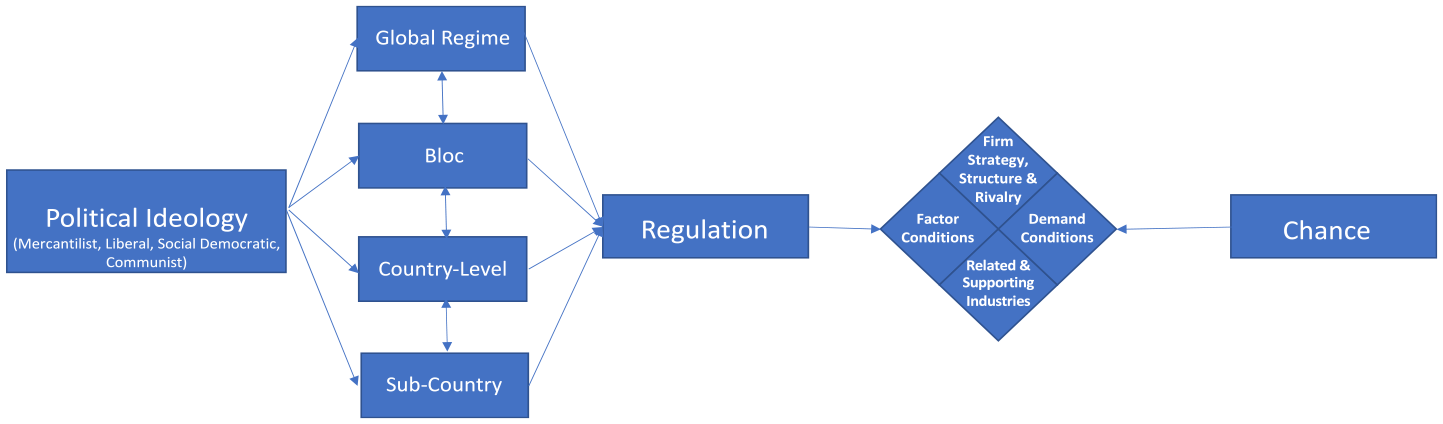
Ideologies and Institutions’ Influence on Porter’s Diamond.
Figure 1 illustrates how Porter’s (1990) original vision of the role of government and regulation is somewhat superficial. It ignores the ideological basis of policies and the institutional bodies (“government”) that produce policies and regulations. Figure 1 shows that ideology shapes the goals and values of decision-makers, and that institutions channel and implement policies that lead to regulations. The levels of institutions that create policies compete against each other and exert different influences based on their constituencies. For example, country-level and sub-country organizations will have constituencies (some of whom are voters) that will have concerns surrounding taxation levels, employment, and living standards. Those institutions will more likely be influenced by Marxist and mercantilist ideals, since employment, taxation, and national security issues are issues that constituencies care about. On the other hand, liberal values will permeate and thrive in institutions that are concerned with the efficiencies of markets. Accordingly, it is likely that different ideologies find receptive environments at different levels of institutional influence. Thus, ideology— and the institutions through which ideological ideas pass—matter.
The first major consideration is the prevailing and institutionalized political ideologies in various markets. Enterprises must consider the local regulations, and international businesses may have to adjust to different markets due to the nature and logic of the regulations in which an enterprise operates. For example, McDonalds exists in myriad countries globally. While its headquarters utilize a set of guidelines to run the global and local operations, it must be sensitive to different regulations across the markets in which its operations are run (Chan & Wan, 2012). In a sense, multinational enterprises (most specifically lodging chains) will not only have to make adaptations in marketing (van Mesdag, 2000), but also make the same sorts of adaptations for regulations with regards to ATs to conform with the regulatory authorities at different levels in specific markets and destinations.
Additionally, it is important to consider how ideologies of regulation condition expectations of customers and influence market operations. One recent study found significant differences in tourists’ willingness to use AI based on either a conservative or a liberal political ideology (van Esch et al., 2022). These findings provide advantageous information to determine the likelihood that AI technology will be used by guests based on the valuable demographic information of clientele of hospitality organizations. While van Esch et al. (2022) offered the lens of the political ideology of the guest, equally important to consider—specifically regarding regulation of ATs—is the political ideology of the area in which the hospitality organization is located. Research shows that ideologies influence customer expectations (Webster et al., 2020). In this case, the market forces are somewhat shaped by the ideologies of consumers, and these ideologies are also conditioned by the environments in which consumers develop their expectations and consumption patterns.
Most interestingly, the intention of policies at various levels may conflict. For example, a bloc—such as the EU—may have considerations for the entire bloc. The EU will then impose guidelines that will be applicable to the entire bloc, suggesting liberal policies to promote the fluidity of labor and finance within the bloc. These regulations will limit the abilities of member countries to have policies that would specifically benefit a particular country, as per mercantilist policies. For example, while the EU may not outright favor a particular member country, member countries may have governments that work in ways that favor the local economy. It is conceivable that specific national legislation (e.g., the Bundestag) could stipulate that a particular ministry purchase a robot made in Germany, if some national security reasons can be imagined for doing so. While EU directives would not be able to favor one particular market within the EU, mercantilist policies could still co-exist under a liberal umbrella, in some specialized situations. So, different layers of governance may not only clash with regards to the implementation of policy, but also start out at very different starting points: one liberal in nature and one mercantilist in nature.
Countries have different concerns than blocs and are often strongly influenced by nationalism and national interest. Indeed, the purchase of the German industrial robot firm Kuka by a Chinese appliance manufacturer was something the German government had to consider on national interest grounds (“Berlin approves Kuka sale to Midea”, 2016). It is most likely that country-level and sub-country level governmental regulators will be more strongly influenced by mercantilist and Marxist policies, meaning that they are more likely to accept inefficiencies of markets to pursue the political goals of national interest and benefit the working classes. As such, we would expect mercantilist policies to promote the local production of robots (to promote local employment and national security) and Marxist policies to limit the use of robots in employment to safeguard employment for the working class.
Moreover, one must inquire about the source from which the regulation parameters come. Are the regulations imposed from an international body/regime, a bloc, a country-level government, or perhaps a sub-country layer of regulation? Are there multiple regulatory bodies, and do their regulations conflict? Is it fiscally feasible to always adhere to the most stringent guidelines? What are the implications for liability and data privacy if there are not consistencies across entities based on the prevailing regulatory body? How does that impact the local and global competitive advantage of the firm? What are the ethical dilemmas involved in implementing the ATs (S. H. Ivanov & Umbrello, 2021)?
These questions all warrant consideration and investigation over time, and as ATs regulations are imposed and implemented locally and globally. TikTok proves the exemplary case in highlighting the aforementioned issues. To start, the regulations surrounding the use of TikTok can be observed at the bloc, country level, and sub-country levels. The European Commission and European Council banned the use of TikTok for all governmental employees, Latvia (Latvian Public Broadcasting, 2023), Austria (Agence France-Presse (AFP), 2023), Belgium (“Belgium bans TikTok”, 2023b), and Denmark’s Ministry of Defense (“Danish defense ministry bans TikTok”, 2023a) banned its use among their governmental employees, and the U.S. state of Montana banned the use of TikTok for anyone in its borders (“Montana becomes first state to ban TikTok”, 2023). The regulations on TikTok within the borders of Montana are difficult to enforce, in large due to tourism, and may negatively impact decisions of tourists who wish to use the app and visit the U.S. state. Of course, the use of TikTok in Montana may have privacy and security violation implications for residents and businesses.
An example of how this pathway would work is shown in Figure 2. Figure 2 illustrates that the General Data Protection Regulation (GDPR) of the EU seems to start with an ideology of liberalism, since it stresses the protection of the individual and does not seem to have a class element in terms of who it protects, although there is some leeway in terms of law enforcement and national security written into the regulation. As the EU—as a bloc—has determined that such a data protection policy is law in the bloc, there may, in the future, be conflicting country and local concerns that would play a role in terms of its administration. However, the general vein of the law would be strong, and interpreted and enforced relatively equally throughout the bloc.
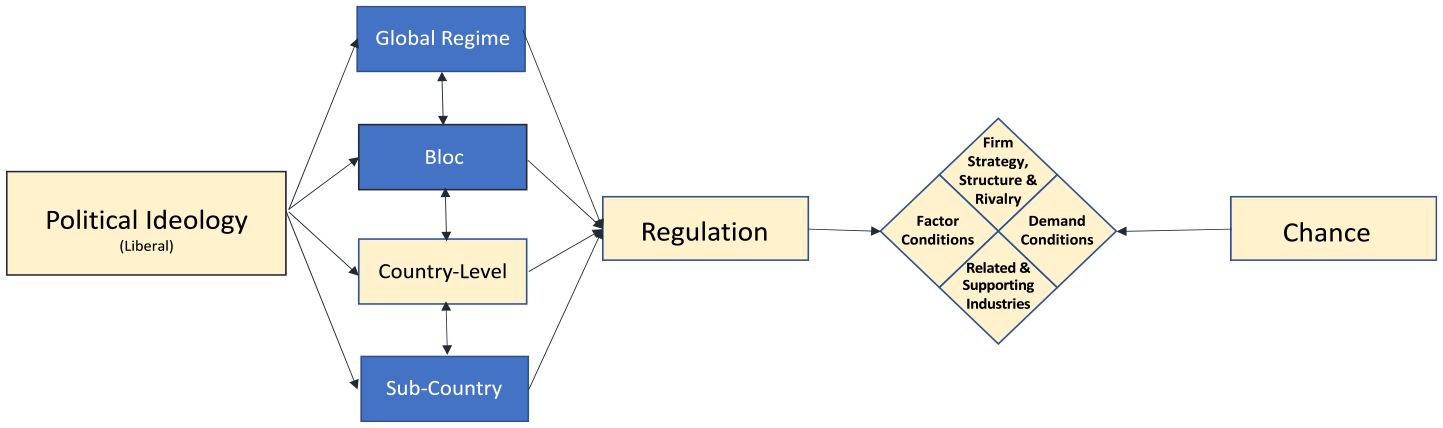
Example of GDPR’s Influence Through Porter’s Diamond on Global Firm Strategy.
In terms of its effects on the competitive environment, it would not, likely, have an impact that would differ from country to country within the EU, although it may make a global firm’s competitiveness different in the EU to elsewhere. The global firm navigating this would have to make a choice regarding accepting the EU’s regulation as a standard that it would impose upon its entire global operations. However, this would be a conscious decision and would also have to take into consideration the competitive position of its operations in non-EU countries and the infrastructure provided in non-EU countries. Thus, the regulation comes from an intention, filters through a regulatory/legal environment, and becomes something that will impact in a positive or negative way upon a country’s hospitality industry. In response, hospitality firms with operations in many countries would have to consider if such a standard would be globally adopted for simplicity and possibly a competitive advantage, or not used as such, since it may impact in a negative way upon its particular firms’ competitiveness in a non-EU market.
The United States’ Junk Fee Prevention Act and Hotel Fees Transparency Act go into effect in July 1, 2024, and will require businesses to display the full price upfront, including fees, to prevent the uptick in surprise charges, and face monetary penalties if failing to comply. “Junk Fee” or “Extra fee” practices have been used in the hotel industry since the late 1990s (Sullivan, 2017). These fees are also known as resort fees, facility fees, destination fees, amenity fees, ancillary resort fees, service fees, and resort charges. These fees can be inclusive of amenities and services such as wi-fi/internet, access to the pool and fitness facilities, parking, shuttle service, bell or concierge service, seasonal activities, business center services, or any other service or amenity that has a direct cost to the hotelier. While only 6% of hotels charge resort fees (AHLA, 2023), resort fees generate upwards of US$3 billion annually for hotels (Sullivan, 2017).
As seen in Figure 3, these liberal Acts are a country-level initiative designed as a consumer protection policy that offers transparency in prices to allow consumers to make the most informed and fiscally responsible choice. The Acts also require businesses to be upfront about whether the fees in question are refundable. Ultimately, the Acts will dictate how additional fees are presented to the customer and included in the bill, either through being built into the initial pricing or by being offered as “a la carte” options for selection. This will naturally influence demand for the properties that provide them in each format in various ways. If built in, the pricing will appear more costly than that of the competitive set. However, if offered a la carte, it will influence how the patron books and which amenities they use at the hotel once there. If a la carte pricing becomes the industry standard for hotels that have multiple amenities, ATs will be leveraged to help with choice provision and purchases.
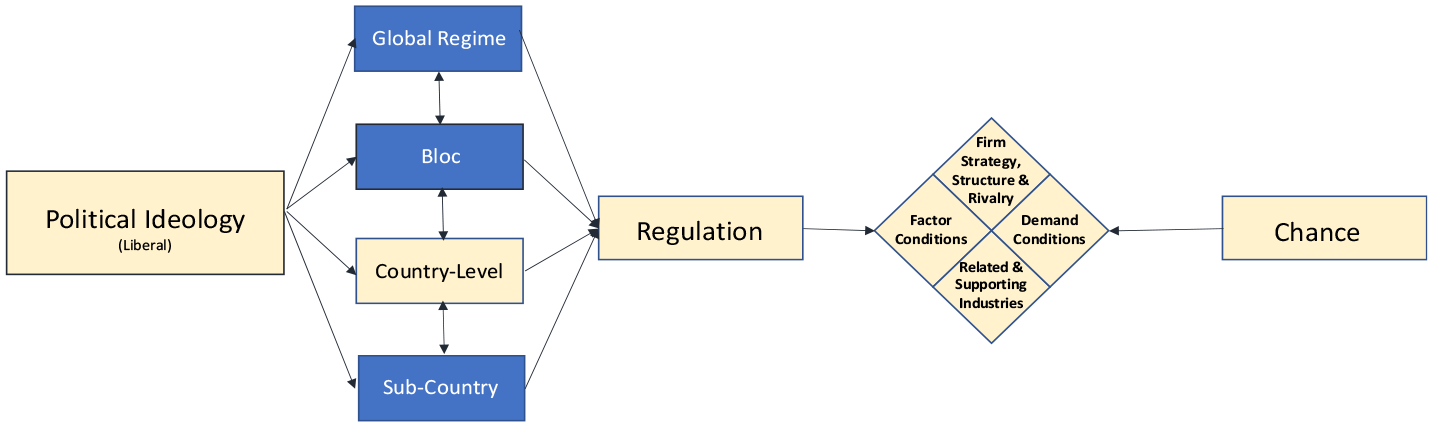
Example of the Junk Fee Prevention Act’s Influence Through Porter’s Diamond on Firm Strategy.
Practical Implications
The most important information this paper affords practitioners is the awareness of where regulations are born, how the political ideology and the level of government influences the formation of those regulations, and, ultimately, how the regulations influence the demand conditions, firm strategy, structure and rivalry, factor conditions and the related supporting industries (Porter, 1990) which their organizations must consider when creating a competitive firm strategy. Understanding the influences behind the regulations can facilitate more informed and more fluid decision-making when it comes to meeting or exceeding the requirements of the proposed regulation. Additionally, as political influences evolve, and as market conditions shift, an understanding of how these changes will influence the organization and its strategic initiative—specifically with regards to AT—is paramount.
In addition to providing the practitioner with a visual understanding of the ways in which political ideologies and levels of political influence impact the competitive strategy, this paper also provides examples of how these forces influence specific policies, and their subsequent influence on regulation and firm strategy. The examples of the General Data Protection Regulation (GDPR) and the Junk Fee Prevention Act are two regulations that hospitality practitioners should use to make strategic decisions when it comes to remaining competitive in their respective sets, and when and how to implement ATs. Another regulation that must be thoughtfully considered is minimum wage. Scanning the competitive set—through the use of human labor and revenue management ATs—and offering wages higher than the competition and the suggested minimum wage, will likely serve to attract and retain more skilled employees.
Given the pervasive labor shortage issues the hospitality industry has experienced (Morosan & Bowen, 2022), identifying ATs that may alleviate these issues by making the brand more attractive through enhanced customer experience applications and more powerful sales tools for front of house staff, and better scheduling programs and assistive technologies for back of house staff, will attract more talent. Ultimately, with all regulations, it is incumbent upon organizational leadership to identify when it is best to implement company policies that simply satisfy the requirements of the existing regulations, and when it is best to supersede them. Porter’s Diamond (Porter, 1990) proves a useful tool to visualize and evaluate the myriad factors that influence these decisions, and enables hospitality leaders to implement the best policies as political ideologies shift and as different levels of government enforce regulations.
Limitations and Future Research
This conceptual paper examined the source of regulations and their impact on ATs in a global hospitality industry context. However, as technology application is universal across industries and locations, an exploration of how ATS impact globally and across multiple industries is a noteworthy topic of future interest. Another area of future exploration, given the myriad geopolitical and international conflicts that exist in 2023, are how these wars and political rifts have led to barriers in the application of technology, specifically ATs. Additionally, it would be beneficial for scholars to examine transition defense psychology, as it is a complex issue. For example, gaining more insight as to how and why China—seen by the West as more conservative and centralized—is more inclusive of ATs and Western science and technology than the West is, with regard to Chinese technology, would be fascinating and enriching. Addressing these gaps in the literature will ultimately provide greater insight into the intricate, complex, and nuanced balance between political systems, cultural disparities, geopolitical climates, and security concerns, and their influence on AT regulation in the hospitality industry and the world.
Conclusion
The hospitality industry will continue to operate in a difficult regulatory ecosystem in which regulations on ATs will have a massive impact on national competitiveness. The role of government, as conceptualized in recent visions of Porter’s Diamond, is not as straightforward and uncomplicated as one small textbox with one word may suggest. Government and its regulations influence every aspect of the Diamond directly and clearly, and itself is influenced by many forces and sources. Regulations are manifold and complicated, consisting of specific explicit regulations and informal expectations and standards, with the nature and logic of the regulations varying and having overlapping and sometimes contradictory terms.
The ideological basis on which policies and regulations are formed may have a profound impact on the competitiveness of hospitality entities across markets. For example, such service industries may be a low priority for countries in which the mercantilist mindset is well established among decision-makers. Thus, decision-makers may be willing to sacrifice the hospitality industry, as per the example of modern North Korea where governmental emphasis is placed on security and control. However, we can expect that many regulations with regards to service automation may be exerted in a way that makes it harder for the hospitality industry to use robots in lieu of human labor, since Marxist ideology dictates that employment for the working class is more critical than efficiency in enterprises. Thus, the intention of policy matters, and a great deal of the intention of policy with regards to service automation, will be molded by the ideology of those who make policies.
The interplay between the different levels from which regulations come, and the intentions of regulations, become a consideration since this can become a Byzantine regulatory structure limiting the possibilities of various operations. The onus is on each firm to recognize these factors at play to leverage AT in a safe and advantageous way that satisfies the myriad factors of Porter’s Diamond, despite significant regulations. Those firms that navigate in the international sphere must consider various levels of regulations and align those regulations with their internal needs and corporate culture. While automated services are needed due to demographic declines in developed countries (Webster, 2021), the feasibility of the increased automation of services and the distortions that governmental regulations inflict on the competitiveness of hospitality, must also be discussed. Future research should investigate how practitioners navigate multiple layers of regulation to ensure cost-effective operations when regulatory frameworks create barriers and limits on what they can do. This study contributes to existing research by illustrating that regulations on ATs come with the baggage of ideology and can be inflicted upon enterprises by various players, hindering or assisting in the competitiveness of the industry.
Footnotes
Declaration of Conflicting Interests
The authors declared no potential conflicts of interest with respect to the research, authorship, and/or publication of this article.
Funding
The authors received no financial support for the research, authorship, and/or publication of this article.
