







Abstract
Loss aversion is a human tendency, which is used to explain the reference price effect. We critically examined the loss aversion account of the reference price effect in accommodation decisions by adopting a mixed-method approach. Physiological reactions to losses were captured by electrodermal activities and trait loss aversion was measured by a behavioral economic task. We tested whether trait loss aversion predicts individuals’ susceptibility to the reference price effect in lodging decisions and whether physiological reactions mediate the effect. We explored the moderating role of travel use history and established a methodological triangulation among the three loss-aversion measures: trait, hotel choice, and physiological. The physiological results gave support to the role of emotions in the reference price effect. Our findings provide valuable insights for managers in addressing asymmetric pricing, particularly highlighting the importance of monitoring customer emotional fluctuations during price presentation and segmenting the market based on travel experience.
Highlights
Trait loss aversion increases the susceptibility to the reference price effect.
Electrodermal activity (EDA) mediates the effect of trait loss aversion on reference price effect.
Hotel experience moderates the loss aversion effect and mediation effect of EDA.
Trait, behavioral, and physiological loss aversions are triangulated.
If we own things, we’re terrified we’ll lose them, if we’ve got nothing we worry it’ll be that way forever.
Introduction
Travelers are susceptible to the reference price effect in their lodging decisions (e.g., Choi & Mattila, 2018; Nicolau, 2011, 2012). When travelers have a hotel in mind, its price will serve as the reference price by which all subsequently encountered hotel prices are evaluated. If the price of the subsequent hotel is higher, the traveler has to decide whether to pay extra for potentially better service (i.e., negative framing), whereas if it is lower, the traveler may consider switching to the cheaper option and save some money (i.e., positive framing). Essentially seeing the same choice set in both situations, a loss-averse traveler is reluctant to incur a monetary loss in the first case. However, the same traveler is more likely to choose the higher-priced option when it is encountered first, since the gain from saving the same amount of money by switching to the lower-priced option cannot make up for the pain of forgoing the superior features offered by the higher-priced option. The asymmetry in responses to the same information framed positively versus negatively is termed the “framing effect” (Kahneman & Tversky, 1979), which has been demonstrated in travelers’ time-of-booking decisions (Rahman, Crouch, & Laing, 2018; Rahman, Crouch, & Levin, 2018).
Our study is motivated by the reference price literature in marketing research (Mazumdar et al., 2005). The reference price literature has consistently found that an unfavorable price comparison has a stronger negative effect on price perception—and thus purchase intention—than the positive effect from a favorable price comparison. When consumers encounter a product or service priced higher than the reference price, they perceive it as a monetary loss, which negatively affects their price perception and purchase intention. However, in a favorable price comparison, when the price is lower than expected, consumers perceive it as a gain, but their perception of this gain is often weaker (see Mazumdar et al., 2005 for a review). Such reference price effect has been explained with the behavioral economic concept of loss aversion (Kahneman & Tversky, 1979) and has been found to vary, depending on the product category and whether the reference price is formed internally or externally (Kalyanaram & Winer, 2022).
While this loss-aversion account is both plausible and prevalent in the literature, we have to be cautious that it is only one possible explanation among many others (Willemsen et al., 2011). For example, consumers’ sensitivity to price differentials diminished as the difference between two prices decreased while larger price differences elicited stronger reactions, which in turn led to asymmetric responses to price increases and decreases (Biswas & Grau, 2008; Levin et al., 2002). Another possibility is an asymmetry in the tendency to accept versus reject an option (Park et al., 2000). After seeing the first hotel option that was characterized by positive attributes, switching to a subsequent alternative was considered a rejection of the original option and required a much more attractive alternative option to justify (Shafir, 1993). Moreover, it has been shown that ownership is a better explanation than loss aversion in the case of asymmetric response (Chatterjee et al., 2013; Dommer & Swaminathan, 2013). Decision makers may feel endowed with the first option encountered; switching to an alternative feels like forgoing their ownership, which boosts the perceived value of the original option.
To pin down this explanation, it is necessary to examine the underlying psychological process of loss aversion when making lodging decisions. Emotions play an important role in decision-making processes. Specifically, “loss aversion represents an affective component of decision making” (Levin et al., 2002, p. 342). This poses a methodological challenge since the literature has been dominated by survey and observational studies, which are not the most ideal for scrutinizing unobservable psychological processes (Viglia & Dolnicar, 2020). These emotional responses may be too subtle and unconscious to the decision makers, making the investigation difficult, if not impossible. For instance, in studying the loss aversion account to the endowment effect, the subtlety of the change in mood was not picked up by self-report measures (Chatterjee et al., 2013).
Thus, we adopted a mixed-method approach by examining electrodermal activities (EDA), a proxy for emotional arousal, to study lodging decisions and uncover its underlying psychological process. We seek to answer whether susceptibility to the reference price effect could be predicted by loss aversion measured using a risky decision task, and whether it could be explained by the physiological responses toward favorable and unfavorable price comparisons. In particular, respondents’ EDA were monitored during hotel decisions. Further, we measured loss aversion using an incentive-compatible behavioral economic task (e.g., Gächter et al., 2022) and examined its power to predict the susceptibility to the reference price effect in lodging decisions. If loss aversion is the driver of the reference-price dependence, the loss aversion measure should predict the extent of reference price effect in hotel decisions. More importantly, we expect loss aversion to exert its effect on hotel decisions by tuning travelers to the price information and thus making the loss-averse travelers to produce a stronger physiological response to the loss-inducing price information, as captured in the EDA data.
Theoretical Background
Reference Price
Reference price effect refers to the observation that purchasing decisions are based on perceived rather than actual prices (Kalyanaram & Winer, 1995). A reference price, an extension of the reference point (Kahneman & Tversky, 1979), influences price perception. In fact, Cheng and Monroe (2013) argued that consumers have a reference price range rather than a single reference point. This reference price range reflects the acceptable range of prices that consumers are willing to consider, or it can be understood as the upper and lower limits of an absolute reference point. Reference prices, studied extensively in marketing (Mazumdar et al., 2005), can be internal or external. Internal reference prices are often viewed as being constructed based on historical prices (Kalyanaram & Little, 1994). More recently, internal reference price has been conceptualized as a more complex construct, from both behavioral and judgmental perspectives, that encompasses multiple factors that are not solely determined by a single historical price (Lowengart, 2002). External reference prices are relevant and available during the purchasing decision (Rajendran & Tellis, 1994), such as prices of competing hotels (Choi & Mattila, 2018). External reference prices are also influenced by the advertised prices of different stores, the manufacturer’s suggested retail price, international reference prices, and other informational cues (Lowengart, 2002). A recent review shows that consumers are often more loss averse in an external reference price than in an internal one (Kalyanaram & Winer, 2022). The order of option presentation can establish external reference prices, with the first encountered option often serving as the reference point (Fisher & Rangel, 2014; Reutskaja et al., 2011; Willemsen et al., 2011).
Product customization also demonstrates reference-dependence in price evaluation (Biswas & Grau, 2008). Consumers often end up with more options when starting with a fully enriched model then subtracting options (downgrading) than when starting with a basic model then adding options (upgrading). For example, pizzas ended up containing more ingredients when starting with a fully loaded pizza then removing ingredients from it than when starting with a basic pizza then adding ingredients to it (Levin et al., 2002). Similar effects occurred in customizing automobiles, computers, and treadmills (Park et al., 2000).
In line with the reference-price literature, the starting point of customization acts as a reference point range. When consumers decide whether to upgrade, they have to sacrifice money for the additional options on top of the starting reference point. As a general observation from both the reference-price and product-customization literature, consumers react more strongly to an observed price above than below the reference price (Kalyanaram & Winer, 1995). Thus, consumers are more likely to refrain from “trading up” when they have to incur a monetary loss above the reference price, in comparison to the opportunity for consumers to make extra purchases with a monetary gain of similar magnitude below the reference price.
Loss Aversion
At the core of the reference price effect is the asymmetric response to favorable versus unfavorable price comparisons, known as loss aversion in prospect theory (Kahneman & Tversky, 1979). In this paper’s epigraph, Murakami (2015) captured the negative feeling of loss depending on a reference point. “If you do not own a particular item, the incremental value of gaining the item is not as great as the loss you would feel if you owned it but then relinquished it” (Levin et al., 2002, p. 336). This contributes to the endowment effect (Kahneman et al., 1990). Experiments have shown that randomly assigned ownership increases the perceived value of items, making forgoing them painful.
Loss aversion is also related to negative bias, the tendency for negative events to be more salient and impactful than positive ones (Rozin & Royzman, 2001). Negative events are more urgent and elicit stronger physiological arousal (Taylor, 1991). We feel pain but not the absence of pain (Schopenhauer, 1844/1995). Thus, it is often found that how people decide depends on whether the same options are described as gains or losses, as illustrated by “framing effect” (Kahneman & Tversky, 1979). Decision makers tend to avoid risk when options are presented in a positive frame than in a negative one. For example, in planning their trips, travelers were more likely to take the safe option (i.e., book early to avoid unavailability later) when it was described positively as some savings than when it was described as some loss from the maximum savings over the uncertain option (i.e., book later to enjoy last-minute deals; Rahman, Crouch, & Laing, 2018, Rahman, Crouch, & Levin, 2018).
Applying to lodging decisions, travelers use the first encountered hotel’s price as a reference (Willemsen et al., 2011). They are more affected by potential losses than equivalent gains (Kahneman & Tversky, 1979), predisposing them towards the status quo (Samuelson & Zeckhauser, 1988). This makes them reluctant to pay extra, as it feels like a loss, outweighing the perceived gain from quality improvement (Biswas & Grau, 2008; Levin et al., 2002; Park et al., 2000). The order of presentation is crucial; encountering the more expensive option first sets a higher reference price, making it more acceptable than switching to a cheaper alternative later (Fisher & Rangel, 2014; Reutskaja et al., 2011). Thus, loss aversion is central to explaining travelers’ reference price effect (Kalyanaram & Winer, 1995): it uniquely predicts that the subjective value function in prospect theory is asymmetric and steeper for losses than gains (Kahneman & Tversky, 1979). Favorable price comparisons are seen as gains, and unfavorable ones as losses, predicting similar asymmetry in physiological responses (Biswas & Grau, 2008; Levin et al., 2002).
Trait Loss Aversion
The natural tendency of loss aversion is ubiquitous and has been demonstrated in a wide range of domains, from trading coffee mugs (Kahneman et al., 1991), purchasing consumer goods (Hardie et al., 1993), deciding work hours (Camerer et al., 1997), to selling condominiums (Genesove & Mayer, 2001). Thus, there appears a general behavioral disposition, stable over time and robust across different situations or decision domains, often referred to as trait loss aversion (e.g., Köbberling & Wakker, 2005). We consider trait loss aversion a domain-general concept of loss aversion that appears to be a general behavioral disposition and should manifest in different specific domains (Gächter et al., 2022). As a trait, it varies among individuals. For example, females (Rau, 2014; Schmidt & Traub, 2002) and older individuals (Klapper et al., 2005) were reported to be more loss-averse. East Asians were less loss-averse in the endowment effect than Westerners (Maddux et al., 2010). People high in conscientiousness were more averse to income loss (Boyce et al., 2016). Loss aversion correlated with individualism, power distance, and masculinity at the country level (Wang et al., 2017). These differences may arise as evolutionary adaptations (Hintze et al., 2015), showing that risk aversion can evolve in small communities. To avoid committing to a particular context, domain-general loss aversion is often measured using risky decision tasks with monetary outcomes (Gächter et al., 2022).
We attempt to examine whether trait loss aversion explains the reference price effect. It has been demonstrated that the loss aversion in specific domains, such as sandwich choices (Karle et al., 2015), the endowment effect of consumer goods (Gächter et al., 2022), and labor market decisions (Fehr & Goette, 2007), increases with the domain-general trait loss aversion. Loss aversion in these decisions is more domain specific. Following the same rationale, loss aversion at the trait level is expected to correlate with the more domain-specific one inferred from their hotel choices. Specifically, travelers with higher trait loss aversion pay more attention to the unfavorable price comparison from the reference price and thus are more susceptible to the reference price effect. Thus, we hypothesize that:
H1: The loss aversion inferred from lodging decisions increases with trait loss aversion.
Individual Differences in Physiological Loss Aversion
Loss aversion may be an inherited biological predisposition, as evidenced by its presence in other primates (Chen et al., 2006). Neuroimaging studies have identified specific brain regions, such as the amygdala, to be associated with loss aversion using EEG (Kokmotou et al., 2017) and fMRI (Tom et al., 2007). The amygdala, linked to the fear response, acts as a brake on engaging in losses (LeDoux, 1998). Lesion studies have shown that patients with amygdala damage were less loss-averse, although they responded to expected values the same way as healthy individuals in risky tasks (De Martino et al., 2010).
Given the mounting evidence of the biological origin of loss aversion, we examine whether loss aversion in lodging decisions can be captured by physiological responses such as EDA. This allows us to directly test the loss-aversion accounts of travelers’ asymmetric price response. The involvement of the amygdala highlights the importance of emotional processing of loss-aversion signals (De Martino et al., 2010; Sokol-Hessner et al., 2013). Further evidence from psychiatric literature has shown that patients with alexithymia, an impairment in identifying emotions, were less susceptible to loss aversion (Bibby & Ferguson, 2011), suggesting a crucial link between emotional process and loss aversion. There are substantial individual differences in trait loss aversion, potentially due to biological hardwiring. Trait loss aversion is associated with variability in functional and structural aspects of the brain, particularly in the amygdala and posterior insula (Canessa et al., 2013). It also correlates with gray-matter volumes in the limbic regions, including the amygdala, thalamus, and striatum. These individual differences may have genetic origins. An imaging genetic study found a polymorphism in the serotonin transporter gene (STin2) to be associated with the amygdala response to loss-oriented risks (Zhong et al., 2012).
Therefore, trait loss aversion likely leaves physiological traces. Loss-averse individuals showed higher EDA responses (Sokol-Hessner et al., 2009). The relationship between EDA and amygdala is well-established. Emotional stimuli triggered both EDA and amygdala responses (Bonnet et al., 2015), and amygdala stimulation increased EDA in epilepsy patients (Inman et al., 2020). Similarly, patients with amygdala lesions showed reduced EDA responses during sympathetic activation tests, and to feedback of reward and punishment (Asahina et al., 2003; Bechara et al., 1999). Taking these findings together, we expect that loss-averse travelers should react more strongly physiologically to unfavorable price comparisons. Thus:
H2: Physiological loss aversion increases with trait loss aversion.
The Mediating Role of Physiological Response
According to the loss aversion account, physiological loss aversion should mediate the relationship between trait loss aversion and behavioral loss aversion, as measured by the reference price effect. Physiological responses like EDA explain individual variations in behavioral loss aversion (Sokol-Hessner et al., 2009). Studies have shown that manipulating factors influencing physiological responses can affect behavioral loss aversion. For example, distraction by sexual stimuli attenuated EDA responses and behavioral loss aversion (Lui & Hsu, 2018). Emotion regulation also weakened physiological responses as measured by EDA (Sokol-Hessner et al., 2009) and fMRI (Sokol-Hessner et al., 2013), resulting in lower loss aversion. These studies suggest that physiological responses precede behavioral loss aversion and demonstrate its mediating role. In this study, we test how individual differences in trait loss aversion affect physiological loss aversion and its behavioral consequences. Thus, we hypothesize that:
H3: Loss aversion in lodging decisions increases with physiological loss aversion.
H4: Physiological response to loss-aversion information mediates the relationship between trait loss aversion and loss aversion in lodging decisions.
The Moderating Role of Hotel Experience
The reference price is found to be attenuated by product knowledge (Kalyanaram & Winer, 2022). The concept is operationalized by travel use history (TUH) in tourism research (Draper et al., 2011), often using the number of non-business trips taken in the previous year (Shinew, 1993). TUH explains how individuals’ psychological interpretations and preferences are shaped by their travel experiences (Hammitt, 1981). For example, experienced travelers relied more on personal experience and less on external information (Draper, 2016), and residents’ TUH shaped their attitudes toward tourism development (Woosnam et al., 2018). By the same token, more experiences with hotel stays may help travelers form price perceptions and evaluate various available options with less reliance on the reference point. Thus, the order of the presentation does not affect their choices regardless of the degree of trait loss aversion. The hypothesis that experience may attenuate the effect of loss aversion has gained support in endowment effect (List, 2003), which is a manifestation of loss aversion (Kahneman et al., 1991; Tversky & Kahneman, 1991). In List’s field experiments conducted in sportscard and collector pin markets, dealers were much more willing to trade their endowments than nondealers, demonstrating that market experience eliminates the endowment effect.
Based on this rationale, we expect a moderating role of TUH. While trait loss aversion is the general disposition that determines the susceptibility to the reference price effect, we further hypothesize that the effect depends on how experienced one is with hotel stays. In particular, the more experience one has, the less their hotel decisions depend on trait loss aversion.
H5a: The relationship between trait loss aversion and loss aversion in lodging decisions is moderated by travel use history. Specifically, this relationship is stronger among travelers with less hotel experience than those with more.
We further examine the moderating role of TUH in the effect of trait loss aversion on physiological responses. Similar to the arguments above, experienced travelers’ physiological reactions to price information should depend less on trait loss aversion. Experience in hotel stays is likely to affect the way travelers encode the values of different options and occur early in the decision process (Willemsen et al., 2011). Thus, TUH is expected to moderate the relationship between trait loss aversion and physiological loss-aversion responses:
H5b: The relationship between trait loss aversion and physiological loss aversion is moderated by travel use history. Specifically, this relationship is stronger among travelers with less hotel experience than those with more.
Figure 1 summarizes the five hypotheses in this study. We seek to establish a methodological triangulation among three different loss-aversion measures: (1) trait level, (2) physiological level, and (3) behavioral level with lodging decisions. This multi-method approach helps pin down the loss-aversion account of travelers’ asymmetric price response.
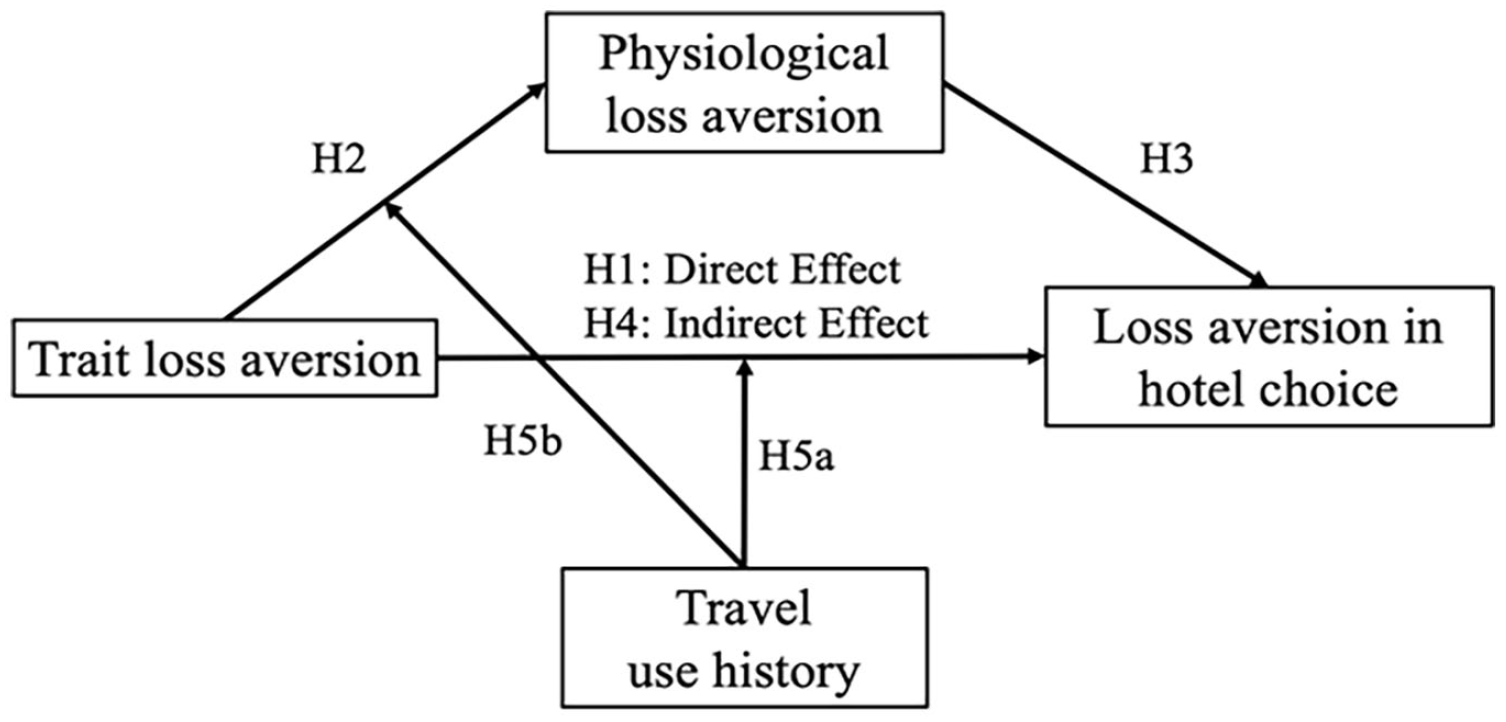
Conceptual Model of the Study.
Methods
Respondents
We recruited 66 respondents (35 females; Mage = 23.4 ± 4.6 SD) from a university in Asia. Human research ethics approval was obtained from ethics review committee of the authors’ university, and each participant provided written informed consent. On average, they had stayed in hotels 4.4 times in the previous 12 months. Only seven (11.7%) had not stayed in a hotel in the previous year. Six were excluded as a result of the poor recording quality of their electrodermal activities, a rate comparable to that reported in the literature (Benedek & Kaernbach, 2010).
Procedures
The study was conducted in Chinese. Respondents gave written consent and wore wristbands to monitor their EDA during a hotel decision task, which took 9.9 (±2.6 SD) minutes. To reduce the tendency to associate the hotel decision task with the risky decision task, a 10-minute filler task was included between the two. Trait loss aversion was measured using a risky decision-making task (Gächter et al., 2022). Demographic information and hotel experience over the last 12 months were collected. The entire study took about 30 minutes.
Measures
Trait Loss Aversion (λtrait)
The design of the task
Trait loss aversion was measured using a risky decision-making task (Gächter et al., 2022) from behavioral economics, new to tourism research. This task measured the utility function’s shape directly and was more abstract and general than domain-specific measures like the reference-price effect in consumer goods. This measure was simple and easy to understand, and we followed best practices in experimental economics by financially incentivizing respondents to ensure serious and truthful decisions (Wakker, 2010). Hypothetical treatments could be problematic (Bühren & Kundt, 2015), but financial incentives reduced response variance and social desirability issues (Camerer & Hogarth, 1999). Such incentive-compatible responses complemented survey data, providing an objective metric to quantify loss aversion (Rozin & Royzman, 2001).
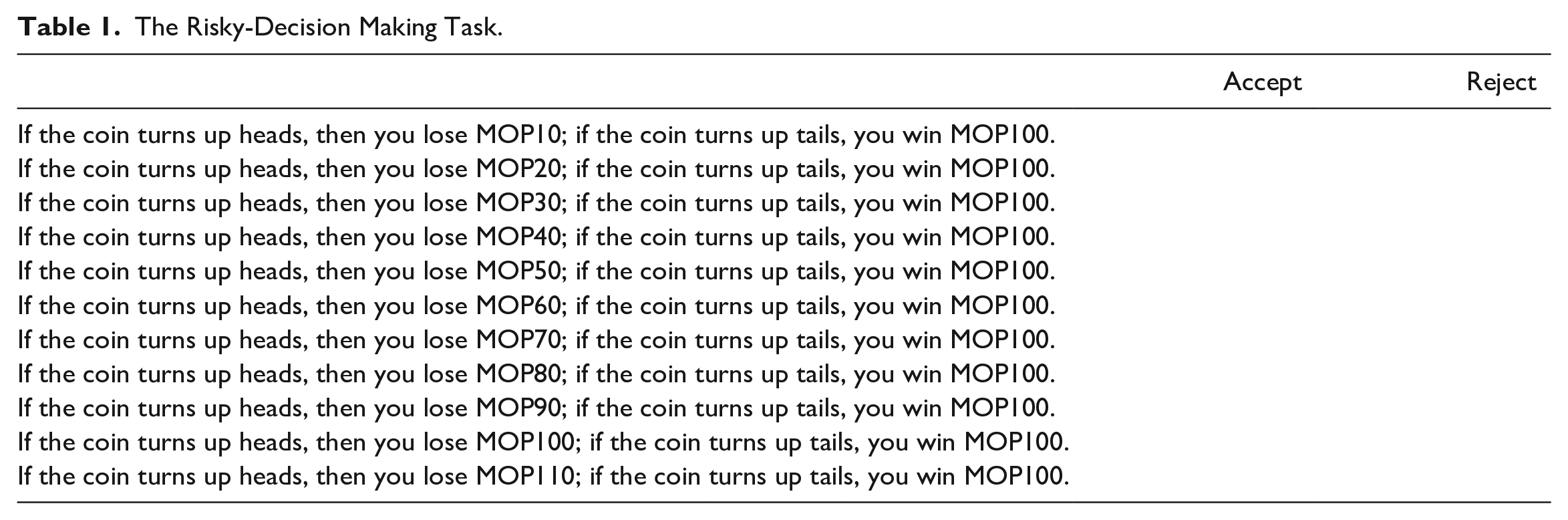
In the present study’s risky decision-making task, respondents decided whether to accept or reject each of the 11 lotteries (see Table 1). Afterward, one of the 11 lotteries was chosen randomly. The respondent played the lottery with real incentive when the lottery was accepted. In this case, respondents had a 50% chance of winning MOP100 (≈USD12.4), which was fixed among the 11 lotteries, and another 50% chance of losing an amount gradually increasing from MOP10 to MOP110 in increments of MOP10.
The Risky-Decision Making Task.
The definition of the construct and its measurement
The rationale of the task is that loss aversion has been conceptualized as a multiplicative overweighting of losses relative to gains (Kahneman & Tversky, 1979). Under the prospect-theory framework, the utility of a risky prospect with n outcomes x1, . . ., xn with probabilities p1, . . ., pn, respectively, takes the form:

where pi and xi are the probability and outcome of event i, respectively. π(∙) is the probability weighting function matching a probability from 0 to 1 to a decision weight also ranging from 0 to 1. The probability weighting function allows the capture of decision makers’ probability distortion, which is often found to have an inverse-S shape reflecting individuals’ hyper-sensitivity in probability perception at the two ends near impossibility and certainty, with insensitivity in the mid-range. v(∙) is the value function matching monetary outcomes to values perceived by the decision maker. The simplest possible and most often used functional form of v(∙) is

where α determines the curvature of the utility function and thus is a measure of risk aversion. λ measures the degree of loss aversion by allowing the asymmetric sensitivity to gains and losses. Empirically, it was typically found in past studies that α = .88 and λ = 2.25 (Tversky & Kahneman, 1992). The risk coefficient α < 1 implies that the utility function is concave in gains and convex in losses and thus on average people are risk-averse in gains and risk-seeking in losses. The loss-aversion coefficient λ ≈ 2 implies that people are about twice as sensitive to losses than to gains. That means the pain one feels with a $100 loss is roughly twice as intensive as the pleasure one feels with a $100 gain.
From the list of 11 lotteries, we could infer an indifference point at which a respondent switched from accepting the lottery with a smaller potential loss to rejecting the lottery with a larger potential loss. In the case of our binary-outcome lotteries, at the indifference point we obtained an indifference condition such that π(50%) ∙ v(x1) + π(50%) ∙ v(x2) = 0, where x1 > 0 and x2 < 0. With the above specification, we had π(50%) ∙ x1α = π(50%) ∙ λ(-x2)α. Assuming risk neutrality (i.e., α = 1), λ = -x2 / x1, where x1 and x2 were the potential gain (i.e., MOP100) and potential loss (ranging from MOP10 to 110), respectively.
Loss Aversion in Hotel Decisions (λhotel)
The design of the task
Loss aversion explains travelers’ asymmetric price response. Individual susceptibility to the reference price effect was probed using a hotel decision task. Respondents were tested in groups of three to five at a time. They worked on the hotel decision task presented by E-prime© (Version 2.0) on a 21-inch monitor. Figure 2 illustrates an example. In the first 5 seconds, respondents were presented with the first hotel. They were then presented with the second hotel after a fixation of random length of 2.5 to 5 seconds. During the presentation of the second hotel, respondents were asked to choose one of the two hotels by pressing corresponding keys on the keyboard. While there was no time limit for the respondents to respond, it took them on average 3.06 (±5.31 SD) seconds to make the decision. Their decisions were then highlighted for a second before the next trial.
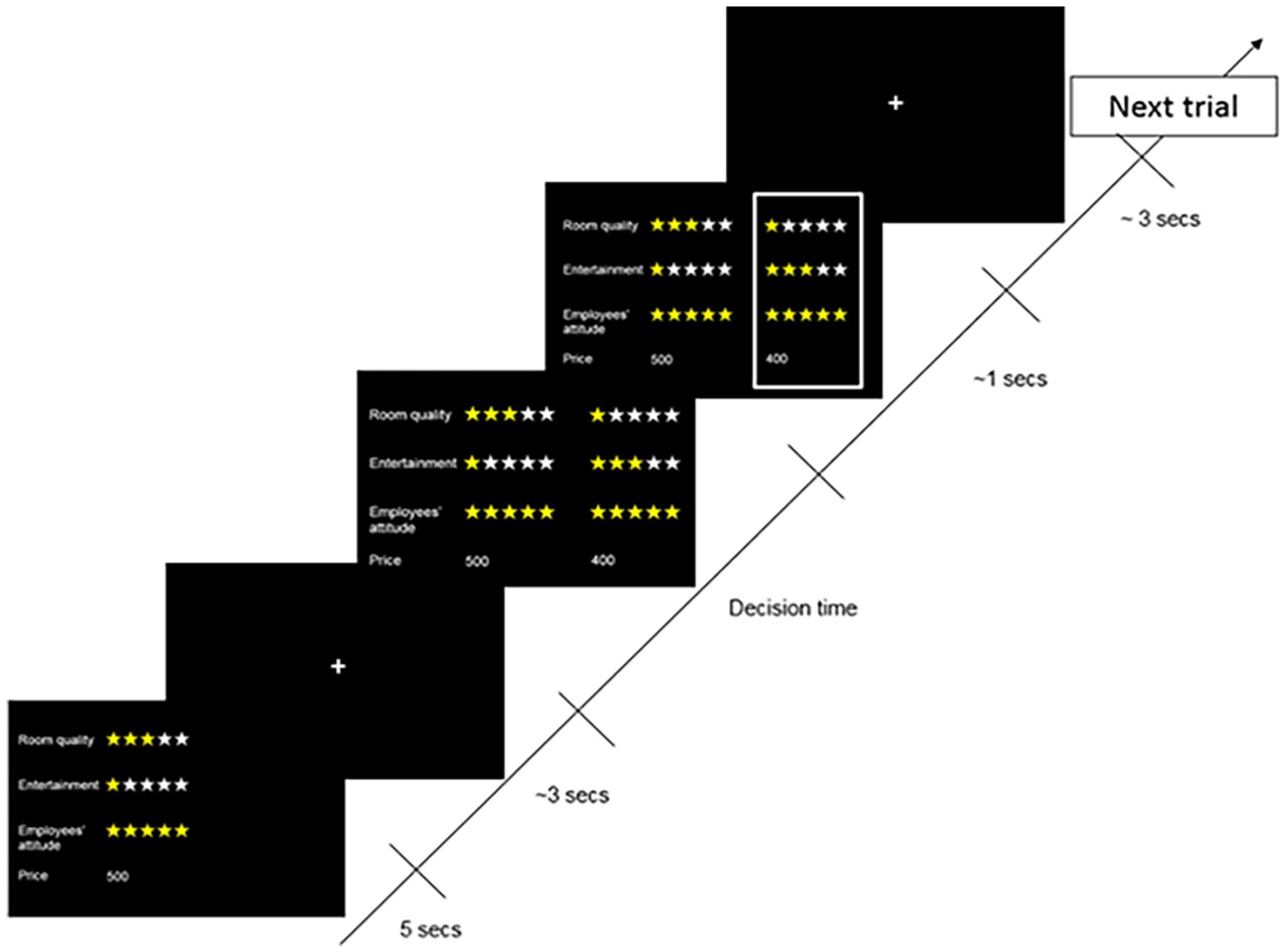
The Timeline of a Trial in the Hotel Decision Task.
There were 50 trials which on average took less than 10 minutes to complete (M = 9.43 minutes ±2.32 SD). In each trial, respondents saw the prices of the two hotels and three attributes randomly selected from a list of 14 attributes (e.g., staff friendliness, room quality, sports facilities). These attributes were adopted from Román and Martín’s (2016) and Kim and Park’s (2017) studies. The ratings that each attribute received were represented by the number of stars ranging from one (the poorest) to five (the highest). Before the task, respondents were given information about the basis of the star ratings of each attribute.
The task was pilot tested by two student helpers and another five participants recruited from the same subject pool, and was fine-tuned according to their comments. In particular, to keep the total time in 10 minutes, the inter-trial interval was shortened from 5–10 seconds to 2.5–5 seconds.
The definition of the construct and its measurement
To infer the degree of loss aversion, we estimated from respondents’ decisions an asymmetric reference price model commonly used in the reference-price literature in marketing (see Mazumdar et al., 2005, for a review) and tourism (Nicolau, 2011, 2012; Nicolau & Sellers, 2020). In particular, the utility of choosing the first hotel at trial t (U1t) is a linear combination of the attribute values and takes the following form:

where βj is the coefficient of the influence of attribute j with a value x1tj. Similarly, the utility of choosing the second hotel (U2t) ptakes the following form:

In addition to the linear combination of the attribute values as in the first hotel, there are two extra terms capturing the reference dependence of the price differences. Specifically, β-ve captures the influence of a price decrease from p1t to p2t and thus is expected to take a positive value. Similarly, β+ve captures the influence of a price increase from p1t to p2t and thus is expected to take a negative value. The reference-price dependence can be captured by an asymmetric response between a price increase and decrease, and can be represented by -β+ve > β-ve. Following Nicolau (2011, 2012) and the reference-price literature in marketing, loss aversion was defined as the ratio λhotel = -β+ve / β-ve > 1.
The choice probability of choosing hotel k (= 1, 2) at trial t takes the logit form:

The parameters β+ve and β-ve were obtained by estimating the multinomial logit model using maximum likelihood with the asclogit function in STATA at the individual level.
Physiological Loss Aversion (λSCR)
The design of the task
Physiological loss aversion was measured throughout the study by monitoring respondents’ EDA. EDA measures the skin’s electrical potential, which varies with sweat secretion levels (Figner & Murphy, 2011). Sweat glands respond to temperature changes and emotional arousal, which activates the autonomic nervous system (ANS), increasing the skin’s electrical potential. Thus, EDA serve as a proxy for emotional arousal.
EDA can be decomposed into tonic activity (SCL) and phasic activity (SCR). SCL responses are slow, lasting over 30 seconds, while SCR responses are quick, within 1 to 4 seconds. We measured SCR from hotel price information, focusing on amplitude differences from onset to peak.
Respondents wore an Empatica E4 wristband (https://www.empatica.com/en-int/research/e4/) during the study. This device is more portable than Ag/AgCl electrodes (Shoval et al., 2018). The lab maintained a temperature of 24 °C. EDA were sampled at 4 Hz and measured in microsiemens (μS). These EDA data were time-locked at the onset of the hotel decision task, with the baseline measure taken from the arrival period.
The EDA data were first preprocessed using Ledalab (www.ledalab.de; Benedek & Kaernbach, 2010). The data set was smoothed by a 16-sample kernel. A model-based approach (Bach et al., 2013) was adopted for analysis. In particular, a Discrete Decomposition Analysis (DDA; Benedek & Kaernbach, 2010) was used to decompose the tonic and phasic components of the EDA. The decomposition relies on an assumption of the stability of the shape of the SCR intrapersonally. As a result, an unbiased estimation of the SCR amplitude can be extracted from the superposed response components in the EDA. The SCRs related to the event of the hotel-price presentation were extracted using the scoring rule of the sum of amplitude (Benedek & Kaernbach, 2010), which summed all reconvolved SCR amplitudes with a time window of 1 to 4 seconds and minimum threshold of 0.01 μS.
The definition of the construct and its measurement
To construct a physiological loss aversion index, we took the trials in which prices of the second hotel were higher than the first one. The SCRs during the presentation of the first hotel (i.e., SCR1st hotel) and the second one (i.e., SCR2nd hotel) were averaged across these trials. Following our definition of trait loss aversion (i.e., λtrait = -x2/x1) and loss aversion in hotel decisions (i.e., λhotel = – β+ve/β-ve), we took the ratio of the SCRs to the price information of the second hotel to that of the first one, i.e.,

Travel Use History (TUH)
Travel use history in tourism research is often measured by the number of non-business trips taken previously (Draper et al., 2011; Shinew, 1993). Given the current context of hotel choices, participants were asked how many times they had stayed in hotels in the last 12 months.
Results
The hotel choices were modeled using the model presented above. The group level estimates are reported in Table 2. We also estimated our respondents’ degrees of loss aversion at the individual level. They were generally loss-averse across the three measures. In the case of trait loss aversion, the mean of λtrait was 3.25 (SD = 2.45). In the cases of loss-averse in their hotel decisions and physiology, the means were λhotel = 1.58 (SD = 1.92) and λSCR = 1.054 (SD = .411), respectively.
Estimation Results for the Asymmetric Reference Price Model.
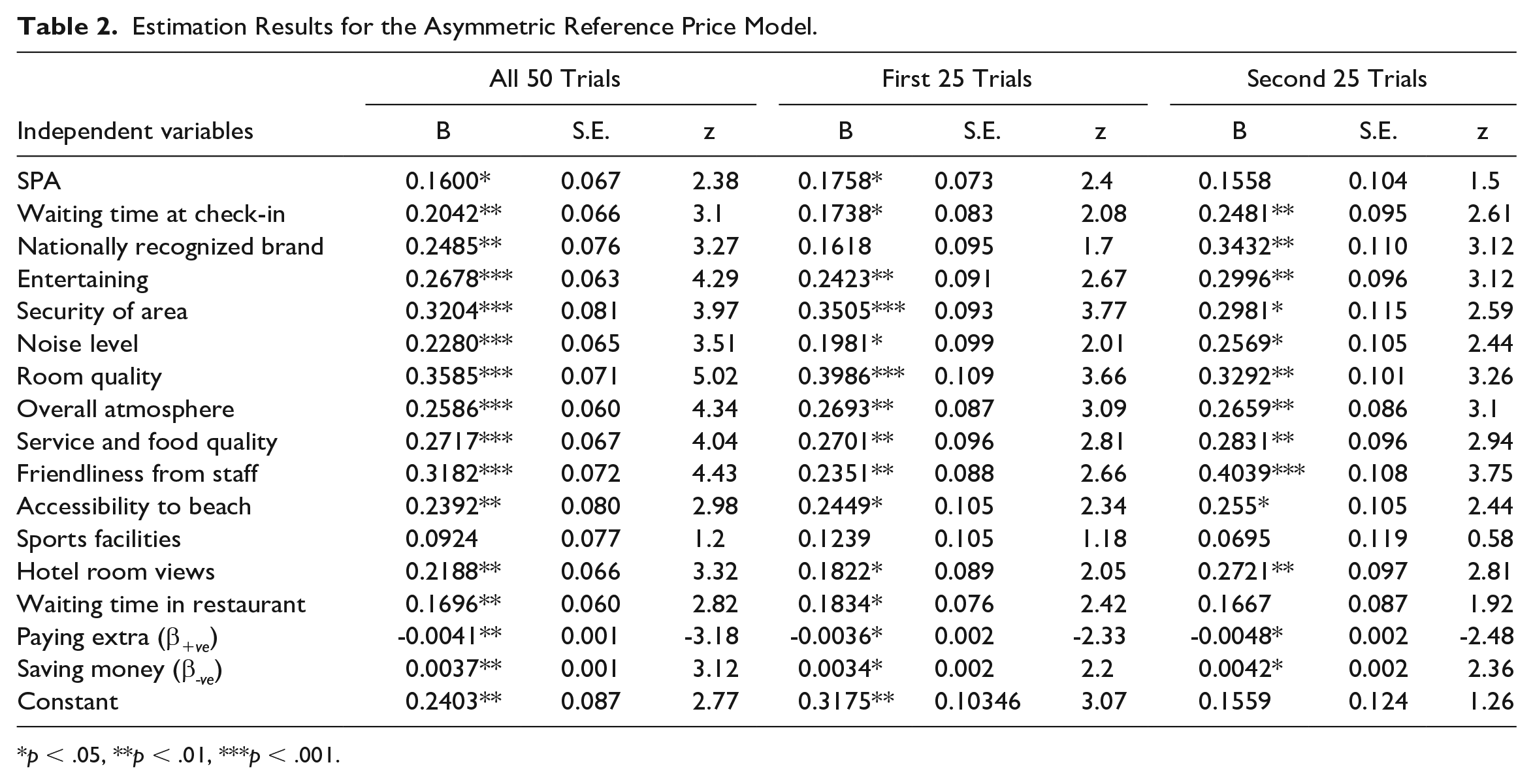
p < .05, **p < .01, ***p < .001.
We tested the six hypotheses with a moderated-mediation model (Preacher et al., 2007) using 10,000 bootstrapped samples with the SPSS PROCESS macro (Hayes, 2013; Model 8; see Figure 3). The direct effect of λtrait on λhotel was significant (.2572, SE = .1238; 95% CI [.0090, .5053]), supporting H1. The trait loss aversion × hotel experience interaction effect was marginally significant (-.0396, SE = .0215; 90% CI [-.0756, -.0036]), thus, H5a was partially supported. The effect of λSCR on λhotel was significant (2.1662, SE = .6422; 95% CI [.8792, 3.4532]). H3 was supported.
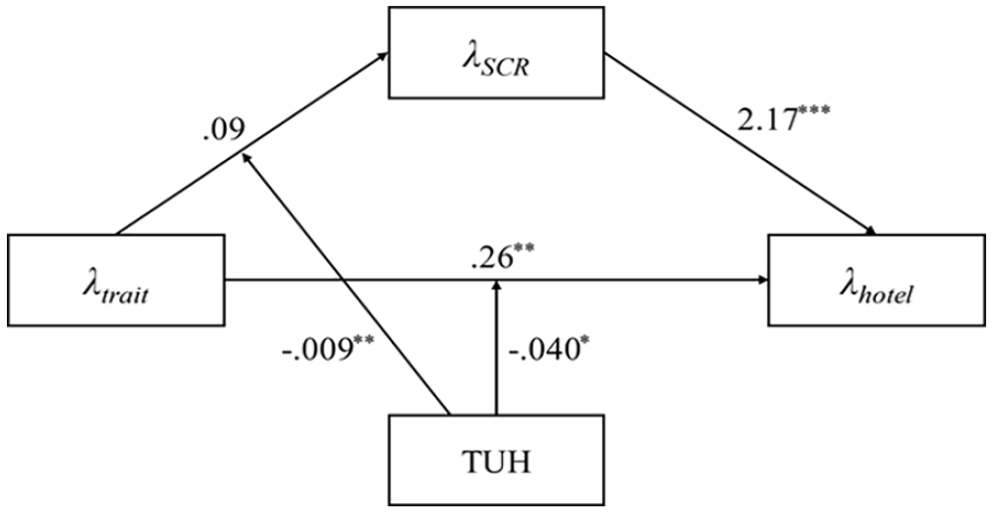
Moderated-Mediation Model of the Effects of Trait Loss Aversion on Loss Aversion Through Physiological Loss Aversion
The effect of λtrait on λSCR was not significant (.0122, SE = .0257; 95% CI [-.0394, .0637]), therefore, H2 was not supported. However, there was a significant trait loss aversion × hotel experience interaction effect on physiological loss aversion (-.0087, SE = .0043; 95% CI [.0173, .0000]), thus, H5b was supported, indicating that the relationship between λtrait and λSCR was moderated by hotel experience. A spotlight analysis reveals how the effect of λtrait on λSCR varies across hotel experience. It showed that the effect of λtrait on λSCR was only significant (.2572, SE = .1238; 95% CI [.0090, .5053]) when hotel experience was one standard deviation below the mean (i.e., when hotel experience = 0) but was not significant (.0823, SE = .0874; 90% CI [-.00640, .2285]) when hotel experience was at the mean (M = 4.4). Trait loss aversion had an effect on physiological loss aversion only at low level of hotel experience.
The mediation of λSCR on the relationship between λtrait and λhotel was not significant (-.0188, SE = .0209; 95% CI [-.0608, .0063]), while the moderated mediation index was significant (-.04; SE = .0215; 95% CI [-.0756, -.0036]). A spotlight analysis revealed that the mediation depended on hotel experience. In particular, it was significant only when hotel experience was at the mean (M = 4.4; SE = .0448; 95% CI [.1547, .0006]) but not one standard deviation above the mean (M = 9.34; SE = .1398; 95% CI [-.4226, .0227]), thus, partially supporting H4. Physiological loss aversion mediated the relationship between trait loss aversion and loss aversion in hotel choices only when respondents’ hotel experience was low.
Discussion
This study examined the reference price effect in lodging decisions. Travelers tend not to pay more for a better hotel if it is presented after a cheaper one, violating the standard choice model. To test the loss-aversion account of this asymmetric price response, we measured trait loss aversion and physiological loss aversion. Our findings show that trait loss aversion predicted reference price effect and inexperienced respondents’ physiological loss aversion. Physiological loss aversion predicts reference price effect and mediated the effect of trait loss aversion on reference price effect in inexperienced travelers, offering convergent evidence for the loss-aversion account.
We measured emotional responses to the loss-aversion signal using EDA and demonstrated that loss-averse travelers experienced greater arousal from higher prices of alternative hotel options. While EDA does not indicate emotional valence, physiological arousal is generally associated with negative events (Taylor, 1991). Negative signals are more attention-grabbing (Rozin & Royzman, 2001), and in this context, physiological responses to asymmetric prices served as a brake, preventing travelers from paying extra for a better hotel.
The adoption of physiological measures, such as eye tracking and EDA, is gaining traction in tourism research. This study is the first to explore SCRs as a mediator, revealing that larger SCR responses led to more loss-averse hotel decisions among inexperienced travelers. Traditional methods like self-reports suffer from pitfalls such as memory bias and social desirability (Paulhus, 1984; Winkielman & Berridge, 2004). Thus, the investigation of physiological responses to loss aversion with EDA enables us to capture real-time psychological processes more objectively and accurately (Li et al., 2018a).
Theoretical Contributions
Our findings have three major theoretical contributions. First, this study contributes to the literature by being the first to adopt a multi-method approach that involved a physiological measure to provide convergent evidence for the loss-aversion account. It has been proposed that the use of physiological measures could allow the investigation of underlying processes and thus theory testing at another level (Li et al., 2023). A recent review identified 25 articles using EDA to study behaviors of consumers, including tourists, and highlighted three contributions of EDA measures (Li et al., 2022). First, unlike self-reports, physiological measures provide continuous emotion measurement. For example, heart rate was used to proxy stress among students while cruising (Petrick et al., 2020), and other studies measured travelers’ real-time emotions using EDA (Kim & Fesenmaier, 2015; Shoval et al., 2018). Second, self-reports have issues like social desirability bias and recall inaccuracies (Paulhus, 1984; Winkielman & Berridge, 2004). EDA offers more accurate predictions of emotional responses than self-reports (Li et al., 2018b). Third, EDA capture passive and active sweat secretion responses, thus proxying emotional arousal (Critchley, 2002).
In our study, we uniquely linked three different types of loss aversion, establishing a theoretical framework that connects individual traits, physiological responses, and domain-specific behaviors. This framework was tested using EDA data that provided a more objective measure of emotional response. Physiological measures, such as EDA, have been recognized to contribute significantly to tourism and travel research (Hosany et al., 2021). Specifically, “triangulating verbal and nonverbal measures (psychophysical indices) offer one solution to capture the complexities of emotional states” (Hosany et al., 2021, p. 1394). Additionally, based on adaptation-level theory, Cheng and Monroe (2013) have suggested that travelers’ price perceptions and behaviors are influenced by various cues, including focal cues, contextual or background cues, and organic cues, which encompass the consumer’s physical and psychological state, as well as the cognitive resources available to consider the offer. This aligns with the results of our experiment, where we used EDA to capture travelers’ emotional responses, particularly the physiological reactions associated with loss aversion, highlighting the role of organic cues in price perception and behavior.
Second, we critically examined the loss aversion account of the reference price effect, which has been demonstrated to impact lodging decisions (Choi & Mattila, 2018), destination choices (Nicolau, 2011), and air ticket and accommodation purchases (Nicolau & Sellers, 2020). There are competing explanations to the reference price effect, for example, diminished sensitivity to price differentials (Biswas & Grau, 2008; Levin et al., 2002). In particular, the price difference seemed greater when the cheaper option was seen first, making travelers reluctant to choose the more expensive option. To isolate the loss-aversion explanation, we measured trait loss aversion from a different domain and found a strong correlation with hotel decision loss aversion. The physiological measure showed a similar association, providing converging evidence for the loss-aversion account. Although both findings were correlational, the domain-general measure of loss aversion predicting the domain-specific one is notable. Trait loss aversion was measured using a risky decision-making task, while hotel decision loss aversion was measured specifically in the tourism domain. Personality constructs might be better studied in smaller subsets since broader concepts may not be homogeneous (Fiske, 1966). For example, domain-general novelty seeking was associated with eveningness (Caci et al., 2004), but when the tourism domain-specific novelty-seeking scale was adopted, morning-type travelers sought novelty more during their travels (Chark et al., 2020; Lee & Crompton, 1992). The support for H1 suggests a common psychological process in loss aversion and the reference price effect in lodging decisions. Physiological arousal to asymmetric prices further confirms loss aversion as the underlying mechanism.
Third, it is known that product knowledge moderates the reference price effect (Kalyanaram & Winer, 2022). In particular, the effect is attenuated when consumers are more familiar with the product and pricing practice. By applying the TUH framework to hotel decisions, we identified the moderating effect of hotel experience, linking TUH literature with the reference price effect in tourism. Prior literature has focused on the direct effect of TUH on tourism preferences and decisions, such as information sources (Draper, 2016) and attitudes toward tourism development (Woosnam et al., 2018). In the context of time-to-book decisions, flying frequency failed to moderate the framing effect (Rahman, Crouch, & Laing, 2018). This study extends the TUH concept to travelers’ experience in hotel stay. We provided insights into the boundary condition under which the reference price effect in lodging decisions can be mitigated.
Another theoretical consideration is that under the prospect theory framework, the two features of the value function are asymmetric slope around a reference point (i.e., loss aversion) and the diminishing sensitivity to the size of deviation from the reference point (i.e., reflection effect). While we examined the former, one may wonder whether the latter is also present in price perception as predicted by prospect theory. Specifically, the reflection effect implies that the value function is concave at the right side of the reference point and convex at the left side. In risky decision making, the concavity and convexity suggest greater tendency of risk aversion and risk affinity in the domains of gains and losses, respectively. To answer this question, we estimated the concavity in gains and the convexity in losses from hotel choices by introducing two quadratic terms to capture the nonlinearity. While the signs of the estimates followed the predictions of the prospect theory, only the convexity in the negative domain was significant; the concavity in the positive domain was not. Interestingly, after controlling for the curvature, the group level estimate of the loss aversion went up to 2.07. Similarly, in the measure of the trait loss aversion, a behavioral economic task was used. When estimating the degree of loss aversion from the risky decisions, a simplifying assumption of linear value function was made. This is a common assumption in the decision theory literature and has gained empirical support from past studies (e.g., Benartzi & Thaler, 1995; Bombardini & Trebbi, 2005).
Practical Implications
Understanding the psychological mechanism behind reference price effect is crucial for practitioners. Our findings suggest that emotional arousal to price information, as measured by SCR, is key to this response. Travel firms should alleviate travelers’ emotional responses to price information. Manipulating factors that contribute to emotional responses can reduce behavioral loss aversion (e.g., Lui & Hsu, 2018). For instance, since reference price is a range rather than a single point, marketers should consider presenting a range of prices that correspond to different types of rooms to prevent loss-averse groups from setting a low reference price (Suk et al., 2012). Hoteliers should also pay attention to external reference price ranges.
Our finding that people with higher trait loss aversion responded more asymmetrically to price has marketing implications, allowing travel firms to segment travelers based on this trait (e.g., Nicolau, 2012). While practitioners cannot easily distinguish more loss-averse consumers from the less loss-averse ones, a meta-analysis shows that certain groups were more loss averse than others (Brown et al., 2024). For example, it was found that culture matters in the degree of loss aversion (Wang et al., 2017). Collectivistic cultures such as Chinese were more loss averse than their individualistic British counterparts (Guo & Spina, 2016). Gender also plays a role in loss aversion, with females being more loss-averse (Rau, 2014; Schmidt & Traub, 2002). Loss aversion also exhibits a curvilinear trend with age, where younger and older people were found to be more loss averse (Guttman et al., 2021). Practitioners may adapt their pricing strategies according to these demographic characteristics.
On the other hand, high-income consumers were less affected by the reference price effect (Erdem et al., 2010). For these consumers, marketers should emphasize other quality signals, such as ratings and reviews, to strengthen the price–quality perception.
Lastly, our results show that travelers with more experience were less affected by their trait loss aversion in hotel decisions. Marketers should be more cautious when dealing with inexperienced travelers since these travelers make hotel decisions that reflect their trait loss aversion. While we do not have much information about how reference-price dependent these less experienced travelers are, it has been documented in the marketing literature that consumers with less product knowledge, as proxied by experience, are more influenced by the reference price (Erdem et al., 2010; Suk et al., 2012).
Limitations and Future Research
We collected our data in a lab environment which posed external validity issues. However, collecting physiological data during an actual hotel decision is difficult. The lab environment facilitates EDA measurement and presents realistic information to respondents, controlling factors like access to hotel information, which enhances internal validity (Viglia & Dolnicar, 2020). Our sample size of 66 was consistent with previous EDA studies, which had an average sample size of 54.13 (± 45.89 SD; Caruelle et al., 2019). Additionally, our respondents were experienced, staying in hotels more than four times a year on average, and were thus familiar with the hotel decision task. Nevertheless, future studies may benefit from examining the decision-making process in a real-life setting.
Loss aversion may also influence tourists’ decisions beyond the reference price effect, such as consumption in the experience economy (Chang, 2018) and destination choices (Masiero & Qiu, 2018). These prior studies investigated loss aversion in non-price attributes. Unlike the reference price literature—which debates consumers’ reliance on external or internal reference prices (Briesch et al., 1997; Choi & Mattila, 2018)—reference points for non-price attributes are often internal. For instance, past consumption or travel experiences were used as reference points in the effect of loss aversion (Chang, 2018; Masiero & Qiu, 2018). We encourage future research to examine the physiology of loss aversion among non-price attributes. In addition, future research could take a qualitative approach involving hoteliers, whose input would be invaluable for gaining more nuanced insights for the industry.
Footnotes
Declaration of Conflicting Interests
The authors declared no potential conflicts of interest with respect to the research, authorship, and/or publication of this article.
Funding
The authors disclosed receipt of the following financial support for the research, authorship, and/or publication of this article: This work was supported by the University of Macau [MYRG-GRG2023-00123-FBA / MYRG2022-00101-FBA]; and the Higher Education Fund of the Government of Macao SAR [TET-UMAC-2021-06].
