







Abstract
This study investigates how room rate disparity across Online Travel Agencies (OTAs) influences consumers’ switching behavior and perceptions of hotel brand integrity. Employing a scenario-based experimental design with a sample of 430 Chinese consumers, we explored how price differences interact with loyalty status, price trajectory information, and brand consistency. Our findings reveal a complex non-linear inverse sigmoid relationship between rate disparity and channel switching. Contrary to expectations, loyalty membership did not reduce switching intent or increase discount thresholds. Moreover, rate disparity triggered brand integrity concerns, with brand doubt consistently exceeding switching intent. While price trajectory information did not change switching intentions, it increased the discount needed to induce switching, suggesting that consumers’ price expectations influence sensitivity. These results advance theory by introducing a new and empirically supported non-linear model of channel switching and linking pricing inconsistency to diminished brand perception. Practically, the findings offer guidance on strategic discounting, brand management, and OTA design.
Highlights
Online Travel Agencies’ switching intentions follow a counter intuitive inverse sigmoid pattern due to price-risk trade-offs.
High discounts trigger brand doubt more easily than they drive switching intentions.
Loyalty programs fail to change switching intentions.
Price trajectory impacts the discount threshold required for switching.
Introduction
Hotel rate parity is the practice of maintaining consistent room rates across all distribution channels (Biełuszko & Marciszewska, 2018), and, although controversial, it is a common practice in the United States, where Online Travel Agencies (OTAs) enforce rate parity through contractual clauses (Mantovani et al., 2018). The practice gained considerable attention in academic literature (e.g., Demirciftci et al., 2010; Haynes & Egan, 2015), and trade publications (e.g., Starkov, 2024), with some scholars highlighting its role in maintaining price stability (e.g., Gazzoli et al., 2008).
However, while rate parity is prevalent and strongly enforced by OTAs in the United States, this situation is rapidly changing globally, leading to increased rate disparity (or lack of rate parity). Specifically, rate disparity refers to the phenomenon in which the same hotel room is offered at different prices across various distribution channels (Jiang & Erdem, 2018). The emergence and prevalence of rate disparity outside the United States can generally be attributed to two main circumstances: regulatory pushback against restrictive contracts and coercive isomorphism within competitive markets. These developments not only alter the competitive landscape but also challenge the foundational assumptions of price consistency in the hospitality industry. The two concepts and their relation to rate parity (or lack of) are explained below.
The legal explanation—that is, the regulatory pushback—centers on the fact that, in recent years, a growing number of countries have either banned, or severely restricted, rate parity clauses and/or their enforcement. Specifically, regulators in the European Union (EU), Australia, New Zealand and India forced OTAs to completely abandon or change the way they handle rate parity clauses. For example, the most recent development happened in September 2024, when the Court of Justice of the European Union (CJEU) ruled in Case C-264/23 (Booking.com) that rate parity clauses do not qualify as "ancillary restraints" under EU competition law. This ruling indicates that such clauses are not automatically exempt from antitrust scrutiny. The court emphasized that such clauses potentially reduce competition and hinder market entry for smaller platforms. This ruling sided with earlier decisions by the German Federal Cartel Office, which had already found these clauses to be anti-competitive (CJEU, 2024). In contrast, similar legal efforts in the United States have not been successful (e.g., O’Neil, 2014), creating a significant geographical divergence in pricing regulations. For an in-depth discussion on the legal aspects of hotel rate parity, see Bianchi and Chen (2024).
Ling (2023) finds empirical evidence in support of the idea that differences in the prevalence and level of rate disparity are explained by the theory of coercive isomorphism. This portion of institutional theory suggests that under regulatory or competitive pressure, firms often adopt practices and structures that match their competitors, irrespective of internal efficiency considerations. Accordingly, Ling (2023) reports significant differences in rate parity enforcement and levels across various countries and regions. From a theoretical perspective, this institutional divergence suggests that rate disparity is not merely a pricing tactic but a reflection of a volatile market environment that may influence consumer trust.
This multifaceted practice of rate disparity is particularly pronounced in the Chinese hotel market, the empirical setting for this study. In China, rate disparity is common and is primarily driven by intense competition within the hospitality sector. Like their counterparts in other areas in the world, Chinese OTAs strive to differentiate themselves not only through pricing but also by enhancing the booking experience, leveraging superior service quality, secure payments, flexible cancellation policies, refund options, and accurate information (Gupta et al., 2004; Hao et al., 2015). These strategies aim to strengthen customer relationships and increase user loyalty (Liu & Zhang, 2014; Monterey & Borbon, 2021). However, despite these efforts, price remains a particularly influential factor in booking decisions. For instance, Tanford et al. (2019) report that 79% of consumers compare prices across multiple OTAs when booking hotels in China. This high level of price sensitivity, coupled with a market characterized by widespread disparity, creates a critical need to investigate how consumers navigate the trade-offs between monetary gains and brand reliability.
To gain a competitive edge, major Chinese OTAs such as Ctrip, Fliggy, and Meituan adopt various pricing strategies that contribute to widespread rate disparity. These include aggressive discounting by reducing their own commission margins (Ling et al., 2021), reducing the hotel's revenue share (Bhatnagar, 2024), and acting as sales platforms for third-party (often offline) entities with access to discounted inventory, some of whom engage in unauthorized or illegal room resales (Hotel News Resource, 2024; Ling, 2024). Such fragmented distribution structures further exacerbate pricing volatility, making the Chinese market an ideal empirical proxy for studying the erosion of brand integrity in a global regulatory environment increasingly shifting toward a post-parity era.
Given the prevalence of rate disparity in China, and considering the recent EU court of justice ruling declaring rate parity clauses unenforceable, this study investigates the extent to which rate disparity influences consumers' choice of OTA. Specifically, it examines the combined effects of price-related and non-price-related factors, such as loyalty status and price trajectory information, on consumers’ booking intentions and their OTA platform preferences. By navigating the complex trade-offs between economic incentives and brand skepticism, the study addresses the following research question:
How do rate disparity, loyalty and price trajectory influence switching intentions?
Furthermore, brand image cultivation is another strategic priority for hotels (H. B. Kim et al., 2003), and price consistency plays a significant role in shaping consumer perceptions of a brand (O'Neill & Mattila, 2010). While the literature on luxury goods (e.g., Matthiesen & Phau, 2010; Wood et al., 2021) discusses issues of pricing and brand dilution, a substantive theoretical gap exists regarding how cross-channel pricing inconsistencies violate the psychological contract between the brand and the consumer in the hospitality context. Specifically, current hospitality literature predominantly focuses on short-term economic outcomes or the perceived fairness of individual transactions; however, there is a theoretical void concerning the cognitive dissonance created when a hotel’s multi-channel pricing strategy conflicts with its brand promise of consistency and reliability. This study transcends a simple contextual application by examining how such pricing inconsistencies could potentially erode the foundational pillars of brand integrity—that is, authenticity and consistency—in a way that standard price-quality inferences do not capture (Kendra, n.d.). Accordingly, this study also explores the following question:
Does rate disparity affect consumers’ perception of a hotel brand’s integrity?
In summary, this study seeks to clarify how rate disparity influences consumers’ OTA choices and their perceptions of brand integrity, thereby contributing to both pricing strategy and branding literature in the hospitality field. It advances theory by extending research on consumer switching in multi-channel environments, introducing and testing a non-linear model of how discounts influence channel switching, and integrating pricing strategy with branding theory. By framing rate disparity as a strategic threat to brand coherence, this research provides a nuanced understanding of how pricing volatility functions as a signal of institutional instability rather than just a monetary incentive. It uniquely connects rate disparity to brand trustworthiness, a previously underexplored nexus, addressing a key gap in the literature. Practically, it provides hotel managers, OTAs, and policymakers with evidence on how rate disparity shapes booking behavior, brand perception, and regulatory considerations, offering actionable guidance on pricing strategies, platform policies, and brand communication initiatives. Moreover, the findings on brand integrity also inform practitioners about the way hotels can balance pricing inconsistency with online visibility without eroding brand equity.
Background and Hypotheses
Rate Disparity and Switching Intentions
The OTAs landscape is highly competitive and dynamic where customer retention is vital. Given the low switching costs (Huang et al., 2017) and minimal differentiation among platforms such as Expedia, Booking.com, and Hotels.com, understanding the drivers of customer loyalty and switching intentions is essential. Loyalty in this context is bifurcated into behavioral (e.g., repeat bookings) or attitudinal (e.g., emotional attachment or brand preference), whereas switching tends to involve a strategic evaluation of perceived value. This evaluative process is framed by structural market conditions where hotel room rates naturally fluctuate and exhibit substantial rate dispersion across brands and markets (W. G. Kim et al., 2020). Such dispersion creates environmental volatility under which OTAs may display different prices for the same room.
Specifically, prior research suggests that hotel customers consider multiple factors when selecting a booking channel and determining their loyalty to the channel, and make trade-offs among them (e.g., Collins et al., 2012; Noone & McGuire, 2013; Zhou, 2019). When consumers perceive another channel as more attractive, they may switch from their preferred or habitual booking platform. The industry often refers to this switching behavior as conversion, which in this study is operationalized as the consumer's intent to switch from one OTA to another due to a perceived rate advantage. Importantly, this switching process is conceptualized as a cognitive negotiation, where the consumer weighs the immediate monetary utility of a discount against the latent risks associated with pricing inconsistency and potential brand dilution.
Several non-monetary factors influence OTA preferences, including perceived service quality, website usability, and trust, all of which contribute to customer satisfaction and, ultimately, continued usage and loyalty (C.-F. Chen & Tsai, 2007). Hwang et al. (2019) found that perceived usefulness and ease of use are key drivers of OTA loyalty, while Buhalis and Law (2008) emphasized the role of positive user experiences in building a favorable brand image and encouraging future bookings. Similarly, Rather et al. (2019) highlighted the impact of engagement and emotional attachment on OTA loyalty, while Kwon and Lennon (2009) along with Noone and McGuire (2013) demonstrated that well-designed loyalty programs (e.g., Booking Genius) can enhance repeat purchase intentions, especially when perceived as fair and rewarding.
Nevertheless, as stated earlier, switching intentions tend to be opportunistic and price-driven, and, moreover, the impact of price on conversion is likely non-linear in the OTA context. First, it is reasonable to assume that Stigler’s (1961) Economics of Information theory is particularly relevant in this context: as OTA customers become more informed, they exhibit higher price-sensitivity. Consequently, price remains a critical competitive factor and, while brand loyalty exists, many consumers are predisposed to platform switching in pursuit of superior deals (Jeong & Lambert, 2001). Within this theoretical framework, rate disparity acts as a powerful catalyst for channel migration, and it is reasonable to assume that the propensity to switch increases disproportionately with the magnitude of the rate disparity.
At the same time, however, rate disparities might trigger a countervailing psychological effect, causing customers to become wary. For example, according to Janiszewski and Lichtenstein (1999), deeply discounted prices can activate quality skepticism, raising concerns about the legitimacy of the offer, or even suspicions of technical errors. Consumers may also fear being denied service at check-in if they suspect the discounted rate is not properly honored. As Ling et al. (2021) suggest, the awareness of such functional and financial risks can significantly decrease consumers' willingness to select highly discounted rates. This study proposes that the interaction of these opposing forces—that is, the economic incentive to switch versus the risk-induced reluctance—manifests as a complex, non-linear relationship between rate disparity and channel switching intent. Specifically, the dominant force shifts depending on the magnitude of the discount; at extreme levels of disparity, the perceived risk may override the monetary benefit, leading to a plateau or even a decline in switching intentions.
Given these two opposing directions of the disparity level and switching intentions, it is difficult to hypothesize the precise pattern of the relationship a priori, and the following conceptual framework further demonstrates this challenge. Consider two competing scenarios, A and B.
In Scenario A, the positive relationship between the level of rate disparity and the switching intention (i.e., the increased intent to select an OTA with the lower room rates) is given by Equation 1:

Where X denotes the rate disparity (i.e., discount level), expressed as a percentage ranging from 0% to 100%.
Cp is the switching rate due to positive impact, bounded within the interval [0%, 100%].
α, β are coefficients.
The negative relations between the disparity level and switching rate (driven by the consumers reluctance to book with the OTA due to concerns about quality or legality) is depicted by equation 2:

Where
Cn is the switching rate due to negative impact
ρ, γ are coefficients
The combined impact of the two opposing forces on the switching rate, C, is given by:

This formulation captures the non-linear nature of the relationship, where switching initially increases with rate disparity but eventually declines as perceived risks outweigh price benefits.
A graphic illustration of the combined impact is shown in Figure 1, where the dashed and dotted lines represent the two opposing forces: the positive economic incentive (the "pull" factor, dashed line) and the negative psychological reluctance (the "push" factor, dotted line). The bold solid line represents the combined effect. Note that in Scenario A, the inverse U-shaped impact indicates that as the level of disparity increases the switching intentions increase and then decline.
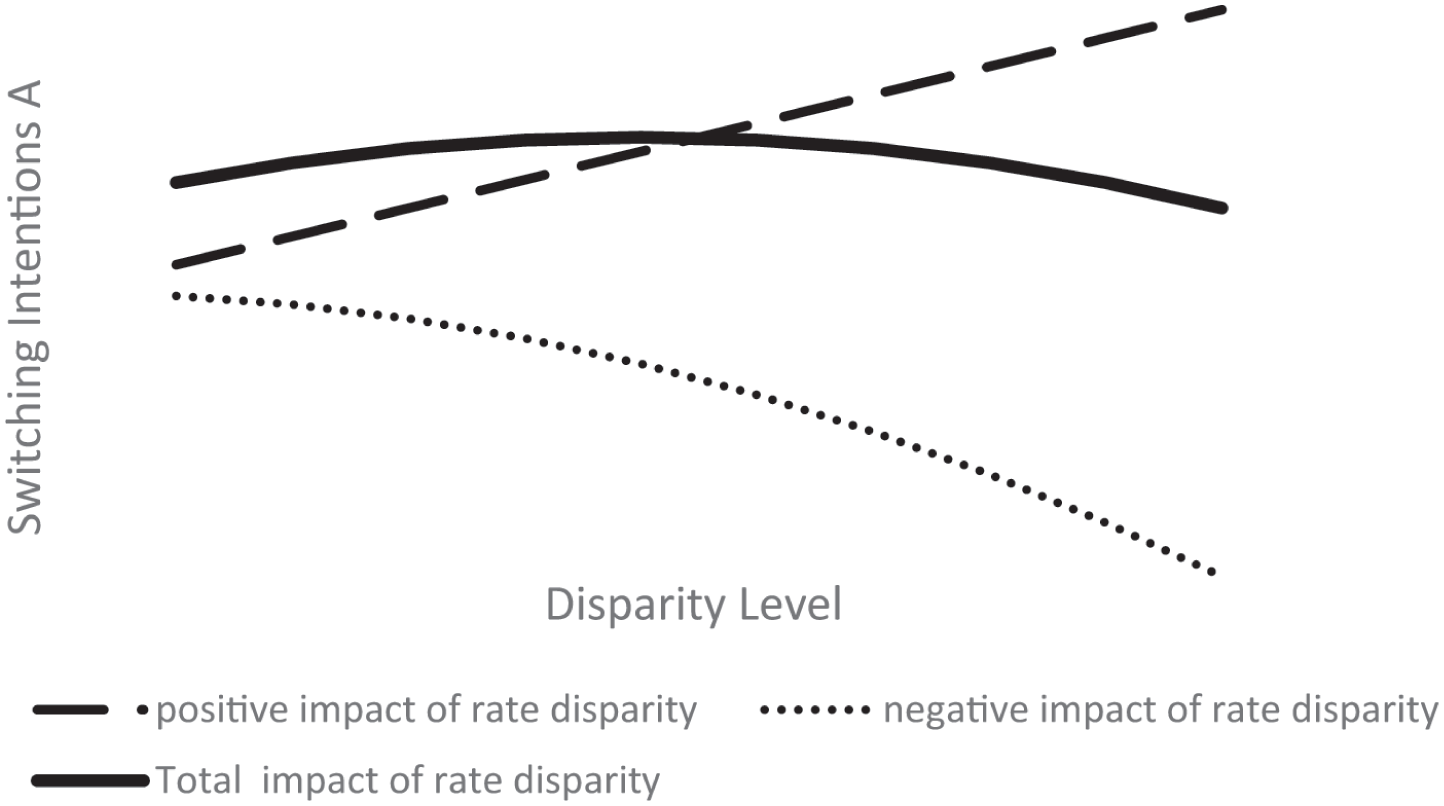
Scenario A: Conceptual inverse U-shape impact of disparity levels on switching intentions.
In Scenario B, the functional shape of the relationship flips by assuming different relative growth rates for the positive and negative effects. The positive and negative relations between the level of rate disparity and the switching are depicted by Equations 4 and 5, respectively, while the overall impact is given by Equation 6.



Figure 2 shows the combined impact of Scenario B. Note that in this scenario, it follows a U shape, where the switching rate first declines in response to increased disparity levels, and then rises as the positive effect outweighs the negative.
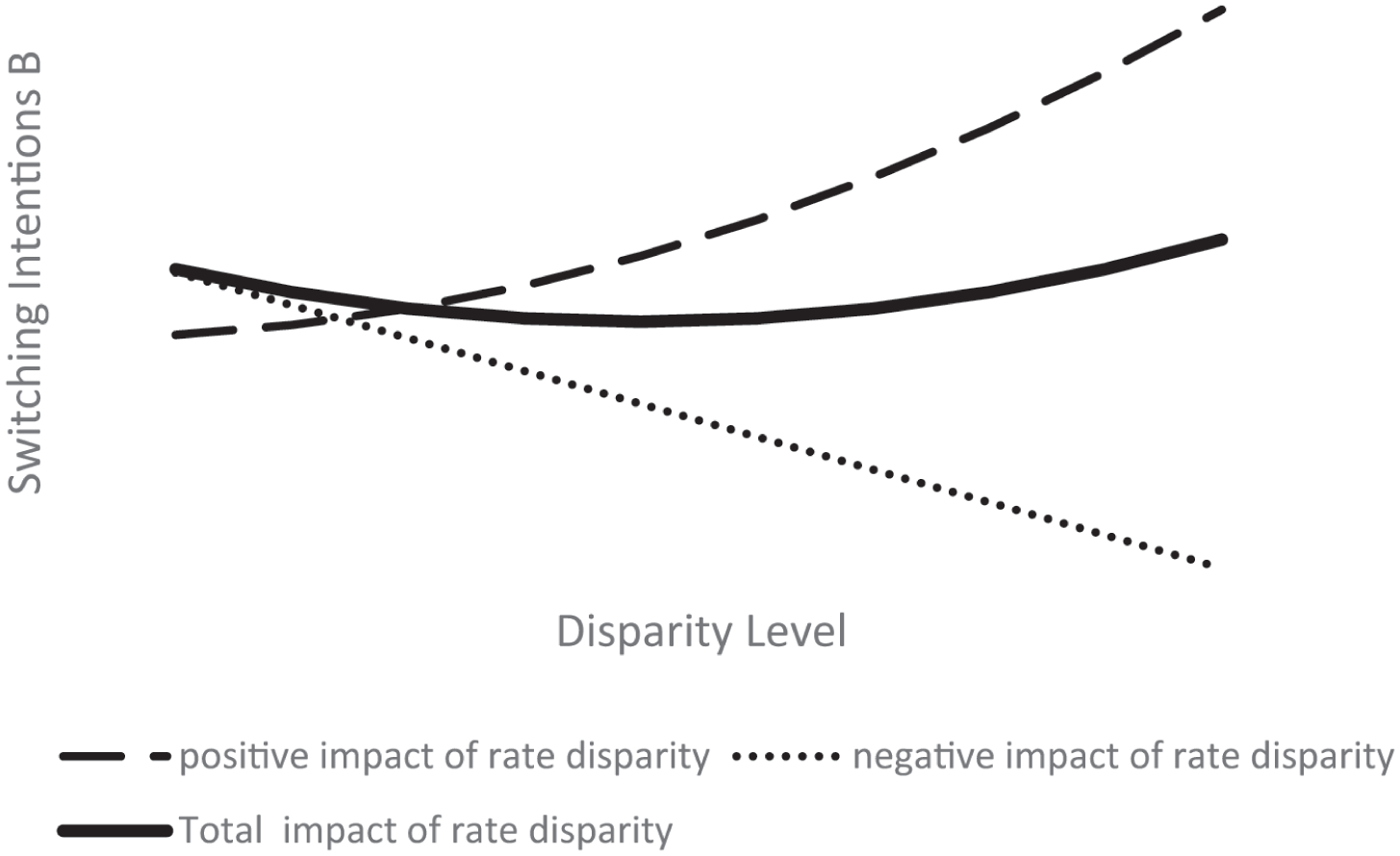
Scenario B: Conceptual U-shaped impact of disparity levels on switching intentions.
Note that the purpose of this analytical analysis (combining the closed-form derivations and their graphical counterparts) is to demonstrate that the sign, curvature, and overall qualitative form of the disparity/conversion mapping are not structural invariants. Rather, they are induced by the functional form and the relative strength of the two underlying components (i.e., the “behavioral forces”) that enter the conversion function with opposing effects. Equivalently, the marginal effect (∂Conversion/∂Disparity) and its higher-order properties (e.g., nonlinearity and possible inflection points) depend on how the positive and negative impact terms evolve over the disparity domain, including the rate at which each term attenuates or amplifies as disparity increases. More specifically, this analytical example demonstrates that distinct qualitative regimes can emerge under plausible alternative specifications of these primitives: the disparity/conversion relationship may be monotone increasing, monotone decreasing, inverted-U (interior maximum), U-shaped (interior minimum), or exhibit threshold-like behavior. Thus, in the absence of defensible empirical or theoretical restrictions on the functional shapes of the positive and negative components, and without identification of the parameter region governing their relative dominance, any directional hypothesis would be over-committal. Accordingly, we formulate a non-directional (two-sided) hypothesis that allows the net effect of disparity on conversion to be positive or negative, contingent on the realized functional forms and parameterization of the underlying behavioral forces.
Loyalty Status and Switching Intentions
In addition to pricing strategies, OTAs influence consumer channel choice through loyalty programs (Bowen, 2017). These programs are designed to drive repeat bookings, foster retention, and reduce reliance on expensive advertising. In an increasingly competitive and commoditized market that is characterized by low switching costs and high price transparency, such programs serve as a key differentiator. As Klemperer (1987) and Shin and Kim (2008) noted, platforms with minimal switching barriers (e.g., no sign-in requirement or seamless booking) make it easier for consumers to migrate across providers. In response, OTAs leverage loyalty programs to create customer stickiness by offering tangible rewards such as discounts, room upgrades, and exclusive perks. These benefits not only incentivize repeat bookings (Noone & Mattila, 2009) but also establish a psychological barrier to switching by increasing the perceived opportunity cost of abandoning the platform.
Loyalty programs also play a defensive role. As hotels push for direct bookings by offering benefits to guests who bypass OTAs, the agencies counter by matching or exceeding those incentives to protect market share (Forgacs, 2011). For example, Booking.com’s Genius program has been shown to increase repeat bookings by offering visible perks such as free upgrades and late check-out (Booking Holdings Inc., 2023). Similarly, the Expedia Group has aggressively integrated its loyalty offerings across platforms like Expedia, Hotels.com, and Vrbo through its One Key program.
Loyalty benefits factor into consumers' perceived value when comparing prices across channels, which may diminish the influence of rate disparity (Katro, 2011). Moreover, loyal members tend to exhibit greater trust in their chosen platform than non-members (Rizal et al., 2020), making them less susceptible to switching. This suggests that loyalty status serves as a critical boundary condition, shifting the threshold at which the economic benefit of a discount outweighs the psychological commitment to the brand. This leads to two related but distinct propositions.
While H2a posits that loyalty members are generally less prone to switching, H2b offers a more specific mechanism, namely, that their resistance to switching is price-dependent and only overcome by sufficiently high discounts. Thus, H2b refines and extends H2a by focusing on the economic threshold required to induce channel switching among loyal users.
Rate Disparity and Brand Integrity
Brand integrity refers to the extent to which a brand consistently aligns its values, communications, and actions, thereby fostering trust and authenticity in the eyes of consumers (Simmons, 2007). In the context of the hospitality industry, brand integrity specifically denotes the hotel’s ability to consistently deliver on its brand promise, ensuring uniform quality and reliable guest experience.
Maintaining such consistency allows guests to expect and receive the same standards regardless of variations between individual properties. As Mangan and Collins (2002, p. 286) explain, “quality variations may encourage the suppliers of high-quality services to exit the brand . . . as consumers’ perceptions of quality variations increase, their trust in the brand diminishes.” In essence, brand integrity in hospitality is preserved when there is strong alignment between the brand’s stated promise and its actual performance across all sales and service interfaces, thereby reducing the cognitive dissonance associated with perceived variability.
Research suggests that chain hotels are generally more diligent in implementing rate parity than independent hotels (Haynes & Egan, 2015; Selvaraj, 2011). This may be attributed to the need for chain hotels to maintain brand integrity across multiple properties and markets (Richard, 2017). For example, Buhalis and Kaldis (2008) suggest that consistent pricing across channels signals reliability and reinforces brand coherence, while Ghodeswar (2008) argues that rate parity supports long-term brand value and consumer trust. Conversely, when guests encounter significant price discrepancies across channels, they may interpret the volatility as a signal of institutional instability or a lack of corporate oversight, leading to reduced brand credibility and potential dilution of perceived brand value (Matthiesen & Phau, 2010).
However, these claims remain largely theoretical as they have not been empirically validated in a multi-channel disparity context. Moving beyond a mere contextual shift to the hospitality sector, this study frames rate disparity as a violation of the psychological contract of price fairness and reliability. Accordingly, this study aims to empirically examine this hypothesized relationship between rate disparity and consumer perceptions of hotel brand integrity. Specifically, we investigate whether inconsistencies in pricing influence not only consumers' choice of distribution channel but also their trust and skepticism toward the brand. We posit that as the magnitude of disparity grows, the "too good to be true" heuristic triggers doubt regarding the brand's authenticity.
Price Trajectory, Demand Signals, and Switching
Hotel rooms are most often purchased in advance, with bookings typically made prior to the actual date of stay. The literature (e.g., C. Chen & Schwartz, 2008) suggests that in such an environment, consumers’ purchase decisions are influenced not only by the current price but also by expectations about future price movements. The Advanced Booking Decision Model (Schwartz, 2006, 2008) outlines how consumers weigh two key factors when deciding whether to book immediately or continue searching: (1) the perceived probability of future price declines, and (2) the perceived risk of unavailability due to sellouts. Specifically, when consumers expect prices to decline and perceive inventory as plentiful, their intention to book immediately diminishes as they continue searching for a better deal. This behavior underscores the importance of price expectations and perceived scarcity in shaping booking intentions.
Furthermore, research indicates that consumers’ expectations regarding future price trajectories—that is, whether prices are likely to increase or decrease—are often influenced by historical pricing patterns (Gunadi & Evangelidis, 2022). In other words, past price movements inform consumers’ forecasts of future prices. For example, in the hospitality context, Smith (2016) demonstrated that changes in quoted prices, relative to a reference price, significantly affect purchase intentions. Additionally, consumers often interpret price movements as signals of demand and inventory levels. Rising prices are typically interpreted as an indicator of high demand and diminishing availability, while stable or declining prices may signal lower demand and greater availability.
Accordingly, this study posits that historical prices may serve as a reference point for consumers making booking decisions on OTAs. More precisely, it is argued that consumers’ historically-informed assessments of future price trajectories influence their perceptions of room scarcity and, in turn, affect their intentions of switching between OTAs in the presence of rate disparity. When prices are perceived to be on the rise, consumers infer low inventory and heightened "fear of missing out (FOMO)". Under such conditions, the attractiveness of switching to a lower-priced OTA diminishes, as consumers prefer to secure the booking through a familiar and trusted channel. In contrast, when prices are perceived to be stable or declining, consumers experience less urgency, leading to a greater intent to switch channels. Therefore, during periods of high demand (as signaled by increasing prices), the influence of rate disparity on switching intentions is attenuated.
Formally, the following hypothesis is proposed:
In summary, this paper explores the complex interplay between economic incentives and psychological barriers in the context of rate disparity and switching intentions. Figure 3 illustrates the conceptual framework, depicting how rate disparity serves as a primary driver of both switching intentions (H1) and brand integrity perceptions (H3). Furthermore, the model specifies how customer loyalty (H2a, H2b) and price trajectory (H4) function as critical boundary conditions that moderate these non-linear relationships. By integrating these diverse factors, the framework provides a comprehensive theoretical lens for understanding the trade-offs consumers navigate when encountering rate disparities in the digital distribution landscape.
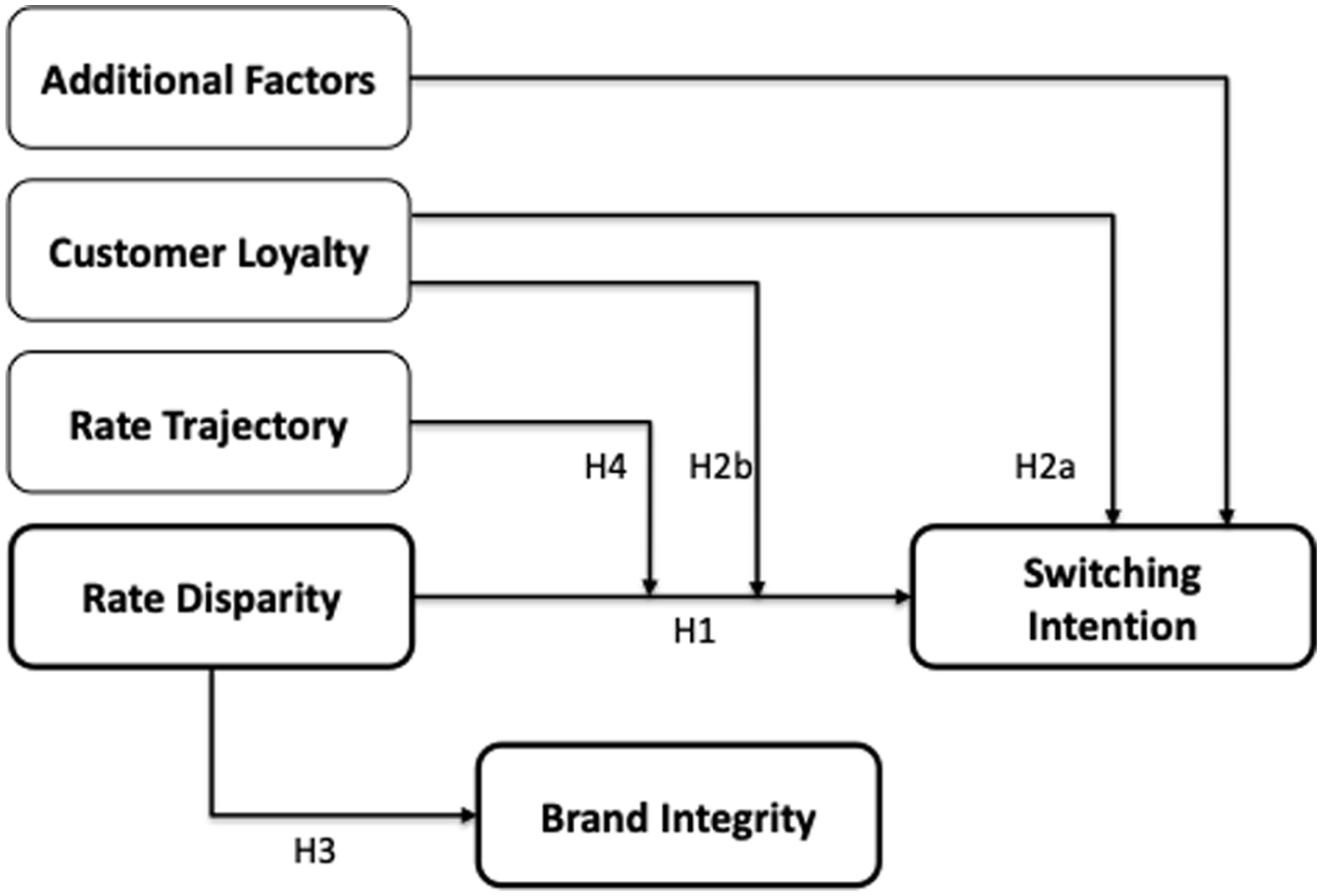
Integrated conceptual framework for the analysis of rate disparity, brand integrity, and switching intentions.
Methodology
Data
Data for this study were collected from Chinese hotel consumers through an online survey administered via Sojump.com (now wjx.cn), the largest online survey platform in China. This platform is widely used in academic research (e.g., Fong et al., 2017; Sun et al., 2020; Wen et al., 2017). Participants were recruited via convenience sampling without demographic or geographic targeting, although they represent a broad spread across China. All had prior experience booking hotels online. Informed consent was obtained, and the study was approved by the university’s Institutional Review Board.
Respondents were presented with a hypothetical scenario in which they were planning a leisure trip and discovered that their preferred hotel was priced at CNY 500 (US$70) on their usual booking channel. They were also informed that the same room was available at a lower price on alternative platforms. Following this scenario, participants were asked a series of questions to assess their intent to switch to the less expensive OTA, the minimum price difference (threshold) that would prompt such a switch, and the extent to which the price disparity would lead them to question the integrity of the hotel brand.
To test the moderating effect of price trajectory information (Hypothesis 4), we employed a between-subjects experimental design. Some participants were randomly assigned to one of two mutually exclusive groups using the built-in randomization mechanism within the survey platform—specifically, whether the current CNY 500 price was higher or lower than the historical average for a comparable period. A control group received no such information. This randomization was executed via the platform's built-in mechanism to ensure balanced group sizes and internal validity.
The dependent variables in this study include:
The intention to switch from their preferred booking channel to a cheaper alternative
The price point (switching threshold) that triggered the switch
Whether the respondent perceived a loss of brand integrity due to price disparity
The minimum level of price disparity required to raise such concerns
Whether awareness of price trajectory influenced the switching threshold
Independent and control variables used in the main hypotheses and analyses are summarized in Table S1 (see the online supplemental material).
The reference price of CNY 500 was selected based on Trustdata (n.d.), which identifies it as the most common and acceptable price among key consumer segments, including young professionals and middle-aged business travelers. This aligns with Ling et al. (2021), who used the same benchmark in their study on Chinese hotel booking intentions. A round number like CNY 500 also reduces cognitive load and avoids complications from odd-pricing strategies. Prior research (e.g., Wadhwa & Zhang, 2015) suggests that whole numbers can also enhance emotion-driven purchasing intentions, making this price suitable for scenario-based studies.
A total of 558 responses were collected through the online survey between January and March, 2023, of which 430 (77%) were deemed usable and included in the final analysis. The descriptive statistics for the respondents' demographics and other variables are presented in Table S2 (in the online supplemental material). Roughly half of the respondents (204) were presented with price trajectory information: 103 were told that the historical price in the comparable period was lower than the current price (an upward price trajectory), while 101 were told that historical price was higher than the current price (a downward price trajectory).
Control measures were applied before and after data collection. The questionnaire was pilot-tested to ensure clarity and minimize misinterpretation. Post-survey screening excluded inattentive or implausible responses, such as those completed in under 30 seconds.
Analysis Models
Empirical analysis included ANOVA, proportion tests, and polynomial regression models. All statistical analyses were conducted using Stata (Version 15) and SPSS (Version 26), and charts were drawn using Excel. Calculus-based estimations of inflection points values and the corresponding thresholds on the fitted non-linear curves, were performed using Mathematica (Version 14.2.)
Findings
Out of 430 valid respondents, approximately half (n = 212, 49.3%) indicated a willingness to book a hotel through a channel other than their preferred one if a lower price was available. Additionally, 259 respondents (60.2%) reported that the presence of price differences (rate disparity) might lead them to question the integrity of the hotel brand. A majority of respondents also self-identified as loyal: 263 (61.2%) to their preferred booking channel(s), and 260 (60.5%) to a specific hotel brand.
Hypothesis 1: Switching Intentions and Rate Disparity
H1—that switching intentions are associated with rate disparity—is supported by the data. A more detailed analysis is shown in Figure 4, which charts the relationship between discount levels and switching rates, using cumulative data. A fitted cubic model reveals a non-linear relationship, following an inverse sigmoid, that is, a reverse S-shaped pattern:

The specific regression coefficients and significance levels are summarized in Table S3 (in the online supplemental material). The curve estimation yields F(3,16) = 424.77, p < .001, with an R2 = 0.99, and a large effect size (Cohen's f2 = 79.65; Cohen, 1988), indicating that approximately 99% of the variance in switching intentions is explained by the model. This provides strong support for H1: rate disparity significantly influences consumer switching, and the relationship is non-linear.
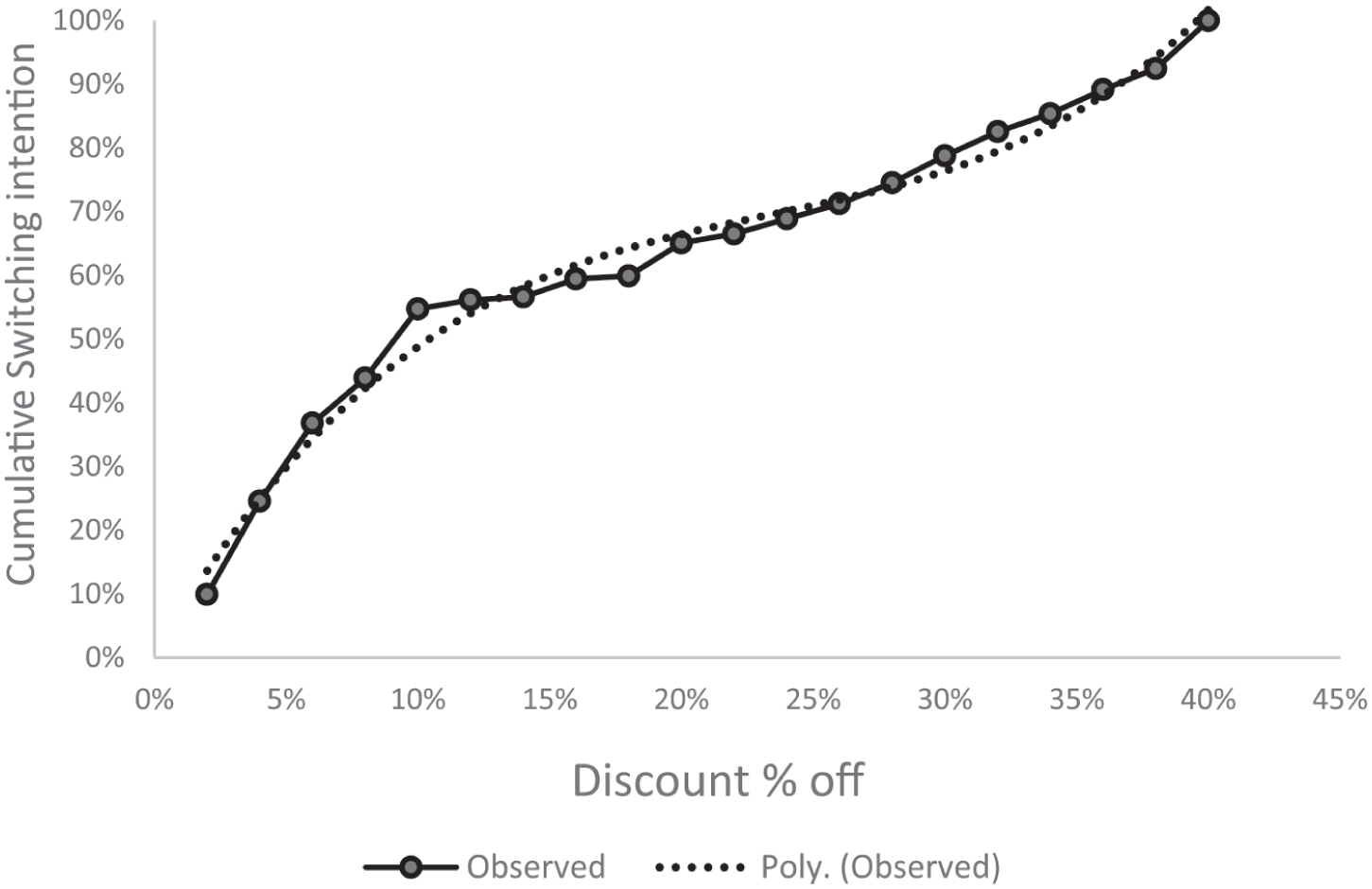
Consumers’ switching intentions given rate disparity levels (discount).
Switching Intention Interpretation
These findings offer first novel empirical evidence for the dual forces influencing customer switching and their somewhat counterintuitive impact on switching intentions. Specifically, the components of Equation 7 reflect both the attraction to lower prices and the hesitation due to perceived risk (e.g., "too good to be true"). The positive effects ("Pull" Factors), that is, the increased intent to switch due to discounts, are captured by the terms (38.408x3 + 7.146x), while the negative effect ("Push" Factors) is represented by the term (-26.896x2). To further validate this behavioral interpretation, we conducted nested model comparisons using F-tests. The quadratic term’s contribution is statistically significant, with F(1,17) = 6.45, p = .021, indicating that the inclusion of X2 improves model fit at the α = 0.05 level. The cubic term provides a highly significant incremental contribution, with F(1,16) = 54.71, p < .001. These results confirm that both higher-order terms offer statistically robust improvements in explanatory power, justifying their inclusion in modeling intentional responses to rate disparity, as a linear model would fail to capture the "tipping points" where perceived risk begins to offset economic gain.
While the coefficients appear large in scale, they are estimated on discount percentage values (0% <X< 100%), and are therefore appropriate. The significant linear (β1) and quadratic (β2) terms capture the initial sharp increase in switching intentions and the subsequent hesitation phase, forming an inverted-S pattern. The dominant cubic term (β3) is essential to model the late-stage rebound at high discount levels, completing the non-monotonic response curve. This structure reflects a progression from price sensitivity to skepticism, with the cubic term providing the final behavioral adjustment beyond what a quadratic model can capture. Due to scaling, the inverse sigmoid shape of the middle line in Figure 5 (that represents the full model) is less visible compared to Figure 4.
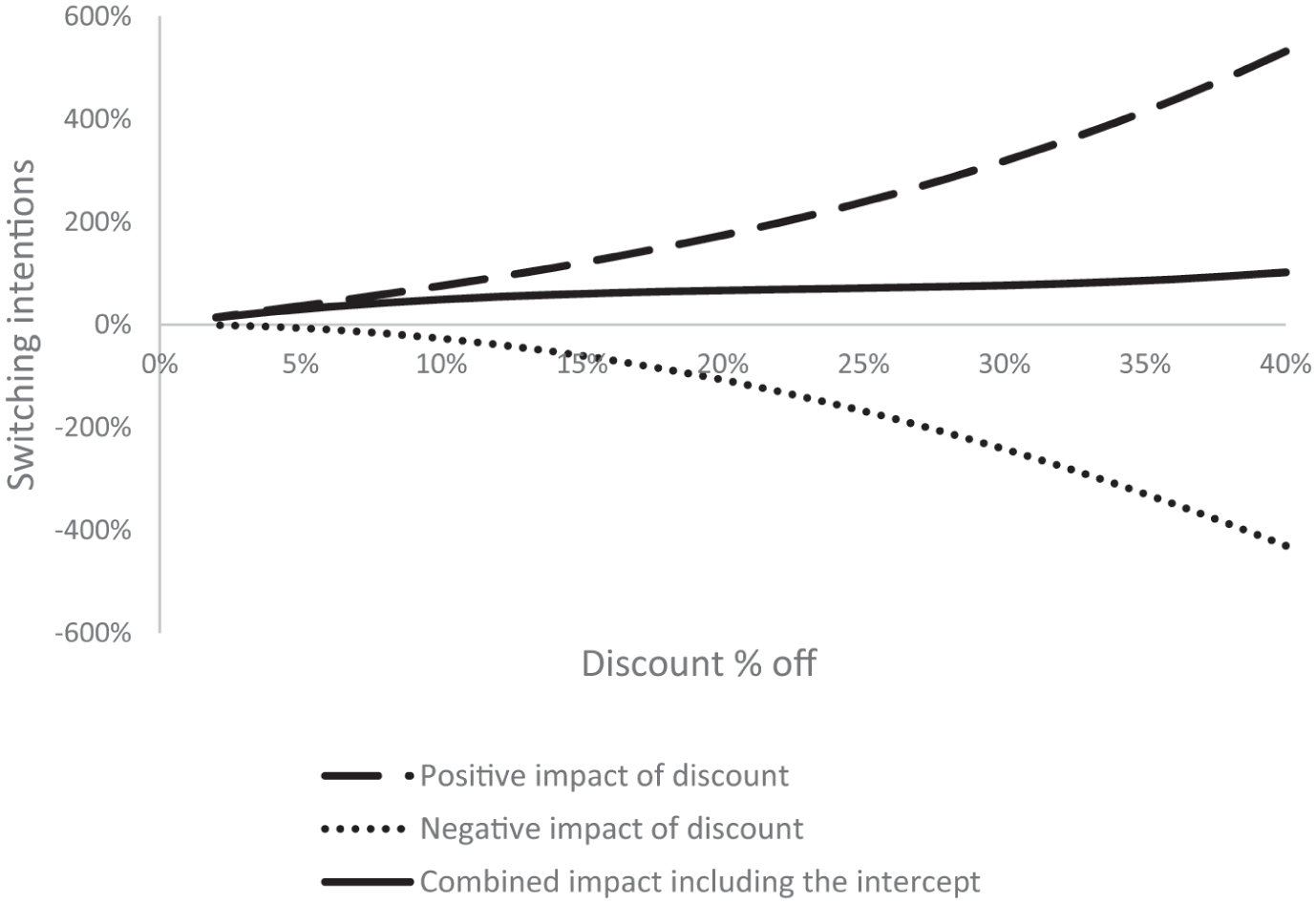
The positive and negative impact of rate disparity on channel switching intentions.
Shape and Inflection
The inverse sigmoid shape observed here is relatively rare in economics and consumer behavior, where standard S-shaped curves are more common. At lower discount levels, the intent to switch increases rapidly before leveling off. Notably, 116 switches occurred within the discount range of CNY 450–490, corresponding to a 2%–10% discount. This means that nearly 55% of all switching occurred at discounts up to 10%.
The inflection point (where the curve transitions from concave to convex) is calculated by setting the second derivative of Equation 7 to zero:

In this case:

The inflection point is roughly at the 23% discount level, representing the transition where the negative effect of skepticism and perceived risk begins to subside, and the strong, accelerating economic incentive (captured by the cubic term) dominates the switching decision once more. At this discount level, the consumer has likely rationalized the massive disparity, or the potential savings have become so significant that they completely overwhelm the residual quality concerns. Note that the portions of the positive and negative lines that are above a 100% switching rate are, of course, hypothetical. On the other hand, the full model is within the realistic bounds of a 0%–100% switching rate.
Hypotheses 2a and 2b: Loyalty and Switching
Hypotheses 2a and 2b were not supported. That is, the data did not confirm the expectation that loyal customers possess a lower intent to switch channels or require a higher discount to consider switching. Among the 430 observations, 263 respondents identified themselves as loyal to a particular channel. Of these, 138 (52.5%) indicated an intent to switch at an average switching threshold of CNY 420 (US$ 60). In comparison, among the 167 respondents who reported no channel loyalty, 74 (44.3%) were willing to switch at an average price of CNY 413 (US$ 59).
Statistical analysis revealed no significant differences between the two groups. A two-tailed proportion test showed no significant difference in the percentage of respondents exhibiting an intent to switch channels, and an ANOVA test found no significant difference in the required discount levels (p < 0.45).
Hypotheses 3: Rate Disparity and Brand Integrity
Hypothesis 3, which posits that discounts may trigger doubts about a brand’s integrity, was supported. Figure 6 charts the relationship between discount levels and brand doubt and is based on cumulative data. Interestingly, like the switching intentions modeled earlier with H1, this relationship is nonlinear and is best described by an inverse sigmoid function. The fitted curve is given by Equation 10, with an inflection point at approximately a 25% discount:

D represents the cumulative percentage of respondents experiencing brand doubt, and X denotes the level of rate disparity. The detailed coefficients, standard errors, and significance levels for the model are summarized in Table S4 (see the online supplemental material).
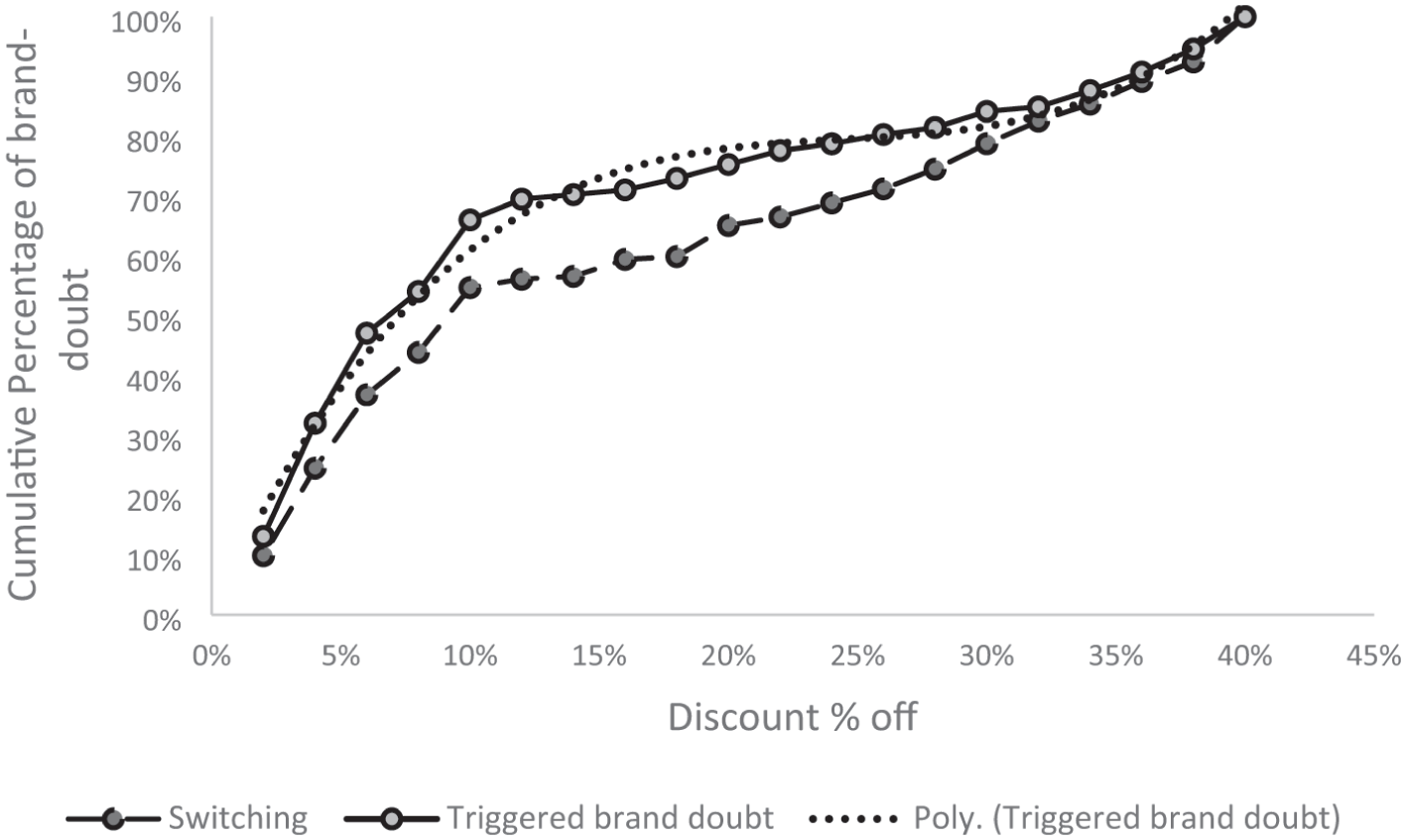
Triggered brand-doubt and channel switching intentions given room rate discounts.
The curve estimation yields a highly significant overall model: F(3,16) = 383.96, p < .001, with an R² = 0.986 and Cohen's f2 = 71.99 (Cohen, 1988), indicating that approximately 99% of the variance in brand doubt is explained by the model. Like Figure 4, the cubic term (β3 = 50.19) is essential for modeling the late-stage rebound in skepticism at higher discount levels, where excessive price cuts may trigger concerns about authenticity or deceptive practices. Crucially, nested F-tests confirmed the highly significant incremental contributions of the higher-order terms, thereby validating the use of the cubic form over simpler alternatives: the addition of the quadratic term was significant, F(1,17) = 15.50, p < .001, and the subsequent addition of the cubic term was also highly significant, F(1,16) = 97.75, p < .001. The reliability of the individual coefficients was further confirmed, with the β1, β2, and β3 all showing high statistical significance (p < .001).
Notably, while the patterns of switching intentions and brand doubt are very similar, the level of brand doubt is consistently higher than that of the switching behavior. A paired-samples t test revealed a significant difference between the average levels of brand doubt and switching intentions (t(19) = 19.1, p < .001), confirming that, for any discount level given, a greater proportion of respondents reported concerns about brand integrity than those who indicated they will consider switching to the cheaper distribution channel. On average, the difference is close to 8 percentage points for every discount level. 1
The reason behind this consistent difference along the entire range of rate disparity is yet to be investigated. One possible explanation is simply that skepticism is a low-cost cognitive response, while switching is a higher-cost behavioral commitment hence more respondents express doubt than willingness to switch at each level.
H4: Price Trajectory and Switching
H4, which posits that price trajectory moderates the effect of rate disparity on consumers’ channel switching intentions, is partially supported.
Among the 226 respondents who were not presented with price trajectory information, 108 (47.8%) indicated an intent to switch channels due to rate disparity. This compares to 51% among respondents who were presented with price trajectory information (either an upward or downward trend). However, this difference is not statistically significant at the 95% confidence level, based on a two-tailed Z test.
Further analysis revealed no significant difference between the effects of upward and downward price trajectories. Of the 103 respondents exposed to an upward price trajectory, 49 (47.6%) indicated they would switch channels, compared to 55 (54.5%) among those exposed to a downward trajectory.
Partial support for H4 emerges when examining the discount required to motivate channel switching. Respondents who did not receive price trajectory information required an average discount of CNY 429 (approximately US$61) (14% off) to change their booking channel. This was significantly smaller than the average discount of CNY 405 (19% off) required by those who were informed about the price trajectory (p < .01), indicating that the presence of price trajectory information raises the price threshold required to induce channel switching. Nonetheless, there was no statistically significant difference between the discount levels required by respondents exposed to upward versus downward price trajectories.
Discussions and Implications
This study finds that rate disparity plays a significant, non-linear role in influencing consumers’ channel-switching intentions. Approximately half of respondents were willing to book through an alternative channel if a discount was offered, and the relationship between discount size and switching followed an inverse sigmoid pattern. Specifically, modest discounts (particularly in the 2%–10% range) prompted a substantial portion of switching, but the effect plateaued before rising again near a 23% discount threshold. This pattern reveals distinct behavioral zones that offer actionable guidance for hotel managers:
High efficiency zone (2%–10%): Discounts in this range are highly effective at driving switching intentions with minimal psychological resistance.
Inefficiency zone (10%–20%): Offering discounts in this range is markedly inefficient, as the switching incentive flattens due to heightened brand skepticism.
Rebound zone (> 23%): Only when discounts exceed the calculated inflection point of 23% does the intent to switch begin to rise again, suggesting that deeper incentives are required to overcome consumer doubt at higher disparity levels.
Notably, rate disparity also significantly eroded perceptions of hotel brand integrity, with the share of respondents expressing such concerns consistently exceeding those intentions to switch by approximately eight percentage points at every discount level. This discrepancy reflects a fundamental insight: brand skepticism is a low-cost cognitive response, making it a more prevalent reaction than channel switching, which is a higher-cost behavioral commitment. This unique connection advances theory by addressing the underexplored link between pricing strategy and brand perception, highlighting that hotels incur a widespread and subtle reputational cost even when rate disparity successfully drives booking switching.
Loyalty, whether toward a booking channel or a hotel brand, did not meaningfully buffer consumers against switching intention, nor did it increase the switching threshold required to induce switching. This suggests that the immediate economic incentive of a discount is potent enough to overcome the relationship capital provided by current online channels’ loyalty programs in a highly transparent market. By contrast, price trajectory information partially moderates the rate disparity effect. While it did not alter the proportion of consumers willing to switch, it increased the average discount required to trigger switching, suggesting that contextual knowledge of price trends can make consumers more discerning and raises the switching threshold. Collectively, these results highlight the nuanced interplay between economic incentives and psychological responses: price discounts can drive tangible behavioral change, but they also carry potential reputational risks for hotel brands.
S-shaped curves are well-documented across economics, consumer behavior, marketing, and psychology. This research, however, identified a mirror image of that pattern: A counterintuitive inverse sigmoid. One plausible explanation is the existence of two distinct customer segments differing in risk preferences: a highly price-sensitive group (represented by the concave portion of the curve) and a more risk-averse group (represented by the convex portion). While this segmentation remains a conjecture requiring further empirical validation, it suggests potential opportunities for profitable price discrimination by tailoring offers to each group’s behavioral profile. This discovery directly challenges linear assumptions in multi-channel pricing models and provides a more nuanced understanding of how high-disparity environments trigger competing psychological heuristics.
In summary, this study advances theory by extending research on consumer switching intentions in multi-channel environments, introducing and empirically testing a non-linear model of how discounts influence channel switching, and integrating pricing strategy with branding theory. It uniquely connects rate disparity to brand trustworthiness and perceived value, addressing an underexplored link between price disparity and brand perception. Practically, it provides hotel managers, OTAs, and policymakers with evidence on how rate disparity shapes booking behavior, brand perception, and regulatory considerations, offering guidance on pricing strategies, platform design, and policy debates. The findings on brand integrity also offer actionable insight into how hotels can balance pricing consistency with online visibility, leveraging discounts strategically without undermining brand equity.
Future Research Directions
The inverse sigmoid pattern uncovered in this study opens promising avenues for further investigation. Future research could test the proposed segmentation hypothesis directly, using experimental or longitudinal designs to assess how price sensitivity and risk preferences interact in shaping channel-switching intentions. Additional work could explore how these patterns vary across cultural, demographic, or situational contexts, as well as the role of competing factors such as loyalty program benefits, perceived service quality, and platform usability. Moreover, integrating behavioral economics approaches—such as framing effects and reference price theory—could help explain why certain discount thresholds prompt sharp behavioral changes while others do not. Such studies would not only validate and refine the current model but also enhance its applicability for dynamic, data-driven pricing strategies in the hospitality sector.
Limitations
While we utilized an experimental design to test specific hypotheses, it is crucial to acknowledge that the reliance on hypothetical scenarios and self-reported survey responses inherently limits the external validity of the findings. Survey responses may not always be an accurate predictor of real-life purchasing behavior. The actual decision-making process of consumers can be influenced by various factors other than the impact of price differences, such as personal preferences and the availability of alternative options.
Second, the study employed a convenience sample of Chinese consumers, which, despite geographic diversity, limits the generalizability of the findings to other national or cultural markets. Given the unique digital and pricing landscape of the Chinese online travel market, the observed channel switching intentions and the strong susceptibility to brand doubt may not translate directly to Western markets.
Therefore, while the study offers robust insights into consumer intentions, its conclusions should be interpreted carefully and ideally strengthened by supplementing them with other types of data, such as actual booking data, to obtain a more complete understanding of this topic.
Supplemental Material
sj-docx-1-jht-10.1177_10963480261451775 – Supplemental material for When Price Varies Across Otas: How Room Rate Disparity Shapes Switching Behavior and Brand Trust
Supplemental material, sj-docx-1-jht-10.1177_10963480261451775 for When Price Varies Across Otas: How Room Rate Disparity Shapes Switching Behavior and Brand Trust by Ling Ling, Chih-Chien Chen and Zvi Schwartz in Journal of Hospitality & Tourism Research
Footnotes

Ethical consideration
This study was approved by the Institutional Review Board (IRB) of the University of Delaware.
Funding
The authors received no financial support for the research, authorship, and/or publication of this article.
Declaration of Conflicting Interests
The authors declared no potential conflicts of interest with respect to the research, authorship, and/or publication of this article.
Supplemental Material
Supplemental material for this article is available online.