







Abstract
Research shows how sexualized violence is moving online and becoming digitalized; however, little is known about the relationship between the manosphere and sexualized violence. This paper aims to explore how content with and about sexualized violence manifests in the Danish manosphere and advance our understanding of conditions conducive to this. Based on a (n)etnographic study in the Danish manosphere, the paper shows that content with and about sexualized violence is present in two ways: Firstly, in leak communities, where sharing sexual imagery of women without consent seems governed by a feeling rule of misogyny. Secondly, in men’s rights communities where critique of #MeToo and the consent-based rape law seems governed by a feeling rule of himpathy. With the concept cathartic shaming the paper suggests how distinct communities may share the use of ridicule and condemnation of women to reduce feelings of humiliation, shame, injustice and unfairness rooted in social expectations about hegemonic, heterosexual masculinity.
Introduction
Despite the global #MeToo movement’s attempts to address the problem of sexualized violence, a growing body of literature has explored how harms of this nature continue and are becoming digitalized and moving online (e.g. Hall, Hearn, and Lewis 2023; Powell and Henry 2017). Some studies also show that attention to the gendered problem of sexualized violence both before and after #MeToo generates backlashes – particularly in online communities colloquially known as ‘the manosphere’ (Gotell and Dutton 2016; Hansson, Sveningsson, and Ganetz 2024). The manosphere is an emic concept popularized by former porn marketer Ian Ironwood’s book The Manosphere: A New Hope for America (Ging 2017). In academia, there seems to be no universal definition of the concept, but a unison understanding that it refers to websites, blogs, and online communities of disparate groups with a somewhat shared belief that Western society has become ‘feminized’, and that feminism has had negative consequences for men and masculinity (Ging 2017; Ribeiro et al. 2021; Van Valkenburgh 2021). This worldview is referred to as The Red Pill philosophy (TRP) (Ging 2017).
Whilst parts of the manosphere are seen as having the potential to foster radicalization (Gerrand et al. 2025; Regehr 2022; Ribeiro et al. 2021), little is known about how sexualized violence manifests within the manosphere and what contributes to this. As a country in which gender equality is considered a national value, Denmark makes up an interesting socio-cultural context to explore this in. Denmark presents a seemingly empirical paradox, ranking second on the European Equality Index despite relatively small gender gaps in access to areas such as work, political power, health and lifelong learning (EIGE 2024), yet national prevalence studies continue to show that sexualized violence disproportionately affects women compared to men (Deen et al., 2018; Helweg-Larsen, Schütt, and Larsen 2009). In the most recent national study, 12.4 percent of the young women aged 16 to 24 had in the past year experienced some form of sexual abuse, compared to 2.5 percent of the young men (Algren and Laursen 2022). This suggests that formal gender equality has not extended to the sexual domain. This is supported by the critical reception of the MeToo movement in Denmark in 2017, which framed it as a threat to (sexual) liberal mindedness (Juncker 2022). However, a shift was seen during the second wave in 2020, during which a consent-based rape law was passed and came into effect from January 2021. The law replaced a definition of rape based on ‘force by violence, threat or other form of illegal coercion’ and exploitation of a person ‘unable to resist the abuse due to e.g. unconsciousness, intoxication or deep sleep’. In the new law, rape is defined as ‘coitus with a person who has not consented to this’ (MoJ 2020). Whilst the law was passed by a unanimous Danish Parliament, it has since been met with criticism from right-wing politicians.
This paper contributes to the limited research of the relationship between the manosphere and sexualized violence by exploring how content with and about sexualized violence manifests in the Danish manosphere and theorizing conditions conducive to this. Based on previous research, sexualized violence is understood here as acts of unwanted sexualization that disregard a person’s vulnerability, needs and dignity, essentially involving being made a sexual object for the benefit and under the power of another. To grasp the complexity of the experiential dimension of sexualized violence, it can be understood as a continuum of different forms of actions that may shade into one another sharing these same underlying characteristics (Johansen 2019, 14; Kelly 1988, 76ff).
Previous Research on Sexualized Violence and the Manosphere
During the past 10 years, studies have explored how the increasing digitalization of our society and the introduction of smartphones have enabled new forms of sexualized violence. Meanwhile, Web 2.0 has exacerbated the effects of violent acts (e.g. Henry and Powell 2016; McGlynn and Rackley 2017). Sexualized violence is no longer confined to a particular situation but can move between offline and online spaces over time (Hall, Hearn, and Lewis 2023; Johansen and Tjørnhøj-Thomsen 2024). In studies of the manosphere, misogyny is a recurring theme, although its meaning is often taken for granted and rarely defined but rather used to refer to some form of ‘extreme views against women’ (e.g. Dickel and Evolvi 2023; Ging 2023a; Ging 2023b). Large-scale quantitative studies suggest that misogyny and violence against women are becoming prevalent in manosphere communities. Hence, Ribeiro et al. (2021) identify a migratory influx of users to communities that display more ‘misogynistic attitudes’, and Farrell et al. (2019) note that content with violent attitudes – including sexualized violence – is more widespread on newer manosphere communities such as incels (involuntary celibate). Several mass-shooting cases committed by men who are active in incel communities has created a link between TRP philosophy and offline perpetration of violence (Regehr 2022), although this relationship may not be causal in itself. Moreover, Ging (2023b) describes how sharing of sexual imagery without consent functions as a currency in parts of the manosphere such as 4chan/b, which suggests a link between some manosphere communities and a particular form of sexualized violence perpetration.
A systematic review of studies on the manosphere across social media platforms shows that few studies focus specifically on sexualized violence; however, several identify ‘rape culture’ as a theme (Rollano, Pérez-González, and Román-González 2025). The few qualitative studies conducted on sexualized violence and the manosphere show how it may appear in different forms. Whilst members of MRA communities may question statistics of rape and position men as victims of ‘misandry’ when rape prevention campaigns target young men (Gotell and Dutton 2016), members of PUA communities may share ‘ethically dubious’ strategies to have sex and overcome women’s ‘last-minute resistance’ (Di Carlo 2023; O’Neill 2018, 102ff). This highlights two different ways in which the manosphere may be a source for challenging what counts as rape and thereby question the basis of women’s experiences (Di Carlo 2023; Dickel and Evolvi 2023; Gotell and Dutton 2016). Two studies exploring how the MeToo movement is portrayed in different manosphere communities show that women’s account of sexualized violence is presented as untrustworthy or exaggerated and some members claim that the movement may ‘potentially destroy men’s lives’ (Dickel and Evolvi 2023, 1402) and advocate for legal procedure (Hansson, Sveningsson, and Ganetz 2024). Hence, a discourse framing men as the ‘real’ victims of ‘feminist demonization’ can be found across different manosphere sites (Hansson, Sveningsson, and Ganetz 2024, 184; Dickel and Evolvi 2023).
A gap in the current literature seems to be what may be conducive to the presence of content with or about sexualized violence in manospheric communities. This paper seeks to address this gap by offering an explanatory perspective, combining online content with experiences of Danish men who participate in such communities.
Theoretical Perspectives
To explore (1) how content with and about sexualized violence manifests in the Danish manosphere, and (2) what conditions may be conducive to this, I aim to link the emotional and social element of practice. The emotional element of practice rests on the critical realist assumption that we as humans are sentient, social beings vulnerable to harm and concerned about our dignity, which makes our motivations to act about more than a reciprocal relationship between agency and structures (Sayer 2011, 139–140). The social element of practice rests on the social constructionist assumption that our actions are partly influenced by social structures that manifest in, for instance, social expectations. Our emotions are a ‘bodily commentary’ on matters of our concern (Sayer 2011, 39), but they can also be fallible and, as Hochschild (1990) argues, shaped by social expectations – feeling rules – that influence how we feel in a given social context.
The manosphere is a diverse cultural context with their own ‘emotional cultures’ influenced by TRP philosophy and hegemonic, heterosexual masculinity (Gordon in Hochschild 1990, 124; e.g. Cosma and Gurevich 2020; Flood 2008). Following Kimmel (2016 [1994]), masculinity can be conceived as a set of social rules that both reinforce hegemonic power and leave men vulnerable to shame when they are unable to live up to social expectations of being masculine in certain ways (see also Connell and Messerschmidt 2005; Gilligan 2000; Hochschild 2024). Hence, masculinity is a homosocial enactment in which ‘manhood is demonstrated for other men’s approval’ (Kimmel 2016 [1994], 64). In this study, some men express feelings of injustice, unfairness, shame and humiliation in the content with and about sexualized violence. These feelings suggest, firstly, how men experience their gender identity through the eyes of other men and society (Kimmel 2016 [1994]) and secondly how social expectations can confront men with their human vulnerability and influence their sense of dignity (Sayer 2011, 168; Hochschild 2024). Based on this theoretical outset, I have developed the concept cathartic shaming to grasp what may be conducive to part of the content with and about sexualized violence in the Danish manosphere. Cathartic shaming refers to the release of shame-like feelings through public ridicule and condemnation of women to restore a sense of male dignity. The concept offers an explanatory interpretation of distinct acts of social shaming employed to reduce feelings of injustice, unfairness, shame and humiliation rooted in social expectations about hegemonic, heterosexual masculinity. Hence, cathartic shaming links the emotional and social element of practice and seeks to extend descriptive concepts of misogyny and himpathy by suggesting the grounds for the development of men’s feelings of shame and their power to transform into actions.
Methods
Overview of the amount of empirical material divided by the source
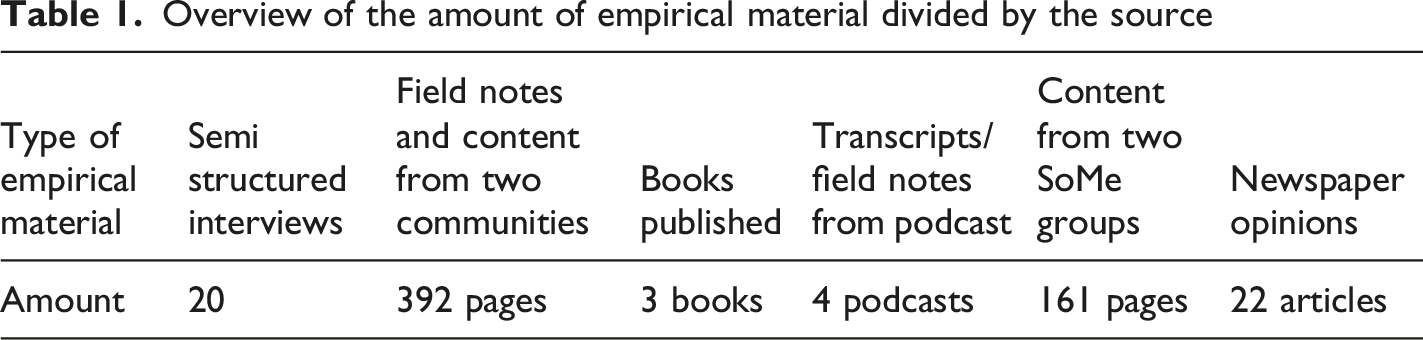
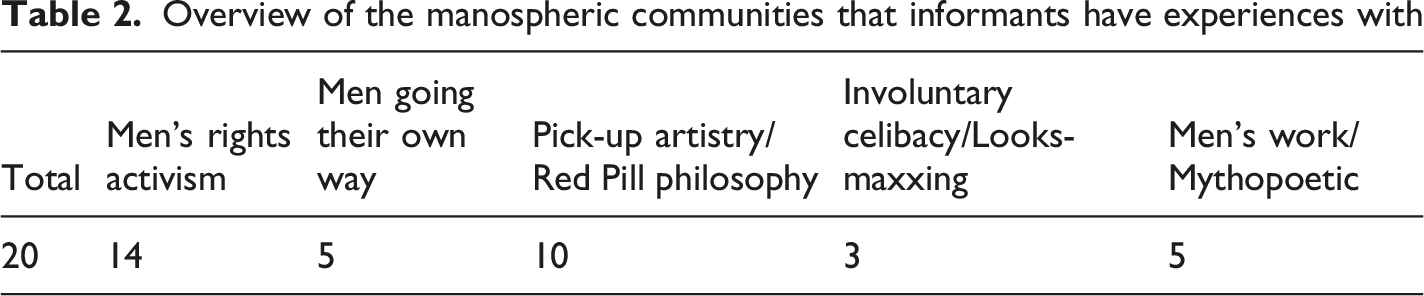
In MRCs, the content is not with but about sexualized violence, such as opinions related to rape and sexual harassment. In LCs, the content is sexual images and videos of women without consent and this has similarities with parts of core communities such as PUA (O'Neill 2018), certain 4chan boards and some incel communities (Ging 2023b; Tranchese and Sugiura 2021) as well as online forums for ‘sex purchasers’ that have been referred as manospheric with regards to objectification of women, disregard for consent and bonding over ‘feeling their masculinity is persecuted’ (Tranchese 2026; Janson 2023, 716). Contrary to the Danish MRCs that seek public exposure to communicate their viewpoints, the LCs depend on member anonymity and a shared agreement of secrecy. The LCs and MRCs represent distinct communities and the content renders no direct ideological link between them. Yet, they seem to share expectations about men’s sexual freedom such as the sexual double standard, that is rooted in the gender ideology of the manosphere with the MRCs as a core community and the LCs a periphery community (Cannito et al., 2021). Moreover, in both communities, ridicule and condemnation of women takes place indicating shared emotional mechanisms across the communities.
Semi-structured interviews with Danish men served to give voice to experiences with different parts of the manosphere, what motivated their engagement and how they related to the content here. Informants were recruited via multiple recruitment strategies all approved by the University’s Research Ethics Committee (REC). The strategies included advertising and reaching out to men and anonymous Danish users in online communities. Finally, a few interviewees had discovered the website of the project by coincidence and reached out to me with an interest in participating.
Overview of the manospheric communities that informants have experiences with
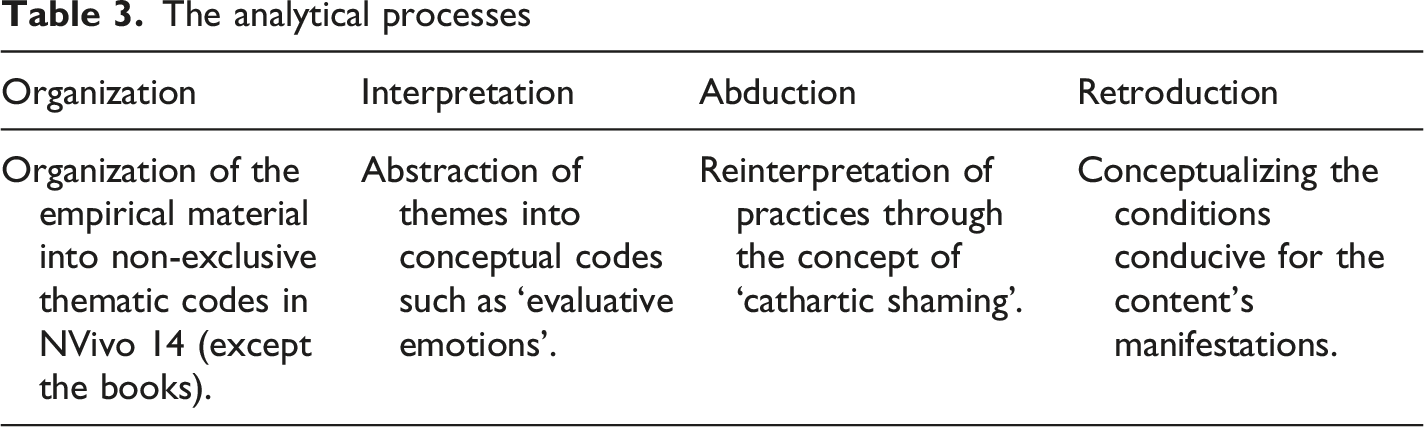
The analytical processes
The project adheres to national regulations, GDPR and the social media’s respective Terms of Service/Use (ToS/U). Informed consent was obtained from all informants and personal online content, except for anonymous users in the two LCs, as observations here were kept anonymous to ensure my safety. To ensure maximal cloaking and anonymity, the empirical excerpts have been translated into English, and details that could reveal an identity or platform have been altered. The National Police of Denmark and the Department of the Public Prosecutor were contacted for advice on the legislation involved in accessing the LCs.
Findings
The findings are presented in three sections. The first section explores how sexualized violence is practised both in imagery and writing in LCs. The following two sections explore MRCs’ critique of #MeToo and the Danish consent-based rape law, with interviewees distancing themselves from sexualized violence against women.
LCs’ Homosocial Objectification of Women
The primary content of the two LCs are photos and videos of women in underwear, naked or during sex, along with chat messages from a minority of the members. Some images or films can be characterized as pornographic and could be produced by women themselves for OnlyFans (OF), with a partner or possibly recorded without the woman knowing. Other images and films were taken without the woman knowing – commonly referred to as ‘creepshots’, such as those taken in secret at the beach, or ‘deepfakes’, where non-nude content is digitally altered into sexualized imagery. Both LCs had a set of rules stating, for instance, the collective responsibility for sharing nude imagery content of so-called ‘non-fat’ Danish/Scandinavian ethnic women and prohibiting any material involving children. The findings are presented in two sections exploring firstly; the use of shame to establish male hierarchies and secondly; the use of shame to establish male entitlement.
‘As Virgin as You’ – Establishing Male Hierarchies Through Shaming
Whilst most of the written content are about women, commentary by the vocal members indicate that they represent different age groups, ethnicities and geographical regions. Members never reveal any personal identifiable information, yet some do refer to a type of work, a city or make references to an age group or ethnicity. References include words that need to be decoded among members, such as when one member does not understand the word ‘legit?’, to which another replies: “Young people’s word for ‘really’.” Another example is anti-immigration attitudes echoing right-wing politics.
This excerpt indicates that different ethnic backgrounds are present in the group and the racist slur ‘paki’ illustrates attempts to establish an ethnic hierarchy among members based on ingroup ridicule and shaming. Besides ethnicity, virginity and the lack of sexual experiences with women is used to shame members. In line with previous studies on hegemonic, heterosexual masculinity this is a recurring means of shame, just as heterosex can be a source of homosocial bonding between men (Flood 2008; Janson 2023). Several men discuss paid interactions with women for instance through OF, prostitution or grooming. This indicate that some men may be unsuccessful in intimate contact with women unless transactional, and this could mean that the men across ethnic, age and geographical diversities share a sense of male inadequacy in relation to the sexual domain. Different preferences with regards to women’s looks and forms of sex or abuse material can also be a source of ingroup shaming. [shortened]
As this exchange illustrates, there seems to be a shared understanding of the reason for being in the group as access to otherwise unattainable women’s bodies. An exception, however, is women who sell ‘nudes’ or sexual films, whose status is consequently lower than that of other women. It also illustrates the recurrent practice in the two groups of ranking women’s (and men’s) looks on a scale from 1 to 10, which is a practice known from manospheric communities. Finally, it shows how age-specific references may be a means to ridicule other members’ preferences or wording. Moreover, homosexuality is used as an insult, as this reaction, from a member who got banned, illustrates: ‘Oh, this gives you some power in your gay life?’. This suggests that homophobia may work as a homosocial enactment of hegemonic, heterosexual masculinity (Kimmel 2016 [1994], 65).
Based on this it seems possible that some of the men share a sense of failure in relation to a hegemonic masculinity ideal about heterosex (Lamb et al., 2018). An ideal where sexual expectations honour a gendered sexual double standard (Powell 2010).
‘All Women Are Whores’ – Establishing Male Entitlement Through Shaming
The written content about women in the LCs reveal the emotional culture of the groups and in particular the feeling rule when it comes to women. The written content can be divided into six themes: (1) requests for named women or women from particular cities or regions; (2) requests for folders or leak communities; (3) evaluation of the quality of images and films, women’s looks and OF accounts; (4) recommendations of prostitutes and where to find women to pay for sex; (5) technical advice for hacking access to images and, finally, (6) requests for particular abuse material. Most of the content centres on themes 1 and 2; however, what all six themes seem to have in common is a feeling rule of misogyny. Following Hochschild (1990, 122), feeling rules are ‘rules about what feeling is or isn’t appropriate to a given social setting’ – in this case, the LCs. Misogyny here refers to ‘a feeling of enmity towards the female sex’, which finds expression in the online practices and in how men relate to one another within these communities (Gilmore 2010, 9).
Women are being referred to as ‘meat’ and called ‘dumb’ or ‘little’, ‘whores’, ‘bitches’, ‘cum sluts’, ‘cheap hooker’, ‘skank’, ‘twat’. Occasionally, the derogatory terms intersect with racist slurs such as ‘nigga’ or ‘black slave’. Furthermore, women are described as being ‘fucked’, indicating that women are passive sexual objects to be used. The feeling rule of misogyny seems to establish through the repeated use of these terms, the nonconsensual sharing of sexual imagery and the evaluation of women’s body parts – othering women as an undifferentiated social group and depriving them of individual human dignity: ‘Women with less than a C cup should have been born as men… nonetheless, women are still objects and dumb sluts.’ Women are held accountable to a sexual double standard, where sexual experiences can reflect negatively on them, as illustrated in this quote: ‘She surely looks used’. Hence, vocal members hierarchize women according to how much content is available of them and whether this content is made available by the women themselves, which makes them less desirable. Women’s sex lives are assessed against conflicting social expectations, where they are required to be neither prudish nor ‘cheap’ (Johansen, Pedersen, and Tjørnhøj-Thomsen 2020; Ringrose et al. 2013). Whilst the LC members share OF content and recommend which women are worth buying from, the women selling are despised. Women’s sexuality is thus both the object of desire and disgust, indicating an ‘affective ambivalence among the men towards women (Gilmore 2010, 9). According to Gilmore (2010), misogyny is a ‘sexual prejudice’ that may be acted out in symbolic and ritualistic ways. In line with previous studies, the LC’s practices illustrate how denigration of women can work as a homosocial glue among men, highlighting how hegemonic, heterosexual masculinity is a homosocial enactment in opposition to what is considered feminine (Flood 2008; Scarcelli 2024; Kimmel 2016 [1994]; Bird 1996).
With the sexual double standard members seem to give moral support to the feeling rule of misogyny, which establishes the two communities as a ‘zone […] free of worry, guilt and shame of the situated feeling’ (Hochschild 1979, 565). The feeling rule becomes articulated when an outsider attempts to shame one of the members in a message shared in the LC. In the message a man calls the member ‘incel’ and he refers to the member as ‘sad’ because he ‘can’t get any’ implying sex. Whilst this seems to support the interpretation of some men as unsuccessful sexually with women, the shame the man attempts to cast upon the member becomes a moment of homosocial solidarity to reaffirm the feeling rule of misogyny and thereby the sense of masculine entitlement in the community, as illustrated in the following excerpt: ‘I die [laughing crying smileys] a woman’s rights advocate here in the group where we treat women the worst.’ The communities function as spaces ‘to relieve inner turmoil by demolishing it’s source’ through ridicule and condemnation of women (Gilmore 2010, 9), which can be conceptualized as cathartic shaming. [shortened]
The excerpt exemplifies how ridicule of the woman’s looks seems to be an emotional outlet for the men that support homosocial bonding as illustrated by the laughing smileys they use. Cathartic shaming can be interpreted as attempts to restore a sense of male dignity that men have been deprived of by for instance women’s rejections and unfulfilled expectations about sexual experiences. As one member declares: ‘I’m not having any of her [woman in a photo] … the majority of these influencer tarts are just bitches when they are out clubbing.’ This indicates that the man may have had experiences of rejection from these women when meeting them in offline contexts. At times, cathartic shaming is expressed through references to acts of sexualized violence – either by requesting material involving violence against women (such as gore); by cheering content that depicts sexually degrading or abusive acts against women; or by encouraging members to commit rape in the comments to images or videos.
As illustrated in the excerpt, cathartic shaming comes across in the smileys used to ridicule women subjected to sexualized violence. The excerpt shows how some men are aware of the relationship between CSA and sexualized violence in adulthood (see also Papalia, Mann, and Ogloff 2021). Despite the frequent enforcement of banning anyone sharing sexual material of minors, some men seem to find pleasure in the ridicule of CSA. A few members requested access to paedophile hunting groups, yet the interest in young women’s ‘nudes’ and comments such as ‘if it’s not tight, it’s not right’ and ‘prison is only a shelter!’ indicate that the interest in paedophile hunting groups may be less about protection of children and more about an opportunity to humiliate someone with violence, which can also be seen as enactments of hegemonic, heterosexual masculinity (Kimmel 2016 [1994]).
MRCs’ Perception of MeToo as Demonizing Men
Moving from the periphery of the manosphere to the core with Danish MRCs, this section unfolds two problems the MRCs raise about #MeToo: (1) a male injustice and (2) a weaponization of victimhood for women.
How MeToo creates a male injustice
In the MRCs, the feelings of injustice centre on both the social dishonour they find that #MeToo casts on men as potential perpetrators of sexualized violence and the humiliation that individual men experience when they are denied due process in the ‘people’s court’ and are subject to gossip discrediting their good name – possibly permanently. Yes, but this movement is like when a big truck swings to the right and then a bicycle-lady gets in the way […] Okay, it’s a movement, but it also hit some people, maybe also innocent people. The next problem with MeToo is that there’s no legal trial. No defence, prosecution or judges. The woman is just believed offhand. […] It is all based on that the woman is telling the truth. And very often it is not true. (Interview, shortened)
This excerpt illustrates the sense of injustice on both an individual level and collective level against men. Moreover, it illustrates a ‘sexual prejudice’ in the MRC context against women as untrustworthy (Gilmore 2010). Hence, it is both the honour of men as legal persons and individual men’s dignity that is violated by MeToo accusations. The injustice framing is often linked to concrete cases with unnamed or named Danish men that they perceive as unrightfully experiencing an unfair public process based either on false accusations or wrongdoings that they find disproportionate to the consequences it has for the men’s livelihoods (e.g. Banet-Weiser 2021). These cases represent what Hochschild has termed cautionary tales. Cautionary tales are significant episodes from the past that carries meaning for the future and which influence our feelings (Hochschild 1990: 127). In the MRC cases, they may not be personal but rather experiences of other men who serve as cautionary tales of what might happen to men in the future. The ‘tales’ express a community feeling rule of what philosopher Kate Manne (2020, 5) has termed himpathy – the sympathy extended to men who have committed or are being accused off misogynistic acts, at the expense of concern for their female victims. The feeling rule of himpathy seems tied to the men’s sense of being vulnerable to a societal shaming. To start with, as a man I would never dream of committing sexual abuse against a woman, man or child, so being told that, this is typical male behaviour that men think they have a right to women’s bodies, that form of articulation is totally foreign to me. I don’t recognize that at all. That’s why [I find] the rhetoric in the public debate is so dramatic – anti-masculine and demonizing men on all agendas. (Interview)
This excerpt illustrates how individual men’s sense of humiliation can be shaped by how they perceive society to view their identities as men. In line with other studies, the men seem to share a feeling of being subject to a masculinity persecution, which may have ties to the victim narrative central to TRP philosophy (James 2024). The lack of due process influences some MRAs’ perception of MeToo as a ‘feminist conspiracy’ to get rid of certain men – a view that comes across in SoMe comments and opinion-based articles, using metaphors that describe MeToo as an ‘invasive epidemic’, a ‘terror movement’ and a ‘fear-inducing ravage’. […] There lies the uncomfortable truth about the militant feminism’s vengeance against men: Because of a few male psychopaths’ misdeeds, all men now must be demonized – and all women must learn to fear men. (Online post, shortened)
As the post excerpt illustrates, concerns are raised about a new form of feminism seeking ‘revenge’ against all men due to violence perpetrated by a minority. Concepts such as ‘toxic masculinity’ and ‘patriarchy’ are used as examples to ‘demonize’ and ‘shame the male gender’ which suggests a philosophical anchor in TRP (Dickel and Evolvi 2023). It highlights how academic attempts to conceptualize conditions conducive to sexualized violence may be misunderstood or misused outside academia (Ging 2023b). In a post listing current fears Danish men may have of women, one example is MeToo accusations at a workplace ‘following the new strict norms’. Sexualized violence seems to be both a problem created by feminists and a problem belonging to a minority of ‘very deviant men’ in contrast to findings in national representative studies (e.g. Algren and Laursen 2022). MRCs seem to balance between being himpathetic toward alleged perpetrators, whilst simultaneously creating moral distance from ‘sociopaths’ perhaps to restore a sense of male dignity.
How MeToo Weaponize Victimhood for Women
The indignation articulated in MRCs on behalf of MeToo-affected men seems to fuel a critical stance against ‘new feminism’, left-wing (female) politicians and Danish women’s rights organizations, which they find use MeToo to monopolize the victim position for women (e.g. Hansson, Sveningsson, and Ganetz 2024).
As illustrated in this interview excerpt, MeToo tends to be seen, along with the hashtag believeallwomen, as weaponizing women because they are more likely to be trusted now than before MeToo, where blame could silence victims’ voices (e.g. Suarez and Gadalla 2010). The movement is believed to have disempowered men by giving women the power to define an experience without regards for men’s perceptions of the situation. Some MRC members see MeToo as an extension of a particular ‘female strategy’ to gain power and to ‘seize privileges’. Others argue that some women may ‘dramatize’ and point at ‘experiences as not being reality’. Similar assumptions are not attributed to men’s experiences. A few members refer to named women as ‘manipulating’ and ‘untruthful’ and question whether the women have used a form of erotic capital against the accused men to advance their own careers (e.g. Hansson, Sveningsson, and Ganetz 2024). Together this illustrates that some MRCs members may attribute individual women with negative ‘female traits’ and this condemnation can be interpreted as a form of cathartic shaming to release feelings of injustice against men. The ‘Schrödinger feminist’ concept – also present on international MRCs - illustrates this: “A woman is simultaneously a victim and empowered until something happens then she chooses which state benefit her the most”. A few times this concept is used to paint a picture of named women who have described unwanted sexual experiences as untrustworthy.
Importantly, a few informants recognize the problem of sexual violence, with some sharing personal experiences or examples of victimized men. They also address how powerful women may exploit workplace power imbalances without facing corporate sanctions or societal shaming. This highlights how feelings of injustice may can be reinforced by biased media coverage and a societal gendered double standard against men.
MRCs Perception of Law Criminalizing Men’s Sexuality
In this section, I unfold two problems MRCs find that the consent-based rape law creates: (1) challenging men’s access to justice and (2) weaponizing women’s fake rape accusations.
How the Law Challenge Men’s Access to Justice
The critique of a lack of access to justice for men focuses on the legal proceedings, where the MRCs argue that the new law implements a ‘reversed burden of proof’ by placing the ‘duty to clarify consent’ on the defendant. Within MRCs and among some legal scholars, this is presented as challenging the presumption of innocence, as it shifts the burden of proof onto the defendant. Focus is placed on ‘word-against-word’ cases, where there may not be any physical evidence, and convictions rely on assessments of the trustworthiness of the defendant’s and the victim’s statements. […] young men go to prison one after another, because they’ve done something everyone has done. Then they are thrown into prison, because somebody said they’ve raped someone, even though there are witnesses testifying this isn’t true. But if what she says is trustworthy and coherent, then you must believe it. (Interview)
What the interview passage illustrates is how the weight of the victim’s testimony is considered unfair when contradicted by other witness testimonies. The outcome is that ‘ordinary young men’ are being convicted of ‘ordinary acts’ seemingly ‘done by everyone’. A recurring theme, this demonstrates an ontological discrepancy between MRCs’ and feminist-inspired definitions of rape – which are also present in international MRCs (Gotell and Dutton 2016). According to the MRCs, ‘regular rape’ involves ’threats, coercion or violence’ in line with the preceding legal definition of rape and a typical stranger rape, narrowing the understandings of rape and thus the room for men to feel shame. This reflects how stranger rape tends to work as a cultural blueprint for the perception of rape – challenging the embodied experiences of victims (Acquaviva, Meeker, and O’Neal 2022Acquaviva et al., 2022; Estrich 1987; Kelly and Radford 1990).
Anonymized cases of men sentenced under the consent-based rape law work as cautionary tales – serving both as testimony to the legal injustice that (young) men are subject to, and as warnings of what might happen to men in the future (Hochschild 1990, 127). This illustrates a tendency to himpathize with the male defendant when the accused young man is someone we may be able to identify with or find sympathetic (Uhnoo, Wettergren, and Bladini 2024). Himpathy can also come across in presentations of accused men as ‘naïve’, ’insecure’ or ’a credulous adult’ who might fall victim of a law criminalizing men’s ‘misunderstanding of women’s signals’, echoing a miscommunication discourse where men’s acts can be both informed by biological preconditions and cultural expectations (Powell 2010). The activist in the studio describes most consent-cases as related to date rape. In some cases, they might have had sex and after falling asleep then the man might ‘put his penis back in’, because ‘he gets excited by a naked girl’s bum’. […] The host continues, ‘nature in men is pressuring the man all the time; the more we feminize him, the less defence he has in him [against this]’. (Field notes, podcast)
What this illustrates is the perception that young men are being prosecuted for what is considered acts of opportunity to which they cannot be held accountable since their actions are biologically driven – echoing the ‘male sex drive discourse’ (e.g. Hollway 1984). Hence, young men are presented both as victims of their own biology and of the impact of ‘feminization’ on their ability to resist biological instincts. Against this background, the law seems to be perceived as punishing male sexuality, adding to MRCs’ sense of societal persecution. Whilst men’s feelings of injustice and vulnerability are authentic and reveal how they experience society’s response to their identity, their analysis of what causes their feelings may not be true but can be shaped by taken-for-granted hegemonic masculinity ideals (Coston and Kimmel 2013).
How the Law Weaponizes Women’s Fake Rape Accusations
The second point of critique against the consent-based rape law is that it ‘has opened a loophole for fake rape accusations because the claims for producing evidence it imposes are low’, as proclaimed in a post. The new consent-based rape law is seen as weaponizing women to commit ‘reversed rape’, as one informant conceptualizes false rape accusations, and as discouraging men from engaging in sexual activities with women (see also Gotell and Dutton 2016). Focus is often on the motives women might have to falsely report men of rape. In a Danish book on manhood, a section titled ‘reasons for accusations of rape’ include infidelity, attention, monetary compensation, revenge and not being ‘cheap’ (Garde and Hansen 2025, 264), whilst actual rape is not mentioned. In the online forums, rape accusations are mentioned in relation to child custody cases where ‘the consent-based rape law has provided one party with a perfect fatal weapon’. By that, women are constructed as what Banet-Weiser and Higgens (2023) term ‘doubtful subjects’, whose truths have been dismissed as a subjective ‘experience’.
At times individual women are ridiculed as illustrated in these descriptions of a female legal scholar: “If you know of [name]’s political activist feminism and at times biased legal method […]” and “[name] has been one of the leading spin doctors and standard-bearer in spreading the blatant untrue myth about women’s indisputable credibility.” Such characterizations can be interpreted as a form of cathartic shaming that can work to dispel the unfairness and vulnerability MRCs find cast upon men with the new law (Coston and Kimmel 2013; Hochschild 2024). Adding to the questions of women’s believability are some informants’ perception of women as having a particular gift for appearing trustworthy and how they can capitalize from the victim position in an ‘economy of believability’ (Banet-Weiser and Higgins 2023). As stated by one informant: ‘[…] Every woman who has a talent for presenting herself as a victim can get any man sentenced. I’d almost put it like that.’ This illustrates how cathartic shaming may be directed against women as a social group and be conditioned by feelings of unfairness, injustice and shame that comes from being vulnerable as a man. A critique raised in relation to this is the lack of prosecutions against women for false rape reports and how the potential sentence is far from the sentence for rape. An acquittal of rape is often presented as tantamount to a false rape report and seen as gendered injustice when not leading to the women being prosecuted.
Conclusion
The findings illustrate how sexualized violence manifests in two distinct forms of content in the Danish manosphere. In LCs, content with sexual violence manifests through image- and word-based abuse, governed a feeling rule of misogyny. In MRCs, content about sexualized violence manifests through critique of MeToo and the consent-based rape law, governed a feeling rule of himpathy. What seems to be conducive to both feeling rules is hegemonic, heterosexual masculinity ideals that shape the basis for men’s feelings of shame, humiliation, unfairness and injustice. These feelings could reflect an aggrieved manhood, where cathartic shaming may function to defy these feelings and restore a sense of male dignity. This highlights how the relationship to women is key in the formation of hegemonic, heterosexual manhood and underlines that recognizing these feelings – but not necessarily the social expectations shaping them – can be key for practitioners in the field.
What links the apparent distinct communities seems to be a sense of being denied sexual freedom as men – either on an individual level in the LCs in having access to women’s bodies or on a structural level in the MRCs to feel vulnerable in relation to sex. Whilst the content shifts from perpetrating to questioning sexualized violence, both seem to be rooted in unmet social expectations related to hegemonic, heterosexual masculinity. This suggests that the communities may serve as spaces for homosocial bonding over a shared sense of aggrieved manhood, reinforcing the same masculinity ideals. Whereas MRCs may question the scale and truthfulness of feminists’ claims about women’s victimization, the LCs represent part of the reality of sexualized violence that feminists are problematizing. The latter presents new challenges for tertiary prevention, such as online police investigations and anonymity, while the former may undermine trust in the legal system and scientific studies of sexualized violence, thereby challenging primary prevention of the problem. In a context like Denmark, where gender equality may be taken for granted, the findings call for further studies that explore men’s understandings of masculinity and experiences of shame-like feelings, the conditions that give rise to these feelings and the human needs they reflect.
Footnotes

Funding
The author disclosed receipt of the following financial support for the research, authorship, and/or publication of this article: The project is funded by the Independent Research Fund Denmark Grant ID 10.46540/3097-00032B.
Declaration of Conflicting Interests
The author declared no potential conflicts of interest with respect to the research, authorship, and/or publication of this article.