






Abstract
This article examines how midlife single fathers in Norway present themselves as parents on dating apps. Drawing on a multimethod design including interviews, qualitative content analysis, and app walkthrough, the study examines how fatherhood is selectively staged in intimate digital spaces shaped by market logics and cultural ideals of gender equality. The analysis reveals that the men engage in a form of reflexive, caring masculinity, with dating profiles that emphasize both paternal dedication and autonomy. Classed and culturally valued forms of fatherhood function as symbolic capital within an economy of attraction. Among the most powerful signals was the mention of 50 percent custody, strategically invoked as shorthand for personal dedication and cultural legitimacy. The study contributes to scholarship on both masculinity and digital dating, by centering an overlooked subject position: midlife single fathers in Norway.
Keywords
Introducing Fatherhood on Dating Apps
In contemporary digital dating cultures, the self is displayed and curated, shaped by both platform constraints and social expectations. As dating apps have become normalized across age groups and life phases (Dwyer et al. 2021; Roca-Cuberes et al. 2023), new forms of relational negotiation have emerged, including for those whose biographies complicate conventional romantic scripts. Among them are single fathers: men navigating parenthood and courtship simultaneously, in a context that prizes flexibility, desirability, and legibility. While much research has focused on how dating platforms affect intimacy (Diesen et al. 2025; Konings et al. 2022), nothing is known about how fatherhood is made visible and meaningful in these spaces. This lack of research is especially notable given three intersecting trends: first, single fathers remain underrepresented in studies of parenting and intimacy (Graf and Wojnicka 2023); second, midlife users now make up a growing segment of the dating app market (BusinessOfApps 2026), yet focus remains on the younger user groups (Diesen et al. 2025; Konings et al. 2022); and third, heterosexual men, despite being the largest user group on mainstream platforms like Tinder (BusinessOfApps 2026), are comparatively underexamined in the literature (Diesen et al. 2025). These gaps underscore the need to explore how this specific group navigates the digital dating field.
Roy and Allen (2022) argue that men’s engagement in caregiving not only challenges dominant expectations of masculinity but participates in reshaping them, within relationships and across generations. This resonates with Connell and Messerschmidt’s (2005) view masculinity as fluid and field-specific: an identity continually negotiated in response to cultural norms and social position. This understanding informs a growing body of research on caring masculinities. As Elliott (2015) suggests, these masculinities do not reject strength, but redefine it through emotional engagement and relational interdependence. Graf and Wojnicka (2023), in their cross-national study of post-separation fatherhood, show how caring practices often remain entangled with protective and traditional masculine ideals. Scheibling’s (2020) study of “dad bloggers” similarly illustrates how fathers publicly rework gender roles online, creating pro-feminist and caring masculinities while negotiating tensions within digital communities. Nayak (2023) adds a critical perspective, arguing that caring masculinities must be situated within global and structural contexts, as they may otherwise reproduce new hegemonies of care aligned with neoliberal and colonial logics. Wojnicka and de Boise (2025) call for a more critical lens that situates caring masculinities within broader socio-political conditions, rather than celebrating them as inherently progressive.
In this article, I examine how fatherhood is made visible, desirable, and narratively meaningful in dating app profiles, when I ask the following research question: How do single fathers in Norway present themselves as parents on dating apps? To address this question, I adopt a Bourdieusian lens to explore how fatherhood and care operate as forms of capital and distinction in a digital field of attraction. Bourdieu’s framework (1984, 1990, 1991) enables attention to how hierarchies of value are reproduced through everyday acts of visibility and recognition, and how masculine legitimacy is negotiated through symbolic boundaries of care, class, and desirability (Coles 2009; Schmitz 2017; Walker and Eller 2016). While previous research show that users aim to present ideal but authentic versions of themselves on dating apps (Degen and Kleeberg-Niepage 2021; Ward 2017), managing impressions strategically without overt deception (Toma et al. 2008), no studies have examined how this process intersects with the cultural politics of fatherhood. In critical dialogue with earlier studies of heterosexual men’s dating app self-presentations, marked by limited self-reflection, narrow personality displays, and reliance on egalitarian and traditional masculinities (Ruiz and Ocampo 2017), as well as tensions between authenticity and the performative demands of muscular masculinity (Waling et al. 2023), this article shows how the single fathers in this study engage in a more reflexive form of self-presentation.
Platformed Intimacy, Missing Men and Invisible Histories
Dating apps are often framed as digital infrastructures of intimacy, where connection unfolds within the logics of platformed commodification (Bandinelli and Gandini 2022; Illouz 2019). Rather than simply matching users, these platforms encode and distribute normative scripts of desirability and relational possibility (Bandinelli and Gandini 2022). Illouz (2019) argues that dating apps foster an emotional style driven by strategic legibility: profiles are calibrated not for introspection but for recognition. Visibility becomes a precondition for intimacy, and strategic disclosure often replaces vulnerability. Still, users do not absorb platform structures passively. Nagy and Neff’s (2015) concept of imagined affordances captures this tension: what users believe a platform invites them to do often matters as much as what the platform technically allows. Duguay (2017) similarly shows how self-presentations on dating platforms are negotiated within broader social and technical constraints, where the pursuit of authenticity becomes a strategic act shaped by dominant norms and platform affordances.
Research focusing specifically on single parents remains limited and has largely centered on mothers. Existing studies show that dating apps expand single mothers’ romantic opportunities, which are otherwise highly constrained by parenting responsibilities (Stoicescu and Rughiniş 2022). Dating apps may also be constitutive of negotiations of motherhood and sexuality (Ntalla 2024), and influence perceptions of desirability linked to parental status (Plumm et al. 2016). However, nothing is known about how single fathers engage with dating apps. Moreover, despite growing interest in platformed intimacy, much of the literature continues to privilege youth. Young adults, often students, are positioned as the prototypical user (Castro and Barrada 2020; Diesen et al. 2025; Konings et al. 2022), with age treated as a demographic variable rather than a structuring force. Yet, as Roca-Cuberes et al. (2023) argue, age shapes not only dating motivations but also how users negotiate desire and relational history. Among midlife adults, dating apps are experienced through the lens of accumulated relational histories, limited time (Dwyer et al. 2021), and caregiving responsibilities (Stoicescu and Rughiniş 2022), all of which complicate the platform’s temporal and affective logic. This article addresses these gaps by focusing on midlife heterosexual single fathers.
Parenting and Policy in the Norwegian Context
In Norway, dominant ideals of fatherhood are closely tied to the country’s cultural and policy-driven commitment to gender equality, alongside a strong emphasis on autonomy and individuality interwoven with expectations of social responsibility (Jacobsen 2018). The emotionally involved, equal-part father has become a middle-class virtue (Kvande 2022), supported by national policies such as 15 weeks fully paid parental leave reserved for fathers. Single parenthood is widespread in Norway, with around one-third of children experiencing parental separation before the age of 17 (Bufdir 2026). The family form therefore carries limited social stigma. This prevalence reflects broader shifts toward gender equality and individualization, as ideals of self-realization and women’s economic independence have lowered the threshold for leaving unsatisfactory relationships (Johansen 2018). Still, fathers’ involvement post-separation varies by class. Ellingsæter et al. (2022) find that intensive fathering is most common among men with cultural and educational privilege, while those from working-class or economically elite backgrounds are less involved. Similar patterns are not found among mothers. Statistics Norway (2022) further indicate that equally shared custody correlates strongly with financial security, higher education, employment, good health (especially among fathers), and low parental conflict. Although class represents the most visible axis of differentiation in these patterns, it operates within a broader social context where cultural sameness often structures belonging. In contrast to countries where skin-color functions as a central analytical category, Norwegian ideas of inclusion tend to hinge on cultural roots and language rather than explicit racial distinctions (Dankertsen and Kristiansen 2021). It is within these structural conditions that midlife single fathers in Norway attempt to position themselves as desirable men on dating apps.
A Bourdieusian Reading of Capital, Care, and Masculinity
Although Norway is often framed as a model of gender and class equality (Jacobsen 2018), ideals do not erase hierarchies. For single fathers navigating dating apps, the question is not simply whether they are parents, but how their parental involvement becomes visible and legitimate within a platformed field of attraction. To understand these dynamics, Bourdieu’s theory of capital and distinction offers a relational framework for analyzing how self-presentations accrue value. For Bourdieu (1983, 1984), capital refers to economic, cultural and symbolic resources that individuals mobilize to gain recognition and advantage within a given field. Distinction arises when these forms of capital are unevenly distributed and differently valued, enabling individuals to assert legitimacy and claim advantage through subtle acts of differentiation and classification (Bourdieu 1984).
In his extensive book, Schmitz (2017) draws explicitly on Bourdieu’s theoretical contributions to conceptualize dating apps as symbolic marketplaces, where users both present themselves and classify others. This classificatory practice is performative and evaluative, he argues: bios, photos, emojis, and tone position users within hierarchies of attraction and legitimacy. These hierarchies reflect what Bourdieu (1983, 1984, 1991) terms symbolic capital, derived from alignment with culturally recognized forms of worth. Bandinelli and Gandini (2022) similarly argue that dating apps constitute a romantic marketplace structured by neoliberal logics of self-branding, competition, and calculated choice, where users treat romantic connection as an economic pursuit, optimizing visibility and compatibility through strategic self-curation. In this sense, dating apps mediate social interaction through market-oriented infrastructures that reward particular forms of legibility and penalize others. Such forms of worth and value are socially inherited. As Bourdieu’s (1990) concept of habitus makes clear, individuals carry dispositions shaped by their social location, which guide how they perceive, act, and present themselves, even in digital dating environments (Schmitz 2017). Symbolic capital can be legitimizing or stigmatizing, depending on context and recognition. Symbolic power lies in shaping what is sayable and desirable, and symbolic violence occurs when dominant classifications are misrecognized as natural. In this context, invisibility is not the absence of performance, it is the disqualification of performances that fall outside the platform’s dominant aesthetic and moral grammar. Bringing Bourdieu into dialogue with studies of men and masculinities (Coles 2009; Walker and Eller 2016), and in particular with studies on caring masculinities (Elliott 2015; Graf and Wojnicka 2023; Wojnicka and de Boise 2025), highlights how the moral value of care itself becomes stratified. The intersection between symbolic capital and digital self-presentation forms the analytical lens of this study, and helps explain how care and fatherhood become symbolic resources through which men seek recognition and legitimacy online.
Methods
To examine the research objective, I employed a triangulated qualitative design (Thurmond 2001), combining a platform walkthrough, semi-structured interviews, and qualitative content analysis (QCA) of Tinder profiles. This multimethod approach enabled a layered understanding of structural affordances, visible cues, and user perspectives. The project was approved by the Norwegian ethical board (SIKT).
Referring to men aged 35–55 as midlife adults may be questionable to some; however, this frame recognizes that the interplay of social roles and life-course timing delineates this stage more meaningfully than chronological age alone (Infurna et al. 2020). The age of 35–55 captures a phase in which men typically balance established responsibilities such as career progression and caring for children (Mehta et al. 2020) with emerging possibilities of repartnering (Dwyer et al. 2021). In Norway, where the average age of first-time fathers is 32.3 years (Statistic Norway 2025), these years correspond to a socially and biographically dense period of parenting and intimate negotiation, making 35–55 a contextually grounded and analytically meaningful framing of midlife adulthood.
Platform Walkthrough and Qualitative Content Analysis
Demographic characteristics in Tinder profiles
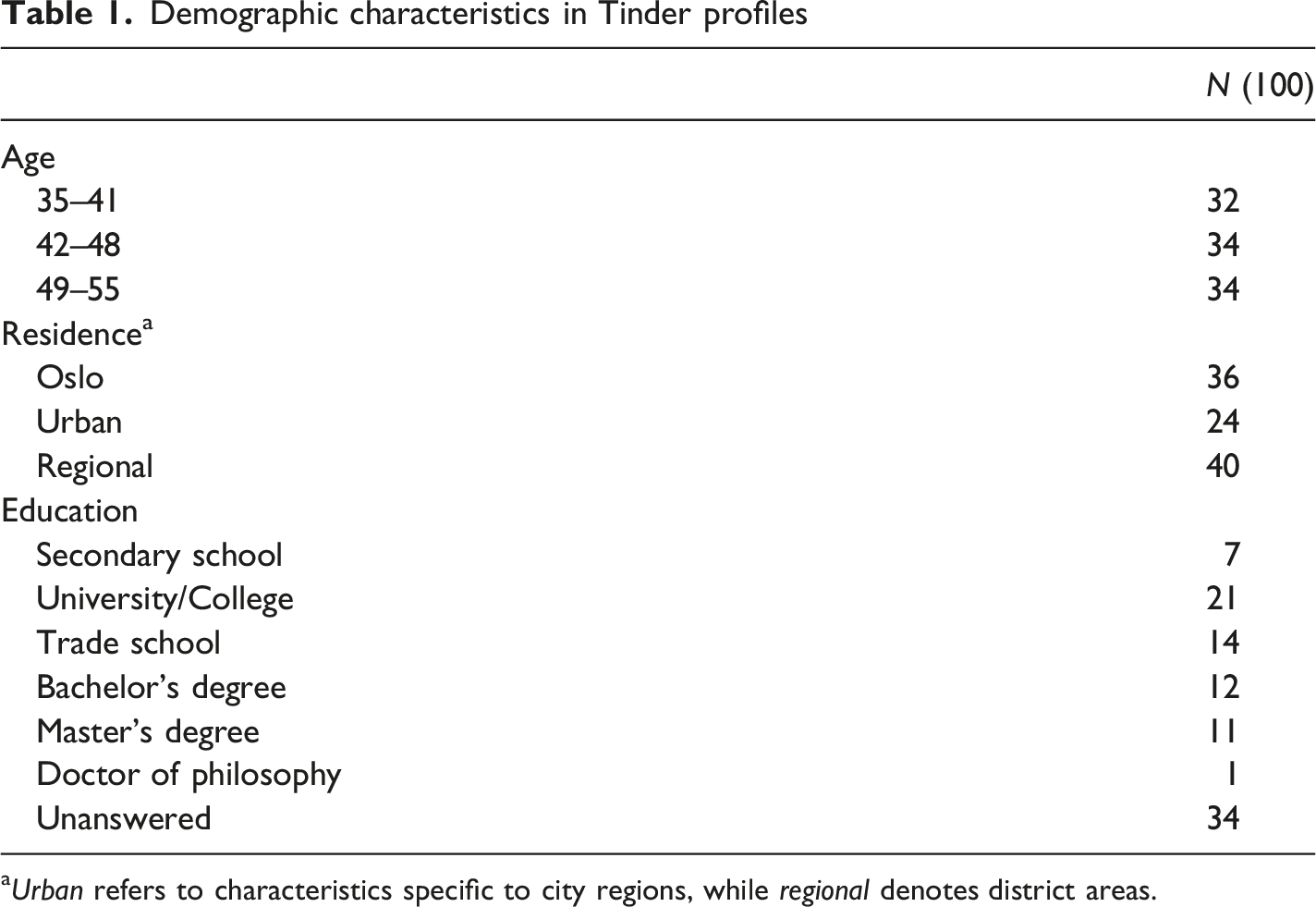
aUrban refers to characteristics specific to city regions, while regional denotes district areas.
In line with ethical guidelines for social media research (Degen and Kleeberg-Niepage 2023; Fossheim and Ingierd 2015), I did not contact the profile owners and refrained from analyzing or storing any potentially sensitive visual material, such as images of children. Instead, I focused solely on textual and hypertextual references to fatherhood. Photos portraying fatherhood were rather addressed through interview data. All profiles were anonymized, and screenshots (taken to mitigate Tinder’s ephemeral interface) were permanently deleted after coding to ensure data security and participant privacy.
Interviews
Demographic characteristics in interviews
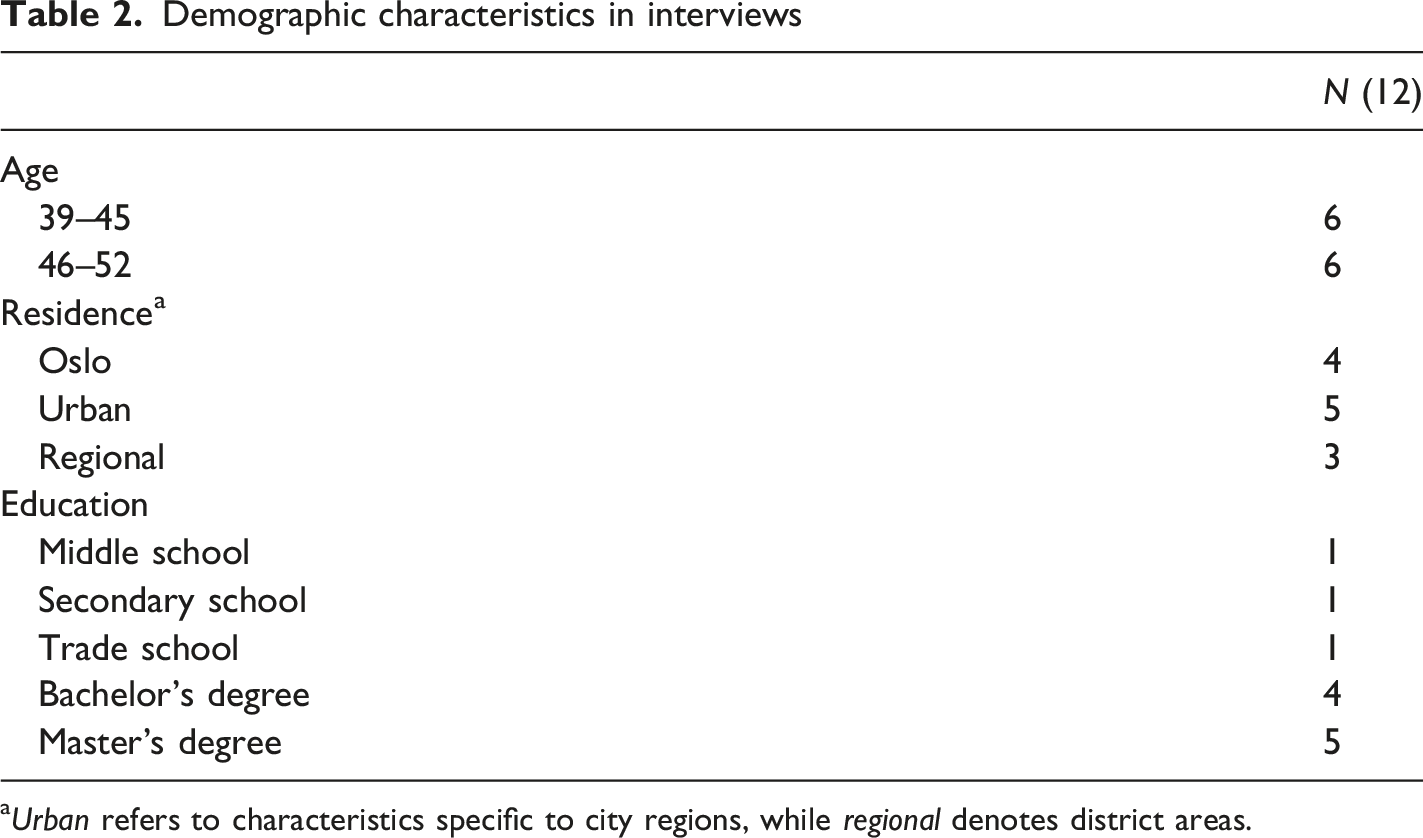
aUrban refers to characteristics specific to city regions, while regional denotes district areas.
As I am a single mother, I informed participants of my status before interviews, primarily to establish trust. In most cases, this appeared to facilitate openness and discussion. However, it may also have shaped how some participants interpreted the interview situation. Following one interview, a participant contacted me to ask whether I would be interested in a date, which I politely declined. In another interview, conducted via Zoom, the participant requested to see me in full view of the camera, which prompted me to terminate the interview. I considered excluding these interviews and conferred with colleagues; however, I ultimately retained them because they had both provided detailed and relevant responses prior to the incidents. These experiences illustrate that researcher positionality can create both access and challenges (Ridgway and Lowe 2022). It is possible that the interviews, and consequently the findings, would have unfolded differently had the researcher been male or positioned outside the participants’ potential dating pool. This possibility further underscores the value of the study’s multimethod design, which allows insights from different sources of data rather than relying solely on interview interactions.
Conversations ranged from 37 to 73 minutes. When conversations turned to sensitive topics regarding children or former partners, I redirected where appropriate. In cases where immediate redirection risked disrupting rapport, concerns were addressed through anonymization or omission during transcription. All interviews were recorded, transcribed, and imported into NVivo for coding and analysis. Using a general inductive approach (Thomas 2006), I read each transcript multiple times, applied in vivo codes, and grouped them into broader themes and tensions. The themes were then compared with findings from the QCA. This made it possible to examine both how presentations were understood and explained, and how fatherhood was in fact presented on profiles. I considered the findings alongside the walkthrough analysis, particularly in relation to which profile elements were optional and how the app’s design encouraged different forms of self-presentation. I selected illustrative quotes from both interviews and profiles that captured key findings and translated all excerpts from Norwegian to English. In the Results section, interview quotations are identified using fictional Norwegian names and participants’ actual ages, whereas Tinder profile excerpts are identified as Man, age.
Results and Discussion
In what follows, I present the findings thematically and discuss them through the lens of Bourdieu’s conceptual framework. The analysis is organized into three sections. First, in Selling Shared Care: Equal Custody as Capital on Dating Apps, I explore how fathers frame their custody arrangements as part of their romantic appeal. Second, in Children in the Frame: Lifestyle Branding and the Politics of Visibility, I examine how children appear as symbolic markers of care and identity in dating profiles. Third, in Final Decisions, Filtered Desires: Vasectomy, Visibility, and the Market of Compatibility, I investigate how the fathers communicate their reproductive boundaries and future family intentions through disclosures and silences.
Selling Shared Care: Equal Custody as Capital on Dating Apps
One way to signal parental status was through the mentioning of custody details in the “About Me” section, commonly known as the bio: the dating app’s open-text field. In the profiles analyzed through QCA, many placed fatherhood front and center, framing it as part of the profile’s appeal. A little under half indicated an alternating-week schedule, and 24 explicitly stated a 50 percent custody arrangement. Notably, no other percentages were mentioned. A recurring line appeared in several profiles, which captured this norm with striking clarity: “I am a 100% dad 50% of the time.” (Man, 36; Man, 38; Man 43; Man, 47). Whether standing alone or embedded in longer descriptions, the phrase performs a dual alignment. The “100 percent” signals emotional dedication and presence, evoking ideals of caring masculinities (Elliott 2015; Wojnicka and de Boise 2025), and the “50 percent” references structural balance, while also preserving space for personal autonomy, which coexist as moral goods in the Norwegian context (Jacobsen 2018). However, moving from the profiles to the interviews, the men with 50 percent custody framed it merely as a matter of information: The part where I write that I have the kids 50%? I really just see that as information. It’s the kind of thing that’s good to know, so it doesn’t come as a big surprise later on. (Trond, 40)
Even seemingly neutral disclosures carry symbolic meaning. As Bourdieu (1984) reminds us, all acts of categorization are situated within fields of value. What looks like an informational statement also functions as a social claim – one that positions the father as predictable and emotionally invested: About the 50%, I don’t know. Isn’t that almost a given these days? I guess it’s really about being a stable and present parent, even if you’re divorced. That there’s predictability. And it’s also about love. Every other week I’m with her, and when I have her, I’m with her 100%. […] Ideally, I want to meet someone who sees that as a positive thing. (Tor, 43)
As Tor explains, equal custody evokes reliability and balance but does so without naming the resources that sustain it. That is precisely how symbolic capital operates: it implies access to other valued forms of capital, without needing to state them (Bourdieu 1983, 1991). What is made visible by presenting oneself as an equal custody father is not just involvement, but a strategically coded class position, rendered attractive precisely because it does not have to be explained. In the symbolic economy of dating, this ability to say little and mean much becomes a potent form of capital (Schmitz 2017). By simply stating “50 percent”, men signal that they belong to a category of fathers who do not only co-parent, but do so in the right way, under conditions widely associated with middle-class stability. Embedded within broader packages of appeal, Sivert’s bio illustrates how factual markers (looks, height, humor, education, and parenting) are combined into a calibrated and recognizably desirable self: My bio says: ‘Tall and dark, slim, a bit funny and pretty cool, sophisticated, educated, imperfect, kids 50/50, 8 and 10 years old. 189 cm.’ […] I think I added the 189 cm because it’s a selling point. Being tall is considered attractive. And I tried to be light and funny, you know. And to answer questions about the kids. (Sivert, 46)
Sivert bundles traits with cultural value into a readable offer of masculine, paternal and romantic legitimacy. What ties these traits together is convertibility: they work as selling points within a digital economy where romantic appeal is tied to strategic readability. This logic aligns with Bandinelli and Gandini’s (2022) analysis of dating apps as infrastructures that promote strategic self-branding and calculated exposure, and with Schmitz’s (2017) conception of dating apps as symbolic marketplaces. Sivert’s bio is not a mirror of the self but a calibrated offer, where symbolic capital is mobilized to generate romantic appeal under conditions of platformed visibility. Along with the profiles analyzed, Trond’s, Tor’s, and Sivert’s seemingly informational attitudes toward equal custody may be heartfelt, yet what appears as character or care is anchored in institutional arrangements and material conditions that remain unspoken. This narrative aligns with national data (Statistics Norway 2022), which show that equal custody is tied to higher levels of education and income. In this light, the phrase “50 percent” communicates far more than a schedule, it condenses a broader class position into a single, legible symbol.
The symbolic value of shared custody, unlike other forms of capital, appears to depend on equilibrium. This is reflected consistently across the Tinder profiles: nobody wrote that they had their children 20 percent or 70 percent, even though such arrangements are undoubtedly part of the broader landscape of single fatherhood. Their absence in profiles is an indication of symbolic illegibility: only certain forms of parenting can be made visible without loss of value – which is symbolic violence (Bourdieu 1991) at play. The pattern discovered in the QCA recurred across interviews: fathers with less-than-equal custody described withholding such details to avoid moral judgment, while those with full custody feared being perceived as overly burdened. Their silence reflects an underlying constraint on what forms of fatherhood can be publicly valorized in the dating field. Only the balanced, bounded version (neither too absent nor too encumbered) translates into symbolic worth. In this sense, symbolic violence operates not only by privileging certain forms of care, but by attaching shame and suspicion to those that deviate from the normative script: I don’t think it’s a selling point exactly, to say that I have 30%. […] It’s hard to explain on dating apps why I don’t have my son 50% of the time. There must be something wrong with me, like: ‘Why don’t you have your son more?’ (Per, 46)
While Per fears being discredited for having too little involvement, other participants faced a different dilemma: What happens when one has too much? Full custody, unlike low involvement, does not trigger the same suspicion or loss of moral standing. But it presents another problem; one of compatibility. If symbolic capital includes what is actionable within the dating field, then full-time fatherhood may become a liability. Indeed, even if full custody signals care and commitment, it can undercut another highly valued trait: autonomy. This tension was evident in the interviews with Geir and Stig, who described holding back information about their full-time parenting because it often led to withdrawal or silence from potential partners: I always wait before mentioning it. I have been chatting with some women, and when they understand my life situation […], that question always comes up: being a single dad, how do we find time together? I don’t think it’s seen as very positive; I can sense that from the women. (Geir, 48) I notice that people pull away because I have 100%, that it becomes too much. People might not say it directly, but you can tell. They think I’m cool, they think I’m kind and all that. But when that package presents, it doesn’t work. (Stig, 47)
Like Per, Geir and Stig exemplify symbolic violence in practice, as both under- and over-involvement are subtly devalued within the dating field. This reveals how only certain forms of fatherhood can be publicly recognized as legitimate. These accounts show how custody becomes a central but fragile resource in single fathers’ dating app presentations. At 50 percent, fatherhood is strategically disclosed as a symbol of care, structure, and availability, a presentable form of symbolic capital. Outside this narrow equilibrium, however, custody becomes too risky to mention, its value harder to convey. A similar dynamic was visible in other dimensions of self-presentation. While 34 profiles lacked formal education data, these omissions can also be read as symbolic performances. Given that education represents a key dimension of cultural capital, concealing it may reflect an awareness that one’s credentials (or lack thereof) risk misalignment with dominant ideals. Such strategic silences thus exemplify symbolic violence beyond parenting, revealing how men anticipate and adapt to what can be displayed without symbolic loss.
Children in the Frame: Lifestyle Branding and the Politics of Visibility
In several Tinder profiles, fathers referenced their children’s interests or leisure activities, with short texts such as “I have two boys who enjoy camping and meeting new people” (Man, 48). These mentions never positioned children as separate or private figures. Instead, they appeared as integrated extensions of the father’s self-presentation, particularly through descriptions of shared activities that embodied the culturally valued ideal of engaged fatherhood (Kvande 2022). These were not anecdotes, but symbolic performances of paternal legitimacy and, subsequently, partner potential. Some men described cross-country skiing, a culturally prestigious sport in Norway, as a shared hobby: “I am lucky to have kids who still enjoy skiing with their dad” (Man, 51). A few profiles also revealed subtle gendering of children. For example, fathers mentioned that their sons played football, and one man added that he himself coached the team: “Both my teenagers [boys] are aiming for a career in football, and I’m still coaching the team where it all began” (Man, 45). Mentions of daughters more often included affectionate or protective language: “My two little princesses are the anchors in my life” (Man, 43), which contrasted with the more activity-oriented depictions of sons. These gestures toward emotional intimacy coexisted with traditional scripts of paternal pride, recasting protection, affection, and active involvement as moralized displays of care and egalitarianism. However, these references rarely stood alone. They were embedded in curated lifestyle narratives that drew on Tinder’s ready-made affordances. Using Tinder’s extensive system of, at the time, 334 predefined tags for hobbies and interests, the men had crafted profiles where paternal involvement signaled more than care; it conveyed a lifestyle: outdoorsy, present, and fit – the latter widely recognized as symbolic currency in a masculine economy of attraction (Ruiz and Ocampo 2017; Waling et al. 2023; Walker and Eller 2016). In Bourdieusian terms (1984, 1991), the children in these profiles function as socially legible signs: their presence serves to anchor the father’s identity within a matrix of culturally appreciated capital. Engaged parenting is presented as a lifestyle credential: a form of symbolic capital that draws on, and converts, economic and cultural investments into romantic value; narratable and desirable within the symbolic economy of platformed intimacy (Schmitz 2017). The child is represented as a coded extension of the father’s identity, anchoring his masculine desirability in recognizable forms of classed normalcy.
While textual references to children emphasized fitness and commitment, the visual field of dating profiles revealed a more ambivalent strategy. As the QCA had excluded images of children, this topic was only addressed in interviews. Most interviewees avoided posting photos of their children, often citing ethical concerns: I don’t think you should expose your kids on an app like that. You can do that once you’ve gotten more comfortable with each other and have been chatting for a while. But not on the app. (Stig, 47)
This refusal did more than express caution; it established a moral boundary, situating the father as responsible and self-aware. Still, some men allowed partial visibility. Mons (44) had uploaded a photo where his daughter sat in the background, her face covered with a heart: Mons: I have a picture of my daughter, where her face is blurred out. It’s really hard to take pictures of yourself, you know. […] There has to be a good vibe. That’s when they turn out best. […] Here it is. She’s just sitting behind me, like that. I drew a heart over her face. Interviewer: Why did you choose to cover her face? Mons: I don’t know, I think I just felt like it was the right thing to do.
Mons’s photo reveals a double logic: the child lends authenticity and emotional texture yet remains visually managed. This reflects legible forms of caring masculinity (Wojnicka and de Boise 2025), but also what Bourdieu (1991) describes as symbolic power, where value depends on strategic visibility within a field of recognition. Once again, the child is not shown as an individual, but as a coded extension of paternal identity: fatherhood made visible as a symbolic claim. This logic extended into more explicit branding. Per described one of his profile photos as follows: I have a full-body photo of myself in a suit because women like suits. And it gives a quick impression of my body. My son is also in the picture, so you can see that I have a son, without his face being very visible. (Per, 46)
Here, the child’s presence is symbolic rather than biographical: it indexes paternal status while leaving the man fully in focus. The suit and full-body framing gesture toward more traditional portrayals of masculinity, what Ruiz and Ocampo (2017) and Waling et al. (2023) describe as egalitarian performances layered onto conventional ideals of male competence and visual appeal. However, rather than reinforcing visual tropes of masculinity, Per extends his paternal self-presentation through a coded joke in his Tinder bio: humor that presumes shared parental knowledge and invites selective recognition: I’ve written something I think is kind of funny in my bio. It’s a reflection on how resource allocation works in Paw Patrol [animated children´s series]. Every time the alarm goes off, they only send out two of them, and they always end up needing reinforcements. So that guy Ryder’s prioritizations are a bit… off. He should’ve learned by now that they always dispatch the wrong resources. I´ve written something along those lines. The idea is that if you have kids in that age group, you’ll recognize the issue. It’s clever marketing, of course. Maybe I’ll pop into the mind of whoever read my profile and is now watching Paw Patrol with their kids, and they chuckle when they see it, like: “He seems like a funny guy.” (Per, 46)
On the surface, it is a dad joke. But, as Per notes, it is also “clever marketing.” The joke presumes shared parental experience and filters the audience accordingly. It serves as a Bourdieusian act of distinction (1984), inviting recognition from those who share the habitus of parenthood. Rather than seeking mass appeal, it marks compatibility through cultural resonance. This layered strategy fits within the logics outlined by Illouz (2019) and Bandinelli and Gandini (2022), who describe how digital intimacy is shaped by affective branding. Yet in Per’s case, the profile does not appear devoid of personality or reflexivity; rather, it reveals an attuned sense of audience and a capacity to embed humor and care within a carefully managed self-presentation. Through a Bourdieusian lens, it becomes clear that these are not just communicative strategies; they are acts of symbolic positioning.
Final Decisions, Filtered Desires: Vasectomy and the Market of Compatibility
If earlier sections showed how fatherhood could be folded into claims of care and lifestyle, this final theme sharpens focus on boundaries, specifically reproductive ones. A small but potent optional affordance – Tinder’s Family Plans tag – enable users to express their stance with striking clarity. Among the Tinder profiles included in the QCA, just over half had selected “I have children and don’t want more.” For some, this was the only indication of fatherhood in the profile, suggesting that the tag carried more than informational weight. This function resonated in the interviews. When asked which tags mattered most, Trond (40) responded decisively: Interviewer: The tags, the ones you fill out. Do you see any of them as particularly important? Trond: “Yes, there’s the one about children. That’s important to me. I have three children and don’t have a strong desire for more. So, if it’s important, and it is for some women aged 30 to 40 without children, they really feel like their clock is ticking. And then, we’re not right for each other. […] I also write in my bio that I have three children already and that I’m not looking for more. So, I can’t help you with that.”
Trond’s phrasing signals more than biological closure; it communicates symbolic non-negotiability. As Schmitz (2017) argues, dating app users classify both themselves and others through markers of compatibility. Within this field, the “Family Plans” tag operates as a tool of distinction, a way to assert boundaries through the performance of immobility. Such declarations reject the platform’s logic of flexibility, signaling decisiveness as value and anchoring the profile in prior investment. In Bourdieusian terms (1984, 1990), this is a position-taking that converts past experiences and future aspirations into symbolic goods legible in the dating field. Yet its value is relational: for those seeking stability, immobility may enhance appeal; for others, such as those wanting children, it can disqualify the profile entirely. This form of reproductive immobility then becomes a deliberate communicative act shaped by imagined affordances (Nagy and Neff 2015). In contrast to critiques that dating profiles promote shallow or affectively flattened self-presentation (Illouz 2019; Ruiz and Ocampo 2017), such disclosures reveal a boundary-conscious and reflexive subjectivity. These are not hesitant or indifferent stances, but ethically framed refusals to enter into negotiations already deemed incompatible. Adam articulated this with clarity, rejecting the script that love should override everything, and positioning his decision as an act of mutual respect rather than personal rigidity: It says on my profile that I don’t want more kids. But I think a lot of women have that mindset of ‘we’ll see what happens.’ Because I think there are many men who say they don’t want more kids and then change their minds when they fall in love. But I’m not going to compromise on that. I’ve made that clear, and I’m not going to budge. I’m open to everything else. If we match anyway, I choose to be quite open about my situation. I bring it up in the chat. So far, it’s happened twice that we’ve realized we’re in different places, so we’ve decided to end it. And it’s good to be able to clear that up before meeting, before anything gets serious. (Adam, 39)
In several profiles, this clarity extended into visual cues, as the bios included a scissors emoji Stig: Well, I don’t want more kids. And I can’t have any either, since I’m sterilized. Interviewer: Have you written that in your profile? Stig: No. But it’s one of the first things I mention in chats. In my bio, I’ve just written that I have kids, and that the ones I have are enough. –an oblique but potent reference to vasectomy in a country where the procedure is commonly referred to as “cutting the cord”. Here, the emoji works as a coded shorthand for reproductive closure: symbolic, discreet, and directed toward those attuned to its meaning. While easily overlooked by outsiders, it exemplifies what Bourdieu (1984) describes as a classificatory practice; an act that sorts and positions the subject in relation to a socially literate audience. The emoji’s symbolic efficacy lies in subtlety: it communicates decisiveness, maturity, and ethical restraint only to those who are positioned to recognize it, while avoiding the risks of overexposure or misinterpretation. None of the men interviewed had included vasectomy disclosures in their profiles, but several emphasized the need for an early clarification. As Stig (47) explained:
This off-profile, but upfront disclosure was described as a matter of ethical responsibility. Sivert made this framing explicit: Yes, the one about kids, that’s important. I’ve filled that one out. I’ve had a vasectomy. So, I’m not about to start dating 27-year-olds who want kids, that wouldn’t be fair. I have children, I’m not having more. There’s no room for negotiation on that one, and I always tell as early as possible. (Sivert, 46)
Sivert reframes reproductive immobility as a moral obligation, not only to protect his own preferences, but to prevent mismatch. Here, the dating app becomes more than a self-marketing site. It becomes an ethical terrain, where declarations of closure carry symbolic weight, not despite their finality, but because of it. However, not all men made such declarations. Some preferred ambiguity. Mons, for instance, left the Family Plans tag blank: The one about kids, I haven’t answered that on mine. Because I’m unsure. I’ve just left it open, so that it’s not visible what I think about it. (Mons, 44)
Ambiguity, too, can be strategic. By leaving the tag unanswered, users like Mons enact a form of reflexivity that keeps relational futures open. This is not indecision, but a deliberate suspension of clarity: a way to maintain room for negotiation without foreclosing desirability. In contrast to profiles that frame reproductive closure as moral or logistical finality, strategic ambiguity signals a different form of agency, one that resists being pinned down by categorical expectations. Such moves underscore the complex terrain single fathers navigate: between visibility and discretion, stability and flexibility, care and autonomy. As the findings have shown, fatherhood is not merely disclosed on dating apps – it is performed, calibrated, and at times withheld, in ways that reflect broader social scripts and symbolic economies.
Conclusion
This article has examined how single, midlife fathers in Norway present themselves as parents on dating apps, not merely as men seeking connection, but as masculine caregivers navigating a gendered and digitally mediated terrain of visibility and legitimacy. Through bios, tags, photos, and silences, these men engage in nuanced acts of symbolic labor, crafting self-presentations that signal care, gender equality, and autonomy within the affordances of the platform. The men in this study demonstrate a clear understanding of what is culturally expected of them as single fathers, and they use that knowledge to strategically present themselves as desirable partners on dating apps. Rather than fully conforming to what prior research has identified as prominent traditional and egalitarian masculinities in heterosexual men’s dating profiles (Ruiz and Ocampo 2017; Waling et al. 2023), they articulate a more contextually reflexive, caring masculinity (Wojnicka and de Boise 2025). Fatherhood was presented through themes of responsibility, protection, competence, and commitment, suggesting that caring practices remained intertwined with traditional forms of masculine authority. In this sense, the findings support arguments that caring masculinities are not necessarily oppositional to traditional masculinity, but may emerge through its selective reworking in specific social contexts (Graf and Wojnicka 2023).
The fathers in this study strategically manage how fatherhood is made visible and intelligible on a platform built around segmentation and legibility. Whether through the calibrated phrasing of “50 percent custody,” the presence of children in lifestyle-coded activities, or the subtle declaration of reproductive boundaries, these men engage in acts of distinction (Bourdieu 1984): sorting themselves into culturally valued categories, while anticipating how they will be read by others. Across profiles and interviews, custody emerges as symbolic capital, unevenly distributed and selectively disclosed. Importantly, this capital accrues value only under specific conditions: when it aligns with cultural ideals of equality and autonomy. In this sense, the dating app becomes a field in which paternal identity is classified and performed in relation to shared doxa.
The findings underscore that dating app presentations do not merely exist in a digital vacuum. The ways they are created are culturally embedded within social hierarchies and moral expectations that shape how users navigate disclosure. This context-sensitive analysis offers a critical rejoinder to dating app studies that treat gender, culture, life situation and desirability in isolation. Masculinity, in this sense, is a negotiated identity shaped by life stage, class position, and moral expectations of the user group in question. As such, future research on dating apps should attend to the socio-demographic and cultural contexts in which self-presentations unfold. This study is not without limitations. While I have offered insight into how single fathers frame themselves as parents, I have not captured how these self-presentations are received. It remains unknow whether the strategies identified here are in fact read as desirable by potential female partners. Future research should examine how such profiles are interpreted and filtered by others within the platform. Moreover, the study focuses exclusively on heterosexual fathers in Norway, limiting its generalizability across sexual orientations and national contexts. The symbolic economies of dating may vary significantly in other settings, where fatherhood does not carry the same cultural resonance or where platform features differ. Nonetheless, this article highlights how digital self-presentation is always socially embedded, and how midlife single fathers, far from being adrift in a neoliberal landscape of self-branding, draw upon deeply social forms of knowledge to navigate the promises and pressures of platformed intimacy.
Footnotes

Funding
The author received no financial support for the research, authorship, and/or publication of this article.
Declaration of Conflicting Interests
The author declared no potential conflicts of interest with respect to the research, authorship, and/or publication of this article.