






Abstract

Introduction
Communication apprehension (CA) is normally associated with speech communication and in particularly the basic public speaking course. However, a number of advertising courses require an oral presentation in which students make formal class presentations of their work. For many students, making these presentations is a difficult task because of their fear of speaking in public, especially when they are being graded. Scholars in speech communication have conducted extensive research on the proper methods of treating CA and the need to ease students' fears in public speaking situations (Adler, 1980; Allen, Hunter, & Donohue, 1989; Ayres & Hopf, 1985; Beatty, 1988; Kelly, 1989; McCroskey, 1972; McCroskey & Anderson, 1976). Recognizing students' fear of speaking in public and determining methods of treatment that can be implemented in the curriculum of advertising courses should be an area of interest to all educators.
Communication apprehension is “an individual's level of fear or anxiety associated with either real or anticipated communication with another person or persons” (McCroskey, 1977, p. 78). This fear or anxiety, known as stage fright or nervousness, can cause shaking knees, a quivering voice, the inability to speak, nausea, or may lead a person to completely avoid communication situations (Beatty, 1988). Although CA may not be apparent in a student's mannerisms and speech, McCroskey (1977 & 1982) claims that all students experience CA at some level, and 20% of them have a serious CA problem. A serious problem would be a situation where the student becomes nauseated, is unable to speak, or cannot stand up in front of the class. In a class of twenty-five students that means five suffer from this severe CA. For many students, classroom presentations are the only public speaking experience they will have in college, and CA could have a negative influence on that experience (Adler, 1980; Pelias, 1989). Pelias (1989) suggests that the possibility of a negative experience may be one indication why so many students are absent on their assigned presentation days or drop out of a course even if it is required for graduation.
Beatty (1988) believes that the long-term effect for a person who experiences anxiety in public speaking situations is “a tendency to avoid all communication situations” (p. 28). In addition to having communication problems, apprehensive individuals tend to have lower overall grade-point averages and score lower on college entrance examinations (McCroskey & Anderson, 1976; McCroskey, Daly, & Sorensen, 1976); they are considered less competent, composed, and attractive than more outgoing individuals (McCroskey & Leppard, 1975, as cited in Adler, 1980); apprehensive individuals are less likely to receive job interviews and when they are hired they are less likely to seek career advancements (Daly & Leth, 1976, as cited in Adler, 1980) and they are stereotyped as “wallflowers” who withdraw from all interaction (Richmond, 1997, p. 259).
These negative consequences leave most communication apprehensive people with a “diminished self-esteem” that could be detrimental in the advertising profession (Adler, 1980, p. 216). With so much at stake in terms of social, professional, and personal growth, becoming aware of students' CA and determining ways to treat CA would seem advantageous for both students and instructors. Because advertising courses prepare students to enter the work place and provide students with the opportunity to make presentations, advertising courses are the ideal setting for confronting and treating students' CA.
Apprehension in Advertising Courses
To determine if advertising students suffer from communication apprehension in their presentations, a survey of 260 advertising majors at two universities was conducted. The survey examined the requirements in the advertising courses, students' perception of those requirements, and students' level of CA when giving an oral presentation. The sample of students was divided between males (43%) and females (57%), and class rank (sophomores, 19%; juniors, 43%; seniors, 37%).
Ninety percent of the respondents indicated that they were required, in at least one of their courses, to work on a group project and 86% said they were required to give an oral presentation. When asked if they liked being required to give an oral presentation 49% said “No;” however, 96% of the students said they thought oral presentations helped them prepare for their professional work. Even though many advertising students do not like giving oral presentations they know they are important in preparing them for their future professions.
When asked specifically about CA, 88% said they were nervous about giving an oral presentation in class. A 4-point Likert scale (i.e., hardly nervous, mildly nervous, very nervous, and extremely nervous) was used to determine how nervous the students were about giving a presentation in front of the class. The results are shown in Table 1.
Students' Level of Nervousness When Giving an Oral Presentation
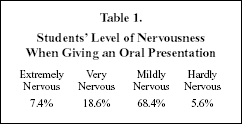
Twenty-six percent of the respondents claim that they are either extremely nervous or very nervous when giving a presentation. These results support McCroskey's (1977 & 1982) findings and indicate that advertising students do have CA problems. An additional 68.4% of the respondents claim that they are mildly nervous about speaking in front of the class. When asked if they had received assistance on how to control their nervousness only 35% of the students said that their advertising instructors provided this type of assistance.
The sample was then asked if they thought instruction on how to deal with and control their nervousness would be helpful in their advertising courses; 85.8% said that this type of instruction would be helpful to them. Seventy-nine percent of the sample had previously taken a public speaking course and 64% said that they were specifically taught techniques on how to control their nervousness. Even with their instruction in the speech course, students believe that having their advertising instructors address CA and provide some instruction on how to control their nervousness would be helpful.
Treating Apprehensive Students in Advertising Courses
Because advertising students have reported high levels of CA and they have indicated an interest in receiving advice on how to handle it, instructors must address this problem in their classes. With this in mind, instructors need to determine the best method for treating CA without sacrificing the class time they have devoted to advertising subjects. Public speaking instructors who face a similar problem interject CA treatment into their regular lectures during scheduled class times (Hoffmann & Sprague, 1982; Kougl, 1980; Robinson, 1997). For advertising instructors to begin to treat their apprehensive students, learning what techniques speech instructors are using and how they are implementing those techniques into their classrooms is necessary.
In a survey designed to determine what techniques public speaking instructors are using to treat CA, Robinson (1997) discovered that they are concentrating on three areas:
specifically mentioning CA and ways to reduce fear,
teaching the organizational and delivery skills necessary to give an oral presentation,
creating a warm and supportive atmosphere in the classroom.
To better understand CA treatment, each of these three areas will be discussed and information provided on how advertising instructors can use the technique to treat CA in their classes.
Specifically Mentioning CA and Ways to Reduce Fear
Specifically mentioning CA in classroom discussions provides instructors with an opportunity to openly talk about CA and ways to handle the problem with their students. The most common in-class instructional technique for treating CA is to identify students' fears as normal (Robinson, 1997). Additionally, lecturing on CA allows students and instructors to openly talk about CA and problems associated with their nervousness.
Identifying Students' Fears as Normal
Communication apprehension is not limited to those speaking in public; stage fright can be experienced by anyone performing in front of an audience. Athletes, actors, musicians, and doctors all, at one time or another, experience apprehension. In fact, when individuals were asked what social event caused them the most apprehension, 70% said, “giving a speech in public” (Lucas, 2000, p. 10). Being afraid to speak in public is common, but for most, learning to put their nervousness to good use is the difference between a poor performance and an excellent one (Reid, 1971). The majority of public speaking textbooks make some reference that CA is normal and that by channeling nervousness (e.g., psyching yourself up and using the energy to give you a competitive edge) students can actually improve their performance (Ehninger, Gronbeck, & Monroe, 2001; Pelias, 1989). Students who are nervous before their presentations are showing “a healthy sign of getting ‘psyched up’ for a good effort” (Lucas, 2000, p. 11). Students need to realize that there are no perfect presentations. They are going to be nervous and they are going to make mistakes but no matter what, they must continue to present the information in their presentation. The audience will overlook the speaker's mistakes if they believe they have been given some information or taught something (Behnke, Sawyer, & King, 1987).
Lecturing on Communication Apprehension
Lecturing on CA in class can be done during a discussion about the oral presentation. Discussing CA in class gives instructors an opportunity to speak openly about the problem and provide some instruction on how to control CA. Instructors should encourage students to voice their concerns and ask questions about CA and the presentation requirements. Most basic public speaking textbooks (e.g., The Art of Public Speaking, by Lucas; Public Speaking, by Osborn & Osborn; Principles of Speech Communication, by German, Gronbeck, Ehninger, Monroe; The Challenge of Effective Speaking, by Verderber; Public Speaking: An Audience-Centered Approach, by Beebe & Beebe) consist of causes and treatments of CA that may be beneficial during these classroom discussions (e.g., be prepared, think positively, communicate with the audience, relax). The discussion of CA does not have to be long or detailed, but should be supportive so students know the instructor is aware of the problem and willing to help.
Teaching the Basic Organizational and Delivery Skills
Students who are organized and prepared for their presentations will have more confidence in their speaking ability and less CA (Bostrum, 1988; Bradley, 1988; Metcalfe, 1991). When making an oral presentation assignment, instructors should take time to talk about the correct method of presentation and provide students with some simple organizational and delivery skills. Areas that should be included are encouraging practice, becoming audience centered, developing the delivery, and using visual aids (Robinson, 1997). In addition to helping students with their CA, this type of instruction may improve the quality of class presentations.
Encouraging Practice of the Presentation
Part of being completely prepared for a presentation is allowing for enough time to practice. Practicing several times before the presentation can help students feel more comfortable with the wording of the presentation when they are in front of the class. Practicing aloud may also help students become accustomed to hearing their own voice and will take some of the strangeness out of the speaking situation (Reid, 1971; Ehningier, German, & Monroe, 2001).
The purpose of a rehearsal is not to memorize the wording but to become familiar with the sequence of ideas, supporting materials, and delivery of the presentation (Reid, 1971). Becoming familiar with the order of information in the presentation allows students to deliver in a confident extemporaneous manner.
First, a practice routine that starts with the speaker practicing by him or herself is suggested to become familiar with the information and wording. Second, if speaking in a group, the entire group should go through a trial run so that all members of the group can critique each other. Finally, the speaker or group should go through a complete dress rehearsal in front of a critical audience. The audience members should be encouraged to ask questions and make suggestions. The more students practice, the more confident and less apprehensive they will be during their presentations (Moriarty & Duncan, 1995; Sprague & Stuart, 2000).
Becoming Audience-Centered
Knowing and understanding the audience is a key component in reducing CA (Hanna & Gibson, 1992). According to McCroskey (1984), most people feel more comfortable speaking to people they know rather than people they do not know. Learning as much as possible about the audience, including how much the audience knows about the topic, can help students better relate their topics to the audience. By concentrating on the audience and the audience's needs, the speaker will have less time to think about his or her own nervousness. The audience will become a partner, not something to fear (Hanna & Gibson, 1992). In the professional world, knowing as much as possible about the client and concentrating on their needs can be the difference in landing an account or not.
Working in groups or participating in small group activities provide students with an opportunity to get to know other classmates, become comfortable with the class setting, and practice their communication skills (Kougl, 1980). The relationships created between students during these group activities are valuable and often turn into support groups. Group activities can be developed to accompany many of the lectures and subjects discussed in advertising courses. Getting to know the audience is key to reducing CA and building speaking confidence (McCroskey, 1984).
Developing the Delivery
The way the presentation is delivered plays an important role in the effectiveness, level of influence, and overall success of the speaker (Reid, 1971). Because the delivery is so important, providing instruction on the different delivery techniques may not only improve presentation skills but also help in lowering CA. The minimum essentials of a good delivery include posture, eye contact, the speaking voice, and using gestures.
Posture
Good posture, Reid (1971) says, “indicates a measure of poise; or to put it another way, a speaker who has learned to stand comfortably in front of an audience has increased his or her own feeling of self-confidence” (p. 179). No one position is suited for all speakers, but they should find a natural position. A natural position is one that is an upright position with the shoulders back and head held high and relaxed. The feet should be slightly apart and firmly on the floor and the arms should be loose and at the side with the hands resting lightly on the front of the thigh (Woodall, 1989). This stance will give the presenter a look of confidence and help him or her feel more comfortable (Moriarty & Duncan, 1995).
By learning and using the body's natural position, students can minimize tension and project confidence and enthusiasm.
Eye contact
At some time during their presentations, speakers should make eye contact with every person in the room (Osborn & Osborn, 1999). By looking into the eyes of the audience the speaker will feel the energy and support the audience projects (Woodall, 1989). Behaviors such as looking over the heads of the audience, looking at the floor, or staring at the back of the room only shows fear and makes the listeners feel uncomfortable. The only way the speaker can feel the audience's support, read their nonverbal communication or answer their questions is by maintaining eye contact with them.
The speaking voice
Controlling and using the voice effectively can increase the speaker's confidence while improving the quality of his or her delivery (Lucas, 2000). Learning how to use the aspects of volume, pitch, rate, pronunciation and articulation can control the voice. Each of these areas in the speaker's vocal variety can be learned by becoming aware of their value, necessity, and by practicing them in their speaking. For example, by simply raising the volume a speaker can create a feeling of power and confidence.
In addition, learning how to pause allows speakers to speak with greater thought as they orally punctuate the ideas in their presentations (Osborn & Osborn, 1999). Effectively using pauses also eliminates annoying mannerisms or “vocalized pauses” like “uh,” “er,” and “um” (Lucas, 2000, p. 242). When the speaker uses pauses effectively, he or she allows the listeners time to reflect on the information and make sense of the presentation. Pausing also gives the speaker time to gather his or her thoughts in preparation for their next point (Moriarty & Duncan, 1995).
Gestures
To keep their hands from shaking, apprehensive students tend to clutch the sides of the podium, clasp their hands in front or behind them, grip their note cards, or put their hands in their pockets. These behaviors lock the students' hands and feet not allowing them to “move out of fear” (Makay, 1992). Movements such as spreading the arms, pointing, stepping to the side of the podium, walking around the room or other planned movements in a presentation can help the speaker gain confidence and reduce CA (Makay, 1992). By simply stepping out in front of the podium or walking from side to side the speaker will be able to relieve any tension he or she may be feeling while building the audience's perception of their confidence.
Outlining and Using Notes
One of the best ways for students to reduce their CA is to be completely prepared for the presentation in terms of the research and the construction of their outline (Metcalfe, 1991). The outline is a blueprint, or skeletal map of the intended communication (Carlile & Daniel, 1991; Wilson & Arnold, 1976). It is when students actually put their presentation together by deciding what to include and what to leave out. Outlining, according to Lucas (2000), “is the stage of the presentation when students decide what they will say in the introduction and conclusion, how they will organize their main points, and what type of supportive material they will use” (p. 194).
The structure of the outline should be simple and logical so students can fix it firmly in their minds. A structure that is easy to follow also allows for greater recall and gives less reason to worry about forgetting the information during the presentation. As Wilson and Arnold (1976) explain, “We remember those things that are orderly and logical but we easily forget that which lacks system, order, and unity” (p. 178). By concentrating on the development and structure of a clear outline, students will find practicing and delivering their presentations easier.
Using Visual Aids
In most advertising presentations, visual aids, such as power point slides, graphs and advertising examples, are used. Using visual aids during a presentation is one way instructors believe students can reduce CA and build confidence in their speaking (Robinson, 1997). Simply having something to handle during the presentation will make students feel more comfortable. Using a visual aid in a presentation also increases the audience's interest in the topic while diverting attention away from the speaker, making them feel less apprehensive (Lucas, 2000).
Visual aids can also be used as speaking notes. Moriarty and Duncan (1995) recommend students create visual aids that “point out the major sections, give the key points and illustrate basic concepts” (p. 119). Then the speaker can refer to the visuals and talk directly to the audience. Students should be taught not to read the visual aids but rather describe what is on them. Gesturing or pointing toward the visual aids will also help students make their points, relieve any tension they feel, and make the presentation more animated (Moriarty and Duncan, 1995).
Creating a Warm and Supportive Atmosphere in the Classroom
Because the thought of giving an oral presentation is distressful for many students, creating a class environment that is positive, practical, supportive, and one that invites apprehensive students to open up and begin to improve their communication skills is important (Kougl, 1980). By establishing a warm climate, making evaluation of presentations a positive experience and encouraging class participation instructors can create an atmosphere that makes students feel comfortable and willing to interact with each other and the instructor.
Establishing a Warm Climate in the Classroom
Instructors must ensure students, as early as the first class meeting, that the class environment will be supportive and interactive. While explaining the syllabus the instructor should make comments, give examples, act in a positive manner, and involve the students in the conversation (Kougl, 1980). This interaction is when the instructor introduces the type of climate and communication he or she wants for the class. Instructors should also explain assignments in detail, provide examples, outline what is expected, and set due dates so nothing will be left to question. Creating situations that allow students to speak in front of the class will provide nonthreatening and successful speaking experiences. For example, mini presentations of their work or classroom critiques can help students get use to speaking in front of the class.
Making Evaluations of Presentation a Positive Experience
Students already feel apprehensive about giving an oral presentation, but those feelings are increased when their performance is being graded. Even if students are audience centered and have overcome their fear of having the audience looking at them, they will still be nervous by the presence of the instructor (McCroskey, 1984). Some students believe the worst part of giving a class presentation is having the instructor watching them and giving them a grade. The evaluation of presentations can be distressing to apprehensive students because they already expect low evaluations and “these expectations feed into their anxieties about communicating” (Pelias, 1989, p. 42). Unfortunately there is little an instructor can do about this part of the student's apprehension. The instructor must be in the room taking notes so an honest and helpful evaluation of the students' work can be made.
In advertising presentations, the students' grade is not only on their presentations but on their work as well. In addition to critiquing their work, students should know the instructor is there to help them improve their communication skills. During the presentation, the instructor should make his or her presence in the room as positive as possible by reinforcing the speakers' efforts and making constructive comments. Reid (1971) wrote that, “human beings are sensitive to comments made about them, a word of praise may be remembered forever” (p. 272). The critique should be made of the performance not the speaker, but it is important to remember the speaker by showing interest in him or her as a person.
When presentation evaluations are made the comments should be positive and constructive, yet critical enough to help students improve on their next presentation. Positive comments build confidence and reinforce the fact that the presentation did have some good qualities. Begin criticism by discussing as many good points as possible. “Candid approval opens the recipient's mind and allows him or her to shed some of his or her tension” (Reid, 1971). Discussing the positive aspects of the presentation will make students more open and teachable, which allows the instructor to address areas of improvement.
Encouraging Class Participation
Class participation can be accomplished by having an open and enthusiastic lecture setting with the instructor interjecting questions throughout the class period that invite all to participate. By simply addressing students by their name, allowing them to sit where they wish, and only calling on them when they have their hand raised or when their face indicates they have a response, students will feel more comfortable about joining in on the conversation (Kougl, 1980).
Conclusion
Advertising courses provide the necessary skills for students to begin their lives as advertising professionals. During many of these courses an oral presentation is required for students to present their work in front of the class and the instructor. Students have, however, indicated that the oral presentations are distressful and that receiving some assistance on how to handle their nervousness would be helpful. Instructors can help their students by 1) specifically mentioning CA and ways to reduce fear 2) teaching the basic organizational and delivery skills necessary to give an oral presentation, and 3) creating a warm and supportive atmosphere in the classroom.
By concentrating on these three areas, instructors can create a supportive interactive atmosphere in the classroom where CA is openly discussed and information is provided on how to handle nervousness and apprehensive students can open up and begin to improve their communication skills.
These approaches do not involve new or unusual treatment techniques, but rather utilize solid teaching practices that can be implemented into any marketing or advertising course. This implementation can take place without sacrificing valuable class time by “exposing students to the traditional subject matter of the course and at the same time build confidence in communication” (Kougl, 1980, p. 217).