






Abstract

Whenever advertising professors get together and the conversation turns to teaching, questions about using case studies inevitably arise. Those questions range from logistics to politics to tactics: How do we write case studies? Where do we get the information we need to write them? How can we share them? How do we get credit for writing case studies in promotion, tenure, and merit decisions? Why would we want to fit case studies into classes already jam-packed not only with the “basics” but also with the urgencies brought about by the contemporary chaos of the media environment? And, if we choose to use case studies, how do we teach them?
Certainly, these are all valid questions. In this essay, we begin to address only the most basic: Why and how do we develop case studies? How do we engage in case-based teaching?
Cases and Case-Based Teaching
We sent an informal questionnaire to a small group of advertising professors who had indicated an interest in pedagogical issues, including case studies. “Do you use case studies in your classes?” we asked. “If so, would you describe those cases?” We provided no definition at that point; we were interested in the respondents' interpretations. According to their responses, a case study could include a wide variety of experiences. Some thought primarily in terms of a “capstone” project in a campaign, creative, research media, or management class. Others thought in terms of a one-day or two-day class discussion, a written analysis of a particular situation, or a course taught exclusively using a series of cases.
In fact, cases can be illustrative, tactical, strategic, or evaluative depending upon the class and the particular learning outcomes sought. We distinguish between using cases as illustrations (e.g., the Audi “Art of the Heist” campaign to illustrate innovative media strategy) and case-based teaching, recognizing that both are pedagogically valuable. We define case-based teaching as the use of cases that include a description of a concrete situation (real or hypothetical) designed specifically for analysis and discussion. Case-based teaching demands a particular classroom dynamic that is discussion-oriented and instructor-facilitated rather than instructor-led.
In this paper, we focus primarily on issues of case-based teaching. We answer the questions: Why use case-based teaching? What practical considerations enter into developing a case? What are the challenges and rewards of case-based teaching and learning, both for students and for teachers? Finally, we offer suggestions for how to get started and provide references for finding cases, case development, and case-based teaching.
The Values of Case-Based Teaching: Active Engagement and Experiential Learning
Tell me and I shall forget. Show me and I might remember. Involve me and I shall understand. (Confucius)
Why use case-based teaching? The standard response to this query is simply: “using case studies teaches students to think critically.” While true, that response provides little insight into how the case method can be used or guidance in doing so. The almost-casual reference to critical thinking camouflages the wide range of learning objectives that can be pursued and attained, as well as the complexity of developing critical thinking through the case method.
Educational researchers have spent decades studying how we learn and what helps us learn most effectively. One of the most widely recognized theories of learning is known as “Bloom's Taxonomy” (1956). He suggested that learning occurs in a six-stage process, moving from knowledge and comprehension through application and analysis to synthesis and evaluation. In this cognitive sequence, then, we progress from the simple to the complex, from concrete to more abstract thinking. Bloom's is a mastery model. We must recognize and understand basic concepts before we can develop skill in using those concepts. Only then can we move on to using the learned material in new situations, breaking down what we have learned into its component parts, evaluating the usefulness of what we've learned under new conditions, and subsequently combining the elements to create new solutions Essentially, we need to learn to walk before we can fly.
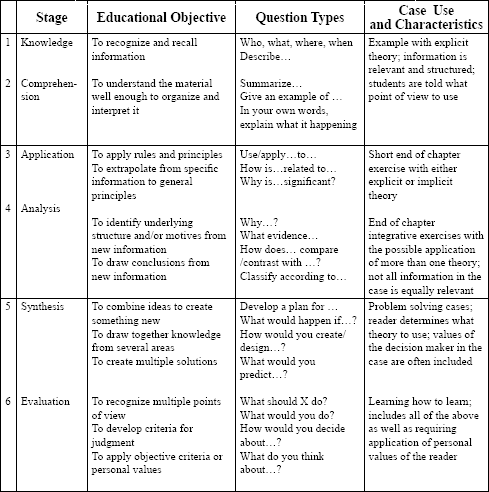
Bloom's Cognitive Goals and Case Teaching
We might now ask: how do we learn most effectively? Like Confucius before him, Kolb's (1984) work with learning styles touts the value of experiential learning. Kolb, like Bloom, articulated a theory of learning; Kolb's four-stage cycle, however, highlighted immediate or concrete experience as the starting point in making the cognitive shift from specific and concrete thought to more abstract and complex patterns of thinking. We can acquire higher order skills, e.g., combining existing ideas into a new whole or making value-based decisions, most successfully through exposure and practice.
Following Kolb and Bloom, case-based teaching actively engages students in learning by providing opportunities for the acquisition and application of content-based and hands-on procedural knowledge (how to do something), integrative thinking skills, and individual and interpersonal communication skills. Students learn “by doing” and subsequently through reflection on that experience. This is true whether creating an advertising campaign or reasoning through the advertising's role in the current dialogue on childhood obesity.
An understanding of the learning process is key to pairing cases with course objectives, for it facilities the development of case-based teaching skills. This is particularly important for asking questions that will move students toward more complex and abstract levels of learning. In the section that follows, we provide examples of the use of case-based teaching in an advertising curriculum, using Bloom's taxonomy as a framework.
Applications for Case-Based Teaching
We have noted objectives and question types at each stage of Bloom's taxonomy. It is apparent that the kinds of cases used and the way they are used will vary widely depending upon the learning stage and, of course, the class being taught.
Knowledge and Comprehension
Stages 1 and 2 of Bloom's taxonomy, knowledge and comprehension, are primarily focused on acquiring basic factual and conceptual knowledge. Learning at this level generally occurs in the introductory course in the advertising curriculum, and early in the semester in more-advanced courses. Students are asked to learn basic terminology, key concepts, and theoretical models used in the field. Cases, in these stages are frequently illustrative, providing “real life” examples. Through “recognition” questioning —who? what? when? where? — students begin to identify and understand the components of the advertising process and how they fit together. Concepts and theories typically are presented in a very explicit form. Students might be asked first simply to recall information and subsequently to explain or identify instances in which key concepts are observed. For example, in teaching an account planning case, we might say, “this is an example of an attitudinal segmentation,” and then ask: “What key variations in attitude were found in the first round of research?”
Application and Analysis
Case-based teaching becomes more instrumental at the application and analysis learning stages. At this point, students understand key concepts; they might be asked to identify relationships between concepts, to apply previously learned information to a new situation, or to arrive at a solution to a particular problem. In teaching cases in the early days of the application stage, the concept/model/theory underlying the case is likely to be stated explicitly: “Use Maslow's hierarchy of needs to ….,”
As students become more comfortable with analysis, they might be asked to determine which of several theories is most applicable to the situation outlined in the case. This requires that students engage in more complex analysis. Frequently, this analysis includes identifying component parts of a situation and the relationships between those parts, culling through information provided to select that which is more relevant, comparing alternatives, recognizing divergent conclusions, making decisions and offering evidence to support decisions. Initially, it may be necessary to tease out the models/theories since students may apply them intuitively rather than consciously. In this process, the goal is for students to understand the necessity of having a model/theory/ criterion upon which to base predictions and make decisions. In this way, the link between theory and practice becomes more explicit; models and theories are perceived as tools.
Synthesis and Evaluation
Finally, in the advanced stages of learning, synthesis and evaluation, students are asked to understand the complexity of information, to evaluate competing perspectives and the basis of those perspectives, and to solve problems creatively. Generally, the types of cases used at these stages provide a great deal of information but draw very few conclusions; they may introduce such complexities as competing interests, internal challenges (e.g., contrasting personalities, budgetary limitations), and ethical issues thus representing the complexities of decision making outside the classroom.
At this stage, it becomes the student's responsibility to analyze, prioritize alternatives, and make recommendations. This is generally the model for “capstone” projects: a “client” provides basic background information and identifies a problem to be solved; students are left to determine how to get from incomplete information to the generation of alternative solutions and ultimately, to the recommendation of a specific solution that they can support. There is no pre-determined “correct” answer.
Cases developed for this stage of learning also can be a prime venue for a discussion of ethical values. For example, in her book, Latinos, Inc.: The Marketing and Making of a People, Davila examines how the Hispanic marketing industry has constructed the Hispanic market as homogeneous, equating language with culture. She then poses questions of social justice: why has our interest in this group of people, defined now as “a market,” not been accompanied by economic and political enfranchisement? How has our construction of the Hispanic market contributed to that disenfranchisement? At this stage, students might be asked to reflect upon the dynamics and practices that make up every-day advertising practices (e.g., the definition of “markets”), and how the experiences of Hispanic marketing pertains to the advertising industry in general.
Summary of Applications
As students progress through the learning stages, they move from simple cognitive knowledge (facts and concepts) to metacognitive knowledge (where to find information, how to assess information, how to balance competing interests, awareness of their own strengths and weaknesses). Further, in discussing cases in class, taking positions, and arguing on behalf of their decisions, students develop interpersonal communication skills, both oral and written. These skills include not only persuasion, but also diplomacy, negotiation, listening, and the ability to comprehend, assess, and value the viewpoints of others, as well as teamwork skills of collaboration and delegation.
David Ewing suggests the value of the case method in moving students through the stages of learning when he comments on the differences between outgoing Harvard MBAs and the students they were when they entered the program: “From dealing with data in an amateurish way, missing significant points, pontificating, applying glib solutions to complex problems, making every other mistake that a group of bright, but wet-behind-the-ears people might be expected to make, and being so sure of themselves that it was frightening, students change profoundly in their ability to undertake critical analyses and discuss issues intelligently, coming to greater understanding of the complexity of doing business.” (Ewing 1990)
Case-Based Teaching: Tips for Getting Started
Introducing cases to the teaching repertoire and to course content requires commitment: to understanding the learning process, to selecting and/or developing appropriate cases, to rethinking the instructor's role in the classroom relative to that of students, and in some instances, to retooling one's own skill set. It is well worth the effort. And, it is best to start simply. In this section, we offer suggestions and considerations, both conceptual and pragmatic, for “getting started” using case-based teaching.
Writing or Selecting a Case: Questions to Ask
Case selection and/or development can be a complex process. As noted earlier, cases vary widely depending on the course, the students, and the specific learning objectives. Two of the most important questions to ask prior to developing or selecting cases for particular courses are: (1) at what cognitive level are the students? and (2) what are the education objectives/outcomes sought? Challenging students to use higher order learning skills prior to their mastery of lower-level skills is apt to create frustration for both student and instructor. Similarly, selecting a case without careful reflection on the desired learning outcomes can result in a less-than-satisfactory contribution to course objectives.
Asking the following conceptual and pragmatic questions prior to developing a case can help facilitate the selection process:
Conceptual Questions:
What are students expected to learn?
Why use a case? Why this particular case?
What process should the students follow in analyzing the case?
What concepts/ideas should students take away from the case discussion??
Pragmatic Questions:
Should the theories/models be explicitly stated or implicit?
What kinds of information do students need to successfully analyze the case? Should the case provide only the relevant facts? Or, is one of the objectives to have students select relevant information from a multitude of unimportant information? Should the instructor provide all the relevant information? If so, in what format? Or, should students be asked to gather necessary data? If so, where are the necessary data to be found?
Locating and Developing Materials
There are a number of alternative to taking on the time-consuming task of writing one's own cases. There is an abundance of fully developed cases complete with supplementary materials, discussion questions, and teaching notes. However, many of those cases are geared toward graduate-level analysis and are less likely to be focused specifically on advertising or marketing communication strategy. Still, such cases can offer valuable data and provide useful starting points from which to write cases without creating them from “whole cloth.”
The supplementary case material or mini-cases at the end of textbook chapters can be another starting point. Those cases are written to draw out discussion of specific material. Another relatively easy option is simply to use contemporary issues from the trade press. Industry issues lend themselves well to asking students “How is X related to Y?” “Why is this significant?” or “What would you do?” This approach has the added benefit of reinforcing the importance of reading the trade press.
Another option is to use industry-written cases (see resources at the conclusion of this essay) asking students to update the data. This obviates the need to create entire cases. For example, students may be asked to compare and contrast Effie winners in the same category: Dove Real Beauty (2006) versus Oil of Olay Regenerist (2004). They may be asked, “What issues do beauty marketers need to consider in light of the extraordinarily positive reception to the Dove campaign
If writing a case from the ground up, it makes sense to refer to available cases before choosing a writing strategy. Should the case be real or fictional? Should it be presented from a third person, objective point of view or from that of a key player in the decision? Should all information necessary for analysis be provided or should students to gather the information? A key challenge is to keep the written case free of evaluative commentary. Cases should be written neutrally, descriptive rather than prescriptive, so students can work through the analysis and come to their own conclusions. Evaluative commentary fits in the teaching note (see below).
Determining Discussion Questions
Discussion questions should be prepared ahead of time. A rule of thumb is to have three of four discussion questions for each key point to be addressed. For students still in the earlier stages of Bloom's taxonomy, you may want to provide students with these questions well in advance of the case discussion.
When arriving at questions to guide discussion, it is easier to begin with the more advanced questions that address key learning objectives, e.g., what would you recommend? Having determined the “big” questions, the instructor can then work backwards to identify questions that need to be asked and answered before getting to the point of making a recommendation.
In the classroom, simply asking, “what's the problem here?” is also a good place to begin the conversation. There are often multiple problems and issues to be resolved. Students then begin to understand the complexity of the challenge; sometimes the immediate and obvious problem identified isn't the real issue. The Harvard model for organizing class discussion is shown in Figure 2.
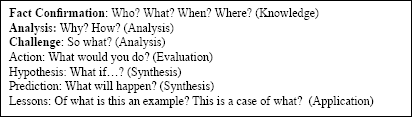
Organizing Class Discussion: The Harvard Model
Developing Teaching Notes
An instructor should keep notes about the case experience for each and every time that the case is used. In published cases, these are referred to as “case teaching notes.” Teaching notes typically include a brief summary of the case, identification of the learning objectives, a list of questions used for discussion and the range of potential responses to those answers. Any evaluative commentary belongs here as well, including your own observations regarding how the case analysis worked.
The case process is highly iterative. Students will point out relationships that the instructor did not see initially. Also, changes in the environment (legal, social, technical) will inevitably raise new issues when a case is used again. Understanding of the case and the potential uses of the case will deepen each time it is used and should become part of ongoing case notes.
Establishing Effective Classroom Dynamics
Selecting or developing a case is only the first step in the case study. The second step is teaching the case effectively.
We have knowledge…only as we actively participate in its construction. Students do so by engaging with other students and with the teacher, in a process of inquiry, critical discourse, and problem solving. The teacher's role is to foster conditions in which students are encouraged to construct knowledge. (Elmore, 1991, p. xii)
Anyone engaged in teaching realizes that creating a discussion-based classroom experience is not an easy task. We would be remiss if we failed to acknowledge the particular challenges faced by students and faculty alike.
One of the most important elements of successful case-based teaching is transparency of process. At the outset, it is useful to talk with students about discussion-based learning, about their role (and our role) the unique roles of the students and the professor in the process, and why the case method is appropriate. In moving into specific cases, the instructor should again tell students why that case was chosen and its goals and purposes. Students should understand the process: how should they approach the case? how should they go about solving the problem? what steps might they use? Finally, it is important that students are aware of the instructor's expectations. What will be the final outcome? If it is a written analysis or an oral presentation, what are the components of such an analysis and how are they to be presented?
Faculty Perspective
Melissa Mead (1991) writes: “We must deal with content (what to teach), process (how to teach), preparation (how to plan ahead), control (how to realize plans), and style (making room for our own personality).” (p. 69)
For many instructors, facilitating discussion is distinctly outside their comfort zone. Like students, faculty must be well prepared. However, discussion teaching also requires what Christensen (1991) identifies as a dual instructional competency. It is no longer enough simply to master the content; it is also necessary to be adept at process (Mead, 1991).
Effective case teaching requires the instructor relinquish some control, trusting students to assume engaged, leadership roles. Yet, the instructor must make certain that the class remains “on task.” Teaching a discussion-based class, thus, is a daily management task. The instructor must remain sharply focused and must listen intently. And, because “students… possess the power to turn a discussion class into an academic charade by withholding involvement” (Christensen, 1991, p. 17), faculty must work every minute to attain and retain student engagement.
Student Perspective
Students are often equally uncomfortable with the new approaches. From the students' perspective, active learning is risky: it requires a change in roles and responsibilities, but with an uncertain payoff. Especially where these methods are rarely or partially practiced, students tend to resist their introduction, fearing that they will learn less in their classes. After all, the argument runs, if the teacher speaks less, isn't less information being conveyed? And won't learning be correspondingly reduced? (Garvin 1991, 7)
For many students, a discussion-based case study is “not what they're used to.” Many have been taught only to take tests on which one answer is right and the remaining answers are wrong. As such, they are uncomfortable with the uncertainty of outcome that so often is a part of the case study; they want to know the right answer. These students frequently perceive the freedom they are given in a case study scenario, and our refusal to identify the right answer as a “lack of guidance.” Then too, in the classroom setting, many students are unaccustomed to the concentrated listening required and are ill equipped to follow the negotiation and re-negotiation of core concepts over time.
Teachers must remember, particularly on the inevitable “quiet days,” that students are likely to be inexperienced with case learning and what it constantly requires of them. It may not be that they haven't prepared for the case so much as that they are unprepared for the “disciplined freedom” that a case study allows them, indeed, that it requires of them.
Conclusions: Opening Dialogue
The improvement of teaching and learning in universities is an important matter. Its purpose is not only to provide students with a more pleasant and rewarding educational experience, but also to prepare them to take charge of their own learning and to participate in a society in which learning is a cooperative more than a competitive act. This goal requires teachers to examine teaching with something like the level of inquisitiveness they bring to their own subjects, to appreciate the social complexities of learning as they do the complex structure of knowledge in their disciplines, and to think about how to nurture student engagement in learning with the same playfulness and creativity as they exercise in thinking about creating the next layer of knowledge in their field. (Elmore, 1991, p. xix)
This paper is intended to be a celebration of case-based teaching, based on a belief in its effectiveness as a teaching and learning tool. Actively engaged in dynamic case discussion, students develop cognitive skills as well as interpersonal communication skills; in Confucian terms: they know, they remember, and they understand.
It certainly is not the intention of this article to overwhelm readers with the challenges of case-based teaching. However, we have sought to be realistic, to anticipate challenges that may arise, to provide strategies for addressing those challenges and a starting point for case application in the classroom.
Teaching is all too frequently a socially isolated experience. Unlike research that enjoys the discourse that comes with publication to a broader audience, what happens behind the closed doors of a classroom remains largely unexamined by colleagues and peers. This is not as it should be. This paper will be a success if it encourages even a few teachers to experiment with case-based teaching. It would be an even greater success if those few share their cases and teaching experiences with others.