






Abstract
After finding that college students are unlikely to use social media for self-advertising/marketing, this paper presents a pedagogical tool to help advertising educators teach them how. The experiential exercise is based on an e-marketing planning process where students conduct a situation analysis, differentiate their brand and set forth personal goals and objectives. Students use social media to promote themselves to employers, their small businesses, hobbies or social causes. Students consider the exercise to be effective in deepening their understanding of how strategic planning can enhance their self-marketing/advertising skills.
Knowing how to self-advertise/market is an essential skill not only for advertising majors, but for all college students (Lowry & Xie, 2008; McCorkle, Alexander, Reardon & Kling, 2003; Taylor & Sheehan, 1997; Waller & Hingorani, 2009). Self-advertising/marketing is the ability to demonstrate one's talent, qualifications or achievements. According to Guthrie (2010, p. 1), self-advertising/marketing maximizes “the return in one's investment of time, energy and effort.” For college students, self-advertising has many potential applications, from helping them find a job to turning their hobbies into small businesses.
Several scholars advocate that advertising/marketing educators incorporate a self-advertising/marketing model to prepare students for their future success (Brett-Elspas, 1990; Cohen, 1985; Kelley & Gaedeke, 1990; McCorkle, Alexander & Diriker, 1992). However, for these models to be effective with today's generation of college students, several issues need to be addressed. First, the models define “self” primarily as “job seeker.” This application is very important, based on such articles as “Building Your Online Career Brand: Five Tools for Job-Seekers,” (Hansen, 2010a) “Building Your Personal Brand: Tactics for Successful Career Brandings” (Hansen, 2010b) and “Career Branding Tutorial” (Hansen, 2010c). Today's “business world is increasingly dominated by social media, and mastering the ability to sell yourself in cyberspace is one of the most important skills a worker can possess” (Greer, 2010, p. 30). However, college students can benefit from conceptualizing the “self” more broadly. They can use the approach to self-advertise their ideas, hobbies, clubs and own businesses.
Second, the models do not merge self-advertising with social network media. Social media are flourishing and very popular with students. According to eMarketer, a recognized authority on online business and consumer behavior, in 2009 the number of Internet users of social sites rose 16% in one quarter (Sonnhalter, 2009). Females are the heaviest users, and younger users (i.e., under the age of 35) represent 70% of site visitors. Facebook, MySpace, LinkedIn and Twitter, respectively, are the most popular sites. LinkedIn, specializing in self-marketing/professional networking, claims more than 60 million users in 200 countries and territories (Greer, 2010).
Social media have great potential for self-advertising (Eckman, 2010) and advertising in general. In the advertising arena the use of social networks drives everything from ad layout styles to overall online ad pricing (Lee, 2010). Social networks provide advertisers with the unique opportunity to track/monitor real-time occurrences of word-of-mouth communication. Liodice (2010) lists social media as the top technological advancement that chief marketing officers must understand to gain a foothold into the marketplace. Other advertising professionals use social media as a tool to gain insight into their target audience. Trade groups note the increased use of social media Web sites to track fan pages and develop strategies to promote product offerings (Shih, 2009). For example, Facebook is the largest Web-based presence for Starbucks (12.7 million fans), Coca-Cola (10.7 million fans), Oreo (8.7 million fans) and Skittles (8.6 million fans) (Neff, 2010). Public relations professionals also find that the effective use of social media has led to the rebound of business within their industries (Bush, 2010).
Increasingly, educators are recognizing the importance of their role in facilitating the effective use of social media among students (Caravella, Ekachai, Jaeger & Zahay, 2009; Eckman, 2010; Marcinek, 2010; Muñoz & Towner, 2010). Marcinek's blog (2010) stresses the development of standards and guidelines to be followed in the classroom and in assignments. It has yielded responses from educators, administrators, students and IT professionals, all expounding the necessity of using these media beneficially. As one author noted, students display “no excitement – no added enthusiasm for investigating this seemingly innovative realm for message delivery to potential prospect” because “social media is nothing new to them.” (Eckman, 2010, p. 15)
Third, few developers of the models provide detailed experiential exercises, which an advertising educator could incorporate into the classroom (Woodbury, Neal & Addams, 2008). Caravella et al. (2009) suggest integrating Web 2.0 technologies, such as blogs, podcasts and content management systems (CMS), to increase student engagement. Muñoz and Towner (2010) recommend that students in an advertising course construct a Facebook page for a student club or an online advertising campaign for a business, college, department or club. Eckman (2010, p. 18) advocates the use of Ning.com to facilitate advertising students’ learning of “influencer marketing tactics and the potential value of social Web marketing for consumer engagement, loyalty building and referral.”
Objective
This paper describes an experiential exercise that advertising educators can use to teach college students how to self-advertise/market in an age where social media dominate. The paper heeds the admonition (Muñoz & Towner, 2010) that while social media like Facebook can be “effectively implanted as a course technology tool, their more important role in the advertising curriculum is to educate students about effective social media business strategies” (p. 25). The authors provide some limited research findings about which social network Web sites their students use and how they are used. This article also provides data on the effectiveness of incorporating the exercise into the classroom, as Muñoz and Towner (2010) recommend.
Survey Findings
The data are based on a survey conducted among 199 undergraduate business majors from a West coast, state-funded university. Fifty-four percent of the respondents were male, and 46% were female, with a mean age of 23 years. Of those who disclosed their ethnicity, 41% were Asian, 28% Caucasian, 28% Latino/Hispanic and 3.5% Black/African Americans. Sixty-five percent of the students were working an average of 24 hours per week.
Among these college students, the most popular Web sites are Facebook, MySpace and Twitter. Their preferences are similar to those of students nationwide (Greer, 2010). The students use social media sites primarily to communicate with friends and family. Like Muñoz and Towner (2010) assert, they do not seem to realize the full potential of using the sites for self-marketing purposes.
Table 1 shows the top five Web sites that students identified as their favorites. The table also shows student responses regarding the reasons they used the Web sites. Facebook was most often used for “chatting with friends” and “finding lost friends” by 90% and 69% of the respondents, respectively. Facebook and LinkedIn were most popular for items related to finding a job. This was broken down to finding jobs after graduation, jobs while in college and internships.
Top Five Web sites and Their Use (in %) (n=199)

Students were also asked to evaluate the usefulness of social network sites for finding jobs, self-marketing and personal communication. Students indicated their agreement using a 7-point Likert scale (7 = Strongly agree; 1 = Strongly disagree) to the following statements:
I find social network sites to be useful for finding jobs or internships (M = 4.07).
I find social network sites to be useful for marketing myself or some interest of mine (M = 5.08).
I find social network sites to be useful for my personal communication with others (M = 6.22).
Reults show that students find social network sites most useful primarily for personal communication, although they recognize the usefulness of these sites for self-marketing and for obtaining employment and/or internships.
Pedagogical Exercise: Description of Social Media Self-Advertising/Marketing Plan
Students were asked to apply general market planning principles to promote themselves as a brand through social media or other digital venues. They were asked to produce a five-page written plan based on the seven-step e-marketing planning process developed by Strauss and Frost (2009). The seven steps included the following: situation analysis, strategic planning, objectives, e-marketing strategies, implementation of the plan budget and evaluation of the plan.
Students were required to select some unique aspect of themselves that they wanted to promote. It could be their qualifications to obtain a job or an internship, or a special idea they believed in, such as “green living,” “loving animals,” “minimizing e-waste” or “healthy eating.” It could also be a hobby they enjoyed and wished to entice more people to share, such as cooking, souvenir collecting, biking, surfing, snowboarding, photography or video editing. Budding entrepreneurs could also apply this exercise to a service or product they would offer, such as home tutoring, pet-sitting, graphic design, market consulting, computer repair or editing service. To help the students understand the concept of brand identity, students were asked to read a free article by Bob Baker (2010) “9 Ways to Create a Rock-Solid Brand Identity Online.”
In Step 1, Situation Analysis, students described their background, their environment and what valuable benefits they wanted to offer, and identified their target audience. They also identified any potential competitors (e.g., you are offering a service, such as home-tutoring, paper editing, pet sitting, etc.) and analyzed their own strengths and weaknesses relative to the competitors. If there were no competitors (e.g., you just wanted to promote your photography or cooking or souvenir collection hobbies and build a reputation through online presence), the SWOT analysis could be omitted.
In Step 2, Strategic Planning, students differentiated their “brand” from other similar promotions or offerings in the market place. They defined what would make their brand unique.
In Step 3, Objectives, students specified the objectives for this self-marketing/advertising plan as concretely as possible. For example, they could increase their presence, enlarge their social network, as measured by 100 friends on Facebook, or 150 followers on Twitter, or 30 visitors each day on their Web site.
In Step 4, E-marketing Strategies, the students detailed their e-marketing strategies, including the offer or product, the value or pricing, distribution, marketing communication and relationship management. In this section, students elaborated on their offer and discussed how it was valuable to their target audience and how its value could be increased. Students selling something tangible discussed the pricing strategies. But most of the time in this self-marketing project, pricing was not involved.
With regard to distribution and communication, students discussed the following: How will information be disseminated? What Internet channels or digital tools are effective? Which online marketing strategies will be most appropriate for achieving objectives? How could a target audience be engaged? How could a fan club be created among the audience that would center around their unique “brand”?
With regard to relationship management strategies, they addressed the following issues: Which social media tools will maintain long-lasting relationships with their target audience? What is the central piece of the promotional strategy? What are the supporting pieces? How do these tools complement each other in achieving their self-marketing objectives?
In Step 5, Implementation of Plan, students described the creative tactics they would employ to execute their plan. They were asked to produce a few examples, such as digital videos, audios, multimedia clips, blogs or Web sites. They were asked to discuss the cost of implementation and pay attention to the estimated effort for maintaining an active online presence.
In Step 6, Budget, students provided a budget based on the tactics they had proposed. Whenever appropriate, they could use metrics, like ROI (return on investment), IRR (internal rate of return), ROMI (return on marketing investment).
In Step 7, Evaluation Plan, students proposed a method to evaluate the implementation of the plan. They answered the following questions: How did they know their objectives would be achieved at the end of the proposed time frame? What was their plan to continuously monitor their promotion efforts and their effects among the target audience?
Self-Advertising/Marketing Plan Outcomes
The Self-Advertising/Marketing Plan was tested with 30 students enrolled in an upper-level, undergraduate Electronic Commerce course taught in the marketing department. The students were evenly divided between males and females. Their average age was 22.4 years.
In addition to the written plan, each student delivered a five-minute oral presentation to the class. Student presentations were scheduled individually with the instructor ahead of time, and delivered at the beginning of each class.
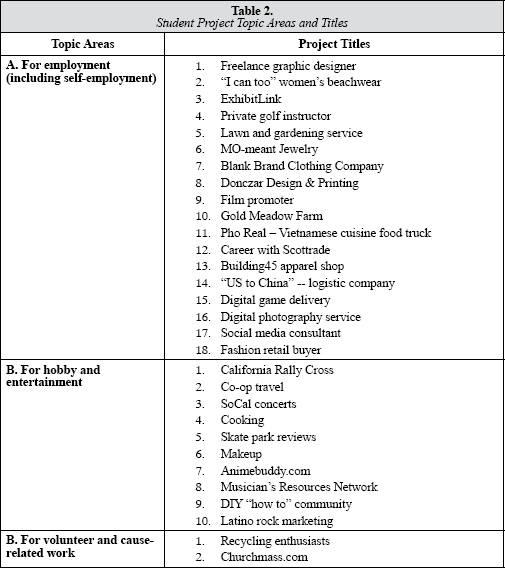
Table 2 shows that the topics selected by the students fell into three major categories that varied from self-promotion to potential employment opportunities (i.e., freelance graphic designer, golf instructor, equestrian trainer) and to startup businesses (i.e., digital photography shop, lawn and garden services, ethnic food truck), to promoting a personal hobby (i.e., cooking, makeup, DIY online community) or promoting for a pro-social cause (i.e., recycling, religious services). Table 2 presents a breakdown of student project topic areas and titles.
Student Project Topic Areas and Titles
Students’ Self-Evaluation of Learning Outcomes
To further understand the students’ learning experience and gain deeper insights regarding the effectiveness of the pedagogical exercise, an exit survey was administered at the end of the quarter. The survey consisted of four Likert-scale type questions that measured the students’ learning experience regarding the strategic marketing planning process, social media and digital tools and self-marketing skills. These items were: 1) “Gained a deeper understanding of the 7-step marketing process,” 2) “More interested in social media and digital tools,” 3) “Learned a lot about social media and digital tools,” and 4) “Better equipped to market myself in the future.” All items were presented in five-point scales, with 1 = “Strongly disagree and 5 = “Strongly agree.”
Students consistently demonstrated positive evaluations of their learning outcomes. For three questions regarding the main learning goals – “deeper understanding of the seven-step marketing process” (M = 4.52), “more interested in social media and digital tools” (M = 4.28), and “enhanced self-marketing skills” (M = 4.21) – students’ mean ratings were consistently above 4 on the 5–point scale. For the item “learned a lot about social media and digital tools,” the mean rating was 3.97, slightly lower than the other three items.
Results showed that the experiential exercise was effective in deepening students’ understanding of the strategic marketing planning process, enhancing students’ self-advertising/marketing skills and generating students’ interest in using social media and digital tools. The slightly lower ratings on the learning outcome of social media and digital tools suggest that students seem to be putting an emphasis on the strategic elements rather than the implementation elements.
Implications
Given the ubiquity of social media and college students’ apparent lack of awareness about how to use them for the purpose of self- advertising/marketing, this project offers great promise. It provides a tool that incorporates social media into the classroom in a fun and engaging way. It demonstrates to students how concepts learned in the classroom can “make sense” in the real world. This exercise shows that marketing principles are not confined just to products, goods and services for sale, but also to myriad other areas of their lives.
The exit survey showed that students in this class found the exercise useful in their study of e-marketing. The lower score in “learning a lot about social media and digital tools” may be attributed to the fact that most of the students were already using social media for various reasons.
The instructors found that the project kept the students interested and motivated throughout the entire term. The project had improved student learning and gave them a grasp of the 7-step marketing process to promote themselves and their ideas as “brands” through social media. They found that scheduling the mini-presentations throughout the term provided a fresh perspective for each presentation, as well as vicarious learning for all the other students in the class. Encouraging students to provide evaluations and feedback on the presentations fostered a sense of community building, echoing the marketing principles in social media and Web 2.0.
The project was incorporated in an e-marketing course. However, it can be utilized in a variety of advertising, direct marketing, or marketing strategy courses with little to no modification. The project was also utilized successfully in a ten-week, quarter academic setting. This suggests that it can easily be adapted to a semester system, which has less rigid time constraints.
The authors intend to use the project in the future on a larger sample of students and share any enhancement or modifications on their Web page. They encourage other educators to do the same.