






Abstract
This paper presents an example of a class project where students are required to use viral advertising/marketing to promote a product for a client. Students were required to first submit a paper on viral marketing. Then in groups, they were given a product to promote using viral advertising/marketing. Students evaluated the project in terms of the usefulness of the exercise.
Overview of Viral Advertising/Marketing
The term viral marketing was coined by Steve Jurvetson and Tim Draper in 1997. It appeared in a Netscape newsletter to describe the process of forwarding messages, via email, from peer to peer resulting in rapid message spreading (Phelps, Lewis, Mobilio, Perry & Raman, 2004). Viral marketing, or online word-of-mouth, has been defined as “any strategy that encourages individuals to pass on a marketing message to others, creating the potential for exponential growth in the message's exposure and influence” (Wilson, 2000, p.1). Currently this medium “exploits existing social networks by encouraging consumers to share product information with their friends” (Leskovec, Adamic & Huberman, 2008, p.1).
Today an increasing number of marketers are using viral techniques to attract potential customers who would otherwise be oblivious to traditional marketing strategies. Viral marketing has the potential to increase a company's sales force by using customers to spread the word, thus costing a company far less than more traditional forms of marketing (Datta, Chowdhury & Chakraborty, 2011). The early successes of companies like CareerBuilder.com, Hotmail.com, Microsoft and Anheuser-Busch Co. have increased awareness of the potential for this type of strategy given the relatively cheap price tag compared with traditional marketing (Vranica, 2006; Wilson, 2000).
However, there are several drawbacks. Brands like Trident have found that viral marketing is not necessarily easy to do (Steel, 2009, p.1). Even when a campaign is successful, it is difficult for marketers to determine how viral marketing efforts translate to actual sales (Vranica, 2006). Holt (2004) suggests that building a company's reputation by relying heavily on viral marketing strategies relinquishes control of the brand's identity to consumers and cultural tastemakers and thus results in a loss of more resilient iconic consumers.
The explosion of social media has significantly contributed to the number of vehicles currently available for viral marketing. For example, YouTube allows its 12 billion users the ability to connect with each other through visual recordings. YouTube usage grew more than 137% from 2008 to 2009 (Yarow & Angelova, 2010). Users who prefer a life-like-virtual environment have increasingly found Second Life to be of interest. The Second Life community offers users personal avatars that roam around seeking entertainment, educational opportunities and product offerings. Users searching for connections in the business/occupational world are using LinkedIn as a medium for viral communications. Facebook’s popularity has soared to more than 500 million users with 250 million active users currently accessing it through their mobile devices (Press Room, 2011). Twitter, with one billion tweets per week, offers a communication service that combines instant messaging with texting (Kissmetrics, 2011).
Viral marketing encompasses viral advertising but authors argue to what degrees. Phelps, et al. (2004) suggest that “electronic word-of-mouth advertising” (p. 2) is synonymous with viral marketing. Porter and Nolan (2006), on the other hand, make a case for recognizing a distinction between viral marketing and viral advertising. Their study sought to compare viral advertising with television advertising while Golan and Zaidner (2008) applied viral advertising strategies to Taylor's Six-Segment Message Strategy Wheel. Viral advertising, “refers to an online advertising distribution method that relies on word of mouth distribution via email or social network platforms as the means of reaching target audiences” (Golan & Zaidner, 2008, p. 962).
Video advertisements are just one form of advertisement that can be transmitted. This is an effective approach for marketers to transmit messages because although the original source of the message may be a marketer, it is consumers who are sharing the messages with their friends. There is a level of credibility associated when consumers transmit these messages between each other that is unmatched when compared to a marketer who may do so. In most cases, consumers send messages that are worthwhile and in many cases share information that may be helpful or entertaining.
Use of Viral Advertising/Marketing as Pedagogy
University students as a whole have grown up with technology as part of their lives. College students, along with their cohorts are “media savvy, multi-tasking students” (Vie, 2008, p.9) who are sometimes referred to as Generation M (Roberts & Foehr, 2005). They are “equally at ease handling multiple instant messaging conversations as they are downloading ring-tones to their Razrs and forwarding viral videos” (Vie, 2008, p.10). As marketers cope with the seemingly infinite possibilities of new media, students can gain an advantage by being exposed to potential applications of new media in their classes (Lowry & Lei, 2008; Waller & Hingoram, 2009). Griffith and Liyanage (2008) found that using social media as a teaching tool yielded higher levels of interaction between teacher and students. The literature also has suggested that increased student satisfaction (Driver, 2002, p.36) improved class performance and development of cohesive classroom community (Dawson, 2006, p.161; Beaudoin, 2002 p. 154) were among the resulting benefits of using social media in the classroom setting.
However, the research also points to the disadvantages of utilizing social media techniques as part of the classroom experience. Lipka (2007) suggests using social media as a teaching tool could change student expectations of the teacher-pupil relationship, thus blurring the line between professional behavior and social activities. Students have indicated that they wanted their social media to remain private preserving its use for connecting with friends (Madge, Meek, Wellins & Hooley, 2009). Thus, classroom pedagogy that provides proper and effective usage of various forms of media such as viral marketing, social networks, search engines and other Web 2.0 applications are important. Appropriate applications of such classroom strategies will provide students useful tools to help them keep up with rapidly changing technology (Caravella, Zahay, Jaeger & Eckachai, 2009).
To add a measure of realism to pedagogy, having a willing participant from the business sector to serve as a client will force students to take the project more seriously. A “client based learning” experience (Parsons & Lepkowska-White, 2009, p.155) takes place when a student works directly with a client. Client based projects (Lopez & Lee, 2005) or client-sponsored projects (Goodell & Kraft, 1991) are terms that have been previously associated with this form of activity. This teaching approach is predicated on clients giving a business task to a classroom of students who analyze the information and formulate a solution that they present to the client. It also gives the students an opportunity to apply their know-how to an actual situation with the intent of providing the students with “a rich, hands-on learning experience” (Lopez & Lee, 2005, p. 173). From a practical standpoint, students benefit because they receive feedback about their work from the client. In a best case scenario, this exercise may serve to give the students confidence and reassurance that the concepts they learn in class have real world applications (Goodell & Kraft, 1991; Razzouk Seitz & Rizkallah, 2003; Cooke & Williams, 2004; Lopez & Lee, 2005).
Objective
Recognizing the increasingly significant role of viral techniques, this paper describes an experiential assignment used to teach students in an upper division marketing strategy class how to create viral advertising/marketing. The exercise is versatile enough to be incorporated into a number of other advertising, promotion or direct marketing courses. In order to add a dimension of reality to the learning experience, the instructor obtained a client who was open to exploring the benefits of viral advertising/marketing as a means of promoting her product. The authors then attempted to evaluate the effectiveness of the project by having students respond to a short survey addressing their impressions about the assignment. The client met with the students twice: 1) to describe her product and objectives; and 2) to evaluate the students’ outputs and recommendations. She was accessible to answer student questions throughout the term.
Another objective of the exercise was to provide students with the opportunity to demonstrate their creative problem-solving abilities with as few constraints as possible.
Inspiration for the Project
As part of a capstone Marketing Strategy course, students are given a very short period of time (approximately two weeks) to develop and execute a creative strategy to launch a new product. Working as part of a team, they are expected to present and perform the creative solution.
The inspiration for this project comes in part from Donald Trump's reality show, The Apprentice. In The Apprentice participants compete for the opportunity to run one of Trump's companies. The contestants are divided into teams, which are assigned the same task, very often a marketing one. The winning team is rewarded while the losers go to the boardroom where someone is fired or eliminated from the show.
Although no one is fired in the classroom version, the students are expected to complete complex marketing tasks in a very short period of time. Like the teams in The Apprentice, a big portion of their evaluations is based on the creativity displayed in their solutions to a marketing problem.
The Marketing Task
During winter quarter 2011, the students were tasked with creating a viral marketing campaign for Shiwido. Shiwido is a hand held instrument that can be used to exercise, dance or express one's creativity.
Shiwido is designed to work out the entire body. It promotes, balance, creativity and concentration. It consists of four parts: 1) the heart: the center that has the weight; 2) the string: the connector between the heart and the tails; 3) the tails: colorful stripes that make it fly; and 4) the holder: the control, where you insert you index and middle finger.
Shiwido was developed by Sofia Puerta, a Columbian native, paragliding champion and yoga instructor. She has taught classes on Shiwido for both children and adults. Sofia wanted the class to help raise awareness for Shiwido so that she could begin mass marketing it. She also wanted their help to narrow her marketing plan which listed nine target markets and numerous promotional activities which could be used to reach the markets in no particular order.
The Mechanics of the Task
The project consisted of several parts: 1) a written paper on viral marketing; 2) creation of viral advertising/marketing activities that could be used to promote Shiwido; 3) a written viral marketing plan and 4) presentation of the activities and plan.
Each member of the class was expected to become familiar with the mechanics of viral marketing through research and writing a three to five page paper. In the paper, they did the following: 1) defined viral marketing and discussed how it differed from traditional marketing, 2) described a minimum of three different techniques and/or methods that are used to create a viral marketing campaign, stating whether these techniques could be used to market Shiwido and why, and 3) described three different viral marketing campaigns and discussed why they thought each succeeded or failed. They also discussed what they learned from each campaign that would help them market Shiwido.
As a team they were asked to create at least one marketing tactic that could be used to promote Shiwido virally. They were expected to modify Sofia's marketing plan to include instructions on how to implement the viral campaign. They could also make other changes to her plan as necessitated by the campaign they proposed. At the end of the two weeks they presented the plan.
Viral Project Outcomes
The Viral Marketing Project was tested on a class of marketing majors enrolled in a capstone Marketing Strategy class at a medium size university in the Southwest region of the United States. The students were divided into teams of four or five members.
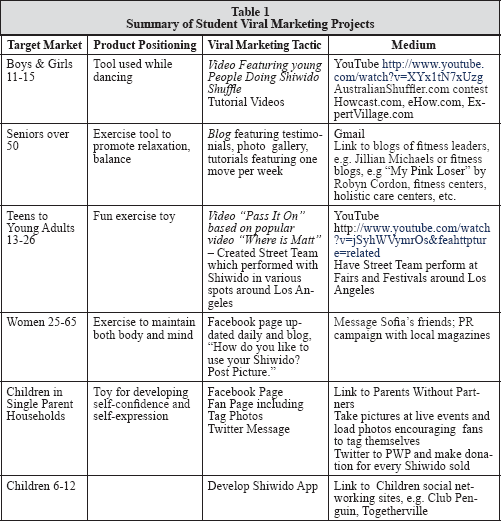
The students performed well under pressure. They targeted a variety of segments ranging from children to seniors. They developed blogs and videos that were well suited to the needs of the target markets. Two teams created videos that as of this writing could be found on YouTube. Table 1 summarizes the projects produced including target market, the product positioning strategy, the viral marketing tactic and the strategy used to make the tactic go viral.
Summary of Student Viral Marketing Projects
One of the most satisfying outcomes of the project was the extent to which the client incorporated the student recommendations. The client adjusted her pricing strategy. She incorporated a blog into her website. She also started a Facebook page and opened a Twitter account. She has also downloaded additional videos featuring the product on YouTube.
Results of Evaluation Questions
After watching all the presentations, the authors administered a short survey to evaluate the effectiveness of this project. Questionnaire items focused on students’ impressions of this viral marketing campaign. Table 2 contains the results of the survey.
Mean Scores for Evaluative Statements (n=32)
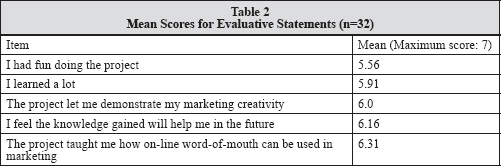
Thirty-two evaluation forms were collected. Eight items were used on the evaluation form with a seven-category Likert scale used for the first six items. The scale points ranged from 1 = “Strongly Disagree” to 7 = “Strongly Agree” as the measures, with “4” representing neutral. The last two items were opened-ended questions.
The item with the highest agreement was “The project taught me how on-line word-of-mouth can be used in marketing,” (M = 6.31), which indicated the level of learning that the students felt took place. The students had an opportunity to take part in a task that was related to marketing based on their knowledge of the subject. By this measure, students may have felt that they were successful in this experience which may give them confidence in demonstrating the skills attained in a future class or even for a future employer. Perhaps this was further instilled in the students based on the feedback given from a “client” and not just from an instructor.
The second highest item, “I feel the knowledge gained will help me in the future” (M = 6.16) indicates the students felt the experience was something that they could take with them and use in their lives if the opportunity presented itself. There are times when students take courses and do not see the relevance of what they are learning or how they can apply the subject matter. This finding signaled that students felt that the time used in doing the project was worthwhile and that the experience was beneficial to them.
The outcome of the “The project let me demonstrate my marketing creativity” (M = 6.31) implies that the students have their own ideas about marketing and desire to have opportunities to show these skills. In cases where students are working for a client, there may be boundaries that can both limit but also provide instances where students may have to be more conscious of the decisions that they make. In the real world, clients have budgets so this may give students a chance to consider the best options within some budgetary constraints.
The statement, “I learned a lot,” (M = 5.91) reinforces the idea that the students’ level of knowledge has grown in between the first day that the students were presented with the project and the state at which the students were at the end of the project. This measure is important because it may show that the students have a better grasp of the topic area and that they expanded their base of knowledge.
For the item, “I had fun doing the project,” (M = 5.56) the score given is consistent with the other positive accounts offered previously. The presentations of the project to the client were very lively and the students were energized in sharing their experiences with not only the client and instructor but also with each other.
The last two items were open-ended attitudinal questions about the project experience. Since there were some common answers among those given for these two questions, those answers were coded based on the answers given. Frequencies were then derived to find out how often students responded similarly to those two questions.
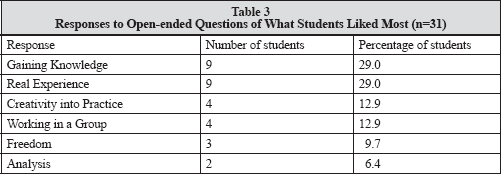
The last two measures were tallied based on the answers given. Tables 3 and 4 show the results.
Responses to Open-ended Questions of What Students Liked Most (n=31)
Responses to Open-ended Questions of What Students Liked Least (n=28)
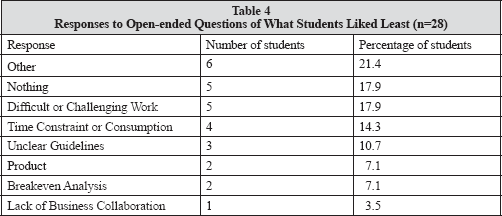
Table 3 lends support to the findings. The responses were consistent with the evaluation form results, especially the top three responses, which were nearly identical to the items on the scale above. It is interesting that four students mentioned that they liked working in a group. There are times when students can find working in a group problematic. Even though the number is small, the viral advertising/marketing project may have had something to do with that score.
There was limited negative reaction to the project with the biggest objection being the amount of time the project took and how challenging it was (See Table 4). It is actually encouraging that the students recognized that finding creative marketing solutions and developing a marketing plan are hard work. A few felt that the guidelines were unclear. This was no doubt partly a function of having to create a campaign where they were given a lot of latitude to exercise their creativity. Students often don't have much experience with the more “messy” side of marketing and feel most comfortable when provided with very specific guidelines to follow. A couple of the students did not like the product, failing to recognize that in their future careers they would not always have the luxury to just work on products they liked. Some wanted more input from the client even though the client was accessible by phone and email and came to class twice throughout the term. Most of the “Other” concerns were random and would have been found in any group project.
Conclusions
Viral advertising/marketing has been incorporated in the advertiser's “tool box” of methods for getting the word out to prospective customers. Generating online word-of-mouth, as well as motivating customers to pass along advertising to their peers, when successful, is a cost effective means of attracting the attention of a digitally savvy target market. Traditional marketing techniques can often miss Generation Y and the upcoming Generation M, but viral videos and messages are passed on and on if these groups find them relevant.
Most marketing and advertising educators feel that involving students in engaging activities as well as hands on activities are essential for student learning (Spiller, Marold, Markovitz & Sandler, 2011). This project gave students a chance to develop a viral advertising/marketing campaign that addressed both of these objectives. The students in this instance had an opportunity to employ their creativity and learning to a task using activities that they may have found quite familiar. This generation, The Net Generation, is a group of tech savvy individuals who have been exposed to multiple forms of online social media, more so than Generation X or the Baby Boomers (Eckmann, 2010). Even prior to earning their degree, this group is in a position to showcase their skill sets to future employers. Those future employers may not be as prepared to take advantage of the opportunities that the Internet offers so these students may be able to come in and contribute more sooner than later. This may occur in spite of instances where they may have had faculty members who were not as well versed in technology. One of the findings of this study is that based on the positive feedback from the client, students can contribute as a new employee to the firm. It is ironic that a source of their knowledge may stem from merely growing up in the time period of the ‘90s and ‘00s.
For faculty, matching student learning expectations with university curriculum objectives may prove to be challenging yet imperative if universities are to provide students with an educational experience that they find satisfactory (Waller & Hingorani, 2009). Although students may have their opinion with regards to expectations, future employers also have expectations of new employees and it is the responsibility of the university and faculty to fully prepare students for this next step. In other words, “practitioner relevance” should be integrated into the classroom experience to increase the likelihood of student success once the student has moved on from the university (Spiller, et.al., 2011).
This project engaged students in formulating a viral marketing campaign in an enjoyable way. They worked on an actual product and met the person who was launching this product. Students were provided latitude to use their creativity. More importantly, this project demonstrated a practical use in applying what was a recreational application of technology to business. Students were already familiar with various application of interactive technology. Applying them to a business setting where they could parlay these skills into marketing an actual product opened their eyes to possibilities.
The evaluation survey indicated that students felt they learned a lot from the project. Videos produced and presented in class were lively and amusing. The authors were pleased with the results. Despite the short amount of time, students really rose up to the task. This project fosters the use of creativity and can be used in a variety of direct marketing and advertising classes.