







Abstract
As a communication tool, the creative brief should seamlessly blend business goals with creative vision. This article investigates the role the creative brief plays as an internal communication tool between account and creative teams. Two data sets were collected. Two open-ended e-mail surveys gathered responses from 33 agency account management members and 42 creative and art directors, asking about their perceptions of the creative brief. Based on the two data sets, we offer pedagogical suggestions to advertising professors for ways to embed more discussions of communication and teamwork into creative brief assignments.
Keywords
Introducing advertising students to the art and commerce of advertising has always been multifaceted. Like those of their full-service or traditional agency counterparts, advertising curriculums cover everything from research to media planning and buying, account management and planning, new media, and creative in one form or another (Fullerton & Kendrick, 2017). But the actual merger of business and creative begins with the development and exploration of the creative brief. This article explores the creative brief as a collaborative communication tool in advertising. We asked account and creative team members for their insights into briefs, and based on their answers, we identify ways in which advertising instructors might consider modifying how they teach creative briefs to incorporate enhanced communication in team relationships.
Literature Review
Interest in the business of creative has taken on more importance as the overlapping knowledge and responsibilities between creative and account management teams has blurred (Blakeman & Taylor, 2017). The advertising field has changed radically over the past decade, ultimately changing how briefs are prepared (Baskin & Waters, 2017).
What Is a Creative Brief?
An internal agency document, “the creative brief, also known as a copy platform, creative work plan, creative plan, or copy strategy, is the next step in the evolution of the creative strategy” (Blakeman, 2018, p. 53). At its most simplistic, it is an outline created by account management for the creative team to use as a springboard to solving the client’s business and, thus, advertising problem. At its most complex, it is the eventual visual and verbal voice of an ad or campaign.
A good brief, according to creative legend Jackie End, is “when you can read it without missing lunch and dinner” (Margulies, 2009, p. 17). Margulies recalled Leo Burnett saying, “A good creative brief” is defined as “brief and single minded … logical and rooted in a compelling truth … [incorporating a powerful human insight]” (p. 22). An informative brief should define “the target audience, introduce the key consumer benefit, describe the individual features and consumer benefits, define objectives, address the competition, and outline tactics. It is the road map the creative team will use to define” (Blakeman, 2018, p. 53) the overall message that needs to be communicated.
It is not a document that speculates or generalizes, nor is it a creative outlet for the account team. They are not writing copy or defining or determining what creative should look like. Instead, it should insightfully inform. It should be detailed and concise enough that the creative team—creative and art directors and copywriters—can use it to develop a creative solution for the client’s communication problem. A well-written brief (ideally, no more than 1 page) ensures that the creative team, the account manager, and the client all have a thorough understanding of exactly what objectives communication efforts need to accomplish.
Like advertising, a creative brief must inspire the target audience, in this case, the creative team, to action. A well-crafted brief is thought out, thoroughly researched, and never thrown together. An informative brief requires culling through the research and reporting only on the insights that matter most. From start to finish, the brief needs to tell the creative team an informative story that will result in a great visual and verbal solution. So, the brief is a means to an end, not the end result (Burns, 2012). There are basically two types of briefs. Those that are created by the client and those that are created by account management. This article concentrates on those created by agency account teams.
The Creative Brief Tells the Story of the Business of Creative
The “creative brief is the key tool with which the planners and account management teams can unlock the talents and imagination of the agency’s creative people” (de Waal Malefyt & Morais, 2010, p. 341). When the account manager is writing the brief, he or she is “crafting the story of [the] brand and its reason to exist and thrive in the world. This is the first and arguably the most important creative act of the entire process” (Margulies, 2009, p. 8).
How much information is shared with the creative team will also depend on the size of the client’s job. Briefs can easily be customized to fit any problem. Peterson (2015) recommends using Cella’s 2014 In-House Creative Services Report that uses a three-tier approach to determine the level of detail needed to complete the project. Tier 1 projects include new business or new campaign development. Those projects require a high level of conceptually creative ideas. Tier 2 is for existing client projects. These projects require an abbreviated brief to ensure everyone is on the same page. Tier 3 is for projects needing a little tweaking or updating. This brief is short and sweet and does little more than outline needs (Peterson, 2015). Tiers 2 and 3 are particularly helpful when working with any fast-paced social, digital, or search-related projects. No matter the size of the project or the medium, a written directive saves time, improves communication between groups, and diminishes the chance of errors.
Teamwork Makes the Business of Creative Work
Agency teams are often formed around a specific brand and are directionally driven by both an account and a creative team. Depending on the client’s needs, larger projects may require the addition of media specialists for areas such as, but certainly not limited to, digital, social, mobile, and direct marketing. The resulting “team creativity” leads to “the generation of novel and useful products or ideas [that are] based on the exchange of information and perspectives using a collaborative approach” (Paulus, Dzindolet, & Kohn, 2011, p. 328). Shared ideas and information can lead to more focused and informed ideas that are strategically sound and creatively unique (Lynch & West, 2017; Perry-Smith & Shalley, 2003; Tesluk, Farr, & Klein, 1997). When multidisciplinary teams share knowledge and insights, chances for a better creative solution that is on target and on strategy improve (Lynch & West, 2017).
Communication between teams is important to both the development and eventual execution of the brief. Memorable advertising campaigns require both the account and creative, and any extended teams, including the client, to work closely together. Tapping into these diverse skill sets helps to bring differing perspectives and ideas together. It is an iterative process, where each team can use its knowledge to develop the overall creative direction.
Once the brief is completed, the next step is idea development. Although not defined in the brief, the direction, if well written, gives both teams a chance to discuss possible solutions and review the client’s overall view for the project. According to Baskin and Waters, “90 percent of the creativity in great communications is in the brief” (2017, p. 9). It is the driving force behind creative development.
Weak briefs can lead to ideas that are off target and off strategy, and contribute to poor interagency communication and, most importantly, poor communication between the agency and the client (Davies, 2000; Sutherland, Duke, & Abernethy, 2013). While many scholars and practitioners write about the value of communication, few actually delve into what kind of communication is most effective. We believe that this gap in the literature could be filled by listening to the voices of both account and creative teams in how they view communication around briefs. We selected a qualitative research method to analyze the responses because it allowed us to gain in-depth insight into our respondents’ experiences.
Method
The role of the creative brief in a successful advertising strategy is clear. But what makes a good creative brief from the perspective of the account and creative teams? This general question prompted two research questions. RQ1: How does the content of the creative brief help the account management team and creative team work together? RQ2: What are the best practices for communication and collaboration around the brief?
The research team used a snowball sample to share a survey, comprised of 12 open-ended questions, with account managers and creatives during the fall of 2015 and spring 2016. Two questions probed specifically into their perceptions and use of the creative brief. The open-ended questions allowed for each account and creative team respondent to tailor his or her own answer and write as much or as little as she/he wanted. Follow-up probes were embedded in the question to structure answers.
Descriptives
We sent open-ended question surveys to 189 account team and 239 creative members at 24 different advertising agencies in 9 different cities (Richmond, Atlanta, Boston, Rochester New York, Nashville, New York City [NYC], Knoxville, Los Angeles, and Memphis). The size of the agencies ranged from 12 employees to 800 employees (M = 418, SD = 238). The questionnaire for each group contained two questions about the creative brief.
A total of 75 advertising professionals completed the open-ended questions. Forty-two art and creative directors and 33 account management team members comprised the samples for this study. Creative respondents’ ages ranged from 22 to 63 years (M = 37, SD = 10.52) and their length of employment at their current agency ranged from 4 months to 35 years (M = 5.6, SD = 7.9). Titles included creative director, art director, vice president creative director, senior creative director, chief creative officer, group creative director, creative group head, executive creative director, junior copywriter, senior art director, and vice president group creative director.
For the account management sample, responses came from 33 predominantly young professionals. Age of respondents ranged from 22 to 58 years (M = 30.5, SD = 9.7). Length of current agency employment ranged from 5 months to 30 years (M = 3.6, SD = 1.6). Titles included account supervisor, account executive, senior account executive, account director, brand manager, account manager, vice president, account director, group account director, associate brand manager, associate account manager, global account director, global business director, and senior social media director.
Data Analysis
We were interested in best practices in working together and what account and creative team members thought about the creative brief as a communication tool. We read the literature about creative briefs and intra-agency communication. After sensitization to the literature, we dissected and analyzed all of the account and creative team members’ answers to the two open-ended questions. We inductively broke down statements into conceptual units by looking for observations and ideas in the text that addressed the research question. The research team discussed the different categories that emerged and agreed when saturation had been achieved. Then, the units were organized and subdivided until cohesive, distinct categories of information emerged. Finally, the researchers named the categories, placing similar conceptual events and incidents together to form thematically representative categories and items of interest. Emergent themes answered the research questions.
Findings
RQ1 inquired how the creative brief helps the account management and creative teams work together. Results showed differences in how long the brief should be and the depth of content it contained. Both teams believe that building a solid brief that is on strategy is a key step in working together.
Perceptions of Length and Depth of Content Vary
Our respondents agreed on the value of the brief. But they disagreed on the length and depth of content. An associate creative director noted, “Simplicity is key, that means length is key, if we can keep it to one page that’s great.” A creative director from Chicago summed up a large number of creative responses explaining the value of a simple brief, saying, “A succinct brief helps. For me, I can immediately zero in on what the advertising must say, or the single most compelling thing that we can say.” An account executive from NYC felt length was not as important as setting the creative team up for success, saying, “No matter the brief’s length, the goal is to brief them with an open mind and with any strategic information necessary to help them succeed—clear objectives, things to avoid, thought starters, best practices.”
The expectation is that the brief needs to be simple and yet informative enough for each team to understand the problem to be solved or the opportunity to be exploited. A group creative director from Nashville saw both sides of the problem, saying, If account service can distill it down to something that fits on a page or two that’s always the dream and almost rarely the reality because on one hand I like to have a lot of information, just to kind of wrap my head around something new and hunt for a nugget that somebody else may have overlooked. So, I guess a good brief has the information clearly articulated, with some kind of a goal, objectives and a key point. I like to know what the limits are. The worst brief ever is account telling you to do what you want or something like that. To do what you want, it is too wide, you don’t have anything to bump up against.
An account supervisor from Memphis summed it up this way, “Collecting all relevant information is the core to building a complete creative brief.” The quality of the content and analysis in the brief also matters a great deal to the creative team. Creatives generally agreed that an easy-to-follow, well-written, informative brief can lead to some of the best possible work. A creative director from Richmond tells us, “The best briefs are concise, thoughtful, and based on customer research and human insight.” An associate art director from Boston believes, “Good work will always be the result of good communication and good briefs.”
An account group head from Dallas related how “the account team needs to be good ‘detectives’—digging out information, putting it in the brief in a timely and informational manner.” An account director from Atlanta was more succinct, saying, “It’s our job to just make a brief that has a challenge on it.”
Briefs Define the Strategy
Both sets of respondents agreed that the brief defines the overall advertising strategy. An account executive from NYC felt that “good account managers are able to distill complex business problems into easily understood, strategically sound briefs for their creative teams.” Another account executive from NYC felt the brief should contain the “information necessary to succeed to the highest ability—clear objectives, strong strategy, things to avoid, thought starters, best practices. Insights are the heart of the creative brief.”
Creatives concurred with these statements. A chief creative officer from Atlanta believed the account team’s job “is to write great project briefs that communicate strategy so that the creative team can hit the key strategic business challenges that we are trying to solve for.” Indeed, a common theme is you can only sell a good idea if the brief is on strategy. “No matter how crazy your idea, if it’s on strategy, it has a chance. If you’re communicating the right thing, account service, and eventually the client, will give you more latitude to play within those boundaries.”
Results from RQ1 showed that today’s briefs need to be simple, informative, easy to follow, and focused on strategy. These answers focused on the actual text of the brief. But what about the communication between teams concerning the brief? Our findings also provided insight into the communication around the brief and how that communication makes or breaks the strategy.
Communication Is an Ongoing Process
RQ2 asked about inter-team communication. Two themes emerged from each group’s answers: (a) Communication is needed before, during, and after the brief is prepared, and (b) so is collaboration.
Communication Shouldn’t Be Brief, But Continuous
Both groups identified communication as a problem when working through briefs. Although communication does occur after the brief is written, more communication needs to occur before the brief is written. Intergroup communication needs to include input from both teams before the first word is put to paper. A group creative director described this approach, noting that “the best briefs I’ve been involved with lately have become even more of a collaborative back and forth process with creative leaders, the client and account service all working together.”
What and how information is communicated is also a problem. One account supervisor told us, One of the biggest mistakes I see account service make is they tell their creative partner what the client thinks the solution is instead of talking through the problem with them so they can come up with a solution together.
Communication needs to be ongoing, especially after creative is presented to the client to ensure any and all changes, additions, or deletions are successfully completed. An art director from NYC felt communication shouldn’t be that hard, saying, “It’s not rocket science, tell us what you want succinctly and don’t fall off the map while we’re working. Communicate with us daily, hourly, until we solve the problem before us.”
An account supervisor from Atlanta believed, The main barrier, is that which is common in most unhealthy relationships: lack of communication. If there is a communication breakdown, the account and creative teams will never be successful. The most successful creative/account teams stay connected throughout the process and not just in the beginning during the briefing.
Collaborating on Direction
A second communication-related theme focused on the topic of collaboration. Many account respondents noted that “there should be a one-team mentality.” One account manager from Chicago saw the lack of collaboration as a barrier, saying, “If both sides are not willing to put forth the effort to engage in conversation, and really honest conversations, you create a barrier to getting the best work out to the client. This must be a collaborative business.” Respondents from both teams believed they must collaborate rather than work in silos, to ensure the best work. An NYC creative director felt, “It’s easy to do great work when you don’t have rules, but most agency briefs have many boxes to ‘tick’ so being a collaborative acct manager and creative is important.”
Although both teams saw communication as an important driving force, neither team believed that the right amount and type of collaboration and communication were routinely happening.
Discussion
The answers to the two research questions suggest ways forward for advertising pedagogy around the creative brief. First, instructors should work to create student competencies in team communication. Second, creative briefs might be enhanced by the creation of a supplemental document that better structures the communication between the teams and with the client. Third, cross-training of creatives and account service students may help them to develop the skills needed to better understand each team’s role in the creative strategy.
Creating Team Competencies: Communication
Responses acknowledged that a lack of communication was considered the most common way to not only derail the team relationship but also hinder the quality of the work. The most successful account/creative teams stay connected throughout the process. Beyond communication skills, results showed the need for account teams to be able to insightfully manage data and prepare briefs that are succinct and easily understood to ensure results that are both on target and on strategy.
We believe the creative brief can serve as a bridge to improving our students’ skills in teamwork and communication. Through teamwork, students can experience firsthand how crucial communication efforts are to completing a job that is both creative and on strategy (Blakeman, Haygood, & Lambert, 2006). A Memphis account supervisor suggested, “Make these kids work together. Let them learn while they’re in school how disastrous and time consuming a poorly written brief can be to not only the message but morale between teams.”
Classes that focus on teamwork allow students to experience firsthand the role the brief plays in the relationship between teams. Being able to see the value in a thoroughly researched and insightfully written brief places the need for sound business development directly in line with the ultimate success or failure of the final creative product.
Any resulting conflicts, concerns, or questions from either team reinforces the need for constant communication to ensure the final visual and verbal solution is both on target and on strategy, ultimately resulting in fewer last-minute revisions.
Switching Sides
To incorporate the issues presented in this article, educators will need to continue to push harder and more often that both teams need to be lateral thinkers. Communication and collaboration allow for shared ideas that help both teams solve the client’s advertising problem.
The best way for account and creatives teams to “walk a mile in each other’s shoes” will require a trade-off. Educators might consider splitting the class in half without initial preference of independent career goals. Each of the two groups will be given a different brand that requires a brief. Once completed, both groups will trade their brief with members of the other team, now wearing their creative hats. Students need to keep track of how much or how little collaboration was needed for each team to understand the visual and verbal direction.
Instructors should ask: Was the brief inspirationally written? Were the objectives strategically sound? Now, each must write out a visual and verbal solution to the brief. Students can also be given time to execute their solutions creatively. What are the results? How much collaboration, if any, went on while working on the creative solution? Were the resulting ideas, perhaps critiqued in class, on target and on strategy? How might they have altered the brief to ensure better clarity and thus a better visual/verbal solution?
Educators can take this idea one step further by teaming up with business and/or graphic design courses to test the quality of the brief beyond the knowledge both outside teams have of the project. Advertising students might write a brief that graphic designers have to interpret. Before the two teams meet, the graphic design team can respond with a written explanation of their visual solution. The response will help determine their skill level in laying out the parameters of the assignment. This exercise could be done in reverse, with business students writing the brief and advertising students responding with their visual/verbal solutions. The amount of collaboration required to successfully complete the project will determine its overall success.
Preparing for Productive Disagreement
Class discussion needs to address more concretely how both teams should react to and respond to questions, concerns, and the most appropriate ways to deliver feedback. Perhaps we need to spend more time with this grade-driven millennial generation on the consequences of poor communication and teamwork skills? It should also be considered that what professionals are experiencing might have less to do with education and reflect more of a learned behavior, as young account managers and creatives watch the interaction between the two groups. However, educators can address where conflicts start and explain how both teams are equally responsible for clearly understanding the parameters of a client directive.
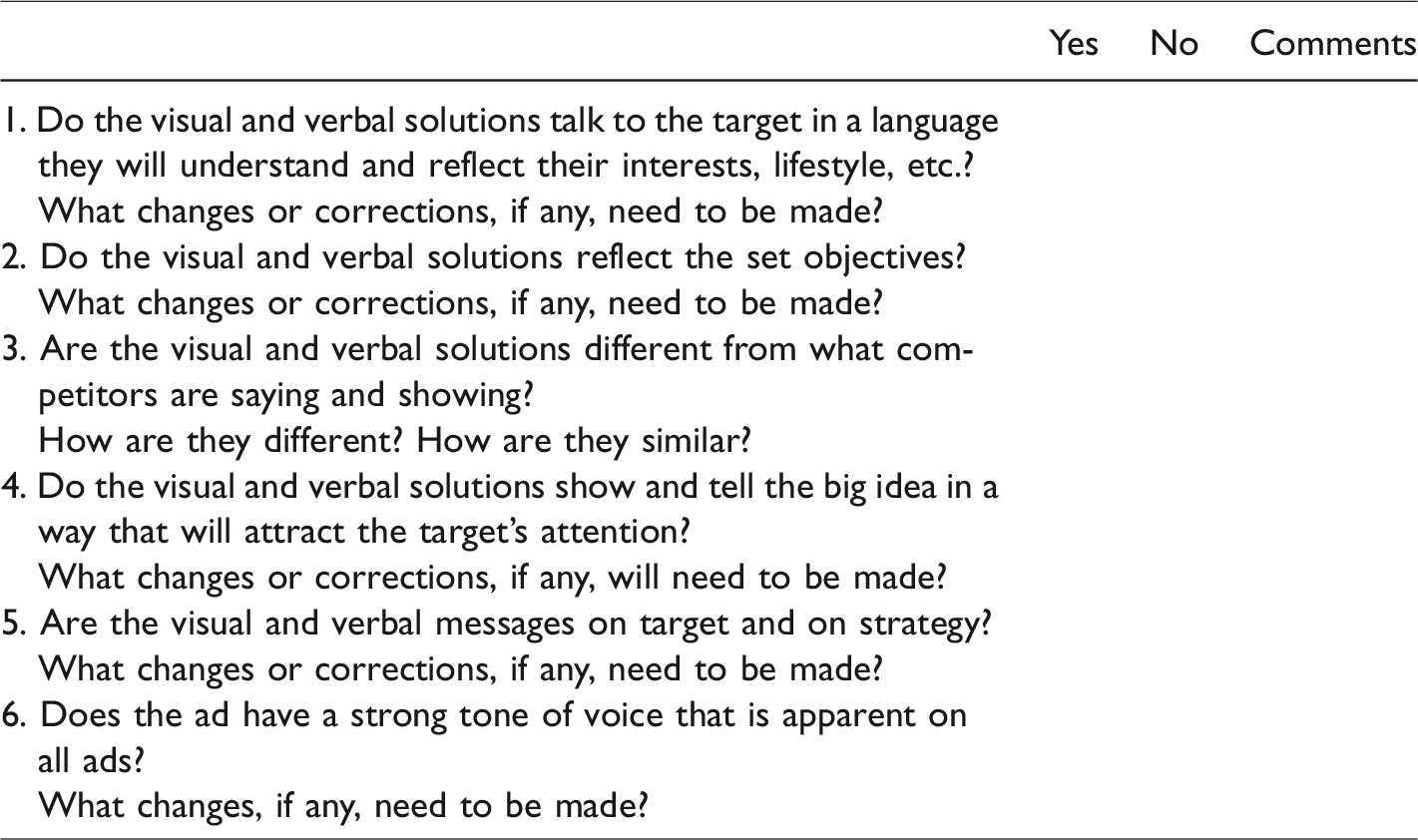
Based on the responses of the account management and creative teams, we have conceptualized a Communication Checklist for students on both teams to complete to structure stronger communication skills (Table 1). One way to facilitate stronger communication tactics in the classroom is to have students dissect each creative idea to ensure it fits within the business parameters laid out in the brief. The following checklist can help both teams confirm whether the visual and verbal solutions are strategically sound and on target.
If the team can answer each of the questions posed in the checklist, then the ad is strategically sound, targeted to reach the correct audience, and hopefully creative.
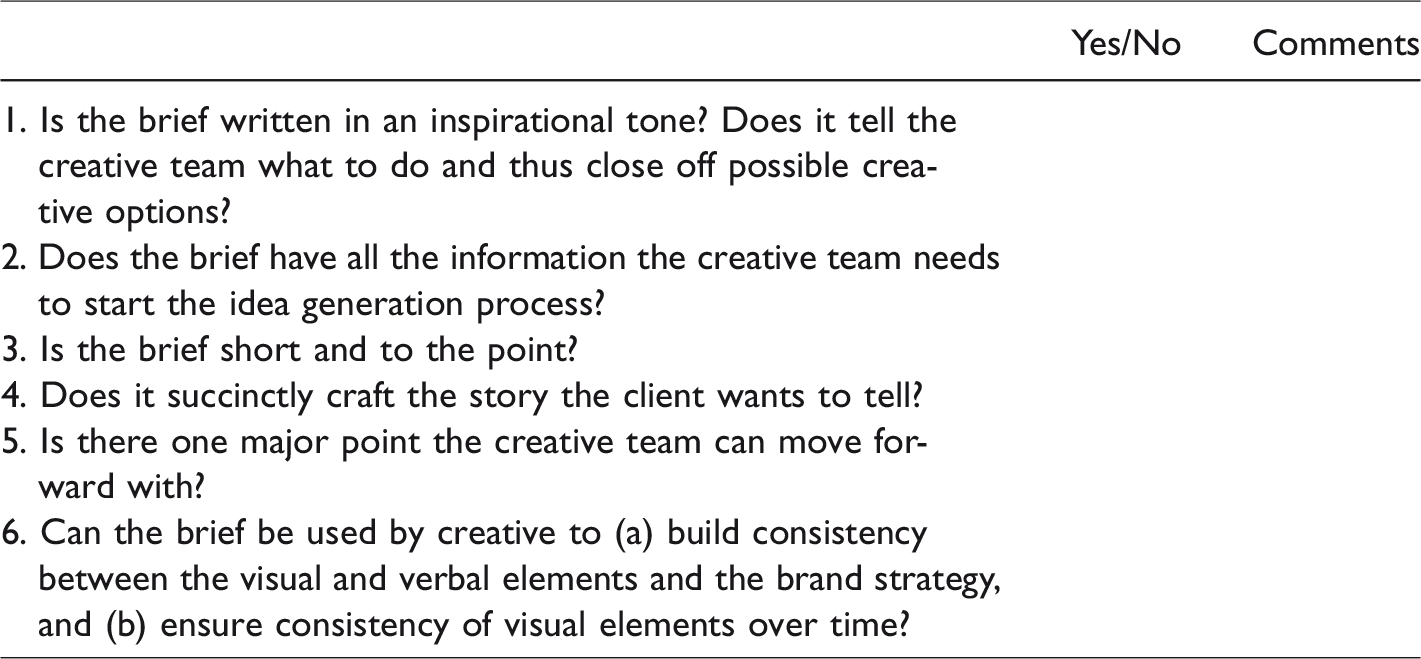
To assist advertising professors, we offer an Instructor’s Creative Brief Checklist to help them quickly and easily evaluate briefs (Table 2). These questions and simple yes/no answers provide a method to check the brief and provide feedback to students.
If the brief successfully answers the initial business questions, then discussions can immediately turn to the possible visual and verbal solutions that can effectively and creatively solve the client’s advertising problem.
Conclusion
The brief should be a starting point, not the final answer to the client’s advertising problem. Its job is to inspire the creative team. Investigating the nature of collaboration offers holistic insights into how working in tandem produces more enlightened work with less conflict. Collaborative efforts breed trust, reduce unnecessary friction, and create a relationship and a working environment where great creative ideas are less formulistic, less eclectic or “artistic,” (Hirschman, 1989; Rothenberg, 1994; Koslow, Sasser, & Riordan, 2003; Morais, 2007), and more strategically driven. The resulting team effort allows the agency to present a professional and unified front to the client with ideas that are focused and unique to the brand and the client’s advertising needs (Hirschman, 1989; Kover & Goldberg, 1995; Morais, 2007).
Shared communication around both the development and use of the creative brief is now a team effort and creates new pedagogical requirements for advertising instructors. Creative teams that once reacted to strategy now assist in planning the direction the brand and creative will take. This integrated knowledge helps in developing a brief that is inspirational to the creative team (Deckinger & Singer, 1985; Vanden Bergh, Smith, & Wicks, 1986). Knowing what the client wants to accomplish with their advertising efforts helps to narrow creative efforts and strengthen the overall message. As a working partner in determining strategic direction, creatives can more accurately target their message.
Alternatively, account teams that become more immersed in the creative process understand that strong, strategic briefs minimize not only creative that is off-strategy but also misunderstandings, all breeding grounds for potential conflicts. In the final analysis these diverse personalities and points of view create that “lovely area where art and commerce rub up against one another and it doesn’t happen anywhere else … but that ‘rubbing up’ generates friction when conflicting values are brought into juxtaposition” (Hackley & Kover, 2007, p. 67).
As advertising educators, we need to prepare our students for these complex relationships and give them the tools to succeed. Adding a pedagogical supplemental communication checklist to teaching creative briefs will help students better understand the different roles in advertising and have the communication skills to negotiate conflict and disagreement and create new opportunities to contribute to the business of the creative.
Account and Creative Communication Checklist
Instructor’s Creative Brief Checklist
Footnotes
Declaration of Conflicting Interests
The author(s) declared no potential conflicts of interest with respect to the research, authorship, and/or publication of this article.
Funding
The author(s) received no financial support for the research, authorship, and/or publication of this article.