






Abstract

Team teaching is a relatively new concept in higher education. It is more commonly reported in K – 12 classes than at the university level. A comprehensive electronic search for research on post-secondary team teaching found several articles from such disciplines as literature, computer technology, medicine, psychology, and special education (Aydai & Crawford, 1996; Gailey & Carroll, 1993). Of the few reports found for team teaching in business, most were at the master's (MBA) level (Watkins, 1996; Silver & McGowan, 1996). Reviews of university team teaching efforts ranged from highly laudatory to outright rejection for its inherent difficulties (Gailey & Carroll, 1993). No reports were found for the type of team-taught course described in this paper.
Obstacles to Team Teaching
Obstacles to effective team teaching at the university level are many and varied. Some are administrative; others are individual. Administratively, a team effort poses workload and staffing problems (Young & Kram, 1996). The norm is one faculty member assigned to each class, not two or more. Administrators challenged by the altered staffing equation required by team-teaching may respond by offering overload payments to team teachers. This response is not always possible or desirable. Another solution requires accruing team teaching hours over one or more semesters. When the total hours banked equal one full course, the team taught course is counted as a full course.
Individual performance evaluations become more complicated with team teaching. Most standardized evaluation forms and merit systems are based on individual outcomes and cannot measure collaborative efforts effectively. It may be extremely difficult to separate individual contributions in a team-taught class. Administering multiple evaluations in order to obtain individual scores can be tedious for students. Evaluation in a team-taught class may be best when performed globally to include all teaching participants, yet this may not be compatible with most evaluation and merit systems.
Obstacles also exist for the individual professor. If the course is taught as an overload, it can reduce time available for class preparations because the team-taught course is an addition to the normal teaching load. This can compromise teacher effectiveness both in the team taught course and individually taught courses. If team members are not fully compatible and equally committed to the teaching effort, it can lead to conflict over power and control (Silver & McGowan, 1996). This may lead to disputes over grades, content decisions, and teaching methods. Teaching style preferences, ranging from unstructured to structured, can determine the degree of interdependence and integration found in the class. Conflicting teaching styles can confuse and irritate students.
Advantages of Team Teaching
Team teaching has many advantages. Without question, students benefit when they are exposed to the complementary strengths and perspectives of multiple teachers (Watkins, 1996; Silver & McGowan, 1996). This richness of perspective and breadth of expertise can magnify the effectiveness of the class, leading to a pedagogical synergy. It also means that members of the teaching team have a unique opportunity to learn from one another, as each member takes a turn leading the class or sharing in the teaching experience.
Multiple teachers create a reduced student-faculty ratio and opportunities to offer more meaningful in-depth feedback on student performance. Multiple teachers can interact on a one-to-one basis with students. Unlike the large, individually-taught class, a team-taught class can focus on time consuming activities designed to develop higher order skills. These include assignments that require critical thinking and problem solving, written and oral communication, and the demonstration of technical expertise.
Team Teaching An Integrated Marketing Communication Course
Team teaching is a means to an end, not an end in itself. The undergraduate course, Introduction to Integrated Marketing Communication (IMC), described in this paper maximizes each team member's experience and professional training to benefit students. The team consists of Professors in Communication, Marketing and Technology. The Communication Professor's background is in broadcast advertising, where she was a continuity director and broadcast coordinator for retail outlets. She teaches broadcasting and advertising. Her most recent experience is in developing promotion strategies for an anti-drug public service campaign funded in part by a National Institute on Drug Abuse (NIDA) grant. The Marketing Professor's background is in marketing communication strategy, non-profit marketing, and Internet education methods. She has consulted most recently on a project that developed marketing strategies for a national federally-funded transportation project. The Technology Professor is a Journeyman Printer. His specialty is electronic publishing and he teaches in the printing management program.
The team has worked together since the Fall of 1997 to offer a project-based IMC course that integrates marketing and mass communication perspectives with Internet technology. The cooperation of marketing and mass communication is a departure from the separation that has marked these fields for at least 30 years (Hutton, 1996). With the addition of technology, the team can present a “hands-on” project based opportunity for undergraduates to learn how to plan marketing IMC strategy, design effective communication, and use html editors to create a marketing Web site.
Definitions of IMC
According to the graduate program in Integrated Marketing Communication at the Medill School, Northwestern University, IMC is “… nothing less than the management of all organizational communications that builds positive relationships with potential customers and stakeholders, including employees, legislators, the media, the financial community, and other segments of the public” (Medill, 1999). This includes everything an organization does, from the way customer service representatives answer the telephone, to traditional mass advertising, product packaging, and other contact points. IMC is a direct outgrowth of marketing promotion that relies on marketing research and database marketing to guide segmentation and targeting, as well as formulate positioning strategies.
While the Medill definition is widely circulated, a standard definition of Integrated Marketing Communication eludes academicians and practioners. Our team operates under the premise that IMC is planned marketing communication designed to facilitate exchanges between buyers and sellers by ensuring that all promotions speak consistently with one voice, one look, and one feel. These promotions carefully target consumers, speak clearly in language the consumer understands, use incentives that are meaningful to the individual, and encourage long-term relationships with consumers. IMC builds impact through synergy, getting all promotion elements to work together effectively. Synergy, where the whole is greater than the sum of its parts, requires a concise, integrated, targeted marketing plan. IMC calls for the use of databases to identify consumers and their buying preferences, and the management of incentive strategies, offline promotion contact points, feedback, and control.
IMC is Still Controversial
Integrated Marketing Communication is not a new concept or process, yet it remains a controversial one (Rose & Miller, 1994). Many academics and practitioners laud its advantages (Schultz, Tannenbaum, & Lauterborn, 1996; Kaatz, 1995; Rose & Miller, 1994; Duncan & Everett, 1993). Schultz et al. (1996) even believe integration is inevitable because consumers already integrate marketing communications on their own. The challenge is to ensure that the integration is as accurate and controlled as possible. Others (Gronstedt & Thorson, 1996) say it is just a “reinvention of the wheel” and/or decry the difficulty of implementing it. Hutton (1996) believes the debate over IMC is a “false issue,” since it has been used for decades, if not longer, by good marketing communicators. Spots, Lambert, and Joyce (1998) believe IMC misrepresents marketing and “… systematically ignores at least 60 years of marketing literature.”
Despite these criticisms, a growing number of agencies and clients believe IMC is a subject of importance (McArthur & Griffin, 1997; Schultz & Kitchen, 1997) and are finding ways to successfully implement it (Gronstedt & Thorson, 1996). While the concept and process of IMC are debated, undergraduate introductory advertising textbook authors increasingly recognize its relevance. They use it in book titles (Burnett & Moriarity, 1998) and are progressing from the early 1990s norm of a few paragraphs of description (Krugman et al., 1994) to free-standing IMC chapters. Some authors integrate IMC throughout their textbooks (Arens, 1999; Venden Bergh & Katz, 1999; Burnett & Moriarity, 1998).
IMC in a Wired World
Most discussions of IMC focus on the coordinated use of traditional offline promotion mix elements directed at consumers engaged in non-Internet-based activities. Given the meteoric expansion of the Internet's World Wide Web, with an estimated 195 million people online worldwide and 107.3 million online in the United States and Canada (Nua, 1999), our team believes the traditional IMC approach in the latter two decades of the 20th century must expand to include interactive Web-based activities in the 21st.
Mainstream advertisers are embracing the Web, although clear winning strategies have not yet emerged. Advertising revenues online were $650 million for all of 1997 (“CyberAtlas,” 1998). First quarter spending in 1999 was $693 million (Cox, 1999a). Online advertising is forecast to account for more than eight percent of all advertising by 2004 (Dreazen, 1999). Estimates vary, but online purchases are projected to reach $95 billion in 1999 and over $1.3 trillion by 2003 (Cox, 1999b). This represents explosive commercial growth, but is still far less than traditional offline sales. These figures emphasize the growing importance of the Web to businesses and consumers, and suggest benefits for undergraduates in a job market that values computer skills and experience in applying IMC Web-based knowledge to solving real world business problems.
A growing body of literature issues the challenge to educators to incorporate the Internet and World Wide Web into their classes (Witmer, 1998). This addresses the need to prepare students for competitive job markets that are becoming more Internet savvy, if not dependent. It also enhances classroom pedagogy when the Internet and World Wide Web are integrated into instruction.
The IMC Team-Teaching Model
The team's goal from the beginning was to break down the traditional disciplinary vertical silos that isolate faculty in departments and colleges. Team members planned to utilize their own individual and disciplinary strengths to develop a unique undergraduate course that provided undergraduate students with an introduction to IMC strategy and the tools to actually implement the strategy in a student-designed Web marketing site. The course presents IMC strategy in a dynamic, fast changing environment coordinating traditional offline promotion mix elements with interactive online marketing. Despite the skeptics in various departments and/or colleges, the team believed that students could be taught the fundamentals of IMC strategy, Web design, and Web editing in one semester. Not only that, but that they could produce a personal home-page and a Web marketing site for a client. To accomplish this within a 16-week semester, exams and textbooks were eliminated to save time for project-based activities. Course content was structured around discussion of current articles, cases, Internet-based projects, speakers, and lectures.
Initially, the course was divided into three separate, but linked, modules based on each professor's individual expertise. All activities and assignments were self-contained within each sequentially taught module. The goal of Module I: Marketing Strategy was to introduce students to IMC and facilitate their ability to develop IMC strategies for online marketing. Topics introduced over the 11 class days of Module I (out of a 36-day semester) included a short history of IMC; the IMC process; use of electronic technology and databases to develop consumer insight; competitive intelligence; measurement, response, feedback, control, and agency issues; Web-site IMC strategy; and development of a IMC Web marketing plan. Some traditional PowerPoint-based lectures were used, but the emphasis was on class discussions, small group exercises, speakers, and Internet-based reading assignments. Topical readings were taken from current business and communication periodicals. Students were assigned two small projects and one large project. The small projects involved visiting one large online marketing site (Lands' End) and one small site (Ump-Attire) to gain insight into how IMC was being used (or not) and link the concept of IMC strategy to real world examples. The large class project required examining the traditional offline promotions and Web IMC strategies of Saturn Corporation, then proposing how Saturn might use IMC more effectively through the use of traditional and non-traditional online marketing communication approaches.
Module II began once students had a strategic understanding of IMC and some hands-on experiences in developing online marketing communication strategies. Module II's goal was to introduce students to basic communication theory and present simple design elements as they apply to the Web. Students were exposed to the concepts of individual page elements, layout and design, and the idea of design consistency throughout the site. A heavy emphasis was placed on the evaluation of a Web site's audience and use of that insight for design purposes. Several in-class activities, mini projects, and guest speakers were used in Module II. Students were asked to view various Web sites looking for design elements and content issues. By this point in the semester, all students had chosen a “real-world” client or organization they would use in designing their sites. We used real clients to provide practical experience for students and as a service for the local business community. Clients have included insurance agents and an insurance company, a bed and breakfast inn owned by a student's parents, landscape gardeners, child care centers, a church, several small resorts, a men's apparel retailer, and a student's father's church.
The final project for Module II was to prepare a complete “blueprint” for the final Web marketing site. Design plans included a description of the company, the product or service, the target audience, the design of the site, and techniques students would use to encourage their audience to return to the site. Finally, students were required to produce a complete flow-chart for the Web site to be created in Module III. Students presented their plans and flow-charts to the class using Microsoft PowerPoint.
The actual creation of Web pages was taught in Module III after completion of Modules I and II. Initially, it was assumed that very few students had any experience in creating Web pages. Although this was true at first, the number of students with prior Web editing experience is slowly increasing. In Module III, students were taught to use Netscape Navigator software as a browser, Adobe PhotoDeluxe as an image editor, and Adobe PageMill as a Web page editor. Students first created a personal home page, which taught them the basic techniques needed for site development. The personal page was linked to their marketing Web site, which contains approximately 10 pages for the client's business. Module III was the culminating, practical application of the course.
Background lectures were given before students began to construct Web pages. These included such topics as Overview of the Internet and the WWW, Using the WWW, and Publishing on the WWW. Students were then taught how to create Web pages and how to prepare graphics for the Web using the software listed above. On the last day of class, students were required to give a presentation of their marketing Web sites in real time and explain how IMC was used to facilitate exchanges between the seller and buyers.
First Semester Feedback
Feedback from the first 15 students, collected at the end of the semester, indicated that the approach was too self-contained and students needed more interaction, discussion, and computer time. Content had not been sufficiently integrated between modules and the introduction of technology (html editing) was delayed until too late in the semester. This meant that students working on their home pages and marketing Web sites were in a panic by late November, as they faced a rapidly approaching end-of-the-semester deadline. They clearly needed more laboratory time earlier in the semester. While Module I provided a “broad understanding of IMC,” this knowledge of IMC was not reflected well enough in the students' home pages and their marketing Web sites.
On the positive side, students commented: “I really liked this class! It is one of the only college classes that stresses hands-on involvement.” This class had an “…excellent emphasis on IMC principles, which are becoming more and more prevalent in the business world.” I “…really benefitted from the team-teaching method, more classes should utilize this approach.” “This class really clarified IMC and I have a much better understanding as a result. It will help me get and keep a job in the future.”
Adjustments to the Initial Course Model
Based on student feedback and instructor observations, the initial course model was modified for its second offering in Spring 1998 and further refined in Fall 1998, as well as in Spring and Fall 1999. Content is still organized around individual areas of expertise, but the scheduling has been changed and the approach has evolved from self-contained independent modules to a model of collaborative co-teaching. For example, in response to student feedback, html editing is now taught early in the semester, before Module II, rather than waiting until Module III begins. This gives students more time to work on their personal and marketing Web sites, once they have learned the editing program. Students also incorporated more IMC and design features from Modules I and II when they could work on Web pages while these modules were being taught. After four semesters together, members of the team are comfortable contributing to class discussions, even when someone else is the primary teacher. This makes for livelier discussions, expanded opportunities to make timely contributions, and a more integrated focus overall.
Three other factors have improved students' success in Module III and lowered end of the semester stress. First, because students bring more knowledge of the Web to the course today than they did in the first semester, the number of Web background lessons was reduced, which allowed for more practical instruction. Second, a book on how to use Adobe PageMill is now required as a text. Third, PageMill software is now available for students in the University's microcomputer center. Although the course is taught in a computer laboratory and some class periods are schedule for lab work, there is simply not enough time for students to complete all their work in class. Students have found the University's computer lab to be more accessible and have created better Web sites as a result.
Student home pages and their marketing Web sites are loaded on the University's Web server at the conclusion of the semester. Anyone with Web access can view these pages. This means current students can examine what previous students have completed. This feature of the course has been very popular with students as they have the opportunity to share their creations with family, friends, and potential employers.
Recent Student Feedback
Following the first semester of the course in Fall 1998, students were surveyed at the end of Module III. None of these students had ever taken a team taught course at the university. Most (63 percent) thought it was an “effective” or “extremely effective” way to teach the course. All thought Module I: Marketing Strategy was useful, either “extremely useful” (50 percent) or “useful” (50 percent). Likewise, the same positive responses were received regarding the usefulness of Module II: Communication Design and Module III: Web Site Construction. Students commented that the course was a “great experience.” The single best thing about it, according to the student, was the mixing of the teaching philosophies, “Having the advantage of three different instructors to ask questions.” One student commented, “3 teachers = 3 brains.” Others praised “being able to create a Web site and apply IMC” and “learning to use the computer as a marketing tool.”
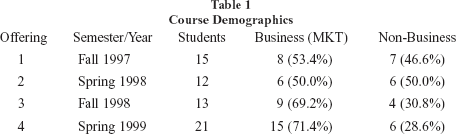
Enrollment (see Table 1) in the course continues to grow, with a high of 21 students registered for Spring 1999. Enrollment has been capped at this number for reasons involving computer and software constraints. The class is attracting mostly marketing and mass communication students, which is not unexpected. As the course continues to be fine tuned, it is hoped that it will become the first in a series of collaborative efforts that may eventually culminate in a new interdisciplinary marketing communication major.
Course Demographics
Discussion
Educators interested in adopting and/or adjusting this model to their own needs should be prepared to address a number of team teaching questions. For example, should the team teach independently in sequential units or collaboratively? In our case, while each instructor takes a turn leading a module, instructors attend and contribute to all the modules, co-teach the laboratory sessions, provide collaborative feedback on student work, and coordinate the schedule. Each faculty member is fully involved with all aspects of the course.
Another question involves compatibility of teaching styles. Members of our team have complementary teaching styles, which makes it much easier for students to adjust to three teachers in the same class. We use PowerPoint to organize presentations and while parts of each module are structured, student discussion and participation are encouraged throughout. We all use student-centered learning activities and the more formal elements of the class are balanced with unstructured periods. The laboratory sessions are unstructured, with all three teachers helping students master the technology. Although class PowerPoint presentations are traditional in format, interactions with students are more casual than in most classes. The hands-on emphasis of the class encourages an easy give-and-take between students and faculty.
Questions about workload and staffing concern both administrators and faculty. The two colleges offering the course have taken different approaches to the workload issue. One college is using overloads; the other uses an enrollment basis for crediting workload in the traditional manner, on alternating semesters.
Grading student work and determining a course grade are other questions that should be resolved in order to avoid grading conflicts later. We agreed at the beginning that faculty teaching the respective modules have primary grading responsibility within their module. However, we collaborate in calculating the final course grade because it is a composite of activities performed in all modules. Modules I and II both are valued at 30 percent of the semester grade; Module III, which includes both the personal and marketing Web sites, is 40 percent of the grade because it includes the culminating activity.
The team meets at the end of each semester to review the course and plan for the next offering. Since all three instructors attend each class, decisions are made collaboratively as needed, throughout the semester. Communication is maintained by E-mail, phone, and meetings. Decisions concerning content in each module are made primarily by the teacher of the module; other decisions are collaborative. The team has developed a camaraderie that allows us to be highly flexible in making adjustments in the schedule, as needed.
Conclusion
While this team cannot promise that the success discussed in this paper will transfer seamlessly to other institutions, it is believed that this approach is worth the effort. We have witnessed students begin the semester with no Web editing skills or knowledge of IMC, then progress to the point where they create a marketing Web site a client is able to mount and use for his/her business. Students believe the class has enhanced their marketing communication skills. Faculty on the team have gained immeasurably from collaborating with colleagues from different backgrounds. Even in a conservative institution where team teaching is not encouraged, committed faculty with a passion for teaching and a willingness to seek creative ways to finesse problems can find a way to make a team taught class happen.