Abstract

According to the Advertising Education Publications' (AEP) annual research survey, advertising and public relations education continued to show growth factors on U.S. college and university campuses, graduating a total 12,068 majors and having 39,615 students enrolled in 306 known degree programs.
The research project is supported by the American Academy of Advertising, American Association of Advertising Agencies, Direct Marketing Association, Hitesman Faculty Research and Publication Fund at the Manship School of Mass Communication (Louisiana State University), Promotional Products Association International, Public Relations Society of America and the School of Mass Communication, Texas Tech University. Principals for AEP are Dr. Billy I. Ross (Louisiana State University) and Dr. Keith F. Johnson (Texas Tech University).
The 1999 project is the 35th annual investigation into the status of advertising and public relations. Results of the research project are reported by individual program in the annual directory, Where shall I go to study advertising and public relations? Aggregate data for the nation is reported in trade press, scholarly press, and is also presented at AEP's website (< www.mcom.ttu.edu/wsig?/ >).
Method
AEP attempts to reach all known advertising and public relations programs in the United States. Programs in major directories, such as the Association for Education in Journalism and Mass Communication (AEJMC) directory, American Association of Collegiate Schools of Business directory, and the Newspaper Fund's Dow Jones' Journalists Road to Success, are regularly polled. In addition, postings on new technology approaches, such as AdForum and PRForum, call for queries as to recipient/ participant program status. Known programs are contacted approximately three times; each fall, all programs from previous years are issued an update form by mail; FAXes are sent, and E-mail solicitations are also sent. In cases where a program may be dropped from the project, personal calls are made to the program to encourage participation. Thus, the AEP project is more a census than a sampling of advertising and public relations degree granting programs in the nation. To be included in the project, the program must meet the following criteria:
The school has indicated a recommended sequence of courses.
The school's catalogue states that an advertising and/or public relations program exists.
The school requires at least three specifically-titled advertising or public relations courses.
The college or university must be regionally accredited.
The school agrees to provide the numbers of advertising and/or public relations students and graduates each year.
AEP publishes individual data for each program each year in the annual directory, Where shall I go to study advertising and public relations? The first year a school does not update, the information in the directory is dated; if a program does not update the second year, all data is deleted leaving only the program name (however, previous year's data is included in the aggregate totals), and if a program does not update in three years the program is dropped from the project.
Measures taken include the following for both advertising, public relations, or joint ADV/PR programs:
Bachelor, MA and Doctorate degrees awarded in the preceding year.
Freshman/Sophomore, Junior/Senior, MA and Ph.D. enrollments in the current year.
Current fulltime and parttime faculty.
Program status re accreditation beyond regional accrediting bodies, and availability of assistantships, loans, on-campus and off-campus employment.
Both university and degree program entry requirements.
Costs for tuition, fees, room and board.
Program title (such as major, sequence, emphasis, etc.), and the specific degrees available in the program (B.A., M.A., Ph.D.).
Number of scholarships available.
Student organizations in the program.
The person and address to contact for addition information.
In addition, AEP's web site contains aggregate information on degrees confirmed, students enrolled and number of faculty for the top 20 schools in each category of advertising, public relations, and ADV/PR programs. Ross and Johnson point out that soon there will be links to all the web sites of schools listed in their study and other data.
For the 1999 project, 306 degree-granting programs were found (108 advertising programs, 145 public relations programs, and 53 combined ADV/PR programs); 245 were bachelor degree granting programs, 109 granted Master's Degrees, and 40 granted doctorates. More degrees were available in advertising programs (178) than in public relation programs (149) or combined programs (67).
Less than half of all the programs (46 percent; 141 of 306 programs) were found to be accredited. ACEMJC (Accrediting Council on Education in Journalism and Mass Communication) accreditation accounted for 39 percent of accreditation; 6.5 percent were accredited by AACSB and only one program (.3 percent) was accredited by Association of Collegiate Business Schools and Programs (ACBSP).
Half of the advertising programs (47 percent; 51 of 108 programs) were accredited by Accrediting Council on Education in Journalism and Mass Communication; six were accredited by the American Assembly of Collegiate School of Business (AACSB).
About one-third of the public relations programs (38 percent; 55 of 145 programs) were accredited by ACEJMC; no other accreditation was found among public relations programs. A fourth of the ADV/PR programs (26 percent; 14 of 53) and a fourth were accredited by AACSB; one other program was accredited by ACBSP.
Advertising programs
As shown in Table 1, bachelor and master degrees confirmed last year increased from the preceding year by approximately seven percent; doctoral degrees granted declined by a third. All together, 4,856 students were granted degrees in advertising programs, down seven percent from 1998.
1998 – 1999 Advertising Graduates, Enrollees
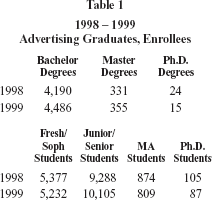
Enrollment in undergraduate students declined somewhat in freshman/sophomore ranks, but showed almost nine percent growth of junior/senior students. Ross and Johnson speculate that many programs are changing methods of classification and are reporting problems in accounting for specific majors among freshman and juniors; many programs in the nation today are basically two-year programs meant for junior- and senior-level students. Junior and senior-level enrollment grew by nine percent. All graduate student enrollment in advertising declined; a seven-percent decline in master's enrollment, and a 17-percent decline in doctoral enrollment.
Overall, the 16,223 students enrolled in advertising programs reflect a 3.77 percent increase from the 1998 enrollment of 15,644.
Fulltime faculty numbers remained static in 1999, increasing from 348 to 349; parttime faculty grew from 160 to 175. The total number of advertising programs reporting increased five percent, from 103 to 108.
Public Relations Programs
Surprisingly, public relations bachelor degrees fell by 1.5 percent in 1999, yet master degrees awarded increased 10 percent (see Table 2). Like advertising programs, the number of doctorates granted by public relations programs decreased as well. Added together, the 4,841 public relations degrees awarded reflected a .84-percent decline from the 4,882 degrees granted in 1998.
1998–1999 Public Relations Graduates, Enrollees
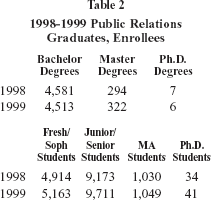
Undergraduate enrollment showed five-percent increases among both the freshman/sophomore and junior/senior ranks; almost two percent enrollment increase in master's programs, and a 21 percent increase in doctoral programs. Overall, the 15,964 students enrolled in doctoral programs reflected a 5.37 percent increase from 1998.
While the number of programs reporting did not change (145), the number of fulltime faculty showed a slight dip of 4.76 percent to 380 fulltime faculty. Parttime faculty numbers also declined from 241 in 1988 to 215 in 1999.
Joint ADV/PR Programs
As shown in Table 3, there has been a marked increase in the number of graduates and enrollees in programs with a combined Advertising/Public Relations curriculum. Ross and Johnson report the larger number of such programs, from 45 in 1998 to 53 in 1999 (17.78 percent), is due in part to programs across the nation combining independent advertising and public relations programs into the new combined curriculum.
1998–1999 ADV/PR Graduates, Enrollees
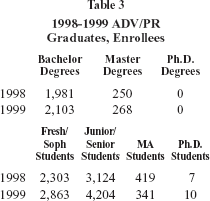
Bachelor degrees awarded increased 6 percent, while master's degrees awarded increased 7 percent. Freshman/sophomore enrollment was up 24 percent and junior/senior enrollment increased by 34 percent. While master's enrollment decreased 18 percent to 341, doctoral enrollment growth almost doubled.
The total number of 7,418 students in joint ADV/PR programs was a 26-percent increase from 1998; fulltime faculty increased 19 percent from 178 to 212. Parttime faculty decreased from 158 to 137, possibly due to the large increase in fulltime faculty.
Aggregate Totals
Table 4 shows the combined advertising, public relations, and ADV/PR program totals for 1999. For bachelor and master's degrees awarded, 3- and 8-percent increases were posted; doctoral degrees granted declined by 32 percent.
1998–1999 Aggregate Graduates, Enrollees
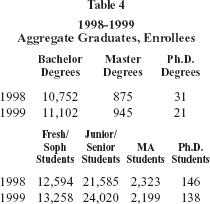
All undergraduate ranks showed increases in enrollment; five percent for freshman/sophomore, 11 percent for junior/senior. However, aggregate totals shows a five-percent decline in masters enrollment and a like decline in doctoral enrollment. The total enrollment of 39,615 reflects an 8.10-percent growth over 1998 totals.
Fulltime faculty showed moderate growth of 1.68 percent to 41 fulltime faculty; parttime faculty likewise grew from 538 to 547. Total numbers of programs reporting increased from 292 to 306, a four-percent increase.
Missing Programs
In the 1999 project, only three programs were dropped from aggregate totals (University of New Haven [CT], Illinois State University, and Morehead State University [KY]). These three programs declined to participate. Thus the growth of 292 to 306 programs reflect a net growth of 11 previously unidentified programs.
Other Measures
A total of 1,639 scholarships were reported as available for advertising and public relations students, 46 percent by advertising programs, and 40 percent by PR programs. Half (49 percent) of programs reported having assistantships available; 79 percent have loan programs, 95 percent offer on-campus employment opportunities, and 81 percent report off campus employment availability. A total of 250 student clubs/organizations were reported; 156 American Advertising Federation Chapters, 54 local campus clubs, 23 Public Relations Student Association of America Chapters, 9 BPAA and 8 Association of Women in Communications.
Half of the programs state their university requires the ACT or SAT; an average 20 ACT (range 15 – 26) or 928 SAT (range 550 – 1200) is required; an average 2.66 high school GPA and placement in the upper 41 percent is also required.
Almost 40 percent of the advertising/public relations programs require a specific GPA for entrance to the program (mean 2.45, range 2.00 – 3.50). A 2.5 GPA was the modal response.
School rankings
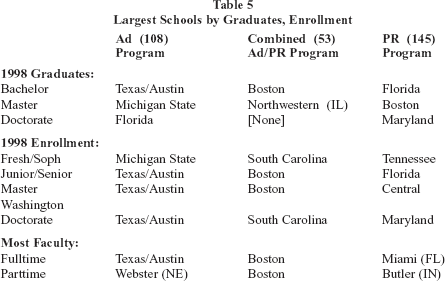
A list of the top 20 schools by graduation, enrollment and faculty measures can be found at AEP's website: < www.mcom.ttu.edu/wsig?/ >. The largest schools in these categories can be found in Table 5.
Largest Schools by Graduates, Enrollment