






Abstract
While positionality statements are often employed to help authors articulate their race, gender, sexual orientation, and other identities, in this article we contend that for Black women, positionality is far more than a checklist of social identifiers. It is a profound, complex, and nuanced site of intellectual exploration that demands deeper theoretical engagement. The authors of this article are introducing the term HEAPS (Highly Educated and Politicized Sisters) to describe ourselves as Black women, each holding advanced degrees, and actively engaged in social justice work. Our positionalities are deeply informed by academic expertise and commitment to the global struggle for Black liberation. We argue that the positionality of Black women transcends the conventional articulation of social identities. We contend that the experiences of Black women, rooted in histories of resistance and survival, deserve to be treated as rich, dynamic spaces for theoretical inquiry.
Introduction
While positionality statements are often employed to help authors articulate their race, gender, sexual orientation, and other identities, in this article we contend that for Black women, positionality is far more than a checklist of social identifiers. It is a profound, complex, and nuanced site of intellectual exploration that demands deeper theoretical engagement. For us, it is deeply intertwined with the principles of Afrofuturism (Wallace & Schwartz, 2022; Womack, 2013; Young & Reid, 2023), Pan-Africanism (Clarke, 1988; James, 2012), and the global struggle for Black liberation.
The authors of this article are introducing the term HEAPS (Highly Educated and Politicized Sisters) to describe ourselves as Black women, each holding advanced degrees, and actively engaged in social justice work through our consulting firms. Our positionalities are deeply informed by academic expertise and commitment to the global struggle for Black liberation. We argue that the positionality of Black women transcends the conventional articulation of social identities. We contend that the experiences of Black women, rooted in histories of resistance and survival, deserve to be treated as rich, dynamic spaces for theoretical inquiry. An evaluator's role is not merely contextualizing data collection, analysis, and interpretation but rather embodying the concept that all experience is data and all identity is data.
A century ago, Langston Hughes wrote I, Too, opening with the lines: “I, too, sing America. I am the darker brother…” (Hughes, 1994). With these words, Hughes declares a positionality—one that places him in relation to whiteness. He names himself as an exception to what America recognizes as belonging, reminding the listener that he, too, is a citizen. He claims his Blackness by referencing his darkness in the context of human brotherhood. Poignant, beautiful, and necessary, this declaration stakes a claim to visibility, but only in contrast to dominant white identities.
To critique positionality, we must ask: What/Who are we centering? What/Who are we relating to? What/Who are we normalizing in a way that forces us to define ourselves through proximity or distance? Kimberlé Crenshaw (2013) gave us language for this inquiry in Mapping the Margins: Intersectionality, Identity Politics, and Violence against Women of Color. She makes clear how violence—physical, psychological, socialized, and state-sanctioned—shapes the lives of Black, Brown, and Indigenous women. Black womanhood is so far from the central axis of what the academy and its professionalized progeny deems as normalized humanity that we have to draw a map to even make it legible. As authors of this article, we see that tapestry through the framework of HEAPS.
Who are HEAPS?
HEAPS are Black women whose formal education serves as both a site of hopeful possibility and a site of unexpected struggle. We hold the equanimous awareness of challenging the socialization of knowledge while building toward liberation that centers on Black aliveness and Black dignity. Our credentials make us hyper-visible, granting us access to spaces where our insights are necessary but not always welcomed. Yet, this visibility also places us at risk—moving from ideological pet to institutional threat (Stilley, 2023; Thomas et al., 2013), depending on the comfort levels of those around us. Indeed, this phenomenon coined by Thomas et al. (2013) highlights the fact that HEAPS can be problematic because our competence and capability do not align with tropes and stereotypes that still abound in the places and spaces we work to effect change. Based on politicized experience, we can be portrayed on one hand as hyper-visible (threat), and another as hyper-invisible (pet). Our fluency in navigating cultural, spatial, and intellectual multiplicities is both a necessity and a power we intentionally wield as evaluators. We connected on our shared recognition that the traditional role of positionality statements in evaluation often reduces identity to a contextual note—acknowledging who we are but not fully recognizing how we move, resist, and transform the field itself. HEAPS disrupt this notion by asserting that our lived experiences are not just background information, but essential sites of inquiry, theoretical frameworks, and methodologies in their own right.
As evaluators, we are not just measuring impact; we are actively assessing the rate of change necessary to build the liberated world we deserve while dismantling the systems that demand our healing and, most of the time—our very own existence. These social systems are rooted in white supremacy and fed by ableism and patriarchal ways of knowing. The work of HEAPS is to defend what we know—not to justify our existence. We fuel Black aliveness and social transformation, because we are as human as any being, whether they present in a white male or female body. To do so, we must cultivate spaces of radical clarity, where our expertise is honored, and where we live in the answered prayer of Nina Simone (1964), “Oh Lord, Don't Let Me be Misunderstood.” What follows are our individual reflections of being and becoming HEAPS, because we recognize our existence is surrounded by systems of cultures that tend to honor the polity and social statures of our being versus the “who we are.”
We are HEAPS!
As we reflected on Black women's positionality in evaluation, we explored the questions of who we are; what we have learned on journeys; how we can be better for each other now and in the future; and how we can be good stewards of this stage of life for those who are younger than us.
Sharon's Reflection
My name is Sharon Adzo Sitsofe Attipoe-Dorcoo.
My mom named me Sharon because Jesus is called the Rose of Sharon in the Bible. In the Ewe culture of Ghana, Adzo is the name given to someone born on Monday. Grandma named me Sitsofe because it means a place of solace in Ewe. Attipoe is my inherited paternal name from my dad. Dorcoo is my adopted name from my husband.
You might wonder why this matters. A name is tied not only to identity but also to our stories. The narratives we share as humans from one generation to another are one of the distinct things that separate us humans from other living beings. Therefore, imagining a world where that is not a part of anybody's history is not a world I want to live in. Certainly not one I want for my three babies, whom I intentionally teach about the complexity of humanity, our beautiful identity of Blackness, and how our cultures are a cacophony of experiences and values. So, to intentionally erase this essence of existence all in the name of upholding an egregiously designed fallacy of human superiority based on skin color is not only preposterous, but harmful to our collective human existence. My journey from Ghana to the United States involved grappling with complexities as a foreign-born Black woman who has experienced the effects of colonialism and learned to show up in the world grappling with the complexities of racism that existed in my new home. In one reality, I exist within the identities of my name and the social choices I make when I am home in Ghana. In the United States, I grapple with the added layers that society expects me to embody as a Black woman and the implications of all that it holds to exist in this space. The collision of such embodiments consequently sent me on a path to self-discovery.
We are all human. Our sex, gender, skin color, or any other observable or nonobservable difference is not a locus of disdain, attack, or violence. Claiming Black aliveness (Thanks, monique!) at the roots of who we are fundamentally starts with our names. It is the genesis of identity and the roots of positionality. All of which is data! (Thanks, Kim!).
Monique's Reflection
Within Black Feminist Thought, Patricia Hill Collins (1990) articulates the matrix of domination—how intersecting systems of power create distinct experiences of violence and oppression for those of us who share these identities. While writing this article with my sisters, I began to see the deeper purpose of our work: taking up space where we are often made invisible, and challenging positionality's utility in our current political times.
During our initial writings, I wanted to claim myself as an antagonism—specifically, as HEAPS—undisciplined, liberated, world-building forces in defiance of white supremacist knowledge creation. But then I returned to the literature that has nurtured me. Christina Sharpe (2016) shifted my thoughts on antagonism by describing how anti-Blackness is a systemic, ever-present force, positioning white supremacy as the primary antagonist against Black existence. Reading this made me exhale a breath I didn’t even realize I was holding. Because I saw, in that moment, how I had still been mapping myself onto white knowledge and existence—making myself the termite, the relentless mosquito, the threat. That framing only reinforces the existing structures designed to sustain Black suffering and death.
But I am not the antagonism.
As a HEAP, I am the fullness, the wholeness—the most profoundly expressive and complete definition of humanity. Whiteness needs to be mapped in relation to how far it stands from me. In this way, I echo bell hooks in her claim that the margin has always been the center (hooks, 1984). This realization empowered me, giving me space to claim a selfdom often neglected in our field. I claim Black womanhood and a HEAP identity to demonstrate how far from a liberated, nonoppressive world we are often situated. I continue to shine light, illuminate, and expose the distance between myself and others, not to segregate but to expand our constellation of knowing in evaluation practice.
As an undisciplined evaluator, I refuse to be tethered to the categories, methods, and logics that white supremacist academia deems necessary or legitimate. I move across rage, theory, practice, art, healing, community, and much more without apology, insisting that evaluation learn from poetry as much as from statistics, and from lived Black experience as much as, if not more than, from peer-reviewed journals.
Kim's Reflection
I am a Black woman with advanced degrees who works daily to maintain going concern as a business owner. I am a researcher by birth, as are all human beings (Wulff & George, 2020). We enter this world, asking why, why not, and what next. I am also an evaluator by birth. I believe all human beings are navigating the world, assessing, measuring, and determining value out of curiosity, on a perpetual quest of meaning-making, decoding, and surviving.
I am an economist by training; a student of human behavior, set against the backdrop of scarcity. I also have a master's in business administration, and a PhD in Research and Policy Analysis. Each of these formal academic credentials brings with them their own set of rigor, knowledge, and skills. The throughline across each of these academic positionalities is a formalized insight into systems and the science behind decision making. I am also a Black identifying, Black -presenting woman born to Black identifying Black presenting parents, both of whom came of age in the 1960s, during the third wave of the Civil Rights Movement (taking into consideration ante-emancipation and reconstruction). Both sets of my grandparents were born at the turn of the twentieth century, and I was privileged to observe their Masterclass in inquiry, testing, interrogation, and value assignment (places, spaces, people, etc.). Their rapid-fire assessments of who and what was safe; opportunities, threats, etc. were almost involuntary reflexes, and assured their survival. In my studies, and also working in community as a researcher, evaluator, consultant, and educator, I witnessed, and became convinced that all humans demonstrate these attributes, calling upon them as needed.
Navigating the systems and completing the processes that crafted the framework for my position as an economist with an MBA and a PhD signaled that my innate identities of researcher and evaluator were somehow more legitimate than other human beings whose lived experiences were very much like mine; except for their academic positionality. Therefore, I leverage my positionality in my work by acknowledging the subject matter expertise all humans bring to problem-solving, question-answering, research, and evaluation. By acknowledging the limitations of my training and practice, I create spaces for deeper learning and knowing. This is particularly true in my work with and on behalf of Black women. I am a disciple of my elders’ stories. The stories that teach me and comfort me, the stories that inspire me, and serve as both my foundation and my bridge. My beloved community fortified me for HEAP-dom while reminding me that education is multifaceted and multipurposed.
HEAPS Positional Commitments in Practice
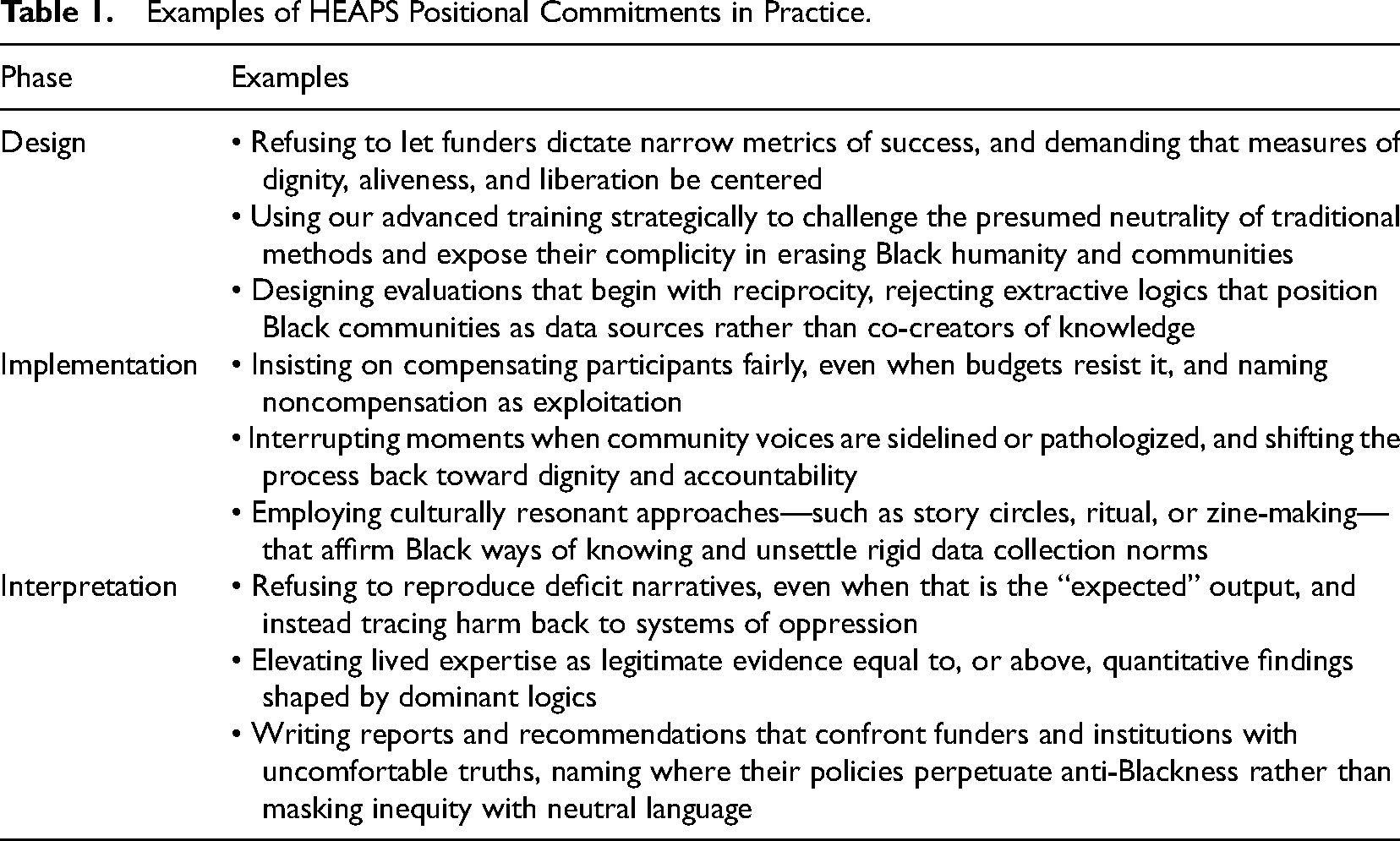
Across our experiences, we provide clearer illustrations of how our positional commitments as HEAPS are reflected in practice. Our identities as Highly Educated and Politicized Sisters compel us to move with both rigor and courage in the face of systems that often resist our presence. These commitments show up across the phases of evaluation—not as neutral decisions, but as acts of refusal, reimagining, and accountability (Table 1).
Examples of HEAPS Positional Commitments in Practice.
Conclusion
Frederick Douglass (1850) once said that knowledge makes a man unfit to be a slave. Being educated is political. And, as politics itself is the act or process of decision making for the public good, then, so too, is being Black and being a Woman. Each of these individual identities has historically been the object of and subject to codification that bound both body and voice. For these two groups, education has represented the promise of social liberation, paid for with the ransom of Black lives, female objectification, and invisibilization. From the timeless question asked by Sojourner Truth—“aint I a woman?”(Truth, 1851) to the modern day toxicities such as the chronic adultification of Black girls (Hood, 2023; Bailes, 2021), the “strong Black woman” stereotype (Golden, 2021; White 2021), and “missing white woman syndrome” (Sommers, 2016; Conlin & Davie, 2015) that still make her question a timely one, for those of us who live and embody the intersection of both said identities, ours has held none of the benefits of white womanhood, however slight it may be, and all of the burden of Blackness, in. its. full. lethality (Richie & Eife, 2021). Pursuing education as a gateway to a more humane condition has been a stony road at best. HEAPS navigate this terrain, and along the way, we have made cracks in countless glass ceilings and have navigated the treacherous terrain around just as many glass cliffs. But what sustains us is knowing that we embody the legacy of a beloved community, represented by a beloved host of “fam,” whose education, however acquired, paved the way for our HEAP-dom. Furthermore, by examining positionality in the field of evaluation, we are interrogating positionality as a static declaration and positioning it as a variable for social analysis. We are also choosing to do so intentionally by writing up, across, and down. Up, in the spirit of our ancestors who spoke truth to power; across to our peers who are looking for other likeminded folks.; and down, not in a hierarchical sense but in terms of speaking to the streets, so emerging evaluators would know that HEAP-dom exists.
In the spirit of HEAP-dom, we acknowledge the brilliant griot facilitation process of Matthew Lewis, with UBUNTU, who helped us birth this article to the world.
Footnotes
Declaration of Conflicting Interests
The authors declared no potential conflicts of interest with respect to the research, authorship, and/or publication of this article.
Funding
The authors received no financial support for the research, authorship, and/or publication of this article.
